
The home appraisal process: What to expect
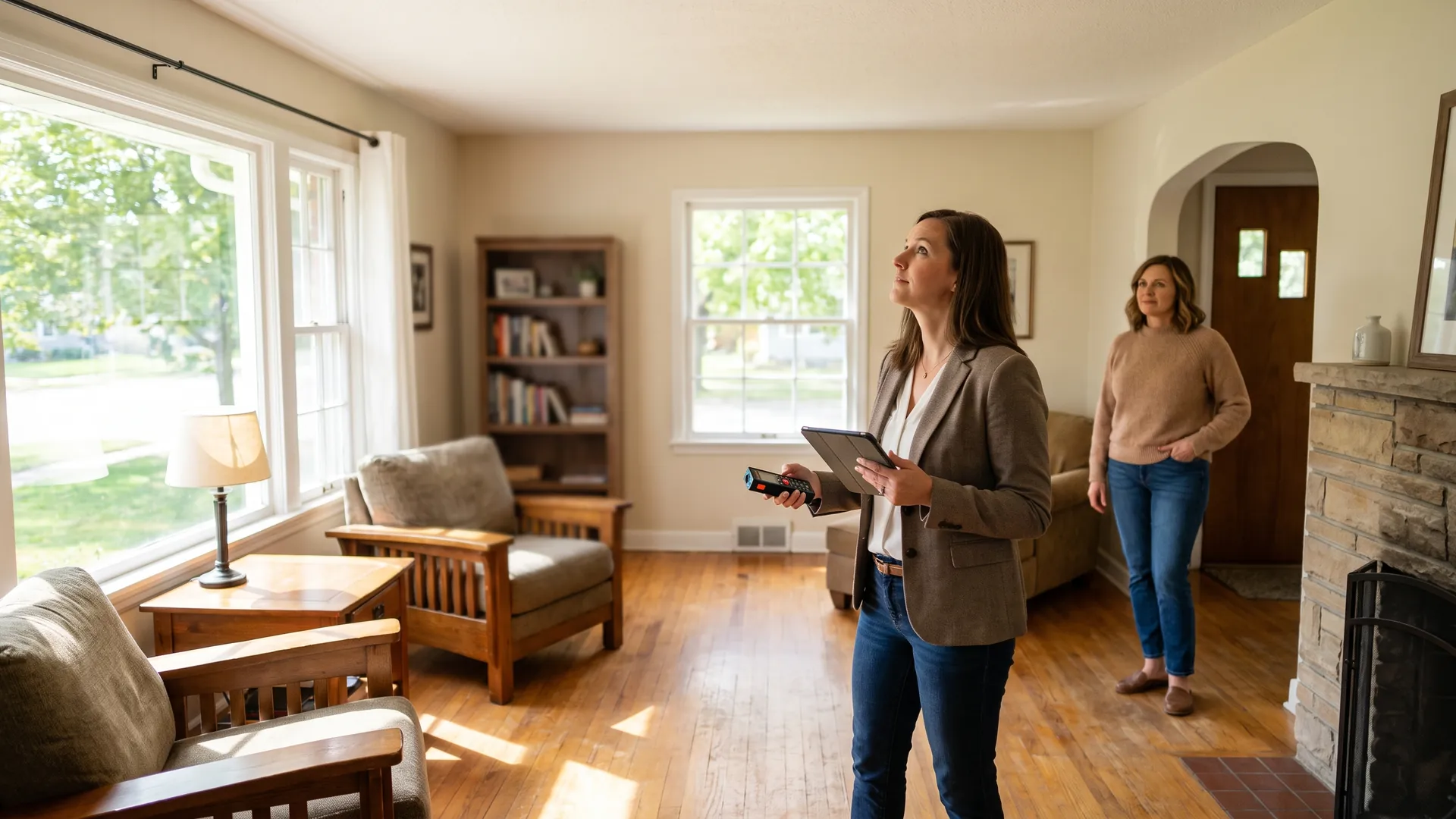
The home appraisal process begins when your lender orders an independent valuation after you apply for a purchase mortgage, a refinance, or a home equity loan. A state-licensed appraiser visits the property, measures and photographs it, researches comparable sales, and produces a report that usually reaches your lender within a few business days of the visit, roughly one to two weeks from order to delivery. You pay for it, and the fee generally runs $300 – $1,500 depending on the property and loan type, with most standard single-family appraisals at the low end.
The appraisal exists for the lender, not for you. Your loan is sized against the lower of the purchase price or the appraised value, so the appraiser’s opinion caps what the lender will lend.
Learn how the home appraisal process works, including who orders and pays for it, what the appraiser records during the visit, how the three approaches to value work, and what to do if the value comes in low. If you’re earlier in the journey, start with our Home Buying guide.
Key takeaways:
- What it costs and who pays: Your lender orders the appraisal and you pay for it, generally $300 – $1,500 depending on the property and loan type, with most standard single-family reports at the low end.
- How long it takes: Expect about 1 – 2 weeks from order to delivered report, with the on-site visit itself running one to a few hours and the finished report reaching the lender a few business days later.
- How the value gets set: The appraiser develops up to 3 approaches to value, sales comparison, cost, and income, then reconciles them, leaning hardest on comparable sales that closed within the 12 months before the appraisal’s effective date.
Step 1: What is a home appraisal, and who orders it?
A home appraisal is an independent, state-licensed appraiser’s opinion of a property’s market value, ordered by your lender to confirm the home is worth enough to secure the loan. You don’t choose the appraiser and you can’t lean on the outcome. That separation is federal law, not lender preference.
Regulation Z’s valuation independence rule bars anyone with an interest in the transaction from using coercion, bribery, intimidation, or inducement to base a value on anything but the appraiser’s independent judgment. Lenders can’t withhold payment because a property missed a number or drop appraisers who report low values. The appraiser may not hold a direct or indirect interest in the property or transaction, and creditors must pay customary and reasonable rates for that market.
Most lenders order through an appraisal management company that assigns your file to an appraiser on its panel, which is why nobody on your side picks a name. Our guide to why home appraisals matter covers what that number protects, and our home buying process guide shows where the appraisal falls between your accepted offer and your keys.
Step 2: How does the appraisal get scheduled, and how do you prepare?
Scheduling usually takes a few days to a week after the order goes out, and it’s the step most likely to stretch your timeline in a busy market. Two federal rules govern when the fee can reach you.
- You can’t be billed before you say go: A creditor may not impose any fee, application, appraisal, or underwriting, until you’ve received your Loan Estimate and indicated an intent to proceed. The only exception is a bona fide and reasonable credit report fee, and silence never counts as intent.
- The fee shouldn’t move at closing: Because the lender picks the appraiser, the appraisal fee generally lands in the zero-tolerance bucket. Third-party fees you weren’t permitted to shop for. It can’t increase at closing unless a valid changed circumstance justifies a revised estimate.
Preparation won’t change what comparable homes sold for, but it changes what the appraiser can see and verify. Give the appraiser access to every room, the basement, the attic access point, the garage, and the mechanicals, a locked door turns a one-visit assignment into two. Then have permits and receipts ready and list the improvements a walkthrough won’t reveal: a new furnace, a rebuilt roof, a repaired foundation. Our checklist on how to prepare for a home appraisal covers the rest.
Step 3: What happens during the appraisal visit?
The on-site visit usually takes one to a few hours, depending on the home’s size and complexity, and it’s a data-collection appointment rather than a pass-fail test. The appraiser walks the interior and exterior, measures the improvements, photographs the property, and records what the report gets built on.
- Size, layout, and room count: Gross living area, bedroom and bathroom counts, basement area and whether it’s finished, garage capacity, and the site.
- Condition and quality: Appraisers assign a standardized rating on a C1 through C6 scale, where C5 means obvious deferred maintenance needing significant repairs and C6 means damage severe enough to affect safety, soundness, or structural integrity.
- Updates and renovations: The report captures whether the home was updated within the last fifteen years and describes any deterioration or depreciation observed.
- Deficiencies that need a second look: A condition affecting livability, soundness, or structural integrity can leave the appraisal conditioned on repair or on an inspection by a qualified professional.
What the visit is not is a home inspection. HUD says it plainly for FHA files: an appraiser’s observation “is limited to readily observable conditions and is not as comprehensive an inspection as one performed by a licensed home inspector.” The VA is equally direct that an appraisal “isn’t a home inspection or a guaranty of value.”
Not every assignment includes an interior walkthrough, either. Some lenders order an exterior-only or drive-by appraisal. On eligible conventional files, Fannie Mae’s Desktop Underwriter can issue a value acceptance offer, formerly called an appraisal waiver, and no appraisal is obtained at all. It generally requires a one-unit property with a prior appraisal in Fannie Mae’s database, and excludes two- to four-unit properties, manufactured homes, and any transaction where the purchase price or the estimated value given to Desktop Underwriter is $1,000,000 or more.
Step 4: How does the appraiser determine your home’s value?
Appraisers develop up to three approaches to value and reconcile them into one opinion, and on a typical single-family home the sales comparison approach carries the most weight. The form tells the appraiser to consider every appropriate approach, enter a value for each one developed, and leave the rest blank.
| Approach | How it works | When it’s used |
|---|---|---|
| Sales comparison | Compares your home to similar nearby properties that recently sold, adjusting for differences in size, condition, age, and features. | Nearly every single-family and condo assignment. It usually drives the final number. |
| Cost | Estimates what it would cost to rebuild the improvements today, subtracts depreciation, and adds the land value. | New or unusual construction, and markets with too few comparable sales. |
| Income | Converts the rent a property can generate into a value, using rates drawn from comparable rentals. | Two- to four-unit and investment properties. |
The comparable-sales research is the part buyers underestimate. Appraisers report the comparable sales that closed within the 12-month period preceding the appraisal’s effective date, what similar homes are currently listed for, and any prior sale or transfer of your property within three years of that date. Then they reconcile the three approaches with a brief written description of the validity and relative strength of each one for that assignment.
The judgment inside those adjustments is why appraisers are licensed by state boards and work under the Uniform Standards of Professional Appraisal Practice, including its competency rule. The Appraisal Institute’s professional standards are the industry reference on that training, and FHFA House Price Index data on home values shows the price movement their market analysis reads against.
Reading your appraisal report, and what to do if it’s low
You’re entitled to a free copy of the appraisal, and the timing is fixed by rule: creditors must provide copies of appraisals and other written valuations promptly upon completion, or three business days before consummation, whichever comes first. A creditor cannot charge you for the copy, though it may require you to reimburse the reasonable cost of the appraisal itself.
Read the report the way underwriting will. Check the address, square footage, room counts, and condition rating for factual errors, then work the comparable sales grid: which homes the appraiser chose, how recent those sales are, how far away they sit, and the size of each adjustment.
When the value lands under your contract price, the lender still sizes the loan against the lower of the sales price or the appraised value. On a $300,000 contract that appraises at $285,000, the $15,000 gap doesn’t reduce your down payment, it sits on top of it.1 You have four moves:
- Renegotiate the price: Ask the seller to meet the appraised value or split the gap. A low appraisal is leverage, because the next financed buyer will likely see the same number.
- Bring the difference in cash: Fastest path, and the most expensive one. Confirm you still have reserves after closing.
- Request a reconsideration of value: A formal challenge supported by better comparable sales, not by your opinion of the house.
- Use your appraisal contingency: If your purchase agreement has one, you can terminate and recover your earnest money inside the contingency window.
That third option now has real structure behind it. Fannie Mae requires lenders to run a borrower-initiated reconsideration process, disclose it when the appraisal is delivered, route qualifying requests back to the original appraiser, and allow one reconsideration per appraisal, none after closing. FHA’s rules run parallel for case numbers assigned on or after September 2, 2024: up to five alternative comparable sales, one request per appraisal, results in writing, at no cost to you, resolved before the loan closes. Our guide to how to appeal a low appraisal covers how to assemble comps that actually move a value.
How much does a home appraisal cost?
Appraisal fees generally run $300 – $1,500, with most standard single-family purchase appraisals toward the bottom of that band; the borrower typically pays, either up front or as a line item at closing. Investopedia publishes a detailed walkthrough of the appraisal process documenting that range across loan and property types.
- Property size and complexity: Large homes, acreage, multi-unit buildings, and unusual construction take longer to measure and support.
- Location and comp availability: Rural properties and thin-data neighborhoods cost more, because the appraiser travels further to build a credible comp set.
- Loan and report type: An exterior-only report costs less than a full interior assignment; multi-unit and income-property reports cost more.
- Turn time: Rush assignments carry a premium, and so do re-inspections after repairs.
One honest note from the broker side: the appraisal fee barely moves from lender to lender, because it has to be customary and reasonable for the market no matter who orders it. What does move is how fast a lender’s panel can schedule your file, and whether that lender’s automated underwriting issues a value acceptance offer. When it does, there’s no appraisal and no appraisal fee. That’s the difference worth shopping for.
Appraisal rules for FHA, VA, and refinance loans
The core process is the same across programs, but three situations add a layer.
FHA appraisals
An FHA appraisal must be performed by an appraiser on the FHA Appraiser Roster, whose job HUD defines as observing, analyzing, and reporting a property’s physical and economic characteristics and providing an opinion of value to FHA. It uses the same Uniform Residential Appraisal Report as conventional loans, with one addition: the appraiser lists any lack of compliance with HUD’s Minimum Property Requirements, which is why FHA appraisals more often come back conditioned on repairs.2
VA appraisals
On a VA loan the lender requests the VA appraisal, which VA describes as an estimate of the house’s market value at the time of inspection, and VA states directly that the appraisal isn’t a home inspection or a guaranty of value. Budget for a separate inspection on a VA purchase.3
Refinance appraisals
A refinance appraisal has no contract price to anchor it, so the appraised value alone sets your loan-to-value ratio, and that one number drives your pricing, your mortgage insurance, and how much equity you can reach. Value acceptance offers are available on eligible limited cash-out and cash-out refinances as well as purchases, which is why some refinances close without an appraisal. Our guide to refinance appraisal requirements covers which refinances need a full appraisal and which don’t.
FAQ: The home appraisal process
Here are answers to common questions about the home appraisal process.
How long does a home appraisal take?
The on-site visit typically takes one to a few hours, depending on the home’s size and complexity. The full process, order, scheduling, the visit, comparable-sales research, and report delivery, usually runs about one to two weeks, and the finished report generally reaches the lender and borrower within a few business days after the inspection. Clear access and documented improvements shorten it, which is what our guide to preparing for a home appraisal is built around.
What do appraisers look at during the visit?
Appraisers document the home’s size, layout, and room count, its overall condition and construction quality, its systems, and any upgrades, photographing the interior and exterior as they go. They also record the site, the garage, and features like finished basement area. Afterward they research recent sales of comparable nearby homes and adjust for differences to reach an opinion of market value. Our guide to why home appraisals matter explains how that becomes a lending decision.
What happens if the appraisal comes in lower than the offer?
The lender bases the loan on the appraised value, so a low appraisal creates a gap you have to close. Your options are to renegotiate the price with the seller, bring extra cash to cover the difference, challenge the value with a reconsideration of value supported by better comparable sales, or, if your contract includes an appraisal contingency, terminate and recover your earnest money. Start with our walkthrough on appealing a low appraisal.
Is an appraisal the same as a home inspection?
No. An appraisal estimates the home’s market value for the lender; an inspection evaluates the home’s condition for you. The appraiser notes obvious condition issues but doesn’t test systems, crawl the attic, or diagnose defects the way an inspector does. Most buyers need both, our home inspection checklist for buyers shows what that second visit covers.
The bottom line on home appraisals
The home appraisal process runs from your lender’s order to a delivered report in about one to two weeks, with the on-site visit taking one to a few hours and the fee generally landing between $300 and $1,500 depending on the property and loan type. A state-licensed, independent appraiser measures and photographs the home, rates its condition, researches comparable sales from the previous 12 months, and reconciles up to three approaches to value into one number. That number matters because your lender lends against the lower of the sales price or the appraised value, and if it lands low, you have four real options, including a reconsideration of value that agency rules now require lenders to offer.
If you’re ready to buy or refinance and want the appraisal step handled cleanly, talk to Align Lending. We’ll shop your scenario across our lender network, tell you up front whether your file may qualify for value acceptance, and stand with you if the value comes back light. Call 248-506-5727 or start online today.
Footnotes:
1. Example figures are hypothetical and for educational purposes only; they do not constitute an advertisement of credit terms or a rate quote under federal or state lending laws. Your loan amount, cash to close, and any appraisal gap depend on your application, the property, the appraisal, and market conditions. Return to text.
2. Align Lending is not acting on behalf of or at the direction of FHA or HUD. FHA appraisal, Minimum Property Requirement, and reconsideration of value standards are set by HUD and are subject to change. Return to text.
3. Align Lending works with VA-approved lenders and is not endorsed or sponsored by the Dept. of Veterans Affairs or any government agency. VA appraisal requirements are set by the Department of Veterans Affairs and are subject to change. Return to text.
Sources: appraisal fee range of $300 – $1,500, Investopedia (linked above). Valuation independence, prohibited coercion, appraiser interest, and customary and reasonable compensation, Regulation Z, 12 CFR § 1026.42. Fees barred before the Loan Estimate and intent to proceed, with the credit report exception, 12 CFR § 1026.19(e)(2)(i); zero tolerance for third-party fees the consumer was not permitted to shop for, 12 CFR § 1026.19(e)(3)(i) and the CFPB TILA-RESPA Integrated Disclosure Small Entity Compliance Guide. Appraisal copy timing and the prohibition on charging for it, Regulation B, 12 CFR § 1002.14. Value acceptance eligibility and Desktop Underwriter delivery, Fannie Mae Selling Guide B4-1.4-10; borrower-initiated reconsideration of value, B4-1.3-12. FHA reconsideration of value, the September 2, 2024 case-number effective date, five-comparable and one-request limits, no cost to the borrower, and resolution before closing, HUD Mortgagee Letter 2024-07. FHA Roster Appraiser duties and the limitation to readily observable conditions, U.S. Department of Housing and Urban Development. Uniform Residential Appraisal Report content, C1 – C6 condition ratings, reporting windows, and reconciliation of the three approaches to value, FHA Single Family Housing Appraisal Report and Data Delivery Guide (Fannie Mae Form 1004 / Freddie Mac Form 70). VA appraisal request, market value at the time of inspection, and that an appraisal isn’t a home inspection or a guaranty of value, U.S. Department of Veterans Affairs.
This article is for informational purposes only and is not intended to provide legal, financial, or tax advice. Purchase agreement terms, appraisal contingencies, and reconsideration of value requests should be reviewed with a licensed real estate professional or attorney in your state. Consult a qualified professional about your situation. Program terms and figures shown are illustrative, are not a rate quote or an offer of credit, and are subject to change. Align Lending is an independent Michigan mortgage broker, NMLS #2041154.
Related resources

12-minute read
Home inspection checklist for buyers: What to look for room by room
See the complete home inspection checklist for buyers, from foundation to attic, so you can spot costly problems before you close on your next home.

12-minute read
How to prepare for a home closing: your step-by-step checklist
Learn how to prepare for a home closing with a step-by-step timeline, documents to bring, and final walk-through tips for a smooth closing day.

12-minute read
Understanding contingencies in home offers: the five that protect buyers
Learn how contingencies in home offers let you walk away without losing your deposit, which five matter most, and how to stay competitive anyway.
4-minute read
The Art of the Automatic Counter-Offer: Master Escalation Clauses to Win Your Dream Home
Understand escalation clauses in home buying and their impact on your mortgage. Make competitive offers today!
