
What to know about refinancing a manufactured home
Refinancing a manufactured home turns on one question your lender asks before any other: is the home legally classified as real property, or is it still personal property? To refinance into a conventional, FHA or VA mortgage, the home generally must be built to the federal HUD Code on or after June 15, 1976, sit on a permanent foundation, measure at least 12 feet wide with at least 400 square feet of finished area, and be titled as real estate along with the land under it.
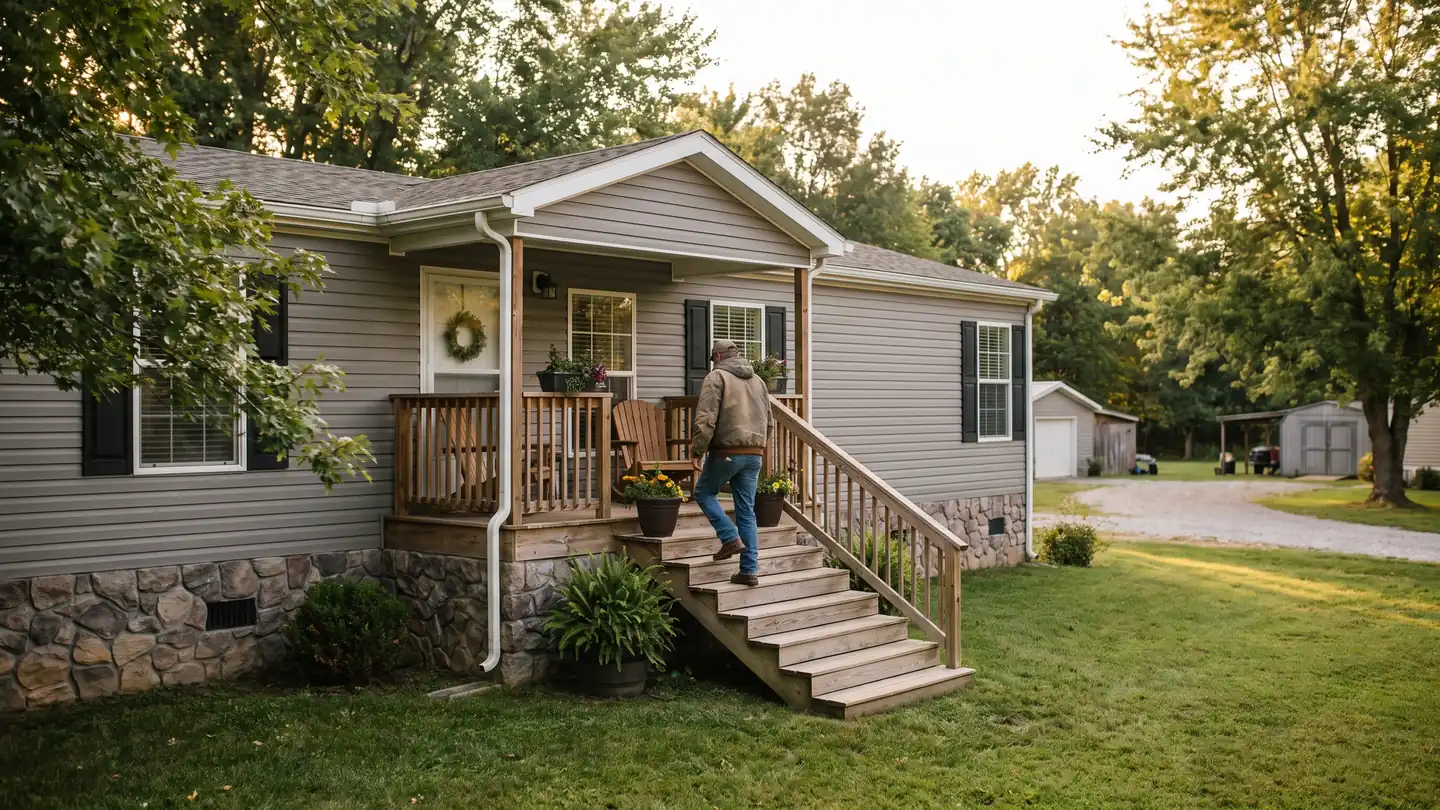
That classification isn’t a technicality. The Consumer Financial Protection Bureau found roughly 42% of manufactured home purchase loans are chattel loans, secured by the home but not the land, and fewer than 4% of chattel originations in 2019 were refinances.
Learn how the title gets converted to real property, which loan programs take the file, and what it costs. For the wider view, start with our refinancing and home equity guide.
Key takeaways:
- Real property status is the gate: Conventional and FHA refinancing require the home and land to be classified as real estate, and the CFPB found about 42% of manufactured home purchase loans are chattel loans secured by the home alone.
- The physical bar is fixed: Fannie Mae and Freddie Mac both require a home built to the HUD Code on or after June 15, 1976, at least 12 feet wide, with at least 400 square feet of above-grade finished area on a permanent foundation.
- Cash-out is stricter here: Both GSEs bar single-wide homes from cash-out entirely, and Fannie Mae requires 12 months of ownership of home and land, double the 6-month seasoning on a site-built conventional cash-out.
What makes refinancing a manufactured home different?
The line between three lookalike categories is the June 15, 1976 HUD Code date, and lenders and appraisers use these words precisely:
- Manufactured home: A dwelling built in a factory on a permanent steel chassis to the federal Manufactured Home Construction and Safety Standards, the HUD Code, effective June 15, 1976. Compliance is evidenced by a HUD Certification Label on each section and a HUD Data Plate inside the home.
- Mobile home: The informal term for a factory-built home produced before June 15, 1976. It predates the HUD Code, carries no certification label, and mortgage programs will not finance it.
- Modular home: A factory-built home built to state and local building codes rather than the HUD Code. Lenders underwrite modular homes as site-built houses, so the categories should never be blurred.
The practical effect: a 1974 single-wide and a 2015 double-wide can sit on the same street, and only one can be refinanced with a mortgage. Our breakdown of manufactured home pros and cons covers how that gap shows up in value and resale.
Real property or personal property? The title question that decides everything
Personal property title is the most common reason a manufactured home refinance dies. If your home was titled the way a vehicle is, through a state certificate of title, the mortgage market treats it as movable collateral rather than real estate.
Fannie Mae states the rule plainly: both the manufactured home and the land must be legally classified as real property under applicable state law. Fannie Mae also excludes homes on leased land subject to a ground lease, unless the home sits in an approved condo or PUD project. Freddie Mac matches it, requiring manufactured homes be titled as real property and permanently affixed to a foundation.
The CFPB’s data explains why converting matters: chattel loans carry higher interest rates and fewer consumer protections than mortgages, and only 27% of manufactured home purchase applications ended in financing against 74% of site-built applications, with 42% of manufactured housing applications denied compared with 7% of site-built ones.
Converting is paperwork, not construction, when the home already sits on a permanent foundation on land you own: surrender the certificate of title, clear any lien recorded against it, and record an affidavit with the county, covered in the Michigan section below. If your file isn’t the standard owner-occupied case, our guide to refinance situations maps the less common paths.
How often do manufactured home owners refinance?
Far less often than owners of site-built homes, according to the Consumer Financial Protection Bureau’s May 2021 report on manufactured housing finance, which used 2019 Home Mortgage Disclosure Act data. The report found that “less than four percent of chattel originations were for refinances,” against about 31% of manufactured home mortgages and 44% of site-built ones, cash-out included (CFPB, Manufactured Housing Finance: New Insights from the Home Mortgage Disclosure Act).
| Loan purpose, 2019 originations | Chattel loans | Manufactured home mortgages | Site-built mortgages |
|---|---|---|---|
| Home purchase | 95.9% | 66.4% | 53.9% |
| Refinancing | 2.5% | 18.0% | 25.9% |
| Cash-out refinancing | 0.9% | 12.8% | 18.3% |
Source: CFPB, Manufactured Housing Finance: New Insights from the Home Mortgage Disclosure Act, May 2021, Table 2, 2019 HMDA data.
The report’s explanation is that savings on a small loan “may not offset the costs of origination.” In the same report, 93.8% of chattel loans were higher-priced loans by the report’s measure, against 52.4% of other manufactured home loans and 11.1% of site-built loans (CFPB report, Table 6). See our guide to refinancing closing costs.
Can you refinance a chattel loan into a mortgage?
Often, if you own the land. The CFPB reported that 27% of 2019 borrowers who took chattel loans owned their land, “even though they may have been eligible for mortgage financing,” while 49% rented the land. Across all landowning manufactured housing borrowers, about 17% took a chattel loan rather than a mortgage, according to the same CFPB report.
For owners in that first group, Fannie Mae’s Selling Guide spells out the path. Under Fannie Mae Selling Guide B5-2-03 (dated 10/08/2025), a limited cash-out refinance on a manufactured home may pay off “an existing personal property lien or first lien mortgage,” may pay off a subordinate lien only if it was used to buy the home or the land, and may return cash to the borrower of no more than the greater of 1% of the new loan balance or $2,000. Where the borrower holds title to the land, the guide lets the land’s value be credited toward the equity requirement for a refinance.
Two early checks save time: a title search on the lot (our guide to property liens explains what can turn up) and a written payoff from the chattel lender, whose lien sits on the certificate of title and whose written consent Michigan’s affidavit of affixture requires. The title company records the paperwork; see how to choose a title company.
Do you qualify to refinance a manufactured home?
Eligibility comes down to six checkable items, and five of them are about the home rather than about you. Here’s what a lender verifies before your credit and income get a serious look.
| Requirement | What the lender needs to see | Source of the rule |
|---|---|---|
| Build date | Built on or after June 15, 1976 to the federal HUD Code | HUD, 24 CFR Part 3280 |
| Certification | HUD Certification Label on each section, plus the HUD Data Plate | Fannie Mae, Freddie Mac |
| Size | At least 12 feet wide and at least 400 square feet of above-grade finished area | Fannie Mae, Freddie Mac |
| Foundation | Permanently affixed; FHA requires a permanent foundation built to FHA criteria | HUD, Fannie Mae, Freddie Mac |
| Land | Land owned by the borrower and pledged with the home; ground-leased sites excluded | Fannie Mae, Freddie Mac |
| Title status | Home and land legally classified as real property under state law | Fannie Mae, Freddie Mac, HUD |
Your side of the file looks like any other refinance. Fannie Mae caps debt-to-income at 36% on manually underwritten loans, allows up to 45% when the borrower meets the credit score and reserve requirements in its Eligibility Matrix, and permits up to 50% through Desktop Underwriter. The CFPB explains how lenders calculate your debt-to-income ratio.
Credit minimums are set by individual lenders, not one federal number. Lenders in Align’s network generally look for a mid-score in the low-to-mid 600s on conventional manufactured home refinances, with more room on FHA files, where HUD’s rule is that maximum financing requires a decision credit score of 580 or above. If your score is the obstacle rather than the property, refinancing with bad credit covers what still works.
Two documents decide how fast the file moves. Photograph the HUD Certification Label, a red metal plate on the exterior of each section, and the HUD Data Plate, a paper label inside a cabinet or electrical panel; if either is missing, HUD can issue a label verification letter your appraiser will need. Expect an engineer’s foundation certification too, especially on FHA and VA files. Our refinancing eligibility guide lists the rest.
What are your loan options for refinancing a manufactured home?
Four mortgage routes and one non-mortgage fallback cover nearly every manufactured home refinance, and the dividing line is again real property status.
| Option | Real property required? | What it does | The limit that bites |
|---|---|---|---|
| Conventional (Fannie Mae, Freddie Mac) | Yes, home and land | Rate-and-term or cash-out | Cash-out requires a multi-width home and 12 months of ownership of home and land |
| FHA Title II1 | Yes, classified as real estate | Rate-and-term, cash-out, and streamline refinancing | Cash-out capped at 80% LTV; rate-and-term capped at 97.75% LTV |
| VA2 | Yes, affixed and real property under state law | IRRRL or cash-out for eligible veterans | Cash-out may not exceed 100% of reasonable value; IRRRL seasoning applies |
| FHA Title I | No, the lot may be leased | Refinance of the home, the lot, or both | Maximum term of 20 years plus 32 days on a manufactured home |
| Chattel or personal property loan | No | Refinance of the home alone | Higher rates and fewer consumer protections than a mortgage, per the CFPB |
Three details deserve their own sentences, because they’re where files get denied late.
- Single-wides can’t cash out: Fannie Mae is explicit that a cash-out property must be a multi-width manufactured home; single-width homes are not permitted. Freddie Mac says the same. A rate-and-term refinance on a single-wide is still on the table.
- Every program keeps its own seasoning clock: A standard conventional cash-out requires one borrower on title for six months before disbursement, but on a manufactured home Fannie Mae requires 12 months of ownership of both home and land before application. FHA cash-out requires 12 months of ownership and occupancy as your principal residence. An FHA streamline requires 210 days from the prior closing date plus six full months of payments since the first payment date. A VA IRRRL is seasoned on the later of six consecutive monthly payments and 210 days after the first payment due date. Those clocks are not interchangeable.
- The 90% VA cash-out ceiling is a lender rule, not a VA rule: VA’s own regulation caps a cash-out refinance at 100% of reasonable value. The 90% figure you’ll see quoted is an overlay applied by individual lenders, and it varies investor to investor, which is exactly the spread a broker can shop.
FHA streamlines carry an upfront mortgage insurance premium on the new loan and may earn a partial refund of the premium paid on the old one, so the net cost is smaller than the sticker figure. FHA annual mortgage insurance runs 11 years when the original loan-to-value is 90% or less on a term over 15 years, and the full loan term above that. Review HUD’s FHA loan programs for manufactured housing and VA home loan options directly.
Two adjacent cases come up often. If the home is a rental, occupancy rules and pricing change; see refinancing an investment property. If the owner carries a reverse mortgage, that’s a separate product, handled in how to refinance a reverse mortgage.
What are the FHA Title I limits for a manufactured home refinance?
HUD’s Title I program insures loans “to finance the purchase or refinancing of a new or used manufactured home,” according to HUD’s Title I program page, without requiring real property. The caps below come from HUD’s Title I Allowable Loan Parameters, the limits Title I Letter 488 set for FHA case numbers assigned on or after March 29, 2024.
| Title I loan type | What it can purchase or refinance | Nationwide loan limit |
|---|---|---|
| Manufactured home loan, single-section | The home | $105,532 |
| Manufactured home loan, multi-section | The home | $193,719 |
| Combination loan, single-section | The home and the lot under it | $148,909 |
| Combination loan, multi-section | The home and the lot under it | $237,096 |
| Manufactured home lot loan | A lot (purchase and develop) | $43,377 |
Source: HUD, Title I Manufactured Home Loan Program Allowable Loan Parameters; effective date from HUD Title I Letter 488, March 18, 2024.
Letter 488 says HUD reviews these limits yearly, setting them at 115% of the average home price for the property type in the Manufactured Housing Survey, so confirm the current figure. The same sheet caps terms at 20 years plus 32 days for a manufactured home or a single-unit home and lot, 25 years plus 32 days for a multi-unit home and lot, and 15 years plus 32 days for a lot. For how FHA’s Title II side compares, see our guide to refinancing an FHA loan.
How much does it cost to refinance a manufactured home?
Freddie Mac tells homeowners to expect 3% to 6% of the loan principal in refinance costs, roughly $3,000 to $6,000 on a $100,000 loan. That covers recording costs, the appraisal, the credit report, origination fees, title services, tax service fees, survey fees, attorney fees and underwriting fees.
Manufactured homes add two line items site-built homes don’t. The appraisal runs on a manufactured-home-specific form and the appraiser must photograph the HUD Data Plate or Certification Label, which means a second trip if the label is missing or painted over. And if the title still needs converting, you’ll pay county recording costs on the affixture paperwork.
Here’s the arithmetic that decides whether it’s worth doing. Hypothetical example, not an offer. Say you owe $95,000 on a double-wide appraised at $150,000, so closing costs land at $2,850 to $5,700. If the new loan lowers your payment by $130 a month, you break even between month 22 and month 44.3 Sell or move before that window closes and the refinance costs you money rather than saving it.
Watch the “no closing cost” pitch. Freddie Mac’s warning is blunt: there is no such thing as a free loan, and a lender offering one is probably charging a higher interest rate and rolling the closing costs into the loan. It’s a trade, not a gift, and you should see both versions priced. Our overview of how refinancing works shows how to compare them.
What does the VA funding fee add to a manufactured home refinance?
According to VA’s funding fee and closing costs page (last updated October 5, 2026), “the VA funding fee rates for refinancing loans don’t change based on your down payment amount.”
| VA loan type | Funding fee, first use | Funding fee, after first use |
|---|---|---|
| Interest Rate Reduction Refinance Loan (IRRRL) | 0.5% | 0.5% |
| Cash-out refinance | 2.15% | 3.3% |
| Manufactured home loan, not permanently affixed | 1% | 1% |
Source: U.S. Department of Veterans Affairs, VA funding fee and loan closing costs, rates effective April 7, 2023, page last updated October 5, 2026.
Hypothetical example, not an offer. On a $95,000 IRRRL, a 0.5% fee is $475. On a $95,000 cash-out refinance for a veteran using the benefit for the first time, 2.15% is $2,042.50. VA’s IRRRL page says that with an IRRRL “you can include these costs in the new loan so you don’t have to pay up front.”
Under 38 U.S.C. 3709, the fees and incurred costs must be scheduled to be recouped within 36 months after the loan is issued. VA’s IRRRL page also warns that “claims that you can skip payments or get very low interest rates or other terms that sound too good to be true may be signs of a misleading offer.” Samantha Shelton puts the same caution in her own words: “I don’t think somebody should refinance just because somebody called them and told them they could.” See our guide to VA IRRRLs.
What do new manufactured homes cost in Michigan?
According to the Census Bureau’s Manufactured Housing Survey, which the Census Bureau says HUD sponsors, a new manufactured home in Michigan averaged $107,800 in 2025, down from $116,000 in 2024, against $113,600 across the Midwest and $127,200 nationally (Census, average sales price by state, 2014 to 2025).
| Average sales price, new manufactured homes, 2025 | Michigan | Midwest | United States |
|---|---|---|---|
| All new homes | $107,800 | $113,600 | $127,200 |
| Single-section | $81,200 | $85,400 | $85,600 |
| Double-section | $145,900 | $154,200 | $157,100 |
Dealers report these prices including set-up costs, for homes “sold at or before the time they are placed on a site” (MHS notes), not an older home with its land; our guide to refinance appraisal requirements covers how that value is set. The survey also tracks titling: of new homes placed for residential use in 2024, 78% were titled as personal property and 18% as real estate, and 23% went into land-leased manufactured home communities, according to the Census Bureau’s cost and size comparison table. In 2014 the titling split was 80% and 13%.
What is HUD proposing to change in the definition of a manufactured home?
On June 12, 2026, HUD proposed letting the upper-floor sections of a multistory manufactured home be built and transported without a permanent chassis, while each section of the bottom floor would still need one (HUD announcement, June 12, 2026). The proposal, Docket FR-6537-P-01, puts the chassis cost at $4,800 to $6,700 per multistory unit and would revise HUD’s Title I rules at 24 CFR 201.2 so those homes “would remain eligible for Title I loans” (Federal Register, document 2026-11851). It is a proposed rule, not a final one; until HUD finalizes a change, lenders apply the current definition in 24 CFR 3280.2, a structure “built on a permanent chassis.”
What Michigan homeowners should know
Michigan titles manufactured homes through the Department of State, the same agency that titles vehicles, which is why so many owners discover mid-refinance that their home is still personal property. The conversion route is statutory, spelled out in the Mobile Home Commission Act.
- The affidavit of affixture is the conversion document: Under MCL 125.2330i, the owner delivers an executed affidavit to the register of deeds for the county where the real property sits, and the register records it. It must describe the home by manufacturer, year, model and serial number, state that it’s affixed, and give the legal description of the land.
- Every lienholder has to sign off: The affidavit must name each holder of a security interest in the home with written consent to terminate that interest and cancel the certificate of title. One unreleased lien from a decade-old chattel loan stops the filing cold, so start that search early.
- Recording costs $30 per document: A Michigan register of deeds charges a flat $30 regardless of page count under MCL 600.2567, so the affidavit plus the new mortgage is $60.
- The change is deliberately hard to undo: Once the Department of State receives a completed affidavit, the home is part of the real property, any security interest in it is terminated, and you may convey it only with the land. You cannot detach an affixed home until the department issues a new certificate of title.
If your home sits on a leased site in a licensed community rather than land you own, there’s no real property to affix it to, and conventional and FHA Title II refinancing stay closed. FHA Title I and chattel financing are the realistic routes; manufactured homes, pros and cons covers how land-lease ownership changes the math.
What else does Michigan law say that affects a manufactured home refinance?
- Two agencies, two jobs: Under MCL 125.2302, “department” in the act means the Department of Licensing and Regulatory Affairs, except in the titling sections, 30 to 30i and 30k, where it means the Department of State. Michigan law still says “mobile home” where federal rules say manufactured.
- What LARA does and does not handle: LARA’s Mobile Home Section licenses mobile home communities, installers and repairers, and dealers, and inspects communities every year. The Bureau of Construction Codes says it has no legal authority over contractual, monetary or warranty issues, so a payoff dispute with a chattel lender is not a LARA complaint.
- The affidavit goes two places: MCL 125.2330i has the owner deliver the completed affidavit, the certificate of title and the title fee to the Department of State, as well as recording an executed copy with the county register of deeds. The department keeps the affidavit for 10 years, and the affidavit must also give the address where the home is affixed.
- Homes in licensed parks pay a specific tax: Under MCL 125.1041, a home in a licensed park pays a specific tax of $3.00 per month, collected and remitted by the park licensee, “in lieu of any property tax levied upon the trailer coach.” Once a home is affixed, MCL 125.2330i treats it as part of the real property; see our guide to how property tax assessments work.
How Align handles a hard refinance
Low equity, a credit setback or an unusual property can make a refinance look impossible at one lender and workable at another. Lenders add their own rules on top of the program's.
Samantha takes your file to the wholesale lender whose rules fit it, and if waiting is the better move, she tells you that instead.
Already have an offer from your current servicer or one of the big national lenders you see advertised? Bring us the Loan Estimate. We will compare it line by line and show you what each line costs and which ones to ask the other lender about.
FAQ: Refinancing a manufactured home
Here are answers to common questions about refinancing a manufactured home.
Can I refinance a manufactured home on leased land?
Not with a conventional or FHA Title II mortgage. Fannie Mae excludes manufactured homes on ground-leased land unless the home is in an approved condo or PUD project, and both GSEs require the home and land to be classified as real property. Your realistic options are an FHA Title I loan, which HUD allows on a leased lot such as a site in a manufactured home community, or a chattel loan. Our guide to refinance situations covers the workarounds that exist.
What is the difference between a mobile home and a manufactured home?
The dividing line is June 15, 1976, the date the federal HUD Code took effect. Factory-built homes produced before that date are commonly called mobile homes, carry no HUD Certification Label, and are effectively unfinanceable with mortgage products. Homes built on or after it are manufactured homes and carry the label and data plate lenders require. See manufactured homes, pros and cons for how that affects value.
How do I convert my manufactured home to real property?
You permanently affix the home to a foundation on land you own, release any lien recorded against the certificate of title, and record an affidavit of affixture with the county register of deeds. In Michigan the affidavit must name every security interest holder with written consent to cancel the title. Once recorded and filed, home and land convey together as real estate, which opens conventional, FHA and VA refinancing. Our refinancing eligibility guide covers what comes next.
How much equity do I need to refinance a manufactured home?
It depends on the program. FHA caps a rate-and-term refinance at 97.75% loan-to-value, meaning as little as 2.25% equity, and caps cash-out at 80%. Conventional cash-out also requires a multi-width home and 12 months of ownership of both home and land. VA does not permit cash-out above 100% of reasonable value, though lenders set tighter ceilings. Start with our refinancing and home equity guide.
Can I refinance a single-wide manufactured home that’s a second home?
Not through Fannie Mae. Fannie Mae Selling Guide B5-2-02 accepts single-width and multi-width manufactured homes as principal residences, but a second home must be multi-width, and the guide treats investment manufactured homes as ineligible. Our guide to buying a second home explains how lenders decide whether a property counts as a second home.
Can I refinance a manufactured home I rent out?
Not with a Fannie Mae loan: its manufactured housing rules list investment properties as ineligible. For taxes, IRS Publication 527 treats a rented mobile home as residential rental property when 80% or more of its gross rental income comes from dwelling units, which sets a 27.5-year depreciation period, and land is never depreciated. See our guide to becoming a landlord.
Do I need an appraisal for an FHA streamline on a manufactured home?
Not under HUD rules. HUD Handbook 4000.1 (revised August 12, 2026) says appraisals are not required on Streamline Refinances. The streamline still needs a net tangible benefit, which HUD defines as a reduced combined rate (interest rate plus mortgage insurance premium rate), a switch from an adjustable rate to a fixed one, or a shorter term. See our guide to FHA streamline refinances.
Is mortgage interest on a manufactured home tax deductible?
It can be. IRS Publication 936 (for 2025 returns) says a home “includes a house, condominium, cooperative, mobile home, house trailer, boat,” or similar property with sleeping, cooking and toilet facilities. Points paid to refinance generally are not deductible in full the year you pay them and are spread over the life of the loan, with an exception for proceeds used to substantially improve your main home. Our guide to mortgage interest deductions has the details.
Does refinancing a manufactured home raise my Michigan property taxes?
Not by itself. Michigan resets taxable value the year after a transfer of ownership under MCL 211.27a(3), and subsection (7)(j) of the same law says a transfer of ownership does not include “a transfer for security or an assignment or discharge of a security interest.” A refinance creates a new security interest, so it is not that kind of transfer. Our Michigan property tax calculator estimates the bill after a sale.
The bottom line on refinancing a manufactured home
Refinancing a manufactured home hinges on whether the home and land are legally classified as real property. If they are, and the home was built to the HUD Code on or after June 15, 1976, measures at least 12 feet wide with at least 400 square feet of finished area, and sits on a permanent foundation, the full conventional, FHA and VA menu is open. If it’s still titled as personal property, an affidavit of affixture is usually the fix. Expect closing costs of 3% to 6% of the loan principal, and remember cash-out is stricter here: both GSEs bar single-wide homes entirely, and Fannie Mae wants 12 months of ownership of home and land.
If you’re ready to find out whether your manufactured home qualifies, talk to Align Lending. We’ll shop your scenario across our lender network, including the smaller set of investors who finance manufactured housing, and show you the numbers side by side. Call 248-506-5727 or start online.
Footnotes:
1. Align Lending is not acting on behalf of or at the direction of FHA or HUD. FHA program requirements, loan-to-value limits, credit score thresholds and mortgage insurance premium rules are set by HUD and are subject to change. Return to text.
2. Align Lending works with VA-approved lenders and is not endorsed or sponsored by the Dept. of Veterans Affairs or any government agency. VA loan eligibility, seasoning and value limits are set by VA and are subject to change; individual lenders may apply stricter overlays. Return to text.
3. Example figures in this article are hypothetical and for educational purposes only; they do not constitute an advertisement of credit terms or a rate quote under federal or state lending laws. Your actual closing costs, payment change and break-even point depend on your loan amount, program, credit profile, property and market conditions, and will be itemized on your Loan Estimate and Closing Disclosure. Return to text.
Sources: HUD Manufactured Home Construction and Safety Standards effective June 15, 1976, and the certification label requirement, 24 CFR Part 3280 and 24 CFR Part 3282; HUD Office of Manufactured Housing Programs. Manufactured home defined as a dwelling built on a permanent chassis with a HUD Data Plate and HUD Certification Label(s), minimum 12 feet wide with at least 400 square feet of above-grade finished area, one-unit dwelling legally classified as real property, Fannie Mae Selling Guide B2-3-02 and B5-2-01. Requirement that both the manufactured home and the land be legally classified as real property, and ineligibility of homes on leased land subject to a ground lease outside an approved condo or PUD project, Fannie Mae Selling Guide B5-2-02. Cash-out refinance restricted to multi-width manufactured homes and 12 months of ownership of both the home and land preceding the application date, Fannie Mae Selling Guide B5-2-03. Six-month title seasoning for a standard cash-out refinance and the 12-month age requirement for a first mortgage being paid off, Fannie Mae Selling Guide B2-1.3-03. Maximum DTI of 36% manually underwritten, up to 45% with credit score and reserve requirements, and 50% through Desktop Underwriter, Fannie Mae Selling Guide B3-6-02. Requirement that manufactured homes be titled as real property and permanently affixed, minimum 12 feet wide and 400 square feet of above-grade finished area, and ineligibility of single-wide homes for cash-out refinancing, Freddie Mac Single-Family Seller/Servicer Guide Section 5703.3 and Freddie Mac Single-Family manufactured home requirements. Refinance costs of 3% to 6% of loan principal and the caution on “no-cost refinance” offers, My Home by Freddie Mac. FHA Title II manufactured home requirements of at least 400 square feet of floor area, construction after June 15, 1976 in conformance with the Federal Manufactured Home Construction and Safety Standards evidenced by an affixed certification label, a permanent foundation built to FHA criteria, and classification as real estate, HUD Homeownership Center Reference Guide 1-09a. FHA cash-out maximum LTV of 80% and the 12-month ownership and occupancy requirement, HUD Mortgagee Letter 2019-11 and Handbook 4000.1. FHA maximum LTV of 97.75% on rate-and-term refinance transactions and the 580 minimum decision credit score for maximum financing, HUD Handbook 4000.1. FHA streamline seasoning of at least 210 days from the closing date of the mortgage being refinanced plus at least six full months of payments since the first payment date, and upfront MIP with a possible refund of the prior premium, HUD Handbook 4000.1 II.A.8 and HUD Homeownership Center Reference Guide 2-19. FHA annual mortgage insurance premium duration of 11 years at 90% LTV or below on terms over 15 years and the mortgage term above 90%, HUD MIP structure for forward mortgages. FHA Title I manufactured home loans permitted on a leased lot and a maximum loan term of 20 years plus 32 days on a manufactured home, HUD Title I Manufactured Home Loan Program Allowable Loan Parameters. VA loan seasoning on the later of six consecutive monthly payments and 210 days after the first payment due date of the loan being refinanced, 38 U.S.C. § 3709(c). VA cash-out refinance limited to 100% of reasonable value, 38 CFR § 36.4306 and VA Circular 26-19-05. Requirement that a VA-guaranteed manufactured home be permanently affixed to a lot and considered real property under state law, 38 CFR Part 36. Approximately 42% of manufactured home purchase loans are chattel loans, fewer than 4% of 2019 chattel originations were refinances, and 27% of manufactured home purchase applications resulting in financing versus 74% for site-built with denial rates of 42% versus 7%, Consumer Financial Protection Bureau, Manufactured Housing Finance: New Insights from the Home Mortgage Disclosure Act, May 27, 2021. Michigan affidavit of affixture contents, delivery to the county register of deeds, lienholder consent to termination of the security interest and cancellation of the certificate of title, and the restriction on detaching an affixed home, MCL 125.2330i. Michigan register of deeds recording fee of $30 per document regardless of page count, MCL 600.2567.
This article is for informational purposes only and is not intended to provide legal, financial, or tax advice. Loan program rules, loan-to-value limits, seasoning requirements, mortgage insurance terms and state titling procedures change and vary by property, county and lender; confirm your figures with your Loan Estimate and Closing Disclosure and consult a qualified professional about your situation. Figures shown are illustrative, are not a rate quote or an offer of credit, and are subject to change. Align Lending is an independent Michigan mortgage broker, NMLS #2041154.
Sources
Every outside source this guide links to, in the order it appears. How we choose and check sources
- The Consumer Financial Protection Bureau foundConsumer Financial Protection Bureau
- Fannie Mae states the rule plainlyFannie Mae Selling Guide
- The CFPB’s data explains why converting mattersConsumer Financial Protection Bureau
- Fannie Mae Selling Guide B5-2-03Fannie Mae Selling Guide
- Fannie Mae caps debt-to-incomeFannie Mae Selling Guide
- How lenders calculate your debt-to-income ratioConsumer Financial Protection Bureau
- HUD’s ruleU.S. Department of Housing and Urban Development
- VA’s own regulationElectronic Code of Federal Regulations
- HUD’s FHA loan programs for manufactured housingU.S. Department of Housing and Urban Development
- VA home loan optionsU.S. Department of Veterans Affairs
- HUD’s Title I program pageU.S. Department of Housing and Urban Development
- HUD’s Title I Allowable Loan ParametersU.S. Department of Housing and Urban Development
- Title I Letter 488U.S. Department of Housing and Urban Development
- Freddie Mac tells homeownersFreddie Mac
- VA’s funding fee and closing costs pageU.S. Department of Veterans Affairs
- IRRRL pageU.S. Department of Veterans Affairs
- 38 U.S.C. 3709law.cornell.edu
- The Census Bureau says HUD sponsorsU.S. Census Bureau
- Census, average sales price by state, 2014 to 2025U.S. Census Bureau
- MHS notesU.S. Census Bureau
- Cost and size comparison tableU.S. Census Bureau
- HUD announcement, June 12, 2026U.S. Department of Housing and Urban Development
- Federal Register, document 2026-11851federalregister.gov
- 24 CFR 3280.2Electronic Code of Federal Regulations
- Under MCL 125.2330iMichigan Legislature
- Under MCL 600.2567Michigan Legislature
- MCL 125.2302Michigan Legislature
- LARA’s Mobile Home SectionState of Michigan
- MCL 125.1041Michigan Legislature
- Publication 527Internal Revenue Service
- Publication 936Internal Revenue Service
- MCL 211.27a(3)Michigan Legislature
- Fannie Mae Selling Guide B2-3-02Fannie Mae Selling Guide
Related resources

20-minute read
Refinancing for home improvements: How to fund your remodel
Learn how refinancing for home improvements works, compare cash-out refinance to a HELOC or renovation loan, and see which projects actually pay you back.

20-minute read
How to refinance with a low appraisal: 7 ways to save the loan
Learn how to refinance after a low appraisal, from a reconsideration of value to appraisal waivers, so a soft number doesn’t sink your loan. Start here.

18-minute read
A Guide to Refinancing a Jumbo Loan
Compare jumbo refinance requirements (680-plus credit, 45% DTI, 20% equity and six months of reserves) and see how a half-point rate cut adds up.
