Align Lending

Florida

Mortgage Broker in Florida

You are already picturing evenings on the lanai. We check the numbers behind that picture: insurance, flood coverage and the tax bill you should plan for, for that address, before you make an offer.

  • No credit pull to talk
  • Licensed mortgage broker, NMLS 2041154
  • 5.0 on Google, 128 reviews

What Florida buyers wish they had known sooner

It is a common Florida story. The house is right, the payment looks fine on the listing's numbers, and then the insurance quote arrives. Or the first full tax bill. Or a letter from the condo board about a special assessment.

None of that has to catch you off guard. Florida resets a home's assessment the January after it sells, prices insurance around hurricane season, and holds older condo buildings to strict inspection and reserve rules. We put all three into your numbers at the start, so you see those costs before you fall for the home.

The loans themselves work the way they do anywhere: conventional, FHA, VA and USDA, shopped across multiple wholesale lenders. And you deal with one licensed broker from the first call to the closing table.

By the numbers

Florida figures that shape a purchase

From the agencies that set them: the FHFA for loan limits and Florida law for the homestead rules. We confirm the current figure for your county and address.

$832,750

2026 conforming loan limit in 66 of Florida's 67 counties, per FHFA

$990,150

2026 conforming loan limit in Monroe County, the Florida Keys

3%

Most a homestead's assessed value can rise in a year under Save Our Homes, or inflation if lower

March 1

Deadline to apply for the homestead exemption with your county property appraiser

Florida property taxes

The seller's tax bill is not your tax bill

The tax figure on a Florida listing belongs to the seller, often someone who has owned the home for years under a cap you will not inherit. Save Our Homes holds a homestead's assessed value to 3 percent growth a year, or the change in inflation if that is lower, for as long as one owner keeps it. When the home sells, the cap comes off. Under section 193.155 of the Florida Statutes, the home is reassessed at just value, which is close to market value, as of January 1 of the year after the sale.

Picture a home worth about $400,000 whose owner has held it long enough for the capped value to sit near $250,000. Once you buy it, the assessment starts over near $400,000. Your taxable value is that assessed value minus your own exemptions, so with the same homestead exemption the seller had, you would be taxed on roughly $150,000 more. Every mill of tax rate on that difference is $150 a year. That is the number we build into your payment, not the one on the listing.

The homestead exemption

If you own the home and it is your permanent residence on January 1, you can exempt up to $50,000 of assessed value. The first $25,000 applies to all property taxes, including school taxes. The second, up to $25,000 and adjusted for inflation since 2025, applies to assessed value between $50,000 and $75,000 and to non-school taxes only. Apply on Form DR-501 with the county property appraiser by March 1. Close in October 2026 and move in, for example, and you apply by March 1, 2027 for the 2027 tax year. Most counties let you file online, and filing late can cost you the exemption for that year, so put the date on your calendar the day you close.

Moving within Florida

Selling one Florida homestead and buying another? Portability lets you carry up to $500,000 of your Save Our Homes difference to the new home, so the years of savings come with you. You have to establish the new homestead within three years of January 1 of the year you left the old one, and file Form DR-501T along with your exemption application. The property appraiser calculates the amount that carries over.

On the November 3, 2026 ballot

Amendment 3 (CS/HJR 1-F) would raise the non-school homestead exemption to up to $150,000 in 2027 and $250,000 in 2028 for people who had a Florida permanent residence by December 31, 2026. People who establish permanent residence on or after January 1, 2027 would start at $50,000 and become eligible for the larger amount in the fifth year of their exemption. The larger exemptions do not apply to school taxes.

The amendment needs 60 percent of the vote and would take effect January 1, 2027. If you are planning a move to Florida, ask the county property appraiser how the timing of your residency affects you. If it does not pass, the exemption works as described above.

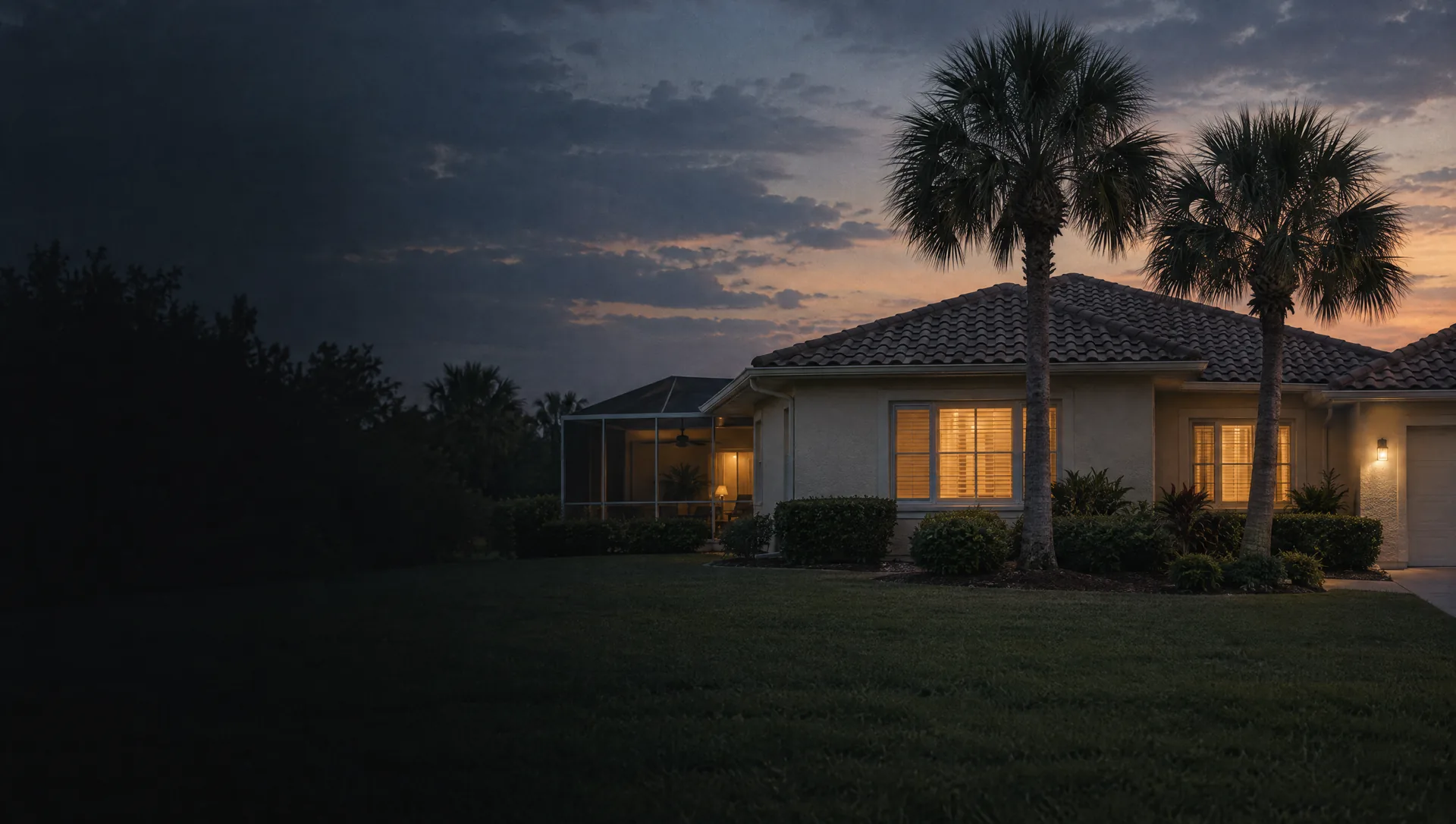
Hurricane season is part of the payment

Homeowners and flood insurance

Every Florida homeowner knows the feeling of opening a renewal notice. Your lender will require coverage that includes windstorm, and most Florida policies carry a separate hurricane deductible, often a percentage of the dwelling coverage rather than a flat dollar amount. Read that line before you compare premiums.

Flood insurance is required on a federally backed loan when the home sits in a FEMA Special Flood Hazard Area. If your policy is with Citizens Property Insurance, the state-backed insurer, flood coverage becomes a condition of most homeowner policies with wind coverage starting January 1, 2027, whatever the flood zone. Outside those cases flood coverage is optional, but flooding in Florida is not limited to mapped zones, so price it by address early. Older homes may need a four-point inspection before a carrier will write a policy, and a wind mitigation inspection can lower the premium on a home with storm-resistant features like impact windows or roof straps. Get those quotes early, while you can still negotiate.

Condos after Surfside

After the 2021 collapse of Champlain Towers South in Surfside, Florida began requiring milestone structural inspections for condo and co-op buildings three habitable stories or taller, starting at about 30 years of age and repeating every 10 years, along with structural integrity reserve studies. Associations can no longer skip funding reserves for those structural items, and some have raised dues or levied special assessments to catch up.

For you, this shows up in two places. Dues and assessments go into your monthly cost and your debt-to-income ratio. And a building with unfinished critical repairs can be ineligible for conventional financing until the work is done. We ask for the association's inspection report, reserve study and budget early in the contract period, so you see the building's finances before you fall for the view. Some buyers in those buildings use loans made for non-warrantable condos, which have different terms.

Know your Florida numbers before you fall for a house

A preapproval tells you what a lender will lend. It does not tell you what the house will cost to own. In Florida that gap is insurance, flood coverage and the reset tax bill, and it can change which house makes sense.

Send us the address, or even just the neighborhood, and we will put those numbers next to the payment before you write the offer.

The listing shows the seller's costs. We show you yours.

Down payment help

Florida Housing programs

If you teach, nurse, police, fight fires or care for children in Florida, Hometown Heroes was written with you in mind. All three programs run through Florida Housing Finance Corporation’s participating lenders, with county income and price limits, a 640 minimum credit score and a homebuyer class, and they are for first-time buyers: no owned and occupied home in the past three years.

Hometown Heroes

Up to 5 percent of the first mortgage, from $10,000 to $35,000, for buyers working full time for a Florida-based employer in health care, schools, public safety, the courts or child care, for servicemembers, and for veterans who work full time for a Florida-based employer. It is not forgiven: it is repaid when you sell, refinance, transfer the home or stop living in it. Funding is set each state fiscal year and reserved first come, first served, so ask us to check availability before you plan around it.

FL Assist

Up to $10,000 toward down payment and closing costs as a deferred second mortgage; Florida Housing sets its terms. Like Hometown Heroes, it is repaid rather than forgiven.

HFA PLUS second mortgage

3, 4 or 5 percent of the loan amount, forgiven 20 percent a year over five years, paired with Florida Housing's conventional first mortgages. Stay five years and it is gone.

Where we help buyers

From Pensacola to Miami

We can talk through any Florida address: the taxes, insurance and loan options for that specific home.

South Florida

Miami-Dade, Broward and Palm Beach counties: coastal condo towers, inland neighborhoods and many older buildings working through the new inspection rules. Miami, Hialeah, Fort Lauderdale, Pembroke Pines, Hollywood, Miramar, Coral Springs and West Palm Beach, among others.

Tampa Bay

Hillsborough, Pinellas, Pasco and Hernando counties: bungalows and ranch homes near the bay, newer subdivisions to the east and north. Tampa, St. Petersburg, Clearwater, Brandon, Spring Hill, Riverview, Largo and Wesley Chapel, among others.

Orlando and Central Florida

From Orlando to Gainesville and Daytona Beach: newer planned communities beside established towns. Orlando, Gainesville, Lakeland, Palm Coast, Deltona, Daytona Beach, Kissimmee and The Villages, among others.

Southwest Florida

Lee, Charlotte, Sarasota and Manatee counties: canal homes and newer construction, where flood zone and elevation shape every insurance quote. Cape Coral, Lehigh Acres, Fort Myers, North Port, Port Charlotte, Bradenton, Sarasota, Bonita Springs.

Space and Treasure Coast

Brevard and St. Lucie counties: single-family neighborhoods along the Indian River Lagoon and the Atlantic. Port St. Lucie, Palm Bay, Melbourne, Fort Pierce.

North Florida and the Panhandle

Duval, Leon and Escambia counties: Jacksonville's wide spread of neighborhoods, the capital, and the Gulf Coast at Pensacola. Jacksonville, Tallahassee, Pensacola.

Florida mortgage questions

If yours is not here, ask it on the call. There are no dumb questions.

Why would I use a Michigan-based broker for a Florida home?

Because where the office sits is not what decides your loan. Align Lending is licensed in Florida under NMLS #2041154, your loan is shopped across multiple wholesale lenders, and your closing is handled by a Florida title company or attorney like any Florida purchase.

What you get is one broker who answers for your file from the first call to the closing table, by phone, video and e-signature. If you are leaving Michigan for Florida, we know that side of the move too.

Florida taxes the deed at 70 cents per $100 of the price in every county except Miami-Dade, which uses its own rate. The new mortgage is taxed separately: 35 cents per $100 of the loan amount in documentary stamps, plus a nonrecurring intangible tax of 0.2 percent. On a $300,000 loan, that is $1,050 plus $600, or $1,650.

Who pays is set by the purchase contract. Commonly the seller pays the tax on the deed and the buyer pays the taxes on the mortgage, and we include them in your closing cost estimate.

Yes, and it is the better order. Most of the work, including your preapproval, happens before you have a Florida address. Tell us where your income will come from after the move, because a new job, a transfer or retirement income each change what we can count.

If you are selling a home first, we plan the timing of both sides so the money from the sale is where it needs to be when you close in Florida.

For 2026 it is $832,750 for a one-unit home in 66 of Florida’s 67 counties. Monroe County, the Florida Keys, is a high-cost area with a limit of $990,150.

A loan above the limit for your county is a jumbo loan, with its own reserve and documentation rules. FHA limits are set separately by county, and we check the one for your address.

What our clients say

5.0 on Google across 128 reviews

Individual experiences. Results vary.

Let's get you the keys

Tell Samantha what you are hoping for in Florida, whether that is a first home, a move closer to family or a place where you finally stop shoveling snow, and she will tell you what it takes, in plain numbers.

  1. 1

    Tell us what you are trying to do

    Not what product you want. What you are actually trying to accomplish.

  2. 2

    We look at your situation

    Samantha works out what matters most for you specifically.

  3. 3

    You leave with a plan

    Your options, the tradeoffs, and your next step. No obligation to go further.

Align Lending LLC, NMLS #2041154, is a mortgage broker licensed in Florida. Samantha Shelton, NMLS 1647301. Equal Housing Opportunity. Licensed in Michigan, Ohio, North Carolina, Florida, Louisiana and Texas. Figures on this page come from the state and federal agencies named and are for orientation, not a quote. This page is for educational purposes only. It is not a credit decision, a preapproval, a commitment to lend, or an offer of credit.

Scroll to Top
Align Lending logo
