
Impact of technology on rental markets: A landlord’s guide
This article is general information about rental technology, consumer reporting law and fair housing law, not legal advice. These rules vary by state and municipality and change often. Take your leases, screening criteria and disclosures to a Michigan attorney.
Technology has reshaped how rental housing is marketed, leased and managed far more than it has reshaped rental supply. In the second quarter of 2026 the U.S. rental vacancy rate was 7.3% and the median asking rent for vacant for-rent units was $1,531, per the Census Bureau’s Housing Vacancy Survey released July 28, 2026, numbers set by construction, household formation and local demand, not by an app. What software changed is the operating layer underneath: listings, applications, screening, payments, maintenance and keys.
Two pieces of that layer carry legal weight, not just convenience. Algorithmic tenant screening is governed by the Fair Credit Reporting Act and the Fair Housing Act whatever a vendor’s marketing claims, and algorithmic rent-setting software is the subject of a federal antitrust case filed August 23, 2024 that remains open.
Learn what rental technology actually changes, where the legal exposure sits, and how the financing side fits, or start with our Real Estate Investing guide.
Key takeaways:
- Market conditions are not a software story: The U.S. rental vacancy rate was 7.3% in the second quarter of 2026 (8.0% in principal cities, 6.9% in suburbs and 5.8% outside metropolitan areas) and renter-occupied units made up 31.3% of the national housing inventory.
- Screening software does not move the legal duty off the landlord: A tenant screening report is a consumer report, including a vendor’s risk score or recommendation, and federal law requires an adverse-action notice naming the reporting agency, stating that the agency did not make the decision, and telling the applicant they can get a free copy of the report within 60 days.
- Rent-setting software sits in active litigation: The United States and co-plaintiff states filed their complaint on August 23, 2024, amended it on January 7, 2025 to add six property management companies as defendants, and filed a proposed final judgment as to RealPage on November 24, 2025. Nothing here predicts how it ends.
What has technology actually changed in rental markets?
The workflow, not the fundamentals. The same Census Bureau survey that put the second-quarter 2026 rental vacancy rate at 7.3% shows it was not statistically different from the 7.0% rate a year earlier and virtually the same as the 7.3% rate in the first quarter of 2026, a market that barely moved while the software around it changed a lot.
- What software compresses: The gap between a vacancy and an application, between a repair request and a work order, the labor cost of collecting rent, and the friction between interest and signature.
- What software does not change: Local supply, wage growth, household formation, taxes, insurance, and what a unit in a given neighborhood commands. That belongs in analyzing rental market trends, not a feature list.
What do the third-quarter 2026 Census figures add?
The next release moved the national rate up. According to the Census Bureau’s third-quarter 2026 release of October 28, 2026 (CB26-161), the rental vacancy rate was 7.6%, higher than 7.1% a year earlier and 7.3% in the second quarter, and the median asking rent for vacant for-rent units was $1,541.
Per the same release, the Northeast and West rates rose from the third quarter of 2025, while the Midwest rate was not statistically different from a year earlier, and about 3,866,000 units were vacant for rent, up from 3,549,000. Those are inputs to a rent assumption, and the city, suburb and regional breakdown sits in analyzing rental potential and investor market analysis, not in a software pitch.
Owners saw little change. The October 28, 2026 release put the homeowner vacancy rate at 1.2%, virtually the same as the third quarter of 2025 and the second quarter of 2026 (1.2% each), and the homeownership rate at 65.5%, not statistically different from 65.3% a year earlier or 65.0% in the second quarter. The 7.3% and $1,531 figures earlier on this page are the second-quarter numbers from the July 28, 2026 release.
Which leasing and payment steps have moved onto software?
Nearly all of them. A vacancy is syndicated from one listing entry to portals such as Zillow, Apartments.com and Realtor.com, shown by video walkthrough, applied for on a phone, screened by a vendor, signed electronically and paid by bank transfer.
| Leasing step | Traditional workflow | Software workflow |
|---|---|---|
| Reaching applicants | Yard sign, classified listing, one photo set | One entry syndicated to multiple portals, with video or 3D tour |
| Showing the unit | Scheduled showings, one party at a time | Recorded walkthrough first, in-person showing for shortlisted applicants |
| Application and screening | Paper form, landlord-run reference calls | Online form, vendor-run consumer report, identical FCRA duties either way |
| Signing and payment | Wet-ink lease, checks or money orders | Electronic signature, recurring bank transfer, automated receipts |
A recorded walkthrough screens your calendar, not your applicants; it must never decide who gets an in-person tour. See how virtual home tours work.
Those records outlive the tenancy. A lease survives the sale of the property: a buyer takes title subject to the existing lease, and the sale is not itself grounds to end a tenancy. Clean copies of the lease, ledger and deposit accounting are what a buyer’s attorney asks for, see how to sell a home with tenants.
How does automation change day-to-day property management?
It converts scattered memory into a record. The value of maintenance and accounting software is less about speed than documentation.
- Maintenance and messaging: A request becomes a dated record with photos, a vendor assignment and a completion note, and notices live in one thread rather than across texts and voicemail, the trail you rely on in a habitability question or deposit dispute.
- Accounting records: Categorized income and expenses, per property, produce usable year-end reporting.
- Portfolio reporting: Once you hold several doors, per-unit turnover, delinquency and repair tracking is the only way to see which property is the problem, see managing multiple rentals.
What automation cannot do is decide. Software can flag a late payment and draft a message; whether to serve a notice, and which one, is a legal decision with statutory timing and a court process behind it. Route those to a Michigan attorney, and see our rental property management hub.
What does smart-home technology change in a rental, and what does it risk?
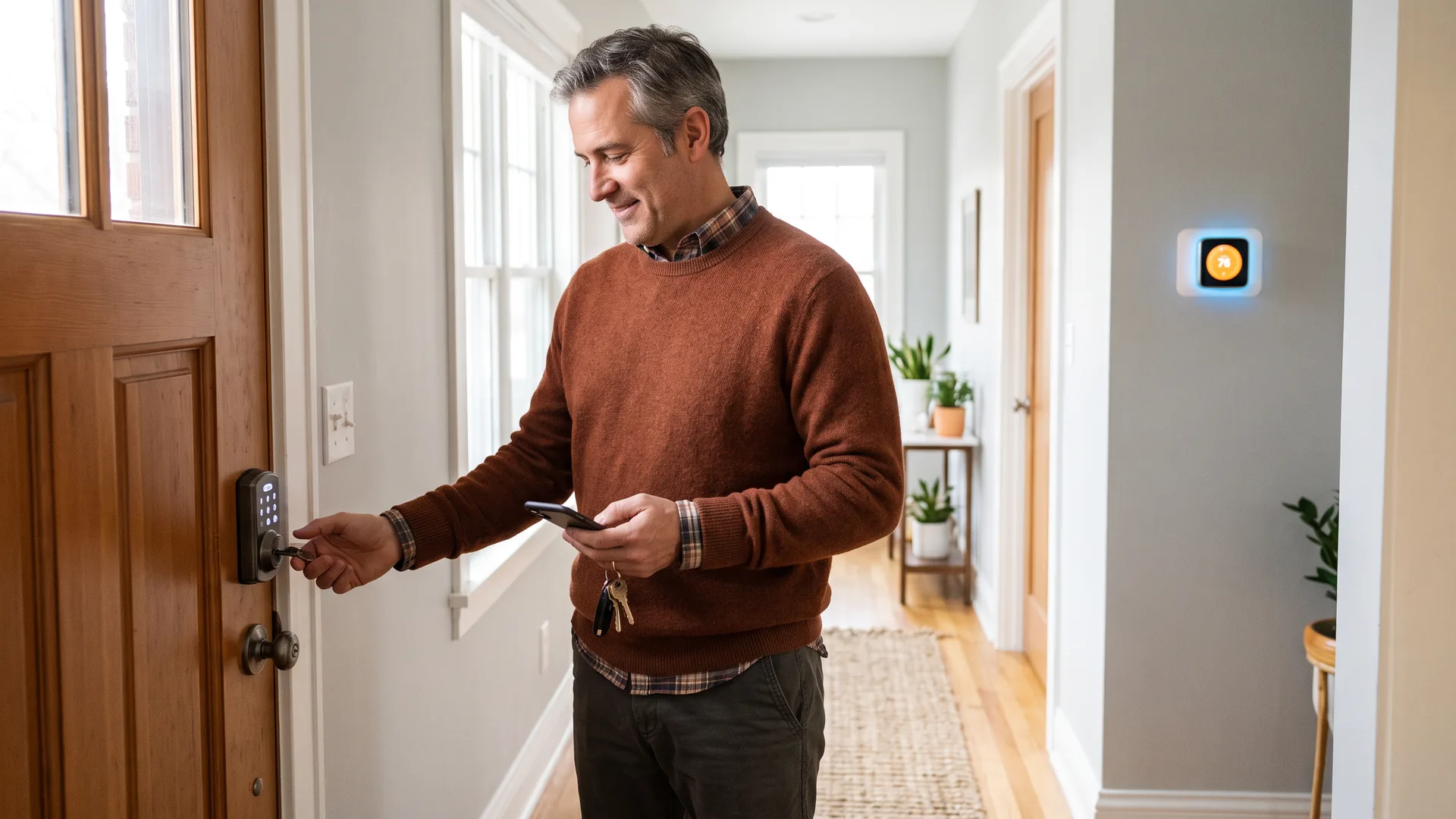
Smart locks and thermostats change turnover cost and utility exposure; cameras change your legal risk profile. Keep the two categories separate when you shop.
- Smart locks and keyless entry: Codes can be issued and revoked without a locksmith, removing rekeying from every turnover. Entry still requires whatever notice your lease and state law demand. A code is not permission.
- Smart thermostats: These matter most where the owner pays heat. ENERGY STAR reports that almost half of the average American household’s annual energy bill goes to heating and cooling, more than $900 a year, and that labeled smart thermostats are independently certified on field data to deliver savings. See ENERGY STAR’s guidance on certified smart thermostats.
- Leak and freeze sensors: The cheapest devices with the clearest case, because a detected leak is a repair and an undetected one is a claim.
- Cameras and monitoring: Keep any recording at exterior entry points and common areas, never inside a unit, disclose it in writing in the lease, and confirm your state’s recording rules before installing anything.1
Settle two questions in writing before installation: who holds the account, and who resets it at move-out. On rent premiums, stay skeptical, percentage lifts attributed to smart features usually come from vendor surveys with no named study, geography or period behind them. The defensible claim is narrower: fewer trips, fewer rekeys, lower owner-paid utility bills.
What legal duties attach to algorithmic tenant screening?
The same duties that attach to a paper application, and they do not transfer to the vendor. The Federal Trade Commission states it plainly: tenant background check reports are consumer reports, and when you use consumer reports to make tenant decisions you must comply with the Fair Credit Reporting Act.2 The FTC’s list of covered reports names the algorithmic product specifically, a risk score or recommendation from a screening company based on criteria you selected. A score is a report. Buying one does not outsource the decision.
- Permissible purpose comes first: You may pull a report on an applicant or a renewing tenant, and you certify to the vendor that you will use it only for housing purposes.
- Adverse action is broader than denial: The FTC counts denying an application, requiring a co-signer, requiring a larger deposit and charging higher rent than another applicant.
- The notice is owed even on a partial basis: Under 15 U.S.C. 1681m(a) the adverse-action notice is due whenever the report was a basis for the action in whole or in part. Even if it was not the main reason. Its required contents are itemized in dealing with multiple offers from tenants.
- Credit scores add a second disclosure: If a score factored in, you must also give the score, its source and date, the range for that model, and the key factors that hurt it, in order of importance.
- Fair housing runs alongside, not instead: Under 42 U.S.C. 3604(a) and (b) it is unlawful to refuse to rent, or to discriminate in the terms or conditions of a rental, because of race, color, religion, sex, familial status or national origin, and 42 U.S.C. 3604(f) extends the same prohibition to disability. Michigan’s Elliott-Larsen Civil Rights Act adds characteristics of its own. The FTC warns that a blanket policy of refusing anyone with a criminal record may violate the Fair Housing Act.
The operational answer is the same one that protected landlords before any of this was automated: written criteria, published in advance, applied identically to every applicant, with a documented reason for every denial and a real path to dispute the data. Never choose on impression or “fit,” and never steer an applicant between units or properties. The same rule governs an AI leasing assistant the moment it touches which applicants advance or which units get shown. The selection-and-adverse-action workflow itself, including criminal-record criteria and record retention, sits in dealing with multiple offers from tenants; the first-year setup around it is in becoming a landlord, and the wider model-risk picture in the impact of AI on real estate markets.
How often do tenant screening reports get the facts wrong?
Often enough that a federal regulator studied it. A Consumer Financial Protection Bureau release of November 15, 2022 reported that its snapshot analyzed more than 24,000 complaints plus focus groups with 44 renters, and that problems included negative information belonging to someone else and outdated information left on reports. Compare the name, birth date and address history on a report against the application before you act on a score.
The data also has to be protected. The Disposal Rule, 16 CFR 682.3, requires reasonable measures against unauthorized access when consumer information is disposed of, with shredding papers as one example. In Michigan, MCL 445.72 requires notice to each affected resident without unreasonable delay after a breach likely to cause loss or identity theft, which reaches applicant files kept in screening software.
Does disparate-impact liability still reach screening algorithms?
On paper, yes, with a rulemaking pending. 24 CFR 100.500, current in the eCFR as of October 26, 2026, says Fair Housing Act liability may rest on a practice’s discriminatory effect even without discriminatory intent, and that a justification must be supported by evidence, not hypothetical or speculative. HUD’s January 14, 2026 proposal (91 FR 1475) would remove those regulations and leave the question to courts, and a supplemental proposal of August 10, 2026 took comments through October 9, 2026. A proposal is not a final rule; see new fair housing laws.
Where does the antitrust case over rent-setting software stand?
It is open, and it deserves to be described by its docket rather than its headlines.3 On August 23, 2024 the United States, with co-plaintiff states, filed a civil antitrust complaint against RealPage, Inc. in the U.S. District Court for the Middle District of North Carolina, and on January 7, 2025 amended it to add six property management companies as defendants.
The government’s Competitive Impact Statement describes the allegations: that RealPage and six landlords violated Section 1 of the Sherman Act, 15 U.S.C. 1, by agreeing to share and use competitively sensitive information about the properties each landlord manages, and that RealPage violated Section 2 by monopolizing the market for commercial revenue management software in conventional multifamily housing. Those are allegations in a complaint.
Settlements have come defendant by defendant. The Antitrust Division’s case page lists proposed final judgments as to Cortland (January 7, 2025), Greystar (August 8, 2025, with final judgment entered March 2, 2026), RealPage itself (November 24, 2025), LivCor (December 23, 2025) and Willow Bridge (July 6, 2026). Each goes through public comment and court review under the Tunney Act, 15 U.S.C. 16(b) through (h), before entry.
Two features of the proposed RealPage judgment show what a settlement is and is not. The parties consented to entry “without trial or adjudication of any issue of fact or law, and without this Final Judgment constituting any evidence against or admission by any party”. A consent decree is not a finding of liability. The relief is conduct-based: limits on using nonpublic data from competing properties when the software generates prices, and a requirement that model training use backward-looking data aged at least 12 months and not drawn from active leases. Read the filings at the Justice Department’s case page.
What this means for a small landlord is narrow. This post does not tell you that using pricing software is lawful or unlawful, and it recommends no product. It tells you the legal questions are live, that some cities and states have adopted or proposed their own restrictions, and that both are worth raising with counsel first.
What has the Justice Department filed since the RealPage settlement?
Another landlord settlement. The case page, updated September 4, 2026, lists a proposed final judgment as to Pinnacle Property Management Services filed that day. Michigan Public, carrying the Associated Press report of November 25, 2025, reported that RealPage would not pay damages under its proposed settlement and that landlords do not have to follow the software’s price suggestions. A suggested rent is an input; the decision stays yours.
What is still experimental in rental technology?
Less than the marketing suggests. Blockchain-based tokenized ownership and smart-contract leasing remain nascent for typical landlords: the property still has to be titled, insured, financed and managed under ordinary real property law, and mainstream lenders do not underwrite a tokenized fractional interest the way they underwrite a mortgage.
How does technology change financing a rental property?
Mostly by improving your documentation. Investor underwriting runs on evidence (leases, rent rolls, deposit records, payment histories) and landlords running on software produce it in an afternoon instead of a month.
- Conventional investor loans: Underwritten to your personal income and credit, with reserve requirements and a cap on how many financed properties you may carry. Documented rental income can help you qualify.
- DSCR and non-QM options: Qualification leans on the property’s income rather than personal income documentation, which is why a defensible rent ledger matters here.
- Portfolio and cash-out structures: Equity in one property can fund the next. Refinancing an investment property is often how a second door happens.
Align Lending is a mortgage broker. We do not manage property, select markets, choose software or give legal or investment advice, we shop your scenario across competing wholesale lenders. See buying a home as an investment property.
Which rental records will a lender actually use?
The program decides. Fannie Mae’s Selling Guide topic B3-3.8-01, dated September 2, 2026, lets lenders use positive rental income only if the borrower has at least 12 months of property management experience, requires a newly signed lease on a property not yet on the tax return to run at least six months, and rules out leases with family members or interested parties. Software helps by exporting the lease and ledger; it does not change those rules. See financing investments, cash flow in real estate, evaluating cash flow potential and buying a multi-family home.
What Michigan landlords should know
Michigan statute answers four questions your software will not.4 Screening rules, lease templates and pricing tools bought off the shelf are written to the federal floor, and Michigan sits above it in places.
- Elliott-Larsen covers more characteristics than the federal list: Under MCL 37.2502(1), a person engaging in a real estate transaction may not discriminate on the basis of religion, race, color, national origin, age, sex, sexual orientation, gender identity or expression, familial status or marital status. Age and marital status are not in the federal Fair Housing Act, so a vendor’s stock criteria can be lawful nationally and a problem here.
- Source of income is protected, and it changes automated income screening: Effective April 2, 2025, MCL 37.2502(3) bars a landlord from denying a tenancy or altering terms based on a prospective tenant’s source of income, and MCL 37.2502(3)(f) provides that a landlord applying an income threshold may not exclude a rent voucher or subsidy when calculating whether that threshold is met. A 3-times-rent rule applied to earned income only will not clear that. Under MCL 37.2502(4) the subsection does not apply to a landlord of fewer than 5 rental units in Michigan.
- Your e-signed lease still owes the Truth in Renting notice: MCL 554.634(2) requires a rental agreement to carry, in type no smaller than 12-point, a notice that Michigan law establishes rights and obligations for parties to rental agreements and that the agreement is required to comply with the Truth in Renting Act. A template pulled from a national platform frequently omits it.
- Rent control is off the table statewide: Under MCL 123.411(2), a local governmental unit may not enact, maintain or enforce an ordinance or resolution having the effect of controlling the amount of rent charged for leasing private residential property. Whatever a pricing tool suggests, no Michigan municipality caps your rent.
Align Lending is a Michigan mortgage broker, not a law firm. Take your screening criteria, lease template and disclosures to a Michigan real estate attorney before you use them.
How do Michigan deposit and lockout rules apply to rental software and smart locks?
Set the deposit module and the lock app to the statute, not the vendor default.
- Deposits: MCL 554.602 caps a deposit at 1 1/2 months’ rent. MCL 554.608 requires move-in and move-out inventory checklists. MCL 554.609 requires an itemized notice of damages mailed within 30 days after occupancy ends, so a portal message alone does not do it.
- The 45-day window: Under MCL 554.613, a landlord must sue for claimed damages within 45 days after occupancy ends, or be liable for double the deposit retained.
- Smart locks: MCL 600.2918(2)(c) treats changing or adding to locks or security devices without immediately giving the person in possession keys or other unlocking devices as unlawful interference, worth actual damages or $200, whichever is greater, for each occurrence. Subsection (7) bars waiving it. Revoking a code is not an eviction.
Hypothetical example, not an offer. For example, at $1,541 a month, the Census Bureau’s third-quarter 2026 median asking rent, the deposit cap is $2,311.50; keeping $500 without the required steps risks $1,000 under MCL 554.613, and two code lockouts carry at least $400 under MCL 600.2918. Per IRS Publication 527 (2025), a deposit you plan to return is not income, but one applied as final rent is advance rent; see tax benefits of real estate investing and depreciation.
Which Michigan local rules change how screening software is set up?
- Ann Arbor: Ordinance ORD-21-06, effective April 18, 2021, bars asking about criminal history, with listed exceptions, and the city’s 2023 poster says checks are allowed only when federal or state law requires one, for landlords with one or more units there.
- Grand Rapids: Its application fee ordinance caps the fee and requires written screening criteria; the implementation policy requires refunding unscreened applicants’ fees within 14 calendar days after the unit is no longer available.
- Owner-occupied duplexes: MCL 37.2503(1)(a) exempts renting in a building for not more than 2 families when the owner or immediate family lives in one; federal law can still apply. See investing in multi-family properties.
Voucher holders are a normal part of Michigan applicant pools: the MSHDA voucher overview reports over 29,000 families assisted across all 83 counties, with payment standards set from HUD’s Fair Market Rents, 40th percentile rents now posted for fiscal year 2027. New owners can start with tips for new real estate investors and investment strategies for beginners.
How Align helps you grow a portfolio
When a rental has built equity, a cash-out refinance or a DSCR loan may turn it into the down payment on the next one. Samantha compares those across multiple wholesale lenders.
She starts with the math that only works when nothing goes wrong, and makes sure yours still works when something does.
FAQ: Technology in rental markets
Here are answers to common questions about technology in rental markets.
What technology do renters expect from a rental today?
Mostly the ability to transact from a phone: listings with real photos or video, a digital application, electronic lease signing, recurring bank-transfer rent, and maintenance requests that produce a record. Renters treat internet service as a utility, not an amenity. None of it raises rent by itself; it removes friction that costs days on market. See analyzing rental market trends.
Do smart home upgrades actually increase rent?
There is no reliable national number, and be wary of any source offering one without a named study, geography and period. What holds up is operational: smart locks remove rekeying and lockout costs at turnover, and smart thermostats cut utility spending where the owner pays heat. Price the upgrade against those savings.
Is property management software worth it for a small landlord?
Usually yes once you hold more than one unit, but for the record-keeping rather than the automation. Categorized income and expenses, a rent ledger, dated maintenance tickets and a message trail are what you need at tax time, in a deposit dispute and in front of an underwriter. A single-unit owner can manage with a payment app and a spreadsheet. See rental management.
What are the risks of adding smart devices to a rental?
Privacy, security and support. Any device that records a tenant creates legal exposure, so keep monitoring at exterior entry points, disclose it in the lease, and confirm your state’s recording rules first. Choose an open standard so a vendor shutdown does not strand your hardware.
How long does a tenant screening company have to investigate a dispute?
Thirty days. Under 15 U.S.C. 1681i(a)(1)(A), the agency must finish a free reinvestigation within 30 days of receiving the dispute. If the item turns out inaccurate, incomplete or unverifiable, it must promptly delete or modify it, and it must send written results within 5 business days after finishing. Ask the applicant for the corrected report before you decide.
How far back can a tenant screening report go?
Usually seven years. Under 15 U.S.C. 1681c(a), bankruptcies drop off after 10 years; civil suits, civil judgments and arrest records after seven years or when the statute of limitations runs out, whichever is longer; and paid tax liens and collection accounts after seven years. Records of criminal convictions are not covered by that limit, though local rules such as Ann Arbor’s still restrict how a landlord may use them.
How long does an applicant have to file a fair housing complaint?
One year with HUD and two years in court. Under 42 U.S.C. 3610(a)(1)(A)(i), a HUD complaint may be filed up to one year after the alleged practice occurred or ended, and 42 U.S.C. 3613(a)(1)(A) allows a civil action within 2 years. Keep screening records and decision notes at least that long.
Can the adverse action notice be sent through a rental app?
Yes. 15 U.S.C. 1681m(a)(1) calls for oral, written or electronic notice of the adverse action, so a message inside a leasing platform can qualify if it carries every required item. Save a dated copy outside the vendor’s system as well, because the record has to outlive your subscription and any dispute that follows the decision.
The bottom line on technology in rental markets
Technology has changed rental operations far more than rental economics. The U.S. rental vacancy rate was 7.3% in the second quarter of 2026 and the median asking rent for vacant for-rent units was $1,531, per the Census Bureau’s Housing Vacancy Survey released July 28, 2026. Conditions software did not set. What software changed is leasing, payments, maintenance and screening, and two carry legal weight: a tenant screening score is a consumer report subject to the Fair Credit Reporting Act and the Fair Housing Act, and algorithmic rent-setting is the subject of a federal antitrust case filed August 23, 2024 that remains open. Buy tools for the hours they save, not the rent they promise.
If you’re ready to buy or refinance a rental property, talk to Align Lending. We’ll shop your scenario across our lender network and show you the numbers side by side. Call 248-506-5727 or start online. Take screening criteria, lease terms and device disclosures to a Michigan attorney.
Footnotes:
1. This is general information, not legal advice. Rules governing audio and video recording, tenant privacy, notice before entry, and required lease disclosures are set by state and local law and vary widely; some states impose consent requirements on audio recording that do not apply to video, and some municipalities regulate rental devices separately. Align Lending is a Michigan mortgage broker, not a property manager or a law firm, and does not endorse or evaluate any device or vendor. Confirm current requirements with a Michigan attorney and with your municipality before installing any monitoring or access device in a rental unit. Return to text.
2. The Fair Credit Reporting Act and Fair Housing Act descriptions above summarize federal requirements and Federal Trade Commission business guidance as of publication and are not a complete statement of your obligations. State and local law, including Michigan’s Elliott-Larsen Civil Rights Act and local ordinances that may add protected characteristics or regulate the use of criminal and eviction records. Can impose additional duties, and enforcement guidance changes. Align Lending is not a consumer reporting agency, a property manager or a law firm and does not review screening criteria. Have written screening criteria, adverse-action procedures and record-retention practices reviewed by a Michigan attorney before you use them. Return to text.
3. The litigation description above reflects filings on the U.S. Department of Justice Antitrust Division’s public case page for U.S. and Plaintiff States v. RealPage, Inc., No. 1:24-cv-00710 (M.D.N.C.), as of publication, and is a neutral summary of the public record. Allegations in a complaint are allegations, not findings; a proposed final judgment is a negotiated settlement that by its terms is entered without trial or adjudication of any issue of fact or law and without constituting any admission by any party. Nothing here asserts or predicts an outcome, states that any use of revenue management or pricing software is or is not lawful, or recommends or criticizes any product or vendor. Separate private and state actions and local ordinances addressing algorithmic pricing exist and change; consult an attorney about your own circumstances. Return to text.
4. The Michigan statutory summaries above reflect the Michigan Compiled Laws as of publication and are general information, not legal advice. Statutes are amended, exemptions and thresholds apply that are not described here, local ordinances may impose additional duties, and how any provision applies turns on facts specific to your property, your portfolio size and your practices. Align Lending is a Michigan mortgage broker, NMLS #2041154, and is not a law firm, a property manager or a consumer reporting agency. Confirm the current text of any statute with the Michigan Legislature and have your lease, screening criteria and required disclosures reviewed by a Michigan real estate attorney before you rely on them. Return to text.
Sources: National rental vacancy rate of 7.3 percent and homeowner vacancy rate of 1.2 percent in the second quarter 2026, the second quarter 2025 rental vacancy rate of 7.0 percent and first quarter 2026 rate of 7.3 percent, the homeownership rate of 65.0 percent, rental vacancy rates of 8.0 percent in principal cities, 6.9 percent in suburbs and 5.8 percent outside metropolitan statistical areas, median asking rent for vacant for-rent units of $1,531, and renter-occupied units at 31.3 percent of the housing inventory, U.S. Census Bureau, Current Population Survey/Housing Vacancy Survey, “Quarterly Residential Vacancies and Homeownership, Second Quarter 2026,” Release Number CB26-116, released July 28, 2026. Tenant background check reports as consumer reports, the inclusion of a risk score or recommendation from a tenant screening company among covered reports, permissible purpose and certification, adverse actions including denial, requiring a co-signer, requiring a larger deposit and charging higher rent, required adverse-action notice contents including the reporting agency’s name, address and telephone number, the statement that the agency did not make the decision, dispute rights and the right to a free report within 60 days, the rule that notice is required even where the report was not the primary reason, additional credit-score disclosure obligations, and the warning that a blanket policy of refusing to rent to anyone with a criminal record may violate the Fair Housing Act, Federal Trade Commission, “Using Consumer Reports: What Landlords Need to Know.” Duties of users taking adverse actions on the basis of information contained in consumer reports, 15 U.S.C. 1681m(a). Unlawful refusal to sell or rent, and discrimination in terms, conditions or privileges of rental, because of race, color, religion, sex, familial status or national origin, 42 U.S.C. 3604(a) and (b); the extension of those prohibitions to discrimination because of a handicap, 42 U.S.C. 3604(f). Prohibition on discrimination in a real estate transaction on the basis of religion, race, color, national origin, age, sex, sexual orientation, gender identity or expression, familial status or marital status, MCL 37.2502(1); prohibition on a landlord denying or altering a tenancy based on a prospective or current tenant’s source of income, and the requirement that a landlord applying an income threshold not exclude a rent voucher or subsidy when calculating whether the criteria are met, MCL 37.2502(3) and (3)(f); the exemption for a landlord of fewer than 5 rental units in this state, MCL 37.2502(4), Elliott-Larsen Civil Rights Act, 1976 PA 453, as amended by 2023 PA 6, effective February 13, 2024, and 2024 PA 180, effective April 2, 2025. Requirement that a rental agreement state, in type not smaller than 12-point, a notice that Michigan law establishes rights and obligations for parties to rental agreements and that the agreement is required to comply with the Truth in Renting Act, MCL 554.634(2), Truth in Renting Act, 1978 PA 454. Complaint filed August 23, 2024 and amended January 7, 2025 to add six property management companies as defendants; allegations under Section 1 of the Sherman Act, 15 U.S.C. 1, regarding the sharing and use of competitively sensitive information and the alignment of pricing, and under Section 2, 15 U.S.C. 2, regarding monopolization of the commercial revenue management software market for conventional multifamily rental housing; proposed Final Judgment and Stipulation and Order filed November 24, 2025; Antitrust Procedures and Penalties Act review, 15 U.S.C. 16(b) through (h); consent to entry without trial or adjudication of any issue of fact or law and without constituting any admission; and the restrictions on use of nonpublic data from competing properties in runtime operation and the model-training limitation to backward-looking data aged at least 12 months and not from active leases, United States v. RealPage, Inc., No. 1:24-cv-00710-WO-JLW (M.D.N.C.), Competitive Impact Statement and Proposed Final Judgment, filed November 24, 2025, together with the Antitrust Division case page listing settlement filings as to Cortland (January 7, 2025), Greystar (August 8, 2025; Final Judgment March 2, 2026), LivCor (December 23, 2025) and Willow Bridge (July 6, 2026). Heating and cooling accounting for almost half of the average American household’s annual energy bill, more than $900 a year, and the certification of ENERGY STAR labeled smart thermostats based on actual field data, U.S. Environmental Protection Agency, ENERGY STAR, “Smart Thermostats.” Prohibition on a local governmental unit enacting, maintaining or enforcing an ordinance or resolution having the effect of controlling the amount of rent charged for leasing private residential property, MCL 123.411(2), Leasing of Private Residential Property, 1988 PA 226, as amended by 2018 PA 585, effective March 28, 2019. Further reading: the FTC’s guidance for landlords using consumer reports and the Census Bureau’s Housing Vacancy Survey.
This article is for informational purposes only and is not intended to provide legal, financial, tax or investment advice. Align Lending is an independent Michigan mortgage broker, NMLS #2041154, and is not a property manager, a real estate brokerage, a consumer reporting agency, a registered investment adviser or a law firm. Tenant screening, privacy, recording, disclosure and landlord-tenant requirements vary by state and municipality and change; confirm them with a Michigan attorney. Confirm tax treatment with a CPA and loan terms with your loan officer.
Sources
Every outside source this guide links to, in the order it appears. How we choose and check sources
- Third-quarter 2026 releaseU.S. Census Bureau
- Same releaseU.S. Census Bureau
- ENERGY STAR’s guidance on certified smart thermostatsENERGY STAR
- Under 15 U.S.C. 1681m(a)law.cornell.edu
- Under 42 U.S.C. 3604(a) and (b)law.cornell.edu
- Michigan’s Elliott-Larsen Civil Rights Act adds characteristics of its ownState of Michigan
- Consumer Financial Protection Bureau release of November 15, 2022Consumer Financial Protection Bureau
- Disposal Rule, 16 CFR 682.3Electronic Code of Federal Regulations
- MCL 445.72Michigan Legislature
- 24 CFR 100.500Electronic Code of Federal Regulations
- January 14, 2026 proposal (91 FR 1475)govinfo.gov
- Supplemental proposal of August 10, 2026federalregister.gov
- The Justice Department’s case pageU.S. Department of Justice
- Michigan Public, carrying the Associated Press report of November 25, 2025michiganpublic.org
- Selling Guide topic B3-3.8-01Fannie Mae Selling Guide
- Under MCL 37.2502(1), a person engaging in a real estate transactionMichigan Legislature
- Effective April 2, 2025, MCL 37.2502(3)fhcmichigan.org
- Under MCL 37.2502(4) the subsection does not applymichiganlegalhelp.org
- MCL 554.634(2) requires a rental agreementMichigan Legislature
- Under MCL 123.411(2), a local governmental unitMichigan Legislature
- MCL 554.602Michigan Legislature
- MCL 554.608Michigan Legislature
- MCL 554.609Michigan Legislature
- MCL 554.613Michigan Legislature
- MCL 600.2918(2)(c)Michigan Legislature
- IRS Publication 527 (2025)Internal Revenue Service
- Ordinance ORD-21-06a2gov.org
- 2023 postera2gov.org
- Application fee ordinancegrandrapidsmi.gov
- Implementation policygrandrapidsmi.gov
- MCL 37.2503(1)(a)Michigan Legislature
- MSHDA voucher overviewState of Michigan
- Fair Market RentsHUD Office of Policy Development and Research
- 15 U.S.C. 1681i(a)(1)(A)law.cornell.edu
- 15 U.S.C. 1681c(a)law.cornell.edu
- 42 U.S.C. 3610(a)(1)(A)(i)law.cornell.edu
- 42 U.S.C. 3613(a)(1)(A)law.cornell.edu
- The FTC’s guidance for landlords using consumer reportsftc.gov
- The Census Bureau’s Housing Vacancy SurveyU.S. Census Bureau
Related resources
20-minute read
A guide to becoming a landlord: Steps, laws and first-year costs
Learn how to become a landlord step by step, from screening tenants and writing a compliant lease to setting rent and buying landlord insurance.

20-minute read
Navigating short-term rental regulations: Zoning, licensing, insurance and lodging taxes
Learn how short-term rental regulations work, from licensing and lodging taxes to primary-residence rules and night caps, before you list your rental.

20-minute read
Dealing with multiple offers from tenants: How to choose fairly and document it
Learn how to handle multiple tenant applications legally, with written rental criteria, consistent screening and records that meet fair housing law.
