
Home inspection checklist for buyers: What to look for room by room
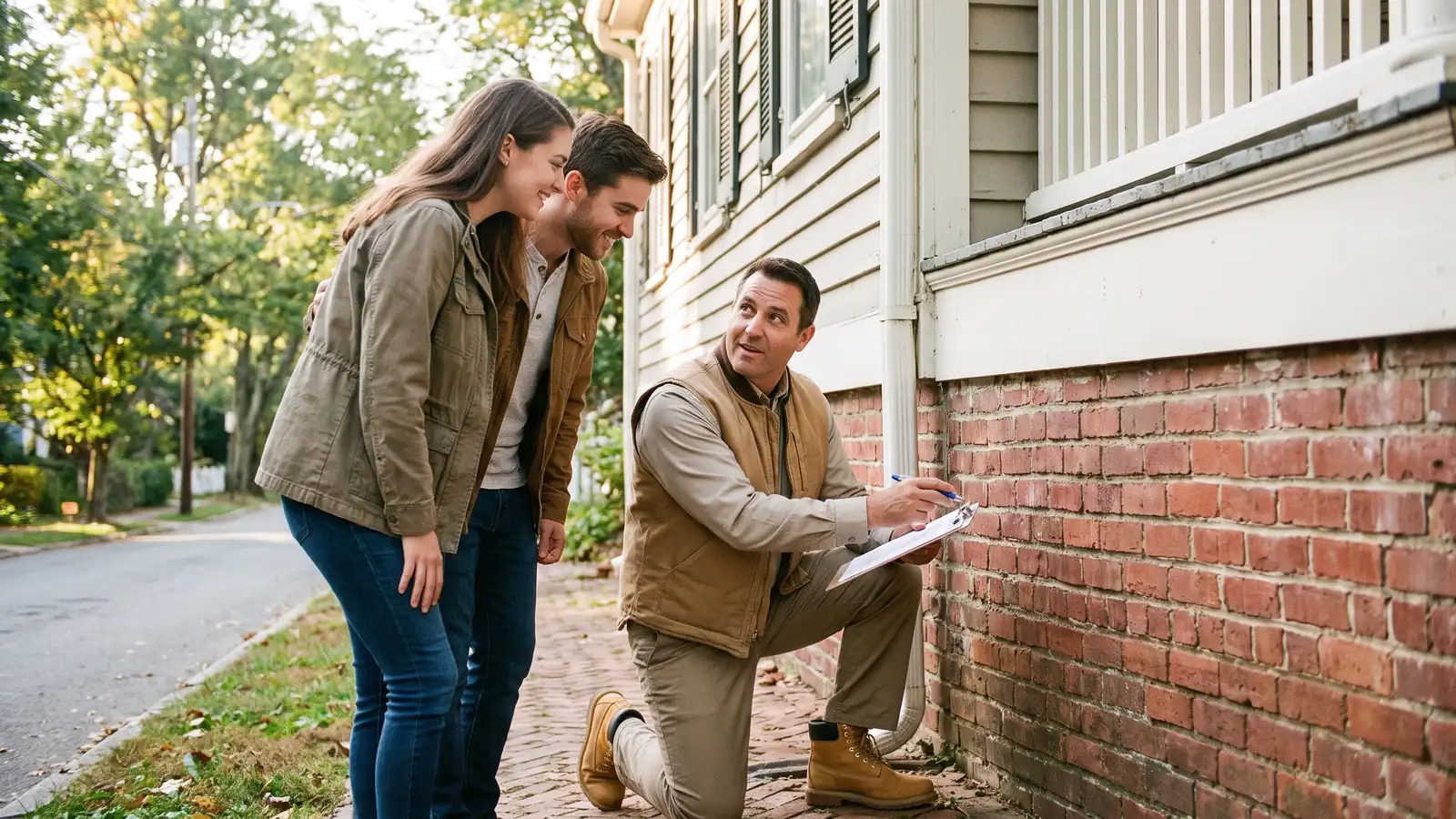
A home inspection checklist for buyers should cover the same 10 systems a professional inspector is expected to examine: the roof, the exterior, the basement and foundation, heating, cooling, plumbing, electrical, the fireplace, the attic and insulation, and interior doors and windows. That list comes from InterNACHI’s Standards of Practice, which define a home inspection as a non-invasive, visual examination of the accessible areas of a home. Meaning the inspector reports what can be seen on the day of the inspection, not what is buried inside a wall.
Walking the house yourself with a checklist doesn’t replace that inspection. It makes the inspection more useful, because you already know which rooms to point at and which questions to ask before your inspection contingency expires.
Learn how to use a home inspection checklist for buyers, including what to check outside, what to look for inside, which systems deserve the closest look, and which specialized tests a standard inspection deliberately leaves out. If you’re earlier in the process, start with our Home Buying guide.
Key takeaways:
- Cover all 10 systems: A complete checklist walks the same 10 systems and components a professional inspector examines under InterNACHI’s Standards of Practice, from the roof down to the interior doors and windows.
- Water is the defect to hunt first: Check the basement, crawl space, attic, and every window for staining or standing water. Question 1 of the property-condition section on Michigan’s seller disclosure form asks whether there has been evidence of water in the basement or crawl space.
- Budget for the tests a standard inspection excludes: Radon, mold, pests, wells, and septic systems all sit outside a standard inspection’s scope, and the EPA tells homeowners to fix any home that tests at 4 pCi/L or higher for radon.
What does a standard home inspection cover?
A standard home inspection covers 10 systems: roof; exterior; basement, foundation, crawl space and structure; heating; cooling; plumbing; electrical; fireplace; attic, insulation and ventilation; and doors, windows and interior. Those categories come straight from InterNACHI’s Standards of Practice, and knowing them tells you what your inspector owes you, and what they don’t.
What they don’t owe you matters just as much. An inspection is not technically exhaustive, won’t identify concealed or latent defects, and won’t address cosmetic issues. An inspector isn’t required to determine remaining service life, capacity or efficiency, the cause of a condition, code compliance, or repair cost, or to operate a system that’s shut down.
Your lender’s appraisal doesn’t fill that gap. HUD’s buyer form says it in a headline, “Appraisals are NOT Home Inspections”, and tells FHA buyers that the appraisal estimates value for the lender, that FHA doesn’t perform home inspections, and that an inspection happens only if you arrange one.1 Your choice of home inspector is yours to make and yours to pay for, and it’s the most consequential vendor decision in the home buying process.
Before the appointment, skim InterNACHI’s complete home inspection checklist and ask each candidate for their standards of practice and a sample report; the American Society of Home Inspectors publishes a comparable standard.
What should you check outside the home?
Start outside, because 2 of the 10 inspected systems, the roof and the exterior, are evaluated largely from ground level and the eaves. An inspector isn’t required to walk any roof surface, and isn’t required to remove snow, ice, or debris to see one, so what you see from the driveway matters.
| Area | What to check | Red flag |
|---|---|---|
| Roof and gutters | Shingle condition, missing tabs, sagging rooflines, gutters that actually carry water away from the house | Downspouts discharging at the foundation wall, or staining under the eaves |
| Foundation and grading | Visible cracks, bowing walls, and whether soil slopes away on all four sides | Ground pitched toward the house, cheap to fix, expensive to ignore |
| Siding and trim | Rot, buckling, gaps where pipes and vents penetrate the wall, peeling paint | Soft wood at the base of siding or around penetrations |
| Windows and doors | Fit in the opening, seal condition, trim and flashing above each opening | Staining or soft trim directly beneath a window |
| Deck, porch, walkways | How the deck attaches to the house, railing firmness, baluster spacing, heaving or trip hazards | A springy deck, or baluster spacing an inspector flags for correction |
| Detached garage or shed | Foundation, roof, door operation, and how power reaches the structure | Extension cords doing the job of permanent wiring |
Give drainage a second pass. Grading, gutters, and downspouts are the 3 cheapest defenses a house has against the problem that later shows up inside. If the property sits low or near water, read buying a home in a flood zone first.
What do inspectors look for inside?
Inside, the checklist narrows to 3 moisture traps, the basement or crawl space, the attic, and the rooms between them. Bring a flashlight and open everything.
| Area | What to check | Red flag |
|---|---|---|
| Basement or crawl space | Staining on walls, efflorescence, standing water, and whether the sump pump runs when you lift the float | A horizontal water line on the foundation wall, or a sump pit that’s bone dry in a wet spring |
| Attic | Daylight through the sheathing, staining on the underside of the roof deck, insulation depth and coverage, soffit and gable ventilation | A bathroom fan venting into the attic instead of outdoors |
| Walls and ceilings | Cracks at the corners of doors and windows, patched drywall, one freshly painted section | New paint in exactly one spot on an otherwise older ceiling |
| Floors | Slope, soft spots, bounce near exterior walls, gaps at baseboards | A noticeable pitch toward one wall in an older home |
| Interior doors and windows | Open and latch every window; confirm sashes stay up; check that doors close without forcing | Doors that swing open on their own, a possible sign of settling |
| Fireplace | Damper operation and visible firebox condition | Any fireplace the seller describes as never used |
Attic insulation decides comfort and utility bills, and it’s the easiest post-closing upgrade here, our guide to evaluating a home’s energy efficiency covers what to measure. If you’re finding plaster and original windows, buying a historic home carries its own inspection considerations.
Which home systems need the closest look?
Three systems, electrical, plumbing, and heating and cooling, produce the repair bills large enough to change whether you buy. Each one can be spot-checked without tools, and each one is a place where a professional’s report should be read line by line.
| System | What to check | Red flag |
|---|---|---|
| Service panel | Amperage rating, whether breakers are labeled, whether cables are secured where they enter the box | Two wires under one breaker, or a panel with no labeling at all |
| Branch wiring | Visible wiring in the basement and attic; ask specifically about knob-and-tube and aluminum branch wiring | Splices wrapped in tape instead of enclosed in a junction box |
| Outlets and switches | Test a sample in every room; press test and reset on outlets near sinks, in the garage, and outdoors | Outlets that don’t hold a plug, or no test button anywhere near water |
| Water heater | Age plate, rust at the base and fittings, and the temperature that actually reaches a tap | Tap water above 120 degrees Fahrenheit |
| Supply and drain lines | Run every fixture at once, watch how fast tubs and sinks drain, look under each sink | Slow drains at more than one fixture, pointing past the trap |
| Furnace and air conditioning | Age plate on both units, filter condition, and a full run cycle on each | Equipment that won’t start with normal controls, which an inspector needn’t operate |
The water heater setting earns its own sentence. The Consumer Product Safety Commission urges households to set water heaters to 120 degrees Fahrenheit, because most adults suffer third-degree burns after about 2 seconds in 150-degree water and about 6 seconds at 140 degrees. A scalding tap is a safety finding, not a preference.
Age matters more than appearance here. Ask for the age of the furnace, air conditioner, water heater, and roof, then weigh those 4 numbers against your cash reserves. If several are near the end of their run, you’re closer to buying a fixer-upper than the listing photos suggest, and renovation financing may fit better.
Specialized inspections you may need
The standards themselves exclude 5 common hazards: radon and other airborne hazards, mold and fungus, pests, environmental hazards such as lead paint and asbestos, and anything underground. Add-on tests are ordered separately and cost extra, and skipping them is how buyers inherit the priciest surprises.
- Radon: The EPA’s action level is 4 pCi/L, and it recommends considering a fix between 2 pCi/L and 4 pCi/L. Radon is invisible and odorless, so a test is the only way to know, see EPA guidance on radon testing.
- Septic and well: Underground items and wells are explicitly outside a home inspector’s scope. A septic inspection and a water quality test are separate appointments, and well water affects a home’s value and its financeability.
- Wood-destroying insects: Inspectors aren’t required to determine the presence of pests, so a pest inspection is its own line item, and some loan programs ask for one.
- Lead-based paint: On housing built before 1978, federal disclosure rules give buyers a 10-day period to conduct a lead paint inspection or risk assessment. The parties can agree in writing to lengthen or shorten it, and a buyer can waive it entirely.
- Pools and mold: Swimming pools sit outside a standard inspection, and so does mold, mildew, or fungus. If the home has a pool, read buying a home with a pool before you budget.
What happens after the inspection?
You’ll get a written report of material defects and 1 short contingency window to act on it. HUD tells buyers to request the inspection early enough that the purchase contract can be made contingent on its results, an inspection ordered after you sign buys information without leverage.
Say a report on a $300,000 Waterford home flags an active roof leak above the garage and a 20-year-old furnace. You have three moves: ask the seller to repair before closing, ask for a $6,000 closing-cost credit and handle the work yourself, or exit under the inspection contingency.2 A credit is usually the cleanest of the three, because it doesn’t hand repair decisions to a seller who’s already moving out.
Read the report the way an inspector wrote it, reading a home inspection report separates safety findings from maintenance notes, and negotiating repairs after a home inspection covers how to ask without losing the house. The same findings feed into negotiating house prices, and structuring the ask is part of creating a competitive offer. First-time buyers can see where this step lands in purchasing your first house.
What Michigan buyers should know
Michigan adds 4 items to the standard checklist, and 1 of them is a statutory deadline measured in hours.
- The seller’s disclosure is not an inspection: Michigan’s Seller Disclosure Act (Act 92 of 1993) applies to transfers of 1 to 4 residential dwelling units and requires the seller to deliver a written disclosure statement before signing a binding purchase agreement. The form says on its face that it isn’t a warranty and isn’t a substitute for inspections, and it notes that sellers typically haven’t inspected generally inaccessible areas such as the foundation or roof.
- A late disclosure gives you 72 hours: If the disclosure statement or an amendment arrives after you’ve signed, you can terminate the purchase agreement by written notice within 72 hours of in-person delivery, or within 120 hours if it came by registered mail. That right ends when the property transfers by deed or land contract.
- Test for radon regardless of the map: The EPA states its Map of Radon Zones should not be used to decide whether an individual home needs testing, test no matter where the house sits. Michigan’s disclosure form asks the seller about radon gas among environmental hazards, but an unknown answer is common and proves nothing.
- Winter inspections see less roof: Inspectors aren’t required to remove snow, ice, or debris to observe roof surfaces, and aren’t required to walk a roof at all. On a January closing, ask exactly how the roof was viewed and whether a spring re-check is worth scheduling. Freeze-thaw cycles and ice damming do their damage at the eaves, where you can’t see it from the ground.
The form also asks directly about the basement and crawl space, roof leaks, the sump pump, a well and pump, and a septic tank and drain field. Read those answers before the appointment and hand them to your inspector. An “unknown” on the sump pump is a place to spend inspection time.
FAQ: Home inspection checklist for buyers
Here are answers to common questions about home inspection checklists.
What do home inspectors look for the most?
Inspectors focus on the big-ticket systems: foundation cracks and settling, roof condition, moisture in basements and attics, electrical panel capacity and wiring safety, plumbing leaks and drainage, and heating and cooling operation. Cosmetic issues matter far less than anything structural, wet, or electrical, because those are the defects that cost thousands and can affect safety or financing. Our guide to avoiding common home inspection pitfalls covers what buyers most often miss.
What are red flags on a home inspection?
Major red flags include foundation cracking or bowing walls, water staining in the basement or attic, an aging or damaged roof, knob-and-tube or aluminum branch wiring, spliced wiring outside a junction box, grading that sends water toward the house, and evidence of pests. Any of these can justify renegotiating, requesting repairs, or walking away, which is why waiving a home inspection trades away your only structured exit.
Can a buyer do their own home inspection?
You can and should walk the home with a checklist, testing faucets, outlets, windows, and doors and looking for moisture. But your walkthrough supplements a professional inspection rather than replacing it. Inspectors work to a published standard, know local defect patterns, and produce a written report you can use in negotiations. The same holds on a brand-new build, see home inspections for new construction.
What is not included in a standard home inspection?
Standard inspections exclude septic systems, wells, radon, mold, pests, swimming pools, and underground items, and inspectors aren’t required to estimate repair costs, remaining service life, or code compliance. Those require add-on inspections at extra cost. If the home has a septic tank or private well, budget for the additional tests, start with buying a home with a septic system.
The bottom line on home inspection checklists
A home inspection checklist for buyers works because it mirrors the professional standard: 10 systems, walked in order, from the roof and exterior through the basement, attic, plumbing, electrical, and heating and cooling. Hunt for water first, the basement, the attic, and the ground around the foundation, then order the tests a standard inspection excludes, including radon, which the EPA says to fix at 4 pCi/L or higher. In Michigan, read the seller’s disclosure before the appointment and remember that a late one gives you 72 hours to terminate.
If you’re ready to buy with confidence, talk to Align Lending, we’ll shop your scenario across our lender network and show you the numbers side by side while you focus on finding a sound home. Call 248-506-5727 or start online today.
Footnotes:
1. Align Lending is not acting on behalf of or at the direction of FHA or HUD. FHA appraisal standards and the required buyer notice are set by HUD and are subject to change. Return to text.
2. Example figures are hypothetical and for educational purposes only; they do not constitute an advertisement of credit terms or a rate quote under federal or state lending laws. Repair costs, seller credits, and the terms of any inspection contingency depend on your purchase agreement, the property, and market conditions. Return to text.
Sources: the 10 inspected systems, the non-invasive visual scope, the “not technically exhaustive” limitation, and exclusions for radon, mold, pests, wells, swimming pools, underground items, code compliance, service-life estimates and repair cost estimates, InterNACHI Standards of Practice (last revised October 2022). “Appraisals are NOT Home Inspections,” FHA not performing home inspections, and the guidance to request an inspection early enough to make the purchase contract contingent on its results, HUD form HUD-92564-CN. Water heater setting of 120 degrees Fahrenheit and third-degree burn exposure times of about 2 seconds at 150 degrees and 6 seconds at 140 degrees, U.S. Consumer Product Safety Commission Publication 5098. Radon action level of 4 pCi/L, the 2 – 4 pCi/L consider-fixing range, and the instruction that the Map of Radon Zones should not be used to decide whether an individual home is tested, U.S. Environmental Protection Agency. The 10-day lead-based paint inspection period on pre-1978 housing, U.S. EPA real estate disclosure rule. Seller disclosure scope of 1 to 4 residential dwelling units, delivery before a binding purchase agreement, the 72-hour and 120-hour termination windows, and the disclosure form’s property-condition questions, Michigan Seller Disclosure Act, MCL 565.952, MCL 565.954, and MCL 565.957.
This article is for informational purposes only and is not intended to provide legal, financial, or tax advice. Inspection contingencies, disclosure obligations, and repair negotiations should be reviewed by a licensed real estate professional or attorney in your state. Consult a qualified professional about your situation. Program terms and figures shown are illustrative, are not a rate quote or an offer of credit, and are subject to change. Align Lending is an independent Michigan mortgage broker, NMLS #2041154.
Related resources
12-minute read
The Home Appraisal Process: What to Expect
Learn how the home appraisal process works, from the lender’s order to the final report, including typical costs of $300-$1,500 and what appraisers check.

12-minute read
How to prepare for a home closing: your step-by-step checklist
Learn how to prepare for a home closing with a step-by-step timeline, documents to bring, and final walk-through tips for a smooth closing day.

12-minute read
Understanding contingencies in home offers: the five that protect buyers
Learn how contingencies in home offers let you walk away without losing your deposit, which five matter most, and how to stay competitive anyway.
4-minute read
The Art of the Automatic Counter-Offer: Master Escalation Clauses to Win Your Dream Home
Understand escalation clauses in home buying and their impact on your mortgage. Make competitive offers today!
