
Guide to Buying a Historic Home: What to Know First
Buying a historic home follows the same basic steps as any purchase, but it adds three layers: preservation regulations, specialized inspections, and renovation-ready financing. A property generally has to be at least 50 years old before it’s even considered for historic designation, and more than 100,000 properties are now listed on the National Register of Historic Places. Though local historic district rules, not the federal listing, decide what you can change.
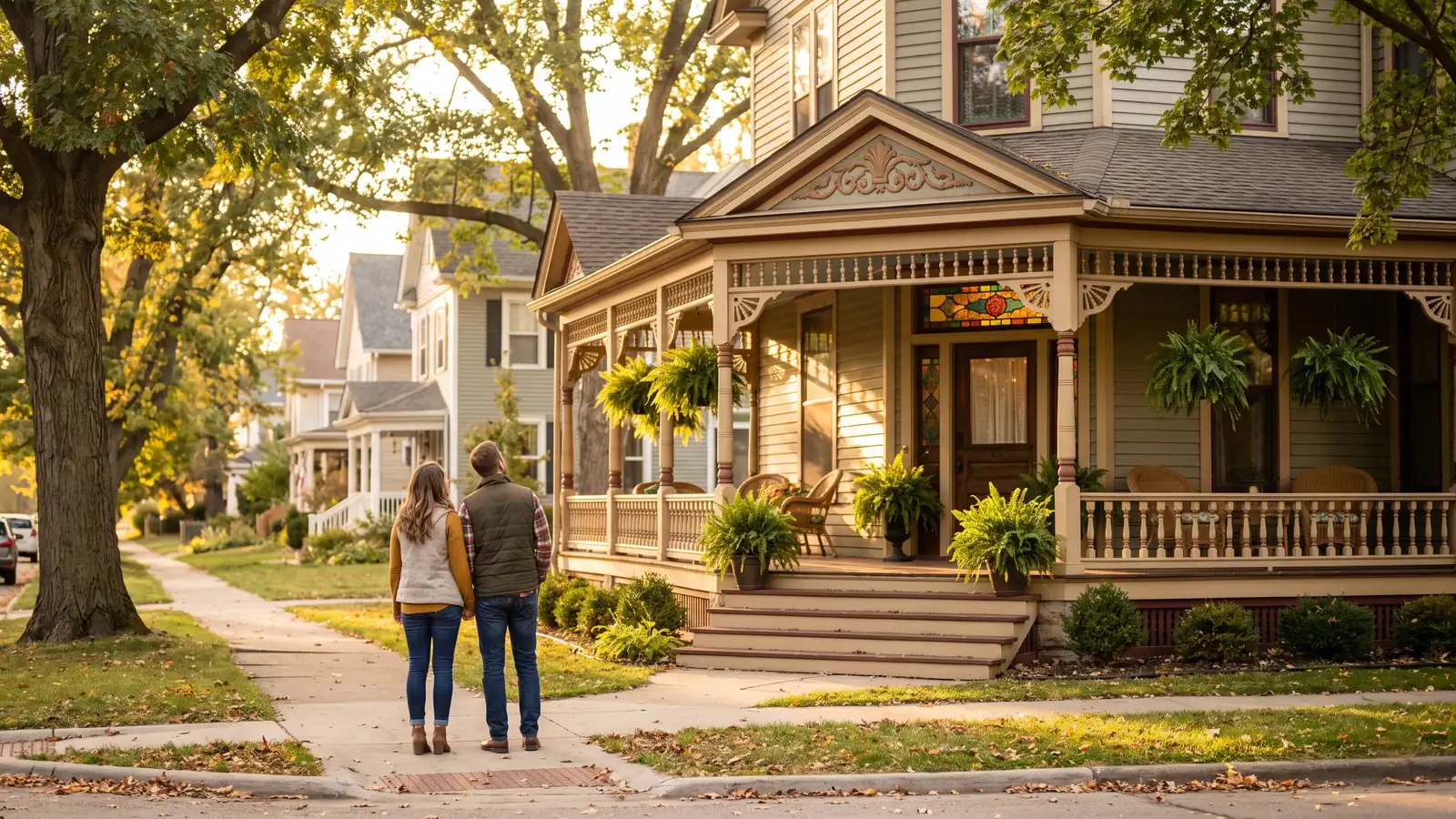
Because older homes commonly need updates to electrical, plumbing, and structural systems, many buyers use an FHA 203(k) loan, which finances the purchase price and renovation costs in one mortgage. The Limited 203(k) covers up to $75,000 of repairs; the Standard 203(k) handles structural work from a $5,000 minimum.
Learn more about buying a historic home, including what makes a home historic, what a specialized inspection has to cover, and which loan programs finance the restoration alongside the purchase. If you’re earlier in the process, start with the broader home buying guide.
Key takeaways:
- Designation decides what you can change: A local historic district commission holds enforceable authority over exterior work, while National Register listing places no federal restrictions on what a private owner does with the property.
- Budget for an old-house inspection: Any home built before January 1, 1978 draws extra scrutiny. On an FHA file, the appraiser must inspect every surface for defective paint and condition the appraisal on its repair.
- One loan can cover purchase and restoration: Renovation financing rolls the price and the rehab budget into a single mortgage up to $75,000 of repairs on a Limited FHA 203(k), with structural work allowed on the Standard version.
What makes a home historic?
A home is generally considered historic when it is at least 50 years old and carries architectural, cultural, or historical significance, but age alone doesn’t create rules you have to follow. The National Park Service applies the 50-year mark as a guideline for the National Register: a property younger than that has to be exceptionally important to qualify at all.
National Register listing vs. a local historic district
- National Register of Historic Places: Largely honorary. The National Park Service is explicit that listing places no federal restrictions or requirements on a private property owner. You may do with the property as you wish, within the framework of local laws and ordinances. Restrictions attach only when a project involves federal funding or permitting. Listing does open the door to preservation tax incentives.
- Local historic district: This is where the real rules live. A local district is created by municipal ordinance and governed by a commission that reviews proposed exterior work. In Michigan, under the Local Historic Districts Act (Public Act 169 of 1970), a permit must be obtained before any work affecting a resource’s exterior appearance is performed inside a district, and the commission issues a certificate of appropriateness before a building permit can follow.
- State registers: Many states keep their own registers of historic sites. In Michigan, State Register listing matters mainly because it’s one of the qualifying paths to the state rehabilitation tax credit.
So the first research question isn’t “is this house historic?” It’s “is this address inside a locally designated district?”
How to buy a historic home
Five steps, and the two that protect you most happen before you write an offer.
1. Confirm the designation and pull the district rules
Before you tour, ask the municipality two questions: is this parcel in a local historic district, and is the building individually listed or a contributing resource. Request the design guidelines in writing. Historic homes also surface through estate sales, probate listings, and courthouse sales, if that’s your route, read how to purchase a home at auction first, because auction buys usually can’t be financed and leave no inspection window.
2. Build a team that has worked on old houses
Three people change the outcome: an agent who has closed in the district, an inspector with documented pre-war experience, and a contractor who has been through a commission review. A general-practice inspector will hand you a clean report on a house with knob-and-tube wiring behind the plaster. The National Trust for Historic Preservation’s home-buying tips make a good pre-tour checklist, and ASHI publishes a directory if you’re finding an ASHI-certified home inspector.
3. Assess the property and inventory what’s original
Walk the house with a camera and document original windows, millwork, hardware, plaster, floors, and roofing. That inventory tells you what the commission will expect you to preserve and what your contractor must repair rather than replace. Ask the seller for permit history and prior approvals. Undocumented renovations are the most common surprise in an old-house file.
4. Write the offer with the right contingencies
Keep the inspection contingency, and give it a wider window than you would on a 1998 colonial. On any home built before 1978, federal law already gives you a 10-day period to conduct a lead-based paint inspection or risk assessment unless you waive it in writing, use it. Inspection findings are your leverage on price: our guide to negotiating house prices covers converting a repair list into a credit, and the broader playbook lives in our buying strategies and situations hub.
5. Close with title and insurance handled early
Historic properties can carry preservation easements, deed restrictions, or chain-of-title complications that take longer to clear. Order title work early, and the insurance quote earlier. Replacement-cost coverage on original plaster and custom millwork prices differently than a tract home, and a carrier’s decision can land late enough to threaten your closing date.
What must a seller hand over on a pre-1978 historic home?
Four items, according to the U.S. Environmental Protection Agency’s real estate disclosure page (last updated May 27, 2026): the pamphlet “Protect Your Family From Lead In Your Home,” any known information about lead-based paint and lead-based paint hazards in the home, all available records and reports on lead-based paint in the housing, and a Lead Warning Statement in the same language as the rest of the contract. EPA notes that lead-based paint “is still present in millions of homes.”
The inspection window can be changed, but only in writing. The federal rule at 40 CFR 745.110 sets the 10-day period “unless the parties mutually agree, in writing, upon a different period of time,” and a buyer waives the opportunity only “by so indicating in writing.” If 10 days is too short to book a lead risk assessment, write a longer period into the offer. Our guides to contingencies in home offers and the home inspection checklist for buyers cover the rest of that clause.
What should a historic home inspection cover?
Six areas carry most of the risk in a pre-war house, and a standard checklist covers about half of them well.
- Foundation and structural movement: Stone, rubble, and early masonry foundations behave differently than poured concrete. Look for active settlement, sagging joists, failed lintels, and staining at the sill plate.
- Electrical service and wiring: Knob-and-tube wiring, fuse panels, and undersized service show up in homes wired before 1950. Insurers ask about these directly, and some decline coverage until the panel is updated.
- Plumbing supply and drains: Galvanized steel lines corrode closed from the inside, lead service lines are still in the ground in many older cities, and cast-iron stacks fail at the joints. Ask for a camera scope of the main line.
- Roof, chimney, and flashing: Slate and clay tile can outlive several asphalt roofs but need specialist repair. Unlined masonry chimneys are both a safety issue and a common water-entry path.
- Windows and painted surfaces: Original wood windows are usually repairable, and often exactly what the commission requires you to keep. Condition matters to your lender too. On an FHA-insured purchase of a home built before January 1, 1978, the appraiser must inspect all interior and exterior surfaces for defective paint and condition the appraisal on its repair.
- Hazardous materials: Residential lead-based paint was banned in 1978, and asbestos turns up in pipe insulation, floor tile, and siding. Test rather than assume. Abatement is a real budget line.
Once you know what the house needs, the question is how to pay for it without draining your cash at closing.
How do you finance a historic home?
Historic homes qualify for the same programs as any other house, conventional, FHA, VA, and USDA. Condition changes the answer, not age. If the appraisal flags significant deferred maintenance, some programs require repairs before closing, which is exactly the problem a renovation loan solves. If the term is new to you, start with what a renovation loan is.
FHA 203(k) rehabilitation loans
The 203(k) is a common tool for historic buyers.1 The Limited 203(k) permits up to $75,000 of non-structural repairs, FHA raised that ceiling from $35,000 in July 2024, with a rehabilitation period not to exceed nine months. The Standard 203(k) handles structural work, requires at least $5,000 of rehabilitation, allows up to 12 months, and uses a HUD-approved 203(k) Consultant for the work write-up. Total property value still has to fall within the county FHA mortgage limit. Standard FHA rules apply otherwise: 3.5% down at a minimum decision credit score of 580 or above, while scores of 500 to 579 are capped at 90% loan-to-value. See HUD’s overview of FHA loan programs.
Fannie Mae HomeStyle Renovation
HomeStyle is the conventional answer, and its cap works differently. On a purchase, renovation funds are limited to 75% of the lesser of the purchase price plus renovation costs, or the “as-completed” appraised value. On a refinance, renovation costs can’t exceed 75% of the “as-completed” value. HomeStyle allows structural work and avoids FHA’s life-of-loan mortgage insurance.
Conventional and VA options on an older home
A historic home in good condition finances conventionally with no special treatment. VA borrowers have two paths: a standard VA purchase loan if the home already meets VA’s minimum property requirements, or a VA alteration and repair loan, which lets improvements be included in the value and completed after closing, with proceeds paid to the contractor during the repair period.2 Lenders in Align’s network set their own overlays, so the same file can be approved at one wholesale lender and declined at the next.
| Feature | Standard FHA 203(k) | Limited FHA 203(k) | HomeStyle Renovation |
|---|---|---|---|
| Suited to | Structural repairs, major rehab | Non-structural repairs and updates | Broad renovation, conventional terms |
| Renovation amount | $5,000 minimum; property value capped by the county FHA limit | Up to $75,000 | Up to 75% of the lesser of price plus renovation costs, or “as-completed” value |
| Structural work | Allowed | Not allowed | Allowed |
| Completion window | Up to 12 months | Up to 9 months | Set by the renovation contract and lender |
| Consultant | HUD-approved 203(k) Consultant required | Optional | Not required |
One common misunderstanding: the federal 20% rehabilitation tax credit applies only to certified historic structures rehabilitated for income-producing use, so owner-occupied residences don’t qualify. State programs are where owner-occupants find help. Talk with a tax professional before counting a credit into your budget.
How do the renovation loan programs compare line by line?
HUD’s Program Comparison Fact Sheet (revised November 4, 2024) compares the three renovation programs; each line is a program rule, not an offer.
| Rule | FHA 203(k) | Fannie Mae HomeStyle Renovation | Freddie Mac CHOICERenovation |
|---|---|---|---|
| Occupancy | 1- to 4-unit primary residence | 1- to 4-unit primary residence, 1-unit second home, 1-unit investment property | 1- to 4-unit primary residence, 1-unit second home, 1-unit investment property |
| Maximum loan-to-value | 96.5% for a primary residence | Up to 97% (1-unit owner-occupied) | 95% (1-unit primary residence) |
| Contingency reserve | Up to 15% | Up to 20% | Up to 20% |
| Upfront draws | Up to 50% of material costs | Up to 50% of material costs | Up to 50% of material costs to contractors |
| Contractors | Licensed when required by law; Standard 203(k) requires an FHA-approved consultant | Licensed when required by law | Licensed when required by law |
Source: U.S. Department of Housing and Urban Development, 203(k) Program Comparison Fact Sheet, revised November 4, 2024.
Fannie Mae’s Selling Guide B5-3.2-02 (topic dated December 10, 2025) adds two HomeStyle details that matter on an old house. If a principal residence cannot be occupied during the work, “up to six months payments (PITIA)” may be included in renovation costs, and on do-it-yourself work the lender “must inspect the completion of all items that cost more than $5,000.”
HUD’s Mortgagee Letter 2025-23 (December 11, 2025) sets the national low-cost area FHA limit at $541,287 for a one-unit property on case numbers assigned on or after January 1, 2026, and a Standard 203(k)’s total property value must fall within the area’s limit. HomeStyle is a conventional loan, and the Federal Housing Finance Agency set the 2026 one-unit conforming limit at $832,750 in most of the United States. Align’s loan limits tool shows each county’s figures, and FHA loan limits explains how they are set.
The Department of Veterans Affairs’ purchase loan page (last updated January 7, 2026) lists “Buy a home and improve it” among a VA loan’s uses; see buying a home with a VA loan.
How do the caps apply to one house?
Hypothetical example, not an offer. A buyer agrees to pay $210,000 for an 1890s house and gets a $70,000 contractor bid, and the appraiser puts the “as completed” value at $300,000. Under Fannie Mae’s HomeStyle rule, renovation costs can’t exceed 75% of the lesser of $280,000 (price plus renovation) or $300,000, which is $210,000, so the $70,000 bid fits. Under FHA, the same $70,000 fits inside the Limited 203(k)’s $75,000 ceiling only if none of it is structural; a rebuilt foundation wall or replaced joists move the file to the Standard 203(k), where HUD’s 203(k) program page says the total property value must still fall within the FHA limit for the area. The fact sheet’s reserve ceilings, up to 15% for FHA and up to 20% for HomeStyle, would be $10,500 and $14,000 on that bid.
Both programs lean on the “as completed” value. According to the Consumer Financial Protection Bureau, you have the right to a free copy of the appraisal for a first-lien mortgage, sent promptly after it is completed and no later than three days before closing (page last modified March 12, 2025). See the home appraisal process, financing home renovations and the benefits of FHA 203(k) loans.
What does the federal rehabilitation credit require when a historic building earns income?
According to the Internal Revenue Service’s Rehabilitation Credit FAQs (last reviewed October 21, 2026), the credit equals 20 percent of qualified rehabilitation expenditures on a “certified historic structure,” meaning a building listed on the National Register or one in a registered historic district that the Secretary of the Interior certifies as contributing to the district. The spending must pass a substantial rehabilitation test: it has to exceed the greater of the building’s adjusted basis or $5,000 within a 24-month measuring period, or 60 months when certain conditions are met.
- Five years both ways: per the IRS, the credit is taken ratably over five years, and the credit is recaptured if the property is disposed of during the 5-year recapture period, starting at 100 percent and dropping 20 percentage points for each full year held.
- Living space is out: according to the IRS, spending on common living areas such as a kitchen, bedroom, living room or bathroom is not eligible because those areas are not used exclusively for business.
What historic district rules mean for your renovation plans
Inside a local historic district, exterior work needs commission approval before the building department issues a permit. Commissions review the proposal against the Secretary of the Interior’s Standards for Rehabilitation, ten principles that favor repairing original material over replacing it.
- What gets reviewed: Windows, siding, roofing material, porches, doors, additions, fencing, and demolition. Paint color is regulated in some ordinances and not others.
- What usually doesn’t: Interior finishes and layout fall outside an ordinance that regulates exterior appearance. Kitchen and bath modernization is your call.
- Timing is the hidden cost: Commissions meet on a set calendar, often monthly. Build review time into your renovation-loan completion window, because a 203(k) clock doesn’t pause for an agenda.
- It follows the house: The rules that constrain you constrain the next buyer too, and district status tends to support values by keeping the streetscape intact.
What should your renovation plan include before you apply?
On an old house the plan has two readers: the appraiser who values the finished house and, in a local historic district, the commission that reviews exterior work. Samantha Shelton, Align’s broker owner, says it plainly: “You’re not just financing the house. You’re financing the plan for the house.” Settle the scope with your contractor before the bid reaches the lender; old houses invite the add-on she recalls from a difficult renovation: “‘Well, while we’re doing that, maybe we should also do this.’ And then this turns into something else.” A later change can mean a new bid, review and appraisal.
- Check the license: Michigan’s Department of Licensing and Regulatory Affairs advised in a May 3, 2017 release to hire a contractor “properly licensed in the State of Michigan”.
- Put exterior energy work in the first application: storm windows that change the house’s external appearance fall outside the ordinary maintenance exemption in MCL 399.201a, covered in the next section; see home renovation permits, energy-efficient home upgrades and home insurance and renovations.
What can a Michigan historic district commission require of an owner?
More than a yes or no on new work, under MCL 399.205 and the definitions in MCL 399.201a:
- “Work” is broad: MCL 399.201a defines it as “construction, addition, alteration, repair, moving, excavation, or demolition,” so a project that only repairs an exterior feature can still need a permit.
- Routine upkeep is not work: ordinary maintenance that does not change the external appearance “does not constitute work for purposes of this act.”
- A city can widen review indoors: a commission “shall not review and act upon interior arrangements” unless the local legislative body specifically authorizes it or interior work will cause a visible change to the exterior.
- Neglect can bring a repair order: if a commission finds a resource “is threatened with demolition by neglect,” it may require the owner to repair all conditions contributing to it, or make the repairs itself when the owner does not act within a reasonable time.
Detroit shows what the calendar looks like. The city’s Historic District Commission lists its 2026 regular meetings, with November 18 and December 16, 2026 still ahead. It warns that “submission alone does not guarantee placement on that meeting’s agenda”; staff must first deem an application complete.
What Michigan buyers should know
Michigan’s older housing stock and its own preservation statute create three specifics worth checking before you write an offer.
- State historic preservation tax credit: Under Public Act 343 of 2020, Michigan offers a credit of up to 25% of qualified rehabilitation expenditures. Owner-occupied projects qualify with a minimum expenditure of $1,000, and the property must be listed on the National Register, the State Register of Historic Sites, or be a contributing resource in a local district. The program runs on a $5 million annual cap, $1 million of it reserved for owner-occupied residential projects, awarded first-come, first-served through the State Historic Preservation Office.
- Local commissions have teeth: PA 169 of 1970 requires a permit before any work affecting a resource’s exterior appearance inside a district. Detroit, Grand Rapids, and Marshall all run active commissions with published guidelines, and as of March 2024, 42 Michigan communities participate in the Certified Local Government program administered jointly by the National Park Service and Michigan’s SHPO.
- Pre-1978 stock is the norm here: In much of Detroit, Ferndale, and Royal Oak, the lead-paint disclosure and 10-day inspection window apply to nearly every listing, and on an FHA file, the defective-paint repair condition rides along with them.
How does a Michigan buyer apply for the state historic tax credit in 2026?
Through a three-part application to the State Historic Preservation Office, according to Michigan SHPO’s State Historic Tax Credit Program page. Part 1 lets SHPO verify the property meets the basic eligibility requirements, Part 2 shows the rehabilitation you plan, and Part 3 shows the finished work meets the Secretary of the Interior’s Standards and is the work that was proposed. The page says owner-occupied residential applicants could apply for the 2026 credit beginning January 2, 2026, and that 2026 applications must be received at the SHPO office no later than Monday, November 30, 2026. Hand-delivered applications are refused.
SHPO says it is “strongly recommended” that you apply and receive approval before beginning work, and the application stays open only until credits are reserved up to the program cap.
What happens to taxes and title records on a Michigan historic home?
In Michigan, a home’s taxable value is capped while one owner holds it. The year after it sells, that cap comes off and taxable value resets to the state equalized value, which is half of the assessor’s estimate of market value, not automatically half of what you paid. Michigan Treasury’s change of ownership page says that under Proposal A of 1994 a transfer of ownership causes taxable value to uncap “in the calendar year following the year of the transfer of ownership.”
Samantha plans above the seller’s bill on purpose: half the price times the property’s homestead millage. Run it for an address in the Michigan property tax calculator (every tool is on the calculators page), and see how home improvements affect property taxes.
Easements and deed restrictions are recorded with the county. According to Oakland County’s Clerk/Register of Deeds, its Super Index provides copies of recorded documents dating back to January 1, 1964, with the exception of subdivision plat maps, so anything recorded earlier comes through a full title search. See choosing a title company and why title insurance matters.
How Align fits your buying strategy
Local real estate agents bring Samantha in for a second opinion when their buyer arrives preapproved somewhere else. She regularly finds a lower rate or less cash to close, whichever helps the buyer more.
That comes from the broker model. One application goes to multiple wholesale lenders, so your offer is built on the loan that fits your situation, not the only one a single bank sells. A 2024 Polygon Research analysis of federal mortgage data found broker borrowers paid about $10,662 less over the life of a $400,000 loan than borrowers at nonbank retail lenders.
FAQ: Buying a historic home
Here are answers to common questions about buying a historic home.
What qualifies a house as historic?
A home is generally considered historic when it is at least 50 years old and has architectural, cultural, or historical significance. Formal recognition comes through the National Register of Historic Places or a local historic district designation. Local designations usually carry the real restrictions, they can regulate exterior changes, additions, and even window choices, while National Register listing alone is largely honorary. Style is a separate question from status.
Is it harder to get a mortgage on a historic home?
Not inherently, historic homes qualify for conventional, FHA, VA, and USDA financing like any other property. The challenge is condition: if the appraisal flags major deferred maintenance, some loan types require repairs before closing. Renovation loans such as the FHA 203(k) or a conventional HomeStyle loan solve this by financing purchase and rehab together. The same math drives the advantages of buying a fixer-upper.
Are there tax credits for restoring a historic home?
Sometimes. The federal 20% rehabilitation tax credit applies only to income-producing historic buildings, not owner-occupied homes. Many states offer their own: Michigan’s credit reaches 25% of qualified expenditures and accepts owner-occupied residential projects with at least $1,000 in eligible work. Local property tax abatements may also exist. Check with your state historic preservation office and a tax professional first, and plan the work with renovating a historic home in mind.
Do historic homes cost more to insure?
Usually, yes. Carriers price replacement-cost coverage on original plaster, millwork, and custom windows differently than on a tract home, and inspection findings drive the quote. Knob-and-tube wiring, fuse panels, galvanized or lead supply lines, and slate or tile roofing all raise premiums, and some carriers decline coverage until the electrical panel is updated. Get a bindable quote inside your inspection window rather than after.
Will a bank finance a house with asbestos siding?
Often, when the condition can be valued. Fannie Mae’s Selling Guide B4-1.4-08 (dated June 4, 2025) lists asbestos-containing materials among hazards appraisers report, buys the loan when the effect “is measurable through an analysis of comparable market data,” and requires the lender to disclose known hazard information to the appraiser. According to the EPA (page updated June 25, 2026), material in good condition that will not be disturbed should be left alone.
Can a renovation loan pay to rebuild a historic house?
Under FHA’s Standard 203(k), yes, if the complete existing foundation system is not affected and will still be used, according to HUD’s 203(k) fact sheet (revised November 4, 2024). Before reconstruction, the 203(k) consultant must get a licensed structural engineer’s report that the foundation is sound and can support the new structure. The Limited 203(k) may not be used for a rebuild. In a Michigan district, demolition is “work” that needs a commission permit under MCL 399.201a.
Do I need a lead-certified contractor to renovate an older home?
For most paint-disturbing work on a home built before 1978, yes. EPA’s Renovation, Repair and Painting rule (page updated December 15, 2025) requires firms that do this work to be EPA- or state-certified. Small jobs are exempt: under 40 CFR 745.83, minor repair disturbs 6 square feet or less of painted surface per room inside, or 20 square feet or less outside, and never includes window replacement or demolition of painted surfaces.
Can you appeal a historic district commission’s decision in Michigan?
Yes, in two steps. Under MCL 399.205, an applicant can appeal a commission decision to the state historic preservation review board, and the appeal must be filed within 60 days after the decision is furnished to the applicant. MCL 399.211 then allows an appeal to circuit court, but an aggrieved permit applicant must first finish the review board appeal. Build that time into a renovation loan’s completion window.
The bottom line on buying a historic home
Buying a historic home is a normal purchase with three extra layers. Designation is first: a local commission controls exterior work through certificates of appropriateness, while National Register listing places no federal restrictions on a private owner. Inspection is second, foundation, wiring, plumbing, roof, and pre-1978 paint and asbestos need a specialist. Financing is third, and it’s the layer you can solve up front: a Limited FHA 203(k) finances up to $75,000 of repairs into the mortgage, a Standard 203(k) covers structural work from a $5,000 minimum, and HomeStyle does the same on conventional terms.
If you’re ready to buy a piece of history without funding the restoration out of pocket, talk to Align Lending. We’ll shop renovation-friendly loan options across our lender network and show you the numbers side by side. Call 248-506-5727 or start online.
Footnotes:
- Align Lending is not acting on behalf of or at the direction of FHA or HUD. Return to text
- Align Lending works with VA-approved lenders and is not endorsed or sponsored by the Dept. of Veterans Affairs or any government agency. Return to text
This article is for informational purposes only and is not intended to provide legal, financial, or tax advice. Consult a qualified professional about your situation. Program terms and figures shown are illustrative, are not a rate quote or an offer of credit, and are subject to change.
Sources
Every outside source this guide links to, in the order it appears. How we choose and check sources
- The National Park Service applies the 50-year mark as a guideline for the National Registernps.gov
- Under the Local Historic Districts Act (Public Act 169 of 1970)Michigan Legislature
- National Trust for Historic Preservation’s home-buying tipsNational Trust for Historic Preservation
- Finding an ASHI-certified home inspectorAmerican Society of Home Inspectors
- Federal law already gives you a 10-day period to conduct a lead-based paint inspection or risk assessmentU.S. Environmental Protection Agency
- 40 CFR 745.110law.cornell.edu
- The Limited 203(k) permits up to $75,000 of non-structural repairsU.S. Department of Housing and Urban Development
- HUD’s overview of FHA loan programsU.S. Department of Housing and Urban Development
- Renovation funds are limited to 75% of the lesser of the purchase price plus renovation costsFannie Mae Selling Guide
- The federal 20% rehabilitation tax credit applies only to certified historic structures rehabilitated for income-producing useInternal Revenue Service
- Program Comparison Fact SheetU.S. Department of Housing and Urban Development
- Mortgagee Letter 2025-23U.S. Department of Housing and Urban Development
- Set the 2026 one-unit conforming limitFederal Housing Finance Agency
- Purchase loan pageU.S. Department of Veterans Affairs
- Consumer Financial Protection Bureau
- The Secretary of the Interior’s Standards for Rehabilitationnps.gov
- Advised in a May 3, 2017 releaseState of Michigan
- MCL 399.201aMichigan Legislature
- Historic District Commissiondetroitmi.gov
- Michigan offers a credit of up to 25% of qualified rehabilitation expendituresmiplace.org
- Change of ownership pageState of Michigan
- Clerk/Register of Deedsoaklandcountymi.gov
- Selling Guide B4-1.4-08Fannie Mae Selling Guide
- EPAU.S. Environmental Protection Agency
- Renovation, Repair and Painting ruleU.S. Environmental Protection Agency
- 40 CFR 745.83law.cornell.edu
- MCL 399.211Michigan Legislature
Related resources

11-minute read
How to create a competitive offer on a house in a seller’s market
Learn how to create a competitive offer on a house, from preapproval and pricing to contingencies and appraisal gap coverage, and win in a hot market.

12-minute read
Advantages of buying a fixer-upper: 7 key benefits (and the tradeoffs)
Discover the advantages of buying a fixer-upper, from lower prices and less competition to renovation loans that roll repair costs into your mortgage.

12-minute read
Guide to Negotiating a Home Purchase
Strategies for negotiating a home purchase, from inspection findings and seller concessions to offers that win without overpaying.
