
Finding a home: Smart strategies for today’s house hunters
Finding the right home comes down to four steps done in order: get pre-approved so you know your true budget, split your wish list into non-negotiables and nice-to-haves, research neighborhoods on schools, commute, taxes, and planned development, and then tour homes in person with an agent who knows the submarket. The order matters because of what the market costs: the median existing home sold for $417,500 in September 2026, so a well-kept house under $300,000 sits far below the national midpoint and draws a crowd the week it lists.

Supply is the other half. Existing-home inventory stood at a 4.8-month supply in September 2026, still short of the roughly six months that signals a balanced market, and NAR’s chief economist said higher inventory and longer days on market give buyers improved negotiating power. Buyers who settle financing first are the ones in a position to use it.
Learn how to go about finding a home, including how to prepare before you open a listing app, which tools and people genuinely speed up a search, and how to evaluate a house and its neighborhood. If you’re earlier in the process, start with our Home Buying guide.
Key takeaways:
- Financing comes before listings: A pre-approval, built on the credit, income, and assets a lender has verified, is your real budget, not a listing site’s affordability slider. The Loan Estimate comes later: once you apply with a specific property address, the lender has 3 business days to deliver it.
- A short must-have list keeps the search honest: Hold your non-negotiables to roughly 5 items you can’t change after closing (location, lot, bedroom count) and treat everything else as a nice-to-have you can renovate, add, or live without.
- Neighborhood research drives livability and resale: School boundaries, commute times, property taxes, and planned development shape what a home is worth later, and your county’s months of supply against the national 4.8-month figure from September 2026 sets your pace.
How should you prepare to find a home?
Do three things before you look at a single listing: get pre-approved, write a two-column wish list, and narrow to two or three neighborhoods you’d genuinely live in, because a search radius spanning four school districts only produces alerts you ignore. The Consumer Financial Protection Bureau frames the purchase as four stages (prepare to shop, explore loan choices, choose a loan offer, and get ready to close), and touring homes comes after those first two stages, not before them.
Get pre-approved before you tour
A pre-approval is a lender’s decision based on documents it has actually verified: credit, income, and assets. It converts a vague price range into a hard number and turns your offer into something a listing agent can check by phone. Start with your credit file: the CFPB’s guidance is to review your reports early, because a dispute takes weeks you don’t want under contract.
Then ask what that number assumes. Lenders quote the maximum your ratios allow, not the payment you’ll be comfortable making for a decade. Say a lender approves you at $340,000, but that payment leaves nothing for repairs and savings. Search at $300,000 instead. A $40,000 lower price is $2,000 less at the closing table at 5% down, plus a smaller payment every month you own the home.1
Because Align Lending is an independent broker, we price the same file through multiple wholesale lenders before you tour, so you can compare those offers side by side, not just take the first one. The CFPB’s step-by-step home buying tools cover what to gather, our guide to the importance of mortgage preapproval explains what the letter proves, and the home buying process maps the sequence from application to keys.
Split your wish list into non-negotiables and nice-to-haves
Two columns, and keep the left one short. Non-negotiables are the facts you can’t renovate your way out of after closing.
- Location and commute: You can change a kitchen; you can’t move the house. Test the drive at the hour you’d actually make it, not at 11 a.m. on a Saturday.
- Bedroom and bathroom count: Adding a bedroom is a permit, a contractor, and a five-figure bill. Set the minimum now and stop touring below it.
- Lot, layout, and structure: Corner lots, steep drives, split levels, and one-bath floor plans are permanent. A single-level layout beats square footage if stairs are a long-term problem.
- Total monthly cost, not sticker price: Principal, interest, taxes, insurance, and any HOA dues are one number. Two homes at the same price can carry payments hundreds of dollars apart.
Everything else (finishes, appliances, paint, landscaping, even a dated kitchen) belongs in the right column; those are the things that make a good house cheap. Our preparing to buy guide covers cash to close.
Tools and people that speed up your search
The fastest searches run on two things: alerts that push listings to you within minutes, and one local professional who sees inventory before it’s public. Everything else is browsing.
Set up alerts that push, and use tours to filter
Configure instant-notification alerts on the major listing portals and on your agent’s MLS feed, filtered to your neighborhoods and your real price ceiling. In tight submarkets, a listing posted Thursday morning can have three showings booked by lunch. The lag between listing and notification is what costs you the house.
Use virtual tours as a filter, never as a decision. They’re excellent at eliminating homes whose layout doesn’t work and unreliable on smell, noise, slope, light, and how the basement feels in April. Social media is worth ten minutes: follow local agents and neighborhood groups where coming-soon listings surface first.
How to choose an agent who knows your submarket
Interview two or three agents and pick on submarket knowledge, not personality. Ask how many transactions they closed in your target neighborhoods in the last 12 months, what the current sale-to-list ratio is there, and how they handle a multiple-offer situation. An agent who answers with numbers has the market memorized; one who answers with adjectives does not.
Get the compensation conversation done before you tour. Buyer representation agreements spell out what the agent is paid, who pays it, and how long the agreement runs, and they’re now standard practice at the start of the relationship. Our guide to how to choose a real estate agent lists the interview questions.
Bring in the free help most buyers never use
A HUD-approved housing counselor gives budgeting and home buying guidance at low or no cost. HUD’s guide to buying a home lays out nine steps and points to counselors at the first one. Your loan officer belongs on the list just as early.
How to evaluate homes and neighborhoods
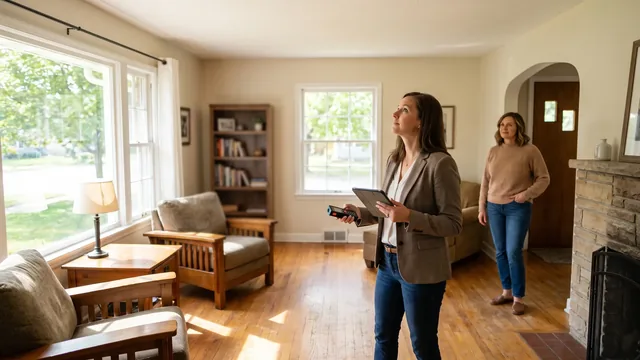
Evaluate every home on two tracks: the building, which you can change, and the location, which you can’t. Most buyer’s remorse traces back to a house that was fine and a location that never was. Run the same checklist at every showing, because memory blurs fast.
A touring checklist you can run in 20 minutes
- Run the systems: Open the electrical panel, note the age on the furnace and water heater labels, and run a faucet upstairs and down. A 22-year-old furnace is a negotiation item, not a deal breaker.
- Read the basement and the roofline: Efflorescence, patched foundation cracks, fresh paint on one wall, sagging gutters, and curling shingles are the tells worth photographing.
- Test what a photo can’t show: Cell signal, water pressure, window operation, door swing, and how loud the road is with the windows open.
- Count storage and outlets: Closets, garage depth, and outlet placement decide daily livability more than square footage does.
- Check the energy story: Ask for 12 months of utility bills. Insulation, window age, and heating type separate two identical-looking houses by real money every month.
Then confirm what you found with a professional. Our home inspection checklist for buyers covers what an inspector catches that you can’t.
How to research a neighborhood before you offer
Layer public data with in-person visits, because each catches what the other misses. Pull school attendance boundaries rather than ratings alone, the tax bill for that specific parcel, flood zone status, commute times, and any planned road or development project at the municipality’s website. Then visit at three different times (a weekday at 5:30 p.m., a weekend evening, and once after dark) and note traffic, noise, parking, and upkeep.
Two items buyers routinely miss: an HOA’s dues, reserves, and rules, which bind you the day you close, and any deed restriction on the parcel. Read buying a home with an HOA before you write on a home in an association. Note too that fair housing law limits how an agent can characterize who lives in a neighborhood: expect facts, not opinions.
Red flags worth a second visit
A home listed far longer than its neighborhood’s norm, one with two or three price cuts, or one that fell out of contract has a reason. A bad photo set or an unrealistic list price is an opportunity; a failed inspection, an unpermitted addition, or a title problem is homework. Ask your agent which one it is before you write.
Why finding a home is hard right now
The core difficulty is arithmetic: not enough affordable inventory for the buyers who want it. With the national median existing-home price at $417,500 in September 2026 and supply at 4.8 months, the sub-$300,000 tier entry-level buyers need is the thinnest part of the market, and the move-in-ready homes in it draw the deepest offer pools. First-time buyers made up just 21% of purchases in the National Association of REALTORS® 2025 Profile of Home Buyers and Sellers, an all-time low the report ties to extremely limited inventory.
Three adjustments help more than waiting does. Widen your geography by one ring, since the next township out often trades cheaper for the same house. Reopen the cosmetic column of your wish list, because dated finishes are the discount other buyers refuse to take. And compete on terms rather than price, because in a thin market the winning offer is usually the cleanest one. NAR’s research and housing statistics track how conditions shift by season and region.
When several buyers land on the same house, the listing agent typically calls for highest and best by a deadline. Read how to handle a bidding war before that email arrives and learn how to create a competitive offer. Competition decides what a clean offer looks like.
What Michigan buyers should know
Michigan isn’t one housing market. Ann Arbor, Grand Rapids, Metro Detroit and Lansing each move at their own pace, and prices can differ widely between neighboring communities in the same metro, so judge your search by your own county’s numbers rather than a statewide or national figure.
- Jumbo rarely enters the conversation: The 2026 baseline conforming loan limit is $832,750 for a one-unit home, comfortably above nearly any house you’ll tour in these four markets, so loan type won’t narrow your search the way it does on the coasts. Compare your county’s months of supply to the national 4.8-month figure to set your pace.
- MSHDA sets a hard ceiling on assistance: The MI Home Loan carries a statewide sales price limit of $566,355 effective June 1, 2026, requires a minimum 640 credit score and a homebuyer education class, and pairs with the MI 10K DPA Loan for up to $10,000 toward down payment, closing costs, and prepaids.2 Confirm current limits before you shop. A hot submarket can price you out of the program.
- Plan on the post-sale tax bill: The year after a Michigan home sells, its taxable value resets to half of the assessor’s market value, so the seller’s tax bill is not your tax bill. The Principal Residence Exemption then removes up to 18 mills of local school operating tax from a home you own and occupy as your primary residence. Ask the assessor for the post-sale estimate, run a planning figure for the address with our Michigan property tax calculator, and talk with a tax professional.
Competition here is seasonal too: spring listings draw the deepest offer pools, while the same house listed in January faces a fraction of it. Because Align Lending is an independent Michigan broker, we can place MSHDA files alongside conventional, FHA, VA, and USDA loans through partner lenders and tell you early which combination fits your file.3 Our roundup of first-time home buyer programs covers the assistance landscape.
How Align moves your purchase to the closing table
Over the last 12 months, Samantha's loans averaged under 14 days from application to clear to close, across more than 100 loans. Your closing date is set by your purchase agreement. Her job is to have your loan ready well before it.
She handles your file herself, with a processor supporting her behind the scenes. You always know who to call, and the person who answers knows your goals.
Build your homebuyer game plan
Sources: Align Lending loan records, 12 months to October 2026.
FAQ: Finding a home
Here are answers to common questions about finding a home.
What is the best way to start looking for a house?
Start with money, not listings. Check your credit, set a budget, and get pre-approved so you know what you can spend. Then build a two-column list of must-haves versus nice-to-haves, pick two or three neighborhoods, and set up instant listing alerts. Only then start touring, ideally with a local agent. Our 15 first-time home buyer tips put the sequence in checklist form.
How long does it take to find a home?
Buyers in the National Association of REALTORS® 2025 Profile of Home Buyers and Sellers searched for a median of 10 weeks, though timelines swing with inventory and how specific your criteria are. Tight markets and narrow criteria stretch it. Then add time from accepted offer to closing, since your lender must deliver the Closing Disclosure at least three business days before you sign. Timing also depends on your own numbers: see whether it’s a good time to buy a house.
How do I research a neighborhood before buying?
Layer data with in-person visits. Look up school attendance boundaries, the parcel’s tax bill, flood zone status, commute times, and any planned development or zoning change. Then visit at different times (weekday rush hour, weekend evening) to gauge noise, traffic, and upkeep, and check how fast nearby homes sell. Do this before you offer, and you’ll rarely regret the purchase.
Do I need a real estate agent to find a home?
You’re not required to use one, but a good buyer’s agent adds real leverage: early access to coming-soon listings, pricing insight from comparable sales, scheduling and negotiation help, and guidance through inspection and closing. Interview two or three, ask about their transaction count in your neighborhoods, and understand how they’re paid before signing a buyer agreement. Our guide to home buyer rebates explains how buyer-side compensation works.
The bottom line on finding a home
Finding a home is a sequence, and the sequence is what saves you time. Get pre-approved first so your budget is a verified number rather than a guess. Hold your non-negotiables to about five items you can’t change after closing, narrow to two or three neighborhoods, set instant alerts, and hire an agent who can quote your submarket from memory. Then tour with a checklist and research the location as hard as the house. With the national median existing-home price at $417,500 in September 2026 and supply at 4.8 months, prepared buyers are the ones who can negotiate.
If you’re ready to start looking with a real number in hand, talk to Align Lending. We’ll shop your scenario across multiple wholesale lenders and show you the options side by side before you tour a single home. Call 248-506-5727 or start online.
Footnotes:
1. Example figures shown in this article are hypothetical and for educational purposes only; they do not constitute an advertisement of credit terms or a rate quote under federal or state lending laws. Your loan amount, payment, down payment, and cash to close depend on your application, the property, the appraisal, and market conditions. Return to text.
2. Align Lending is not acting on behalf of or at the direction of FHA or HUD. MSHDA program requirements, sales price limits, income limits, and down payment assistance amounts are set by the Michigan State Housing Development Authority and are subject to change. Return to text.
3. Align Lending works with VA-approved lenders and is not endorsed or sponsored by the Dept. of Veterans Affairs or any government agency. Program eligibility for VA, FHA, USDA, and conventional financing is determined by the agency and the lender, and is subject to change. Return to text.
Sources: national median existing-home price of $417,500 and inventory at a 4.8-month supply, September 2026, and the chief economist’s comment that higher inventory and longer days on market give buyers improved negotiating power, National Association of REALTORS® Existing-Home Sales (released October 13, 2026); six months of supply as a balanced market, National Association of REALTORS®; first-time buyers at an all-time low 21% share amid extremely limited housing inventory, and a median home search of 10 weeks, National Association of REALTORS® 2025 Profile of Home Buyers and Sellers (transactions July 2024 through June 2025). Four stages of the home buying process, guidance to review credit reports early, Loan Estimate delivery within three business days of application, and the six pieces of information, a property address among them, that make a submission an application (12 CFR 1026.2(a)(3)(ii)), and Closing Disclosure delivery at least three business days before closing, Consumer Financial Protection Bureau. Nine steps to buying a home and HUD-approved housing counseling, U.S. Department of Housing and Urban Development. 2026 baseline conforming loan limit of $832,750 for one-unit properties, Federal Housing Finance Agency. MI Home Loan sales price limit of $566,355 effective June 1, 2026, minimum 640 credit score, homebuyer education requirement, and MI 10K DPA Loan of up to $10,000, Michigan State Housing Development Authority. Principal Residence Exemption of up to 18 mills of local school operating tax, and taxable value resetting to the state equalized value the year after a transfer, Michigan Department of Treasury.
This article is for informational purposes only and is not intended to provide legal, financial, or tax advice. Property tax estimates, assessment practices, HOA documents, and buyer representation agreements should be reviewed by a licensed real estate professional, tax professional, or attorney in your state. Consult a qualified professional about your situation. Program terms and figures shown are illustrative, are not a rate quote or an offer of credit, and are subject to change. Align Lending is an independent Michigan mortgage broker, NMLS #2041154.
Related resources
12-minute read
The home appraisal process: What to expect
Learn how the home appraisal process works, from the lender’s order to the final report, including typical costs of $300 to $1,500 and what appraisers check.

12-minute read
Home inspection checklist for buyers: What to look for room by room
See the complete home inspection checklist for buyers, from foundation to attic, so you can spot costly problems before you close on your next home.

12-minute read
How to prepare for a home closing: your step-by-step checklist
Learn how to prepare for a home closing with a step-by-step timeline, documents to bring, and final walk-through tips for a smooth closing day.
