
Fire safety tips for homeowners: What actually prevents home fires
Three things do most of the work in home fire safety: working smoke alarms, attentive cooking, and an escape plan your household has actually rehearsed. The numbers behind that ranking are blunt. Nearly three out of five home fire deaths in 2018 to 2022 happened in properties with no smoke alarms at all (43%) or with alarms that failed to operate (16%), and the death rate per 1,000 reported home fires was about 60% lower where an alarm was present and working.1
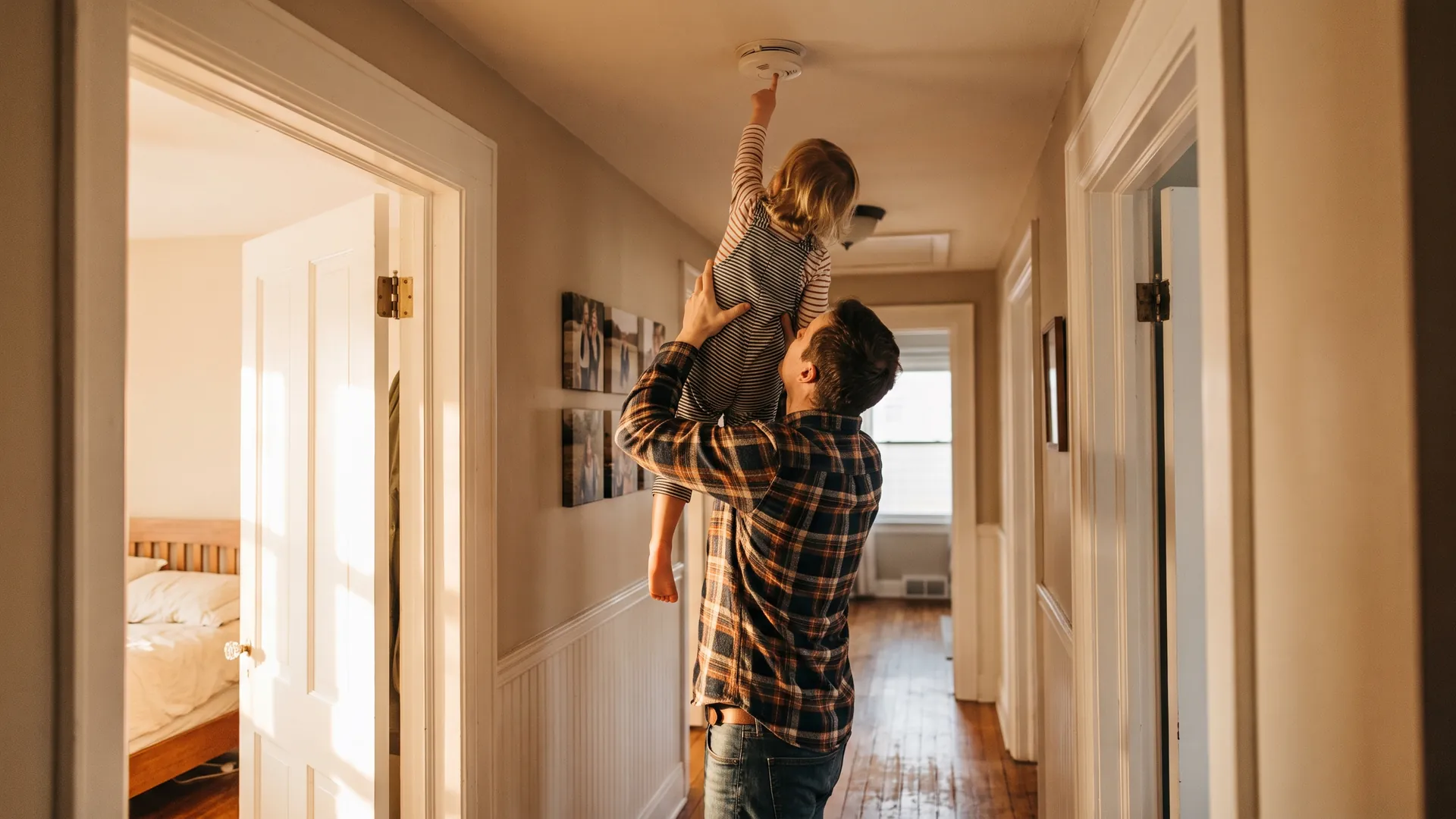
The rest of the risk is behavioral, not mechanical. U.S. fire departments responded to an average of 328,590 home structure fires a year in 2019 to 2023, and cooking led both home fires and home fire injuries across that period. Equipment left unattended, not faulty equipment, is the biggest contributing factor in kitchen fires.
Learn the fire safety tips for homeowners that measurably reduce risk, including how many smoke alarms your home needs, which rooms deserve the most attention, and how to build an escape plan that holds up under two minutes of pressure. For the wider protection picture, start with our Homeownership guide.
Key takeaways:
- Alarms decide survival: Nearly 3 out of 5 home fire deaths occur in homes with no smoke alarms or none that operated, and the death rate per 1,000 home fires falls roughly 60% when a working alarm is present.
- Cooking is the top cause, and attention is the fix: Cooking caused 44% of reported home fires in 2017 to 2021, and unattended equipment was the leading contributing factor, 28% of those fires and 48% of the deaths they caused.
- Practice buys the minutes: Residents may have less than 2 minutes to escape once the alarm sounds, so plan 2 ways out of every room, pick one outside meeting place, and run the drill at least twice a year.
How many smoke alarms does your home need?
You need an alarm inside every bedroom, one outside each separate sleeping area, and at least one on every level including the basement. In a typical three-bedroom, two-story home with a basement, that’s six alarms minimum. More if the floor plan is long.
Coverage is only half of it. The National Fire Protection Association’s guidance is that alarms should be interconnected, so when one sounds, they all sound, and NFPA notes most homes don’t have that. It matters because the deadliest scenario is a fire starting far from where people are sleeping.
Where each alarm goes
- Inside every bedroom: A closed door slows smoke, heat, and fire, which is protective, but it also means a hallway-only alarm may not wake the person behind it in time.
- Outside each sleeping area: Hallway units catch fires that start elsewhere on the floor, the standard second layer.
- On every level, including the basement: Furnaces, water heaters, and electrical panels usually live on the lowest level, and so do a lot of ignition sources.
- At least 10 feet from the stove: NFPA puts alarms on the ceiling or high on a wall and at least 10 feet (3 meters) from cooking equipment, because nuisance alarms are why people disable them.
Testing, batteries, and the 10-year rule
Test every alarm at least once a month with the test button, replace batteries in battery-powered models at least once a year, and replace the entire alarm 10 years from the manufacture date printed on the back. The 10-year clock applies even to sealed lithium units that never need a battery change.
Power source matters more than most homeowners realize. Hardwired alarms operated in 94% of home fires large enough to trigger them; battery-only alarms operated 85% of the time, and missing, dead, or disconnected batteries were the most common failure. If you’re already having electrical work done, ask about hardwired interconnected alarms with battery backup.
Which type of smoke alarm should you buy?
The U.S. Fire Administration’s smoke alarm guidance, last reviewed October 13, 2026, says ionization and photoelectric smoke alarms detect different types of fires. For that reason USFA recommends that every home and place where people sleep have both ionization and photoelectric alarms, or dual-sensor alarms that contain both kinds of sensor.
What are the leading causes of home fires?
Five causes account for most home fires and most home fire casualties: cooking, heating equipment, electrical distribution and lighting equipment, intentional fire setting, and smoking materials. Cooking leads on fire counts and injuries; smoking materials cause the largest share of deaths.
- Cooking: An average of 158,400 home cooking fires a year in 2017 to 2021, 44% of reported home fires, 42% of home fire injuries, and 18% of home fire deaths. Ranges and cooktops were involved in 53% of them.
- Heating equipment: An estimated 32,200 home heating fires in 2021 caused 190 deaths, 625 injuries, and $442 million in property loss. Portable space heaters were just 3% of home heating fires in 2017 to 2019 but 41% of the fatal ones.
- Electrical distribution and lighting: An estimated 24,200 residential electrical fires in 2021 caused about 295 deaths, 900 injuries, and more than $1.2 billion in property damage. Wiring, outlets, cords, and plugs all sit in this category.
- Smoking materials: About 15,200 home structure fires a year in 2019 to 2023 killed an average of 590 people, 23% of home fire deaths, the largest share of any single cause.
- Candles: Not a top-five cause, but persistent. About 7,610 home candle fires a year in 2014 to 2018, and 60% of them started when something that could burn sat too close to the flame.
Notice what’s missing: freak accidents. Almost every entry is a habit or a maintenance item, which is why the countermeasures below are cheap and repeatable.
How do you prevent fires room by room?
Work the house one room at a time and fix the highest-probability hazard in each. This table is the short version of a walkthrough you can finish in an afternoon.
| Room | Top hazard | The countermeasure |
|---|---|---|
| Kitchen | Unattended cooking, the leading factor in 28% of home cooking fires and 48% of cooking fire deaths | Stay in the kitchen while frying, broiling, or boiling. Keep towels, wrappers, and packaging off the cooktop, and a lid within reach to smother a pan fire. |
| Laundry | Lint buildup. Failure to clean was the leading factor in 31% of clothes dryer fires in 2018 to 2020 | Clean the lint screen every load and the full exhaust duct periodically. Don’t run the dryer while you’re out or asleep. |
| Garage | Flammable liquids stored near ignition sources, plus overloaded circuits | Store gasoline and solvents in approved containers, away from water heaters and furnaces. Plug major appliances directly into wall outlets, never extension cords. |
| Basement and utility area | Heating equipment and aging electrical distribution | Have heating equipment and chimneys cleaned and inspected each year by a professional. Replace worn cords immediately. |
| Bedrooms | Candles and smoking materials, both of which kill disproportionately while people sleep | Keep candles out of bedrooms where possible. Never smoke in bed. Confirm each bedroom has its own alarm. |
| Living room and fireplace | Combustibles too close to a heat source | Keep anything that can burn at least 3 feet from fireplaces, wood stoves, radiators, space heaters, and candles. Turn space heaters off when you leave the room. |
Two habits cover a surprising share of that list: the 3-foot clearance rule around every heat source, and never using an oven to heat a room. Fold the seasonal items, chimney sweep, dryer duct, furnace service, alarm battery swap, into your seasonal home maintenance checklist so they happen on schedule. The U.S. Fire Administration home fire prevention pages break each hazard down further.
How do you build an escape plan that works?
Start from the constraint: residents may have less than two minutes to get out once the alarm sounds. A plan nobody has walked at speed isn’t a plan, it’s an intention. Build yours in six steps.
- 1. Draw a map of your home: Include every door and window. On paper, rooms with only one usable exit become obvious.
- 2. Find two ways out of every room: Usually a door and a window. Confirm each opens, and that screens, storm windows, and security bars work from the inside.
- 3. Clear the paths: Furniture, storage, and seasonal clutter can’t block doors or windows on the escape routes.
- 4. Pick one outside meeting place: Something fixed in front of the home, a mailbox, a specific tree, so you can account for everyone fast.
- 5. Practice with everyone in the home: Push the test button, then move to the meeting place. Children, older adults, and anyone who needs assistance are part of the drill, not exempt from it.
- 6. Run it at least twice a year: Vary the starting point so nobody is only rehearsing the easy route.
Three rules belong in the drill itself. Stay low, because the breathable air is near the floor. Call 911 from outside, on a mobile or a neighbor’s phone. And once you’re out, stay out. Ready.gov home fire preparedness has printable plan templates to fill in with the household.
What fire safety equipment belongs in every home?
Four categories, in order of protection bought per dollar: smoke alarms, carbon monoxide alarms, fire extinguishers, and, where the project allows, residential sprinklers.
- Carbon monoxide alarms: Install them in a central location outside each separate sleeping area and on every level. Combination smoke and CO units are convenient, but follow the manufacturer’s replacement interval, often shorter than a smoke alarm’s 10 years.
- Fire extinguishers: A multipurpose A-B-C unit covers ordinary combustibles, flammable liquids, and energized electrical equipment. Mount one in the kitchen near an exit rather than beside the stove, plus units in the garage and near heating equipment.
- Residential sprinklers: In home structure fires from 2017 to 2021, the civilian death rate was 89% lower and the injury rate 31% lower where sprinklers were present, and they operated in 95% of fires large enough to activate them.
- Monitored and connected detection: Smart smoke and CO detectors alert your phone when nobody’s home; monitored systems notify a central station.
On extinguishers, the honest guidance is restrictive. The U.S. Fire Administration says to use one only if the fire department has already been called, the fire is small and contained to a single object, you’re safe from the smoke, you have a clear escape route, and you’re physically able. Otherwise: alert everyone, get out, call 911. That caution is earned, more than half of the non-fatal injuries in home cooking fires happened when people tried to fight the fire themselves. If you do use one: pull the pin, aim low at the base, squeeze the lever, sweep side to side.
Many insurers credit safety devices. The Insurance Information Institute says you can usually get at least 5% off for a smoke detector, burglar alarm, or dead-bolt locks, and some companies cut premiums by as much as 15% or 20% for a sophisticated sprinkler system paired with a fire and burglar alarm that rings at a monitoring station.2 Ask your carrier which devices qualify before you buy and how the credit interacts with your homeowners insurance deductible.
What Michigan homeowners should know
Michigan’s residential fire outcomes run worse than the national average, which raises the value of every item above. In 2023 reporting, Michigan averaged 9.5 deaths and 31.4 injuries per 1,000 residential structure fires, against 5.8 deaths and 19.7 injuries nationally. Several Michigan-specific pressures explain part of the gap.
- A long heating season concentrates risk: Nationally, residential heating fires peak in January at about 20% of the annual total and bottom out in June through August. Michigan runs heating equipment for more of the year than most states, stretching that exposure.
- Space heaters are the outsized danger: Portable heaters were 3% of home heating fires but 41% of the fatal ones. Keep 3 feet of clearance, plug them directly into a wall outlet, and turn them off when you leave the room or go to sleep.
- Older housing stock means older wiring: Much of Metro Detroit, Flint, Grand Rapids, and the older Oakland County suburbs is pre-1970 construction. Aging panels, ungrounded circuits, and decades of added load deserve a licensed electrician’s inspection before you finish a basement or add a heat-producing appliance.
- Schedule the winter items in fall: Chimney and furnace inspections, dryer duct cleaning, and alarm checks belong on the pre-heating-season list, not the January one.
One financing note: older Michigan homes are where electrical upgrades most often turn into five-figure projects. That’s a mortgage conversation, and it sits alongside the coverage questions in our Insurance & Protection hub.
How many home fires does the latest federal data count?
According to the U.S. Fire Administration’s residential fire estimate summaries, fires fell over 2014 to 2023 while deaths and dollar losses rose. USFA counts residential buildings, not NFPA’s homes, so the totals differ from those above.
| Measure | 2023 estimate | Change, 2014 to 2023 |
|---|---|---|
| Residential building fires | 344,600 | 6% fewer |
| Deaths | 2,890 | 5% more |
| Injuries | 10,400 | 8% fewer |
| Dollar loss | $11,266,200,000 | 25% more, adjusted to 2023 dollars |
Source: U.S. Fire Administration, Residential fire estimate summaries (2014 to 2023).
How does Michigan’s fire record compare with the national average?
The U.S. Fire Administration’s Michigan fire loss and fire department profile, built from 2023 National Fire Incident Reporting System data, shows residential buildings carry most of the state’s fire toll: they account for about three of every four Michigan fire deaths and injuries. Across all fire types, Michigan reported about twice the national rate of deaths and injuries per 1,000 fires.
| 2023 measure | Michigan | National average |
|---|---|---|
| Deaths per 1,000 fires, all fires | 4.4 | 2.1 |
| Injuries per 1,000 fires, all fires | 13.9 | 6.4 |
| Residential share of fire deaths | 74.8% | 68.3% |
| Residential share of fire injuries | 78.6% | 74.5% |
| Residential share of firefighter injuries | 73.3% | 56.3% |
Source: U.S. Fire Administration, Michigan fire loss and fire department profile (2023 NFIRS data).
Why does a closed bedroom door matter in a fire?
A closed door slows heat and smoke enough to change what a sleeping person breathes. The Close Before You Doze campaign from UL Research Institutes’ Fire Safety Research Institute reports that a closed door can mean the difference between 1,000 degrees and 100 degrees in a fire, and can hold carbon monoxide near 1,000 PPM instead of 10,000 PPM with the door left open. The EPA’s indoor air guidance, last updated July 15, 2026, puts average levels in homes without gas stoves at 0.5 to 5 ppm.
Close it before you sleep: per Ready.gov’s home fire page, last updated February 26, 2026, a residence can be engulfed in flames in five minutes.
How often should carbon monoxide detectors be checked and replaced?
Check the batteries twice a year, when the clocks change each spring and fall, and replace the detector when its manufacturer says to or every 5 years, according to the Centers for Disease Control and Prevention. The CDC also calls for a battery-operated or battery back-up detector near every sleeping area. A smoke alarm does not cover this: carbon monoxide from a furnace, water heater or a car left running in an attached garage is colorless and odorless and makes no smoke, and the CDC counts more than 14,000 hospital stays a year from carbon monoxide poisoning that has nothing to do with a fire.
What does a Michigan homeowners policy pay after a fire?
The Michigan Department of Insurance and Financial Services consumer guide to homeowners insurance sets out separate limits inside a standard policy. Per the DIFS guide, additional living expenses while you live elsewhere are typically 20% of the insurance on your house, and ordinance and law coverage pays for code upgrades when a damaged home cannot be rebuilt to its original condition. For remodels, see home insurance and renovations.
| Coverage part | Typical limit, per DIFS | On $300,000 of dwelling coverage |
|---|---|---|
| Other structures (garage, shed) | Up to 10% of dwelling | $30,000 |
| Additional living expenses | Typically 20% of dwelling | $60,000 |
| Ordinance and law (code upgrades) | Standard 10% of dwelling | $30,000 |
Hypothetical example, not an offer. Source: limits from the DIFS guide Your Guide to Homeowners Insurance for Michigan Consumers; the dollar column applies them to a $300,000 dwelling amount, and your own declarations page sets the real limits.
DIFS notes that rebuilding is priced at current material and labor costs, not the purchase price, which includes the land. Its replacement cost fact sheet, FIS-PUB 0208, adds that most companies require insurance equal to at least 80% of the replacement cost of the home or they will not pay the full cost of a partial loss, and that by law a company can refuse to sell a replacement cost policy on property not worth at least $35,000. See our guide to evaluating home insurance options.
Fannie Mae’s Selling Guide topic B7-3-02, in the Guide published October 7, 2026, lists fire or lightning among the perils a policy must cover on a one- to four-unit home, requires coverage on a replacement cost basis except for roofs, and caps the deductible at 5% of the coverage amount. Premiums are often paid through mortgage escrow accounts, and the CFPB notes a premium change moves the escrow payment with it (see payments, escrow and servicing).
On an older house, the DIFS guide says repair cost coverage rebuilds with contemporary materials, so plaster walls may become drywall, and an otherwise eligible applicant cannot be denied insurance solely because of the home’s age. See buying a historic home on getting a quote inside the inspection window.
What records make a fire insurance claim easier?
Per the DIFS homeowners guide, the work starts before any loss: create and regularly update a written inventory of the home’s contents, keep receipts that show what you bought, when and for how much, and photograph or video every room, closet, cabinet, drawer, the garage, the attic and any separate buildings, plus the exterior from different angles. Keep the policy, inventory, appraisals and photos in a secure second location, such as an office or a safe deposit box, update them annually, and have jewelry, antiques, coins and other collectibles appraised.
That matters because of how contents are paid. According to the same DIFS guide, covered personal property is usually settled at actual cash value, which is replacement cost minus depreciation; for example, the actual cash value of a 10-year-old television may be only $50, and many companies sell replacement cost coverage on contents for an added premium. Special limits apply to items such as money, jewelry, computers and furs, and property lost away from home, such as in a car or hotel room, is usually limited to 10% of the contents coverage.
How does a fire insurance claim work under Michigan law?
The Michigan Insurance Code sets deadlines on the insurer. Per the DIFS claims fact sheet FIS-PUB 0216, the insurer must tell you within 30 days of your claim what information it needs as proof of loss, and must pay within 60 days after it receives proof of loss. A claim not paid within those 60 days is overdue, and interest is owed on the overdue amount at 12% simple interest. Your side, per the same sheet: notify the insurer or agent as soon as possible and cooperate with its reasonable requests for information.
Per the DIFS claims fact sheet, you must take reasonable action to minimize the damage, such as boarding up or covering damaged property, and the DIFS homeowners guide says not to make permanent repairs until the insurer has inspected; keep receipts for the temporary work. If a claim stalls, DIFS takes complaints at michigan.gov/DIFScomplaints or 877-999-6442. A cash cushion helps with the deductible; see planning for unexpected home repairs.
How do you replace cash and savings bonds damaged in a fire?
The Bureau of Engraving and Printing provides free mutilated currency redemption and names fire among the most common causes of damage. It pays full value when clearly more than 50% of a note identifiable as United States currency is present; when 50% or less remains, it must be satisfied from the evidence that the missing portion was destroyed.
TreasuryDirect says a lost, stolen, destroyed or mutilated EE or I bond can be replaced or cashed by filing FS Form 1048, and that when the problem came from a disaster Treasury may waive the requirement to hold a bond for a year before cashing it.
How can you finance larger fire safety upgrades?
Buying an older house? Price these items during the inspection. Ask the inspector to note the panel’s age and any ungrounded outlets (electrical and heating are standard sections of a home inspection for buyers), read the hazardous electrical notes first (how to read a home inspection report), and get an electrician’s estimate before your inspection contingency deadline to back a repair request or credit.
A renovation loan or a 203(k) loan can fold repair costs into the purchase mortgage. Per HUD’s 203(k) program page, the Limited 203(k) finances up to $75,000 into the mortgage to repair, improve or upgrade a home, and the Standard 203(k), for major rehabilitation, needs costs of at least $5,000. Owners can draw on equity with a home equity line of credit or a cash-out refinance; refinancing for home improvements and financing home renovations compare them. Electrical, heating and sprinkler work usually runs under a local permit; see home renovation permits.
Samantha can tell you what the lenders she works with are asking for on your file before you sign with a contractor.
How Align handles insurance and taxes in your payment
Insurance is part of your monthly cost whether it is escrowed or not, so Samantha prices the full payment before you commit, not just principal and interest.
She also builds in Michigan's tax uncapping. The year after a Michigan home sells, its taxable value resets to half of the assessor's market value, so the seller's tax bill is not your tax bill. She quotes your number, not theirs.
Get a homebuying budget review
Sources: Michigan Treasury, transfer of ownership and uncapping.
FAQ: Home fire safety
Here are answers to common questions about fire safety tips for homeowners.
How many smoke alarms does a house need?
NFPA recommends an alarm inside every bedroom, outside each separate sleeping area, and on every level of the home including the basement. In a typical three-bedroom, two-story house with a basement, that is at least six alarms. Interconnected alarms, where one sounding triggers all of them, provide the earliest warning for people sleeping far from where a fire starts, which is the scenario that causes the most deaths.
How often should smoke alarms be replaced?
Replace the entire alarm every 10 years from the manufacture date printed on the unit, regardless of whether it still chirps when tested. Test alarms monthly and replace batteries in battery-powered models at least annually, or immediately when the low-battery chirp starts. Sealed 10-year lithium battery alarms eliminate battery changes but still reach end of life on the same 10-year schedule. Put the test on a recurring date in your seasonal home maintenance checklist.
Where should I keep a fire extinguisher?
Keep one in the kitchen mounted near an exit rather than directly beside the stove, so you are never reaching over flames to grab it. Add units in the garage, near a furnace or fireplace, and on each additional level. Use a multipurpose ABC-rated extinguisher and check the pressure gauge periodically. Extinguishers are for small, contained fires only, get everyone out and call 911 first.
What are the most common causes of house fires?
Cooking leads by a wide margin, followed by heating equipment, electrical distribution and lighting equipment, intentional fire setting, and smoking materials. Candles sit just outside that top five. Heating and electrical fires cluster in winter and in older homes with overloaded or aging wiring. That mix explains the standard advice: never leave cooking unattended, keep flammables three feet from heat sources, and have older electrical systems professionally inspected.
Does homeowners insurance cover fire damage?
Generally yes. The DIFS homeowners guide lists fire, lightning and smoke among the named perils in a broad HO-2 policy, and calls the all-risk HO-3 the most common type: the dwelling is covered against every peril not specifically excluded, while contents are generally covered against named perils. A condominium HO-6 policy covers the owner’s part of the building and the contents against named perils.
Do smoke detectors lower homeowners insurance?
Often, though the size varies by company. The DIFS homeowners guide lists smoke detectors and fire extinguishers among common protective device discounts, and notes that when discounts add up to more than 90% of the premium, a company may limit the total to 50%. For example, its illustrative premium shows a 2% smoke detector credit, $30 on a $1,510 base, one sample beside the broader range the Insurance Information Institute gives above.
Why is a portable generator a carbon monoxide risk?
It burns fuel and puts out carbon monoxide, and the Consumer Product Safety Commission counts more than 200 U.S. deaths a year from accidental non-fire carbon monoxide poisoning tied to consumer products, more than 100 of them linked to portable generators. Run one outdoors, more than 20 feet from windows, doors and vents, never inside the home or garage even with the doors open, per the CDC, and keep a working CO alarm inside.
The bottom line on home fire safety
The fire safety tips for homeowners that actually move the needle are unglamorous and cheap. Put a working smoke alarm inside every bedroom, outside each sleeping area, and on every level including the basement; test them monthly and replace them at 10 years. Nearly three out of five home fire deaths happen where alarms are missing or non-functional, and the death rate per 1,000 home fires runs about 60% lower when one works. Never leave cooking unattended, since cooking causes 44% of home fires, and keep 3 feet of clearance around every heat source. Then plan two ways out of every room, pick a meeting place, and practice twice a year. You may have less than two minutes. Keep the NFPA public education fire safety guidance bookmarked.
If you’re ready to take on the bigger safety work, rewiring an older Michigan home, replacing aging heating equipment, or adding sprinklers as part of a renovation, talk to Align Lending. We’ll shop your scenario across our lender network and show you the options side by side.3 Call 248-506-5727 or start online. For the rest of the ownership checklist, start with our Homeownership guide.
Footnotes:
1. The smoke alarm figures are national estimates from NFPA’s Smoke Alarms in US Home Fires report (June 2024), covering 2018 to 2022 and derived from the U.S. Fire Administration’s National Fire Incident Reporting System combined with NFPA’s annual fire department experience survey. The roughly 60% figure compares the death rate per 1,000 reported home fires where an alarm was present and operated (5.8) against fires with no alarm or none that operated (14.4). These are population-level rates across many households, not a prediction for any individual home. Return to text.
2. Insurance discount percentages are general industry guidance published by the Insurance Information Institute, not a quote. Carriers differ on which devices qualify, how much credit they give, and whether the discount is available in a given state. Not every system qualifies. Confirm eligibility, required documentation, and the actual premium effect with your own carrier or agent before purchasing equipment. Align Lending does not sell insurance and does not set insurance rates. Return to text.
3. Align Lending is an independent mortgage broker and does not set loan terms. Renovation and cash-out refinance program terms, eligibility, and available loan amounts are set by the individual wholesale lenders in Align’s network and are subject to change, credit approval, property eligibility, and equity requirements. Nothing here is an offer of credit or a commitment to lend. Return to text.
Sources: National Fire Protection Association, Smoke Alarms in US Home Fires (June 2024, 2018 to 2022 data) for alarm presence, operation, and death rates; Home Structure Fires (August 2025, 2019 to 2023 data) for annual totals and the five leading causes; Home Cooking Fires (September 2023, 2017 to 2021 data) for cooking shares and unattended-equipment factors; U.S. Experience with Sprinklers (2017 to 2021 data) for sprinkler death and injury rate reductions; Home Candle Fires (May 2020, 2014 to 2018 data); and Home Fires Started by Smoking Materials (March 2025, 2019 to 2023 data) for smoking-material fires, deaths, and share of home fire deaths; plus NFPA public education materials for alarm placement, 10-foot stove clearance, and 10-year replacement. U.S. Fire Administration (FEMA) for escape planning steps, the less-than-two-minutes figure, extinguisher use criteria, the 3-foot clearance rule, heating and electrical fire totals, portable heater fatality share, dryer lint factor, carbon monoxide alarm placement, the January heating fire peak (Heating Fires in Residential Buildings, 2017 to 2019 data), and Michigan and national residential fire casualty rates per 1,000 fires (state fire loss profile, 2023 NFIRS data). Insurance Information Institute for device discount ranges.
This article is for informational purposes only and is not intended to provide legal, financial, tax, insurance, or engineering advice. Fire safety codes, product standards, and insurance practices vary by jurisdiction and carrier, follow your local fire code, your manufacturer’s instructions, and your insurer’s requirements. Electrical, HVAC, chimney, and sprinkler work should be performed by a licensed contractor under local code and permitting requirements. In an emergency, get out and call 911. Align Lending is an independent Michigan mortgage broker, NMLS #2041154.
Sources
Every outside source this guide links to, in the order it appears. How we choose and check sources
- Smoke alarm guidanceU.S. Fire Administration
- U.S. Fire Administration home fire preventionU.S. Fire Administration
- Ready.gov home fire preparednessReady.gov
- The U.S. Fire Administration says to use one only ifU.S. Fire Administration
- The Insurance Information Institute saysInsurance Information Institute
- U.S. Fire Administration’s residential fire estimate summariesU.S. Fire Administration
- Michigan fire loss and fire department profileU.S. Fire Administration
- Close Before You Doze campaigncloseyourdoor.org
- EPA’s indoor air guidanceU.S. Environmental Protection Agency
- Centers for Disease Control and Preventioncdc.gov
- Michigan Department of Insurance and Financial Services consumer guide to homeowners insuranceState of Michigan
- FIS-PUB 0208State of Michigan
- Selling Guide topic B7-3-02Fannie Mae Selling Guide
- CFPBConsumer Financial Protection Bureau
- FIS-PUB 0216State of Michigan
- Michigan.gov/DIFScomplaintsState of Michigan
- Bureau of Engraving and Printingbep.gov
- TreasuryDirecttreasurydirect.gov
- HUD’s 203(k) program pageU.S. Department of Housing and Urban Development
- Consumer Product Safety Commissioncpsc.gov
- NFPA public education fire safety guidanceNational Fire Protection Association
Related resources

20-minute read
How to evaluate home insurance options: Coverage, limits and quotes
Learn how to evaluate home insurance options by comparing dwelling limits, deductibles, exclusions and discounts so your coverage truly rebuilds your home.
20-minute read
Homeowners insurance deductibles: How they work and how to choose one
Learn how homeowners insurance deductibles work, why percentage deductibles can cost thousands more, and how to pick an amount that fits your savings.
20-minute read
Home insurance and renovations: What to tell your insurer
Learn how renovations change your home insurance, which upgrades raise or lower premiums, and why calling your insurer before demolition protects you.
