
Virtual home tours: how they work and how buyers should use them
A virtual home tour is an interactive digital walkthrough that lets you move through a property at your own pace from any device. It’s created by capturing a home with a 360-degree camera or a 3D scanner from multiple positions, then stitching those captures into a connected model you navigate room to room, usually with a dollhouse view and measurement tools attached.
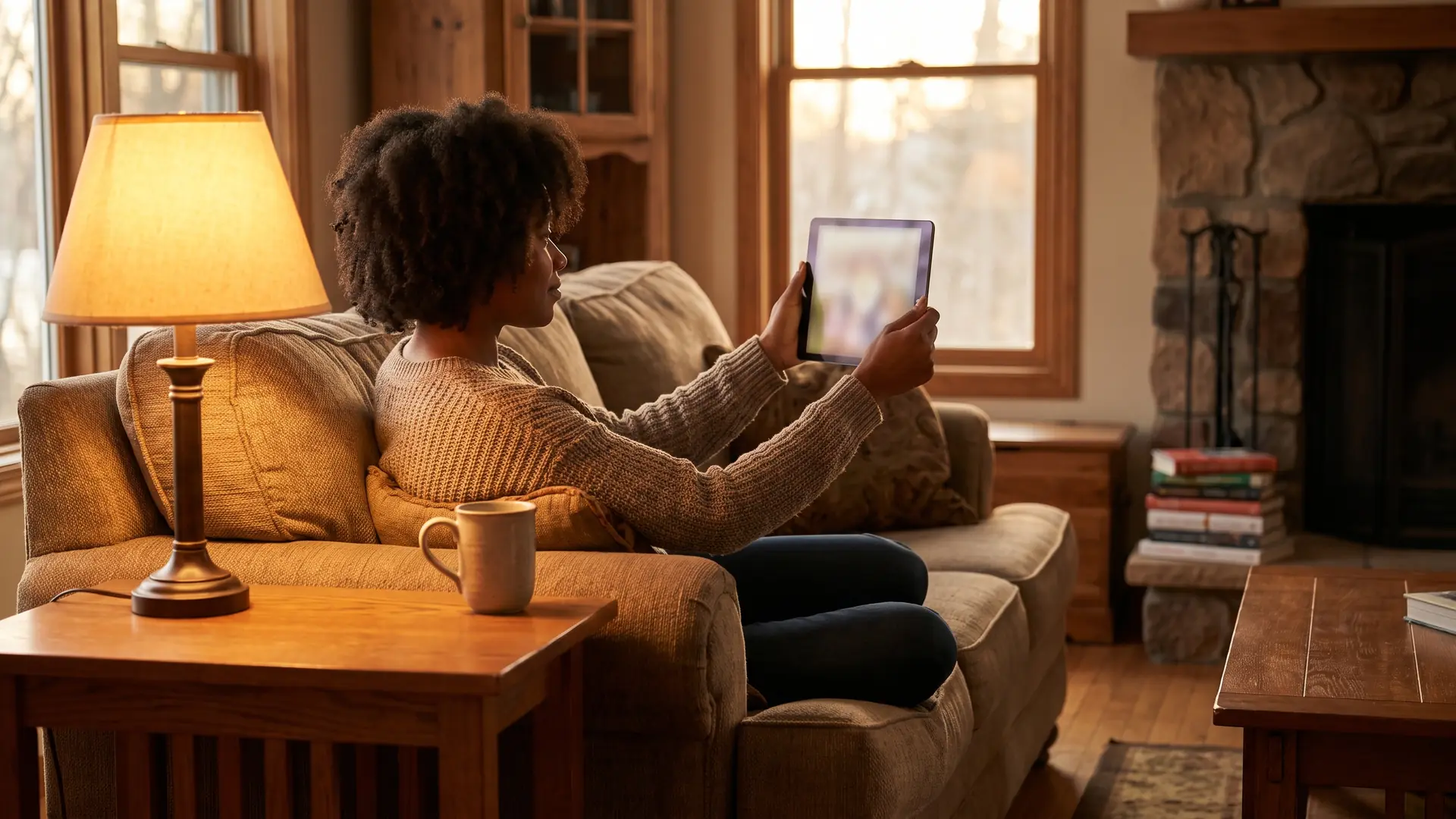
Virtual tours spread quickly after 2020, but they remain a selective marketing choice rather than a default. Only 16% of sellers who used an agent had one used to market the home. Among buyers who use the internet to house hunt, 41% rank virtual tours as a “very useful” website feature, behind listing photos at 83% and detailed property information at 79%, but ahead of video at 29%, per the National Association of Realtors’ 2025 Home Buyers and Sellers Generational Trends Report.
Tours are excellent for screening homes and comparing layouts, but they cannot convey smell, sound, floor slope or neighborhood feel. Learn more about how virtual home tours work, including how a home gets captured and stitched into a tour, how the four listing formats differ, and what a tour will never show you. If you’re earlier in the process, start with our Home Buying guide.
Key takeaways:
- Tours are built from 360-degree or 3D scans: A photographer shoots 1 or 2 full-sphere captures per room and software stitches them into a navigable model, so a tour is not the ordinary listing photo set.
- They excel at screening and layout comparison: Remote and time-constrained buyers use tours to eliminate homes before driving to them, which matters when the median buyer views 7 homes over a 10-week search and 51% find the home they buy online.
- They cannot replace an in-person visit: Odor, sound, floor slope, water pressure and the block outside are 5 things a screen never renders, so treat a tour as a screening tool and keep your inspection contingency intact.
What is a virtual home tour, and how does it work?
A virtual home tour is an interactive, self-guided walkthrough built from images or scans captured at fixed positions throughout a home and connected so you can click from one position to the next. The distinguishing feature is control: you choose which room to enter, where to look, and how long to stay, instead of watching someone else’s route at their pace.
Three things have to happen before a tour reaches a listing page, here’s how the industry builds and uses virtual tours.
Capture: 360-degree cameras and 3D scanners
A photographer or agent sets a camera on a tripod at chest height and captures a full sphere from each position, typically one or two per room, plus hallway and landing positions so the rooms connect. Three tiers of hardware do this.
- 360-degree cameras: Consumer devices with two opposing fisheye lenses that shoot a full sphere in one press. They produce panoramas fast and cheaply, which is why most DIY tours use them.
- 3D scanners: Higher-end rigs pair the camera with a depth sensor or lidar, recording the distance to every surface. That depth data is what makes measurement tools, floor plans and dollhouse views possible.
- Phones: Modern apps stitch a serviceable tour, and handsets with depth sensors produce rough floor plans. Quality tracks the operator more than the hardware.
Stitching: how the rooms get connected
Software aligns overlapping captures and welds them into one continuous model, so the step from kitchen to hallway lands where you’d expect. On a depth-sensing scan it also builds a geometric mesh of the house. That mesh is the digital twin, and it’s what rotates when you open the dollhouse view. The interactive layer gets added here too: click-to-move points, zoom, feature tags, a floor plan, and a measuring tool that reads dimensions off the mesh.
Publishing: where the finished tour lives
The finished tour is hosted by the platform that produced it and embedded everywhere the listing appears, the MLS, the brokerage site, the portals, social posts. Nothing installs on your end: a browser on a phone, tablet or computer loads it, and a headset adds immersion without being required.
Types of virtual tours compared
Four formats get called a “virtual tour” on listing sites, and only two of them let you steer. Knowing which one you’re looking at tells you how much weight to put on it.
| Format | What it is | Best for | Limits |
|---|---|---|---|
| Photo gallery | A curated set of 20 to 40 still images shot by a listing photographer | Fast first impressions and finishes | No spatial relationship between rooms; wide lenses stretch small spaces; the photographer picks every angle |
| Video walkthrough | A recorded, narrated walk through the home at the videographer’s pace | Narration, street context, and features you’d otherwise miss | Passive. You can’t stop and look where you want, and skipped rooms are easy to miss |
| 360-degree tour | Linked panoramic photos you click between, looking any direction from each position | Sight lines, room connections, and exploring at your own pace | Movement is limited to the positions captured; no true measurement or floor plan |
| 3D digital twin | A depth-scanned model with dollhouse view, floor plan and measuring tools | Layout, approximate dimensions, furniture planning, remote screening | Only what was scanned exists. Basements, attics and garages are frequently left out |
That last limit is the one buyers most often miss. A 3D tour feels complete because it’s navigable, so an unscanned mechanical room reads as absence rather than omission. If a tour never lets you into the basement, that’s a question.
What virtual tours do well for buyers
The honest case for virtual tours is screening, not deciding. NAR’s data shows how much of the search has already moved onto a screen: 43% of buyers say looking online for properties was their very first step, and 51% found the home they purchased on the internet, ahead of the 29% who found it through an agent.
- You eliminate homes faster: The median buyer views 7 homes across a 10-week search, so every listing you can rule out from a screen is a Saturday you get back. A tour turns a two-hour round trip into a four-minute click-through.
- You understand the layout, not just the rooms: Photos show you a kitchen. A tour shows you the kitchen is three turns from the front door and the only bathroom opens onto the dining room. Flow is what photos structurally cannot convey.
- You can shop from anywhere, at any hour: Relocating buyers, deployed service members, and anyone whose schedule doesn’t match a listing agent’s get the same access at 11 p.m. as a local buyer gets Sunday afternoon.
- You reduce the cost of a wide search: Finding the right property is the hardest step of buying for 55% of buyers, and walking into a showing already knowing the layout sends your 30 minutes to condition instead of orientation.
Where tours fit in the sequence, after preapproval, before showings and offers, is laid out in our guide to buying a house in 12 steps and the home buying process walkthrough. For how inventory shifts by market, listing and inventory research data is updated monthly.
What do the 2026 market numbers mean for shopping by virtual tour?
A tour narrows the list, but most buyers still close with a professional beside them. In the 2025 Profile of Home Buyers and Sellers, a survey NAR mailed in July 2025 to 173,250 recent buyers that drew 6,103 responses, 88% of buyers purchased through a real estate agent or broker. Buyers most wanted that agent’s help finding the right home (50%), well ahead of negotiating the terms of the sale (13%).
The same survey reported a change in why people move. Among repeat buyers, being closer to friends and family was the top reason to buy, at 19%, and convenience to the buyer’s job fell to 31% of all buyers from 52% in 2014, according to NAR. Those figures come from the same NAR survey. For a buyer moving toward family in another state, a tour often has to stand in for the first look, and our guide on how to evaluate a property’s location covers the homework a tour cannot do.
The pace of the market sets how long you have between a tour and an offer. Existing-home sales rose 1.5% in September 2026 to an annual pace of 3.99 million, inventory rose to 1.60 million homes, and prices were up 1.3%, according to NAR’s September 2026 existing-home sales release. The Midwest made up 23% of those sales, per NAR’s September 2026 summary tables.
U.S. house prices rose 0.3% in August 2026 from July and 2.4% from August 2025, with 12-month changes from 0.5% in the Mountain division to 4.4% in the East North Central division, per the FHFA House Price Index released October 27, 2026. Our housing market trends guide tracks what that means for buyers.
What virtual tours can’t show you
Every sense except sight is missing, and so is everything past the property line. A tour is an accurate floor plan and an optimistic condition report. Here’s the specific list of what doesn’t render.
- Smell: Pets, cigarette smoke, mildew, a damp crawlspace, a failing septic field. Odor is the most common reason an opinion flips between the tour and the front hall.
- Sound: Road noise, a rail line two streets over, an airport approach path, thin walls, a loud furnace. Tours are silent by design.
- Floor slope and structure: Cameras level themselves, quietly correcting the one thing you’d notice instantly by walking. Settled floors, bouncy joists and doors that swing shut on their own all disappear on screen.
- Water pressure and drainage: Nothing gets turned on during a capture. Faucets, showers, water heater recovery and tub drainage stay invisible until someone runs them.
- Systems you can see but can’t test: A pool reads as a blue rectangle; the pump, heater, liner age and safety compliance don’t render, see what to know about buying a home with a pool.
- What’s outside the property line: Tours stop at the walls. Neighbor proximity, the house next door, traffic patterns and how a community operates stay off camera, which is why what to know about buying a home in a gated community covers gate access and shared amenities separately.
- Condition drift and staged light: Tours are captured once, before the listing goes live, at one flattering hour, with bracketed exposures brightening every room. A tour 60 days old predates every scuff, leak and storm since, and a north-facing living room that looks sunlit on screen can be dim in February.
None of that makes tours dishonest, it makes them a filter, and a flattering one on homes that need work. The showing and the inspection are where condition gets established, and where the advantages of buying a fixer-upper stop being theoretical.
Which checks does a virtual tour leave to the inspection and disclosures?
Some of the costliest facts about a house are invisible to any camera and are settled by tests, maps and federal rules instead.
- Lead-based paint: Lead-based paint was banned for use in homes in 1978 but is still present in millions of homes, according to the EPA’s real estate lead disclosure page. For housing built before 1978, sellers must give buyers a 10-day period to conduct a paint inspection or risk assessment, a window the parties can change in writing.
- Radon: Radon has no color or smell, and a tour cannot measure it. The EPA estimates about 21,000 lung cancer deaths a year from radon, with an uncertainty range of 8,000 to 45,000, per its radon health risk page. Only a test shows the level in a specific house.
- Flood zone: In communities that take part in the National Flood Insurance Program, owners in a high-risk Zone A with a federally backed mortgage must buy flood insurance, and 1 in 3 flood insurance claims come from low- and moderate-risk zones, according to FEMA’s FloodSmart site. Check the flood map for the address itself; our guide to buying a home in a flood zone covers what a zone means for the loan.
- An independent inspection: Federal law, at 12 U.S.C. 1701x-1, has HUD give FHA buyers a notice titled “For Your Protection: Get a Home Inspection,” to inform them of the availability and importance of an independent home inspection. Our guides on how to choose a home inspector and how to read the inspection report cover the next steps.
- Condition that affects the loan: Fannie Mae will not buy a loan on a property with a condition rating of C6, and deficiencies affecting safety, soundness or structural integrity must be repaired to at least C5 first, per Selling Guide B4-1.3-06. Damage a flattering tour hides can become a financing question, so keep the contingencies in your offer until those reports come back.
Do a 3D tour’s measurements match what the appraiser reports?
Not necessarily, because the two are measured for different purposes. For a loan sold to Fannie Mae, appraisers measuring above-grade and below-grade area must follow the ANSI Z765-2021 square footage method, and sketching or 3D scanning output used in the appraisal must conform to that standard, per Fannie Mae Selling Guide B4-1.3-05 (topic dated June 4, 2025). A listing tour’s measuring tool is a platform feature; the appraisal’s square footage is the figure the loan relies on.
Some loans close without an appraiser visiting at all. Fannie Mae’s value acceptance policy, B4-1.4-10, lets it consider an offer of value acceptance in place of an appraisal on certain purchase, limited cash-out and cash-out refinance transactions. On those files, your own showing and your inspector’s visit may be the only in-person looks the house gets before closing.
When an appraisal is done, you are entitled to see it. Under Regulation B, a creditor must give you a copy of all appraisals and other written valuations on a first-lien home loan promptly upon completion or three business days before consummation, whichever is earlier, per the CFPB’s text of 12 CFR 1002.14. Compare its room count and square footage with the tour; the home appraisal process guide explains what to do if they disagree.
Align Lending is not acting on behalf of or at the direction of FHA or HUD, and works with VA-approved lenders and is not endorsed or sponsored by the Department of Veterans Affairs or any government agency. Program and investor requirements are set by those agencies and Fannie Mae and are subject to change.
How to get more out of a virtual tour
Most buyers click through a tour in 90 seconds and treat it like a slideshow. Five minutes with the tools built into it changes what you learn.
- Start with the dollhouse view: Rotate the model before entering a room. In 10 seconds you’ll see the footprint, the addition that doesn’t match the roofline, and whether the bedrooms are split or clustered.
- Use the measuring tool, then verify: Scan-based measurements are usually within a couple of inches, close enough to know whether your sectional fits, not close enough to order countertops.
- Count the rooms against the listing: If the listing says four bedrooms and the tour has three, or there’s no basement or garage, the missing space wasn’t captured. Ask why.
- Look up and down: Ceilings and floors hold the evidence. Stains under an upstairs bath, patched drywall near a chimney, mismatched flooring where a wall used to be.
- Note the mechanicals and the smart gear: Zoom on the furnace and water heater labels for age, the panel for breaker count, and any thermostats or sensors. Window type and insulation stay invisible, so pair the tour with how to evaluate a home’s energy efficiency.
- Move fast when the market is tight: A tour lets you screen a listing the hour it posts, real leverage when homes go under contract in days. See how to win a house in a seller’s market.
- Then go stand in it: Screenshot your questions for your agent first, so answers are waiting when you arrive. Our guide to avoiding buyer’s remorse covers the checks hurried buyers skip.
Tours are one tool for narrowing a market, and which tools matter depends on your situation, the full set lives in our Buying Strategies & Situations hub.
Can a virtual tour be used in a scam?
Yes. A tour or photo set can be copied and reposted on a fake listing, so a polished tour proves someone captured a house, not that the person showing it controls it. Before any deposit leaves your account:
- Check who owns the house: look up the owner of record with the county register of deeds or the local assessor, and make sure that name matches the seller in the listing and the purchase agreement.
- Ask for a live walkthrough: a video call led by the licensed listing agent, scheduled by you, where the camera goes where you ask.
- Confirm the agent first: send no money until you reach the listing agent through the brokerage’s published phone number, not one from the message that sent the tour.
The FBI’s Internet Crime Complaint Center, in its 2025 IC3 Annual Report, reported 1,008,597 complaints and $20.877 billion in losses across all crime types in 2025. Its Real Estate category covers fraud involving rental or timeshare property and real estate investments; wire fraud that impersonates a closing attorney or title company is counted separately, under business email compromise.
| IC3 Real Estate category | 2023 | 2024 | 2025 |
|---|---|---|---|
| Complaints | 9,521 | 9,359 | 12,368 |
| Losses | $145,243,348 | $173,586,820 | $275,110,419 |
Source: FBI Internet Crime Complaint Center, 2025 IC3 Annual Report, Real Estate category, three-year comparison.
The same IC3 report counted 22,191 complaints from Michigan in 2025, 14th among the states, and $381,068,131 in reported losses, 16th. Complainants age 60 and over filed 2,473 Real Estate complaints with $123,671,936 in losses. If money has already gone to the wrong account, our guide to financing a home with gift funds walks through the wire recall and the IC3 complaint.
The Consumer Financial Protection Bureau’s warning on mortgage closing scams lists the habits that protect you: never follow wiring instructions contained in an email, verify the account name and number with your trusted representatives in person or at a phone number you agreed on beforehand, and do not email financial information. Our guides to earnest money deposits, choosing a title company and preparing for closing show where each of those payments goes.
What sellers should know about DIY vs. professional tours
If you’re buying and selling at once, production matters too. The share of listings that get one is still small: among sellers who used an agent, 16% had a virtual tour used to market the home and 12% had video, against 86% listed on the MLS website, per NAR’s 2025 generational trends data.
- DIY: A 360-degree camera and a hosting subscription put a usable tour on a listing in a day. The tradeoff is polish, uneven exposure, awkward capture positions, no floor plan or measurement layer.
- Professional: A scanning service delivers the dollhouse view, floor plan, measurement tools and corrected lighting. It costs more and takes longer to schedule, and it’s the version out-of-state buyers actually need.
What does Michigan law add when you buy a home you first toured online?
- The seller’s disclosure statement: Under the Seller Disclosure Act, the seller must deliver the disclosure statement before signing a binding purchase agreement with you, MCL 565.954 says. If it arrives after, you may end the agreement by written notice not later than 72 hours after in-person delivery, or 120 hours after delivery by registered mail. The form in MCL 565.957 asks, among other things, about any outstanding municipal assessments or fees and any homeowners’ association with authority over the property, two things no tour shows. See what a seller’s disclosure covers and how to handle seller disclosures.
- Earnest money held in trust: A Michigan real estate broker must deposit money belonging to others not later than 2 banking days after the broker has received notice that an offer to purchase has been accepted by all parties, under MCL 339.2512.
- Recorded documents: Easements, restrictions and liens live in the county register of deeds, not in a tour. In Oakland County, the Clerk/Register of Deeds Super Index provides copies of recorded documents dating back to January 1, 1964, with the exception of subdivision plat maps. Our guides to property liens and plat maps explain what to look for.
- Internet service at the address: A tour cannot show whether the house has the connection you need to work from it. The Michigan Public Service Commission points buyers to the Michigan High-Speed Internet Office map, searchable by street address for providers, technology and maximum speeds. The Michigan High-Speed Internet Office reports that more than 212,000 households in the state lack access to a high-speed connection and another 865,000 face barriers related to affordability, adoption or digital literacy.
Homes in Oakland and Livingston counties averaged under a month on the market in September 2026, according to Realcomp’s September 2026 statistical highlights, so a buyer touring from out of town should plan the in-person visit or inspection before the offer deadline, not after. Our guide to negotiating a home purchase has the county figures.
How Align fits your buying strategy
Local real estate agents bring Samantha in for a second opinion when their buyer arrives preapproved somewhere else. She regularly finds a lower rate or less cash to close, whichever helps the buyer more.
That comes from the broker model. One application goes to multiple wholesale lenders, so your offer is built on the loan that fits your situation, not the only one a single bank sells. A 2024 Polygon Research analysis of federal mortgage data found broker borrowers paid about $10,662 less over the life of a $400,000 loan than borrowers at nonbank retail lenders.
FAQ: Virtual home tours
Here are answers to common questions about virtual home tours.
Are virtual home tours accurate?
The geometry is generally accurate, because 3D scans capture real spatial data and many platforms offer reasonably reliable measurement tools. What isn’t neutral is presentation: wide lenses can flatter room proportions, bright staging hides wear, and tours are often captured before minor damage occurs. Treat a tour as an accurate floor plan and an optimistic condition report, then let the home inspection checklist for buyers establish what shape the house is actually in.
Can I buy a house using only a virtual tour?
It happens, especially with relocating buyers, but it raises your risk. If you can’t visit, send a local agent or a trusted contact for a live video walkthrough where you direct the camera, and never waive the inspection contingency. Also ask for photos of the basement, attic, mechanical room and roof, which tours frequently skip. Building those protections into the paperwork is part of how to create a competitive offer.
What is the difference between a virtual tour and a video walkthrough?
A video walkthrough is passive: you watch someone else’s path at their pace. A virtual tour is interactive: you click through the space, choose which rooms to enter, look up and down, and often view a dollhouse floor plan. Tours are better for understanding layout and flow; video is better for narration and highlighting specific features.
Do virtual tours cost buyers anything?
No. Virtual tours are a marketing expense paid by the seller or listing agent, and they’re free to view on listing sites, brokerage sites and the MLS. All you need is a browser on a phone, tablet or computer. A VR headset improves immersion but is never required. If you’re on the other side of the transaction, how to market your home online covers what that spend buys you.
Do I need a written buyer agreement before a virtual tour with an agent?
Yes, if the agent is touring the home with you. Since August 17, 2024, buyers are asked to sign a written agreement before touring a home with them, in person or virtually, according to NAR’s consumer guide to written buyer agreements. An open house you visit on your own does not require one. Agent compensation is agreed in writing before you start touring, so you know that cost up front and can build it into your offer.
Can I close on a Michigan home without being there in person?
Often. Michigan law lets a notary perform a notarial act through a remote electronic notarization platform approved by the Secretary of State and the Department of Technology, Management, and Budget, under MCL 55.286b, last amended in 2020. The journal and any recording must be kept at least 10 years. Ask your lender and title company early whether your closing can use it; see the home closing process.
Is virtual staging allowed in listing photos and tours?
The images must not mislead. Article 12 of the 2026 NAR Code of Ethics requires REALTORS to be honest and truthful in their real estate communications and to present a true picture in their advertising, marketing and other representations, and Standard of Practice 12-10 extends that duty to internet content and images. If furniture looks digitally added, ask the agent which rooms were staged, then judge the empty rooms when you visit.
If a VA buyer offers on a home seen only on a tour, is the earnest money at risk if the value comes in low?
Not because of the value alone. A VA purchase contract signed before the Veteran receives the Notice of Value must carry VA’s escape clause, which says the buyer will not lose their earnest money deposit or be obligated to complete the purchase if the price exceeds the reasonable value VA establishes, per VA’s escape clause page. Other contract terms still apply. See buying a home with a VA loan.
The bottom line on virtual home tours
A virtual home tour is an interactive digital walkthrough built by capturing a home with a 360-degree camera or a 3D scanner from multiple positions and stitching those captures into a connected model you navigate room to room. Buyers who search online rank tours “very useful” at 41%, behind photos at 83% and ahead of video at 29%, useful, not decisive. Use tours to screen and compare layouts, then go stand in the house, because smell, sound, floor slope and the block itself never render on screen. NAR research on how buyers search online tracks these habits year over year.
If you’re ready to turn a tour you love into an offer that holds up, talk to Align Lending. We’ll get you a real preapproval, shop your scenario across our lender network, and show you the numbers side by side, so you can move the moment a tour turns into a showing. The importance of mortgage preapproval is what separates a browser from a buyer. Call 248-506-5727 or start online.
Sources: website features ranked “very useful,” first step taken, length of search, homes viewed, where buyers found their home, hardest step, and agent marketing methods, National Association of Realtors, 2025 Home Buyers and Sellers Generational Trends Report, Exhibits 3-1, 3-3, 3-4, 3-5, 3-6 and 7-8.
This article is for informational purposes only and is not intended to provide legal, financial, or tax advice. Contract language and contingencies should be reviewed by a licensed real estate professional or attorney in your state. Consult a qualified professional about your situation. Align Lending is an independent Michigan mortgage broker, NMLS #2041154.
Sources
Every outside source this guide links to, in the order it appears. How we choose and check sources
- How the industry builds and uses virtual toursinman.com
- 2025 Profile of Home Buyers and SellersNational Association of Realtors
- NAR’s September 2026 existing-home sales releaseNational Association of Realtors
- September 2026 summary tablesNational Association of Realtors
- FHFA House Price Index released October 27, 2026Federal Housing Finance Agency
- EPA’s real estate lead disclosure pageU.S. Environmental Protection Agency
- Radon health risk pageU.S. Environmental Protection Agency
- FEMA’s FloodSmart siteFEMA, National Flood Insurance Program
- 12 U.S.C. 1701x-1law.cornell.edu
- Selling Guide B4-1.3-06Fannie Mae Selling Guide
- Fannie Mae Selling Guide B4-1.3-05Fannie Mae Selling Guide
- Value acceptance policy, B4-1.4-10Fannie Mae Selling Guide
- CFPB’s text of 12 CFR 1002.14Consumer Financial Protection Bureau
- 2025 IC3 Annual Reportic3.gov
- Warning on mortgage closing scamsConsumer Financial Protection Bureau
- MCL 565.954Michigan Legislature
- MCL 565.957Michigan Legislature
- MCL 339.2512Michigan Legislature
- Clerk/Register of Deeds Super Indexoaklandcountymi.gov
- Michigan High-Speed Internet Office mapState of Michigan
- Michigan High-Speed Internet OfficeState of Michigan
- Realcomp’s September 2026 statistical highlightsrealcomp.com
- NAR’s consumer guide to written buyer agreementsNational Association of Realtors
- MCL 55.286bMichigan Legislature
- 2026 NAR Code of EthicsNational Association of Realtors
- VA’s escape clause pageU.S. Department of Veterans Affairs
- NAR research on how buyers search onlineNational Association of Realtors
Related resources

20-minute read
How to create a competitive offer on a house in a seller’s market
Learn how to create a competitive offer on a house, from preapproval and pricing to contingencies and appraisal gap coverage, and win in a hot market.
20-minute read
Advantages of buying a fixer-upper: 7 key benefits (and the tradeoffs)
Discover the advantages of buying a fixer-upper, from lower prices and less competition to renovation loans that roll repair costs into your mortgage.
20-minute read
Guide to Negotiating a Home Purchase
Strategies for negotiating a home purchase, from inspection findings and seller concessions to offers that win without overpaying.
