
What to know about buying a home with a pool
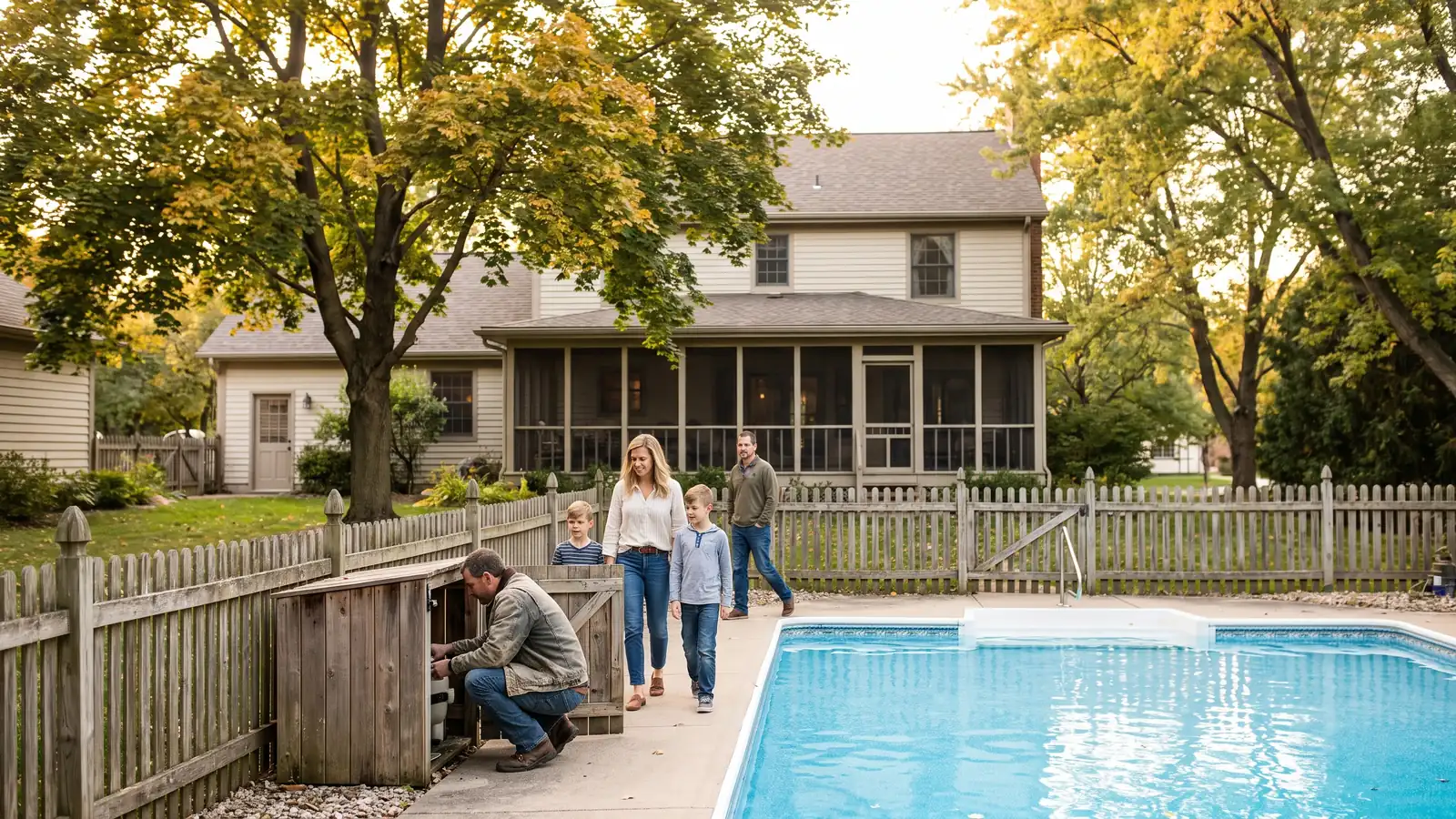
A pool is a second property system with its own budget. Routine service commonly runs about $100 – $150 a month outsourced or roughly $50 – $75 a month in DIY chemicals and supplies, seasonal opening and closing adds about $150 – $300 a year, and resurfacing every 10 – 15 years costs roughly $5,000 – $10,000.
Equipment is the surprise line. Pumps run about $500 – $1,200, heaters $1,000 – $3,500 and filters $200 – $1,000, and a standard home inspection covers none of it. That gap is the most expensive thing buyers miss, because the pool inspection you skip is the repair bill you inherit.
Learn what to know about buying a home with a pool, including what a dedicated pool inspection examines, what the pool costs to run in year one, how it affects appraised value and insurance, and how Michigan’s short season changes the math. If you’re earlier in the process, start with our Home Buying guide.
Key takeaways:
- Order a separate pool inspection: A general home inspection excludes the pool shell, plumbing, pump, heater and filter, so a few hundred dollars for a dedicated inspection buys visibility on the $5,000 – $10,000 failures that live there.
- Budget the recurring costs up front: Roughly $100 – $150 a month for professional service, $150 – $300 a year to open and close, and $5,000 – $10,000 to resurface every 10 – 15 years.
- Safety features affect insurance and liability: The Michigan Residential Code requires a barrier at least 48 inches high with self-closing, self-latching gates, and that barrier plus a rated safety cover and alarms can reduce the premium impact of adding a pool to your policy.
Does a home inspection cover the pool?
No. The standards of practice most home inspectors work under specifically exclude in-ground pools and spas, so the shell, plumbing, pump, heater, filter and safety barrier go unexamined unless you hire someone else to look at them. A dedicated pool inspection typically costs a few hundred dollars. A rounding error next to a $7,000 resurfacing job you didn’t know was due.
Order it inside your inspection window, alongside the general inspection, so both reports land while you still have the contractual right to ask for something. Where that window falls is mapped out in the home buying process guide, and choosing a home inspector covers how to vet who you hire. Ask yours for a pool specialist referral if they don’t carry the credential themselves.
What a dedicated pool inspection covers
A pool inspector is looking at five systems, and each one carries a different failure cost.
- The shell and surface: Cracks, hollow spots, rough or stained plaster, and failing tile or coping, the wear that tells you where the pool sits in its 10 – 15 year resurfacing cycle.
- Leaks and water loss: A pool losing more than normal evaporation is losing it somewhere. Underground plumbing leaks are the repair that turns into deck demolition.
- Equipment age and function: Manufacture dates on the pump, heater and filter, plus whether each runs a full cycle. A 12-year-old heater isn’t a working heater; it’s a $1,000 – $3,500 purchase with an unknown date on it.
- Electrical and bonding: GFCI protection, equipment pad wiring, lighting, and the metal bonding grid that keeps the pool from becoming an electrical hazard.
- Barriers and safety equipment: Fence height and gaps, self-closing and self-latching gates, alarms, and compliant drain covers. Your insurer cares about this list even if the seller never did.
How to turn pool findings into dollars
Prioritize the way you would on the house itself: lead with safety, structure and systems, and leave the cosmetic list alone. Three documented findings, a failing heater, a bonding defect, plaster at the end of its life, make a request a seller can evaluate. A 20-item list padded with faded coping invites a refusal on all of it. Read a home inspection report carefully first, because inspectors flag conditions and not every flag is a defect.
Then pick a remedy. A price reduction lowers your loan amount but does nothing for the cash in your pocket at closing. The trade-offs are covered in how to negotiate house prices. A credit at closing lets you choose the contractor and the timing. Seller-completed repairs make sense when a permit is involved or your lender will require the work done before funding.
How much does a pool cost to own?
Plan on roughly $1,500 – $2,500 a year in routine cost before a single repair, plus a five-figure reserve for the two big-ticket events every pool eventually has: resurfacing and equipment replacement.
| Cost item | Frequency | Typical range |
|---|---|---|
| Professional weekly service | Monthly, in season | $100 – $150 per month |
| DIY chemicals and supplies | Monthly, in season | $50 – $75 per month |
| Seasonal opening and closing | Annually | $150 – $300 per year |
| Pump replacement | Every 8 – 12 years | $500 – $1,200 |
| Heater replacement | Every 8 – 12 years | $1,000 – $3,500 |
| Filter replacement | Every 8 – 15 years | $200 – $1,000 |
| Resurfacing | Every 10 – 15 years | $5,000 – $10,000 |
| Added water and electricity | Monthly, in season | Varies by pump type, heater use and utility rates |
Run the ten-year math before you fall for the backyard. Say you buy a home in Waterford with a 15-year-old pool and hire out the service. Ten seasons at $125 a month for five months a year is about $6,250, plus $225 a year to open and close is $2,250, plus one resurfacing at $7,500 and a pump-and-heater replacement at roughly $3,000, call it $19,000 over a decade, or about $158 a month averaged out.1 Doing the service yourself cuts several thousand off that and adds a few hours a week to your calendar.
Two costs sit outside the table and catch people anyway. Utilities rise, because a pool pump can be one of the largest electrical loads on a house. A variable-speed pump is the upgrade that pays for itself here. And your insurance premium changes, which the next section covers. Angi’s home project cost data is a reasonable place to sanity-check contractor pricing in your ZIP code before you put a number in a repair request.
Fold all of it into your purchase budget instead of treating it as a next-year problem. Our guide to spotting hidden costs in a home purchase runs the same exercise for the rest of the property, budgeting for closing costs covers the cash you need at the table, and home buyer rebates can fund a first-season service contract.
Pool safety, fencing and insurance
Assume the barrier is a requirement, not an upgrade. Michigan adopts the International Residential Code, which sets the residential pool barrier standard: a barrier at least 48 inches high measured from the outside grade, with gates that are self-closing and self-latching, and no climbable gaps. Local jurisdictions administer and can add to that standard, and a non-compliant barrier becomes your problem the day you take title. Call the local building department with the address before closing and ask what the current requirement is and whether the pool was permitted.
Layer the protections rather than relying on one. The features that matter most, and that insurers ask about:
- A compliant barrier with self-closing gates: A 48-inch minimum barrier with gates that latch on their own removes the human error fencing exists to catch, and the fence drives both code compliance and insurability.
- A safety cover, not a solar cover: A rated safety cover is engineered to hold weight; a floating solar blanket is a heating accessory and can be a hazard itself.
- Alarms: Gate, surface-wave and house-side door alarms are inexpensive and often the difference between a discount and a surcharge.
- Compliant drain covers and non-slip decking: Entrapment-rated main drain covers are a hard safety requirement, and textured decking prevents the ordinary injury that generates most pool claims.
Carriers treat a pool as an attractive nuisance: a feature that draws people onto your property, including people who were never invited. Expect your carrier to ask about the pool, to want higher liability limits than a standard policy carries, and to raise an umbrella policy as the practical way to cover a claim that exceeds them. The Insurance Information Institute on homeowners coverage explains how the two fit together. Get a bindable quote on the specific address during your inspection window. An insurance surprise found in the final week is a closing-delay problem, not a shopping problem.
How does a pool affect home value and resale?
Aggregated U.S. market analyses put the premium at roughly 5% – 8% for an in-ground pool in areas and price points where buyers expect one, with larger lifts in warm-climate Sun Belt markets and little to none in cold-climate and family-heavy submarkets. Recovery against build cost is the number that matters more: the typical resale return on an in-ground pool runs about 40% – 50% of what it cost to install. A $60,000 pool doesn’t become $60,000 of appraised value. It becomes an adjustment line worth roughly $24,000 – $30,000.2
That matters to your loan, because your lender lends against the lower of the sales price or the appraised value. Pay a pool premium the appraiser doesn’t support and the gap is yours to cover in cash, know how to appeal a low appraisal before you’re negotiating one under time pressure.
Resale cuts both ways. A pool narrows your future buyer pool to people who want one, a smaller group in Michigan than in Phoenix, and families with toddlers often read it as a liability. Buyers planning to stay put for decades, the same audience thinking about buying a home for aging in place. Sometimes value the low-impact exercise and sometimes see maintenance they won’t want at 75.
A neglected pool is its own category. If the shell is sound but the equipment and surface are shot, you’re buying a project with a known price, the same calculus behind the advantages of buying a fixer-upper. If the shell is cracked or the pool has been drained and abandoned, price in removal.
How a pool changes your loan and your credits
Three things about a pool can touch your financing, and all three are easier to handle before you’re under contract than after.
- Appraiser callouts: If the appraiser notes a safety condition, an unfenced pool, exposed wiring at the equipment pad, a collapsed cover, lenders in Align’s network commonly require it corrected and re-inspected before funding. Find it at inspection, not at appraisal.
- Repair credits are interested-party contributions: A seller credit toward pool work is treated like any other seller credit. Every loan program caps how much an interested party can contribute, and the credit has to be documented in the purchase agreement your underwriter sees. Ask what your program allows before you name a number, our guide to negotiating seller concessions covers the mechanics.
- Renovation financing needs a pre-check: If you plan to roll pool repairs into the loan, eligibility for pool work varies by renovation program. Get the current guideline confirmed in writing before you count on it.
Which lever fits depends on your cash position, timeline and program, the full set of moves lives in our Buying Strategies & Situations hub. Because Align is a broker, we can compare how different lenders and programs handle the same pool credit instead of fitting your file to one bank’s answer.
What Michigan buyers should know about pools
Michigan pools cost close to a full year of money for roughly a third of a year of use, and that ratio is the honest starting point for the decision.
- A short season, a full-year bill: Outdoor swimming here realistically runs from late May into September about four months without a heater. Opening and closing still costs $150 – $300 every year, and the resurfacing clock doesn’t pause in January.
- Winterization isn’t optional: Water left in lines, pumps and filters freezes and splits them, which is how a skipped $200 closing becomes a $1,000 – $3,500 heater. Ask for closing invoices from the last three seasons; a gap in that record is both a real risk and a real negotiating point.
- Heaters get used harder: A heater is what stretches a Michigan season into May and October, and running one that often shortens its life. Confirm the heater’s age and BTU rating at inspection, not after the first cold week.
- Appraisers here adjust conservatively: The 5% – 8% average premium, and the larger lifts reported in warm-climate markets, are not the Michigan number. Expect a smaller appraisal adjustment and price your offer accordingly, and if you’re on the other side of this someday, our guide to selling a home with a pool covers how Michigan buyers evaluate one.
None of that makes a Michigan pool a bad purchase. It makes it a lifestyle purchase with a known price, which is far easier to plan for than a surprise.
How Align fits your buying strategy
Local real estate agents bring Samantha in for a second opinion when their buyer arrives preapproved somewhere else. She regularly finds a lower rate or less cash to close, whichever helps the buyer more.
That comes from the broker model. One application goes to multiple wholesale lenders, so your offer is built on the loan that fits your situation, not the only one a single bank sells. A 2024 Polygon Research analysis of federal mortgage data found broker borrowers paid about $10,662 less over the life of a $400,000 loan than borrowers at nonbank retail lenders.
FAQ: Buying a home with a pool
Here are answers to common questions about buying a home with a pool.
Does a home inspection cover the swimming pool?
No. Standard home inspection standards of practice exclude in-ground pools and spas, so the pool shell, plumbing, pump, heater, filter and safety equipment go unexamined unless you hire a pool specialist. A dedicated pool inspection typically costs a few hundred dollars and covers structure, equipment age and function, leaks and code-required barriers. Order it during your inspection window so findings can drive a price or credit request, and use the home inspection checklist for buyers to confirm what the general inspection did and didn’t include.
How much does a pool add to homeowners insurance?
Enough that you should quote it before you close. Insurers treat a pool as an attractive nuisance and usually require higher liability limits, and many recommend an umbrella policy. Compliant fencing, self-closing and self-latching gates, and a safety cover can reduce or offset the increase. Get a bindable quote on the specific address with the pool disclosed rather than assuming your current premium carries over, our guide to evaluating home insurance options covers how to compare what comes back.
Does a pool increase a home’s value?
Sometimes. Market analyses suggest roughly 5% to 8% for an in-ground pool in areas and price points where buyers expect one, but the premium shrinks or disappears in colder climates and family markets where a pool reads as maintenance. Appraisers usually credit only about 40% to 50% of what a pool cost to build, which is worth understanding before you write the offer, see how the home appraisal process handles features like this. Buy a pool because you’ll use it, not as an investment thesis.
What questions should I ask the seller about the pool?
Ask the pool’s age, when it was last resurfaced, the age of the pump, heater and filter, whether it’s maintained by a service company or the owner, whether any leaks have been repaired, whether the barrier meets current local code, and whether any equipment carries a transferable warranty. Request service records. Undocumented maintenance history is itself a negotiating point, the same leverage logic behind negotiating repairs after a home inspection.
The bottom line on buying a home with a pool
Buy the pool with your eyes open and it’s a lifestyle purchase with a known price. Routine service runs about $100 – $150 a month outsourced or $50 – $75 in DIY supplies, opening and closing adds $150 – $300 a year, equipment replacement runs $500 – $1,200 for a pump, $1,000 – $3,500 for a heater and $200 – $1,000 for a filter, and resurfacing every 10 – 15 years costs $5,000 – $10,000. Order a separate pool inspection, confirm the barrier meets Michigan’s 48-inch code minimum, quote the insurance before you close, and treat the 5% – 8% value premium as an average that runs higher in warm markets and lower in Michigan. What to line up before you tour is in preparing to buy.
If you’re ready to write an offer on a home with a pool, talk to Align Lending, we’ll shop your scenario across our lender network, show you the pricing side by side, and tell you exactly how a pool-related repair credit lands in your loan file. Call 248-506-5727 or start online today.
Footnotes:
1. Example figures are hypothetical and for educational purposes only; they do not constitute an advertisement of credit terms or a rate quote under federal or state lending laws. Pool service, equipment and resurfacing costs vary by pool size, equipment type, region and contractor, and your rate and loan terms will depend on your application and market conditions. Return to text.
2. The $60,000 pool illustration is hypothetical and for educational purposes only. Value premiums and cost-recovery ranges are market averages, not appraisals; the value credited to any specific pool is determined by a licensed appraiser using local comparable sales. Return to text.
Sources: pool service, seasonal open/close, equipment replacement and resurfacing ranges reflect aggregated home-services industry cost research; homeowners liability, attractive-nuisance and umbrella policy treatment per the Insurance Information Institute; the 5% – 8% in-ground pool value premium and the 40% – 50% typical cost recovery at resale reflect aggregated U.S. residential real-estate market analyses. Pool barrier standard of at least 48 inches with self-closing, self-latching gates, Michigan Residential Code as adopted from the International Residential Code; local jurisdictions administer and may add requirements, so confirm the current standard with the building department for the property’s jurisdiction.
This article is for informational purposes only and is not intended to provide legal, financial, tax or insurance advice. Code compliance, insurance coverage and contract language should be reviewed by a qualified professional in your state. Program terms and figures shown are illustrative, are not a rate quote or an offer of credit, and are subject to change. Align Lending is an independent Michigan mortgage broker, NMLS #2041154.
Related resources

11-minute read
How to create a competitive offer on a house in a seller’s market
Learn how to create a competitive offer on a house, from preapproval and pricing to contingencies and appraisal gap coverage, and win in a hot market.
12-minute read
Advantages of buying a fixer-upper: 7 key benefits (and the tradeoffs)
Discover the advantages of buying a fixer-upper, from lower prices and less competition to renovation loans that roll repair costs into your mortgage.

12-minute read
Guide to Negotiating a Home Purchase
Learn proven strategies for negotiating a home purchase, from using inspection findings and seller concessions to crafting offers that win without overpaying.
