
Guide to Buying a Historic Home: What to Know First
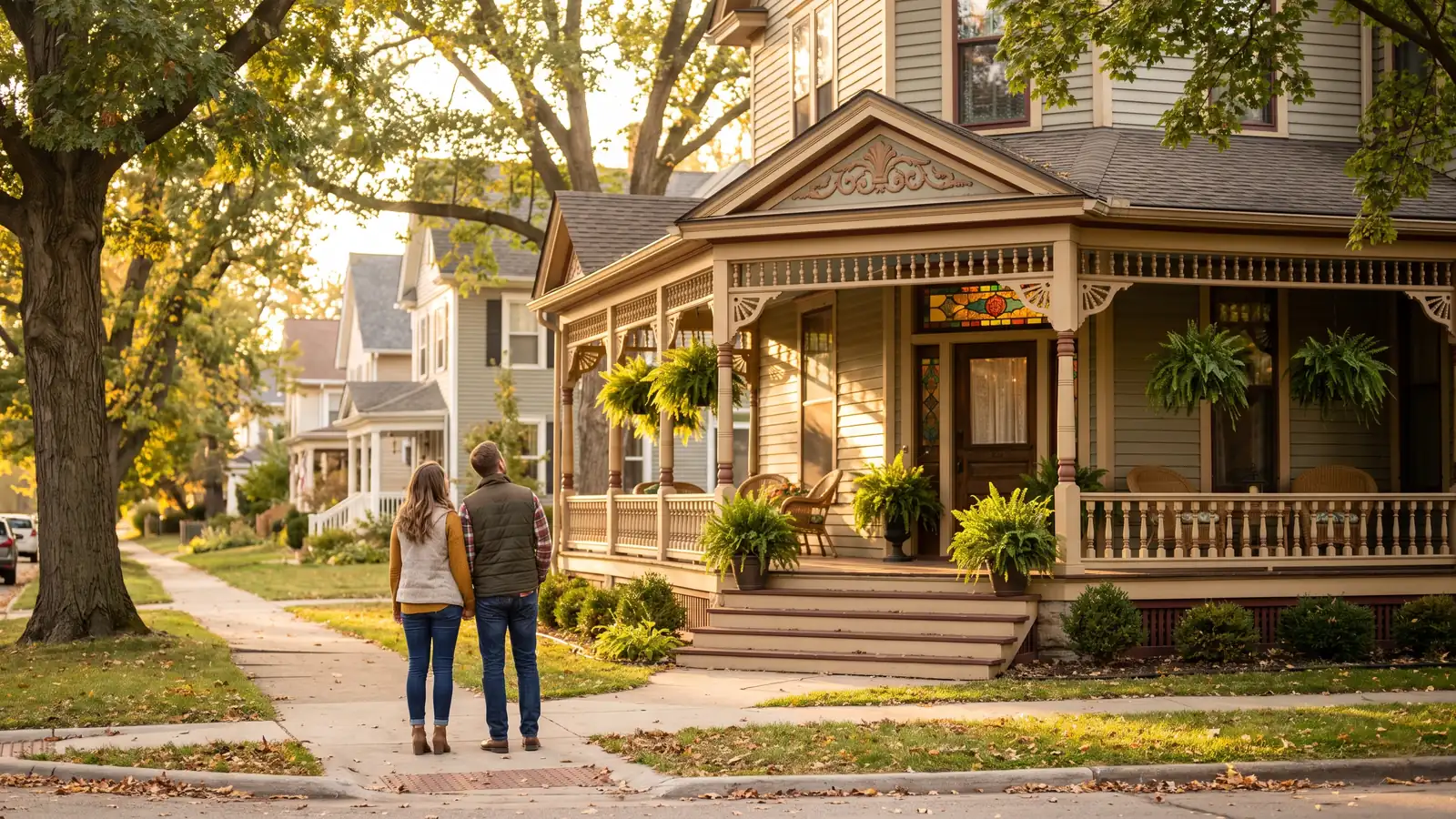
Buying a historic home follows the same basic steps as any purchase, but it adds three layers: preservation regulations, specialized inspections, and renovation-ready financing. A property generally has to be at least 50 years old before it’s even considered for historic designation, and more than 100,000 properties are now listed on the National Register of Historic Places. Though local historic district rules, not the federal listing, decide what you can change.
Because older homes commonly need updates to electrical, plumbing, and structural systems, many buyers use an FHA 203(k) loan, which finances the purchase price and renovation costs in one mortgage. The Limited 203(k) covers up to $75,000 of repairs; the Standard 203(k) handles structural work from a $5,000 minimum.
Learn more about buying a historic home, including what makes a home historic, what a specialized inspection has to cover, and which loan programs finance the restoration alongside the purchase. If you’re earlier in the process, start with the broader home buying guide.
Key takeaways:
- Designation decides what you can change: A local historic district commission holds enforceable authority over exterior work, while National Register listing places no federal restrictions on what a private owner does with the property.
- Budget for an old-house inspection: Any home built before January 1, 1978 draws extra scrutiny. On an FHA file, the appraiser must inspect every surface for defective paint and condition the appraisal on its repair.
- One loan can cover purchase and restoration: Renovation financing rolls the price and the rehab budget into a single mortgage up to $75,000 of repairs on a Limited FHA 203(k), with structural work allowed on the Standard version.
What makes a home historic?
A home is generally considered historic when it is at least 50 years old and carries architectural, cultural, or historical significance, but age alone doesn’t create rules you have to follow. The National Park Service applies the 50-year mark as a guideline for the National Register: a property younger than that has to be exceptionally important to qualify at all.
National Register listing vs. a local historic district
- National Register of Historic Places: Largely honorary. The National Park Service is explicit that listing places no federal restrictions or requirements on a private property owner. You may do with the property as you wish, within the framework of local laws and ordinances. Restrictions attach only when a project involves federal funding or permitting. Listing does open the door to preservation tax incentives.
- Local historic district: This is where the real rules live. A local district is created by municipal ordinance and governed by a commission that reviews proposed exterior work. In Michigan, under the Local Historic Districts Act (Public Act 169 of 1970), a permit must be obtained before any work affecting a resource’s exterior appearance is performed inside a district, and the commission issues a certificate of appropriateness before a building permit can follow.
- State registers: Many states keep their own registers of historic sites. In Michigan, State Register listing matters mainly because it’s one of the qualifying paths to the state rehabilitation tax credit.
So the first research question isn’t “is this house historic?” It’s “is this address inside a locally designated district?”
How to buy a historic home
Five steps, and the two that protect you most happen before you write an offer.
1. Confirm the designation and pull the district rules
Before you tour, ask the municipality two questions: is this parcel in a local historic district, and is the building individually listed or a contributing resource. Request the design guidelines in writing. Historic homes also surface through estate sales, probate listings, and courthouse sales, if that’s your route, read how to purchase a home at auction first, because auction buys usually can’t be financed and leave no inspection window.
2. Build a team that has worked on old houses
Three people change the outcome: an agent who has closed in the district, an inspector with documented pre-war experience, and a contractor who has been through a commission review. A general-practice inspector will hand you a clean report on a house with knob-and-tube wiring behind the plaster. The National Trust for Historic Preservation’s home-buying tips make a good pre-tour checklist, and ASHI publishes a directory if you’re finding an ASHI-certified home inspector.
3. Assess the property and inventory what’s original
Walk the house with a camera and document original windows, millwork, hardware, plaster, floors, and roofing. That inventory tells you what the commission will expect you to preserve and what your contractor must repair rather than replace. Ask the seller for permit history and prior approvals. Undocumented renovations are the most common surprise in an old-house file.
4. Write the offer with the right contingencies
Keep the inspection contingency, and give it a wider window than you would on a 1998 colonial. On any home built before 1978, federal law already gives you a 10-day period to conduct a lead-based paint inspection or risk assessment unless you waive it in writing, use it. Inspection findings are your leverage on price: our guide to negotiating house prices covers converting a repair list into a credit, and the broader playbook lives in our buying strategies and situations hub.
5. Close with title and insurance handled early
Historic properties can carry preservation easements, deed restrictions, or chain-of-title complications that take longer to clear. Order title work early, and the insurance quote earlier. Replacement-cost coverage on original plaster and custom millwork prices differently than a tract home, and a carrier’s decision can land late enough to threaten your closing date.
What should a historic home inspection cover?
Six areas carry most of the risk in a pre-war house, and a standard checklist covers about half of them well.
- Foundation and structural movement: Stone, rubble, and early masonry foundations behave differently than poured concrete. Look for active settlement, sagging joists, failed lintels, and staining at the sill plate.
- Electrical service and wiring: Knob-and-tube wiring, fuse panels, and undersized service show up in homes wired before 1950. Insurers ask about these directly, and some decline coverage until the panel is updated.
- Plumbing supply and drains: Galvanized steel lines corrode closed from the inside, lead service lines are still in the ground in many older cities, and cast-iron stacks fail at the joints. Ask for a camera scope of the main line.
- Roof, chimney, and flashing: Slate and clay tile can outlive several asphalt roofs but need specialist repair. Unlined masonry chimneys are both a safety issue and a common water-entry path.
- Windows and painted surfaces: Original wood windows are usually repairable, and often exactly what the commission requires you to keep. Condition matters to your lender too. On an FHA-insured purchase of a home built before January 1, 1978, the appraiser must inspect all interior and exterior surfaces for defective paint and condition the appraisal on its repair.
- Hazardous materials: Residential lead-based paint was banned in 1978, and asbestos turns up in pipe insulation, floor tile, and siding. Test rather than assume. Abatement is a real budget line.
Once you know what the house needs, the question is how to pay for it without draining your cash at closing.
How do you finance a historic home?
Historic homes qualify for the same programs as any other house, conventional, FHA, VA, and USDA. Condition changes the answer, not age. If the appraisal flags significant deferred maintenance, some programs require repairs before closing, which is exactly the problem a renovation loan solves. If the term is new to you, start with what a renovation loan is.
FHA 203(k) rehabilitation loans
The 203(k) is the most-used tool for historic buyers.1 The Limited 203(k) permits up to $75,000 of non-structural repairs, FHA raised that ceiling from $35,000 in July 2024, with a rehabilitation period not to exceed nine months. The Standard 203(k) handles structural work, requires at least $5,000 of rehabilitation, allows up to 12 months, and uses a HUD-approved 203(k) Consultant for the work write-up. Total property value still has to fall within the county FHA mortgage limit. Standard FHA rules apply otherwise: 3.5% down at a minimum decision credit score of 580 or above, while scores of 500 to 579 are capped at 90% loan-to-value. See HUD’s overview of FHA loan programs.
Fannie Mae HomeStyle Renovation
HomeStyle is the conventional answer, and its cap works differently. On a purchase, renovation funds are limited to 75% of the lesser of the purchase price plus renovation costs, or the “as-completed” appraised value. On a refinance, renovation costs can’t exceed 75% of the “as-completed” value. HomeStyle allows structural work and avoids FHA’s life-of-loan mortgage insurance.
Conventional and VA options on an older home
A historic home in good condition finances conventionally with no special treatment. VA borrowers have two paths: a standard VA purchase loan if the home already meets VA’s minimum property requirements, or a VA alteration and repair loan, which lets improvements be included in the value and completed after closing, with proceeds paid to the contractor during the repair period.2 Lenders in Align’s network set their own overlays, so the same file can be approved at one wholesale lender and declined at the next.
| Feature | Standard FHA 203(k) | Limited FHA 203(k) | HomeStyle Renovation |
|---|---|---|---|
| Best for | Structural repairs, major rehab | Non-structural repairs and updates | Broad renovation, conventional terms |
| Renovation amount | $5,000 minimum; property value capped by the county FHA limit | Up to $75,000 | Up to 75% of the lesser of price plus renovation costs, or “as-completed” value |
| Structural work | Allowed | Not allowed | Allowed |
| Completion window | Up to 12 months | Up to 9 months | Set by the renovation contract and lender |
| Consultant | HUD-approved 203(k) Consultant required | Optional | Not required |
One common misunderstanding: the federal 20% rehabilitation tax credit applies only to certified historic structures rehabilitated for income-producing use, so owner-occupied residences don’t qualify. State programs are where owner-occupants find help. Talk with a tax professional before counting a credit into your budget.
What historic district rules mean for your renovation plans
Inside a local historic district, exterior work needs commission approval before the building department issues a permit. Commissions review the proposal against the Secretary of the Interior’s Standards for Rehabilitation, ten principles that favor repairing original material over replacing it.
- What gets reviewed: Windows, siding, roofing material, porches, doors, additions, fencing, and demolition. Paint color is regulated in some ordinances and not others.
- What usually doesn’t: Interior finishes and layout fall outside an ordinance that regulates exterior appearance. Kitchen and bath modernization is your call.
- Timing is the hidden cost: Commissions meet on a set calendar, often monthly. Build review time into your renovation-loan completion window, because a 203(k) clock doesn’t pause for an agenda.
- It follows the house: The rules that constrain you constrain the next buyer too, and district status tends to support values by keeping the streetscape intact. See selling a historic home.
What Michigan buyers should know
Michigan’s older housing stock and its own preservation statute create three specifics worth checking before you write an offer.
- State historic preservation tax credit: Under Public Act 343 of 2020, Michigan offers a credit of up to 25% of qualified rehabilitation expenditures. Owner-occupied projects qualify with a minimum expenditure of $1,000, and the property must be listed on the National Register, the State Register of Historic Sites, or be a contributing resource in a local district. The program runs on a $5 million annual cap, $1 million of it reserved for owner-occupied residential projects, awarded first-come, first-served through the State Historic Preservation Office.
- Local commissions have teeth: PA 169 of 1970 requires a permit before any work affecting a resource’s exterior appearance inside a district. Detroit, Grand Rapids, and Marshall all run active commissions with published guidelines, and as of March 2024, 42 Michigan communities participate in the Certified Local Government program administered jointly by the National Park Service and Michigan’s SHPO.
- Pre-1978 stock is the norm here: In much of Detroit, Ferndale, and Royal Oak, the lead-paint disclosure and 10-day inspection window apply to nearly every listing, and on an FHA file, the defective-paint repair condition rides along with them.
How Align fits your buying strategy
Local real estate agents bring Samantha in for a second opinion when their buyer arrives preapproved somewhere else. She regularly finds a lower rate or less cash to close, whichever helps the buyer more.
That comes from the broker model. One application goes to multiple wholesale lenders, so your offer is built on the loan that fits your situation, not the only one a single bank sells. A 2024 Polygon Research analysis of federal mortgage data found broker borrowers paid about $10,662 less over the life of a $400,000 loan than borrowers at nonbank retail lenders.
FAQ: Buying a historic home
Here are answers to common questions about buying a historic home.
What qualifies a house as historic?
A home is generally considered historic when it is at least 50 years old and has architectural, cultural, or historical significance. Formal recognition comes through the National Register of Historic Places or a local historic district designation. Local designations usually carry the real restrictions, they can regulate exterior changes, additions, and even window choices, while National Register listing alone is largely honorary. Style is a separate question from status; our guide to Victorian house features and styles covers what you’re actually looking at.
Is it harder to get a mortgage on a historic home?
Not inherently, historic homes qualify for conventional, FHA, VA, and USDA financing like any other property. The challenge is condition: if the appraisal flags major deferred maintenance, some loan types require repairs before closing. Renovation loans such as the FHA 203(k) or a conventional HomeStyle loan solve this by financing purchase and rehab together. The same math drives the advantages of buying a fixer-upper.
Are there tax credits for restoring a historic home?
Sometimes. The federal 20% rehabilitation tax credit applies only to income-producing historic buildings, not owner-occupied homes. Many states offer their own: Michigan’s credit reaches 25% of qualified expenditures and accepts owner-occupied residential projects with at least $1,000 in eligible work. Local property tax abatements may also exist. Check with your state historic preservation office and a tax professional first, and plan the work with renovating a historic home in mind.
Do historic homes cost more to insure?
Usually, yes. Carriers price replacement-cost coverage on original plaster, millwork, and custom windows differently than on a tract home, and inspection findings drive the quote. Knob-and-tube wiring, fuse panels, galvanized or lead supply lines, and slate or tile roofing all raise premiums, and some carriers decline coverage until the electrical panel is updated. Get a bindable quote inside your inspection window rather than after, and read insuring a historic home before you commit.
The bottom line on buying a historic home
Buying a historic home is a normal purchase with three extra layers. Designation is first: a local commission controls exterior work through certificates of appropriateness, while National Register listing places no federal restrictions on a private owner. Inspection is second, foundation, wiring, plumbing, roof, and pre-1978 paint and asbestos need a specialist. Financing is third, and it’s the layer you can solve up front: a Limited FHA 203(k) finances up to $75,000 of repairs into the mortgage, a Standard 203(k) covers structural work from a $5,000 minimum, and HomeStyle does the same on conventional terms.
If you’re ready to buy a piece of history without funding the restoration out of pocket, talk to Align Lending, we’ll shop renovation-friendly loan options across our lender network and show you the numbers side by side. Call 248-506-5727 or start online today.
Footnotes:
- Align Lending is not acting on behalf of or at the direction of FHA or HUD. Return to text
- Align Lending works with VA-approved lenders and is not endorsed or sponsored by the Dept. of Veterans Affairs or any government agency. Return to text
This article is for informational purposes only and is not intended to provide legal, financial, or tax advice. Consult a qualified professional about your situation. Program terms and figures shown are illustrative, are not a rate quote or an offer of credit, and are subject to change.
Related resources

11-minute read
How to create a competitive offer on a house in a seller’s market
Learn how to create a competitive offer on a house, from preapproval and pricing to contingencies and appraisal gap coverage, and win in a hot market.

12-minute read
Advantages of buying a fixer-upper: 7 key benefits (and the tradeoffs)
Discover the advantages of buying a fixer-upper, from lower prices and less competition to renovation loans that roll repair costs into your mortgage.

12-minute read
Guide to Negotiating a Home Purchase
Learn proven strategies for negotiating a home purchase, from using inspection findings and seller concessions to crafting offers that win without overpaying.
