
How to price your home for a quick sale without leaving money behind
This article is for informational purposes only and is not intended to provide legal, financial, or tax advice. Tax rules, dollar limits, and thresholds change, and how they apply depends on your situation. Consult a qualified tax professional about your situation.

Homes that sold across the country in July 2026 went under contract in a median of 29 days, and your list price is the lever that moves that number in either direction. Speed is something you buy: you shorten days on market by listing below what a patient seller would hold out for, and the gap between those two numbers is what the speed costs you.
Whether that trade is worth making is arithmetic, not instinct. In the same month, NAR’s survey of its members put the average listing at 2.0 offers, with 19% of homes selling above list price, so a bidding war is a possibility, not a plan. Learn what a fast sale costs in net proceeds, what days on market does to perceived value, when a low list price is the wrong move, and how Michigan’s calendar changes the answer. This post assumes you can already build a comparative market analysis; if you can’t, start with pricing a home for sale, or the Selling a Home guide for the full sequence.
Key takeaways:
- Speed is purchased, not granted: Homes that sold nationally in July 2026 took a median of 29 days to go under contract, and the usual way to beat that is to list under comparable value and absorb the difference yourself.
- Run the discount against your carrying cost: A $21,000 haircut on a $340,000 home pays for itself only if it saves more months than it costs, which at $2,400 a month to hold the house means about eight and a half.
- The market will not rescue an overpriced listing: FHFA measured U.S. house prices up 2.1% year over year in the second quarter of 2026, roughly $595 a month on a $340,000 home against $2,400 a month to keep owning it.
What does pricing for a quick sale actually mean?
It means deliberately listing below the number your comparable sales support, and treating the difference as the purchase price of a faster sale. That is the whole strategy. Staging, photography and the open house schedule change how well your house shows at whatever price you picked. Only the price changes how many buyers see it at all.
The range agents most often describe for deliberate underpricing is roughly 5% to 10% below comparable value. Treat it as a rule of thumb, not a measured result: no rigorous published study converts a specific discount into a specific number of days, and any article handing you a precise exchange rate is quoting a number nobody measured. Your side of the trade you can calculate to the dollar.
Underpricing is a dial, not a setting. On a $340,000 home, 3% is $10,200, 6% is $20,400 and 10% is $34,000. The question is never “should I underprice.” It is “how many dollars for how many weeks, and what if the weeks don’t materialize.” Our companion piece on pricing and preparing covers the non-price levers to exhaust first.
How much does a fast sale cost in net proceeds?
Work the discount and the carrying cost as two columns of one ledger, because a discount that saves fewer months than it costs is just a smaller check. Here is the arithmetic on a hypothetical Waterford home worth $340,000 by the comps.1
| Line | List at $340,000 | List at $319,000 (about 6% under) |
|---|---|---|
| Contract price | $340,000 | $319,000 |
| Michigan transfer tax at $8.60 per $1,000 | $2,924 | $2,743 |
| Listing-side fee at a negotiated 2.5% | $8,500 | $7,975 |
| Proceeds before payoff and prorations | $328,576 | $308,282 |
The discount looks like $21,000 and nets out near $20,300, because the transfer tax and the listing fee both scale with the smaller number and hand a little back. Now price the other column: principal and interest, property tax and insurance escrow, utilities, lawn or snow service. Call it $2,400 a month. That $20,300 discount buys roughly eight and a half months of carrying cost.
Eight and a half months is a long time in a market where the median Michigan listing in July 2026 sat 41 days. If you genuinely believe the house needs nine months at $340,000, the comps are telling you it isn’t worth $340,000. If you think it needs two, the discount costs about $15,500 more than the wait would have.
Two things change that ledger fast. A deadline you cannot move, a job start date or a second mortgage payment you already carry, converts months into money well above $2,400. And a house you have moved out of costs the same $2,400 while generating nothing. Price out bridge loans before a price cut: financing the overlap is sometimes cheaper than discounting the house.
What does days on market do to your price?
Days on market is a published number, not a private one, which is why it becomes a negotiating tool the moment it gets large. The MLS carries the field, the portals display it, and buyer’s agents open showings by saying how long the house has sat. A high number answers a question nobody asked out loud: what does everyone else know that I don’t?
You can watch that pressure resolve into price cuts. Across Michigan, 19.6% of active listings took a reduction in July 2026, up from 12.2% in February 2026. Those are spring listings aging into late summer. The seller who lists in April at a hopeful number is often the seller cutting in August at a real one, four months of carrying cost later.
A house that opens at $319,000 and a house that opens at $340,000 and gets cut to $319,000 in September are not the same product, even though the screen shows the same number. One is priced. The other is negotiable, and buyers will test it. If your listing is already here, what to do if your home doesn’t sell walks the recovery options in order.
Waiting for appreciation to close the gap is the strategy that reliably fails. The FHFA House Price Index measured U.S. house prices up 2.1% year over year in the second quarter of 2026, and 0.3% quarter over quarter. On a $340,000 home a full year of that is about $7,100, roughly $595 a month, against $2,400 a month to hold the house. The market cannot catch up to your price faster than carrying cost eats the difference.
One cheap piece of speed sits outside this trade-off: buyers shop inside price filters set at round numbers, so a list price a few thousand dollars above one of them hides the house from a whole bracket of people. How to set a list price that lands under the right bracket is covered in pricing a home for sale.
Your first ten days: what to change, and what not to
Ten to fourteen days is the standard checkpoint, and what you change depends on which of two problems you have. Showings and offers are separate diagnostics; treating a condition problem as a price problem is how sellers end up cutting twice.
- Few or no showings means price: If buyers aren’t coming to look, they are filtering you out before they see the photos. The fix is a meaningful cut into the next bracket down, not $2,000 off.
- Showings but no offers means condition or terms: The price got them in the door and something inside talked them out. Look at deferred maintenance, smells, clutter and the possession date before touching the price.
- Offers dying in inspection means disclosure and repairs: Repeated failure at the same stage is a defect problem, and a lower price does not make a known defect go away. Address it or price it in, in writing.
- Small repeated cuts train buyers to wait: Three $3,000 reductions over six weeks tell the market a fourth is coming. One decisive cut that clears a search bracket does not.
Every fix on that list except the first is cheaper than a discount. Exhaust them first; the full list is in strategies for selling a home quickly.
When pricing low is the wrong move
Underpricing only works when enough active buyers exist to bid the price back up; in a thin market it hands the discount to the first person who shows up. Four situations where the strategy breaks down:
- A shallow buyer pool: The average listing drew 2.0 offers in July 2026. Underpricing assumes competition; where there is one buyer, there is no auction, only a discount.
- A price so low it reads as a defect: Buyers price risk. A number well under the block’s comps invites the question of what is wrong with the house, and the answer they invent is worse than the truth.
- A house that won’t appraise where the bidding lands: On a purchase, the lender sizes the loan against the lower of contract price or appraised value. If offers push a $319,000 list to $345,000 and the appraisal returns $330,000, the buyer covers the gap in cash or you renegotiate. Sellers cannot contact the appraiser to influence value. See the home appraisal process.
- A discount priced to paper over a defect: That is exposure, not strategy. Selling as-is or at a discount does not waive Michigan’s statutory disclosure duty, and known defects must be disclosed regardless of price.
Buyer-agent compensation is not a pricing lever either. Since August 17, 2024, offers of compensation cannot be communicated through an MLS, and agents working with buyers must have a written agreement before touring a home. Compensation is negotiable with no standard rate, so treat any quoted “going rate” as an opening position.
Price the tax question too. Sellers meeting the ownership and use tests can generally exclude up to $250,000 of gain, or $500,000 filing jointly, having owned and lived in the home at least 24 months of the previous five years.2 If your gain sits near those lines, your discount has a tax consequence; start with capital gains tax exemptions.
What Michigan sellers should know
Michigan’s selling calendar swings hard, and the month you list changes the answer to every question above by about a month of carrying cost.
- Season is worth roughly a month: Michigan listings carried a median 38 days on market in May and June 2026 and 41 in July, against 68 in February 2026, a full month longer. A winter listing is not broken, it is seasonal, and a February seller who panics into a price cut in week three is paying for a calendar problem with cash.
- Price cuts cluster in the back half of the year: The share of Michigan active listings taking a reduction ran 12.2% in February 2026 and 19.6% in July 2026. Those are the spring listings that never adjusted.
- Transfer tax is a fixed seller line, $8.60 per $1,000: Michigan charges $3.75 per $500 at the state level plus 55 cents per $500 at the county level, and state law makes the seller liable. On a $340,000 sale that is $2,924.
- “As-is” does not waive the Seller Disclosure Act: Michigan’s act applies to transfers of not less than one and not more than four residential dwelling units. Court-ordered transfers, foreclosure sales, bankruptcy trustee transfers, eminent domain and newly constructed residential property are excepted. A discount is not.
If you control your timing, listing into the deeper spring buyer pool costs nothing and does work a 5% discount would otherwise have to do. If you don’t, price for the season you are in.
How Align helps before you list
If you are buying your next home too, talk to Samantha before you list. Knowing your buying power and your timeline first lets you price and prepare your home with a plan, not a guess.
Over the last 12 months, her loans averaged under 14 days from application to clear to close, across more than 100 loans. Your closing date is set by your purchase agreement. Her job is to have your loan ready well before it.
Sources: Align Lending loan records, 12 months to October 2026.
FAQ: Pricing your home for a quick sale
Here are answers to common questions about pricing a home for a quick sale.
Is it better to underprice or overprice my home?
Underprice, if speed is genuinely what you need. A home priced slightly below comparable sales pulls more buyers through the door, and where competition exists, competing offers can carry the final number back toward market. Overpricing produces the opposite sequence: light traffic, a listing aging in public, and a price cut arriving with weeks of carrying cost already spent.
How far below market should I price for a fast sale?
Roughly 5% to 10% below comparable value is the range agents commonly describe, but treat it as a rule of thumb, not a measured outcome. Run it as arithmetic: on a $340,000 home, 5% is $17,000 and 10% is $34,000, and either is worth it only if it saves more months than it costs. Establish comparable value first, using pricing a home for sale.
How long should I wait before reducing the price?
Ten to fourteen days is the standard checkpoint. Very few showings means the price is filtering buyers out, and the fix is a cut large enough to clear the next search bracket, not a token $2,000. Strong showings with no offers points at condition, photos or terms instead, and cutting price there spends money on the wrong problem. Full triage list: strategies for selling a home quickly.
Does a comparative market analysis cost anything?
Agents typically prepare one at no charge as part of a listing consultation. A CMA is not an appraisal: an appraisal is a licensed opinion of value the buyer’s lender orders, and on a purchase the lender lends against the lower of contract price or appraised value. A useful CMA leans on closed sales, not active listings, because active listings only show what sellers are asking. See the home appraisal process.
The bottom line on pricing for a quick sale
Pricing for a quick sale means buying speed with dollars, so price both sides of the trade. Homes that sold nationally in July 2026 went under contract in a median of 29 days; the median Michigan listing sat 41. A $21,000 discount on a $340,000 home nets out near $20,300 and buys about eight and a half months of carrying cost at $2,400 a month, which is worth doing only if you truly expect to wait that long. Clear the search bracket first, exhaust the condition fixes second, then cut decisively rather than repeatedly. At 2.1% a year, appreciation will not bail you out.
If you’re ready to turn your net proceeds into a plan for the next house, talk to Align Lending. We’ll shop your next mortgage across our lender network and show you what each list-price scenario actually buys, side by side. Start with a preapproval so you know your number before you set theirs. Call 248-506-5727 or start online.
Footnotes:
1. Example figures in this article are hypothetical and for educational purposes only; they do not constitute an advertisement of credit terms, a rate quote, or an opinion of value on any specific property. The $340,000 comparable value, the $2,400 monthly carrying cost and the 2.5% negotiated listing-side fee are illustrative assumptions, not market rates. Real estate commissions are fully negotiable and there is no standard or set rate. Your proceeds depend on your contract price, your payoff, prorations, county recording practice and the terms you negotiate, and will be itemized on your settlement statement. Return to text.
2. This is general information, not tax advice. Eligibility for the exclusion of gain on the sale of a main home depends on your individual circumstances, including the ownership and use tests and any prior use of the exclusion. Consult a qualified tax professional about your situation. Return to text.
Sources: median time on market of 29 days in July 2026, up from 28 days the prior month and one year earlier, National Association of REALTORS® Existing-Home Sales report released August 11, 2026 (NAR research and statistics). Average of 2.0 offers per listing and 19% of homes sold above list price in July 2026, NAR REALTORS® Confidence Index, July 2026; these are self-reported figures from surveyed REALTORS®, not measured transaction records. U.S. house prices up 2.1% year over year and 0.3% quarter over quarter in 2026 Q2, Federal Housing Finance Agency (FHFA House Price Index), U.S. House Price Index Report 2026 Q2. Michigan median days on market of 38 in May 2026, 38 in June 2026, 41 in July 2026 and 68 in February 2026, and Michigan price-reduced share of active listings of 12.2% in February 2026 and 19.6% in July 2026, Realtor.com Residential Listings Inventory Core Metrics, state history file (also published as series MEDDAYONMARMI via the Federal Reserve Bank of St. Louis); days on market here is measured from list date to closing, pending or off-market date, so it is not directly comparable to NAR’s listing-to-contract figure. For your own metro and county figures, see Redfin’s downloadable housing market data. Michigan state real estate transfer tax of $3.75 per $500 and seller liability, MCL 207.525 and MCL 207.523; Michigan county real estate transfer tax of 55 cents per $500 in counties under 2,000,000 population, MCL 207.504. Application of the Seller Disclosure Act to transfers of not less than 1 and not more than 4 residential dwelling units and the listed exceptions, MCL 565.951 and MCL 565.953. Loan-to-value on a purchase money loan determined using the lower of the sales price or the appraised value, Fannie Mae Selling Guide B2-1.2-01. Prohibition on communicating offers of compensation through an MLS and the written buyer agreement requirement, both effective August 17, 2024, National Association of REALTORS® settlement practice changes. Exclusion of up to $250,000 of gain, or $500,000 on a joint return, with ownership and use for at least 24 months of the 5 years ending on the sale date, IRS Topic No. 701.
This article is for informational purposes only and is not intended to provide legal, financial, real estate brokerage, or tax advice. Align Lending is an independent Michigan mortgage broker and does not list or sell real estate; consult a licensed real estate professional about listing decisions and a qualified tax professional about your situation. Market data, transfer taxes, statutory disclosure duties and program rules change and vary by property, county and loan program. Figures shown are illustrative, are not a rate quote or an offer of credit, and are subject to change. Align Lending, NMLS #2041154.
Related resources
12-minute read
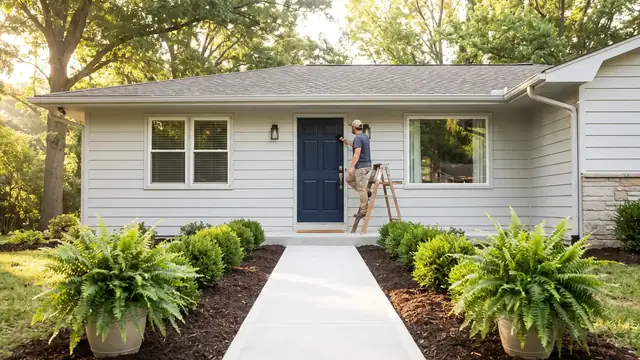
How to improve your home’s curb appeal before you list
Discover how to improve your home’s curb appeal with paint, cleaning, landscaping and lighting upgrades that photograph well and bring buyers to the door.

12-minute read
Benefits of a pre-listing home inspection: what sellers gain
See how a pre-listing home inspection helps you price accurately, control repairs and avoid renegotiation, plus what it costs and when to order one.
