
A guide to low-down-payment mortgages: your options from 0% to 3.5%
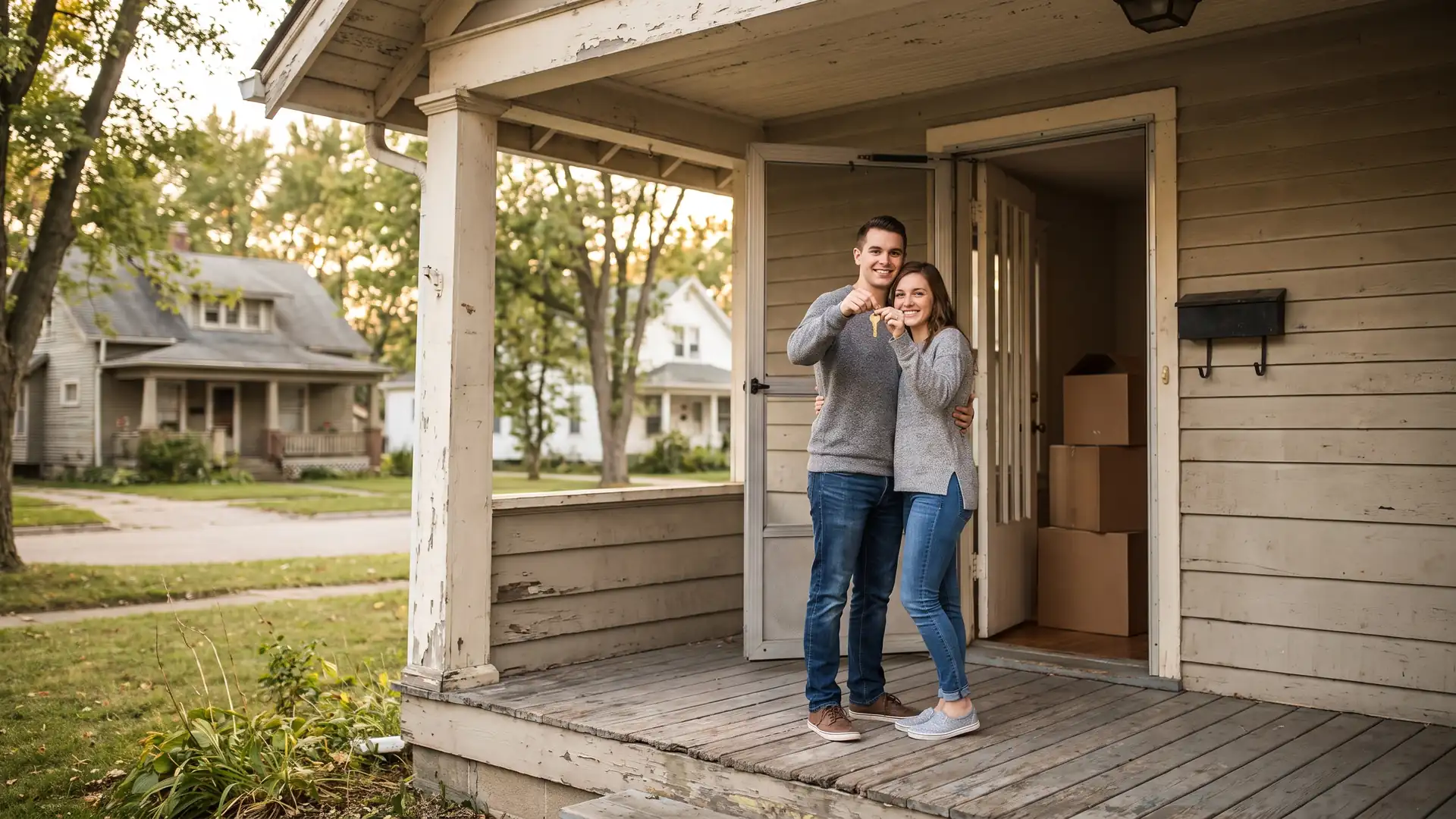
You do not need 20% down to buy a home. Four mainstream programs cover almost every low-down-payment buyer: conventional loans starting at 3% down, FHA loans at 3.5% down with a credit score of 580 or higher, and VA and USDA loans at 0% down for eligible military borrowers and buyers in eligible rural areas. On a $250,000 house, that’s $7,500, $8,750 or nothing at all at the closing table.
The trade-off is mortgage insurance or a guarantee fee. Conventional private mortgage insurance comes off at an equity threshold federal law sets; FHA’s annual premium generally runs the full loan term at the 3.5% minimum.
Learn how each low-down-payment mortgage works, what credit score each asks for, what the mortgage insurance costs and when it stops. For the wider menu, start with our Loan Types & Programs guide.
Key takeaways:
- Four programs, three floors: Conventional loans start at 3% down and FHA at 3.5%, while VA and USDA finance up to 100% for buyers who qualify, $7,500, $8,750 or $0 on a $250,000 home.
- Mortgage insurance is the real cost difference: Conventional PMI must terminate automatically at 78% of the home’s original value, while FHA’s annual premium runs the full 30-year term at the 3.5% minimum and stops after 11 years only with at least 10% down.
- The cash gap is smaller than the percentage suggests: Gift funds can cover the entire down payment on a one-unit primary residence, and Michigan’s MI 10K DPA adds up to $10,000 more.
What counts as a low-down-payment mortgage?
A low-down-payment mortgage is any home loan that lets you buy a primary residence with less than 20% down in practice, 0% to 10% of the purchase price. The 20% figure was never a legal requirement. It is simply the loan-to-value threshold at which a conventional lender stops requiring private mortgage insurance.
Three things change below 20%. You pay mortgage insurance or a guarantee fee until you hit the program’s exit point, you build equity more slowly at first, and you take on program rules, income caps, location rules, service eligibility, a 20%-down buyer never sees. Our companion piece on buying a home with a low down payment takes the same programs from the cash-to-close angle.
The four low-down-payment programs, side by side
Almost every buyer with less than 20% ends up in one of four programs, and the fastest way to narrow the field is to read the eligibility column first. VA and USDA are the cheapest, but you either qualify or you don’t.
| Program | Minimum down | Minimum credit score | Mortgage insurance | How the insurance ends | Best for |
|---|---|---|---|---|---|
| Conventional 97, HomeReady, Home Possible | 3% | 620 for manually underwritten fixed-rate loans; no stated minimum through Desktop Underwriter | Private mortgage insurance (PMI) | By your request at 80% of original value; automatically at 78% | Buyers with solid credit who want the insurance to end |
| FHA | 3.5% at 580+; 10% at 500 – 579 | 580 for 3.5% down; 500 is the absolute floor | 1.75% upfront premium plus an annual premium | Runs the loan term above 90% LTV; 11 years at 90% LTV or below | Buyers with lower or thinner credit |
| VA | 0% when the price doesn’t exceed the appraised value | VA sets none; your lender sets its own | None, a one-time funding fee instead | No monthly insurance to cancel | Eligible veterans, service members and surviving spouses |
| USDA Section 502 Guaranteed | 0% | USDA sets none; 640 meets its credit reputation standard, and below that triggers a cautious manual underwrite | Upfront guarantee fee plus an annual fee | The annual fee runs the life of the loan | Moderate-income buyers in eligible rural areas |
Two ceilings sit above all four, and both are rewritten every year. FHFA resets the conforming loan limit annually. The 2026 one-unit baseline is $832,750, with a high-cost ceiling of 150% of that. FHA derives its limits from the same number, setting its floor at 65% of the conforming baseline and its ceiling at 150%, which put FHA’s 2026 one-unit floor at $541,287. Check the current year’s tables before assuming a price fits; our Loan Comparisons hub goes deeper.
Conventional loans at 3% down
Conventional 3%-down financing comes in three flavors, and the difference is who’s allowed to use it. Fannie Mae’s standard 97% LTV option requires at least one borrower to be a first-time home buyer but imposes no income limit. HomeReady and Freddie Mac’s Home Possible drop the first-time requirement and instead cap qualifying income at 80% of area median for the property’s location, in exchange for reduced mortgage insurance coverage. Fannie Mae’s HomeReady 3%-down program lists current parameters; we break both down in what is a Conventional 97 loan and HomeReady mortgages.
Be careful with the credit number you’ve probably read. Fannie Mae’s 620 minimum representative score applies to manually underwritten fixed-rate loans; casefiles run through Desktop Underwriter carry no stated minimum, because DU weighs credit risk on its own factors, and most 3%-down approvals go through automated underwriting.
FHA loans at 3.5% down
FHA ties your down payment directly to your credit score.1 A minimum decision credit score of 580 or above qualifies for maximum financing at 96.5% loan-to-value, 3.5% down. A score between 500 and 579 caps you at 90% LTV, or 10% down. Below 500, you aren’t eligible for FHA-insured financing at all. Confirm current terms in HUD’s overview of FHA loan requirements; our FHA loan tips cover thin files.
VA loans at 0% down
VA is the only program here with no down payment and no monthly mortgage insurance.2 Eligible veterans, service members and certain surviving spouses can finance 100% of the purchase price when it doesn’t exceed the appraised value. VA sets no minimum credit score; the lender does. Which is why shopping lenders matters more on a VA file than any other. See VA home loan program details for eligibility and the Certificate of Eligibility.
USDA loans at 0% down
USDA’s Section 502 Guaranteed program finances up to 100% of the purchase price for households at or below 115% of area median income in an eligible rural area. “Rural” is broader than most Michigan buyers assume, and eligibility is address-specific, so check the map first. Our guide to government-backed loans covers how VA, USDA and FHA differ underneath.
How much does mortgage insurance actually cost, and when does it stop?
Duration is what separates the programs: conventional PMI ends, and FHA’s annual premium usually doesn’t. That distinction is worth more over 30 years than the half-point gap in minimum down payment.
- Conventional PMI ends at a fixed equity line: Under the federal Homeowners Protection Act, you can request cancellation once the balance reaches 80% of the home’s original value, and your servicer must terminate PMI automatically when the balance is first scheduled to reach 78%, provided you’re current. “Original value” is the lower of your contract price or the purchase appraisal.
- FHA charges twice, and the annual charge usually stays: Every FHA loan carries an upfront premium of 1.75% of the base loan amount, normally financed rather than paid in cash, plus an annual premium collected monthly, 0.55% above 95% LTV on a 30-year term with a base loan amount of $726,200 or less, per HUD Mortgagee Letter 2023-05. Duration follows your starting LTV, not equity you build later: above 90% LTV it runs the mortgage term; at 90% or below it stops after 11 years.
- VA replaces insurance with one fee: For loans closed on or after April 7, 2023, VA’s funding fee on a first-use purchase with less than 5% down is 2.15% of the loan amount, dropping to 1.5% at 5% down and 1.25% at 10%; subsequent use under 5% down runs 3.3%. Borrowers receiving VA compensation for a service-connected disability, among other categories, are exempt entirely.
- USDA splits the cost in two: USDA charges an upfront guarantee fee plus an annual fee instead of mortgage insurance. Statute caps them at 3.5% upfront and 0.5% annually, and USDA sets the actual rates each fiscal year well below those ceilings, 1% and 0.35% in recent years. Because they can reset every October 1, confirm the current schedule with USDA Rural Development.
Put numbers on it. On a $250,000 Waterford home, a 3.5%-down FHA buyer puts $8,750 down on a $241,250 base loan, adds about $4,222 of upfront premium to the balance, and pays roughly $111 a month in premium in year one for the life of the loan.3 A 3%-down conventional buyer puts $7,500 down and pays PMI priced off credit score and loan-to-value, so ask for the real quote. The durable difference isn’t the monthly figure. It’s that one of them ends.
Where the down payment money actually comes from
Most low-down-payment buyers don’t fund the whole thing out of savings, and the programs assume as much. Two sources do the heavy lifting.
- Gift funds can cover 100% of it: On a one-unit principal residence, Fannie Mae requires no minimum contribution from the borrower’s own funds, so the entire down payment can be a gift. The donor must be a relative or someone with a documented familial-like relationship, must sign a gift letter stating the money is not a loan, and cannot be the builder, developer, agent or any other interested party. FHA’s donor list is broader: family, your employer or labor union, a close friend with a documented interest in you, a charity, or a government homeownership program. Our gift funds guide covers the paperwork.
- Down payment assistance stacks on top: State and local programs supply grants, forgivable loans and deferred second mortgages toward your down payment and closing costs. They’re underwritten with the loan at application, not bolted on at closing, so raise them early.
If neither applies yet, run the savings math first: how to save for a down payment sets the target for each program at several price points.
How to choose between the four
Work the decision in this order and it usually resolves in one pass:
- Check eligibility before price: With VA entitlement, VA almost always wins, zero down, no monthly insurance. If the address is USDA-eligible and income sits at or below 115% of area median, USDA is the next-cheapest zero-down door.
- Then compare the insurance exit, not the monthly figure: If your credit supports conventional pricing, PMI that terminates at 78% of original value usually beats FHA’s lower entry bar. Below 620, FHA’s 580 threshold may be the only path.
- Then count all the cash: The gap between 3% and 3.5% down is $1,250 on a $250,000 home, often smaller than the closing-cost spread between two lenders on the same file.
- Keep the rate structure separate: A 3%-down loan can be fixed or adjustable, see fixed- vs. adjustable-rate mortgage (ARM) before assuming one is safer. Because Align is a broker, we place all four through partner lenders, including USDA, which many retail banks don’t offer.
What Michigan buyers should know
Michigan is unusually simple on loan limits and unusually specific on down payment help.
- One conforming limit statewide, and one FHA limit: No Michigan county carries a high-cost adjustment in the 2026 tables, so all 83 counties sit at the $832,750 conforming baseline and at FHA’s national floor of $541,287 for a one-unit home. Above $541,287 in Michigan, FHA stops reaching, but conventional does, and so does a VA loan for a borrower with full entitlement, since VA caps guaranty rather than loan size.
- MI Home Loan carries a 640 credit floor and a $566,355 sales price limit: The Michigan State Housing Development Authority’s first mortgage is open to first-time buyers statewide and repeat buyers in targeted areas, and can be structured as conventional, FHA, VA or USDA financing. The statewide sales price limit took effect June 1, 2026. FHA alone goes to 580; adding state assistance raises the bar to 640.
- MI 10K DPA adds up to $10,000, but only behind MSHDA’s own first mortgage: It covers down payment, closing costs and prepaids as an interest-free, non-amortizing loan with no monthly payment, deferred until you pay off, sell, refinance or move out. It requires an MI Home Loan and a homebuyer education certificate. It won’t attach to a Conventional 97.
- Income limits are county-specific and move on MSHDA’s schedule: MSHDA publishes income limits by county and household size, higher in federally targeted areas, on the same table that sets the sales price limit. Program funding moves too, the First-Generation assistance pilot has closed to new applications, so confirm current status with MSHDA.
The trade-off is where a broker earns their keep: MSHDA gives you $10,000 and a defined first mortgage; a Conventional 97 gives you a wider menu of lenders competing on price. Price both. Our roundup of first-time home buyer grants and programs covers what else stacks.
How Align compares your options
Samantha lays out your real options side by side, with the same numbers in each column, before you choose. Not the product we prefer, the one that fits.
A 2024 Polygon Research analysis of federal mortgage data found broker borrowers paid about $10,662 less over the life of a $400,000 loan than borrowers at nonbank retail lenders.
Already have an offer from one of the big national lenders you see advertised? Bring us the Loan Estimate. We will compare it line by line and show you where we can do better.
FAQ: Low-down-payment mortgages
Here are answers to common questions about low-down-payment mortgages.
Can I buy a home with no money down?
Yes, through two government programs. VA loans offer 100% financing to eligible veterans, active-duty service members and some surviving spouses, with no monthly mortgage insurance. USDA loans offer 100% financing in eligible rural and many suburban areas, subject to household income limits. Both charge an upfront fee that can usually be rolled into the loan amount rather than paid in cash, and USDA adds an annual fee on top. Our guide to government-backed loans compares the two on eligibility.
Do low-down-payment mortgages cost more in the long run?
Monthly, yes, you borrow more and you pay mortgage insurance or a guarantee fee until you reach the cancellation threshold. Over the long run it is less clear, because waiting years to save 20% means paying rent and buying at whatever prices and rates arrive later. Compare the cost of the insurance against the cost of the delay on your own numbers, using how to save for a down payment as the baseline.
Can I use gift funds for a low down payment?
Most programs allow it. Conventional, FHA, VA and USDA loans all permit gifts from acceptable donors, generally close family members, with FHA also allowing certain employers, labor unions and charitable organizations. You’ll need a signed gift letter stating the money is not a loan, plus documentation showing the transfer. Talk to your loan officer before the money moves, our guide to gift funds shows what underwriting will ask for.
What credit score do I need for a low-down-payment mortgage?
FHA allows 3.5% down at 580 and 10% down between 500 and 579. Conventional 3%-down loans use a 620 minimum representative score when manually underwritten, with no stated minimum through automated underwriting. USDA lenders commonly look for 640 for streamlined processing. VA sets no minimum at all, though individual lenders impose their own. Requirements vary by lender, which is why shopping matters, see our FHA loan tips for how to strengthen a borderline file.
The bottom line on low-down-payment mortgages
You do not need 20% down. Conventional loans start at 3%, FHA at 3.5% with a 580 credit score, and VA and USDA at 0% for eligible buyers, $7,500, $8,750 or $0 on a $250,000 home. The cost is mortgage insurance or a guarantee fee, and what matters most is not the premium but the date it stops: conventional PMI terminates automatically at 78% of original value, while FHA’s runs the full loan term at the 3.5% minimum. Gift funds and assistance shrink the cash you actually need.
If you’re ready to find out which low-down-payment program costs you the least, talk to Align Lending, we’ll shop your scenario across our lender network and put conventional, FHA, VA and USDA pricing in front of you side by side. Call 248-506-5727 or start online today.
Footnotes:
1. Align Lending is not acting on behalf of or at the direction of FHA or HUD. FHA credit score, loan-to-value, mortgage insurance premium and loan limit requirements are set by HUD and are subject to change. Return to text.
2. Align Lending works with VA-approved lenders and is not endorsed or sponsored by the Dept. of Veterans Affairs or any government agency. VA eligibility, entitlement and funding fee rules are set by the Department of Veterans Affairs and are subject to change. Return to text.
3. Example figures are hypothetical and for educational purposes only; they do not constitute an advertisement of credit terms or a rate quote under federal or state lending laws. Your down payment, mortgage insurance premium, fees and monthly payment depend on your application, program, property and market conditions, and will be itemized on your Loan Estimate. Return to text.
Figures current as of August 2026; verify current limits with the linked source before relying on them.
Sources: 2026 conforming loan limit values, one-unit baseline of $832,750 and a ceiling of 150% of the baseline, Federal Housing Finance Agency, 2026 conforming loan limit values announcement. FHA forward mortgage limit floor of 65% and ceiling of 150% of the national conforming limit, and a 2026 one-unit floor of $541,287, U.S. Department of Housing and Urban Development, Mortgagee Letter 2025-23, “2026 Nationwide Forward Mortgage Loan Limits.” FHA maximum financing at 96.5% LTV for minimum decision credit scores of 580 and above, 90% LTV for scores of 500 to 579, and ineligibility below 500, HUD Single Family Housing Policy Handbook 4000.1. FHA upfront mortgage insurance premium of 1.75% of the base loan amount, an annual premium of 0.55% on terms over 15 years above 95% LTV for base loan amounts of $726,200 or less, and annual premium durations of the mortgage term above 90% LTV and 11 years at 90% LTV or below, HUD Mortgagee Letter 2023-05 and Handbook 4000.1 Appendix 1.0. Fannie Mae standard 97% LTV requiring at least one first-time home buyer with no income limit; HomeReady at 97% LTV, 3% down and qualifying income at or below 80% of area median income; and no minimum borrower contribution on a one-unit principal residence, Fannie Mae Selling Guide and HomeReady product materials. Minimum representative credit score of 620 for manually underwritten fixed-rate loans (640 for manually underwritten ARMs) and no minimum credit score for Desktop Underwriter loan casefiles, Fannie Mae Selling Guide B3-5.1-01. PMI cancellation by borrower request at 80% of original value and automatic termination at 78% of original value when current, and the definition of original value, Homeowners Protection Act; Consumer Financial Protection Bureau. VA funding fee of 2.15% on a first-use purchase with less than 5% down, 1.5% at 5% down, 1.25% at 10% down and 3.3% on subsequent use with less than 5% down, effective for loans closed on or after April 7, 2023, plus exemption categories and the absence of monthly mortgage insurance, U.S. Department of Veterans Affairs. USDA Single Family Housing Guaranteed Loan Program income limit of 115% of area median income, no down payment requirement, and statutory fee ceilings of 3.5% upfront and 0.5% annually for the life of the loan, USDA Rural Development; FDIC Affordable Mortgage Lending Guide. MSHDA MI Home Loan minimum credit score of 640 and statewide sales price limit of $566,355 effective June 1, 2026; MI 10K DPA of up to $10,000 as an interest-free non-amortizing loan requiring an MI Home Loan first mortgage and homebuyer education, Michigan State Housing Development Authority.
This article is for informational purposes only and is not intended to provide legal, financial, or tax advice. Loan program requirements, mortgage insurance premiums, funding and guarantee fees, loan limits and state assistance program terms change and vary by borrower, property and county; confirm your figures with the program source and your Loan Estimate, and consult a qualified professional about your situation. Figures shown are illustrative, are not a rate quote or an offer of credit, and are subject to change. Align Lending is an independent Michigan mortgage broker, NMLS #2041154.
Related resources

12-minute read
Guide to government-backed loans: FHA, VA, and USDA options
Compare government-backed loans (FHA, VA, and USDA) on down payment, credit, and loan limits, and find out which program opens the door to your first home.
3-minute read
Home Sweet Affordable: Your Complete Guide to Freddie Mac’s Home Possible Loans in 2025
Explore Freddie Mac’s Home Possible loans, their benefits, and mortgage requirements. Start your journey now!
