
Pros and cons of investing in mobile home parks and manufactured homes
This article is general education about a property type. It is not tax, legal or investment advice, and not an offer to sell or a solicitation to buy any security. Take depreciation and basis questions to a qualified tax professional, and titling, lot-lease and licensing questions to a Michigan attorney. Align Lending is an independent Michigan mortgage broker financing one- to four-unit residential property, not a commercial lender, syndicator, property manager, broker-dealer or investment adviser.
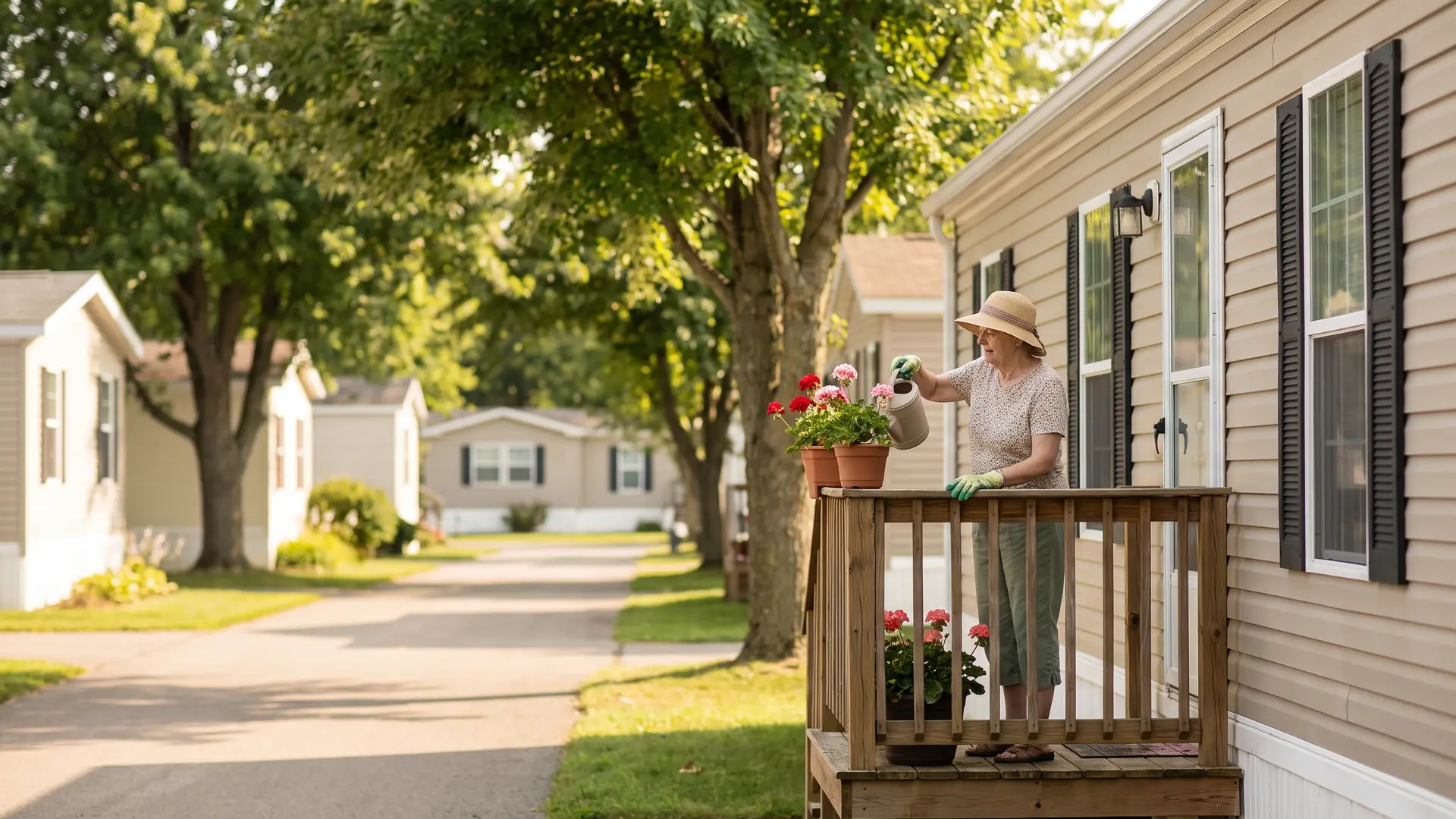
One question decides almost everything about manufactured housing as an investment: is the home titled as personal property, or has it been converted to real property along with the land? In 2025, 72% of new manufactured homes placed for residential use were titled as personal property and just 22% as real estate, per the Census Bureau and HUD’s Manufactured Housing Survey.
That split is not a technicality. Analyzing 2019 mortgage disclosure data, the Consumer Financial Protection Bureau found a median interest rate of 8.6% on chattel loans, secured by the home alone, against 4.9% on manufactured-home mortgages secured by home and land together. Two identical homes, two different asset classes.
A second decision sits on top: whether you buy homes inside someone else’s community, or buy the community and rent the lots. Learn how the pros and cons of investing in mobile home parks really break down, title, lot rent risk, chattel terms and Michigan’s rules. New to the category? Start with our Real Estate Investing guide or the Investment Property Types hub.
Key takeaways:
- Title governs the whole deal: 72% of new manufactured homes placed in 2025 were titled as personal property rather than real estate, and personal-property title is what pushes a buyer into a chattel loan instead of a mortgage.
- Chattel money costs more and runs shorter: In 2019 lending data the CFPB found a median rate of 8.6% on chattel loans against 4.9% on manufactured-home mortgages, and a median chattel term of 23 years against 30.
- Lot rent is the risk you never control: About 26% of new manufactured homes placed in 2025 went onto land-leased community sites, and Michigan law requires just cause to evict a park tenant but does not stop an operator from changing the rent once a written lease ends.
What makes manufactured housing different from every other property type?
Its title, not its construction. A manufactured home starts life as personal property, the same legal category as a vehicle, and stays there unless someone deliberately affixes it to land and converts it to real property. No other residential asset class works this way. The vocabulary matters because lenders and assessors use it precisely.
- Manufactured home: A structure transportable in one or more sections, at least 8 body feet wide or 40 body feet long, or 320 or more square feet when erected on site. HUD’s definition in 24 CFR 3280.2 still requires a permanent chassis, but since Public Law 119-101 of July 11, 2026 the statute at 42 U.S.C. 5402 reads “with or without a permanent chassis.”
- Mobile home: Strictly, a pre-Code unit. HUD’s construction and safety standards apply to homes entering the first stage of production on or after June 15, 1976, so an older home was never built to the HUD Code at all. Many lenders will not finance one.
- Modular home: Built to state and local building codes rather than the HUD Code, and normally titled as real property from day one. Different animal, different financing, covered in trends in modular housing markets and the benefits of modular homes.
The cost gap is why anyone looks. New manufactured homes averaged $123,300 in 2024 at about 1,460 square feet, roughly $84 per square foot, while new site-built homes averaged $514,500 with land and about $169 per square foot excluding land, per the Census Bureau’s Manufactured Housing Survey annual data.
How does a chattel loan differ from a mortgage on the same home?
A chattel loan is secured by the home only; a mortgage is secured by the home and land together, which is why it prices like real estate. In the CFPB’s analysis of 2019 manufactured housing lending, the median chattel rate was 8.6% against 4.9% for manufactured-home mortgages and 4.1% for site-built, and 93.8% of chattel loans were classified as higher-priced against 11.1% of site-built loans.1
| Feature | Chattel loan (home titled as personal property) | Mortgage (home converted to real property) |
|---|---|---|
| What secures it | The home alone | The home and the land together |
| Median interest rate, 2019 data | 8.6% | 4.9% |
| Median loan term, 2019 data | 23 years | 30 years |
| Share classified higher-priced, 2019 data | 93.8% | 52.4% |
| Land requirement | The home may sit on a rented lot | Fannie Mae requires the borrower to own the land, with a narrow condo or PUD ground-lease exception |
The agency rules are explicit about conversion. Fannie Mae’s Selling Guide requires the home to be legally classified as real property under applicable state law and attached to a permanent foundation meeting state affixation requirements. FHA’s rule at 24 CFR 203.43f goes further: the mortgage must cover the home and the site, the property must be classified and taxed as real estate, the towing hitch and running gear must have been removed, and the term cannot exceed 30 years. Both rules describe a home that has become real property; neither reaches a home still titled as personal property on a rented lot.2
- Owning the land is not the same as having a mortgage: More than 60% of manufactured housing borrowers own their land, yet 17% of them still took a chattel loan. Eligibility for the cheaper loan is not the same as getting it.
- Chattel debt is hard to escape: Fewer than 4% of chattel originations in 2019 were refinances, against about 44% for site-built, so a high fixed rate tends to stay put, which changes how real estate leverage behaves here.
What are the pros of investing in mobile home parks?
The strongest argument is structural: in a lot-rent community you own dirt, roads and utility lines while residents own the buildings. That inverts the usual landlord cost stack, because the failure-prone part of a rental is somebody else’s asset.
- Repair responsibility sits with the resident: Roofs, furnaces, water heaters and interior turnover are not your capital budget when the home belongs to the household. That is a different expense profile from the one in evaluating a property’s cash flow potential.
- Turnover is unusually low: Moving a manufactured home means transport permits, heavy equipment, setup and utility reconnection, and it often costs more than a household has. Residents who dislike a rent increase usually pay it, which is precisely why tenant-protection questions here are serious ones.
- The housing on your lots is cheap to replace: A new single-section home averaged $85,600 nationally in 2025 and a double-section $157,100, per the Census Bureau. That is the resident’s cost, not yours, in a lot-rent community, but it is what a vacant lot has to attract, and what you would pay if you ever bought park-owned homes.
- Land improvements depreciate even though land does not: Roads, fences and shrubbery fall in the IRS 15-year property class when they are depreciable at all, faster than the 27.5 years for residential rental buildings. Land itself is never depreciable.3
- Demand is durable: Shipments ran about 102,700 homes in 2025, and manufactured housing is about 6% of occupied housing stock and the largest source of unsubsidized affordable housing in the country, per the CFPB.
Notice what is missing: appreciation. A home titled as personal property has no land beneath it and behaves more like a depreciating durable good than the asset described in real estate appreciation. Here the appreciation case belongs to the land, which means to the community owner, not the home owner.
What are the cons of investing in mobile home parks?
The central risk is lot rent, and it points at whichever side you are not on. Own homes on rented lots and an operator can raise the rent while you cannot move the collateral. Own the community and you set a rent residents cannot escape, which invites regulatory and reputational risk.
- Lot rent compounds against a fixed payment: Hypothetical example, not an offer: a $475 monthly lot rent rising 5% a year reaches about $606 by year five, roughly $1,570 more annually, while a fixed-rate chattel payment does not move at all.4
- Chattel financing is expensive and sticky: The 8.6% versus 4.9% median gap in 2019 data is no rounding error, and borrowers who take that rate usually keep it.
- Pre-1976 homes are a financing dead end: The federal standards reach only homes produced on or after June 15, 1976. A true pre-Code mobile home is hard to finance, hard to insure, and hard to replace when a municipality will not permit a new unit on the site.
- Private utility infrastructure is the buried liability: Older communities often run their own water lines, septic fields or lagoons and their own roads. A failure is a six-figure capital event with no rent increase behind it, and it belongs at the center of real estate due diligence.
- Park-owned homes re-import what you avoided: Company-owned homes raise gross revenue but hand back repair, turnover and habitability duties.
- The exit pool is thin: Homes on rented lots sell to a small set of cash and chattel buyers; communities sell to a small set of commercial buyers. Both are less liquid than the market in how to spot a good real estate deal.
Can an investor use FHA, Fannie Mae or Title I financing on a manufactured home?
Generally not for a pure rental: the three main federal channels for manufactured home credit are written around the person who lives in the home.
- Fannie Mae: Selling Guide B5-2-02, dated December 10, 2025, lists the occupancy types Fannie Mae buys on manufactured homes as principal residences (single- and multi-width) and second homes (multi-width only). Investment property is not on that list.
- FHA Title II mortgages: HUD’s Single Family Housing Policy Handbook 4000.1 states that investment properties are not eligible for FHA insurance, with an exception for HUD-approved nonprofit borrowers. The handbook update HUD posted on August 12, 2026 repeats the occupancy rule: according to the Handbook 4000.1 update redline, at least one borrower must occupy the property within 60 days of signing the security instrument and intend to keep living there for at least one year.
- FHA Title I manufactured home loans: HUD’s February 28, 2024 final rule in the Federal Register restates the program’s core condition: the manufactured home must be used as the principal residence of the borrower.
A home you plan to rent from day one sits outside all three programs, so price the deal on the financing you can actually get. Owner-occupant trade-offs are in manufactured homes pros and cons, the federal program basics in our FHA loans guide, and what Align can finance for a home converted to real property on the manufactured home loans page.
Should you own homes in a community, or own the community itself?
Two different businesses. Owning individual homes is a small-ticket personal-property business. Owning the community is commercial real estate, financed as business-purpose credit.
| Question | Owning homes on rented lots | Owning the community |
|---|---|---|
| What you actually own | Structures titled as personal property | Land, roads, utility infrastructure and lot leases |
| Typical financing | Chattel loans, or a mortgage only after conversion to real property | Commercial credit, or agency multifamily programs at scale |
| Who controls lot rent | The community operator | You, subject to state law and the lease |
| Biggest single risk | Lot rent increases you cannot escape | Aging private water, sewer and road infrastructure |
| Consumer lending protections | Generally apply to owner-occupant consumer credit | Do not apply; business-purpose commercial credit sits outside them |
That last row is the one investors get wrong most often. The Loan Estimate, the Closing Disclosure and the Truth in Lending and RESPA protections behind them do not attach to a business-purpose loan. What you get instead is a negotiated structure: a maturity shorter than the amortization schedule, a balloon payoff and debt-service-coverage underwriting rather than a debt-to-income ratio, set lender by lender rather than by an agency guideline. See commercial real estate investing, and net operating income for the figure that gets underwritten.
If the appeal is several rent checks under one ownership, weigh this against small multifamily, where residential financing still reaches four units: see investing in multi-family properties and buying a multi-family home. Align Lending finances one- to four-unit property, including a manufactured home converted to real property that meets agency requirements. We do not lend on manufactured home communities.
What lease protections come with agency financing for a community?
If you buy a community with Fannie Mae or Freddie Mac multifamily money, your lot leases come with federal conditions. FHFA’s Duty to Serve regulation at 12 CFR 1282.33(c)(4) gives the enterprises credit for financing communities whose pad leases carry at least these protections, or that sit under state or local laws that equal or exceed them:
- A one-year renewable lease term unless there is good cause for nonrenewal.
- Thirty-day written notice of rent increases.
- A five-day grace period for rent payments and a right to cure defaults on rent.
- The right to sell the home without first relocating it out of the community, the right to post “For Sale” signs, and the right to sublease or assign the pad lease to the buyer of the home without unreasonable restraint.
- The right to sell the home in place within a reasonable time after an eviction by the community owner.
- At least 60 days advance notice of a planned sale or closure of the community.
In its 2023 Duty to Serve report, dated March 15, 2024 and published by FHFA, Fannie Mae reported financing 331 manufactured housing community properties with tenant site lease protections, totaling 61,833 pads and $2.875 billion in mission-adjusted unpaid principal balance, and described full implementation of the protections as a standard condition of its community business. The same report estimated that overall community transactions fell about 20% in 2023.
The report also flags a dispute that matters to home investors: Fannie Mae believes the sublease protection applies only when a home is sold, while some market participants read it to cover third-party investors who buy homes, lease them out and sublease the pad. Read the community’s lease before you buy, and see becoming a landlord and rental management for the duties that come with a renter in the home.
How do depreciation and land basis work in manufactured housing?
Land is never depreciable, which is the first line of any honest projection here. The IRS states that you cannot depreciate the cost of land because it does not wear out, and that when a purchase price covers both land and buildings you must divide the cost between them to figure basis.5
- Residential rental buildings recover over 27.5 years, land improvements over 15: Roads, fences and shrubbery sit in the 15-year class when depreciable, per IRS Publication 527.
- Personal-property title complicates it: Whether a home you rent out while it is titled as personal property is depreciated as residential rental property or as tangible personal property depends on the facts. That is a CPA question, not a broker question.
- Every allocation needs support: A depreciation schedule is only as defensible as the land-versus-improvements split behind it. See real estate depreciation.
What did the July 2026 federal housing law change for manufactured homes?
The 21st Century ROAD to Housing Act, Public Law 119-101, signed July 11, 2026, includes a title called Manufactured Housing for America.
- The chassis requirement left the statute: Section 301 struck “on a permanent chassis” from the federal definition in 42 U.S.C. 5402(6) and inserted “with or without a permanent chassis.” It also directs HUD, working with its consensus committee, to issue revised construction standards for homes built without a permanent chassis. Until HUD does, its regulatory definition in 24 CFR 3280.2 still reads “built on a permanent chassis,” as published on eCFR in November 2026.
- Title I was rewritten: Section 303 replaced the program’s statutory loan limits with new ones, set separate limits for single-section and multi-section homes with and without a lot, and let HUD set the loan term up to 30 years. HUD has one year from enactment to choose a new indexing method; until it does, the index set by the 2024 rule keeps applying.
Neither change alters the occupancy rules above or Michigan’s title and tax statutes.
What Michigan investors should know
Michigan regulates this category by statute in ways most states do not, and four provisions change the math. New manufactured homes sold in Michigan averaged $107,800 in 2025, with single-section units at $81,200 and double-section at $145,900.
- Operating a community requires a state license: Under the Mobile Home Commission Act, 1987 PA 96, MCL 125.2301 and following, no one may operate a mobile home park without a license. It runs three years, costs $225.00 plus $3.00 for each home site above 25, or any lesser amount the state sets under section 9(5) of the act, and requires the park to have been found in substantial compliance at its last inspection. The act also licenses dealers and installers.
- Homes in a licensed park pay a $3.00 monthly specific tax, not property tax: MCL 125.1041 requires the licensee to collect and remit $3.00 per month per occupied home, expressly in lieu of property tax on the home under the General Property Tax Act. That is $36.00 a year, which is why conversion to real property changes an owner’s tax picture so sharply.
- Conversion happens by affidavit of affixture: Under MCL 125.2330i, an owner who affixes a home to land they own files the affidavit, the state cancels the certificate of title, the home becomes part of the real property, existing security interests terminate, and future liens must be perfected as real property liens. The affidavit is recorded with the register of deeds, and detaching later requires a recorded affidavit of detachment and a new title first.
- Just cause is required to evict, but not to raise rent: MCL 600.5775 bars terminating a park tenancy without just cause and lists the grounds. Subsection (3) then states the section does not prohibit a change of the rental payments or the terms or conditions of tenancy following termination or expiration of a written lease. Read those two together before underwriting a lot lease.
Much of this stock sits in Michigan’s rural counties.
What does it take to build or expand a mobile home park in Michigan?
A state permit to construct, issued only after a stack of local approvals. According to LARA’s Mobile Home Section, building a new park, expanding or reducing an existing one, or altering one requires plan approval and a permit to construct from the Bureau of Construction Codes’ Building Trades Section, not the Mobile Home Section itself.
- Local sign-offs come first: Before applying, the developer obtains preliminary approvals from the local health department, the county road commission, the county drain commissioner and the municipality, plus a construction plan approval for water and sewer. The application adds sealed construction documents, easements, a soil analysis report and evidence of title.
- Private water can make you a regulated utility: Under the EPA’s definition, a system that pipes drinking water to at least 15 service connections, or serves an average of at least 25 people for at least 60 days a year, is a public water system, and one serving the same population year-round is a community water system. A park well serving 15 or more connected homes meets that test on its face.
On an existing park, ask the seller for the permit to construct and the water and sewer approvals behind its last expansion.
What happens to a home after a Michigan park wins an eviction case?
The home stays the owner’s property, and the statute sets a clock for removing or selling it. The Michigan Judicial Institute’s Landlord-Tenant Benchbook explains that park terminations are governed by MCL 600.5771 to MCL 600.5785, and summarizes the timelines that follow a judgment:
| Step | Timeline | Statute cited by the benchbook |
|---|---|---|
| Tenant pays after a written demand for nonpayment | Within 7 days of service | MCL 600.5714(1)(a) |
| Tenant asks for an in-person conference after a just-cause demand | Within 10 days, by certified or registered mail | MCL 600.5777 |
| Owner sets the conference date | Within 20 days of the request | MCL 600.5777 |
| Owner may disconnect park-supplied utilities | After 10 days from the judgment of possession | MCL 600.5781(c) |
| Tenant sells or moves the home | 90 days from the judgment, extended if the owner denies tenancy to a bona fide buyer | MCL 600.5781(a) |
Source: Michigan Judicial Institute, Landlord-Tenant Benchbook, Mobile Homes, as opened November 2, 2026.
The benchbook adds that the tenant must provide proof of winterization by a licensed installer and repairer, or the owner may seek an immediate writ of restitution. Michigan Legal Help, the state’s nonprofit self-help site, puts the ownership point plainly in its guide to mobile home park evictions: if the home is left in the park, the park does not become its owner. For a community owner, those 90 days are part of underwriting a vacancy. For someone who owns homes on rented lots, they are the window to sell in place, and a clean title matters then: see why title insurance is important.
How Align matches lenders to rentals
Lenders treat a duplex, a condo rental and a short-term rental very differently. Some count projected rent, some want a signed lease, and some will not finance the property at all.
Because Align is a broker, Samantha takes your file to the wholesale lender whose rules fit the property you actually want to buy. One application, multiple lenders.
FAQ: Mobile home park investing
Here are answers to common questions about investing in mobile home parks and manufactured homes.
How much does it cost to buy a mobile home park?
It depends on lot count, lot rent and infrastructure condition rather than any price per square foot. Small communities in secondary markets are the usual entry point for individual investors. Because a community is commercial real estate, expect commercial terms rather than agency pricing, and expect utility systems to move price more than curb appeal. Work the income side using cash flow in real estate.
What is the biggest risk in mobile home park investing?
Private utility infrastructure. Older communities often run their own water lines, septic systems or lagoons and their own roads, and a failure can be a six-figure capital event with no rent increase behind it. Order an infrastructure inspection and pull the municipality’s violation history before you are under a loan clock. See how to find undervalued properties for where deferred capital hides.
Should I buy a park with park-owned homes?
Be cautious. Park-owned homes raise gross revenue but hand back the repair, turnover and habitability duties that make lot-only ownership attractive. Many operators buy such communities specifically to sell the homes to residents and convert the income to lot rent, a business plan with execution risk. Model both versions using cash-on-cash return.
Can you get a conventional mortgage on a mobile home park?
No. A community is commercial real estate, so financing comes from commercial lenders or agency multifamily programs, not the one- to four-unit residential market. A single home is different: once it is legally classified as real property under state law, attached to a permanent foundation and titled with the land, agency financing becomes possible. See buying a home as an investment property.
Do mobile homes go up in value?
Not reliably on their own, because a home on a rented lot has no land behind it. Even new-home prices move both ways: the average new manufactured home sold in Michigan was $116,000 in 2024, then lower in 2025, according to the Census Bureau’s average sales price by state table. Any appreciation case usually rests on the land, so price a lot-rent home as a durable good that wears.
Can a Michigan mobile home park raise lot rent to push someone out?
Not legitimately, according to Michigan Legal Help, the state’s nonprofit self-help site. Its guide to mobile home park evictions says a park may raise the rent at the end of a lease, but not in an excessive way meant to force the tenant out. For an investor on either side of a lot lease, that makes the size and pattern of increases a legal question as well as a pricing one.
Can FHA insure a loan on a manufactured home on a rented lot?
Possibly, through Title I rather than a standard FHA mortgage. HUD’s Title I rule explains that a Title I manufactured home loan may finance the home, a lot to place it on, or the two together, with FHA insuring the lender against loss. The home must be the borrower’s principal residence, so this is a path for an owner-occupant, not a landlord.
Who inspects mobile home parks in Michigan?
The state does. LARA‘s Mobile Home Section in the Bureau of Construction Codes handles initial and renewal licensing of communities, installers and repairers and dealers, conducts the annual inspections of mobile home communities, and takes complaints about communities, installers and dealers. Ask a seller for recent inspection results before you make an offer on a park.
The bottom line on investing in mobile home parks
Manufactured housing is the one residential category where the title, not the building, decides the investment. In 2025, 72% of new manufactured homes placed were titled as personal property and 22% as real estate, and that split explains the 8.6% versus 4.9% median rate gap the CFPB found in 2019 data and the 23-year versus 30-year terms. The pros are real: residents own the structures, turnover is low, cost per unit is low, and land improvements depreciate over 15 years. So are the cons: lot rent you do not control, aging private utility systems, pre-1976 homes that cannot be financed, and a thin exit market.
If you’re ready to finance a manufactured home converted to real property, or to weigh it against a one- to four-unit rental, talk to Align Lending. We’ll shop your scenario across our lender network and show you the numbers side by side. Call 248-506-5727 or start online. Take depreciation questions to a qualified tax professional, and titling, licensing and lot-lease questions to a Michigan attorney.
Footnotes:
1. The interest rate, loan term, rate spread, higher-priced share, origination and refinance figures attributed to the Consumer Financial Protection Bureau describe loans reported under the Home Mortgage Disclosure Act in 2019 and published by the CFPB in May 2021. They are historical medians for a specific year, not current market rates, not a rate quote, not an offer of credit and not an advertisement of credit terms. Rates and terms available today depend on the applicant, the property, the program and market conditions, and will differ. Return to text.
2. Align Lending works with wholesale lenders approved to originate FHA-insured loans and is not endorsed or sponsored by the Federal Housing Administration, the U.S. Department of Housing and Urban Development, or any government agency, and is not acting on behalf of or at the direction of FHA or HUD. FHA and HUD set their own eligibility, property, construction-standard and program requirements, which change over time; confirm current requirements with HUD or your loan officer before relying on them. Return to text.
3. This is general information, not tax advice. Recovery periods, property classifications, the deductible-versus-capitalized treatment of a given expenditure, passive-activity loss rules, recapture and entity choice depend on your individual circumstances and change over time, and depreciation recapture applies to amounts allowed or allowable, not only to amounts actually claimed. Consult a qualified tax professional about your situation. Align Lending is a mortgage broker and does not provide tax, legal or investment advice. Return to text.
4. Example figures are hypothetical and for educational purposes only; they do not constitute an advertisement of credit terms, a rate quote, an offer of credit, or a projection of investment returns under federal or state law. The $475 starting lot rent, the 5% annual increase, the resulting approximate $606 monthly figure and the approximate $1,570 annual difference are Align Lending arithmetic shown to illustrate how a compounding ground charge interacts with a fixed loan payment. They are not observed market lot rents, do not describe any specific community, and do not predict what any operator will charge. Past performance does not predict future results. Return to text.
5. This is general information, not tax advice. Allocating basis between land and improvements, and determining the correct asset class and recovery period for a manufactured home held as personal property, are fact-specific determinations. Consult a qualified tax professional before relying on any depreciation figure. Return to text.
Sources: 50,900 of 70,700 new manufactured homes placed for residential use titled as personal property (72%) and 15,600 titled as real estate (22%) in 2025; 18,700 of 70,700 new manufactured homes placed on land-leased or manufactured home community sites in 2025 (26%); average sales price of new manufactured homes of $123,300 at approximately 1,460 square feet and $84.45 per square foot in 2024, the latest year in the cost and size comparison series; average sales price of new single-family site-built homes sold of $514,500 including land and $168.86 per square foot excluding land in 2024; manufactured home shipments of 102,700 units in 2025 and 103,300 in 2024; national average sales price of new manufactured homes in 2025 of $85,600 for single-section and $157,100 for double-section units; and Michigan average sales price of new manufactured homes of $107,800 in 2025, with single-section at $81,200 and double-section at $145,900, U.S. Census Bureau and U.S. Department of Housing and Urban Development, Manufactured Housing Survey, Cost and Size Comparisons and Average Sales Price by State time series. Median interest rates of 8.6% on chattel loans, 4.9% on manufactured-home mortgages and 4.1% on site-built mortgages; higher-priced mortgage loan shares of 93.8%, 52.4% and 11.1%; median loan terms of 23 years for chattel and 30 years for mortgages; more than 60% of manufactured housing borrowers owning their land with 17% of those taking chattel loans; refinance shares of under 4% for chattel and about 44% for site-built; and manufactured housing accounting for about 6% of occupied housing stock as the largest source of unsubsidized affordable housing. Consumer Financial Protection Bureau, Manufactured Housing Finance: New Insights from the Home Mortgage Disclosure Act Data, May 2021, using 2019 HMDA data. Application of the Federal Manufactured Home Construction and Safety Standards to homes entering the first stage of production on or after June 15, 1976, 24 CFR 3282.8. Definition of a manufactured home as 8 body feet or more in width or 40 body feet or more in length, or 320 or more square feet when erected on site, built on a permanent chassis, per 24 CFR 3280.2; 42 U.S.C. 5402 reads “with or without a permanent chassis” since Public Law 119-101 of July 11, 2026. Requirement that a manufactured home be legally classified as real property under applicable state law, be attached to a permanent foundation, and that the borrower own the land subject to a limited condominium or PUD ground-lease exception, Fannie Mae Selling Guide B5-2-05, Manufactured Housing Legal Considerations. Requirement that an FHA-insured mortgage cover the manufactured home and site, that the property be classified and taxed as real estate, that the towing hitch and running gear be removed, and that the term not exceed 30 years, 24 CFR 203.43f. Land not being depreciable, the requirement to divide cost between land and buildings to figure basis, the 27.5-year recovery period for residential rental property, and the 15-year property class including roads, fences and shrubbery, Internal Revenue Service Publications 527 and 946. Requirement of a license to operate a mobile home park, three-year license term, and license fee of $225.00 plus $3.00 for each home site in excess of 25, or any lesser amount established under section 9(5) of the act, MCL 125.2316, Mobile Home Commission Act, 1987 PA 96, MCL 125.2301 et seq. Affidavit of affixture procedure, cancellation of the certificate of title, treatment of the home as part of the real property, termination of existing security interests, recording with the register of deeds, and the affidavit of detachment requirement, MCL 125.2330i. Specific tax of $3.00 per month per occupied home, collected and remitted by the licensee and levied in lieu of any property tax on the home under the General Property Tax Act, MCL 125.1041, 1959 PA 243. Just cause requirement for terminating a mobile home park tenancy and the provision that the section does not prohibit a change of rental payments or terms following termination or expiration of a written lease, MCL 600.5775, Revised Judicature Act of 1961. Michigan statutory citations reflect the Michigan Compiled Laws as published by the Michigan Legislature and current through PA 91 of 2026; confirm current text before relying on it.
This article is for informational purposes only and is not intended to provide legal, financial, tax or investment advice, and it is not an offer to sell or a solicitation of an offer to buy any security. Titling rules, licensing requirements, statutory fees, tax treatment, lot-lease law and loan program requirements change and vary by property, program and locality; confirm current figures with your loan officer, confirm tax treatment with a qualified tax professional, and confirm titling, licensing, lease and entity questions with a Michigan attorney. Figures shown are illustrative or historical, are not a rate quote or an offer of credit, and do not constitute an advertisement of credit terms or a projection of investment returns. Past performance does not predict future results. Align Lending is an independent Michigan mortgage broker, NMLS #2041154, financing one- to four-unit residential property, and is not a commercial lender, broker-dealer, investment adviser, syndicator or property manager.
Sources
Every outside source this guide links to, in the order it appears. How we choose and check sources
- 24 CFR 3280.2Electronic Code of Federal Regulations
- 42 U.S.C. 5402law.cornell.edu
- HUD’s construction and safety standardsElectronic Code of Federal Regulations
- Manufactured Housing Survey annual dataU.S. Census Bureau
- Analysis of 2019 manufactured housing lendingConsumer Financial Protection Bureau
- Fannie Mae’s Selling GuideFannie Mae Selling Guide
- FHA’s rule at 24 CFR 203.43fElectronic Code of Federal Regulations
- Averaged $85,600 nationally in 2025U.S. Census Bureau
- IRS 15-year property classInternal Revenue Service
- Selling Guide B5-2-02Fannie Mae Selling Guide
- Single Family Housing Policy Handbook 4000.1U.S. Department of Housing and Urban Development
- Handbook 4000.1 update redlineU.S. Department of Housing and Urban Development
- February 28, 2024 final rulefederalregister.gov
- 12 CFR 1282.33(c)(4)Electronic Code of Federal Regulations
- Reported financing 331 manufactured housing community propertiesFederal Housing Finance Agency
- IRS Publication 527Internal Revenue Service
- Public Law 119-101govinfo.gov
- LARA’s Mobile Home SectionState of Michigan
- The EPA’s definitionU.S. Environmental Protection Agency
- Landlord-Tenant BenchbookState of Michigan
- Mobile home park evictionsmichiganlegalhelp.org
Related resources

20-minute read
A guide to investing in short-term rentals
How short-term rental investing works: picking a market and property, the 14-day and 7-day tax rules, and the local rules that can kill a deal.
20-minute read
A guide to investing in multi-family properties
Learn how multi-family investing works, why vacancy risk drops across units, how financing changes at five units, and what house hacking does.
20-minute read
Benefits of investing in senior housing markets, from demographics to operating risk
Compare senior housing investment segments and returns, see why 78% of investors are expanding portfolios, and learn the operating risks before you commit.
