
Benefits of modular homes: Cost savings, faster builds and sustainability
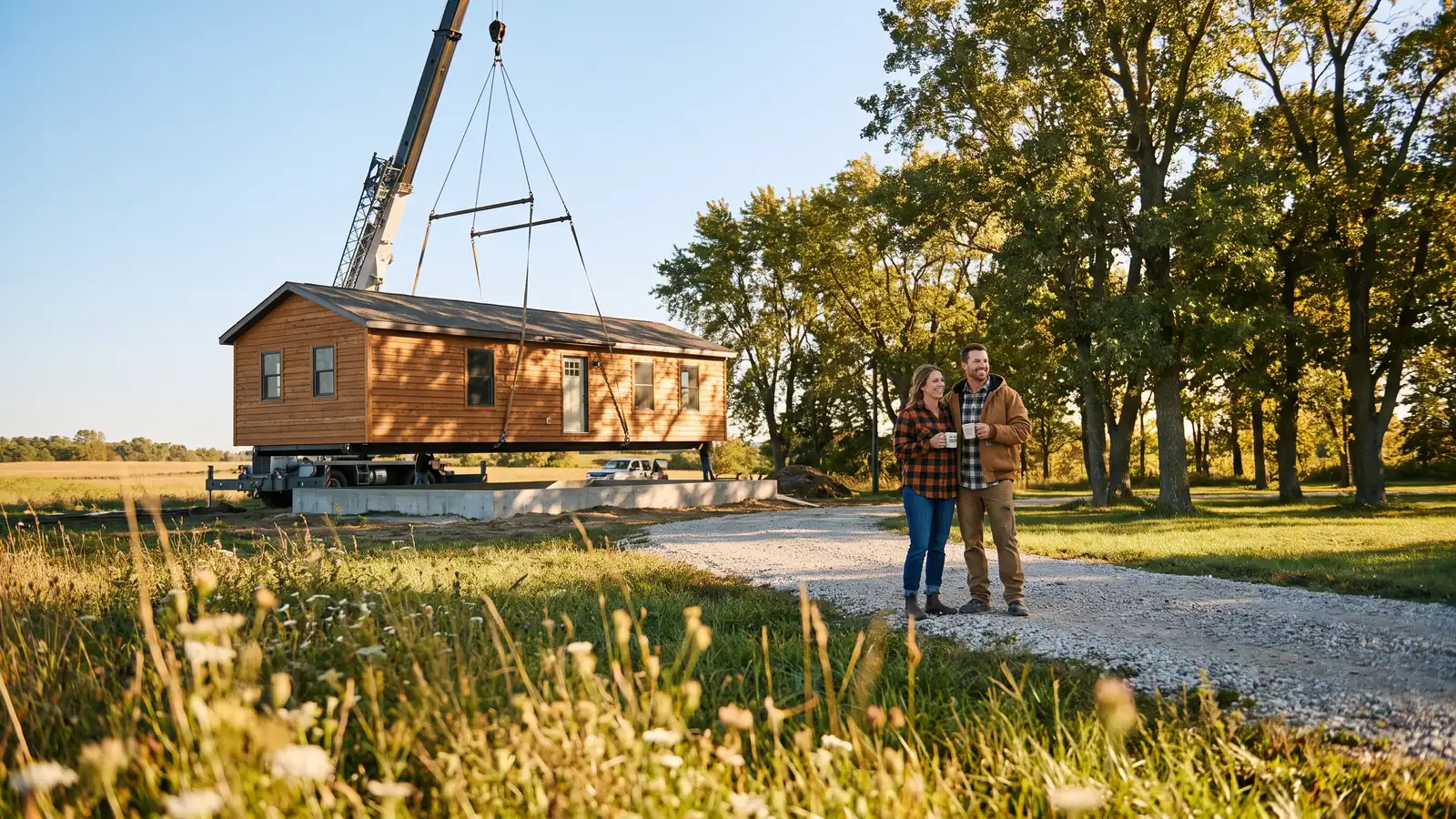
A modular home is built in finished sections inside a factory, trucked to your lot and craned onto a permanent foundation, and the benefit with the hardest number attached is time. McKinsey & Company’s review of modular construction found projects delivering 20% – 50% faster than traditional methods, with potential construction-cost savings of up to 20% and a real risk of costs running up to 10% higher when logistics or materials go wrong.
They’re still rare. Of the 1,019,000 single-family homes completed in the U.S. in 2024, about 13,000 were modular and 15,000 panelized or pre-cut, roughly 3% combined, per Census new residential construction data analyzed by the National Association of Home Builders. The Midwest leads at 7%.
Learn how modular homes work, including how they differ from manufactured homes, where the savings come from, and how lenders finance them. Still comparing housing types? Our Home Types & Living guide covers the field.
Key takeaways:
- Speed is the measurable win: Modular projects have delivered 20% – 50% faster than conventional construction in McKinsey’s review of the sector, because factory framing and on-site foundation work run on parallel schedules instead of back to back.
- Cost savings are real but narrower than the pitch: Modular builders commonly advertise 10% – 20% below comparable site-built pricing, and McKinsey found construction-cost savings of up to 20%, but the factory quote isn’t the delivered price, so land, foundation, transport, crane set and finish work still land on your budget.
- Financing works like a site-built house: Once the home is complete on a permanent foundation, conventional, FHA, VA and USDA loans all reach it, and Fannie Mae’s single-closing construction-to-permanent structure allows no single construction period longer than 12 months, with a total period capped at 18 months.
What is a modular home?
A modular home is a house built in finished three-dimensional sections in a factory, transported to your site and assembled on a permanent foundation, and it is built to the same state and local building codes as a site-built house. That last clause is the whole ballgame. Fannie Mae’s Selling Guide requires modular homes to be built under the International Residential Code administered by the state agency where the home is installed, the same code governing the house going up down the street.
Inspection happens in two places. A state-approved third-party agency reviews the plans, inspects units in process and affixes a state certification insignia to each module before it ships. On your lot, your local building department handles the foundation, utility connections, the set and the final inspection.
Modular vs. manufactured vs. site-built homes
Modular versus manufactured is the distinction that decides how a home is titled, financed and appraised. A manufactured home is built to the federal HUD Code, the Manufactured Home Construction and Safety Standards at 24 CFR Part 3280, on a permanent chassis, and sized at 8 body feet or more in width or 40 body feet or more in length in the traveling mode, or 320 or more square feet when erected on site (24 CFR 3280.2), and that standard preempts state construction codes. A modular home has no permanent chassis and answers to your state’s code instead.
| Feature | Modular | Manufactured (HUD Code) | Site-built |
|---|---|---|---|
| Code standard | State and local building codes (IRC) | Federal HUD Code, 24 CFR Part 3280 | State and local building codes |
| Permanent chassis | No | Yes; 8 body feet wide or 40 long in transit, or 320 sq ft erected | No |
| Foundation | Permanent foundation, set by crane | Permanent foundation or piers, depending on siting | Permanent foundation |
| How it’s titled | Real property | Real or personal property, depending on state law and siting | Real property |
| Typical financing | Conventional, FHA, VA, USDA, same as site-built | A mortgage if titled as real property; otherwise a chattel loan | Conventional, FHA, VA, USDA |
| Appraisal comparables | Site-built comps are acceptable | Generally compared to other manufactured homes | Site-built comps |
That titling difference carries a price tag. The Consumer Financial Protection Bureau reports that roughly 42% of manufactured-home purchase loans are chattel loans, secured by the home but not the land, and that chattel borrowers face higher denial rates, higher interest rates and fewer consumer protections than mortgage borrowers. None of that applies to a finished modular home, which is simply real estate. If you’re weighing both, read our breakdown of manufactured home pros and cons first.
One dated caveat: a HUD proposed rule published June 12, 2026 would let the upper floors of multistory HUD Code homes skip the permanent chassis. It was not final as of this update, so the line above still holds.
How much do modular homes save, and where do the savings come from?
Modular builders commonly advertise 10% – 20% below comparable site-built pricing, and McKinsey’s analysis of modular projects put potential construction-cost savings at up to 20%. While flagging that costs can instead run up to 10% higher when delivery or material costs go sideways. Treat the advertised range as a hypothesis to test with quotes, not a budget.
The savings are structural, and they come from four places.
- Labor efficiency: Crews work at fixed stations on repeated plans instead of climbing a different jobsite every week, so the same house takes fewer labor hours to frame.
- Bulk purchasing: A plant buying lumber, drywall and windows for hundreds of homes a year prices materials differently than a builder buying for one.
- Less material waste: Cut lists are optimized across many units and offcuts get reused, shrinking the scrap pile.
- Less weather and theft loss: Framing and materials sit indoors instead of absorbing three weeks of rain or walking off an open site.
Here’s the part the marketing skips: the factory price buys the modules, not the house. Your all-in cost also includes land, site work, the foundation, well or sewer and utility connections, transportation, the crane and set crew, and the “button-up” work that finishes seams, roof ridges, mechanicals and trim after the modules land. Ask every builder for a delivered-and-installed quote, then set it next to a stick-built bid on the same floor plan, our guide to what it really costs to build a house and our tips for building a home on a budget walk through that math.
Why modular homes go up faster
Speed is where modular’s advantage is best documented: 20% – 50% faster project delivery in McKinsey’s review, and builders routinely advertise 30% – 60% on residential jobs. The mechanism is simple, two schedules run at once.
- Parallel construction: Your foundation is poured while your modules are framed 200 miles away. Site-built runs those phases back to back.
- Weather independence: A Michigan February shuts down framing on an open lot. It doesn’t shut down a heated plant, which matters more the further north you build.
- No trade-scheduling gaps: Dead days waiting on an electrician or drywall crew largely disappear inside a factory that staffs those trades full time.
- A shorter on-site window: Modules are typically set in a day or two, so your street sees weeks of construction traffic instead of months.
Two honest counterweights. The clock doesn’t start until plans are approved and permits are pulled, and that front end is no faster for modular. And a plant has a production queue. If it’s booked out and the crane can’t be scheduled, your faster build waits in line. Get the lead time in writing. Our post on the benefits of buying a newly constructed home compares this against buying a finished spec house.
Factory-built quality and sustainability
Modules are engineered to survive a highway trip and a crane lift, a structural load no site-built house ever faces. That pushes plants toward more fasteners, adhesive and bracing than a code minimum demands, a durability side effect of the shipping problem, not a marketing claim. Quality control also gets two layers: the third-party agency inspects in the plant, including work concealed before shipment, and your local inspector still signs off on the foundation, the set and the finished house.
The honest environmental framing is that modular reduces jobsite waste rather than eliminating it. The problem is large, EPA estimated 600 million tons of construction and demolition debris generated in the United States in 2018, more than twice that year’s municipal solid waste. Optimized cut lists and offcut reuse shrink the dumpster, though how much depends on the manufacturer. Ask the plant for its waste-diversion rate; a good one will know.
Energy performance is the piece you can verify. Modular homes are eligible for ENERGY STAR certification under the same Single-Family New Homes program as site-built houses, using the same rater-based process, checklists and ENERGY STAR efficiency standards, the rater simply verifies in the plant anything concealed before shipment. HUD Code homes fall under a separate ENERGY STAR program. Specify certification in your build contract rather than assuming it, and pair it with our guide to energy-efficient home upgrades.
Don’t build a budget around federal energy tax credits. Under Public Law 119-21, signed July 4, 2025, the IRS allows the Energy Efficient Home Improvement Credit only for qualifying property placed in service before December 31, 2025, and the Residential Clean Energy Credit is not available for any property placed in service after December 31, 2025. The builder-side New Energy Efficient Home Credit is not allowed for homes acquired after June 30, 2026. Talk with a tax professional before counting on any incentive.
How modular homes hold their value
Yes. Because a finished modular home is appraised and financed as ordinary real property, its value tracks the same local market forces as any site-built house nearby. Fannie Mae states plainly that modular, prefabricated, panelized and sectional housing “is not considered manufactured housing,” is eligible under its standard one-unit guidelines, and does not require factory-built comparable sales. VA Pamphlet 26-7 is equally direct: the appraiser will typically treat modular housing the same as conventionally built housing.
That treatment carries through the loan menu.
- Conventional: Eligible as a one-unit property under Fannie Mae’s factory-built housing guidelines, with no minimum requirements for width, size or roof pitch.
- FHA: Because modular homes aren’t manufactured housing, they’re insured under FHA’s standard single-family programs rather than its manufactured-housing rules.1
- VA: Eligible, with the appraiser treating the home like conventional construction; on-frame modular units carry extra conditions such as removal of running gear.2
- USDA: Modular is a named eligible structure type under the Section 502 Guaranteed Loan Program for buyers in eligible rural areas.
Most modular buyers need two loans stitched into one. A construction-to-permanent loan funds the plant deposit, the foundation and the draws, then converts to a permanent mortgage once the home is finished. Under Fannie Mae’s single-closing structure, the construction loan period may have no single period longer than 12 months and the total period may not exceed 18 months, and credit documents must be no more than four months old at the note date. Lenders in Align’s network structure these differently, draw schedules, deposit handling and appraisal timing all vary.3 Our construction loan guide covers the mechanics; our look at trends in modular housing markets covers where demand is heading.
What to check before you commit to a modular build
Six checks prevent nearly every expensive surprise here. Run them before you put money down.
- Crane and truck access: Modules arrive on tractor-trailers and are set by crane, so narrow streets, tight turnarounds, steep grades, overhead lines and mature trees can add cost or kill the plan, the pie-shaped lots common on cul-de-sac streets are a frequent culprit. Have the builder walk the site first.
- Deed restrictions and HOA covenants: Some subdivisions restrict factory-built housing by name, others do it accidentally through minimum-square-footage or roof-pitch rules. Read the recorded covenants.
- The plant’s state approval: Confirm which third-party inspection agency the manufacturer uses, that it’s approved in your state, and that the insignia will be on every module. That’s documentation you can ask for.
- Who owns the button-up: Seams, roof ridge, mechanical tie-ins and finish work after the set are where responsibility gets murky. Get one party to warranty both the modules and the on-site completion, in writing.
- Insurance in two phases: A finished modular home on a permanent foundation is typically written on the same standard homeowners form, the HO-3 most site-built houses use, rather than the specialty mobile-home policy common for HUD Code homes. Flood damage is excluded from standard homeowners policies and needs a separate NFIP or private flood policy. During construction, confirm in writing who carries risk on the modules in transit and on the crane.
- How it compares to other ownership forms: If you’re also weighing attached housing, the ownership structure changes the loan: a co-op is financed with a share loan secured by your shares and a proprietary lease rather than a mortgage lien on real property, see our condo vs. co-op comparison. Modular sidesteps it entirely: you own the land and the house.
Worth saying plainly: Align Lending doesn’t sell modular homes and has no stake in which manufacturer you pick. Where modular meets our work is the financing.
What Michigan buyers should know
Michigan is a good modular market for one reason and a tricky one for another: the winter that stalls an open jobsite doesn’t touch a heated plant, but the same winter narrows the window for pouring your foundation and setting modules.
- MSHDA reaches a finished modular home, up to $10,000 in help: Because a completed modular home on a permanent foundation is titled as an ordinary single-family home, it fits the MI Home Loan program’s eligible property list. MSHDA’s MI 10K DPA Loan provides up to $10,000 as an interest-free down payment assistance loan statewide, subject to income and sales price limits.
- Spring frost laws can move your set date: MDOT and county road commissions impose seasonal weight restrictions during the spring thaw, typically sometime between March and May, announced year to year, which limit heavy and oversize loads on many Michigan roads. Modules travel on tractor-trailers, so ask the plant and the hauler to check the route with the road agency before you commit to a delivery week.
- Budget $8.60 per $1,000 of sale price for transfer tax when you sell: Michigan’s state real estate transfer tax runs $3.75 per $500 of value and the county tax is 55 cents per $500 in counties under 2 million people. A finished modular home is real property, so it is taxed on resale exactly like the site-built house next door, another way the modular-versus-manufactured distinction shows up in dollars.
One scheduling note: plant queues and Michigan’s short foundation season stack on top of each other, so get the factory lead time, the pour date and the crane date in writing before you sign. The construction window on a single-closing construction-to-permanent loan is finite, and a slipped set date eats it. Our Homeownership guide covers what comes after the set.
How Align matches the loan to the property
Lenders do not treat every property the same. Condos, including non-warrantable ones, and homes with two to four units each come with rules that vary from one lender to the next.
Because Align is a broker, Samantha can take your file to the wholesale lender whose guidelines fit the property, instead of forcing it into one bank's box. One application, multiple lenders, and one person on your file from start to finish.
FAQ: Modular homes
Here are answers to common questions about modular homes.
What is the difference between a modular home and a manufactured home?
A modular home is built in factory sections, assembled on a permanent foundation and constructed to the same state and local building codes as site-built homes. A manufactured home is built entirely in a factory on a permanent steel chassis to the federal HUD Code and may or may not sit on a permanent foundation. The distinction drives financing, appraisal and resale value, see our full comparison of manufactured home pros and cons.
Do modular homes hold their value?
Yes. Once permanently installed on a foundation, a modular home is appraised and resold like a site-built house, and its value follows the same local market forces: location, condition, size and demand. Appraisers may use comparable site-built sales, and both Fannie Mae and VA guidance treat modular homes as conventional construction. The lingering stigma comes from confusing modular homes with chassis-built manufactured homes, a gap our review of trends in modular housing markets tracks.
Are modular homes cheaper than stick-built homes?
Usually, though by less than the brochures suggest. Modular builders commonly advertise savings of 10% – 20% versus comparable site-built construction, and McKinsey’s analysis of modular projects found potential construction-cost savings of up to 20%. Total project cost still includes land, foundation, site work, utility connections, transportation and the crane set, so insist on a delivered-and-installed quote before comparing it against a stick-built bid or the figures in our guide to the cost of building a house.
Can you get a regular mortgage on a modular home?
Yes. Because modular homes are built to standard building codes and permanently affixed to a foundation, they qualify for conventional, FHA, VA and USDA financing just like site-built homes. During construction you’ll typically use a construction-to-permanent loan that converts to a permanent mortgage once the home is set and finished, a structure explained in our construction loan guide.
The bottom line on modular homes
Modular homes are built in finished sections in a factory, set on a permanent foundation and governed by the same building codes as a site-built house. The strongest benefit is speed: McKinsey’s review found modular projects delivering 20% – 50% faster than traditional methods, with construction-cost savings of up to 20% and a risk of costs running up to 10% higher when logistics go wrong. Builders commonly advertise 10% – 20% savings, but the factory price never includes land, foundation, transport, crane set or finish work, so compare delivered-and-installed quotes only. Once complete, the home is appraised, insured and financed like any other house.
If you’re ready to price a modular build, talk to Align Lending, we’ll shop your construction-to-permanent and purchase scenarios across our lender network and show you the structures side by side. Call 248-506-5727 or start online today.
Footnotes:
1. Align Lending is not acting on behalf of or at the direction of FHA or HUD. FHA eligibility, property acceptability and program requirements are set by HUD and applied by the individual FHA-approved lender, and are subject to change. Nothing here is an offer of credit or a commitment to lend. Return to text.
2. Align Lending works with VA-approved lenders and is not endorsed or sponsored by the Dept. of Veterans Affairs or any government agency. VA loan eligibility, entitlement and property requirements are determined by the VA and the VA-approved lender. Return to text.
3. Align Lending is an independent mortgage broker and does not set loan terms. Construction-to-permanent and purchase program terms, draw schedules, deposit handling, eligibility and available loan amounts are set by the individual wholesale lenders in Align’s network and are subject to change, credit approval, property eligibility and appraisal. Agency guideline references reflect published guidance as of the updated date shown on this article and may be revised. Return to text.
Sources: 2024 single-family completions by construction method (13,000 modular, 15,000 panelized/pre-cut, 1,019,000 total, 3% combined share, Midwest 7%), U.S. Census Bureau Survey of Construction with National Association of Home Builders analysis. Project delivery 20% – 50% faster, construction-cost savings of up to 20% and cost-overrun risk of up to 10%, McKinsey & Company, “Modular construction: From projects to products” (2019). Modular code and appraisal treatment, Fannie Mae Selling Guide B4-1.4-02 and B2-3-02; construction-to-permanent terms, Fannie Mae Selling Guide B5-3.1-02. Modular appraisal treatment, VA Pamphlet 26-7, Chapter 12. Manufactured Home Construction and Safety Standards, 24 CFR Part 3280 (HUD); proposed rule revising the definition of “manufactured home,” published in the Federal Register June 12, 2026, comment period closed August 11, 2026. Modular eligibility for Section 502 guaranteed loans, USDA Rural Development Handbook HB-1-3555. Share of manufactured-home purchase loans that are chattel and the associated pricing and denial outcomes, Consumer Financial Protection Bureau, “Manufactured Housing Finance: New Insights from the Home Mortgage Disclosure Act” (2021). 600 million tons of construction and demolition debris generated in 2018, U.S. Environmental Protection Agency. Modular eligibility under ENERGY STAR Single-Family New Homes program requirements, U.S. EPA ENERGY STAR. Termination dates for the Energy Efficient Home Improvement Credit, Residential Clean Energy Credit and New Energy Efficient Home Credit, Internal Revenue Service guidance on Public Law 119-21. Flood exclusion from standard homeowners policies, FEMA National Flood Insurance Program. MI Home Loan eligible property types and the MI 10K DPA Loan amount of up to $10,000, Michigan State Housing Development Authority. Seasonal weight restrictions on Michigan roads during the spring thaw, Michigan Department of Transportation and county road commissions. State real estate transfer tax of $3.75 per $500 (Act 330 of 1993) and county transfer tax of 55 cents per $500 (Act 134 of 1966), Michigan Legislature.
This article is for informational purposes only and is not intended to provide legal, financial, tax, insurance, or engineering advice. Building costs, factory lead times, agency guidelines, code adoption, insurance terms and tax provisions change frequently and vary by state, county, manufacturer and carrier, verify current details and get written quotes before you commit. Consult a qualified tax professional about any credit or deduction, and a licensed insurance agent about coverage. Align Lending is an independent Michigan mortgage broker, NMLS #2041154.
Related resources

12-minute read
Condo vs. Co-op: Similarities and Differences Every Urban Buyer Should Know
Compare condo vs. co-op ownership, monthly fees and board approval rules so you can choose the urban home type that fits your budget and lifestyle.
11-minute read
Guide to the Different Types of Houses by Structure and Style
Discover the different types of houses by structure and style, from ranch and colonial to craftsman and Victorian, and find which home type fits your life.
11-minute read
Craftsman Houses: History and Features That Still Win Buyers Over
Discover the history and signature features of Craftsman houses, from tapered porch columns to built-ins, and why buyers still love this style today.
