
How to improve your home’s curb appeal before you list
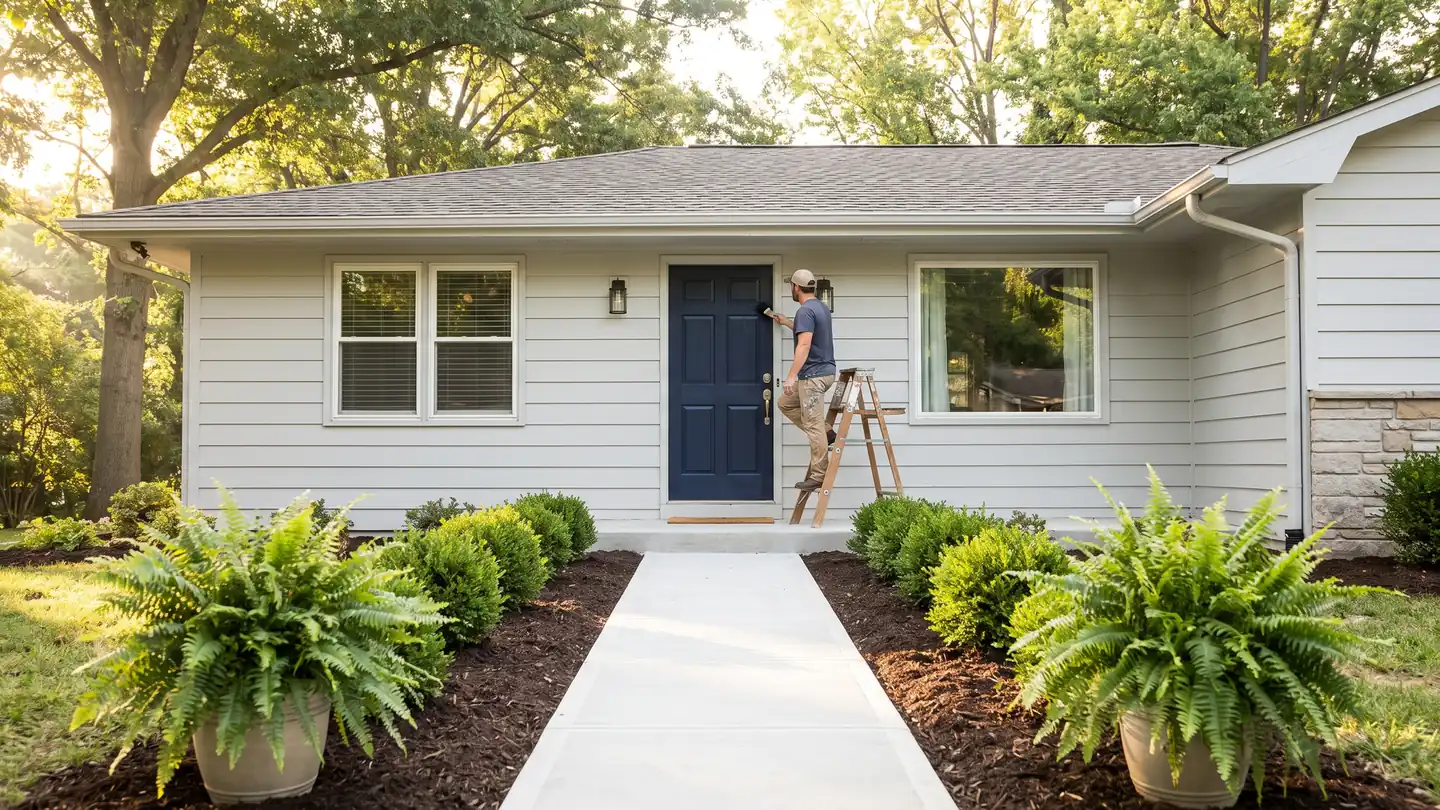
The fastest way to improve your home’s curb appeal is to clean the front of the house, then paint it, then light it in that order. Cleaning is nearly free and changes your listing photos more than new plants do, which is one reason 92% of REALTORS® say they recommend sellers improve curb appeal before a home goes on the market, according to the 2023 Remodeling Impact Report: Outdoor Features from the National Association of REALTORS® and the National Association of Landscape Professionals.
Exterior work also carries the strongest reported returns of any project category. In Zonda’s 2025 Cost vs. Value Report, real estate professionals estimated that a garage door replacement recoups 267.7% of its $4,672 national average job cost, and a steel entry door replacement 216.4% of $2,435, the two highest-recouping projects in the study.
Learn how to improve your home’s curb appeal in the order that saves money, including which projects to sequence first, what the research actually says about return, and how to fit the whole thing into the weeks before photo day. If you’re earlier in the process, start with our Selling a Home guide.
Key takeaways:
- Clean before you buy anything: 92% of REALTORS® recommend improving curb appeal before listing, and the cheapest moves (washing, trimming, clearing gutters) change the photos more than new plantings do.
- The entry and the garage carry the return: Agents surveyed for the 2025 Cost vs. Value Report put garage door replacement at 267.7% cost recouped and a steel entry door at 216.4%, the top two of 28 projects studied.
- Budget roughly 1% of your expected sale price and start 4 – 6 weeks out: On a $300,000 home that’s about $3,000, which covers washing, paint, mulch, fixtures and small repairs with time left for a contractor.
Does curb appeal actually affect your sale price?
The honest answer is that curb appeal reliably affects buyer traffic, and the price effect is estimated rather than measured. The 92% figure above comes from REALTORS® describing what they advise their own sellers to do. The cost-recovery percentages you see quoted everywhere come from the same kind of source: in the 2023 outdoor features report, landscape professionals estimated typical project costs and REALTORS® estimated what each project would return, and in Zonda’s 2025 Cost vs. Value Report, resale values are derived in part from surveys of real estate professionals across 115 markets, with project costs built from Zonda’s partnership with Verisk’s XactRemodel estimating data.
That matters. Agent-estimated ROI is a judgment about buyer behavior, not a tracked outcome from paired sales, so treat percentages above 100% as a signal about which projects buyers notice rather than a promise about your closing statement. Where exterior work sits among your other options is covered in maximizing your home’s resale value.
What the numbers agree on is the shape of the curve: small, visible, exterior projects outperform large ones. In the same 2023 report, standard lawn care service, an estimated $415, carried the highest cost recovery of any outdoor project at 217%, while an in-ground pool, fire features and landscape lighting landed in the 56% – 59% range. Spend where buyers look, not where the invoice is biggest, and pair the work with a realistic list price using our guide to pricing and preparing your home.
Which curb appeal projects should you do first?
Sequence the work by what a phone camera picks up from the curb, because that image is the first thing almost every buyer sees. Here’s the priority order, with the published cost figures where they exist and an honest blank where they don’t.
| Project | Typical cost | Weekend or pro | Photo impact |
|---|---|---|---|
| Pressure wash siding, walk and driveway | Machine rental plus a day; no national estimate published | Weekend | Highest per dollar. Brightens every wide shot. |
| Paint the front door, trim and shutters | Paint and hardware only | Weekend | Highest. The entry is the hero shot. |
| Replace the entry door (steel) | $2,435 national average job cost, 2025 | Pro | High. 216.4% cost recouped in agent estimates. |
| Standard lawn care service | $415 national estimate, 2023 | Pro | High. Edged, green turf reads as maintained. |
| Fresh mulch and trimmed shrubs | Materials plus your time | Weekend | High. Defines beds in every exterior frame. |
| House numbers and mailbox | Materials only | Weekend | Medium. Shows in close-ups and at the door. |
| Exterior light fixtures | Fixture cost, plus an electrician if wiring is old | Either | Medium-high. Makes evening showings possible. |
| Garage door replacement | $4,672 national average job cost, 2025 | Pro | Highest on street-view shots. 267.7% recouped. |
A workable ceiling for the whole list is about 1% of your expected sale price, roughly $3,000 on a $300,000 home.1 Go past that only when the exterior is genuinely keeping buyers in the car, which is a different problem with a different playbook: see how to sell a home with low curb appeal.
Clean, paint, detail: the order that saves you money
Run the exterior in three passes, and do them in this sequence, because each pass changes what the next one needs. Sellers who buy plants first almost always end up washing dirt onto them.
1. Clean everything before you buy anything
Washing is the highest-return hour you’ll spend, because it costs a machine rental and a Saturday. Pressure wash the siding, the front walk, the driveway and the porch; clean the windows inside and out; clear the gutters and downspouts. Then stop and look at the house again. A gray-green film of algae reads to a buyer as deferred maintenance, and once it’s gone, half the “we need to replace things” list usually disappears with it. Our full sequence for the rest of the property is in preparing your home for sale.
2. Paint the front door, trim and garage door
Paint is the single highest-impact cosmetic upgrade because it’s the only one that changes color in a photo. Start with the front door in a saturated, classic color, then the trim, then the shutters and garage door if they’re chalky. New door hardware and a fresh kick plate cost less than a dinner out and finish the look. If the door itself is rotted or out of square, replacement is the better call. In the 2025 Remodeling Impact Report, a new steel front door came in at 100% cost recovery, the highest of the projects that report highlighted, a figure estimated by members of the National Association of the Remodeling Industry, not measured from tracked sales.
One rule that catches sellers by surprise: if your home was built before 1978 and you’re paying someone to do the work, EPA’s Renovation, Repair and Painting rule requires the firm to be EPA Lead-Safe Certified whenever the job disturbs more than 20 square feet of exterior painted surface (or more than 6 square feet inside). Scraping and sanding old siding clears that threshold quickly. Ask for the certification number before the crew starts.
3. Detail the small stuff buyers photograph
Details are cheap and they’re what fills the close-up shots. Replace faded house numbers, swap a dented mailbox, re-caulk the door frame, straighten the porch light and put down a clean mat. Two matched planters flanking the entry beat a dozen scattered pots. Keep decor seasonal-neutral so the photos don’t date themselves, the same restraint that governs staging your home for a quick sale inside.
How landscaping and lighting extend your selling window
Landscaping and lighting are what keep the home showing well after the first weekend and after dark. The lawn is the highest-leverage line: standard lawn care service carried the top cost-recovery estimate of any outdoor project in the 2023 report at 217% on an estimated $415, while landscape maintenance came in at 104% on $4,800 and an overall landscape upgrade at 100% on $9,000. You can read the underlying work in NAR’s remodeling impact research on outdoor projects.
- Mow, edge and trim on a schedule: Edging is what separates a maintained yard from a mowed one in a photo, and it takes about 20 minutes with a string trimmer.
- Mulch the beds and cut the shrubs back from the windows: Overgrown foundation plantings block light and hide the house. Trim to below the sill line.
- Plant for the season you’re actually listing in: Choose species that hold up in your zone rather than whatever is blooming at the garden center. Our guides to eco-friendly landscaping ideas and creating a low-maintenance landscape cover plantings that survive a summer of showings without a sprinkler bill.
- Light the path and the entry: Working exterior lights are what make a 6 p.m. showing in November possible at all. Replace burned-out and mismatched bulbs with matched LEDs at the same color temperature, and if the fixture itself is the problem, check ENERGY STAR certified light fixtures before you buy. EPA no longer certifies individual light bulbs, so ignore any “ENERGY STAR bulb” savings claim you find quoted online.
Your one-weekend curb appeal plan
If you have one weekend and a photographer booked, this is the order that fits. Everything below is doable by two people without a contractor.
- Friday evening: Rent the pressure washer, buy paint, mulch and hardware, and clear cars, hoses, trash bins, toys and the basketball hoop out of every camera line.
- Saturday morning: Wash the siding, walk, driveway and porch. Clean the gutters and downspouts while the surfaces dry.
- Saturday afternoon: Trim shrubs back from the windows, edge the beds, pull weeds, then mulch. Mow and edge the lawn last so clippings don’t land on fresh mulch.
- Sunday morning: Paint the front door and trim. While it cures, install the new house numbers, mailbox, mat and light fixtures, and wash the windows.
- Sunday afternoon: Set the two planters, re-caulk the door frame, replace burned-out bulbs, and walk to the curb with your phone. Photograph what a buyer sees and fix whatever the picture shows you.
What curb appeal will not fix
Curb appeal changes how fast buyers come to the door; it does not change your home’s condition rating or your legal obligations. Appraisers value condition and comparable sales, not decor, so mulch and a new mat will not raise an appraised value on their own. Visible deferred maintenance is a different story: peeling paint, rotted trim, broken steps and a failing roof affect condition and can trigger lender-required repairs.
- FHA files inspect paint on pre-1978 homes: Under HUD’s Single Family Housing Policy Handbook 4000.1, the appraiser must examine all interior and exterior surfaces of a home built before January 1, 1978 for defective paint, and correction is required in accordance with 24 CFR Part 35.2
- VA files apply their own property condition standards: If your buyer is using a VA loan, condition items flagged at the appraisal generally have to be corrected before closing, so cosmetic-only fixes can stall a deal.3
- Lead disclosure is federal and non-negotiable: For housing built before 1978, sellers must disclose known lead-based paint and hazards, hand over any records or reports, provide EPA’s “Protect Your Family From Lead in Your Home” pamphlet, and give buyers a 10-day opportunity to conduct a paint inspection or risk assessment unless both parties agree in writing to a different period.
- Fresh paint never substitutes for disclosure: Painting over a stain does not erase a known water, foundation or environmental defect, and selling “as-is” does not waive a statutory disclosure duty. If the exterior is hiding a real problem, read how to sell a home with low curb appeal before you spend on cosmetics.
What Michigan sellers should know
Michigan’s freeze-thaw cycle does measurable damage to exactly the surfaces buyers photograph, which is why a March cleanup weekend belongs on every spring seller’s calendar.
- Salt and freeze-thaw wreck walks and drives: Frozen ground thaws from the surface downward and traps moisture underneath. MDOT imposes seasonal weight restrictions on state roads every spring for exactly this reason, timed off frost-depth readings rather than a fixed calendar date. Your driveway and walks go through the same cycle. Budget for crack filling and a salt-residue wash before photos.
- Winter burn shows up on evergreens in March: Brown, desiccated foliage on yews and arborvitae along the foundation is the first thing that dates a spring listing photo. Trim it out or replace the shrub, and do it four to six weeks before your photo date so the beds look settled.
- Curb appeal does not touch your disclosure duty: Michigan’s Seller Disclosure Act, Act 92 of 1993 (MCL 565.951 et seq.), requires a written disclosure statement on transfers of not less than one and not more than four residential dwelling units, with exemptions listed at MCL 565.953 for court-ordered transfers, foreclosure sales, bankruptcy trustees and similar situations. Known defects get disclosed regardless of how the front of the house looks.
- Sequence the work to the thaw, not the calendar: In most of Michigan the first reliable dry painting weekend lands well after the frost leaves. Book the photographer after the work, not before, and line up your list price with pricing and preparing.
How Align helps before you list
If you are buying your next home too, talk to Samantha before you list. Knowing your buying power and your timeline first lets you price and prepare your home with a plan, not a guess.
Over the last 12 months, her loans averaged under 14 days from application to clear to close, across more than 100 loans. Your closing date is set by your purchase agreement. Her job is to have your loan ready well before it.
Sources: Align Lending loan records, 12 months to October 2026.
FAQ: Improving curb appeal before you sell
Here are answers to common questions about improving your home’s curb appeal.
What curb appeal project gives the best return?
Cleaning, because it costs almost nothing. After that, painting the front door and trim, fresh mulch with trimmed shrubs, updated house numbers and modern exterior light fixtures deliver the most visible change per dollar. Larger swaps like a garage door or steel entry door cost more but consistently rank at the top of agent-estimated cost recovery. Weigh them against your other options in maximizing your home’s resale value.
How much should I spend on curb appeal before selling?
Most sellers should stay under about 1% of the expected sale price on exterior cosmetics. On a $300,000 home that is roughly $3,000, which comfortably covers pressure washing, paint, mulch, plants, light fixtures and a few repairs. Spend more only when the exterior is actively deterring buyers from getting out of the car, and fold the number into the broader budget in preparing your home for sale.
Does curb appeal affect the appraisal?
Indirectly. Appraisers value condition and comparable sales, not decor, so mulch will not raise your appraised value on its own. But visible deferred maintenance such as peeling paint, rotted trim, damaged steps or a failing roof does affect condition ratings and can trigger lender-required repairs on government-backed loans. Our walkthrough of selling a home covers where the appraisal falls in the timeline.
When should I do curb appeal work if I am listing in spring?
Start four to six weeks before your photo date. That gives you a dry weekend to pressure wash and paint, lets fresh mulch and new plantings settle in, and leaves room for a contractor if a repair turns out bigger than expected. Choose plantings that will still look right in July with a low-maintenance landscape. Photos come after the work, never before.
The bottom line on curb appeal
Improve your home’s curb appeal in three passes (clean, paint, detail) and keep the whole budget near 1% of your expected sale price, about $3,000 on a $300,000 home. The research points the same direction every year: 92% of REALTORS® recommend curb appeal work before listing, and the highest agent-estimated returns sit on small exterior items like the entry door and garage door rather than on pools and patios. Do the work first, photograph second, and let the disclosure obligations stay exactly where the law puts them.
If you’re ready to plan the purchase on the other side of this sale, talk to Align Lending. We’ll shop your next mortgage across our lender network and show you the numbers side by side. Call 248-506-5727 or start online today.
Footnotes:
1. Example figures in this article are hypothetical and for educational purposes only; they do not constitute an advertisement of credit terms or a rate quote under federal or state lending laws. Project costs vary by property, market, materials and contractor. Return to text.
2. Align Lending is not acting on behalf of or at the direction of FHA or HUD. FHA property requirements are set by HUD in Single Family Housing Policy Handbook 4000.1 and are subject to change. Return to text.
3. Align Lending works with VA-approved lenders and is not endorsed or sponsored by the Dept. of Veterans Affairs or any government agency. Return to text.
Sources: 92% of REALTORS® recommend sellers improve curb appeal before listing; standard lawn care service estimated at $415 with 217% cost recovery, landscape maintenance $4,800 at 104%, overall landscape upgrade $9,000 at 100%, and landscape lighting, fire features and in-ground pools in the 56% – 59% range, National Association of REALTORS® and National Association of Landscape Professionals, 2023 Remodeling Impact Report: Outdoor Features (March 2023). In that report, project costs were estimated by NALP members and cost recovery was estimated by REALTORS®; the figures are survey estimates, not measured sale outcomes. Garage door replacement at 267.7% cost recouped on a $4,672 average job cost, steel entry door replacement at 216.4% on $2,435, manufactured stone veneer at 207.9% and vinyl siding replacement at 96.5%, Zonda, 2025 Cost vs. Value Report, 38th annual edition (September 18, 2025), covering 28 project types across 115 U.S. markets; resale values in that report are derived in part from surveys of real estate professionals and project costs from Zonda’s partnership with Verisk’s XactRemodel, so the recovery percentages are estimates, not measured sale outcomes. New steel front door at 100% cost recovery, closet renovation 83%, new fiberglass front door 80%, as estimated by members of the National Association of the Remodeling Industry (NARI), National Association of REALTORS® and NARI, 2025 Remodeling Impact Report (April 9, 2025). Lead-Safe Certification required for firms performing renovation, repair or painting that disturbs more than 6 square feet of interior or more than 20 square feet of exterior painted surface in housing built before 1978, U.S. Environmental Protection Agency, Renovation, Repair and Painting Rule, 40 CFR Part 745, Subpart E. Seller disclosure of known lead-based paint and hazards, delivery of the “Protect Your Family From Lead in Your Home” pamphlet, and a 10-day opportunity to conduct a paint inspection or risk assessment, Residential Lead-Based Paint Hazard Reduction Act, Section 1018 of Title X, 42 U.S.C. § 4852d; 40 CFR Part 745, Subpart F. Appraiser inspection of all interior and exterior surfaces for defective paint on properties built before January 1, 1978, with correction required in accordance with 24 CFR Part 35, HUD Single Family Housing Policy Handbook 4000.1. ENERGY STAR certifies light fixtures but no longer certifies individual light bulbs or lamps, U.S. EPA, ENERGY STAR product categories. Written seller disclosure statement required on transfers of not less than 1 and not more than 4 residential dwelling units, with exemptions including court-ordered transfers, foreclosure sales, transfers by a bankruptcy trustee and eminent domain, Michigan Seller Disclosure Act, Act 92 of 1993, MCL 565.951 et seq.; MCL 565.952; MCL 565.953. Seasonal spring weight restrictions imposed on state roads based on frost-depth readings and thawing conditions, with roadbeds thawing from the surface downward, Michigan Department of Transportation.
This article is for informational purposes only and is not intended to provide legal, financial, or tax advice. Disclosure obligations, property standards and project costs change and vary by property, county and loan program; confirm your situation with a qualified professional. Figures shown are illustrative, are not a rate quote or an offer of credit, and are subject to change. Align Lending is an independent Michigan mortgage broker, NMLS #2041154, and does not list or sell homes.
Related resources

12-minute read
How to Choose a Real Estate Agent: 7 Steps to Vet the Right One
Learn how to choose a real estate agent using recent sales data, a comparative market analysis, license checks, and the red flags that signal a poor fit.
13-minute read
Downsizing your home: tips for a smooth transition
Learn how to downsize your home without the chaos, with a decluttering timeline, a moving budget, tax rules on your gain and help with the emotional part.

13-minute read
Understanding home sale contingencies
Learn how home sale contingencies work, why buyers request them, and how sellers use deadlines, kick-out clauses, and earnest money to limit the risk.
