
New construction home inspections: Why brand-new homes still need them
Yes, a brand-new home still needs an independent inspection you hire yourself. New builds are best inspected at 3 stages. Pre-pour, before the foundation concrete is placed; pre-drywall, once framing and the electrical, plumbing, and HVAC rough-ins are done; and a final inspection shortly before your builder walkthrough. A standard home inspection typically runs about $300 to $500, a fraction of what a missed grading, insulation, flashing, or plumbing defect costs to fix after the drywall is up.
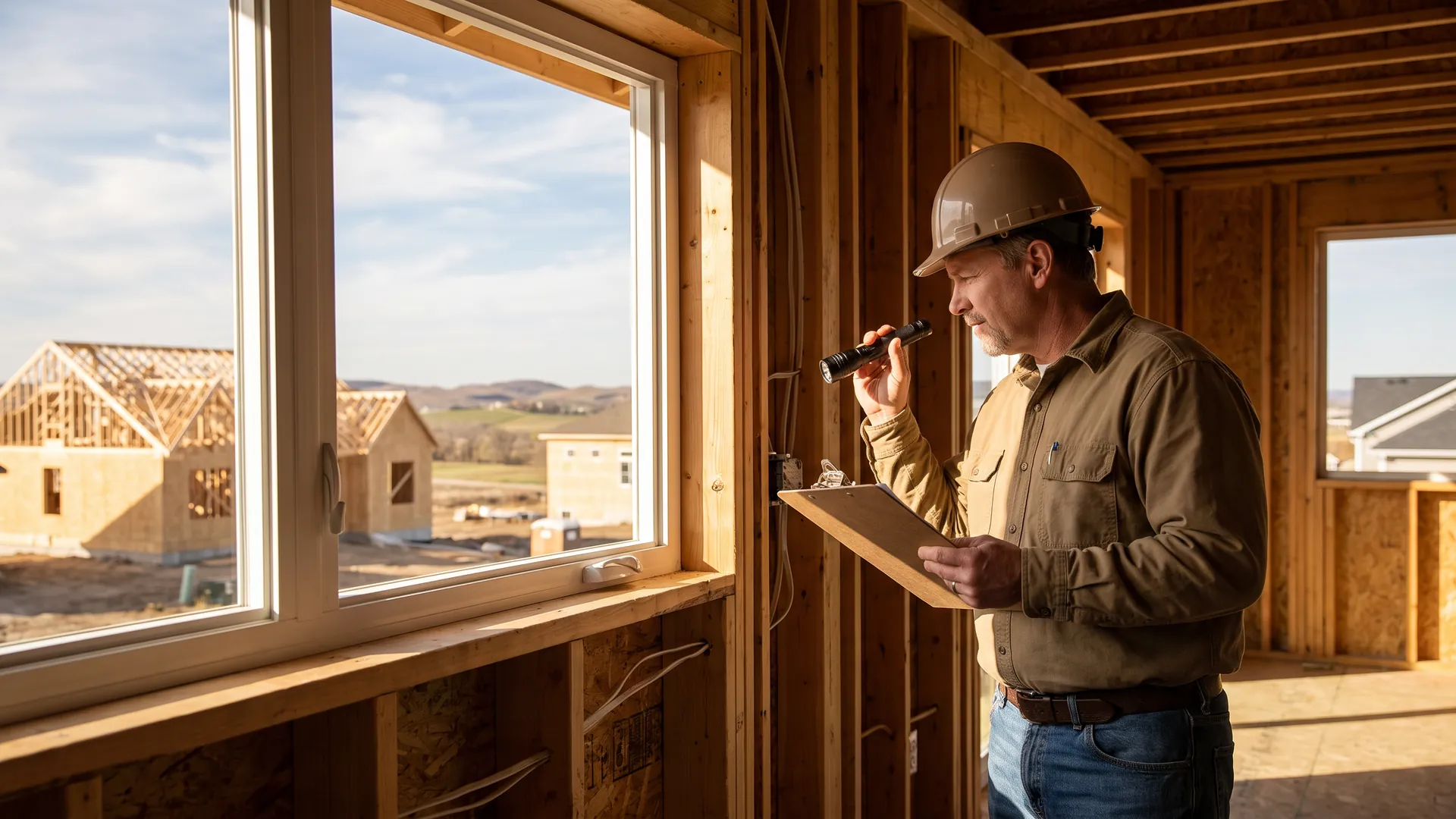
The municipal code inspection and the builder’s walkthrough are not substitutes. A code official verifies the house meets minimum code; the inspector you hire evaluates the workmanship you’ll live with. Only one of those jobs is done on your behalf.
Learn how home inspections for new construction work, including the three phases, the defects inspectors find most often, and how to write inspection rights into your builder contract. If you’re earlier in the process, start with our Home Buying guide.
Key takeaways:
- Code sign-offs check minimums, not quality: Many jurisdictions inspect a new build as few as 3 times, footing, framing, and final, and FHA accepts exactly those 3 inspections as evidence of code compliance, which says nothing about workmanship.
- Three phases give you the most protection: Pre-pour, pre-drywall, and final inspections each cover work the next stage buries under concrete or drywall, and at roughly $300 to $500 per standard inspection, phase coverage costs less than a single avoided repair.
- A builder warranty is not a substitute: The new-construction warranty behind FHA and VA financing runs 1 year, so a documented punch list before closing, while your leverage is highest, protects you better than a claim filed in month 13.
Why does a brand-new home need an inspection?
Because nobody else in the process was hired to protect you. A new house is assembled in months by a dozen or more subcontractor crews working in sequence, each covering the last crew’s work. The code official, the appraiser, and the builder’s superintendent all answer someone else’s question. Your inspector answers yours, the honest counterweight to the real benefits of buying a newly constructed home. Modern systems and a warranty are genuine advantages, but they don’t prove the house was built correctly.
Code inspections check minimums, not workmanship
A municipal inspector confirms the work meets the minimum the code allows, at a handful of scheduled milestones. FHA’s rules show how thin that can be: for proposed construction, the lender must obtain a building permit and a certificate of occupancy, or copies of 3 inspections, footing, framing, and final, by the local authority or an ICC-certified inspector.1 Three visits across a build involving 20-plus trades is a compliance check, not a quality review.
Your inspector does something different, and the national standards say so. The InterNACHI Standards of Practice define a home inspection as a non-invasive, visual examination of the accessible areas of a home, and explicitly do not require the inspector to determine code compliance; the American Society of Home Inspectors standard works the same way. Compliance and condition are separate questions, which is why both inspections have value. For the code side, see our guide to the impact of new building codes on home purchases.
Your appraisal isn’t an inspection either
HUD’s required disclosure to FHA borrowers, “For Your Protection: Get a Home Inspection,” states that an appraisal estimates the home’s value for the lender, does not replace a home inspection, and that FHA does not perform home inspections at all. That’s a general rule, not an FHA quirk: the home appraisal process answers one question on every loan type. Is the collateral worth the loan amount. If an inspection happens on your new build, it’s because you scheduled one.
How many new homes are sold before they are finished?
A large share, which is why the early inspection windows are often still open when you sign. According to the Census Bureau’s New Residential Sales report for August 2026, released with HUD on September 24, 2026, 678,000 new single-family houses sold in 2025. Of those, 67,000 sold before construction started and 215,000 while the house was being built, so 282,000, or about 42%, sold before the house was complete.
| Stage of construction | Sold in 2025 | Sold, August 2026 (annual rate) | For sale, end of August 2026 |
|---|---|---|---|
| Not started | 67,000 | 83,000 | 114,000 |
| Under construction | 215,000 | 248,000 | 256,000 |
| Completed | 396,000 | 353,000 | 113,000 |
| Total | 678,000 | 684,000 | 483,000 |
Source: U.S. Census Bureau and HUD, New Residential Sales, August 2026, Tables 3a and 3b (2025 not seasonally adjusted; August 2026 seasonally adjusted).
At the end of August 2026, 370,000 of the 483,000 new houses for sale had not started or were still being built, and 113,000 were finished. If you sign on a house that has not started, all three inspection phases are ahead of you; on a finished spec house, only the final is left. Building on your own lot with construction-to-permanent financing puts you at the start of the schedule every time.
A finished spec house may have sat empty before you walk it. The same New Residential Sales report (Table 3b, September 24, 2026) counted 134,000 completed new houses for sale at the end of 2025, and put the median time since completion at 3.2 months in August 2026. On a house that has been sitting, have the final inspector run every fixture, check that drain traps hold water and look for leaks under sinks and around the water heater.
The same sales report put the median price of new houses sold in August 2026 at $393,700, 5.8% below the August 2025 median of $417,900. For example, three phase inspections at $600 to $1,500, two to three times the single-inspection range above, come to less than 0.4% of that median price. Hypothetical example, not an offer.
When to schedule new construction inspections
Ideally three times, because each stage permanently hides the one before it. If your budget stretches to only one, take the final, but by then the framing, wiring, and plumbing you’re paying for sit behind painted drywall. Book early; good inspectors schedule weeks out. Our guide to choosing a home inspector covers the new-construction experience to screen for.
1. Pre-pour foundation inspection
This happens before any concrete is placed, often a single day between the forms going up and the truck arriving. The inspector reviews footings, rebar placement, forms, the vapor barrier under the slab, soil prep, and how the site is graded to move water away from the house. Grading errors caught here are an afternoon’s work; caught later, they mean excavating around a finished home.
2. Pre-drywall inspection
A high-value stop on the schedule, and an easy one to skip. It comes after framing, sheathing, and the roof are complete, but before insulation and drywall close the walls. Everything structural and mechanical is visible exactly once, right here: flashing at windows and roof penetrations, duct runs and sealing, supply and drain lines, notched framing, insulation coverage. All of it disappears within days.
3. Final inspection before your builder walkthrough
Schedule this a few days before your walkthrough, not after, you want findings in hand when you sit down with the superintendent. The inspector tests what’s now operable: HVAC in heating and cooling modes, GFCI and AFCI protection, panel labeling, fixtures, appliances, doors, windows, and the finish work that gets rushed at the end. Bring the report and use our home inspection checklist for buyers as a second pass.
| Inspection phase | What gets checked | What fixing it later takes |
|---|---|---|
| Pre-pour foundation | Footings, rebar, forms, vapor barrier, soil prep, grading and drainage | Excavation and concrete work; regrading through finished landscaping |
| Pre-drywall | Framing, sheathing, roof and window flashing, electrical, plumbing and HVAC rough-ins, insulation | Opening finished walls and ceilings, then re-insulating, re-drywalling, repainting |
| Final | Roof, siding, grading, appliances, fixtures, GFCI and AFCI outlets, panel labeling, HVAC, caulking | A warranty claim on the builder’s schedule, after you’ve moved in |
Priced individually, three phase inspections generally run two to three times the $300 to $500 a single standard inspection costs. Set that against one uncorrected grading defect pushing water toward a foundation for a decade, and the math stops being close.2
What should the pre-pour inspection check for radon?
Most radon-resistant features go in before the slab, so the pre-pour visit is the one chance to see them. The EPA’s Radon-Resistant Construction Basics and Techniques page, last updated August 6, 2026, lists five basic features builders should include:
- Gravel: a 4-inch layer of clean, coarse gravel below the slab so soil gases can move freely underneath.
- Plastic sheeting: heavy-duty 6 mil polyethylene or a vapor retarder laid on top of that gravel.
- A vent pipe: 3-inch or 4-inch solid PVC Schedule 40 pipe stubbed up from the gravel layer when the slab is poured and labeled “Radon System.”
- Sealing and caulking: polyurethane caulk at openings, cracks and crevices in the foundation floor, and in the walls.
- A junction box: an electrical outlet in the attic, so a vent fan can be added if a later test calls for one.
The same EPA page says more than 1.5 million new homes have been built with radon-resistant features since 1990, based on an annual builder survey by the NAHB Research Center, and that a buyer may ask the builder to include the features.
The features do not replace a test. HUD’s For Your Protection notice says the EPA and the Surgeon General recommend that all houses be tested for radon, while the InterNACHI Standards of Practice do not require an inspector to determine the presence of airborne hazards, including radon, so the test is its own line item. In Michigan, EGLE reports that elevated radon levels have been found in all 83 Michigan counties and that one in four Michigan homes has high levels, according to its Indoor Radon Program overview; its county map draws on over 200,000 homeowner test results.
What inspectors find wrong in new construction homes
Most findings on a new build are workmanship issues, not code violations. Exactly why the municipal sign-off didn’t catch them. A house can pass every code inspection and still have compressed insulation, an unsealed flashing joint, and reversed hot and cold lines at the guest bath. Knowing what to look for when buying a house helps; these are the categories inspectors concentrate on.
Exterior and site
- Grading and drainage: Soil sloped toward the foundation instead of away, downspouts discharging at the wall, negative grade at patios. A common and costly new-build finding.
- Roof and flashing: Unsealed flashing at valleys, chimneys, and roof penetrations; exposed fasteners; missing kick-out flashing where a roof meets a wall.
- Siding, windows, and doors: Gaps at penetrations, unsealed material transitions, units out of square, hardware that doesn’t latch.
Structure and envelope
- Foundation: Shrinkage cracks are normal in new concrete; diagonal, stair-step, or displaced cracking is not. An inspector tells you which you have.
- Framing: Over-notched or over-drilled joists and studs where a plumber or electrician needed a path, missing hangers, walls out of plumb.
- Insulation and ventilation: Missing coverage at rim joists and behind tubs, batts compressed by wiring, bath fans exhausting into the attic.
Systems and interior finishes
- Plumbing: Reversed hot and cold supply lines, slow leaks at fittings, missing traps, water heaters set without required expansion tanks or drain pans.
- Electrical: Mislabeled panels, missing GFCI or AFCI protection where required, reversed polarity at outlets, junction boxes left open behind fixtures.
- HVAC and finishes: Crushed duct runs, unsealed joints leaking conditioned air into unconditioned space, condensate lines with no slope, cracked tile, unfinished caulking.
Two cautions: don’t treat every line item as a defect worth fighting over, and don’t let a long report scare you off a sound house. Our guide to avoiding common home inspection pitfalls separates structural from cosmetic.
How to work with your builder
Your leverage peaks before closing and drops the moment you take title. Builders who intend to do good work welcome a second set of eyes; the ones who resist are telling you something useful.
Put inspection rights in the purchase agreement before you sign
Write phase-inspection rights into the contract at the start, not after the foundation is poured. Name all three phases, state that your inspector may access the site with reasonable notice, and preserve a final inspection before your walkthrough. Builder contracts are drafted by the builder and are often far less buyer-friendly than a resale contract. Builder-side practices are documented by the National Association of Home Builders, and you can verify credentials through InterNACHI certified inspectors.
Turn the report into a punch list
An inspection report is not a punch list. Convert it: one line per item, grouped by trade, with the report page, a photo, and a requested correction. Hand it to the superintendent in writing and ask for a completion date on each line. Learning how to read a home inspection report lets you triage it, and negotiating repairs after a home inspection works the same way with a builder, except the builder corrects their own work instead of writing a credit.
Know what your builder warranty actually covers
The warranty behind government-backed new construction financing is shorter than most buyers assume. HUD requires the builder and buyer of a newly constructed home to execute a one-year Warranty of Completion of Construction, form HUD-92544, as a condition of FHA mortgage insurance, and HUD removed the older requirement that borrowers buy a 10-year protection plan to qualify for high loan-to-value FHA financing, effective March 14, 2019. VA requires new construction to carry a one-year builder’s warranty on VA Form 26-1859 or a HUD-acceptable ten-year insured protection plan.3
So the federal floor is one year. Many builders voluntarily offer more, commonly one year on workmanship, two on systems, ten on major structural components, but that’s a private contract, and the exclusions are where arguments happen. Read the warranty before closing, and compare it against the home warranty options for buyers you can buy separately.
What does the HUD-92544 warranty form actually promise?
The current form HUD-92544 (4/2023) combines the old HUD-92544-A and VA Form 26-1859, so FHA and VA new builds sign the same document. It makes two promises: that the dwelling is built in substantial conformity with the plans and specifications, including amendments, changes and variations, and that the property is free of defects in equipment, material or workmanship supplied by the warrantor or any subcontractor or supplier at any tier, measured by acceptable trade practices.
- It sits on top of your other rights: the form says it is in addition to rights under any other law or instrument, survives the conveyance of title, and binds the warrantor notwithstanding any contrary provision in the purchase contract.
- The agency has the last word: the FHA Commissioner or the Secretary of Veterans Affairs reserves the right to make a final determination as to whether a defect exists and whether the builder must remedy it.
- The builder certifies compliance: the warrantor certifies under penalty of perjury that the house meets HUD’s Minimum Property Requirements and Minimum Property Standards or VA’s new construction requirements.
If a builder offers a ten-year structural plan, HUD’s last figures give you a yardstick. Its December 14, 2018 final rule reported 50,000 to 60,000 such plans issued to FHA borrowers a year, with average coverage of $200,000 and an average premium of $2.70 per $1,000 of coverage, roughly $540 a year, or $4,060 to $4,740 in present value over ten years (discounted at 7% and 3%). It also cited studies finding that 10% to 30% of homes have warranties. Ask who pays the premium, what it excludes and whether it transfers.
How new construction financing affects your inspection timeline
Your lender won’t fund until the house is finished, and the document that proves it is a completion report, not your inspection report. On new construction the appraisal is typically completed subject to completion per plans and specifications, and the finished condition is documented on an Appraisal Update and/or Completion Report (Fannie Mae Form 1004D) or, on FHA files, a Compliance Inspection Report (form HUD-92051). Neither evaluates workmanship for you.
Builder timelines also slip, and a moving completion date can collide with a rate lock or a lease expiration. Keep your loan officer current on the schedule, and know what the home buying process asks of you in the final two weeks so a delayed certificate of occupancy doesn’t become a delayed closing, our guide to preparing for a home closing maps that stretch. Financing a new build isn’t one product, either: buying from a builder’s inventory is a standard purchase loan, while building on your own lot may call for construction-to-permanent financing, where the true cost of building a house and the draw schedule both matter. Because Align is a broker, we can place both and compare them side by side.
What do the lender’s completion documents actually confirm?
That the house was finished to plan, and on some loans you sign that statement yourself. Fannie Mae’s Selling Guide topic B4-1.2-05, Requirements for Verifying Completion and Postponed Improvements, dated December 10, 2025, lets a letter replace Form 1004D on new or proposed construction. The letter confirms the property was completed and constructed in conformity with the plans and specifications, and it must carry the borrower’s name, certification language, signatures and dates by the borrower and the builder, and exterior and interior photos. Finish your final inspection and punch list before you sign that letter, not after. On VA loans, the VA notes that its appraisal estimates market value at the time of inspection and isn’t a guaranty of value.
On FHA loans, the inspectors behind the three-inspection option described above changed in 2018. HUD’s Mortgagee Letter 2019-04, dated March 12, 2019, removed the FHA Inspector Roster under a rule effective August 2, 2018, and turned to ICC-certified inspectors, with a registered architect, professional engineer or licensed tradesperson where none is available.
What does Michigan law add for new construction buyers?
Which code will a Michigan inspector measure against?
The 2015 edition. LARA’s Bureau of Construction Codes lists the 2015 Michigan Residential Code as the current code, effective February 8, 2016. An update adopting the 2021 International Residential Code and 2021 residential energy standards was set to take effect August 29, 2025, but as of October 2026 LARA’s rules page says a July 7, 2025 Michigan Court of Claims order temporarily prevents LARA from implementing both rule sets while the litigation continues, and the 2015 versions remain in effect. Bridge Michigan reported on July 24, 2025 that a federal study put the added upfront cost of the new code at as much as $5,000 per single-family home, against Department of Energy estimates of $396 a year in utility savings. The DOE’s Michigan energy code status page lists the state’s residential energy code as the 2015 IECC with state amendments, which it rates as equivalent to the 2009 IECC. For more than that baseline, see our guide to energy-efficient home upgrades.
Can your inspector walk the site with the city inspector?
Only with permission. Under MCL 125.1512 of the Stille-DeRossett-Hale Single State Construction Code Act, no one other than the owner or the owner’s agent, architect, engineer or builder may accompany the code inspector without one of their consent. While the builder still owns the lot, your contract is what gets your inspector on site.
When can you move in?
MCL 125.1513 bars anyone from using or occupying a new building until the enforcing agency issues a certificate of use and occupancy. The agency must issue it within 5 business days after a written application, and must give the owner at least 12 hours’ notice of the final inspection. Ask the builder for that date so your own final lands before it.
What can you do if the work falls short of code?
MCL 339.2411 makes workmanship that does not meet the Michigan Residential Code, a willful departure from plans and specifications, and a willful violation of building laws grounds for discipline of a licensed residential builder. On a project that needs an occupancy permit, the complaint is due within 18 months after the later of the certificate of occupancy or closing. You describe the facts in writing and copy the builder; a state or local code official’s inspection report confirming it leads the department to send the builder a verified complaint; you must show you gave the builder reasonable times to make repairs and they were not made within 60 days, unless the department finds a safety need; and if the contract provides for alternative dispute resolution, that comes first unless it is not completed within 90 days. Under MCL 339.2412, an unlicensed builder cannot sue to collect for work that requires a license or place a lien, and a prosecutor or the attorney general can seek a civil fine of $5,000 to $25,000.
How long do you have to act on hidden defects?
MCL 600.5839 generally bars a suit against a contractor over a defective or unsafe improvement unless it is filed within 6 years after occupancy, use or acceptance. When the defect results from the contractor’s gross negligence, the window is 1 year after the defect is or should have been discovered, but no more than 10 years after occupancy. Keep every inspection report and punch list letter well past the one-year warranty.
Why might the builder’s tax bill understate yours?
The house may not be on it yet. MCL 211.34d defines new construction as property not in existence on the immediately preceding tax day and adds it to taxable value at its true cash value multiplied by 0.50. The year after a Michigan home sells, its taxable value resets to half of the assessor’s market value, so the seller’s tax bill is not your tax bill. Plan from the finished home with our Michigan property tax calculator.
How Align moves your purchase to the closing table
Your closing date is set by your purchase agreement. Her job is to have your loan ready well before it.
She handles your file herself, with a processor supporting her behind the scenes. You always know who to call, and the person who answers knows your goals.
FAQ: New construction home inspections
Here are answers to common questions about home inspections for new construction.
Do you really need a home inspection on new construction?
Yes. New homes are built quickly by multiple subcontractors, and municipal code inspections verify only minimum standards. Independent inspectors regularly find grading problems, missing insulation, HVAC installation errors, and plumbing leaks in brand-new houses. Spending a few hundred dollars before closing is far cheaper than discovering hidden defects after your warranty windows start closing, the same tradeoff covered in our guide to home inspection waivers.
When should you inspect a new construction home?
Ideally three times: a pre-pour inspection before the foundation concrete is placed, a pre-drywall inspection after framing and the electrical, plumbing, and HVAC rough-ins are complete, and a final inspection shortly before your walkthrough with the builder. If you can only afford one, choose the final inspection, but pre-drywall catches problems that become invisible later. Our overview of new home construction shows where each phase falls.
What do inspectors find wrong in new construction homes?
Common findings include improper site grading and drainage, foundation cracks, missing or compressed insulation, unsealed roof flashing, ductwork errors, reversed hot and cold plumbing lines, mislabeled electrical panels, and unfinished caulking or grout. Most are workmanship issues rather than code violations, which is exactly why an independent inspection adds value beyond the municipal sign-off. If items are still open near closing, see managing home repairs during escrow.
Can a builder refuse to allow a home inspection?
Most reputable builders allow buyer inspections, though some limit access during construction phases. Put inspection rights in your purchase agreement before signing including phase inspections and a final inspection before the walkthrough. If a builder resists any independent inspection, treat that as a significant red flag about the quality of the work. Our guide to home purchase contingencies covers how those rights are preserved.
What is an 11-month warranty inspection on a new home?
It is an inspection booked shortly before the first anniversary so findings still fall inside the one-year warranty. On form HUD-92544, the plans-and-specifications promise covers nonconformities reported to the warrantor in writing within one year of conveyance of title or initial occupancy, whichever comes first, and items postponed at closing get one year from their own completion. Send the inspector’s findings in writing, not by phone.
Does FHA require termite treatment on a new build in Michigan?
It depends on the county. FHA’s Termite Treatment Exception Areas list, last revised November 3, 2021 and tied to the handbook’s required documentation for new construction financing, says treatment is not required in 46 Michigan counties, among them Alcona, Bay, Grand Traverse, Marquette, Midland and Saginaw, and is required in any other county, which includes Oakland, Wayne, Macomb, Kent and Washtenaw. Ask your lender to confirm the termite paperwork is in your file.
Are the appliances and furnace in a new house covered by the builder warranty?
Not only by the builder warranty: separate equipment can carry its own manufacturer warranty under federal law. Under the FTC’s interpretation at 16 CFR 700.1, the Magnuson-Moss Warranty Act covers separate items of equipment attached to a house, such as furnaces, air conditioners and water heaters, but not the wiring, plumbing, ducts, windows or roofing sold as part of it. At your final inspection, photograph each unit’s model and serial plate and register those warranties.
Does a standard inspection cover the well and septic on a new build?
No. The InterNACHI standards say the inspector is not required to inspect wells, septic systems or drainfields, so those need their own inspection. Michigan Public reported on May 5, 2025 that Michigan is the only state without a statewide septic code and that EGLE estimates as many as 25% of the state’s 1.3 million systems are failing in some way. See buying a home with a septic system and well water.
The bottom line on new construction inspections
A brand-new home still needs an independent inspection, because everyone who already looked at it was answering someone else’s question. Inspect at 3 stages when you can, pre-pour, pre-drywall, and final before your builder walkthrough, since each stage permanently hides the one before it. At roughly $300 to $500 for a standard inspection, that cost is small against a grading, flashing, or insulation defect you’d otherwise find after the one-year builder warranty behind FHA and VA financing has run out. Write inspection rights into the contract before you sign, convert the report into a written punch list, and settle items while your leverage is highest: before closing.
If you’re ready to buy or build new construction, talk to Align Lending. We’ll shop your scenario across our lender network, compare construction-to-permanent and standard purchase options side by side, and keep your financing aligned with the builder’s schedule. Call 248-506-5727 or start online.
Footnotes:
1. Align Lending is not acting on behalf of or at the direction of FHA or HUD. FHA new construction requirements are set by HUD and are subject to change. Return to text.
2. Example figures are hypothetical and for educational purposes only; they do not constitute an advertisement of credit terms or a rate quote under federal or state lending laws. Inspection pricing varies by inspector, market, and scope. Return to text.
3. Align Lending works with VA-approved lenders and is not endorsed or sponsored by the Dept. of Veterans Affairs or any government agency. VA warranty and construction requirements are set by the VA and are subject to change. Return to text.
Sources: HUD form HUD-92564-CN; HUD Mortgagee Letters 2019-04 (FHA Inspector Roster removal) and 2019-05 (ten-year protection plan removal) and Handbook 4000.1; HUD final rule “Streamlining Warranty Requirements for FHA Single-Family Mortgage Insurance,” effective March 14, 2019; VA Pamphlet 26-7 and VA Circular 26-18-7; InterNACHI and ASHI Standards of Practice; Angi home services cost data.
This article is for informational purposes only and is not legal, financial, or tax advice. Builder contracts, inspection-access provisions, and warranty language should be reviewed by a licensed real estate professional or attorney in your state. Figures shown are illustrative and subject to change. Align Lending is an independent Michigan mortgage broker, NMLS #2041154.
Sources
Every outside source this guide links to, in the order it appears. How we choose and check sources
- InterNACHI Standards of PracticeInternational Association of Certified Home Inspectors
- American Society of Home Inspectors
- For Your Protection: Get a Home InspectionU.S. Department of Housing and Urban Development
- New Residential Sales report for August 2026U.S. Census Bureau
- Radon-Resistant Construction Basics and TechniquesU.S. Environmental Protection Agency
- Indoor Radon Program overviewState of Michigan
- National Association of Home Builders
- InterNACHI certified inspectorsInternational Association of Certified Home Inspectors
- Form HUD-92544U.S. Department of Housing and Urban Development
- December 14, 2018 final rulegovinfo.gov
- Fannie Mae Form 1004DFannie Mae Selling Guide
- VA notesU.S. Department of Veterans Affairs
- Mortgagee Letter 2019-04U.S. Department of Housing and Urban Development
- 2015 Michigan Residential Code as the current code, effective February 8, 2016State of Michigan
- Rules pageState of Michigan
- Reported on July 24, 2025bridgemi.com
- Michigan energy code status pageenergycodes.gov
- MCL 125.1512Michigan Legislature
- MCL 125.1513Michigan Legislature
- MCL 339.2411Michigan Legislature
- MCL 339.2412Michigan Legislature
- MCL 600.5839Michigan Legislature
- MCL 211.34dMichigan Legislature
- Termite Treatment Exception Areas listU.S. Department of Housing and Urban Development
- 16 CFR 700.1Electronic Code of Federal Regulations
- Reported on May 5, 2025michiganpublic.org
- 2019-05 (ten-year protection plan removal)U.S. Department of Housing and Urban Development
Related resources

20-minute read
The home appraisal process: What to expect
Learn how the home appraisal process works, from the lender’s order to the final report, including typical costs of $300 to $1,500 and what appraisers check.
12-minute read
Home inspection checklist for buyers: What to look for room by room
See the complete home inspection checklist for buyers, from foundation to attic, so you can spot costly problems before you close on your next home.

12-minute read
How to prepare for a home closing: your step-by-step checklist
Learn how to prepare for a home closing with a step-by-step timeline, documents to bring, and final walk-through tips for a smooth closing day.
