
New home construction: What to expect from contract to move-in
Buying a new construction home typically takes 6 to 12 months from contract to move-in, and the path is predictable: research builders and communities, sign a purchase agreement, secure financing, make design selections, track construction milestones, then complete a final walkthrough and closing. The build itself is usually faster than buyers expect, single-family homes finished in 2025 averaged 7.4 months from groundbreaking to completion, and homes builders put up for sale averaged just 6.1 months, according to the U.S. Census Bureau’s Survey of Construction.
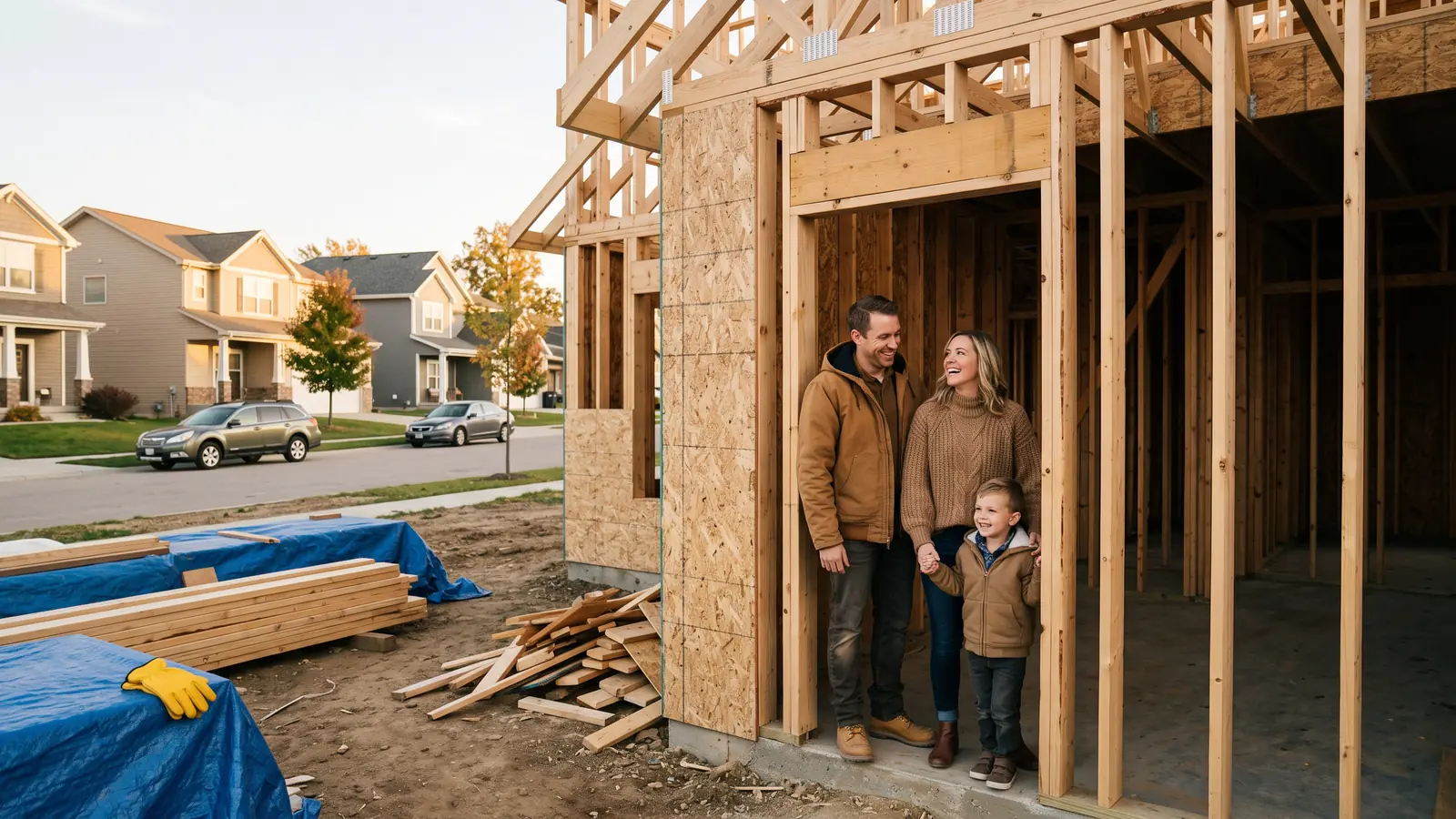
Budget well past the base price. Landscaping, fencing, window treatments, some appliances, design-center upgrades, and HOA dues usually sit outside the advertised number. And builder pricing is more negotiable than a sales office lets on, just not in the way most buyers expect.
Learn what to expect with new home construction, including how long each phase takes, which contract clauses to read before you sign, and how to weigh a builder’s financing incentive against outside offers. If you’re earlier in the process, start with our Home Buying guide.
Key takeaways:
- Plan on 6 to 12 months from contract to keys: Census Bureau data puts the average single-family build at 7.4 months from start to completion, with permitting, design selections, and closing on either side of that window.
- Most new homes aren’t built from scratch for you: Of the 678,000 new single-family homes sold in 2025, about 58% were already finished on the day they sold and only about 10% sold before ground broke.
- Builders negotiate incentives before they cut price: With a 9.3-month supply of new homes on the market as of June 2026, closing-cost credits, free upgrades, and rate buydowns are the levers most builders actually pull.
What are the steps in the new home construction process?
New construction moves through five phases, and the full sequence usually takes 6 to 12 months from the day you sign. The two phases that most often cost buyers money, the contract and the design center, come early.
| Phase | Typical duration | What happens |
|---|---|---|
| 1. Research and builder selection | 2 to 8 weeks | Tour models, compare communities and floor plans, vet the builder’s finished work. |
| 2. Contract and financing | 1 to 3 weeks | Sign, deposit, and lock financing. Get preapproved before this step, not after. |
| 3. Design selections | 2 to 6 weeks | Choose finishes and approve upgrades. Most pricing decisions become permanent here. |
| 4. Permitting and construction | 6 to 12 months | Site work, foundation, framing, rough-ins, drywall, finishes, municipal inspections. |
| 5. Walkthrough and closing | 1 to 2 weeks | Final walkthrough, punch list, Closing Disclosure review, funding, keys. |
The clock varies more by who is building than by anything else. In 2025, homes built for sale by production builders averaged 6.1 months start to completion, contractor-built homes on an owner’s lot averaged 10.5 months, and owner-built homes averaged 12.8 months. A spec home from a national builder puts you on the fast end; a custom plan on your own land puts you on the slow end.
A true ground-up build is also the exception. Of the 678,000 new single-family homes sold in 2025, roughly 396,000 were already completed at the time of sale and only about 67,000 sold before construction started, per U.S. Census Bureau new residential sales data. Most new construction buyers choose from inventory, not from a lot map.
Watch out: A builder’s schedule is a forecast, not a promise. Don’t give notice on a lease or schedule movers until the house is drywalled and the builder has confirmed a closing window in writing.
How do you choose a builder and a community?
Tour at least three of a builder’s finished communities before you write a deposit check. A model home is a marketing asset with every upgrade installed; the houses two streets over, occupied for three years, tell you what the builder actually delivers.
- Reputation: Read reviews, check state licensing and complaint records, and knock on doors in a community the builder finished two or three years ago. Ask what broke and how fast it got fixed.
- Transparency: A builder who gives you a written inclusions list, a milestone schedule, and a named contact before you sign usually behaves the same way during the build.
- Community type: Master-planned communities bundle amenities and charge HOA dues to maintain them. Get the current dues figure and the HOA’s reserve status in writing.
- Lot: Cul-de-sac, walkout, wooded, and water-view lots carry premiums that sit outside the base price. Corner and busy-street lots are cheapest for a reason.
Decide early whether a production build is even the right format. Semi-custom builders give you fixed plans with real finish choices, full custom buys control at the cost of time and money, and factory-built construction is its own path, weigh the benefits of modular homes before assuming site-built is the only option. More tactics live in our Buying Strategies & Situations hub.
Watch out: Unanswered warranty complaints in reviews and a refusal to name a completion window are both reasons to walk before you’re contractually committed.
What should you look for in a builder contract?
Builder contracts are written by the builder’s attorney and are negotiable in more places than buyers realize. Read these six clauses before you sign, and have a real estate attorney review the agreement, it looks nothing like the standard resale contract your agent uses.
| Clause | What to check | Why it matters |
|---|---|---|
| Price escalation | Whether the builder can raise the price for cost increases, and whether it’s capped | An uncapped clause makes your price a moving target you must still qualify for. |
| Completion timeline | Whether a date is guaranteed, what counts as an excused delay, your remedy | Most contracts excuse weather, supply, and labor delays. |
| Included features | A written, itemized list of what the base price covers | “Standard” varies enormously between builders; the list is your defense against surprises. |
| Allowances and change orders | Allowances for flooring, lighting, and appliances, plus the fee to change your mind | Thin allowances push you into upgrades, and change fees hit even small revisions. |
| Warranty | What’s covered, for how long, and who administers claims | Coverage commonly runs one year on workmanship, two on systems, ten on structural, but terms vary. |
| Deposit and dispute resolution | Whether your deposit is refundable and escrowed, and whether disputes go to arbitration | Non-refundable deposits and mandatory arbitration are common and limit your options. |
Then get clear on what the base price excludes. Commonly outside the number: full-yard landscaping and sod, fencing, window treatments, the refrigerator and washer/dryer, garage door openers, deck extensions, basement finishing, lot premiums, and nearly every design-center choice beyond builder-grade.
For perspective on where the money goes, the National Association of Home Builders 2024 Construction Cost Survey, a builder-reported sample, not a count of every home built, broke a typical new home’s $665,298 sales price into $428,215 of construction cost, $91,057 for the finished lot, $72,971 of builder profit, and the rest in financing, overhead, and commission. Everything you add after closing sits on top of that stack.
Watch out: If a salesperson promises it, get it in the contract or an addendum. Verbal commitments about upgrades, lot grading, or completion timing are unenforceable, and the person who made the promise may not work there in nine months.
How much should you budget for design selections and upgrades?
Set your upgrade ceiling in writing before the design-center appointment and treat it as hard. The design center is a sales environment where every choice is presented as a small incremental cost, and buyers routinely leave having approved five figures they hadn’t planned to spend.
Do the math once, slowly. Hypothetical example, not an offer: if your base price is $400,000 and you approve $40,000 in upgrades, you’re financing a $440,000 home, a 10% increase you carry for the life of the loan, plus a larger down payment and larger closing costs.1 An appraiser also may not credit those upgrades dollar-for-dollar, which matters if the appraisal has to support the contract price.
- Splurge on what’s hard to change later: Structural options, window placement, rough-in plumbing, extra electrical, and insulation are expensive or impossible to retrofit.
- Save on what’s easy to change: Light fixtures, faucets, mirrors, backsplash tile, and window treatments cost less after closing than the design center charges.
- Keep resale in view: Neutral, durable finishes hold value; highly personal choices rarely return what they cost.
- Reserve a contingency: Plan for post-closing costs the builder never quoted, blinds, a fence, back-yard landscaping, and excluded appliances.
Our guide to building a home on a budget goes deeper on which upgrades are worth negotiating rather than buying.
What happens during the construction phase?
Construction runs in a fixed order. Permits and site work, foundation, framing, rough-in of plumbing, electrical, and HVAC, insulation and drywall, then finishes, and each stage triggers a municipal inspection before the next can start. Ask for a milestone schedule and a single point of contact; a check-in every two to three weeks is generally enough.
Delays are normal and mostly outside your builder’s control: weather, permit backlogs, material lead times, and subcontractor availability. Raise problems the moment you see them. A framing question is cheap to answer before drywall and expensive after.
Independent inspections on new construction
Hire your own inspector even though the city already inspects the house. Municipal inspections verify code compliance, not workmanship, and independent inspectors regularly find real defects in brand-new homes, missing insulation, improperly flashed roofs and windows, unsupported ductwork, and grading that pitches toward the foundation.
- Pre-drywall inspection: After rough-ins, before insulation closes the walls. The only time framing, wiring, plumbing, and duct runs are visible.
- Pre-closing inspection: Before your final walkthrough, so defects land on the punch list while the builder still holds your money.
- Eleven-month warranty inspection: Just before a one-year workmanship warranty expires, when settling cracks and HVAC balance problems have had time to appear.
Each costs a few hundred dollars, small insurance against a defect the builder’s own quality check missed. Our guide to home inspections for new construction covers what a good inspector looks for at each stage.
How do you finance a new construction home?
Buying a completed or in-progress home from a builder takes an ordinary purchase mortgage, the builder carries the construction financing and you close once, at completion. Building from scratch on your own lot takes financing that funds in draws and then converts, and our guide to construction-to-permanent loans explains how the single-close version works.
The bigger decision for most buyers is the builder’s preferred lender. Builders frequently attach real money to using their affiliated lender, closing-cost credits, free upgrades, or a rate buydown, and those incentives are legal and often genuinely valuable. Two things to know:
- You can’t be required to use them: Under RESPA, a builder generally can’t condition the sale on your use of a particular settlement service provider, and any affiliated business arrangement must be disclosed in writing at or before the referral.
- The incentive isn’t automatically the better deal: A $10,000 closing-cost credit can be worth less than a lower rate and lower fees over the years you keep the loan. The only way to know is to compare Loan Estimates.
That’s what the disclosure system is built for. A lender must give you a Loan Estimate within three business days of receiving your application, and the form is standardized so competing offers line up side by side, see the CFPB on comparing Loan Estimates from multiple lenders. Get the builder lender’s estimate, get at least one outside estimate for the same loan type and terms, then compare rate, lender fees, and total cash to close together. Hand the better outside offer back and ask the builder’s lender to match it. Incentives are frequently negotiable when the builder wants the sale, which is worth knowing when you’re navigating a buyer’s market.
One timing item: a long build can outrun a standard rate lock. Lenders in Align’s network offer extended lock programs that hold a rate for several months to roughly a year, usually for an upfront fee or a pricing adjustment, and some include a one-time float-down.2 Ask about lock length before you sign, not at month seven.
What happens at the final walkthrough and closing?
Budget two to three hours for the final walkthrough and bring a written list, a phone for photos, and a charger to test outlets. This is your leverage point: once you close, unresolved items move from “fix before funding” to “file a ticket.”
- Build the punch list: Document every defect, misaligned door, paint gap, and non-working fixture, and get it signed by the builder’s representative with correction dates.
- Test everything that runs: Outlets, switches, faucets, drains, appliances, windows, exterior doors, the garage opener, and HVAC in both heating and cooling modes.
- Confirm the paperwork: Certificate of occupancy, final survey, warranty documents, and a written subcontractor list for claims.
- Review the Closing Disclosure early: Compare it line by line against your most recent Loan Estimate and raise discrepancies before closing day.
Then start the warranty clock deliberately: note the date your one-year workmanship coverage expires, calendar the eleven-month inspection now, and submit every claim in writing.
What do the latest new-home sales numbers show for 2026?
Sales of new single-family houses in September 2026 ran at a seasonally adjusted annual rate of 676,000, 5.3% below the 714,000 pace of September 2025, and the 476,000 new houses for sale at the end of September equaled an 8.4-month supply, according to the Census Bureau and HUD New Residential Sales release of October 27, 2026. The median price was 3.9% below September 2025’s $416,800 and the average 6.7% below $506,800.
In the NAHB Housing Market Index for October 2026, builder confidence fell three points to 29, 43% of builders reported cutting prices, the average cut held at 6% for the seventh consecutive month, and 65% reported using sales incentives.
The New Residential Construction release of October 20, 2026 put September single-family starts at a seasonally adjusted annual rate of 859,000, 4.6% below August’s 900,000; single-family permits at 845,000, 4.0% below August’s 880,000; and single-family completions at 840,000, 2.4% below August’s 861,000.
What do the figures show for the Midwest, the Census region that includes Michigan?
| Midwest measure | Latest | A year earlier |
|---|---|---|
| New houses sold, September, annual rate | 89,000 (2026) | 97,000 (2025); the 8.2% drop is not statistically significant, per the release |
| New houses sold, January to September | 63,000 (2026) | 63,000 (2025); 0.5% lower in 2026 before rounding |
| Single-family permits, September, annual rate | 121,000 (2026) | 130,000 (2025) |
Sources: U.S. Census Bureau and HUD, New Residential Sales, September 2026, tables 1a and 1b; New Residential Construction, September 2026, table 1a.
How do loan rules limit what a builder can contribute?
A builder’s credit is capped. Fannie Mae’s Selling Guide section B3-4.1-02 on interested party contributions (topic dated May 7, 2025) names the builder or developer as an interested party. For a principal residence or second home, the maximum financing concessions are 3% when the loan-to-value or combined ratio is greater than 90%, 6% from 75.01% to 90%, and 9% at 75% or less; an investment property is held to 2%. The percentages run on the lower of the sales price or appraised value, and the contributions cannot be used for the down payment or reserves.
The same section says financing concessions must be equal to or less than the buyer’s closing costs; anything above that is a sales concession, deducted from the price, with the ratio recalculated. A buydown funded by the builder or a lender affiliated with it counts toward the cap, so a builder’s buydown and closing-cost credit draw on one allowance; see seller-paid closing costs and mortgage rate buydowns. Under Fannie Mae’s section B2-1.4-04 on temporary buydowns (topic dated August 7, 2024), the rate reduction may not exceed 3%, the rate may rise no more than 1% per year and the plan must be a written agreement.
Hypothetical example, not an offer. A $400,000 home that appraises at $400,000 with a $360,000 loan sits at 90% loan-to-value, the 6% tier of Fannie Mae’s interested party contribution table, which would allow up to $24,000. If closing costs total $11,000 and the builder credits $15,000, the extra $4,000 becomes a sales concession, the price used for the ratio drops to $396,000, and the same loan sits at about 90.9%, in the 3% tier.
To weigh a credit against a lower rate, use the points vs. lender credit calculator.
What changes in the loan paperwork when closing is months away?
Under 12 CFR 1026.19(e)(3)(iv)(F), when a lender reasonably expects settlement more than 60 days after it gives you the Loan Estimate, it may issue revised disclosures for that reason only if the original Loan Estimate states clearly and conspicuously that at any time prior to 60 days before consummation the lender may issue revised disclosures. Look for that sentence on every estimate you collect. The same section requires that you receive the Closing Disclosure no later than three business days before consummation; compare it with your estimate in the Loan Estimate check.
Lock length is the other gap. The CFPB says rate locks are typically available for 30, 45, or 60 days and may be expensive to extend. Against the 2025 average of 6.1 months from start to completion for single-family homes built for sale in the Census Bureau’s start to completion table, a standard lock taken at contract on a home not yet started would expire long before it is finished; see what a mortgage rate lock is and the benefits of a rate lock.
How is a new home appraised when nothing nearby has resold?
Fannie Mae’s Selling Guide section B4-1.3-08 on comparable sales (topic dated June 4, 2025) treats a subdivision as new when there are limited or no resales, or when the builder is involved in marketing the homes. The appraisal must then include at least one settled sale from inside the subdivision, preferably a resale that does not involve the builder, at least one from outside it, and a third from either. If the value comes in low, see the home appraisal process and appealing a low appraisal.
What warranty paperwork comes with an FHA, VA or USDA new build?
HUD’s form HUD-92544, Warranty of Completion of Construction (April 2023 edition, which combines the former VA Form 26-1859) has the builder warrant that the house was built in substantial conformity with the plans and specifications and against defects in equipment, material or workmanship. Written notice of a nonconformity is due within one year from the original conveyance of title or initial occupancy, whichever comes first; if you took title before completion, the year runs from completion or initial occupancy, whichever comes first. Completed copies go to the homebuyer and the builder at closing. For an item that had to be postponed, notice may be given within one year from the date that item is fully completed. The VA lists building a new home among the uses of a VA-backed purchase loan; see VA loans, VA construction loans and FHA loans.
For USDA guaranteed loans, 7 CFR 3555.202 requires new dwellings to meet or exceed the International Energy Conservation Code in effect at construction, and lets the guarantee issue with unfinished work that does not affect habitability, health or safety when that work costs no more than 10% of the final loan amount, an escrow holds at least 100% of the cost to complete, and a contract calls for completion within 180 days of closing; see USDA loan basics. Align Lending is not affiliated with or endorsed by HUD, FHA, VA or USDA.
What should Michigan buyers check before building or buying new?
Is the builder licensed in Michigan?
Since June 1, 2008, an applicant for a LARA residential builder license must complete 60 hours of approved prelicensure education, with at least 6 hours in each of seven subjects including the Michigan Residential Code, according to LARA’s prelicensure requirements page. Look a builder up on LARA’s Verify a Licensed Professional or Business page.
How do Michigan construction liens affect a new build?
Under the Construction Lien Act, the owner contracting for the work records a notice of commencement with the county register of deeds before work begins (MCL 570.1108); the contractor gives the owner a sworn statement listing each subcontractor and supplier when payment is requested (MCL 570.1110); and a lien claimant must record its claim within 90 days after its last furnishing of labor or material (MCL 570.1111). LARA’s May 3, 2017 consumer release advises asking for signed waivers of lien. Recorded liens are public: Oakland County’s Register of Deeds offers copies of recorded documents back to January 1, 1964, and Macomb County’s Register of Deeds records liens and lis pendens. See also why title insurance is important.
How will a new Michigan home be taxed?
Michigan sets taxable status as of December 31 of the prior year under MCL 211.2, so first bills can reflect what stood on the parcel that day rather than the finished house. The year after a home sells, its taxable value uncaps, as Michigan Treasury’s page on transfers of ownership explains. Under MCL 211.27a, property is assessed at 50% of its true cash value, and after a transfer taxable value resets to the state equalized value, which is half of the assessor’s estimate of market value, not automatically half of what you paid. Plan with the Michigan property tax calculator and how property tax assessments work.
How Align fits your buying strategy
Local real estate agents bring Samantha in for a second opinion when their buyer arrives preapproved somewhere else. She regularly finds a lower rate or less cash to close, whichever helps the buyer more.
That comes from the broker model. One application goes to multiple wholesale lenders, so your offer is built on the loan that fits your situation, not the only one a single bank sells. A 2024 Polygon Research analysis of federal mortgage data found broker borrowers paid about $10,662 less over the life of a $400,000 loan than borrowers at nonbank retail lenders.
FAQ: Buying a new construction home
Here are answers to common questions about new home construction.
Can you negotiate the price of a new construction home?
Yes. Builders often resist cutting the base price because it lowers the comps for every remaining home in the community, but they routinely negotiate closing-cost credits, free design upgrades, premium lots, or a rate buydown, especially on completed inventory homes or at the end of a quarter. An agent who specializes in new construction knows which levers each builder actually pulls, and knowing how to read a buyer’s market as a home buyer tells you how much room you have.
How long does it take to build a new construction home?
Most production homes take 6 to 12 months from contract to completion, and Census Bureau data puts the 2025 average build at 7.4 months from start to finish. Semi-custom and custom builds run longer, and permitting, weather, supply-chain issues, and labor shortages can all extend the timeline. Ask for a milestone schedule and whether the contract offers any remedy for extended delays, and if you’re building on your own lot, look at construction-to-permanent loans built for a longer runway.
Do you need a home inspection on new construction?
Yes. New does not mean flawless. Municipal inspections check code compliance, not workmanship, and independent inspectors regularly find problems in new builds, from missing insulation to improperly flashed roofs. Many buyers schedule three: pre-drywall, pre-closing, and one just before the one-year builder warranty expires. Our guide to home inspections for new construction covers what each one should catch.
What is usually not included in a new construction base price?
Commonly excluded: full-yard landscaping and sod, fencing, window treatments, some appliances (often the refrigerator and washer/dryer), garage door openers, deck or patio extensions, basement finishing, and nearly every design-center upgrade beyond builder-grade finishes. Lot premiums and HOA dues add more. Get a written inclusions list before you sign.
Are new construction homes more expensive than existing homes?
Not by the national medians in fall 2026. New houses sold in September 2026 had a median price of $400,400 and an average of $472,800, per the Census Bureau. The median existing home sold for $417,500 that month, up 1.3% from $412,300 a year earlier, per the National Association of REALTORS report of October 13, 2026. Medians mix different sizes and locations, so compare specific homes on their all-in cost.
Does a new construction home need flood insurance?
It depends on the FEMA flood zone. In Zone A, a high-risk area, homeowners with federally backed mortgages in communities that participate in the National Flood Insurance Program must buy flood insurance, per FloodSmart. The same page notes 1 in 3 flood insurance claims come from low- and moderate-risk zones, and owners can request a Letter of Map Amendment or Revision to change a designation. Our guide to buying in a flood zone covers the rest.
Can you claim Michigan’s principal residence exemption while your home is still being built?
Not until you live in it. MCL 211.7cc requires the property to be occupied as a principal residence by its owner, and mere statements of intent are insufficient, per Treasury’s occupancy requirement guidelines. After move-in, file Form 2368 with the local assessor: filed by June 1 it starts with that year’s summer levy, June 2 through November 1 with the winter levy, per Michigan Treasury. It removes school operating millage up to 18 mills, according to Treasury.
Who gets the federal tax credit for an energy-efficient new home?
The builder, not the buyer. The IRS says eligible contractors who build qualified energy-efficient homes may claim up to $5,000 per home for homes acquired in 2023 through June 30, 2026, depending on the ENERGY STAR or Zero Energy Ready Home program the home was built under. The Department of Energy’s program is now called DOE Efficient New Homes. Ask the builder for the certification; our guide to energy-efficient upgrades covers what it means for bills.
The bottom line on buying new construction
New home construction typically runs 6 to 12 months from contract to move-in, with Census Bureau data putting the average single-family build at 7.4 months from start to completion. The two phases that decide how the deal turns out come early: the contract, where price escalation, completion timing, included features, and warranty terms are still negotiable, and the design center, where upgrades get financed for thirty years. Budget past the base price, hire your own inspector at pre-drywall and again before closing, and treat the builder’s financing incentive as one offer to compare rather than the answer.
If you’re ready to buy or build new construction, talk to Align Lending. We’ll shop your scenario across our wholesale lender network and put the builder’s incentive next to competing offers so you can see which one actually wins. Call 248-506-5727 or start online.
Footnotes:
1. Example figures are hypothetical and for educational purposes only; they do not constitute an advertisement of credit terms or a rate quote under federal or state lending laws. Your loan amount, upgrade pricing, appraised value, down payment, and cash to close depend on your application, your builder’s pricing, the property, and market conditions. Return to text.
2. Align Lending is a broker and does not set lender program terms. Extended rate lock availability, lock periods, fees, pricing adjustments, and float-down features are set by individual wholesale lenders, vary by lender and loan program, and are subject to change without notice. Nothing here is a rate quote or an offer of credit. Return to text.
Sources: average length of time from start to completion for single-family homes (7.4 months in 2025; 6.1 months built for sale, 10.5 months contractor-built, 12.8 months owner-built), U.S. Census Bureau, Survey of Construction, Average Length of Time from Start to Completion. New single-family homes sold in 2025 by stage of construction (678,000 total; 396,000 completed, 215,000 under construction, 67,000 not started) and months’ supply of new homes (9.3 months, June 2026), U.S. Census Bureau and U.S. Department of Housing and Urban Development, New Residential Sales. Single-family price and cost breakdown ($665,298 average sales price; $428,215 construction cost; $91,057 finished lot; $72,971 builder profit), National Association of Home Builders, Cost of Constructing a Home, 2024. Loan Estimate delivery within three business days of application and guidance on comparing Loan Estimates, Consumer Financial Protection Bureau. Prohibition on required use of a particular settlement service provider and affiliated business arrangement disclosure timing, Real Estate Settlement Procedures Act and Regulation X, 12 CFR 1024.15 and 1024.16.
This article is for informational purposes only and is not intended to provide legal, financial, or tax advice. Builder purchase agreements, warranty terms, arbitration clauses, and deposit provisions should be reviewed by a licensed real estate professional or attorney in your state before you sign. Consult a qualified professional about your situation. Program terms and figures shown are illustrative, are not a rate quote or an offer of credit, and are subject to change. Align Lending is an independent Michigan mortgage broker, NMLS #2041154.
Sources
Every outside source this guide links to, in the order it appears. How we choose and check sources
- U.S. Census Bureau’s Survey of ConstructionU.S. Census Bureau
- U.S. Census Bureau new residential sales dataU.S. Census Bureau
- National Association of Home Builders
- The CFPB on comparing Loan Estimates from multiple lendersConsumer Financial Protection Bureau
- Census Bureau and HUD New Residential Sales release of October 27, 2026U.S. Census Bureau
- NAHB Housing Market Index for October 2026National Association of Home Builders
- New Residential Construction release of October 20, 2026U.S. Census Bureau
- New Residential Sales, September 2026U.S. Census Bureau
- Selling Guide section B3-4.1-02 on interested party contributionsFannie Mae Selling Guide
- Section B2-1.4-04 on temporary buydownsFannie Mae Selling Guide
- 12 CFR 1026.19(e)(3)(iv)(F)Electronic Code of Federal Regulations
- CFPB says rate locks are typically available for 30, 45, or 60 daysConsumer Financial Protection Bureau
- Selling Guide section B4-1.3-08 on comparable salesFannie Mae Selling Guide
- Form HUD-92544, Warranty of Completion of ConstructionU.S. Department of Housing and Urban Development
- VA lists building a new homeU.S. Department of Veterans Affairs
- 7 CFR 3555.202Electronic Code of Federal Regulations
- LARA’s prelicensure requirements pageState of Michigan
- Verify a Licensed Professional or BusinessState of Michigan
- MCL 570.1108Michigan Legislature
- MCL 570.1110Michigan Legislature
- MCL 570.1111Michigan Legislature
- May 3, 2017 consumer releaseState of Michigan
- Oakland County’s Register of Deedsoaklandcountymi.gov
- Macomb County’s Register of Deedsmacombgov.org
- MCL 211.2Michigan Legislature
- Michigan Treasury’s page on transfers of ownershipState of Michigan
- MCL 211.27aMichigan Legislature
- National Association of REALTORS report of October 13, 2026National Association of Realtors
- FloodSmartFEMA, National Flood Insurance Program
- Occupancy requirement guidelinesState of Michigan
- Michigan TreasuryState of Michigan
- TreasuryState of Michigan
- IRS says eligible contractorsInternal Revenue Service
- Now called DOE Efficient New HomesU.S. Department of Energy
- Cost of Constructing a Home, 2024National Association of Home Builders
- 12 CFR 1024.15Consumer Financial Protection Bureau
Related resources

20-minute read
How to create a competitive offer on a house in a seller’s market
Learn how to create a competitive offer on a house, from preapproval and pricing to contingencies and appraisal gap coverage, and win in a hot market.

20-minute read
Advantages of buying a fixer-upper: 7 key benefits (and the tradeoffs)
Discover the advantages of buying a fixer-upper, from lower prices and less competition to renovation loans that roll repair costs into your mortgage.

20-minute read
Guide to Negotiating a Home Purchase
Strategies for negotiating a home purchase, from inspection findings and seller concessions to offers that win without overpaying.
