
Understanding construction-to-permanent loans: One close, two phases
A construction-to-permanent loan finances the build and the mortgage in a single closing that happens before ground is broken. Under Fannie Mae’s Selling Guide, the construction phase of a single-closing loan may have no single period longer than 12 months, and the total period may not exceed 18 months. During that window the lender releases money to your builder in draws as completed work is inspected, and you pay interest only on what’s been advanced.
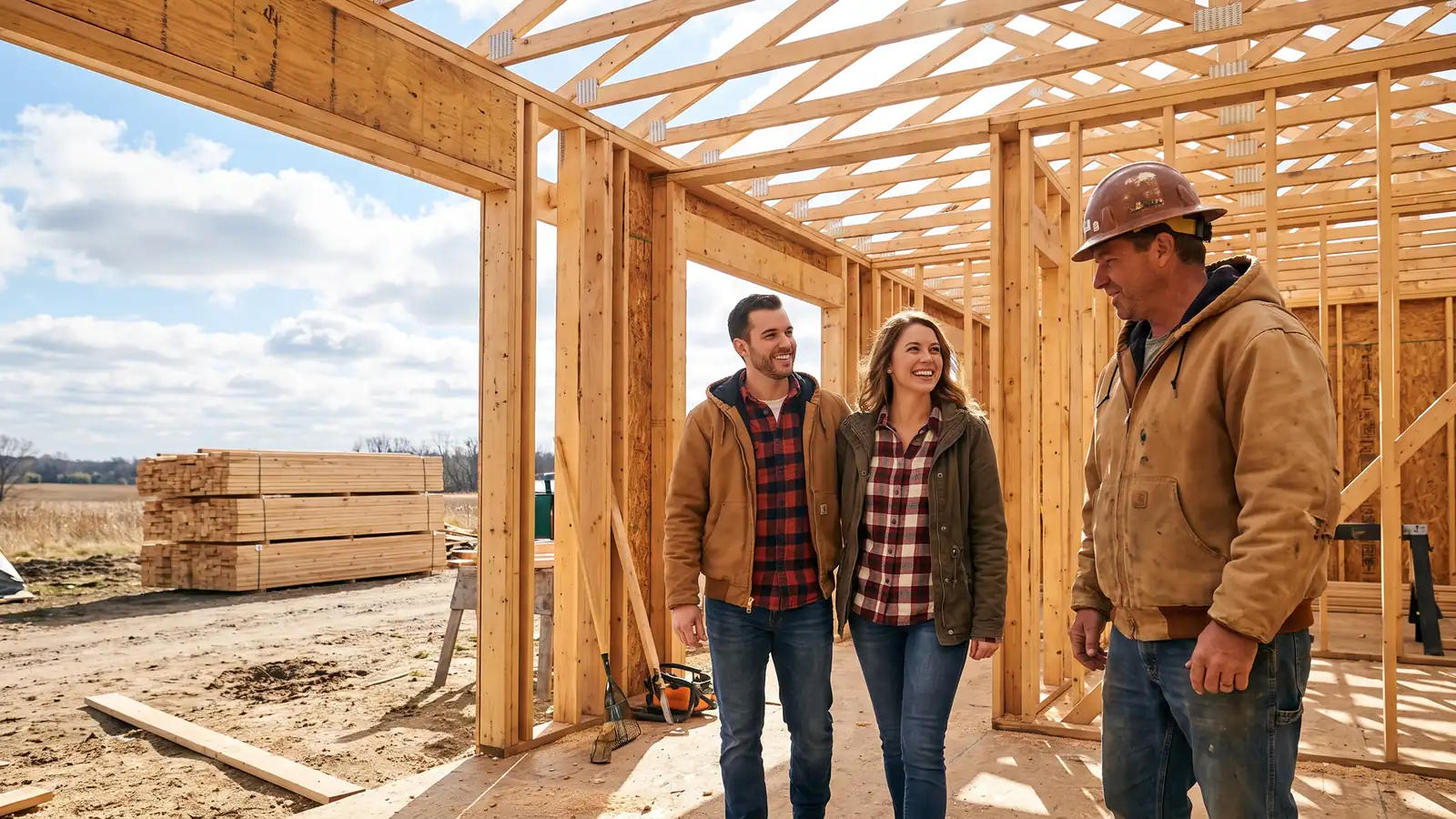
When the house is finished and the certificate of occupancy is issued, the loan converts to a standard amortizing mortgage by rider or modification agreement. No second closing, no second application. Qualifying is tighter than a purchase loan: construction lenders in Align’s network typically want a larger down payment, a credit score near 680, a DTI under 45%, and approval of your builder, blueprints and line-item budget.
Learn how construction-to-permanent loans work: how draws are released, when the loan converts, and what lenders check first. If you’re still comparing structures, start with our Loan Types & Programs guide.
Key takeaways:
- One closing covers both phases: A single closing before construction starts replaces the 2 closings and 2 sets of costs a stand-alone construction loan needs, and the note converts by rider or modification when the home is complete.
- You pay interest only on drawn funds: With $150,000 of a $375,000 construction budget released, interest accrues on $150,000, not on the full commitment, so the payment climbs in steps as the house goes up.
- Plan for stricter qualifying and a 12-month clock: Construction lenders commonly ask for a bigger down payment than a purchase loan needs, a 680 credit score and a DTI under 45%, and Fannie Mae caps any single construction period at 12 months and the total at 18 months.
What is a construction-to-permanent loan?
A construction-to-permanent loan is a single mortgage that funds construction in draws, then converts into the long-term mortgage on that home without a second closing. Fannie Mae describes the conversion as “the granting of a long-term mortgage to a borrower for the purpose of replacing interim construction financing,” and allows the structure to be built as one closing or as two separate closings.
The single-closing version, also called one-time close, is what most people mean by the term. You are underwritten once, on the permanent terms, before construction starts. The construction phase is a temporary state of that same loan, not a separate debt to pay off later. The CFPB’s explainer on what a construction loan is gives the regulator’s framing.
Not every property qualifies. Fannie Mae makes attached condo units and all co-ops ineligible; detached condo units are permitted, including manufactured homes in a condo project, subject to project review. This is specialty lending, in the family most retail banks don’t originate. Our Specialty Financing hub covers that corner of the market, from renovation loans for an existing house to reverse mortgages at the far end of the timeline.
How does the construction phase work?
Money leaves the loan in stages. Your builder submits a draw request tied to finished work, an inspector verifies it against the approved budget, title is rechecked for liens, and only then are funds released. You owe interest on the cumulative amount advanced, which is why month two’s payment looks nothing like month nine’s.
Federal rules recognize two versions, and you should know which you have. Regulation Z’s Appendix D, governing multiple-advance construction loans, sets out one procedure where interest is payable only on the amount advanced and another where it is payable on the entire commitment. For the first, the rule tells creditors to assume one-half of the commitment is outstanding at the contract rate for the whole construction period, which doubles as a budgeting model.1
What a typical draw schedule looks like
| Stage | What triggers the release | What the lender verifies |
|---|---|---|
| Closing advance | Loan closes before construction begins | Recorded mortgage, clear title, notice of commencement where required |
| Foundation | Footings, foundation walls and backfill complete | Work in place matches the budget; title rechecked for liens |
| Framing and dry-in | Structure framed, sheathed, roofed and weather-tight | Percentage complete matches the draw request |
| Mechanical rough-in | Plumbing, electrical and HVAC roughed in | Municipal rough-in inspections signed off |
| Drywall and interior | Insulation, drywall, cabinets and trim set | Installed work, not materials sitting on site |
| Final draw | Certificate of occupancy issued and punch list closed | Completion report; all construction liens satisfied |
Draws follow finished work, whatever your lender calls the stages. Our Construction Loan Guide details the mechanics, and the National Association of Home Builders resources on the build process pair well with your builder’s contract.
Where does the money in a construction budget go?
The National Association of Home Builders reported in January 2025 that construction costs made up 64.4% of the average price of a new single-family home in its 2024 Cost of Construction Survey, with the finished lot the second largest cost at 13.7% of the sales price, according to NAHB’s summary of the survey. Inside construction costs, interior finishes were the largest category at 24.1%, followed by major system rough-ins at 19.2%, framing at 16.6% and exterior finishes at 13.4%, so the biggest single slice of the budget is released late in the build.
| Stage, in rough build order | Share of construction cost (NAHB 2024 survey) | Hypothetical draw on a $375,000 budget | Total drawn after this stage |
|---|---|---|---|
| Site work | 7.6% | $28,500 | $28,500 |
| Foundations | 10.5% | $39,375 | $67,875 |
| Framing | 16.6% | $62,250 | $130,125 |
| Exterior finishes | 13.4% | $50,250 | $180,375 |
| Major system rough-ins | 19.2% | $72,000 | $252,375 |
| Interior finishes | 24.1% | $90,375 | $342,750 |
| Final steps | 6.5% | $24,375 | $367,125 |
| Other costs | 2.1% | $7,875 | $375,000 |
Source: construction cost shares from the NAHB 2024 Cost of Construction Survey, Cost of Constructing a Home in 2024 (January 23, 2025). The two dollar columns are a hypothetical example, not an offer: they apply the survey shares to a $375,000 construction budget; your builder’s contract sets the real draws.
Hypothetical example, not an offer. On that same $375,000 budget, the estimating rule in Appendix D to Regulation Z for loans that charge interest only on amounts advanced assumes one-half of the commitment, $187,500, is outstanding for the whole construction period. In a single-closing transaction, Fannie Mae’s single-closing topic, B5-3.1-02, makes the lender responsible for managing the disbursement of loan proceeds to the builder, contractor or other authorized suppliers. Our guide to building a home on a budget covers ways to protect the contingency line.
When does the loan convert to a mortgage?
Conversion happens at completion, and it is paperwork rather than a closing. Fannie Mae lets the loan convert through either a construction loan rider or a separate modification agreement, executed and recorded before delivery. Two conditions come first: the lender must retain a certificate of occupancy or equivalent from the applicable government authority, and all mechanic’s liens, materialmen’s liens and other construction claims must be satisfied.
An Appraisal Update and/or Completion Report (Form 1004D) must be completed in its entirety, including the certification of completion. If the appraiser reports that value has declined, the lender must obtain a new appraisal and requalify you, the one scenario that puts a single-close borrower back in underwriting.
Your file also has a shelf life. Fannie Mae requires the credit documents to be no more than four months old at conversion, extended to 18 months when LTV, CLTV and HCLTV all stay at 95% or less and the loan got an Approve/Eligible recommendation from Desktop Underwriter at the original closing. Lenders may modify the rate, loan amount, term and amortization type so long as the loan is underwritten on the modified terms, but the only amortization change permitted is adjustable-rate to fixed-rate, and a loan-amount increase is limited to documented increases in construction costs. Change any other loan term and the file has to be processed as a two-closing transaction.
What does Fannie Mae require between closing and conversion?
Fannie Mae will not buy a single-close loan until construction is complete and the loan has converted to its permanent terms, according to Selling Guide topic B5-3.1-02 (dated May 6, 2026), so the lender carries the loan through the build. The same topic lets lenders assemble the construction period from shorter pieces, giving three 6-month periods, one 12-month period plus one 6-month period, or six 3-month periods as examples, and it states that exceptions to the 12-month and 18-month limits will not be granted.
Two timing rules sit beside the credit document clock, per the same Fannie Mae topic. The appraisal’s effective date can be no more than four months before the note date, which is the closing date of the construction loan. If the loan uses a construction loan rider and the house is finished sooner or later than planned, the lender amends the rider with new dates for when amortization begins and ends. Our guide to the home appraisal process explains what an as-completed value rests on. If the rate or loan amount changes on a manually underwritten loan, the lender re-underwrites it when the recalculated DTI stays at or under 45%, and a DTI that rises above 36% must meet the Eligibility Matrix credit score and reserve rules for that band.
Where the cash comes from: on a single-close purchase, Fannie Mae requires your own funds for the minimum borrower contribution unless the loan-to-value ratio, CLTV or HCLTV is 80% or less, or you are buying a one-unit principal residence and meet its rules for gifts, donated grant funds or employer assistance. Our guide to financing a purchase with gift funds walks through those rules.
Construction-to-permanent vs. a stand-alone construction loan
The difference is how many times you go to closing. Fannie Mae calls the alternative a two-closing transaction: the first obtains the interim construction financing and may include the lot purchase, the second obtains permanent financing at completion.
| Feature | Single-closing (construction-to-permanent) | Two-closing (construction loan, then mortgage) |
|---|---|---|
| Number of closings | 1, before construction begins | 2, at the start and at completion |
| Sets of closing costs | 1 | 2 |
| Requalifying at completion | No second application; converts by rider or modification | Yes. Underwritten on the terms of the permanent mortgage |
| Permanent rate | Set at the first closing, subject to allowed modification | Set at the second closing, months later |
| Construction period limit | No single period over 12 months; 18 months total | Not capped; a long build must be processed this way |
| Cash out at completion | No. Closes as a purchase or limited cash-out refinance | Cash-out allowed if you held legal title to the lot at least 6 months |
Single-close wins on cost and certainty. Two-close wins on flexibility, and it is the fallback when a build runs long: exceed those limits and Fannie Mae requires the lender to process the loan as a two-closing transaction.
What do you need to qualify?
Start with what the agencies actually require, because it is less than most articles claim. Fannie Mae sets no special construction-to-permanent down payment. Both versions take the standard purchase and limited cash-out refinance maximum LTV, CLTV and HCLTV ratios for the property type, published in Fannie Mae’s Eligibility Matrix. The 20% figure you see everywhere is a lender overlay, not an agency rule.
Classification turns on one fact: whether you owned the lot at the first advance. If not, it is a purchase, and LTV is the loan amount divided by the lesser of the purchase price (construction cost plus the lot’s sales price) or the “as completed” appraised value. If you did, it is a limited cash-out refinance, and LTV is the loan amount divided by the “as completed” value of lot and improvements. That second formula is why buyers who bought land years ago often need far less cash than 20% suggests: their lot equity works as the down payment.
- Down payment: Lenders in Align’s network commonly want a bigger down payment on a conventional single-close file than on a purchase loan, measured against as-completed value; Samantha can tell you what her lenders are asking for on your build.
- Credit score: Around 680 is the common construction-lending floor, a lender overlay rather than a Fannie Mae or Freddie Mac minimum.
- Debt-to-income ratio: Under 45% is typical, calculated on the permanent payment, not the interest-only one.
- Builder approval: Expect review of your builder’s license, insurance, financials and references. Several programs bar owner-builders outright.
- Plans and a line-item budget: A fixed-price contract with a realistic completion date and a contingency line for weather, permits and materials is the best thing you can bring to underwriting.
Freddie Mac runs a parallel structure on its own rules, setting the value used for LTV, TLTV and HTLTV ratios in Guide Section 4602.2 for One-Time Close and Section 4203.1 for Two-Time Close.
How the rules change by loan program
Every major program has a single-close version, and each changes the down payment math. Because Align is a broker, we place these through partner lenders even when the bank down the street offers none of them.
Conventional
Fannie Mae and Freddie Mac both buy single-close construction-to-permanent loans, subject to the 12- and 18-month period limits and the standard LTV ceilings for the property type.
FHA
HUD’s Single Family Housing Policy Handbook 4000.1 describes a Construction to Permanent Mortgage as one combining a construction loan and the traditional long-term permanent mortgage with a single mortgage closing prior to the start of construction, with no separate permanent-loan closing. FHA’s minimum required investment stays at 3.5% of adjusted value at a 580 credit score or above, and a licensed general contractor is required.2
VA
Eligible veterans can build on the same no-down-payment terms that apply to a VA purchase, and the funding fee is a percentage of the loan amount, not a flat charge. VA’s published purchase fee schedule in effect as of August 2026 is 2.15% for first use with less than 5% down, 1.5% at 5% or more down and 1.25% at 10% or more down; after first use it is 3.3% with less than 5% down, with the same 1.5% and 1.25% tiers above that. Confirm the current table on va.gov before you budget it. It is waived for veterans receiving VA compensation for a service-connected disability, among other exemptions. VA Circular 26-25-1, issued March 31, 2025, also eliminated the requirement that a builder obtain a VA-issued builder identification number before the Notice of Value, though builders must still meet state and local licensing rules and the ID still applies to Specially Adapted Housing grants and Native American Direct Loans. Our guide to the benefits of VA construction loans covers the rest.3
USDA
USDA Rural Development offers a combination construction-to-permanent, or single close, option inside the Single Family Housing Guaranteed Loan Program, with the loan note guarantee issued before construction begins. The catch is on the lender side: a participating approved lender must have two years of experience originating and administering construction loans, which narrows the field. USDA’s Guaranteed and Direct programs are separate, with different income limits, and this product sits in Guaranteed.
Who inspects the work on a VA construction loan?
Not VA. According to the background section of VA Circular 26-25-1, VA stopped compliance inspections for new and proposed construction in February 2006 and relies instead on local building inspections and 1- or 10-year construction warranties. The same circular changed how VA handles a veteran’s complaint about a builder: VA now points veterans to resources such as the local building department, licensing boards or, for a serious matter, legal counsel, instead of interceding. VA continues to process complaints received during the 1-year warranty period on loans whose Notice of Value was issued before that update.
VA’s funding fee page prints one fee table for VA-backed purchase and construction loans, effective April 7, 2023, so a construction loan uses the purchase schedule described above. Read our guides to home warranty options and VA loans before you sign the builder’s contract.
What did USDA change in its single close rule?
The Rural Housing Service published a final rule in the Federal Register on July 22, 2019, effective August 21, 2019, that reshaped USDA’s guaranteed single close loan. It lets lenders set up a reserve for up to 12 months of the borrower’s regularly scheduled principal, interest, taxes and insurance payments during construction, so the borrower is not paying an existing housing payment and a construction payment at the same time, and any money left in that reserve after construction goes to principal. The rule also removed the requirement for a loan modification or re-amortization when construction ends.
The same rule added rehabilitation of an existing dwelling at purchase as a single close loan purpose and eliminated the maximum interest rate cap for all loans in the guaranteed program. The regulation itself, 7 CFR 3555.101, says Rural Development will guarantee a combination construction and permanent loan “during the term of construction and prior to the borrower occupying the property.” For income and location rules, see our USDA loan basics and recent changes to USDA loan programs.
What Michigan buyers should know
Michigan adds two wrinkles: a build season that eats the 12-month clock, and a tax cycle that shifts under your escrow mid-build.
- The 12-month cap has less cushion than it looks: Census Bureau Survey of Construction data for single-family homes completed in 2024 put the average at 9.1 months from permit authorization to completion, 1.4 months waiting to start plus 7.6 months of construction. Split by who does the building, that stretches to about 12 months for contractor-built homes and 15.1 months for owner-built homes. A Michigan start that loses six weeks to frost can push a contractor-built schedule past the 12-month single-period limit, forcing the file into two-closing treatment.
- The Construction Lien Act runs its own clock: Under MCL 570.1108, the owner or lessee contracting for improvements records a notice of commencement before physical improvements begin. Under MCL 570.1111, a contractor, subcontractor, laborer or supplier must record a claim of lien within 90 days after last furnishing labor or material. Because Fannie Mae requires every lien satisfied before delivery, one unpaid sub can stall your conversion, so collect sworn statements and lien waivers with every draw.
- Your escrow is set on a number that’s about to change: While you build, the parcel is assessed as land. The finished house lands on the roll afterward, so the figure behind your initial escrow deposit is not what you’ll pay in year two. Ask the assessor for a post-completion estimate.
- File the Principal Residence Exemption on time: A PRE exempts your principal residence from up to 18 mills of local school operating tax. Michigan Treasury Form 2368 is due by June 1 for the summer levy or November 1 for the winter levy, and you must own and occupy the home to qualify. A build finishing in late June misses the summer deadline and picks the exemption up on the winter bill.4
How do Michigan’s lien and licensing laws protect each draw?
Michigan’s Construction Lien Act spells out what the paperwork behind a draw must say. Under MCL 570.1110, a contractor must give the owner a sworn statement when payment is due or when the contractor requests payment, and the statement must list each subcontractor and supplier the contractor hired for the job, plus any laborers whose wages or fringe benefits are due but unpaid, with the amounts owed. Ask your lender or title company how it collects these before each release.
The notice of commencement is recorded with the register of deeds in each county where the property is located, and the statute requires it to carry the property’s legal description, the owner’s name and address, the general contractor’s information and an affidavit from the owner.
Licensing matters too. Under MCL 339.2412, a residential builder or residential maintenance and alteration contractor cannot sue to collect payment for work that requires a license, or take action to impose a lien on real property, unless it was licensed during the work, and a prosecuting attorney or the attorney general can seek a civil fine of $5,000 to $25,000 against an unlicensed person who violates the licensing requirement. Michigan’s Department of Licensing and Regulatory Affairs advises homeowners to ask for a copy of the contractor’s license and verify it on the LARA website, and to get a signed waiver of lien from the contractor, subcontractors and suppliers.
How long do builds take in Michigan’s Census division?
Michigan sits in the Census Bureau’s East North Central division with Illinois, Indiana, Ohio and Wisconsin, per the Census Bureau’s regions and divisions map. NAHB’s analysis of Census Survey of Construction figures, published September 22, 2025, reported an average of 9.4 months from authorization to completion for single-family homes completed in that division in 2024, above the national average, while its 0.9-month wait from permit to start was the shortest of any division.
Size changes the clock. The same NAHB analysis put homes of 4,000 to 4,999 square feet at about 10.7 months and 5,000 to 5,999 square feet at around 14 months from permit to finish, homes over 6,000 square feet at almost 16 months, and homes under 1,200 square feet at 14.2 months, which NAHB attributes mainly to half of those small homes being built for rent. Homes of 1,200 to 3,999 square feet came in near the average, typically around 9 months.
How Align handles specialty financing
Specialty loans are where a single bank's menu runs out. Align places HomeStyle and FHA 203(k) renovation loans, non-warrantable condo loans, DSCR loans and standalone HELOCs through multiple wholesale lenders.
Samantha handles these files herself, from the first conversation to the closing table, with a processor supporting her behind the scenes. Complicated and impossible are not the same thing.
FAQ: Construction-to-permanent loans
Here are answers to common questions about construction-to-permanent loans.
What’s the difference between a construction loan and a construction-to-permanent loan?
A stand-alone construction loan is short-term financing that must be paid off when the home is finished, usually by closing a separate mortgage: two closings, two sets of costs, a second underwrite. A construction-to-permanent loan handles both in one closing, funding the build and then converting at completion by rider or modification agreement without a new application.
How do construction draws work?
The lender releases funds in stages tied to completed work: foundation, framing, mechanical rough-in, drywall and final. Before each release an inspector verifies the work against the approved budget and title is rechecked for contractor liens. You pay interest only on the cumulative amount drawn, so the payment rises in steps. Our guide to home inspections for new construction covers each stage.
Can the land purchase be included in a construction-to-permanent loan?
Yes. If you don’t already own the lot, the land purchase is rolled in and funded at closing, and LTV is measured against the lesser of the total purchase price or the as-completed appraised value. If you owned the lot at the first advance, the loan is a limited cash-out refinance measured against as-completed value, so lot equity works as the down payment. Our walkthrough of new home construction shows how lot acquisition fits the timeline.
What happens if construction runs past the deadline?
Most lenders allow an extension, usually for a fee and often with an updated appraisal and revised builder schedule. The agency limits are firm, though: if the construction period exceeds 12 months in any single period or 18 months total, Fannie Mae requires the lender to process the loan as a two-closing transaction. Our overview of the mortgage loan process shows where delay hurts most.
Can a construction-to-permanent loan have a fixed rate?
Yes. The permanent terms, a fixed rate included, are set in the loan documents at the single closing. If the rate is changed before conversion, Fannie Mae has it documented on its Loan Modification Agreement (Providing for Fixed Interest Rate), Form 3179, or Form 3161 for an adjustable rate, and a change outside Desktop Underwriter’s resubmission tolerances means the loan is re-underwritten. Ask how long your lock lasts on a build; our rate lock guide explains extensions.
Do you make payments while the house is being built?
It depends on the loan, and the disclosure has to tell you. The CFPB notes that payments on a construction loan sometimes start six to 24 months after the loan is made. Appendix D to Regulation Z lets the creditor leave the number and amounts of construction-period interest payments out of the payment schedule, but it must disclose that interest payments are required and when they are due. Our guide to interest-only mortgages explains how interest-only payments are figured.
Is interest paid during construction tax deductible?
It can be. IRS Publication 936 (2025) lets you treat a home under construction as a qualified home for up to 24 months, but only if it becomes your qualified home when it is ready for occupancy, and the 24-month period can start any time on or after construction begins. This is general information, not tax advice, so confirm with a tax professional. More in our guide to mortgage interest deductions.
Does the ability-to-repay rule apply to a construction-to-permanent loan?
To the permanent phase, yes. Regulation Z’s ability-to-repay rule exempts “a construction phase of 12 months or less of a construction-to-permanent loan,” and Fannie Mae requires the construction loan in a single-close deal to be structured as a temporary loan exempt from those requirements. A construction phase longer than 12 months falls outside that exemption, which is another reason to keep each construction period within the 12-month line.
Can a construction-to-permanent loan go above the conforming limit?
Not as a loan Fannie Mae can buy. Fannie Mae requires both the original construction loan amount and the final modified amount to meet the loan limits in effect, and FHFA set the 2026 one-unit conforming limit at $832,750 in most of the United States, up $26,250 from 2025. Above that, the loan is a jumbo loan, covered in our guide to qualifying for a jumbo loan. Our loan limits tool shows the figure for each Michigan county.
The bottom line on construction-to-permanent loans
A construction-to-permanent loan finances the build and the mortgage in one closing before construction starts. Fannie Mae limits the construction phase to no single period longer than 12 months and 18 months total, during which you pay interest only on funds actually advanced. At completion, with a certificate of occupancy in hand and every construction lien satisfied, the loan converts by rider or modification agreement. No second closing, no second application. Expect lenders to want a bigger down payment than a purchase loan, a 680 credit score and a DTI under 45%, and to underwrite your builder as closely as they underwrite you. Check the numbers on the Loan Estimate for your construction financing before committing to anyone.
If you’re ready to build, talk to Align Lending. Single-close construction is a specialty product and only a short list of wholesale lenders runs it well, which is where these deals get stuck. We’ll shop your scenario across our lender network and put the draw schedules, down payments and conversion terms side by side. Call 248-506-5727 or start online.
Footnotes:
1. Example figures in this article are hypothetical and for educational purposes only; they do not constitute an advertisement of credit terms or a rate quote under federal or state lending laws. Your loan amount, draw schedule, payments and terms depend on your application, your builder’s contract, your lender’s program and market conditions, and will be itemized on your Loan Estimate and Closing Disclosure. Return to text.
2. Align Lending is not acting on behalf of or at the direction of FHA or HUD. FHA construction-to-permanent requirements, minimum required investment and credit standards are set by HUD in Single Family Housing Policy Handbook 4000.1 and are subject to change. Return to text.
3. Align Lending works with VA-approved lenders and is not endorsed or sponsored by the Dept. of Veterans Affairs or any government agency. VA funding fee rates, exemptions and builder requirements are set by VA and are subject to change; confirm current figures at va.gov before relying on them. Return to text.
4. This is general information, not tax advice. Property tax assessment, escrow analysis and Principal Residence Exemption eligibility and deadlines are governed by Michigan law and administered by your local assessor. Consult a qualified tax professional about your situation. Return to text.
Figures current as of August 2026; verify with the linked source. Sources: the definition of conversion of construction-to-permanent financing, the one-closing and two-closing structures, the requirement that a certificate of occupancy or equivalent be retained, the requirement that all mechanic’s liens, materialmen’s liens and other construction liens be satisfied before delivery, and the ineligibility of attached condo units and all co-op properties, Fannie Mae Selling Guide B5-3.1-01. The rule that no single construction period may exceed 12 months and the total may not exceed 18 months, the requirement to process the loan as a two-closing transaction if it does, the purchase versus limited cash-out refinance classification based on lot ownership at the first advance, the LTV formulas for each, the application of standard purchase and limited cash-out refinance maximum LTV, CLTV and HCLTV ratios from the Eligibility Matrix, conversion by construction loan rider or separate modification agreement, permitted modifications to rate, loan amount, term and amortization type with the only permitted amortization change being adjustable-rate to fixed-rate and changes to any other loan terms requiring a two-closing transaction, loan-amount increases limited to documented increased construction costs, credit documents no more than four months old at conversion (up to 18 months at 95% or less LTV, CLTV and HCLTV with a DU Approve/Eligible recommendation at the original closing), and the Form 1004D Appraisal Update and/or Completion Report requirement, Fannie Mae Selling Guide B5-3.1-02. The two-closing structure, the treatment of the permanent loan as a limited cash-out or cash-out refinance, the requirement to underwrite the borrower on the terms of the permanent mortgage, and the six-month legal title requirement for cash-out, Fannie Mae Selling Guide B5-3.1-03. Guide sections governing the value used for One-Time Close (4602.2) and Two-Time Close (4203.1) LTV, TLTV and HTLTV ratios, Freddie Mac Single-Family Seller/Servicer Guide. The definition of a Construction to Permanent Mortgage as a single mortgage closing prior to the start of construction with no separate permanent-loan closing, the 3.5% minimum required investment at a 580 credit score, and the licensed general contractor requirement, HUD Single Family Housing Policy Handbook 4000.1. VA purchase funding fee rates in effect as of August 2026 of 2.15%, 1.5% and 1.25% for first use and 3.3%, 1.5% and 1.25% after first use by down payment tier, the fee as a percentage of the total loan amount, and the exemption for veterans receiving VA compensation for a service-connected disability, U.S. Department of Veterans Affairs. Elimination of the VA-issued builder identification number requirement prior to the Notice of Value, the continuing state and local licensing expectation, and the unchanged requirement for Specially Adapted Housing grants and Native American Direct Loans, VA Circular 26-25-1 (March 31, 2025). The combination construction-to-permanent (single close) option under the Single Family Housing Guaranteed Loan Program, issuance of the loan note guarantee before construction begins, and the requirement that a participating approved lender have two years of experience originating and administering construction loans, USDA Rural Development. Separate disclosure procedures for multiple-advance construction loans, the option to treat the construction and permanent phases as one transaction or more than one, and the assumption that one-half of the commitment amount is outstanding at the contract rate when interest is payable only on amounts advanced, Appendix D to 12 CFR Part 1026 (Regulation Z). Average time for single-family homes completed in 2024 of 9.1 months from permit authorization to completion (1.4 months from authorization to start plus 7.6 months from start to completion), 7.6 months from authorization to completion for homes built for sale, about 12 months for contractor-built homes and 15.1 months for owner-built homes, U.S. Census Bureau and U.S. Department of Housing and Urban Development, Survey of Construction, 2024 data (the most recent full-year characteristics release; verify against the current year’s data at census.gov). Recording of a notice of commencement before physical improvements begin, MCL 570.1108; recording of a claim of lien within 90 days after last furnishing labor or material, MCL 570.1111. Principal Residence Exemption of up to 18 mills of local school operating tax, the own-and-occupy requirement, and Form 2368 deadlines of June 1 for the summer levy and November 1 for the winter levy, Michigan Department of Treasury and MCL 211.7cc. Larger construction down payments, credit score floors near 680 and debt-to-income limits under 45% are lender overlays observed across Align Lending’s wholesale lender network, not agency requirements.
This article is for informational purposes only and is not intended to provide legal, financial, or tax advice. Loan program rules, agency guidelines, funding fees, construction period limits and Michigan tax deadlines change and vary by lender, property and program; confirm your figures with your Loan Estimate and Closing Disclosure and consult a qualified professional about your situation. Figures shown are illustrative, are not a rate quote or an offer of credit, and are subject to change. Align Lending is an independent Michigan mortgage broker, NMLS #2041154.
Sources
Every outside source this guide links to, in the order it appears. How we choose and check sources
- Fannie Mae’s Selling GuideFannie Mae Selling Guide
- Fannie Mae describes the conversionFannie Mae Selling Guide
- What a construction loan isConsumer Financial Protection Bureau
- Regulation Z’s Appendix DElectronic Code of Federal Regulations
- National Association of Home Builders resources on the build processNational Association of Home Builders
- NAHB’s summary of the surveyeyeonhousing.org
- Fannie Mae calls the alternativeFannie Mae Selling Guide
- Freddie Mac runs a parallel structureFreddie Mac
- HUD’s Single Family Housing Policy Handbook 4000.1U.S. Department of Housing and Urban Development
- VA’s published purchase fee scheduleU.S. Department of Veterans Affairs
- VA Circular 26-25-1, issued March 31, 2025U.S. Department of Veterans Affairs
- Combination construction-to-permanent, or single close, optionElectronic Code of Federal Regulations
- Final rule in the Federal Register on July 22, 2019federalregister.gov
- Census Bureau Survey of Construction dataeyeonhousing.org
- Under MCL 570.1108Michigan Legislature
- Under MCL 570.1111Michigan Legislature
- MCL 570.1110Michigan Legislature
- MCL 339.2412Michigan Legislature
- Advises homeownersState of Michigan
- Regions and divisions mapU.S. Census Bureau
- Publication 936Internal Revenue Service
- Ability-to-repay ruleElectronic Code of Federal Regulations
- 2026 one-unit conforming limit at $832,750Federal Housing Finance Agency
- The Loan Estimate for your construction financingConsumer Financial Protection Bureau
Related resources

20-minute read
What Is a Renovation Loan? How to Finance a Home and Its Remodel Together
See how renovation loans finance a home purchase and remodel in one mortgage using after-improved value, and compare 203(k), HomeStyle and HELOC options.

20-minute read
Condominium Financing: What You Need to Know Before Buying a Condo
Learn how condominium financing works, why some condos are non-warrantable and what lenders review before approving your condo loan application.

20-minute read
Alternative financing options for home buyers: 6 paths beyond a traditional mortgage
Compare alternative financing options for home buyers, including seller financing, lease-to-own, bank statement loans and flexible government programs.
