
Benefits of investing in mixed-use developments, and what makes them harder to finance
This article is general information about a property type. It is not tax, legal or investment advice, and not an offer to sell or a solicitation to buy any security. Take depreciation and basis questions to a qualified tax professional, and zoning, lease and title questions to a Michigan attorney. Align Lending is an independent Michigan mortgage broker financing one- to four-unit residential property, not a commercial lender, broker-dealer, investment adviser, syndicator or property manager.
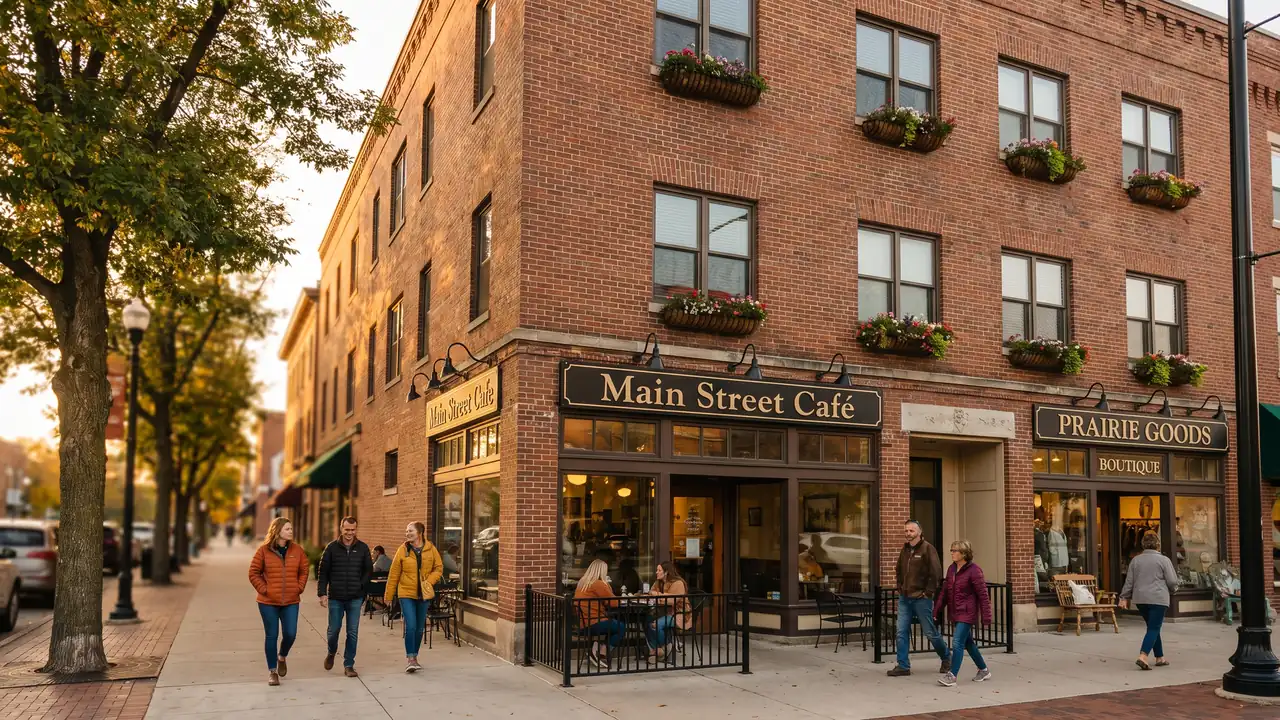
A mixed-use development puts residential units and commercial space (usually ground-floor retail, office or service space under apartments) in one building, and investors like it because those two income streams rarely soften at the same time. Experienced investors lead with the financing instead: FHA insures a one- to four-unit mixed-use property only when a minimum of 51 percent of the entire building square footage is residential, and Fannie Mae’s mixed-use path is narrower still, a one-unit dwelling the borrower occupies as a principal residence, with the borrower acting as both the owner and the operator of the business.
Read those two rules again and the problem shows itself. The classic investor deal (a storefront leased to a coffee shop with two apartments rented above, none of which you live in) fits neither. It is not an owner-occupied residence, and you do not run the business downstairs. That deal has no conventional residential mortgage path, which is why buyers hear “no” and never learn why.
Learn how investing in mixed-use developments works: which rule decides your loan type, what the diversification benefit is worth, where the risks concentrate, and what Michigan’s rehabilitation statutes change. New to the asset class? Start with our Real Estate Investing guide or the Investment Property Types hub.
Key takeaways:
- Financing is the constraint, not the concept: Fannie Mae’s mixed-use policy reaches only a one-unit property the borrower occupies and operates the business from, so a storefront with rented apartments above falls outside conventional residential lending.
- Square footage is what gets measured, and 51% is the FHA line: FHA insures a mixed-use one- to four-unit property only when at least 51 percent of the entire building square footage is residential and the commercial use will not affect occupant health and safety.
- Income share decides your depreciation, and the test is 80%: A building is residential rental property only when 80% or more of gross rental income comes from dwelling units, the difference between a 27.5-year and a 39-year recovery period.
What is a mixed-use development?
A mixed-use development is a single property combining residential dwelling units with non-residential space under one ownership. HUD defines it the same way: mixed use refers to a property suitable for a combination of uses including commercial, residential, retail, office or parking space.
- The small main-street building: One or two ground-floor commercial bays with two to six apartments above. The version individual investors actually buy, and the version this article is about.
- The podium project or planned district: Dozens of apartments over parking and street-level retail, or several buildings under a municipal development agreement, institutional debt, joint-venture ownership.
One boundary governs everything downstream: Fannie Mae’s general property eligibility rules reach one- to four-unit properties. A building with five or more dwelling units is not a residential loan no matter what sits on the ground floor. It is commercial real estate investing, underwritten as a business. And a building that is entirely residential with two to four units is not mixed-use at all; see investing in multi-family properties.
Why are mixed-use properties in demand?
Demand for the format tracks demand for walkable districts, which makes it a location story rather than a building story. These buildings earn the premium people associate with the category only where pedestrians already are, the pressures covered in the impact of urbanization on housing demand. Municipalities push the same direction for their own reasons: one parcel producing both residential and commercial tax base on infrastructure already in the ground.
What that demand does not do is guarantee appreciation. No major index publishes a mixed-use price or return series, there is no mixed-use equivalent of the FHFA House Price Index, so any claim that these appreciate faster is a generalization, not a measured figure. Judge the district, not the category, using how to evaluate a real estate market for investment.
How do you finance a mixed-use property?
Three different measurements decide which lending world you are in: unit count decides whether residential financing is possible at all, residential square footage decides FHA eligibility, and occupancy plus who runs the business decides conventional eligibility. Miss one and you are in commercial credit.
What Fannie Mae actually requires
Fannie Mae’s mixed-use policy is about occupancy, not percentages. Under Selling Guide section B2-3-04, the property must be a one-unit dwelling the borrower occupies as a principal residence, the borrower must be both the owner and the operator of the business, the property must be primarily residential in nature, and the dwelling must not be modified in a way that hurts its marketability as a residential property. The appraiser, separately, must confirm the mixed use is legal and permissible under local zoning and must report value based on the residential characteristics rather than the business use.
You will see a “25% commercial floor area” rule repeated on investor forums as if it were Fannie Mae policy. It is not in the Selling Guide’s mixed-use section, which states no percentage limit at all. The operative words are “primarily residential in nature.” Individual lenders may impose their own overlays, and many do, but attributing a percentage to Fannie Mae is folklore, and building an offer on it is how files die two weeks before closing.
What FHA requires on a one- to four-unit mixed-use property
FHA is the more generous program on space and the stricter one on who you have to be. A mixed-use one- to four-unit property is eligible for FHA insurance provided a minimum of 51 percent of the entire building square footage is for residential use and the commercial use will not affect the health and safety of the residential occupants, per HUD Handbook 4000.1.1 The same 51 percent threshold, measured as gross building area, applies under the 203(k) rehabilitation program.
The catch is occupancy. At least one borrower must occupy the property within 60 days of signing the security instrument and intend to keep occupying it for at least one year, so FHA serves an owner-occupant buying a building to live in and rent from, not a passive investor. A three- or four-unit FHA purchase adds the self-sufficiency test, which does not apply to a two-unit: PITI divided by monthly net self-sufficiency rental income may not exceed 100 percent.
Run the square-footage math before you write an offer. A 6,000-square-foot building with 2,400 square feet of ground-floor retail and 3,600 square feet of apartments above is 60 percent residential and clears the line; flip those figures and it does not.2
When the property crosses into commercial lending
Miss any of those tests and the loan is business-purpose commercial credit, a different legal product, not a stricter mortgage. Regulation Z exempts an extension of credit primarily for a business, commercial or agricultural purpose, and RESPA’s Regulation X carries the same exemption. In practice: no Loan Estimate, no Closing Disclosure, none of the consumer-mortgage protections you may be expecting.
Underwriting changes with it. A commercial lender sizes the loan against the property’s net operating income and its debt service coverage ratio rather than your personal income, so building an honest net operating income (NOI) figure becomes the whole exercise. Terms commonly carry a balloon maturity years before amortization ends, and recourse is negotiated rather than assumed.3
| Feature | Residential path (1 to 4 units) | Commercial path |
|---|---|---|
| What makes you eligible | Unit count, residential square-footage share, occupancy | Property economics; occupancy is not gating |
| Owner occupancy | Required for FHA and Fannie Mae’s mixed-use policy | Not required |
| Underwriting basis | Your income, credit and debt-to-income ratio | Net operating income and debt service coverage ratio |
| TILA and RESPA protections | Usually apply; Regulation Z treats credit to buy an owner-occupied building with more than 2 housing units as business credit | Exempt as business-purpose credit |
| Term structure | Fully amortizing, commonly 15 to 30 years | Balloon maturity commonly precedes end of amortization |
| Regulatory equity reference | No supervisory LTV limit on owner-occupied 1 to 4 family | 85% supervisory LTV ceiling on improved property |
That last row is worth sitting with. The federal banking agencies’ Interagency Guidelines for Real Estate Lending Policies set a supervisory loan-to-value ceiling of 85% on loans secured by improved property. A category expressly including one- to four-family property that is not owner-occupied and residential property with five or more dwelling units. It is a supervisory maximum for insured depository institutions, not an offer, and lenders set internal limits below it. What that debt does to your return is the subject of real estate leverage.
Does Regulation Z treat every residential mixed-use loan as consumer credit?
No. Under the CFPB’s official interpretation of Regulation Z section 1026.3, credit to acquire, improve or maintain rental property that is not owner-occupied is business-purpose credit regardless of the number of units, and a property is owner-occupied only if the owner expects to occupy it for more than 14 days in the coming year.
For a building the owner will occupy within the coming year, credit to acquire it is deemed business-purpose above 2 housing units, and credit to improve or maintain it above 4. RESPA’s exemption in 12 CFR 1024.5(b)(2) lets lenders rely on Regulation Z for the same call. An owner-occupant buying a three-unit mixed-use building can be in a residential program and still outside the consumer disclosure rules, so ask which disclosures your file will receive.
What are banks reporting about commercial real estate credit in 2026?
Banks generally reported easier standards and basically unchanged demand for commercial real estate loans over the second quarter of 2026, with moderate and modest net shares easing standards on nonfarm nonresidential and multifamily loans, respectively, according to the Federal Reserve’s July 2026 Senior Loan Officer Opinion Survey. The survey reports direction, not the standards themselves, and does not break out mixed-use buildings.
What are the benefits of investing in mixed-use developments?
The genuine benefits are structural rather than promotional. Here is each with its condition attached.
Two income streams that respond to different pressures
This is the real argument for the asset class. Residential demand tracks household formation and wages; retail and office demand track consumer spending and business formation. Correlated, but not tightly, a soft quarter downstairs rarely lands in the quarter the apartments empty.
Value you can underwrite, not only appraise
Priced on income rather than comparable home sales, every dollar of durable net operating income carries a multiple, which is why cap rates in real estate govern commercial pricing. It cuts both ways: an expense increase is capitalized against you at that same multiple.
Longer commercial leases smooth the income
Commercial leases run years rather than a year, often with escalations and with the tenant carrying a share of taxes, insurance and common-area costs. Residential leases give you none of that. The trade is concentration.
Two pricing methods on one rent roll
Commercial space is quoted per square foot per year and benchmarks against other listings on the same street; residential rents come from comparable units. Two independent checks on a seller’s numbers during real estate due diligence.
One parcel, one roof, one tax bill
Land, structure, parking and utility service are shared across both uses, so fixed costs consolidate and capital replacements happen once instead of twice. A modest, real efficiency, and one routinely oversold.
Public incentives are aimed at exactly this asset
Corridor redevelopment programs, tax abatements and form-based districts were written to produce buildings like these. They are local, competitive and conditional, so never assume one in a pro forma, but they exist in a way they do not for a rental house.
How do you check a commercial lease’s rent increases against inflation?
A lease either steps the rent by a fixed amount each year or ties it to a price index, and an index clause should name the series, the base month and any cap. The Consumer Price Index for all items rose 3.7% for the 12 months ending September 2026, the shelter index rose 3.2% and the food away from home index rose 3.5%, according to the BLS Consumer Price Index release for September 2026.
Hypothetical example, not an offer. A storefront lease at $36,000 a year with a fixed 2% step reaches $36,720 in year two. Had that rent moved with the 3.7% all-items change, it would be $37,332, so the fixed step leaves $612 of that year’s inflation with the owner. That gap compounds, so put the escalation clause in the cash flow model next to the expense lines the tenant does and does not reimburse.
What are the real risks of a mixed-use property?
The risk profile is wider in both directions than an apartment building’s, and the downside concentrates in the commercial half.
- Re-leasing commercial space is a capital event, not a turnover: Vacant retail typically sits longer than a vacant apartment and comes back only after a tenant improvement allowance, free rent and a leasing commission. Residential turnover is paint, carpet and two weeks.
- One tenant can be most of your income: In a small building the ground-floor lease often carries a disproportionate share of the rent roll, and diversification across two uses does not help when one use is most of the money.
- You are operating two disciplines at once: Residential leases, commercial leases, two insurance exposures and two maintenance standards in one asset. A food-service tenant in particular changes the insurance conversation.
- Residential lenders decline these routinely: A building marketed to residential buyers that fails the occupancy or square-footage tests can go under contract and die in underwriting. Confirm the loan path before your inspection period closes.
- Exit liquidity is thinner: Your buyer pool is investors who can obtain commercial credit, not the owner-occupant pool that supports resale on a house. That shows up in marketing time and in price.
The 80% income test decides your depreciation schedule
A building counts as residential rental property, depreciated over 27.5 years under the general depreciation system, only when 80% or more of the gross rental income for the tax year is from dwelling units, per IRS Publication 527. Fall below that share and the structure is nonresidential real property with a 39-year recovery period.4
Two things follow. The test is on income, not square footage, so the same building can change classification as leases turn over. And land is never depreciable, so every estimate needs a defensible land-versus-improvement basis allocation behind it. Take that to a CPA before you close. Our overview of real estate depreciation is orientation, not advice.
How can a building pass FHA’s space test and still fail the IRS income test?
FHA counts square footage; the IRS counts gross rental income. A building that is 60 percent residential by area, can still miss the 80% dwelling-unit income share that Publication 527 requires for the 27.5-year class when the storefront carries a large share of the rent.
Hypothetical example, not an offer. Suppose the 2,400-square-foot storefront leases for $3,000 a month and each of three apartments rents for $1,200 a month.
| Space | Monthly rent | Yearly rent |
|---|---|---|
| Ground-floor storefront | $3,000 | $36,000 |
| Apartment 1 | $1,200 | $14,400 |
| Apartment 2 | $1,200 | $14,400 |
| Apartment 3 | $1,200 | $14,400 |
| Total gross rent | $6,600 | $79,200 |
| Share from dwelling units | $43,200 of $79,200, or 54.5% | |
Source: rents are hypothetical and Align Lending arithmetic; the 80% dwelling-unit income test is from IRS Publication 527 (2025), Residential Rental Property.
At 54.5%, this building is nonresidential real property under the IRS 80% test, even though it clears FHA’s space test. For the apartments to supply 80% of gross rent, total rent could be no more than $54,000 a year ($43,200 divided by 0.80), which caps the storefront at $10,800 a year, or $900 a month. Have a CPA read the rent roll before you price the tax benefit; our guide to the tax benefits of real estate investing covers the wider picture.
If the storefront sits empty for six months, gross rent drops by $18,000, from $79,200 to $61,200, a 22.7% loss. If one apartment sits empty for six months, the loss is $7,200, about 9.1%. Samantha Shelton put the underwriting point plainly in her interview answers for Align: “I don’t love a deal that only works when nothing goes wrong.” Run the storefront vacancy case first when you are evaluating a property’s cash flow potential.
How do zoning and municipal approval affect a mixed-use deal?
Zoning is a gate before financing, because the appraiser has to confirm the mixed use is legal and permissible under local zoning. If the commercial bay is a legal nonconforming use, or units were converted without permits, it surfaces in the appraisal and stops the loan.
- Confirm the use is permitted by right: A use allowed only by special land use or conditional approval can be conditioned or denied. Ask what the district permits as of right, in writing.
- Check the certificate of occupancy against reality: It should describe the same unit count and commercial use you are underwriting. Mismatches are common in older main-street buildings.
- Parking is the usual sticking point: Minimums are set per use, so adding units or changing the tenant type can trigger a requirement the site cannot meet.
- Approval timelines are carry cost: Site plan review, variances and permits consume months a pro forma built on stabilized rents will not show.
Our primer on zoning regulations covers the mechanics, and the trade-offs on the pure commercial side are in the pros and cons of investing in commercial housing markets.
What Michigan investors should know
Michigan writes its redevelopment incentives around exactly this property type, and puts every zoning decision in local hands under one statute.
- One enabling act, four kinds of local authority: The Michigan Zoning Enabling Act, 2006 PA 110, effective July 1, 2006, codifies zoning for counties, townships, cities and villages. There is no statewide mixed-use district. The governing ordinance is the one that municipality adopted.
- The Commercial Rehabilitation Act was drafted for this overlap: Under 2005 PA 210, “commercial property” means land improvements whose primary purpose and use is a commercial business enterprise or multifamily residential use, and expressly excludes land. A certificate may run at least 1 year and no more than 12 years, and districts are normally at least 3 acres unless they sit in a downtown or business area.
- OPRA reaches obsolete buildings, apartments included: The Obsolete Property Rehabilitation Act, 2000 PA 146, covers commercial property or commercial housing property that is blighted, an environmental facility, or functionally obsolete, in a qualified local governmental unit, and “commercial housing property” includes a dwelling unit in a multiple-purpose structure, meaning the apartments over the shop. These certificates also run up to 12 years.
- Check the community’s certification first: The Michigan Economic Development Corporation runs Redevelopment Ready Communities, a voluntary certification for local units meeting its planning and zoning best practices, useful before you budget an approval timeline.
Statutory text is on the Michigan Legislature’s site for the Commercial Rehabilitation Act. Abatements are granted by local resolution and reviewed by the State Tax Commission, so confirm eligibility with the municipality and a Michigan attorney before pricing one into a deal.
How does Michigan’s rental vacancy rate compare for the apartments upstairs?
The apartments upstairs compete in the ordinary rental market. According to the Census Bureau’s Housing Vacancy Survey table of rental vacancy rates by state, Michigan’s rate was 6.0% in the second quarter of 2026, with a margin of error of plus or minus 2.1 points.
| Second quarter | Michigan rental vacancy rate | Margin of error (points) |
|---|---|---|
| 2022 | 5.2% | 2.0 |
| 2023 | 7.0% | 2.3 |
| 2024 | 5.8% | 2.1 |
| 2025 | 7.1% | 2.2 |
| 2026 | 6.0% | 2.1 |
Source: U.S. Census Bureau, Housing Vacancy Survey, Table 1, Rental Vacancy Rates by State: 2005 to 2026, last revised July 28, 2026.
Nationally, the Census Bureau reported a rental vacancy rate of 7.3% for the second quarter of 2026, up from 7.0% a year earlier, in its Quarterly Residential Vacancies and Homeownership release of July 28, 2026. With margins that wide, the swings in the table may not be meaningful, and a statewide rate says nothing about one block; see our guide to analyzing rental market trends.
What changed for Michigan’s Commercial Rehabilitation Act in 2026?
Senate Bill 722 was signed into law on July 22, 2026, and extends the expiration date for issuing new commercial facility exemption certificates through December 31, 2035, according to the Michigan Department of Treasury’s Commercial Rehabilitation Act page.
The property must sit inside an established Commercial Rehabilitation District, and the local unit of government sets the exemption’s term. Applications are filed with, reviewed and approved by the local unit, then reviewed at the state level by Treasury’s Community Services Division, and the State Tax Commission gives final approval and issues the certificate. Per Treasury, an exemption is not effective until the commission approves it, so never count the abatement from the day you close.
Also check the Michigan Economic Development Corporation’s Redevelopment Ready Communities map, which the program says is updated monthly and shows whether a community is engaged or has reached a designation. An abatement is separate from the assessor’s work on the building’s value; see how property tax assessments work.
How Align matches lenders to rentals
Lenders treat a duplex, a condo rental and a short-term rental very differently. Some count projected rent, some want a signed lease, and some will not finance the property at all.
Because Align is a broker, Samantha takes your file to the wholesale lender whose rules fit the property you actually want to buy. One application, multiple lenders.
FAQ: Investing in mixed-use developments
Here are answers to common questions about investing in mixed-use developments.
What counts as a mixed-use property?
A mixed-use property combines residential dwelling units with non-residential space (commercial, retail, office or parking) in one building under single ownership, most often ground-floor retail with apartments above. A building that is entirely residential with two to four units is not mixed-use; that is small multifamily, covered in buying a multi-family home.
Which loan programs cover a mixed-use building?
It depends on unit count, residential square footage and whether you will live there. FHA insures a one- to four-unit mixed-use property when at least 51 percent of the building square footage is residential and a borrower occupies it. Fannie Mae’s policy applies only to a one-unit owner-occupied property where the borrower runs the business. Everything else is business-purpose commercial credit, start with how to finance a real estate investment.
Are mixed-use developments riskier than apartments?
They carry different risk, not uniformly more. Two unlike income streams lower the odds that all income disappears at once, a genuine defensive quality. But commercial space takes longer and costs more to re-lease, one tenant can dominate a small rent roll, and the buyer pool at exit is narrower. What you actually earn on the cash you put in is measured by cash-on-cash return.
Do mixed-use properties appreciate faster?
No published index measures mixed-use appreciation separately, so treat that claim as a generalization rather than a measured figure. Value follows the district: a building on a walkable street with real pedestrian traffic supports rents a building on a high-speed arterial does not. Past performance does not predict future results, see real estate appreciation.
Can I claim Michigan’s principal residence exemption on a mixed-use building I live in?
Only on the part you live in. Under MCL 211.7cc, an owner whose home is a dwelling unit in a multiple-purpose structure claims the exemption for only that portion of the total taxable value used as the owner’s principal residence. The exemption applies to the local school district’s operating tax, with the affidavit due to the local tax collecting unit by June 1 for the summer levy or November 1 for the winter levy.
Who is responsible for ADA access in a ground-floor storefront, the landlord or the tenant?
Both. Under the Justice Department’s Title III rule, 28 CFR 36.201(b), the landlord who owns a building housing a place of public accommodation and the tenant who operates it are each covered, and the lease may divide the compliance work between them. ADA.gov lists shops and restaurants among the businesses Title III covers. Settle that allocation in the lease before a retail or food tenant opens.
Can I trade a rental house for a mixed-use building in a 1031 exchange?
Generally the properties can be like-kind. The IRS like-kind exchange tax tips say real properties generally are of like kind whether improved or unimproved, and the rule covers real property used for business or held as an investment, not property held primarily for sale. The exchange is reported on Form 8824. Deadlines and any part you will live in belong with a tax professional; see our 1031 exchange guide.
Can an SBA 504 loan finance a mixed-use building?
Only when your own business occupies most of it. Under 13 CFR 120.131, a borrower in an existing building must occupy at least 51 percent of the rentable property and may permanently lease up to 49 percent; in new construction it must occupy at least 60 percent and may permanently lease up to 20 percent. The SBA 504 program page lists speculation or investment in rental real estate as an ineligible use.
The bottom line on mixed-use investing
The benefit of a mixed-use development is genuine and narrow: two unlike income streams under one roof, valued on income rather than comparable sales, in a category public policy wants built. The obstacle is equally specific. FHA requires at least 51 percent residential square footage plus owner occupancy, Fannie Mae’s mixed-use policy reaches only a one-unit owner-occupied property where the borrower runs the business, and anything else is business-purpose commercial credit with no TILA or RESPA protections. Settle which of those worlds your building is in before you negotiate price.
If you’re ready to find out whether a building can be financed on the residential side, talk to Align Lending. We’ll shop your one- to four-unit scenario across our lender network and show you the numbers side by side, and we’ll say so plainly when a deal belongs with a commercial lender instead. Call 248-506-5727 or start online. Take depreciation and basis questions to a qualified tax professional, and zoning, lease and abatement questions to a Michigan attorney.
Footnotes:
1. Align Lending is not acting on behalf of or at the direction of FHA or HUD, and is not endorsed or sponsored by any government agency. FHA program requirements are set by HUD and change over time; confirm current requirements in the operative version of HUD Handbook 4000.1 and with your loan officer before relying on them. Return to text.
2. Example figures are hypothetical and for educational purposes only; they do not constitute an advertisement of credit terms, a rate quote, an offer of credit, or a projection of investment returns under federal or state law. The 6,000-square-foot building with 2,400 square feet of commercial space and 3,600 square feet of residential space, and the resulting 60% residential share, are Align Lending arithmetic shown to demonstrate how the square-footage test is applied. They describe no specific property, and actual eligibility depends on the appraiser’s measurements and the lender’s review. Return to text.
3. Commercial loan structures (amortization, balloon maturities, recourse and coverage requirements) are set by individual lenders and are not standardized. The 85% supervisory loan-to-value limit for improved property is bank-regulatory guidance for insured depository institutions under the Interagency Guidelines for Real Estate Lending Policies; it is a supervisory maximum, not a borrower entitlement, an approval standard or an offer of credit, and institutions set their own lower internal limits. Align Lending brokers financing for one- to four-unit residential property and is not a commercial lender. Return to text.
4. This is general information, not tax advice. Depreciation recovery periods, the 80% gross-rental-income classification test, land-versus-improvement basis allocation, depreciation recapture (which applies to depreciation allowed or allowable), passive-activity loss rules and entity choice all depend on your individual circumstances and change over time. Land is never depreciable. Consult a qualified tax professional about your situation. Align Lending does not provide tax, legal or investment advice. Return to text.
Sources: mixed-use eligibility requiring a one-unit dwelling occupied by the borrower as a principal residence, the borrower being both the owner and operator of the business, the property being primarily residential in nature, and no stated percentage limit on commercial floor area, Fannie Mae Single-Family Selling Guide B2-3-04, Special Property Eligibility Considerations. Appraiser requirements to confirm the mixed use is a legal, permissible use under local zoning and to report market value based on the residential characteristics rather than the business use, Fannie Mae Selling Guide B4-1.4-07, Mixed-Use Property Appraisal Requirements. Eligibility limited to properties with one to four units, Fannie Mae Selling Guide B2-3-01, General Property Eligibility. Definition of mixed use; eligibility of mixed use one- to four-unit single family properties provided a minimum of 51 percent of the entire building square footage is for residential use and the commercial use will not affect the health and safety of the occupants; the same 51 percent gross building area threshold under the 203(k) program; the requirement that at least one borrower occupy the property within 60 days of signing the security instrument and intend to continue occupancy for at least one year; and the three- to four-unit self-sufficiency standard that PITI divided by monthly net self-sufficiency rental income may not exceed 100 percent, calculated from the appraiser’s estimate of fair market rent for all units less the greater of the appraiser’s vacancy and maintenance estimate or 25 percent of fair market rent, U.S. Department of Housing and Urban Development, FHA Single Family Housing Policy Handbook 4000.1. Residential rental property defined as a building for which 80% or more of the gross rental income for the tax year is from dwelling units, the 27.5-year general depreciation system recovery period for residential rental property, and the 39-year recovery period for nonresidential real property, Internal Revenue Service Publication 527, Residential Rental Property. Exemption of an extension of credit primarily for a business, commercial or agricultural purpose, 12 CFR 1026.3(a)(1), Regulation Z; corresponding business-purpose exemption, 12 CFR 1024.5(b)(2), Regulation X. Supervisory loan-to-value limit of 85 percent for improved property, and the definition of an improved property loan as including one- to four-family residential property that is not owner-occupied, residential property containing five or more individual dwelling units, and completed income-producing property, Interagency Guidelines for Real Estate Lending Policies adopted by the OCC, the Board of Governors of the Federal Reserve System and the FDIC (12 CFR part 34, 12 CFR part 208 appendix C and 12 CFR part 365 appendix A). Codification of local zoning authority for counties, townships, cities and villages, Michigan Zoning Enabling Act, 2006 PA 110, MCL 125.3101 et seq., effective July 1, 2006. Definition of commercial property as land improvements whose primary purpose and use is the operation of a commercial business enterprise or multifamily residential use, exclusion of land, certificate duration of at least 1 year and not to exceed 12 years, and the 3-acre district minimum with a downtown or business area exception, Commercial Rehabilitation Act, 2005 PA 210, MCL 207.841 et seq. Definitions of obsolete property and commercial housing property, the qualified local governmental unit requirement, the statement of taxable value for the tax year immediately preceding the certificate’s effective date, and the 12-year maximum, Obsolete Property Rehabilitation Act, 2000 PA 146, MCL 125.2781 et seq. Redevelopment Ready Communities is a voluntary certification program administered by the Michigan Economic Development Corporation.
This article is for informational purposes only and is not intended to provide legal, financial, tax or investment advice, and it is not an offer to sell or a solicitation of an offer to buy any security. Agency guidelines, tax rules, zoning ordinances, abatement programs and loan program requirements change and vary by property, program and locality; confirm current figures with your loan officer, confirm tax treatment with a qualified tax professional, and confirm zoning, lease, title and abatement questions with a Michigan attorney. Figures shown are illustrative, are not a rate quote or an offer of credit, and do not constitute an advertisement of credit terms or a projection of investment returns. Past performance does not predict future results. Align Lending is an independent Michigan mortgage broker, NMLS #2041154, financing one- to four-unit residential property; it is not a commercial lender, broker-dealer, investment adviser, syndicator or property manager.
Sources
Every outside source this guide links to, in the order it appears. How we choose and check sources
- FHFA House Price IndexFederal Housing Finance Agency
- Selling Guide section B2-3-04Fannie Mae Selling Guide
- Must report value based on the residential characteristics rather than the business useFannie Mae Selling Guide
- HUD Handbook 4000.1U.S. Department of Housing and Urban Development
- Regulation Z exemptsConsumer Financial Protection Bureau
- Regulation X carries the same exemptionConsumer Financial Protection Bureau
- A supervisory loan-to-value ceiling of 85% on loans secured by improved propertyElectronic Code of Federal Regulations
- July 2026 Senior Loan Officer Opinion SurveyFederal Reserve Board
- BLS Consumer Price Index release for September 2026bls.gov
- IRS Publication 527Internal Revenue Service
- Nonresidential real property with a 39-year recovery periodInternal Revenue Service
- Codifies zoning for counties, townships, cities and villagesMichigan Legislature
- Includes a dwelling unit in a multiple-purpose structureMichigan Legislature
- Commercial Rehabilitation ActMichigan Legislature
- Table of rental vacancy rates by stateU.S. Census Bureau
- Quarterly Residential Vacancies and Homeownership releaseU.S. Census Bureau
- Michigan Department of Treasury’s Commercial Rehabilitation Act pageState of Michigan
- Redevelopment Ready Communities mapmiplace.org
- MCL 211.7ccMichigan Legislature
- 28 CFR 36.201(b)law.cornell.edu
- ADA.gov
- IRS like-kind exchange tax tipsInternal Revenue Service
- 13 CFR 120.131law.cornell.edu
- SBA 504 program pagesba.gov
Related resources

20-minute read
A guide to investing in short-term rentals
How short-term rental investing works: picking a market and property, the 14-day and 7-day tax rules, and the local rules that can kill a deal.

20-minute read
A guide to investing in multi-family properties
Learn how multi-family investing works, why vacancy risk drops across units, how financing changes at five units, and what house hacking does.
18-minute read
Guide to buying a multi-family home: Financing a duplex, triplex or fourplex
Learn how to buy a multi-family home, from financing duplexes with 3.5% down FHA loans to analyzing cash flow, cap rates and property management costs.