
Benefits of VA construction loans: Build with $0 down
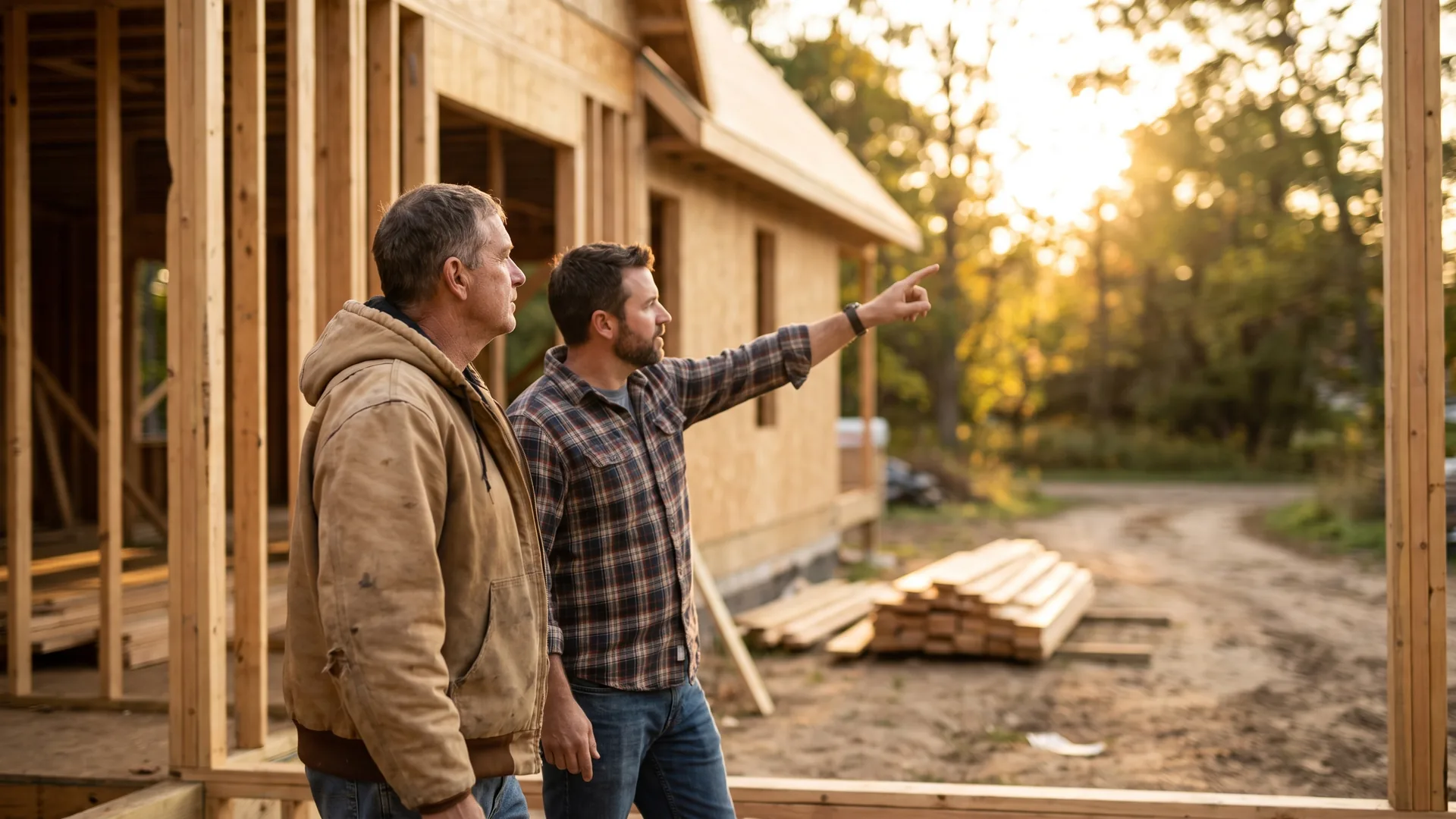
A VA construction loan lets an eligible veteran finance the lot and the build of a new home with no down payment and no mortgage insurance.1 Those two benefits come straight from the VA-backed purchase loan itself: VA’s rule is “no down payment as long as the sales price isn’t higher than the home’s appraised value,” and “no need for private mortgage insurance (PMI) or mortgage insurance premiums (MIP).” On a build financed at 100%, the main VA-specific charge is the funding fee – 2.15% of the loan amount for a first-use borrower putting nothing down.
The single-close version wraps the construction financing and the permanent mortgage into one transaction, so you close once instead of twice and pay one set of closing costs. And veterans who receive VA compensation for a service-connected disability pay no funding fee at all.
Learn how VA construction loans work, what they cost, how they compare with conventional construction financing, and what to do when no lender near you writes them. If you’re still weighing programs, start with our loan types and programs guide or the broader VA loans hub.
Key takeaways:
- Zero down payment: A VA construction loan can finance up to 100% of the completed value, while conventional construction-to-permanent financing never reaches 100% loan-to-value under Fannie Mae’s standard purchase limits, and construction lenders commonly ask for 20% to 25% down.
- No mortgage insurance, and often no funding fee: VA loans carry no PMI or MIP at any loan-to-value, and the 2.15% first-use funding fee drops to zero for veterans receiving VA compensation for a service-connected disability.
- One closing instead of two: A single-close VA construction loan converts to a permanent VA mortgage at completion, so you sign once – and with full entitlement, VA sets no maximum loan amount on the finished mortgage.
What is a VA construction loan?
A VA construction loan is a VA-guaranteed mortgage used to build a new home rather than buy an existing one, and it carries the same two headline benefits as any VA purchase loan: $0 down and no mortgage insurance. The loan funds the construction in draws as the house goes up, then becomes a permanent VA mortgage once the home is finished and appraised.
Two structures exist, and the difference matters more than almost anything else in this article:
- Single-close (one-time close): One application, one underwrite, one closing. The loan funds construction and then converts to the permanent mortgage without a second closing or a second set of closing costs. This is the structure that preserves the zero-down benefit end to end.
- Two-close (build then finance): A short-term construction loan from one lender, then a separate VA loan that pays it off at completion. Two closings, two sets of costs, and the construction lender sets its own down payment terms, which is usually where the $0-down advantage gets lost.
One thing worth being precise about: VA guarantees the loan, it doesn’t originate it. There is no VA-published rulebook for single-close construction programs the way there is for a standard purchase. The construction mechanics – draw schedules, contingency reserves, rate-setting at the initial closing – are set by each wholesale lender on top of the VA guaranty, so terms genuinely vary by lender.2 Our construction loan guide covers the draw-and-inspection machinery common to all construction financing, and construction-to-permanent loans explains how the conversion works across programs.
The biggest benefits of VA construction loans
Each of these is a benefit no conventional construction loan can match, and each one carries a number.
- No down payment, up to 100% financing: VA allows financing to the full “as completed” appraised value with nothing down. Conventional construction-to-permanent financing is bound by Fannie Mae’s standard purchase loan-to-value limits, which never reach 100%, so a down payment is always part of a conventional build.
- No PMI, ever: VA loans carry no private mortgage insurance and no mortgage insurance premium at any loan-to-value. A conventional borrower financing above 80% pays monthly mortgage insurance until the balance amortizes down; an FHA borrower pays an upfront premium plus an annual one. On a VA loan that line item simply doesn’t exist, which permanently lowers the payment at the same rate and balance.
- A funding fee that can be $0: The VA funding fee is a percentage of the loan amount, not a flat charge. For a purchase or construction loan it runs 2.15% for first use with less than 5% down, 1.5% with 5% or more down, and 1.25% with 10% or more down; subsequent use with less than 5% down is 3.3%.3 On a $400,000 loan that’s $8,600 first-use, or $13,200 on a subsequent use. It is waived entirely for veterans receiving VA compensation for a service-connected disability, veterans entitled to that compensation but receiving retirement or active-duty pay instead, surviving spouses receiving Dependency and Indemnity Compensation, borrowers with a proposed or memorandum rating before closing, and active-duty members who document a Purple Heart by the closing date.
- No VA loan limit with full entitlement: VA does not cap the loan amount for a veteran with full entitlement. The ceiling is what you qualify for and what the completed home appraises for. Loan limits only re-enter the picture when you have remaining entitlement from another active VA loan, in which case the guaranty is calculated against the county conforming loan limit ($832,750 baseline for one-unit properties in 2026, up to $1,249,125 in high-cost counties).
- The lot can be financed with the build: When the land is acquired as part of the construction project, its cost can be rolled into the loan. If you already own the lot, its equity typically counts toward the project and reduces what you need to borrow.
- One closing, one set of costs: On a single-close program the construction period and the permanent mortgage share one closing. You avoid a second round of origination, title, and recording charges, and you aren’t exposed to requalifying at completion.
For the benefits that apply to every VA loan, not just construction, see VA loan benefits for veterans and the VA’s home loan program guide.
VA construction loans vs. conventional construction loans
The gap shows up in cash required at the table. A veteran with full entitlement can start a build with the funding fee and closing costs; a conventional borrower brings a down payment on top.
| Feature | VA construction loan | Conventional construction-to-permanent |
|---|---|---|
| Down payment | $0 with full entitlement, up to 100% of “as completed” value | Always required; capped below 100% LTV by Fannie Mae purchase limits, and construction lenders commonly set 20% – 25% |
| Mortgage insurance | None at any loan-to-value | Monthly PMI above 80% LTV until the balance amortizes down |
| Upfront program fee | VA funding fee, 2.15% first use with nothing down; $0 if exempt | No agency funding fee; lender construction fees apply |
| Number of closings | One on a single-close program; two if you build then refinance | One on a single-close program; two on a two-closing structure |
| Construction period rules | Set by the lender’s program on top of the VA guaranty | Fannie Mae: no single period over 12 months, 18 months total, no exceptions |
| Builder requirements | State and local licensing; VA builder ID no longer required as of March 2025 | Lender-approved builder, licensed and insured |
| Loan amount ceiling | No VA-set maximum with full entitlement | $832,750 baseline in 2026, higher in high-cost counties |
One row deserves a caveat. Fannie Mae’s 12-month and 18-month construction periods are a conventional rule and shouldn’t be read onto a VA file, but in practice most VA single-close programs set a comparable window, because a build that runs long is a risk every lender prices for.
What it takes to qualify for a VA construction loan
You need the same VA eligibility as any other VA loan, plus a build the lender can underwrite. Start with your Certificate of Eligibility (COE), which VA describes as “the first step in getting a VA-backed home loan” and which confirms to your lender that you qualify for the benefit.
- Credit: no VA minimum, but a real lender minimum: VA sets no minimum credit score. It asks only that you meet VA’s and “your lender’s standards for credit, income, and any other requirements.” Lenders fill that gap with their own overlays, commonly in the 620 to 680 range and often higher on construction files, because an unfinished house is weaker collateral than a finished one.
- Income, DTI, and residual income: VA underwriting weighs residual income (the money left after the mortgage, debts, and estimated maintenance) alongside debt-to-income. Construction files also draw scrutiny on reserves, since cost overruns land on the borrower.
- A fixed-price contract and complete plans: Lenders want plans, specifications, and a builder contract with a firm price before they’ll issue a Notice of Value on a proposed-construction property. Vague allowances are the most common reason a construction file stalls.
- An “as completed” appraisal: The property is valued from the plans and specs as though finished, and the finished home must meet VA’s minimum property requirements.
Our walkthrough of how to qualify for a VA loan covers entitlement, COE, and income documentation in detail, and VA loan tips covers the file-prep habits that keep an approval moving.
Does your builder still need a VA builder ID number?
No, not since March 31, 2025. VA Circular 26-25-1 rescinded the procedure entirely, stating that “a VA-issued builder identification number is no longer necessary for issuing the NOV or processing a loan on a new or proposed construction property for VA-guaranteed loans.” A lot of older articles still tell veterans to hunt for a VA-registered builder; that requirement is gone for VA-guaranteed purchase and construction loans.
Three things did not change. Builders “are still expected to meet any state and/or local licensing requirements.” The builder ID requirement still applies to Specially Adapted Housing grants and Native American Direct Loans. And the warranty still stands: federal law requires the builder to warrant that the dwelling “is constructed in substantial conformity with the plans and specifications,” covering defects the owner reports in writing within one year of title transfer or first occupancy, whichever comes first.
Worth knowing alongside that: VA stopped performing its own compliance inspections on new and proposed construction back in February 2006, relying instead on local building inspections and 1- or 10-year construction warranties. Draw inspections on your file come from your lender’s program, not from VA.
What if no lender in your area offers VA construction loans?
This is the real obstacle, and it’s more common than the zero-down headline suggests. Most VA lenders decline construction financing because of the inspection workload and the risk of an unfinished house, so a veteran can be fully eligible and still get told no by every retail bank in town.
The usual workaround is to build with a conventional construction loan, then refinance into a VA loan once the home is complete. It works, but count the cost honestly: the construction lender will require a down payment, you pay two sets of closing costs, and you requalify at completion with whatever rates exist then, not the ones that existed when you broke ground. Compare that against a single-close VA program before defaulting to it. Our overview of new home construction financing lays out both paths, and an overview of VA construction lending for service members covers the same trade-off.
The trade-offs to plan for
The benefits are real, but so is the extra work. Four things catch veterans off guard.
- Lender availability is the binding constraint: Not eligibility. You may qualify easily and still need a broker to find the handful of wholesale lenders writing single-close VA construction loans.
- Cost overruns are yours: Financing is sized off the fixed-price contract and the “as completed” appraisal. Change orders and material swings typically come out of pocket unless the program carries a contingency reserve, so ask what the reserve is before you sign. Build costs move with materials and labor markets, National Association of Home Builders construction data tracks those inputs.
- The timeline is longer, and it’s on the clock: Plans, permits, appraisal from specs, and draw inspections all stack ahead of the first shovel. Construction periods are bounded. Fannie Mae’s conventional limit is 12 months per period and 18 months total, and VA lenders set comparable windows.
- Documentation is heavier than a purchase: Plans, specs, the builder contract, licensing and insurance, permits, and draw paperwork all sit on top of a normal VA file.
None of that outweighs $0 down and no PMI. It just means the file needs to be assembled properly the first time.
How Align handles VA loans
Samantha helps veterans use every benefit they earned and deserve, starting before you write an offer. If you receive VA disability compensation, you do not pay the VA funding fee, and she confirms that on your Certificate of Eligibility up front. She also points qualifying disabled veterans to Michigan's Disabled Veterans Exemption, which removes property taxes on the home you live in.
Shopping matters on a VA loan too. A 2024 Polygon Research analysis of federal mortgage data found veterans who used a broker paid about $13,432 less over the life of a $400,000 loan than veterans at nonbank retail lenders. Align is a broker: one application, multiple wholesale lenders, and Samantha on your file from the first call to the closing table.
Sources: Polygon Research, Loan Costs Channel Study 2024 (2023 federal HMDA data, 30-year fixed VA purchase loans; commissioned by United Wholesale Mortgage and Willow Canyon Advisors); VA.gov, VA funding fee; Michigan Treasury, Disabled Veterans Exemption (MCL 211.7b).
FAQ: VA construction loans
Here are answers to common questions about VA construction loans.
Do all VA lenders offer VA construction loans?
No. Most VA lenders decline construction loans because of the added risk and inspection workload, so veterans often have to search for a specialty lender. A common workaround is to use a conventional construction loan for the build, then refinance into a VA loan at completion, but that means two closings, a down payment, and requalifying at the end, which a single-close program avoids. See construction-to-permanent loans for how the one-closing structure works.
Can a VA construction loan pay for the land?
Yes, if construction begins promptly. A VA construction loan can finance the lot purchase along with the build when the two happen as part of one project. It is not a way to buy raw land you intend to hold for years. If you already own the lot, its equity typically counts toward the project and reduces the amount you need to borrow, which our construction loan guide walks through.
What credit score do you need for a VA construction loan?
VA sets no minimum credit score. Lenders do, commonly 620 to 680, and often higher on construction files because the collateral is unfinished. Lenders also review debt-to-income, residual income, and cash reserves. A veteran with a documented builder contract and clean reserves has a far easier path than the score alone suggests, how to qualify for a VA loan covers what underwriters weigh.
Does a VA construction loan require builder approval?
Yes, but by your lender, not by VA. Since March 31, 2025, VA no longer issues builder identification numbers for VA-guaranteed construction loans; builders must still hold state and local licensing, and the lender approves the builder, the plans, and the fixed-price contract. A one-year warranty of substantial conformity with the plans still applies. More prep habits are in VA loan tips.
The bottom line on VA construction loans
A VA construction loan is the only way most veterans can build a home with no down payment and no mortgage insurance. Financing runs up to 100% of the “as completed” value, the funding fee is 2.15% for a first-use borrower putting nothing down and $0 for veterans receiving VA compensation for a service-connected disability, and with full entitlement VA sets no maximum loan amount. The catch isn’t eligibility, it’s availability: most lenders simply don’t write these, and the build-then-refinance workaround costs you a down payment and a second closing.
If you’re ready to build, talk to Align Lending. As a broker, we go find the wholesale lenders that actually write single-close VA construction loans instead of turning veterans away, and we’ll put their programs side by side. Call 248-506-5727 or start online today.
Footnotes:
1. Align Lending works with VA-approved lenders and is not endorsed or sponsored by the Dept. of Veterans Affairs or any government agency. Return to text.
2. Construction program mechanics, credit score minimums, draw schedules, and contingency reserves are set by individual lenders, not by VA. Lenders in Align’s network set their own overlays, and terms vary by lender and by file. Return to text.
3. Example figures in this article are hypothetical and for educational purposes only; they do not constitute an advertisement of credit terms or a rate quote under federal or state lending laws. Your funding fee, rate, and terms depend on your entitlement, exemption status, down payment, and application. Return to text.
Figures current as of August 2026; verify with the linked source before relying on them. VA funding fee rates (purchase and construction: 2.15% first use with less than 5% down, 1.5% with 5% or more down, 1.25% with 10% or more down; 3.3% subsequent use with less than 5% down), effective for loans closed on or after April 7, 2023, and the complete list of funding fee exemptions, U.S. Department of Veterans Affairs, VA funding fee and loan closing costs. No down payment when the sales price does not exceed the appraised value, no requirement for private mortgage insurance or mortgage insurance premiums, and the requirement to meet VA’s and the lender’s standards for credit and income, U.S. Department of Veterans Affairs, VA-backed purchase loan. No VA loan limit for borrowers with full entitlement, and basic entitlement of $36,000, U.S. Department of Veterans Affairs, VA home loan limits. Certificate of Eligibility as the first step in obtaining a VA-backed loan, U.S. Department of Veterans Affairs, how to apply. Elimination of the VA builder identification number for VA-guaranteed loans on new and proposed construction, effective immediately, with builders still expected to meet state and local licensing requirements and no change for Specially Adapted Housing grants or Native American Direct Loans; and VA’s February 2006 discontinuation of compliance inspections in favor of local building inspections and 1- or 10-year construction warranties, VA Circular 26-25-1, March 31, 2025. Builder warranty of substantial conformity with the plans and specifications, limited to defects reported in writing within one year of conveyance of title or initial occupancy, whichever occurs first, 38 U.S.C. § 3705(a). Single-closing construction-to-permanent construction periods of no more than 12 months in any single period and 18 months in total, with no exceptions granted, and LTV calculated against the lesser of construction cost plus lot price or the “as completed” appraised value, Fannie Mae Selling Guide B5-3.1-02. 2026 conforming loan limit of $832,750 for one-unit properties and a high-cost ceiling of $1,249,125, Federal Housing Finance Agency.
This article is for informational purposes only and is not intended to provide legal, financial, or tax advice. VA program rules, funding fee tiers, conforming loan limits, and lender requirements change and vary by borrower, property, and lender; confirm your figures with VA and with your Loan Estimate, and consult a qualified professional about your situation. Figures shown are illustrative, are not a rate quote or an offer of credit, and are subject to change. Align Lending is an independent Michigan mortgage broker, NMLS #2041154.
Related resources
12-minute read
Guide to Buying a Home With a VA Loan
Learn how to buy a home with a VA loan, from getting your Certificate of Eligibility to closing, with no down payment and no PMI for eligible veterans.
