
New construction home inspections: Why brand-new homes still need them
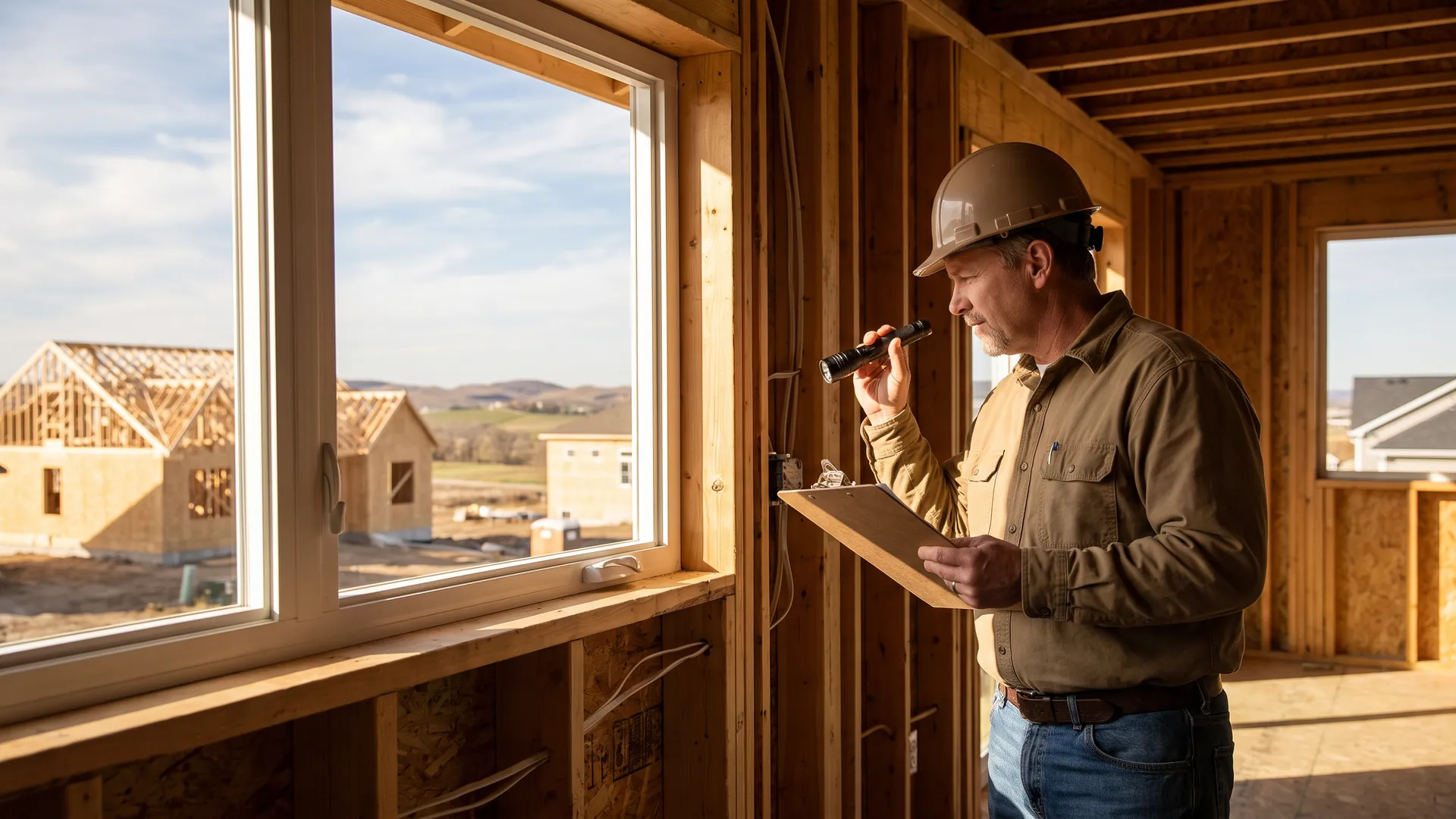
Yes, a brand-new home still needs an independent inspection you hire yourself. New builds are best inspected at 3 stages. Pre-pour, before the foundation concrete is placed; pre-drywall, once framing and the electrical, plumbing, and HVAC rough-ins are done; and a final inspection shortly before your builder walkthrough. A standard home inspection typically runs about $300 – $500, a fraction of what a missed grading, insulation, flashing, or plumbing defect costs to fix after the drywall is up.
The municipal code inspection and the builder’s walkthrough are not substitutes. A code official verifies the house meets minimum code; the inspector you hire evaluates the workmanship you’ll live with. Only one of those jobs is done on your behalf.
Learn how home inspections for new construction work, including the three phases, the defects inspectors find most often, and how to write inspection rights into your builder contract. If you’re earlier in the process, start with our Home Buying guide.
Key takeaways:
- Code sign-offs check minimums, not quality: Many jurisdictions inspect a new build as few as 3 times, footing, framing, and final, and FHA accepts exactly those 3 inspections as evidence of code compliance, which says nothing about workmanship.
- Three phases give you the most protection: Pre-pour, pre-drywall, and final inspections each cover work the next stage buries under concrete or drywall, and at roughly $300 – $500 per standard inspection, phase coverage costs less than a single avoided repair.
- A builder warranty is not a substitute: The new-construction warranty behind FHA and VA financing runs 1 year, so a documented punch list before closing, while your leverage is highest, protects you better than a claim filed in month 13.
Why does a brand-new home need an inspection?
Because nobody else in the process was hired to protect you. A new house is assembled in months by a dozen or more subcontractor crews working in sequence, each covering the last crew’s work. The code official, the appraiser, and the builder’s superintendent all answer someone else’s question. Your inspector answers yours, the honest counterweight to the real benefits of buying a newly constructed home. Modern systems and a warranty are genuine advantages, but they don’t prove the house was built correctly.
Code inspections check minimums, not workmanship
A municipal inspector confirms the work meets the minimum the code allows, at a handful of scheduled milestones. FHA’s rules show how thin that can be: for proposed construction, the lender must obtain a building permit and a certificate of occupancy, or copies of 3 inspections, footing, framing, and final, by the local authority or an ICC-certified inspector.1 Three visits across a build involving 20-plus trades is a compliance check, not a quality review.
Your inspector does something different, and the national standards say so. The InterNACHI Standards of Practice define a home inspection as a non-invasive, visual examination of the accessible areas of a home, and explicitly do not require the inspector to determine code compliance; the American Society of Home Inspectors standard works the same way. Compliance and condition are separate questions, which is why both inspections have value. For the code side, see our guide to the impact of new building codes on home purchases.
Your appraisal isn’t an inspection either
HUD’s required disclosure to FHA borrowers, “For Your Protection: Get a Home Inspection,” states that an appraisal estimates the home’s value for the lender, does not replace a home inspection, and that FHA does not perform home inspections at all. That’s a general rule, not an FHA quirk: the home appraisal process answers one question on every loan type. Is the collateral worth the loan amount. If an inspection happens on your new build, it’s because you scheduled one.
When to schedule new construction inspections
Ideally three times, because each stage permanently hides the one before it. If your budget stretches to only one, take the final, but by then the framing, wiring, and plumbing you’re paying for sit behind painted drywall. Book early; good inspectors schedule weeks out. Our guide to choosing a home inspector covers the new-construction experience to screen for.
1. Pre-pour foundation inspection
This happens before any concrete is placed, often a single day between the forms going up and the truck arriving. The inspector reviews footings, rebar placement, forms, the vapor barrier under the slab, soil prep, and how the site is graded to move water away from the house. Grading errors caught here are an afternoon’s work; caught later, they mean excavating around a finished home.
2. Pre-drywall inspection
The highest-value stop on the schedule, and the one most buyers skip. It comes after framing, sheathing, and the roof are complete, but before insulation and drywall close the walls. Everything structural and mechanical is visible exactly once, right here: flashing at windows and roof penetrations, duct runs and sealing, supply and drain lines, notched framing, insulation coverage. All of it disappears within days.
3. Final inspection before your builder walkthrough
Schedule this a few days before your walkthrough, not after, you want findings in hand when you sit down with the superintendent. The inspector tests what’s now operable: HVAC in heating and cooling modes, GFCI and AFCI protection, panel labeling, fixtures, appliances, doors, windows, and the finish work that gets rushed at the end. Bring the report and use our home inspection checklist for buyers as a second pass.
| Inspection phase | What gets checked | What fixing it later takes |
|---|---|---|
| Pre-pour foundation | Footings, rebar, forms, vapor barrier, soil prep, grading and drainage | Excavation and concrete work; regrading through finished landscaping |
| Pre-drywall | Framing, sheathing, roof and window flashing, electrical, plumbing and HVAC rough-ins, insulation | Opening finished walls and ceilings, then re-insulating, re-drywalling, repainting |
| Final | Roof, siding, grading, appliances, fixtures, GFCI and AFCI outlets, panel labeling, HVAC, caulking | A warranty claim on the builder’s schedule, after you’ve moved in |
Priced individually, three phase inspections generally run two to three times the $300 – $500 a single standard inspection costs. Set that against one uncorrected grading defect pushing water toward a foundation for a decade, and the math stops being close.2
What inspectors find wrong in new construction homes
Most findings on a new build are workmanship issues, not code violations. Exactly why the municipal sign-off didn’t catch them. A house can pass every code inspection and still have compressed insulation, an unsealed flashing joint, and reversed hot and cold lines at the guest bath. Knowing what to look for when buying a house helps; these are the categories inspectors concentrate on.
Exterior and site
- Grading and drainage: Soil sloped toward the foundation instead of away, downspouts discharging at the wall, negative grade at patios. The most common and most expensive new-build finding.
- Roof and flashing: Unsealed flashing at valleys, chimneys, and roof penetrations; exposed fasteners; missing kick-out flashing where a roof meets a wall.
- Siding, windows, and doors: Gaps at penetrations, unsealed material transitions, units out of square, hardware that doesn’t latch.
Structure and envelope
- Foundation: Shrinkage cracks are normal in new concrete; diagonal, stair-step, or displaced cracking is not. An inspector tells you which you have.
- Framing: Over-notched or over-drilled joists and studs where a plumber or electrician needed a path, missing hangers, walls out of plumb.
- Insulation and ventilation: Missing coverage at rim joists and behind tubs, batts compressed by wiring, bath fans exhausting into the attic.
Systems and interior finishes
- Plumbing: Reversed hot and cold supply lines, slow leaks at fittings, missing traps, water heaters set without required expansion tanks or drain pans.
- Electrical: Mislabeled panels, missing GFCI or AFCI protection where required, reversed polarity at outlets, junction boxes left open behind fixtures.
- HVAC and finishes: Crushed duct runs, unsealed joints leaking conditioned air into unconditioned space, condensate lines with no slope, cracked tile, unfinished caulking.
Two cautions: don’t treat every line item as a defect worth fighting over, and don’t let a long report scare you off a sound house. Our guide to avoiding common home inspection pitfalls separates structural from cosmetic.
How to work with your builder
Your leverage peaks before closing and drops the moment you take title. Builders who intend to do good work welcome a second set of eyes; the ones who resist are telling you something useful.
Put inspection rights in the purchase agreement before you sign
Write phase-inspection rights into the contract at the start, not after the foundation is poured. Name all three phases, state that your inspector may access the site with reasonable notice, and preserve a final inspection before your walkthrough. Builder contracts are drafted by the builder and are often far less buyer-friendly than a resale contract, read one the way you’d read any home purchase agreement. Builder-side practices are documented by the National Association of Home Builders, and you can verify credentials through InterNACHI certified inspectors.
Turn the report into a punch list
An inspection report is not a punch list. Convert it: one line per item, grouped by trade, with the report page, a photo, and a requested correction. Hand it to the superintendent in writing and ask for a completion date on each line. Learning how to read a home inspection report lets you triage it, and negotiating repairs after a home inspection works the same way with a builder, except the builder corrects their own work instead of writing a credit.
Know what your builder warranty actually covers
The warranty behind government-backed new construction financing is shorter than most buyers assume. HUD requires the builder and buyer of a newly constructed home to execute a one-year Warranty of Completion of Construction, form HUD-92544, as a condition of FHA mortgage insurance, and HUD removed the older requirement that borrowers buy a 10-year protection plan to qualify for high loan-to-value FHA financing, effective March 14, 2019. VA requires new construction to carry a one-year builder’s warranty on VA Form 26-1859 or a HUD-acceptable ten-year insured protection plan.3
So the federal floor is one year. Many builders voluntarily offer more, commonly one year on workmanship, two on systems, ten on major structural components, but that’s a private contract, and the exclusions are where arguments happen. Read the warranty before closing, and compare it against the home warranty options for buyers you can buy separately.
How new construction financing affects your inspection timeline
Your lender won’t fund until the house is finished, and the document that proves it is a completion report, not your inspection report. On new construction the appraisal is typically completed subject to completion per plans and specifications, and the finished condition is documented on an Appraisal Update and/or Completion Report (Fannie Mae Form 1004D) or, on FHA files, a Compliance Inspection Report (form HUD-92051). Neither evaluates workmanship for you.
Builder timelines also slip, and a moving completion date can collide with a rate lock or a lease expiration. Keep your loan officer current on the schedule, and know what the home buying process asks of you in the final two weeks so a delayed certificate of occupancy doesn’t become a delayed closing, our guide to preparing for a home closing maps that stretch. Financing a new build isn’t one product, either: buying from a builder’s inventory is a standard purchase loan, while building on your own lot may call for construction-to-permanent financing, where the true cost of building a house and the draw schedule both matter. Because Align is a broker, we can place both and compare them side by side.
How Align moves your purchase to the closing table
Over the last 12 months, Samantha's loans averaged under 14 days from application to clear to close, across more than 100 loans. Your closing date is set by your purchase agreement. Her job is to have your loan ready well before it.
She handles your file herself, with a processor supporting her behind the scenes. You always know who to call, and the person who answers knows your goals.
Build your homebuyer game plan
Sources: Align Lending loan records, 12 months to October 2026.
FAQ: New construction home inspections
Here are answers to common questions about home inspections for new construction.
Do you really need a home inspection on new construction?
Yes. New homes are built quickly by multiple subcontractors, and municipal code inspections verify only minimum standards. Independent inspectors regularly find grading problems, missing insulation, HVAC installation errors, and plumbing leaks in brand-new houses. Spending a few hundred dollars before closing is far cheaper than discovering hidden defects after your warranty windows start closing, the same tradeoff covered in our guide to home inspection waivers.
When should you inspect a new construction home?
Ideally three times: a pre-pour inspection before the foundation concrete is placed, a pre-drywall inspection after framing and the electrical, plumbing, and HVAC rough-ins are complete, and a final inspection shortly before your walkthrough with the builder. If you can only afford one, choose the final inspection, but pre-drywall catches problems that become invisible later. Our overview of new home construction shows where each phase falls.
What do inspectors find wrong in new construction homes?
Common findings include improper site grading and drainage, foundation cracks, missing or compressed insulation, unsealed roof flashing, ductwork errors, reversed hot and cold plumbing lines, mislabeled electrical panels, and unfinished caulking or grout. Most are workmanship issues rather than code violations, which is exactly why an independent inspection adds value beyond the municipal sign-off. If items are still open near closing, see managing home repairs during escrow.
Can a builder refuse to allow a home inspection?
Most reputable builders allow buyer inspections, though some limit access during construction phases. Put inspection rights in your purchase agreement before signing including phase inspections and a final inspection before the walkthrough. If a builder resists any independent inspection, treat that as a significant red flag about the quality of the work. Our guide to home purchase contingencies covers how those rights are preserved.
The bottom line on new construction inspections
A brand-new home still needs an independent inspection, because everyone who already looked at it was answering someone else’s question. Inspect at 3 stages when you can, pre-pour, pre-drywall, and final before your builder walkthrough, since each stage permanently hides the one before it. At roughly $300 – $500 for a standard inspection, that cost is small against a grading, flashing, or insulation defect you’d otherwise find after the one-year builder warranty behind FHA and VA financing has run out. Write inspection rights into the contract before you sign, convert the report into a written punch list, and settle items while your leverage is highest: before closing.
If you’re ready to buy or build new construction, talk to Align Lending, we’ll shop your scenario across our lender network, compare construction-to-permanent and standard purchase options side by side, and keep your financing aligned with the builder’s schedule. Call 248-506-5727 or start online today.
Footnotes:
1. Align Lending is not acting on behalf of or at the direction of FHA or HUD. FHA new construction requirements are set by HUD and are subject to change. Return to text.
2. Example figures are hypothetical and for educational purposes only; they do not constitute an advertisement of credit terms or a rate quote under federal or state lending laws. Inspection pricing varies by inspector, market, and scope. Return to text.
3. Align Lending works with VA-approved lenders and is not endorsed or sponsored by the Dept. of Veterans Affairs or any government agency. VA warranty and construction requirements are set by the VA and are subject to change. Return to text.
Sources: HUD form HUD-92564-CN; HUD Mortgagee Letters 2019-04 (FHA Inspector Roster removal) and 2019-05 (ten-year protection plan removal) and Handbook 4000.1; HUD final rule “Streamlining Warranty Requirements for FHA Single-Family Mortgage Insurance,” effective March 14, 2019; VA Pamphlet 26-7 and VA Circular 26-18-7; InterNACHI and ASHI Standards of Practice; Angi home services cost data.
This article is for informational purposes only and is not legal, financial, or tax advice. Builder contracts, inspection-access provisions, and warranty language should be reviewed by a licensed real estate professional or attorney in your state. Figures shown are illustrative and subject to change. Align Lending is an independent Michigan mortgage broker, NMLS #2041154.
Related resources
12-minute read
The Home Appraisal Process: What to Expect
Learn how the home appraisal process works, from the lender’s order to the final report, including typical costs of $300-$1,500 and what appraisers check.
12-minute read
Home inspection checklist for buyers: What to look for room by room
See the complete home inspection checklist for buyers, from foundation to attic, so you can spot costly problems before you close on your next home.

12-minute read
How to prepare for a home closing: your step-by-step checklist
Learn how to prepare for a home closing with a step-by-step timeline, documents to bring, and final walk-through tips for a smooth closing day.
