
Tips for buying a home in a rural area: financing, wells, septic and access
Buying in a rural area changes three things: how you finance the home, how you verify the utilities, and how you confirm legal access. The USDA Guaranteed Loan is the headline tool, offering 0% down on eligible properties, with most lenders looking for a credit score around 640 and household income under the area limit.
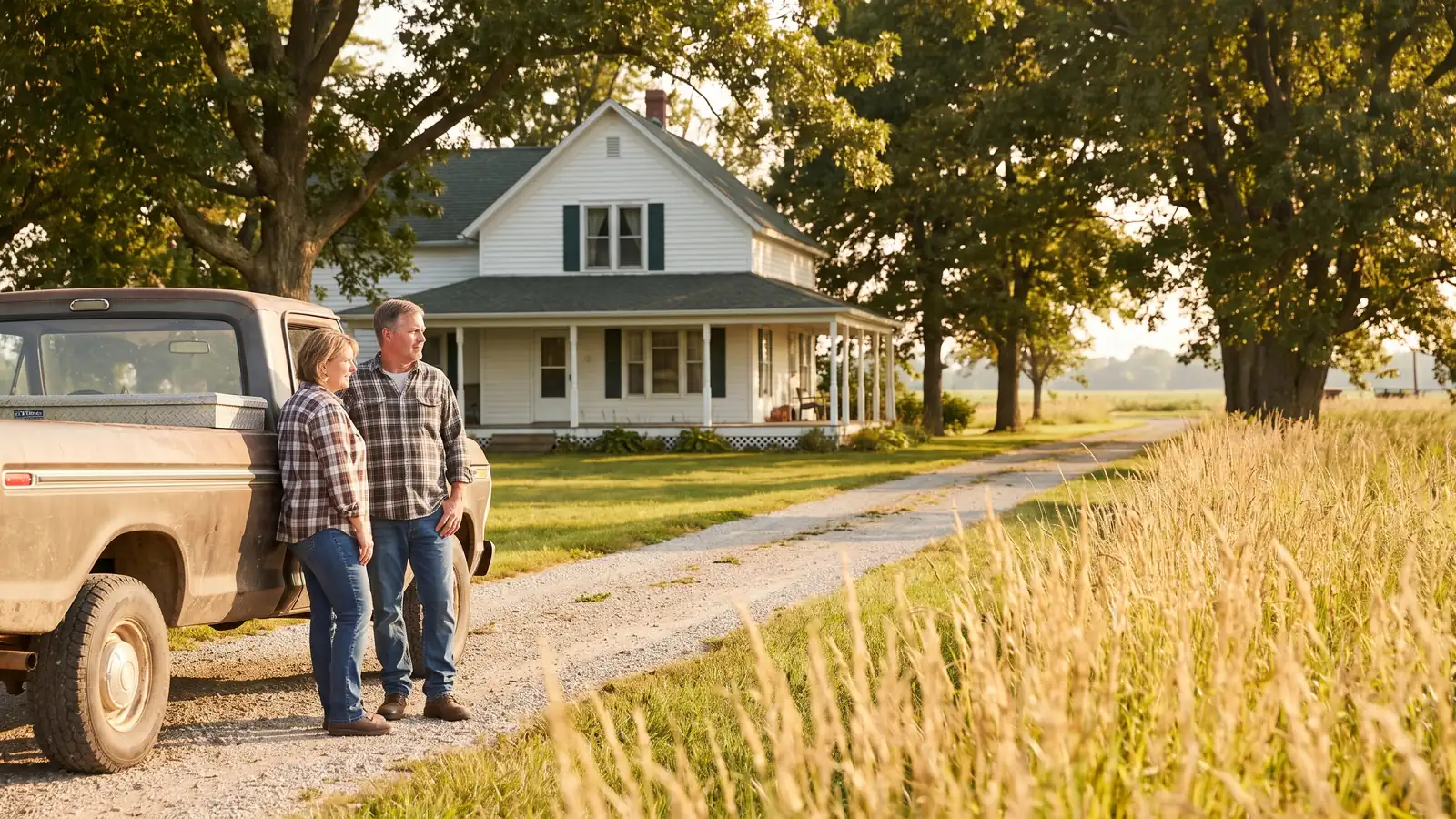
Because USDA eligibility is based on the property’s location rather than the seller or the buyer’s occupation, the first step is checking the address on the USDA eligibility map. Then budget inspection dollars for a well test, a septic inspection and a look at how the driveway is legally maintained.
Learn how USDA compares with FHA and conventional loans, what a rural utilities check covers, and how lenders treat private-road access. If you’re earlier in the process, start with our Home Buying guide.
Key takeaways:
- USDA Guaranteed Loans allow 0% down: Eligible rural properties can be financed at 100%, with lenders typically wanting a credit score near 640 and household income under the county limit.
- Eligibility follows the property, not the person: Check the exact address against the USDA eligibility map before you write an offer, and check your household income against USDA’s ceiling of 115% of the area median.
- Rural inspections cost more and matter more: 4 extra checks, a well test, a septic inspection, a road-access review and a zoning confirmation, replace the hookups suburban buyers take for granted.
How do you finance a home in a rural area?
Four programs do almost all of the work, and the cheapest entry point is USDA’s Section 502 Guaranteed Loan at 0% down. It runs through approved private lenders with a USDA guarantee behind it, and it exists to put low- and moderate-income households into modest homes in eligible rural areas. Our USDA loan basics guide walks it end to end; USDA lists the rest under its USDA Rural Development single-family housing programs.
Compare the four programs rural buyers actually use
| Program | Minimum down payment | Credit expectation | Property and borrower limits |
|---|---|---|---|
| USDA Guaranteed (Section 502) | 0%, 100% financing | 640 or higher meets USDA’s minimum credit reputation standard; below 640 triggers a cautious manual underwrite | Property must sit in an eligible rural area and be your primary residence; household income capped at 115% of area median |
| USDA Direct (Section 502) | 0%, typically no down payment required | Judged on willingness and ability to repay rather than a published score floor | Loan comes from USDA itself; adjusted income at or below the area low-income limit; term up to 33 years, or 38 for very low income applicants. Payment assistance can cut the effective rate to as low as 1% |
| FHA | 3.5% with a 580 credit score; 10% at 500 to 579 | 580 is the threshold for the 3.5% minimum investment1 | No rural requirement; primary residence; county loan limits apply |
| Conventional (Fannie Mae 97% LTV / HomeReady) | 3% | Set by the program and the automated underwriting decision | Fixed-rate, one-unit primary residence; HomeReady caps qualifying income at 80% of the area median |
If you or your spouse served, the VA loan belongs on that list too. It finances rural homes with no down payment and no monthly mortgage insurance, in exchange for a one-time funding fee, 2.15% of the loan amount for a first use with nothing down, waived for veterans receiving VA compensation for a service-connected disability.2
On a $250,000 farmhouse, that spread is real money at the table: USDA asks for nothing down, FHA’s 3.5% minimum is $8,750, and 3% conventional is $7,500.3
What USDA financing actually costs
Zero down is not zero cost. USDA charges an upfront guarantee fee, currently 1% of the loan amount, which most borrowers finance, plus an annual fee of 0.35% of the unpaid balance, collected monthly. USDA resets both each fiscal year, so confirm them while budgeting for closing costs.
How do you know if a property counts as rural?
You check the address, not the scenery. USDA eligibility is drawn on a map, and boundaries follow census population data. Areas with a population above 10,000 but not above 35,000 can still be designated rural when they are rural in character and underserved by mortgage credit, which is why plenty of small towns and outer-suburban edges qualify. Two checks decide it, and both happen before you write an offer.
- The property check: Enter the exact street address on USDA’s eligibility map. A home two miles past a boundary can qualify while a nearly identical one just inside it cannot, so a ZIP code isn’t good enough.
- The income check: Household income for the Guaranteed program can’t exceed 115% of the area median for that county. USDA Direct uses a tighter low-income limit. Both count the whole household, not just the people on the loan.
Boundaries and limits get revised, so verify both the day you’re serious about a property. Then get a preapproval on file, the importance of mortgage preapproval is amplified in rural markets, where sellers want certainty that the financing matches the property.
How does federal law define a rural area for USDA?
The definition lives in section 520 of the Housing Act of 1949, and USDA’s own single-family housing rule, 7 CFR 3555.10, points straight back to it. According to 42 U.S. Code section 1490, a place counts as rural when it is not part of or associated with an urban area and fits one of three tiers:
- Up to 2,500 people: Open country, or any place, town, village or city with 2,500 or fewer inhabitants.
- 2,500 to 10,000 people: A place larger than 2,500 but no larger than 10,000 qualifies if it is rural in character.
- 10,000 to 20,000 people: A place in this range qualifies only if it sits outside a metropolitan statistical area and has a serious lack of mortgage credit for lower and moderate-income families, as determined by the Secretaries of Agriculture and Housing and Urban Development.
The 35,000 figure comes from a grandfather clause in the same section: places already treated as rural with 10,000 to 35,000 people keep the designation until data from the 2030 census is received, as long as they stay rural in character with a serious lack of mortgage credit. For those grandfathered towns of 10,000 to 35,000 people, the designation can be looked at again once the 2030 counts are published.
The Census Bureau draws a different line. According to the Census Bureau’s urban and rural criteria for the 2020 Census, an urban area must hold at least 2,000 housing units or a population of at least 5,000, and rural is all territory left outside urban areas. The statute’s urban area test is USDA’s to apply, so a Census label alone does not settle USDA eligibility. USDA’s Income and Property Eligibility Site runs both of the program’s tests, household income and property location, and Align’s USDA eligibility check looks up a single address against USDA’s map. Our guide to USDA loans and assistance programs covers how the loan can pair with other help.
What utilities do you need to check on a rural property?
Assume nothing is municipal until a document proves it. USDA’s property rules require that a site meet community standards for utilities, including water and wastewater systems, so a well or septic problem can stop the loan. Run this checklist on every rural listing.
- Well flow and water quality: Ask for a flow-rate test and a sample covering bacteria and nitrates. USDA’s standard is that well water must meet state or local requirements, and where no local standard exists, EPA’s maximum contaminant levels apply. Quality also moves the appraised number, see how well water impacts a home’s value.
- Septic tank and drain field: Have the tank pumped during the inspection so the interior is visible, and get the drain field evaluated separately. A failed field is the expensive one. Our guide to buying a home with a septic system covers what replacement involves.
- Heat source and fuel: Natural gas lines stop where the subdivisions stop. Ask whether the home runs on propane, fuel oil, electric or wood, whether the tank is owned or leased, and what a winter fill costs.
- Internet and cell service: Check actual speeds at the address with the providers, not the coverage map. If anyone works from home, that’s a contingency-period question.
- Power reliability: Ask neighbors how often the power goes out and how long it stays out. Rural circuits are longer and get restored later. Budget for a generator if the answer is “a few days, more than once a winter.”
None of these are deal-killers on their own. They’re pricing information, and pricing information is leverage while the contingency is still open.
Who is responsible for the water from a private well?
The owner, which means you from the day you close. According to the EPA’s private wells page (last updated August 25, 2026), private well owners are responsible for the drinking water delivered to their households, and the agency estimates more than 23 million U.S. households rely on private wells, around 15% of the population, or over 43 million people.
No federal standard backs the owner up. The U.S. Geological Survey reported that the quality of water from domestic wells is not regulated by the federal Safe Drinking Water Act or, in most cases, by state laws. The same USGS page describes 3-D models from its National Water Quality Program that predict where high concentrations of arsenic and manganese are likely in the glacial aquifer system, the groundwater supply for 30 million people. Neither metal is part of a bacteria and nitrate sample, so ask the lab about a metals test before the inspection window closes, and read the results with our guide on how to read a home inspection report.
What does a septic system cost to maintain and to replace?
More than one in five U.S. households depend on individual septic systems or small community cluster systems, according to the EPA (page last updated July 7, 2026). The EPA’s septic care guidance (last updated August 17, 2026) says a household system should be inspected at least every three years by a septic service professional, tanks are typically pumped every three to five years, and alternative systems with pumps or mechanical parts generally need an inspection once a year.
The cost gap is the reason to inspect before you buy. Per the EPA (last updated March 11, 2026), routine maintenance runs $250 to $500 every three to five years, while repairing or replacing a malfunctioning conventional system can cost between $5,000 and $15,000, and alternative systems can cost more. The agency adds that a system in disrepair lowers property value and can become a costly legal liability.
Ask the seller for pumping receipts and the date of the last inspection. The EPA’s care guidance puts indoor water use as high as 70 gallons per person per day and says a single running toilet can add up to 200 gallons a day, so a household larger than the seller’s sends more water into the same drain field. Put the pumping schedule into your home maintenance plan the week you move in.
What should a rural home inspection cover?
Everything a suburban inspection covers, plus four things it doesn’t, and the extras are separate contracts with separate specialists. Hire the well and septic inspectors yourself rather than accepting whoever the seller used.
- Well and septic, as standalone inspections: These are rarely inside a general inspector’s scope. Book them early, because water samples take days to come back from the lab.
- Outbuildings and their systems: Barns, pole buildings and detached garages carry their own roofs, electrical service and structural risk, and appraisers may assign them little value.
- Drainage and the land itself: Ask about field tile, low spots, standing water, and whether the parcel is mapped as wetland or floodplain.
- Access surfaces: A gravel drive that washes out is a maintenance item; a bridge or culvert on your parcel is a capital expense.
Rural listings sit far from where you live, and the drive discourages repeat visits. Screening with virtual home tours saves the trip for homes worth touring, but never replaces the in-person inspection. Build lab timing into your contingencies in home offers.
How much does it cost to heat a rural home with propane?
Heating is the largest energy line in most homes, and rural homes often heat with a delivered fuel. The U.S. Energy Information Administration reported that space heating and air conditioning made up 52% of a household’s annual energy consumption in 2020, and that natural gas was used in 58% of homes that year, which means 42% of homes did not use natural gas.
According to the EIA’s Heating Oil and Propane Update, residential propane averaged $2.458 a gallon in Michigan and $2.730 nationally for the week of October 26, 2026. The EIA collects those weekly prices only during the heating season, October through March, so there is no weekly figure to compare against in summer.
For example, a home that burns 800 gallons over a winter would spend about $1,966 at that Michigan price, before delivery charges. Hypothetical example, not an offer. Ask the seller for the last two years of fill receipts so the home’s real usage replaces the guess.
How do zoning and land use rules affect a rural property?
Rural zoning is looser about some things and stricter about others, and the mismatch is where buyers get hurt. Agricultural zoning may let a neighbor run livestock or spray fields next to your yard, while a residential-agricultural classification can still block the pole barn, the short-term rental or the home business you had in mind.
Before you remove contingencies, confirm the parcel’s zoning with the township, ask what’s permitted by right versus what needs a variance, and check for deed restrictions or conservation easements recorded against the land. Ask about setbacks from the well and septic field, because those distances govern where a future addition can go. Our guide to zoning regulations explains the classifications and where to find the recorded documents.
How do you confirm legal road access and easements?
Get it in writing before you remove your financing contingency, because documented legal access is a lender condition, not a nicety. USDA requires that streets and roads be hard surfaced or all-weather surfaced, a surface emergency vehicles and typical passenger vehicles can always pass over, and that the property meet road access and maintenance requirements. Four questions settle it.
- Is the road public or private? A publicly maintained road is the simple answer. A private road or shared drive means the access rights live in recorded documents, not the seller’s memory.
- Is there a recorded easement? If your only way in crosses someone else’s land, you need a recorded easement running with the property. Verbal permission conveys nothing to you and nothing to the next buyer.
- Who maintains it, and who pays? Ask for the written road maintenance agreement, the annual cost per household, and how a special assessment gets decided when the culvert fails.
- Who plows, and when? Snow removal on a private road is a private problem. Find out whether it’s contracted, shared or informal.
Title work surfaces most recorded issues, but late in the process. Ask for the documents during the inspection period, and have an attorney read anything unusual.
What changes about day-to-day life in a rural home?
Plan for distance and self-sufficiency. Emergency response runs longer than in town, and one vehicle failure is a bigger problem when the nearest grocery store is 20 minutes away. Keep a pantry and water supply for outages, size your vehicles for gravel and snow, and confirm the school bus route and mail delivery before you close. Trash service, ambulance coverage and address numbering are township decisions, ask the township office, not the listing agent.
Who should be on your rural buying team?
Three people, lined up before you tour: an agent who closes deals in that township, certified well and septic inspectors, and a lender that places USDA loans. That last one narrows the field fast, because many retail banks don’t originate USDA at all.
Interview the agent for local volume and for private-road and well-and-septic closings, using our guide to choosing a real estate agent. Because Align Lending is a broker, we place USDA loans through partner lenders alongside FHA, VA and conventional options and quote all of them on the same file. Which matters when the property, not your preference, decides the program. Rural buying is one of several situations that changes the playbook; the rest live in our Buying Strategies & Situations hub, and the CFPB’s home-buying process tools make a useful neutral checklist alongside it.
What Michigan buyers should know
Michigan is a strong USDA state, and its well and septic rules are unusually local. Three things change the math.
- USDA coverage is broader than buyers assume: Large stretches of Michigan outside the Detroit, Grand Rapids, Lansing and Ann Arbor cores sit inside USDA-eligible boundaries, including much of the Thumb, northern Lower Michigan and the Upper Peninsula. Check the specific parcel rather than assuming the county.
- MSHDA assistance can stack onto the purchase: The MI 10K DPA Loan offers up to $10,000 toward down payment, closing costs and prepaids as a 0% non-amortizing second mortgage, repaid when you sell, refinance, pay off the first mortgage or stop living in the home. MSHDA’s MI Home Loan requires a 640 minimum credit score and homebuyer education, with a statewide sales price limit of $566,355 as of June 1, 2026. MSHDA’s separate $25,000 First-Generation down payment assistance pilot is closed, its $8 million appropriation is exhausted and applications are not being accepted, so plan around the $10,000 program.
- Well and septic rules are set county by county: Michigan has no statewide sanitary code, each local health department adopts its own, so requirements differ across county lines. Several counties, Washtenaw among them, run time-of-sale programs requiring a certified well and septic evaluation before transfer. Call the health department early: a backlogged evaluation can move your closing date.
MSHDA and USDA revise income limits, price caps and program terms periodically. Confirm current figures with a participating lender.
What do Michigan’s well, farm and zoning laws mean for a rural buyer?
Michigan leaves more of the rural checklist to the buyer and the local unit of government than many buyers expect. Eight points are worth knowing before you write an offer.
- Nearly 30% of Michigan drinks from wells: The Michigan Department of Health and Human Services reports more than one million private residential wells serving over 2.6 million people, nearly 30% of residents. EGLE stated in a May 4, 2026 release that private residential wells are only required to be tested and inspected when installed, so outside a county time-of-sale program, no state rule requires a test when the home changes hands.
- Michigan’s standard well concerns go past bacteria and nitrate: EGLE’s private well testing page lists coliform bacteria, nitrate, nitrite, fluoride, chloride, sulfate, sodium, hardness and metals including arsenic, lead, iron, manganese and uranium among the standard water quality concerns for private wells.
- The farm next door usually has the law on its side: Under the Michigan Right to Farm Act, MCL 286.473, a farm that conforms to generally accepted agricultural and management practices (GAAMPs) cannot be found a public or private nuisance, and neither can a farm that existed before a change in land use within 1 mile of its boundaries, if it would not have been a nuisance before that change. Complaints go to the Michigan Department of Agriculture and Rural Development, which assesses whether the farm conforms to the GAAMPs.
- Zoning is set locally: The Michigan Zoning Enabling Act, MCL 125.3201, lets a local unit of government regulate land development and establish its own districts by ordinance, which is why the rules for a pole barn or a home business change from one township to the next.
- Check internet by address on the state map, then with the provider: The Michigan Public Service Commission points to the Michigan High-Speed Internet Office map, searchable by street address, which shows the providers serving that address, their technology and their maximum download and upload speeds. The Michigan High-Speed Internet Office reports more than 212,000 households in the state lack access to a high-speed connection and another 865,000 face barriers of affordability, adoption or digital literacy.
- Flood-prone land is a measurable share of the state: EGLE estimates that 6% of Michigan’s land is flood-prone, including about 200,000 buildings, and defines the 100-year flood as one with a 1% chance of occurring in any given year.
- Solar panels come with a utility agreement: The Michigan Public Service Commission’s distributed generation page says a customer must properly interconnect a project with the utility before operating it, and that eligible projects can now be up to 550kW, with a customer’s capacity up to 110% of the prior 12 months of electricity use. Ask the seller for the interconnection agreement on any rooftop or ground-mounted array.
- Your tax bill will not match the seller’s: The year after a Michigan home sells, its taxable value resets to half of the assessor’s market value, so the seller’s tax bill is not your tax bill. Michigan Treasury’s change of ownership page explains the reset; our guide to how property tax assessments work and the Michigan property tax calculator turn it into a planning number for a rural address.
How Align fits your buying strategy
Local real estate agents bring Samantha in for a second opinion when their buyer arrives preapproved somewhere else. She regularly finds a lower rate or less cash to close, whichever helps the buyer more.
That comes from the broker model. One application goes to multiple wholesale lenders, so your offer is built on the loan that fits your situation, not the only one a single bank sells. A 2024 Polygon Research analysis of federal mortgage data found broker borrowers paid about $10,662 less over the life of a $400,000 loan than borrowers at nonbank retail lenders.
FAQ: Buying a home in a rural area
Here are answers to common questions about buying a home in a rural area.
What counts as a rural area for a USDA loan?
USDA defines rural by population and location, not by scenery. Many small towns and the outer edges of suburbs qualify, which surprises most buyers. Eligibility is tied to the property address, so a home two miles outside a designated boundary can qualify while a nearly identical one inside it cannot. Check the specific address on the USDA eligibility map before making an offer, and track recent changes to USDA loan programs, since boundaries get revised.
Do I need a well and septic inspection when buying a rural home?
Yes, and treat them as separate line items from the general home inspection. A well test should cover flow rate plus bacteria and nitrate levels. A septic inspection should include tank pumping and a drain field evaluation. Replacing a failed drain field can run into five figures, so build both inspections into your contingency period rather than skipping them to look competitive. Our home inspection checklist for buyers covers the general inspection.
Can I get a conventional mortgage on a rural property?
Yes. Conventional, FHA and VA loans all finance rural homes, though appraisers may struggle to find nearby comparable sales, and lenders scrutinize large acreage, outbuildings and any income-producing use. Properties with heavy acreage or agricultural elements sometimes need a portfolio or farm loan instead. A broker with multiple lender relationships can find the program that fits the property. For an investment purchase, weigh the pros and cons of investing in rural housing.
What should I check about road access on a rural property?
Confirm in writing whether the road is public or private, and if private, get the recorded easement and the maintenance agreement. Lenders often require documented legal access before closing. Also ask who plows in winter, how the driveway drains, and whether emergency vehicles can reach the house year-round. Verbal assurances from a seller are not sufficient. The role of a closing attorney includes reading these documents.
How often should you test a private well?
Once a year is the EPA’s baseline. Have a lab certified for drinking water check total coliform bacteria, nitrates, total dissolved solids and pH, and ask the county health department first, because some run the test at no charge (EPA, Protect Your Home’s Water). In Michigan, MDHHS recommends testing well water for lead every 3 to 5 years, because groundwater can change over time.
Is a septic inspection required to sell a house in Michigan?
Not statewide. In 2024 the Michigan Association of Counties counted 11 counties running point-of-sale programs. Senate Bill 771, introduced January 28, 2026, would create statewide septic inspection requirements, but its latest action, on June 17, 2026, placed it on third reading with a substitute, so it is not law. Washtenaw’s program reviews about 900 to 1,000 reports a year, The Sun Times News reported.
Who maintains a private road in Michigan?
The people who own land along it. Orion Township, for example, states that private roads are maintained by the owners of the property abutting them, and that townships in Michigan have no jurisdiction over roads, so the township office is not the place to call about repairs or plowing. Compare any maintenance agreement with your title commitment; our guide to title insurance explains what the policy covers.
Do you need flood insurance on a rural home?
If the home sits in a high-risk Zone A in a community that participates in the NFIP, flood insurance is mandatory with a federally backed mortgage, according to FloodSmart. Outside those zones it is optional, yet 1 in 3 flood insurance claims come from low- and moderate-risk zones. FEMA says an NFIP policy typically has a 30-day waiting period, so price it early. See buying a home in a flood zone.
The bottom line on buying a home in a rural area
Buying in a rural area comes down to financing, utilities and access. USDA’s Section 502 Guaranteed Loan finances eligible rural properties at 0% down, with lenders looking for a credit score around 640 and household income at or below 115% of the area median, and eligibility follows the property address, so check the map before you write an offer. Then pay for the checks a suburban buyer never makes: a well flow and water quality test, a septic and drain field inspection, a zoning confirmation, and written proof of legal road access.
If you’re ready to buy a home in the country, talk to Align Lending. We’ll check the property’s USDA eligibility, shop your scenario across our lender network, and show you USDA, FHA, VA and conventional pricing side by side. Call 248-506-5727 or start online.
Footnotes:
1. Align Lending is not acting on behalf of or at the direction of FHA or HUD. FHA credit score, minimum investment and loan limit requirements are set by HUD and are subject to change. Return to text.
2. Align Lending works with VA-approved lenders and is not endorsed or sponsored by the Dept. of Veterans Affairs or any government agency. VA funding fee amounts and exemptions are set by the Department of Veterans Affairs and are subject to change. Return to text.
3. Example figures are hypothetical and for educational purposes only; they do not constitute an advertisement of credit terms or a rate quote under federal or state lending laws. Your down payment, fees, and eligibility depend on your application, the property, the program, and market conditions. Return to text.
Sources: USDA Section 502 Guaranteed and Direct loan terms, income limits, payment assistance and repayment periods, USDA Rural Development. Credit score standard of 640, USDA Handbook HB-1-3555 Chapter 10. Rural area population criteria, site utility standards, all-weather road surface and private well water quality requirements, USDA Handbook HB-1-3555 Chapter 12. FHA minimum credit score and minimum required investment tiers, HUD Single Family Housing Policy Handbook 4000.1. VA funding fee and exemptions, U.S. Department of Veterans Affairs. 97% LTV and HomeReady down payment and income limits, Fannie Mae Selling Guide B5-6.01 and Fannie Mae 97% LTV options. MI 10K DPA and MI Home Loan terms, credit score minimum and sales price limit, Michigan State Housing Development Authority. Local sanitary code and onsite wastewater authority, Michigan Department of Environment, Great Lakes, and Energy.
This article is for informational purposes only and is not intended to provide legal, financial, or tax advice. Easement, zoning, and property-transfer requirements vary by county and township and should be reviewed by a licensed real estate professional or attorney in your state. Consult a qualified professional about your situation. Program terms and figures shown are illustrative, are not a rate quote or an offer of credit, and are subject to change. Align Lending is an independent Michigan mortgage broker, NMLS #2041154.
Sources
Every outside source this guide links to, in the order it appears. How we choose and check sources
- USDA Rural Development single-family housing programsUSDA Rural Development
- USDA’s eligibility mapUSDA Rural Development
- 7 CFR 3555.10Electronic Code of Federal Regulations
- 42 U.S. Code section 1490law.cornell.edu
- Census Bureau’s urban and rural criteriaU.S. Census Bureau
- EPA’s private wells pageU.S. Environmental Protection Agency
- U.S. Geological Surveyusgs.gov
- EPAU.S. Environmental Protection Agency
- EPA’s septic care guidanceU.S. Environmental Protection Agency
- EPAU.S. Environmental Protection Agency
- U.S. Energy Information Administrationeia.gov
- EIA’s Heating Oil and Propane Updateeia.gov
- The CFPB’s home-buying process toolsConsumer Financial Protection Bureau
- Michigan has no statewide sanitary codethesuntimesnews.com
- Michigan Department of Health and Human ServicesState of Michigan
- EGLE stated in a May 4, 2026 releaseState of Michigan
- EGLE’s private well testing pageState of Michigan
- MCL 286.473Michigan Legislature
- Michigan Department of Agriculture and Rural DevelopmentState of Michigan
- MCL 125.3201Michigan Legislature
- Michigan Public Service CommissionState of Michigan
- Michigan High-Speed Internet OfficeState of Michigan
- EGLE estimatesState of Michigan
- Michigan Public Service Commission’s distributed generation pageState of Michigan
- Michigan Treasury’s change of ownership pageState of Michigan
- EPA, Protect Your Home’s WaterU.S. Environmental Protection Agency
- MDHHS recommendsState of Michigan
- Michigan Association of Countiesmicounties.org
- Senate Bill 771Michigan Legislature
- Orion Township, for example, statesoriontownship.org
- FloodSmartFEMA, National Flood Insurance Program
- FEMAFederal Emergency Management Agency
- Michigan Department of Environment, Great Lakes, and EnergyState of Michigan
Related resources

20-minute read
How to create a competitive offer on a house in a seller’s market
Learn how to create a competitive offer on a house, from preapproval and pricing to contingencies and appraisal gap coverage, and win in a hot market.

20-minute read
Advantages of buying a fixer-upper: 7 key benefits (and the tradeoffs)
Discover the advantages of buying a fixer-upper, from lower prices and less competition to renovation loans that roll repair costs into your mortgage.

20-minute read
Guide to Negotiating a Home Purchase
Strategies for negotiating a home purchase, from inspection findings and seller concessions to offers that win without overpaying.
