
USDA loan basics: How rural housing loans work and who qualifies
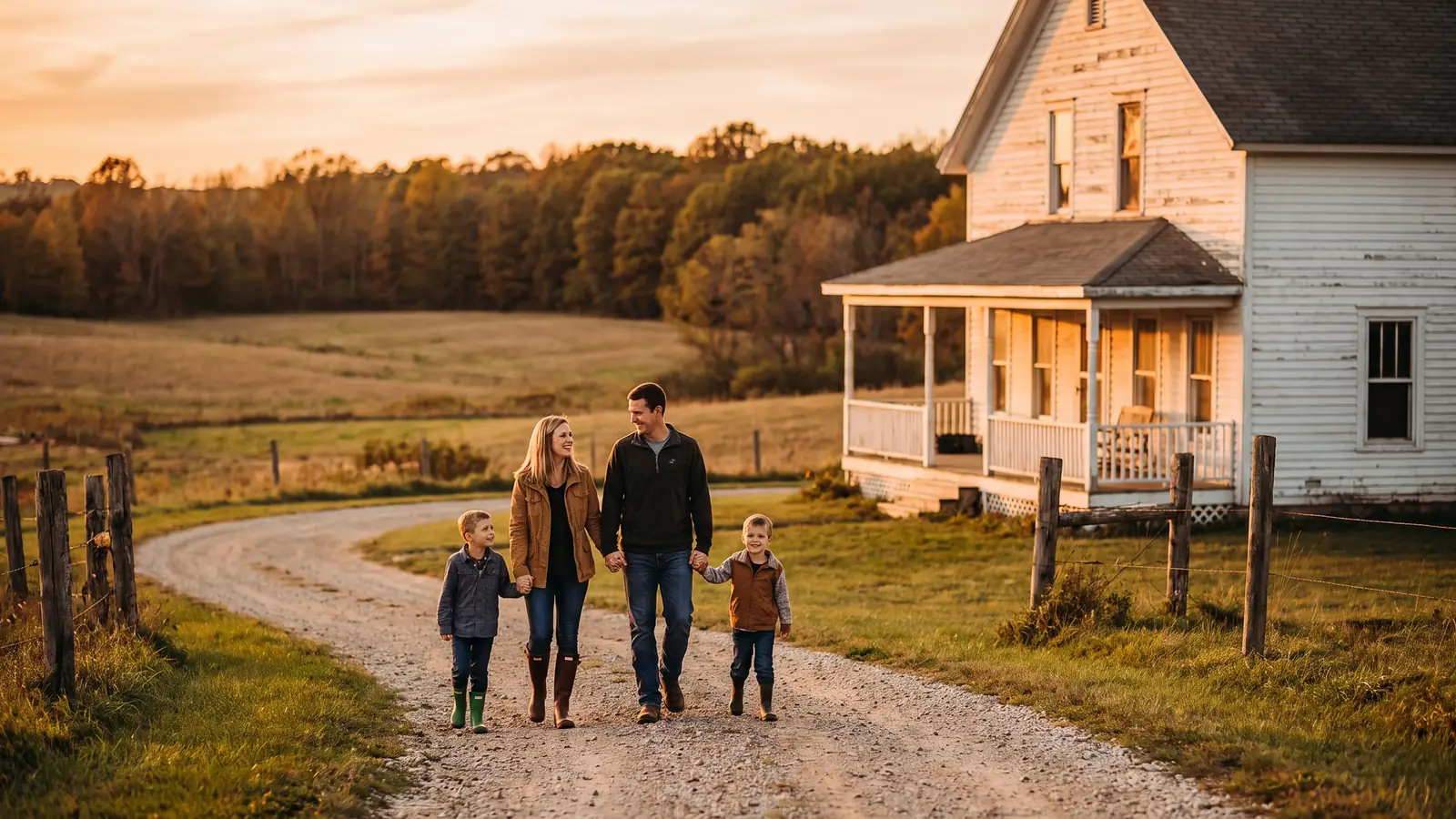
A USDA loan is a mortgage backed by the U.S. Department of Agriculture that lets buyers in eligible rural and small-town areas finance 100% of the purchase price with no down payment. Two purchase programs do that work: the Section 502 Guaranteed loan, made by approved private lenders to households earning up to 115% of area median income, and the Section 502 Direct loan, made by USDA itself to low- and very-low-income buyers, where payment assistance can drop the effective interest rate to as low as 1% and stretch the term to 38 years.
A third program isn’t for buying at all: Section 504 lends existing rural homeowners up to $40,000 at a fixed 1% for up to 20 years to repair a home they already own, plus grants up to a $10,000 lifetime limit for owners age 62 and older. Guaranteed, Direct and 504 are three different rulebooks.
Learn which program fits your household, how the income and address rules work, and what zero down actually costs. If you’re mapping the field, start with our loan types and programs guide.
Key takeaways:
- Both purchase programs allow 100% financing: USDA backs the Guaranteed loan with a 90% loan note guarantee to the approved lender, which is what makes a zero-down mortgage possible.
- The income cap depends on your program: Guaranteed loans run up to 115% of area median income; Direct loans stop at the area’s low-income limit, generally 80% of area median, with “very low income” starting below 50%.
- The address qualifies before your file does: USDA’s rural definition reaches communities of up to 35,000 people, and no amount of income or credit strength overrides a property outside the eligible map.
What is a USDA loan?
A USDA loan is a home loan made or guaranteed by USDA Rural Development so low- and moderate-income households can buy or repair a modest, decent, safe and sanitary primary residence in an eligible rural area. All three tie eligibility to household income and the property’s address.
On the Guaranteed side, USDA doesn’t lend you the money. It issues a 90% loan note guarantee to an approved private lender, and that backstop is what lets the lender finance the full purchase price. On the Direct side, USDA is the lender and servicer and adds a payment subsidy on top.
USDA and VA are the two mainstream programs that finance an entire purchase with nothing down.1 VA turns on military service; USDA turns on where you’re buying and what you earn. Our guide to government-backed loans compares FHA, VA and USDA, and low-down-payment mortgages shows where each lands against 3%-down conventional options.
Who qualifies for a USDA loan?
For the Guaranteed program, household adjusted income has to sit at or below 115% of area median income for the county and household size, and the property has to sit inside a USDA-designated rural area.2 Those two gates do most of the disqualifying. Here’s what underwriting checks next.
- How USDA calculates the income cap: The Guaranteed moderate-income limit is the greater of 115% of U.S. median family income, 115% of the average of statewide and state non-metro median family incomes, or 115/80ths of the area low-income limit. That formula is why a published county limit sometimes sits above a simple 115% of the local median. Our USDA and assistance programs hub walks the county lookup.
- Household income is not qualifying income: USDA counts essentially every adult against the eligibility cap, including people who won’t be on the loan, then measures repayment ability on the applicants alone. A working adult child at home can push a household over the limit without adding a dollar you can qualify with.
- No fixed credit score minimum: USDA requires an acceptable credit reputation rather than a numeric floor, and its guaranteed handbook treats a score of 640 or higher as meeting that standard absent disqualifying indicators. Lenders add their own floors on top.
- Debt ratios of 29% and 41%: USDA finds repayment ability when housing expense stays at or below 29% of repayment income and total debts at or below 41%. Manually underwritten files can exceed both with documented compensating factors.
- Citizenship and occupancy: Applicants must be a U.S. citizen, U.S. non-citizen national or qualified alien and must occupy the home as a primary residence. No second homes, rentals or investment property.
Which property addresses qualify?
“Rural” is a statutory term here, not a description of scenery, and it reaches communities of up to 35,000 people. The baseline sits at populations of 2,500 or less and extends to 20,000 under specified conditions, and areas that lost rural status in a recent census stay classified as rural through 2030 when population runs between 10,000 and 35,000.
Small towns qualify, and so do large stretches of what buyers would call suburbs. USDA’s public eligibility site returns one of three answers for an address, eligible, ineligible, or unable to determine. Check it before you write an offer, because boundaries are redrawn after census updates. Our notes on buying a home in a rural area cover what else changes out there.
Direct adds limits Guaranteed doesn’t: the home is generally 2,000 square feet or less, with no in-ground pool and no design for income-producing activities.
Guaranteed vs. Direct vs. Section 504: which USDA program fits?
Sort by income first, purpose second.
| Feature | Section 502 Guaranteed | Section 502 Direct | Section 504 repair |
|---|---|---|---|
| Who it’s for | Low- and moderate-income buyers | Low- and very-low-income buyers | Very-low-income existing owners |
| Who lends | USDA-approved private lender | USDA Rural Development | USDA Rural Development |
| Income limit | Up to 115% of area median | Area low-income limit, generally 80% of area median | Very-low-income limit, generally below 50% of area median |
| Interest rate | Set by the lender; fixed rate required | USDA’s published Direct rate, as low as 1% effective with payment assistance | 1% fixed |
| Term | Fixed, commonly 30 years | 33 years, or 38 under 60% of area median when needed to qualify | Up to 20 years |
| Down payment | None required | None typically required | Not applicable |
| Maximum amount | No dollar cap; limited by value, repayment ability and income | Lesser of repayment ability and the county area loan limit | $40,000 loan; $10,000 lifetime grant; $50,000 combined |
Section 502 Guaranteed: the one most buyers use
Eligible applicants may purchase, build, rehabilitate, improve or relocate a dwelling with 100% financing. USDA’s regulations require a fixed rate over the term and make adjustable-rate, balloon and prepayment-penalty mortgages ineligible outright. A private lender originates it, so it moves at normal mortgage speed. It also has a refinance lane with its own seasoning rules, covered in the USDA streamline refinance.
Section 502 Direct: USDA as your lender
Direct loans go to applicants whose adjusted income sits at or below the area’s low-income limit and who are unable to obtain a loan elsewhere on terms they could reasonably be expected to meet. The distinguishing feature is payment assistance, a subsidy that reduces the payment and can bring the effective rate down to 1%. The amount is set by adjusted family income, so it moves as your income moves.
Two things to plan around. Terms run 33 years, extending to 38 when adjusted income doesn’t exceed 60% of area median and the longer schedule is needed. And payment assistance is recaptured: borrowers repay all or part of the subsidy when title transfers or they stop living in the home, a deferred cost rather than a penalty. Applications go through your local Rural Development office rather than a lender. If your income is near the line, our guide to buying a home with low income compares this against FHA and 3%-down conventional loans.
Section 504: repair loans and grants for owners who already qualify
Section 504 lends very-low-income homeowners up to $40,000 at a fixed 1% over up to 20 years to repair, improve or modernize a home they already own. Grants up to a $10,000 lifetime limit remove health and safety hazards, and a grant applicant must be 62 or older and unable to afford a repair loan. Loans and grants combine for up to $50,000, and grant funds must be repaid if the property sells in under three years.
What two USDA households actually look like
The gap between the purchase programs is easiest to see with one house and two households.3
- The Guaranteed household: A family of four earning right at their county’s 115% limit buys a $240,000 home in an eligible township. They bring $0 down, finance the full price, pay the upfront guarantee fee, and carry the annual fee inside the payment at their lender’s fixed rate.
- The Direct household: A family of three below the area’s low-income limit applies through Rural Development for the same house. USDA funds the loan, and payment assistance reduces the payment toward what a 1% loan would cost. Under 60% of area median, the term can run 38 years. When they sell, part of the subsidy returns to USDA.
Same house, same zero down, two entirely different files. The dividing line is income.
What does a USDA loan cost with no down payment?
The cost shows up as fees: an upfront guarantee fee that can be financed, plus an annual fee collected monthly for the life of the loan. Regulation caps the upfront fee at 3.5% of the principal obligation and the annual fee at 0.5% of the average annual scheduled unpaid principal balance, and USDA sets the actual rates well below those ceilings, republishing them by fiscal year. The published rates are 1% upfront and 0.35% annual (USDA Rural Development, fiscal year 2026). They can reset each October, so confirm the current schedule and see recent changes to USDA loan programs.
Zero down doesn’t mean zero cash. You still owe closing costs and prepaid escrow items, and USDA gives you two ways to cover them. Seller and other interested-party contributions are limited to 6% of the sales price. And because the Guaranteed maximum loan is tied to appraised market value rather than purchase price alone, an appraisal above the contract price can create room to finance eligible costs. See our breakdown of closing costs for buyers.
How to apply for a USDA loan
Guaranteed loans go through an approved lender; Direct loans go through USDA, and the wrong door costs weeks.
- Check the address first: Run the property through USDA’s eligibility site before anything else. An ineligible address ends the conversation no matter how strong your file is.
- Check income against the right limit: Pull the published limit for your county and household size, and compare it against total household income, not just the applicants’.
- Pick your lane: Under the low-income limit, ask about Section 502 Direct at your local Rural Development office, which takes applications year-round. At or under 115% of area median, use a lender approved for Section 502 Guaranteed.
- Stack assistance at application: Down payment and closing-cost programs get layered on at application, not bolted on at closing. See first-time home buyer grants and programs.
- Get free help for a second read: Find a HUD-approved housing counselor at no cost, compare offers with the CFPB home-buying tools, and see every option under USDA Rural Development single-family housing programs.
What Michigan buyers should know
Michigan is one of the better USDA states: the eligible map covers most of the land area while the population sits in a few metros.
- Eligibility follows the address, not the county name: Consistent with the 35,000-population rule, much of the Thumb, the northern Lower Peninsula and nearly all of the Upper Peninsula sit inside eligible territory. The boundary typically runs through the outer townships around Detroit, Grand Rapids, Lansing, Ann Arbor and Kalamazoo, so two homes a mile apart get different answers.
- MSHDA’s $10,000 assistance pairs with USDA: The MI 10K DPA Loan provides up to $10,000 behind an MI Home Loan first mortgage, which MSHDA offers as conventional, FHA, VA or RD (USDA Rural Development) financing. On a zero-down USDA loan there’s no down payment to cover, so the $10,000 goes toward closing costs and prepaid taxes and insurance, where a rural buyer’s cash gap actually sits.
- Adding MSHDA raises the credit bar: The MI Home Loan carries a minimum credit score of 640 and a statewide sales price limit of $566,355 effective after June 1, 2026. USDA alone sets no score minimum, so state assistance introduces the 640 floor.
- Two income tests, not one: Pairing USDA with MSHDA means clearing USDA’s county household income limit and MSHDA’s own limit. They’re calculated differently, so passing one doesn’t mean passing the other. Our roundup of state-specific mortgage assistance programs shows how the layers stack.
How Align uses assistance programs
Align places MSHDA loans, including down payment assistance, alongside USDA and FHA options. Samantha shows you how each one changes your cash to close and your monthly payment, so you choose with the numbers in front of you.
Assistance programs come with their own rules and paperwork. With one person on your file from start to finish, those rules get read before you write an offer, not after.
FAQ: USDA loan basics
Here are answers to common questions about USDA loans.
What is the difference between a USDA Direct loan and a USDA Guaranteed loan?
A Direct loan is made and serviced by USDA itself for low- and very-low-income households, with payment assistance that can bring the effective rate to 1% and terms up to 38 years. A Guaranteed loan comes from an approved private lender with a USDA guarantee behind it, is available up to 115% of area median income, and moves faster on standard lender processing. Our USDA and assistance programs hub covers both.
Do USDA loans really require zero down payment?
Yes. Both Section 502 programs allow 100% financing on eligible properties, one of the few true no-down-payment options outside VA loans. You still owe closing costs and prepaid escrow items, though sellers can contribute up to 6% of the sales price, and the Guaranteed program carries an upfront guarantee fee plus a small annual fee inside your payment. See how it compares in low-down-payment mortgages.
How do I know if a property is in a USDA eligible area?
USDA publishes an online eligibility site where you enter an address and get back eligible, ineligible, or unable to determine. Eligible areas are broader than most buyers expect, routinely including small towns and the outer edges of metro areas. Boundaries get redrawn after census updates, so confirm the designation before writing an offer. Our guide to buying a home in a rural area covers what else to check.
Is there a credit score minimum for a USDA loan?
USDA sets no hard minimum score. Its rules require an acceptable credit reputation, and its guaranteed handbook treats 640 or higher as meeting that standard absent disqualifying indicators. Below that, or with no score, files can still qualify through nontraditional credit or manual underwriting. Each lender adds its own overlay, so a borrower declined at one may still qualify at another. Compare credit rules across programs in our guide to government-backed loans.
The bottom line on USDA loans
USDA loans let qualified buyers finance 100% of a home in an eligible rural or small-town area with no down payment. Section 502 Guaranteed is the one most buyers use: an approved private lender writes the loan, USDA backs it with a 90% guarantee, and household income can run up to 115% of area median income. Section 502 Direct serves low- and very-low-income households with USDA as the lender, payment assistance that can bring the effective rate to 1%, and terms of 33 to 38 years. Section 504 lends existing owners up to $40,000 at 1% for repairs. Two gates decide it: the address and the income.
If you’re ready to find out whether your address and income qualify, talk to Align Lending, we’ll shop your scenario across our lender network and put USDA and its alternatives in front of you side by side. Call 248-506-5727 or start online today.
Footnotes:
1. Align Lending works with VA-approved lenders and is not endorsed or sponsored by the Dept. of Veterans Affairs or any government agency. Return to text.
2. The 115% of area median income limit applies to the Section 502 Guaranteed program only; the Section 502 Direct and Section 504 programs use lower income limits. The 1% figure cited for Section 502 Direct is an effective interest rate produced by USDA payment assistance, not a note rate offered to borrowers, and payment assistance is subject to recapture. USDA publishes and periodically updates the Section 502 Direct interest rate. All USDA program terms, income limits, fees and area designations are set by USDA and are subject to change. Return to text.
3. Example figures in this article are hypothetical and for educational purposes only; they do not constitute an advertisement of credit terms or a rate quote under federal or state lending laws. Your rate, fees and eligibility depend on your application, your household income, the property address and market conditions. Return to text.
Figures current as of August 2026; verify with the linked source. Sources: Section 502 Guaranteed program purpose, 100% financing, 90% loan note guarantee, citizenship categories (U.S. citizen, U.S. non-citizen national or qualified alien), primary-residence occupancy, and moderate income defined as the greater of 115% of U.S. median family income, 115% of the average of statewide and state non-metro median family incomes, or 115/80ths of the area low-income limit, USDA Rural Development, Single Family Housing Guaranteed Loan Program. Section 502 Direct eligibility at or below the applicable area low-income limit, inability to obtain a loan from other resources on terms that can reasonably be expected to be met, payment assistance reducing the effective interest rate to as low as 1%, a 33-year term with up to 38 years when adjusted income does not exceed 60% of area median and a longer term is needed for repayment, no down payment typically required, maximum loan set by repayment ability and the county area loan limit, and subsidy recapture on title transfer or when the borrower no longer occupies the dwelling, USDA Rural Development, Single Family Housing Direct Home Loans; 7 CFR 3550.67 and 3550.68. Section 502 Direct property standards of generally 2,000 square feet or less, no in-ground swimming pool, and no design for income-producing activities, USDA Rural Development. Very-low income below 50% and low income 50% to 80% of area median income, USDA Rural Development. Rural area population thresholds of 2,500, 10,000 and 20,000, and continued rural classification through 2030 for areas of 10,000 to 35,000 that are rural in character with a serious lack of mortgage credit for lower- and moderate-income families, Section 520 of the Housing Act of 1949 as applied in USDA Rural Development HB-1-3555 Chapter 12; property eligibility determinations of “Eligible,” “Ineligible” or “Unable to Determine” at USDA’s property eligibility site. Fixed interest rate required over the loan term, with adjustable-rate, balloon-term and prepayment-penalty mortgages ineligible, 7 CFR 3555.104(a)(1) and (b); maximum guaranteed loan amount tied to the lesser of appraised market value plus the financed upfront guarantee fee or purchase price plus eligible acquisition costs, 7 CFR 3555.103. Upfront guarantee fee capped at 3.5% of the principal obligation and annual fee capped at 0.5% of the average annual scheduled unpaid principal balance, 7 CFR 3555.107(g) and (h); published rates of 1% upfront and 0.35% annual, USDA Rural Development, fiscal year 2026. Acceptable credit reputation rather than a fixed minimum credit score, 7 CFR 3555.151(i); credit scores of 640 or greater meeting the minimum credit reputation standard absent indicators of unacceptable credit, and eligibility of nontraditional-credit and no-score files, USDA Rural Development HB-1-3555 Chapter 10. PITI ratio of 29% and total debt ratio of 41% of repayment income, with waivers on manually underwritten files supported by documented compensating factors, HB-1-3555 Chapter 11. Interested-party contributions limited to 6% of the sales price and restricted to eligible loan purposes, HB-1-3555 Chapter 6. Section 504 repair loans of up to $40,000 at 1% for up to 20 years, grants with a $10,000 lifetime limit for applicants age 62 or older who cannot afford a repair loan, combined loan and grant assistance up to $50,000, and repayment of grant funds if the property is sold in less than three years, USDA Rural Development, Single Family Housing Repair Loans and Grants (Section 504 Home Repair). MI 10K DPA Loan of up to $10,000 for down payment, closing costs and prepaid expenses, paired with an MI Home Loan first mortgage offered as conventional, FHA, VA or RD financing; MI Home Loan minimum credit score of 640 and statewide sales price limit of $566,355 effective after June 1, 2026, Michigan State Housing Development Authority.
This article is for informational purposes only and is not intended to provide legal, financial, or tax advice. USDA income limits, area loan limits, fees, eligible-area designations and program rules are set by USDA and change; confirm current figures with USDA Rural Development or MSHDA before relying on them, and consult a qualified professional about your situation. Figures shown are illustrative, are not a rate quote or an offer of credit, and are subject to change. Align Lending works with USDA-approved lenders and is not acting on behalf of, endorsed by, or sponsored by USDA, HUD, or any government agency. Align Lending is an independent Michigan mortgage broker, NMLS #2041154.
Related resources
12-minute read
State-specific mortgage assistance programs: How to find and qualify
Discover state-specific mortgage assistance programs (down payment help, deferred loans and grants) plus the income limits and steps to qualify.
