
VA Loan Benefits for Veterans: The 8 Advantages That Matter Most
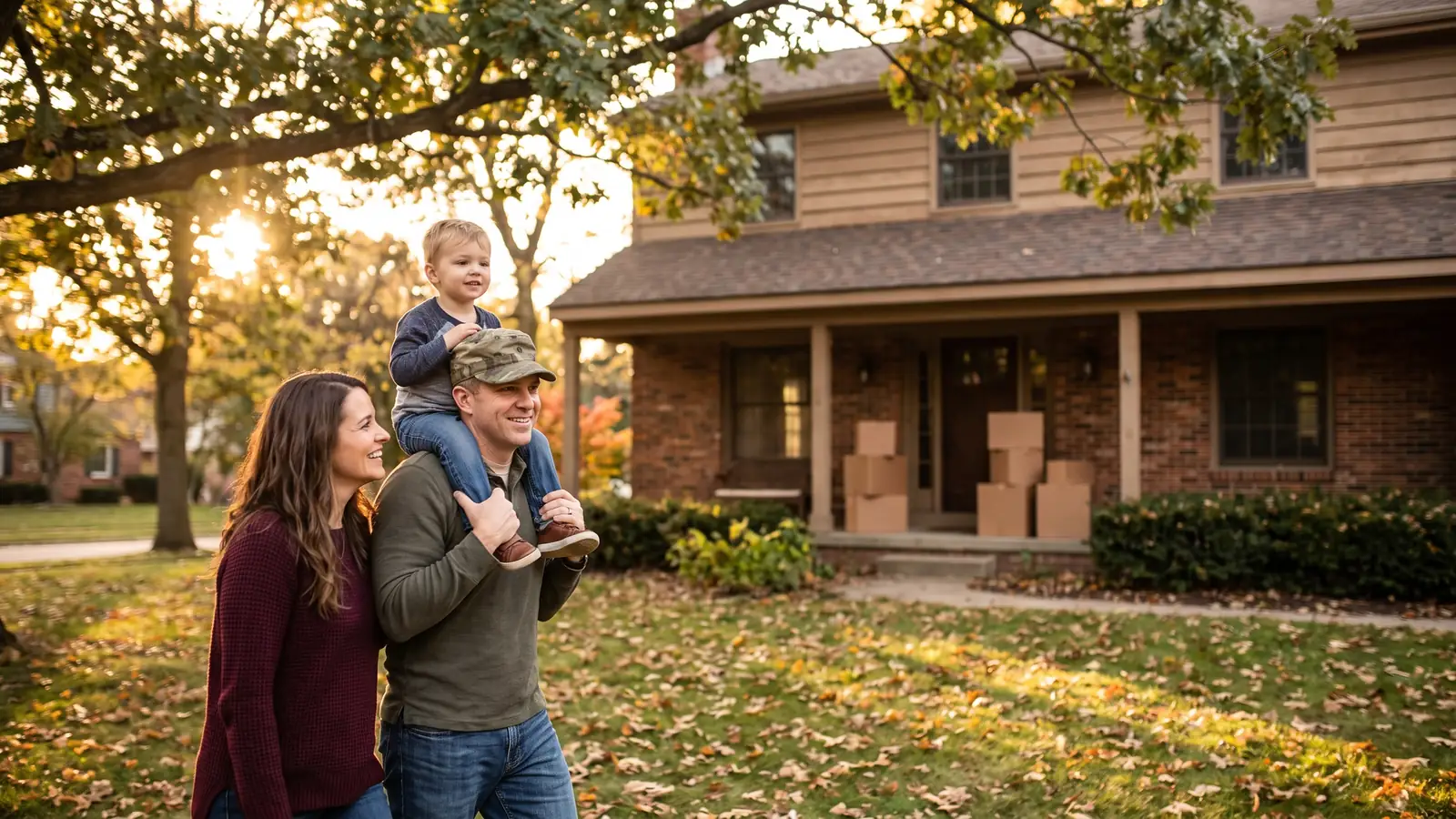
VA loans let eligible veterans, service members and surviving spouses buy a home with no down payment and no private mortgage insurance, and the VA reports that nearly 90% of all VA-backed home loans are made without a down payment.1 For a veteran with full entitlement, the VA sets no maximum loan amount at all: the ceiling is the appraised value or the purchase price, whichever is lower, plus whatever your lender approves you to carry.
The one VA-specific cost is the funding fee, a percentage of the loan amount rather than a flat charge: 2.15% on a first purchase with less than 5% down, 1.5% with 5% down, and 1.25% with 10% down, effective April 7, 2023. Veterans receiving VA compensation for a service-connected disability pay none of it.
Learn which VA loan benefits move the most money, where each stops, and which limits come from the VA versus your lender. Still comparing programs? Start with our Loan Types & Programs guide or our guide to government-backed loans.
Key takeaways:
- Zero down on nearly 9 in 10 VA loans: The VA reports nearly 90% of VA-backed home loans close with no down payment, and none carry private mortgage insurance at any loan-to-value ratio.
- The funding fee runs 2.15% on a first purchase, or $0 with a disability rating: Veterans receiving VA compensation for a service-connected disability are exempt entirely, which on a $300,000 loan is $6,450 never charged.
- Entitlement is a lifetime benefit, not a one-time perk: It’s restored each time you pay off a VA loan and sell the property, and the VA allows 1 restoration where the loan is paid in full but you still own the home.
What is a VA loan, and who backs it?
A VA loan is a mortgage made by a private lender and partially guaranteed by the U.S. Department of Veterans Affairs, which is what lets the lender skip the down payment and the mortgage insurance. On a standard purchase loan the VA doesn’t hand you money. It promises your lender that a portion of the balance is covered if you default, and that guaranty is the whole reason the terms beat the conventional shelf.
Entitlement is how much of that guaranty you have available. With full entitlement, there’s no VA-imposed limit on loan size. With partial entitlement, usually because another VA loan is outstanding, your remaining guaranty is measured against the county conforming loan limit, and a down payment may be required above what’s covered. Our VA loans hub maps entitlement across multiple homes.
How to get your Certificate of Eligibility
Every VA loan starts with a Certificate of Eligibility (COE). There are 3 ways to request one:
- 1. Online through VA.gov: The fastest route. Request it from the VA home loan programs and Certificate of Eligibility page.
- 2. Through your lender: A VA-approved lender can pull your COE through the VA’s Web LGY system, often while you’re on the phone.
- 3. By mail: Submit VA Form 26-1880 with your service documentation. Slowest, but the fallback when electronic records are incomplete.
What are the biggest VA loan benefits?
Eight advantages carry nearly all the value. The first four save cash at closing; the last four keep you from being disqualified, boxed in, or foreclosed on.
1. No down payment on a purchase up to the appraised value
The VA states it plainly: no down payment is required as long as the sales price isn’t higher than the appraised value. On a $300,000 purchase that’s $60,000 you never produce to match a 20% conventional down payment. If the appraisal lands under contract price, you cover the gap in cash or renegotiate, the one place the zero-down structure has a hard edge. Our guide to buying a home with a VA loan covers low appraisals.
2. No private mortgage insurance at any loan-to-value ratio
VA loans require no private mortgage insurance (PMI) and no mortgage insurance premium (MIP), no matter how little you put down. Conventional financing cannot match that: as the CFPB explainer on private mortgage insurance puts it, PMI is required on a conventional loan when the down payment is under 20% of the purchase price.
Here’s the dollar figure. Freddie Mac tells buyers to expect PMI of roughly $30 – $70 a month for every $100,000 borrowed. On a $300,000 loan that’s about $90 – $210 a month, or $1,080 – $2,520 a year, that a VA borrower never pays.2 Conventional PMI ends automatically when the balance is scheduled to reach 78% of original value, but the early years carry it in full.
3. A funding fee that’s waived entirely for service-connected disability
The funding fee replaces monthly mortgage insurance with a single charge you can finance into the loan. It’s a percentage of the loan amount, moving with your down payment and whether you’ve used the benefit before.
- First use, less than 5% down: 2.15% of the loan amount, or $6,450 on a $300,000 loan.
- Subsequent use, less than 5% down: 3.3%, the strongest argument in the program for putting 5% down on a second VA purchase.
- 5% or more down: 1.5%, first use or subsequent.
- 10% or more down: 1.25%, first use or subsequent.
- Interest Rate Reduction Refinance Loan: 0.5%, the cheapest tier in the program.
Then the exemption. You owe no funding fee at all if you receive VA compensation for a service-connected disability, are eligible for it but take retirement or active-duty pay instead, are a surviving spouse receiving Dependency and Indemnity Compensation, hold a pre-discharge memorandum rating, or are an active-duty service member who provided evidence of a Purple Heart before closing.
4. Closing costs the VA caps by regulation
Federal regulation limits what a lender can charge a VA borrower. A lender may charge a flat origination charge of no more than 1% of the loan amount, and that 1% stands in place of all other origination costs, so application, document prep and processing fees can’t be stacked on top of a full 1% charge. Beyond it, no fee may be charged unless it’s on the VA’s permitted list: appraisal, recording fees, credit report, title work, hazard insurance and survey.
Two more protections ride along. A seller may contribute up to 4% of reasonable value in concessions, covering your funding fee, prepaid taxes and insurance, or a temporary rate buydown, and seller-paid closing costs sit outside that cap. And VA loans carry no prepayment penalty: you may prepay any part of the balance at any time without premium or fee. More in our VA loan tips.
5. No VA-set loan limit when you have full entitlement
This is the benefit most often reported wrong. The VA does not publish a maximum loan amount for a veteran with full entitlement. Your capacity is set by your income, your debts and your lender’s underwriting, not by a program ceiling.
County loan limits matter only for partial entitlement, where remaining bonus entitlement is measured against the county conforming loan limit. The 2026 baseline for a one-unit property is $832,750, up from $806,500 (FHFA, announced November 25, 2025). That figure resets annually against the FHFA House Price Index, so check the current-year value.
6. No VA-set minimum credit score
The VA sets no minimum credit score. It says you must meet its standards and your lender’s standards for credit and income, and acknowledges that lenders may impose additional requirements such as a minimum score. Every credit floor you meet on a VA loan, whether 580, 620 or 640, is a lender overlay, not a VA rule.
That distinction is worth real money, because overlays differ lender to lender on the same file. For the full qualification picture, see how to qualify for a VA loan.
7. A lifetime entitlement you can reuse
VA entitlement isn’t consumed once. Pay off a VA loan and dispose of the property and your used eligibility is restored, with no lifetime cap on uses. The VA also allows 1 restoration where the prior loan is paid in full but you still own the home.
One precision point that costs veterans dearly. VA loans are generally assumable with lender approval, and a buyer taking over a low-rate VA loan is a real selling advantage. But if a non-veteran assumes your loan, your entitlement is not restored. It stays tied to that property until the loan is paid off, or until an eligible veteran assumer substitutes their own entitlement for yours. Approve an assumption without that substitution and your benefit may be unavailable on your next home.
8. The VA helps you keep the house if payments get hard
The benefit doesn’t end at closing. VA loan technicians work with your servicer on your behalf, and the VA provides counseling even if your loan isn’t VA-guaranteed. Options include a repayment plan, special forbearance, traditional, 30-year and 40-year modifications, and the VA partial claim, where the VA pays missed payments after a 3-month trial period.
Which VA loan you use the benefit on
The same entitlement supports several structures, and a broker can place all of them.
- Purchase loan: Zero down up to appraised value on a primary residence, including 2- to 4-unit properties when you occupy a unit.
- Interest Rate Reduction Refinance Loan: The streamline refinance, carrying the program’s lowest 0.5% funding fee. See our breakdown of VA interest rate reduction refinance loans.
- Cash-out refinance: Federal regulation caps the new loan at 100% of reasonable value. A 90% ceiling is a lender overlay, not a VA rule; another lender may not apply it.
- Construction and renovation: The benefit can finance building or improving a home, not just buying one. See the benefits of VA construction loans.
- Energy efficient mortgage: Federal law lets the loan grow by the documented cost of energy improvements up to $3,000, or up to $6,000 when the added principal and interest doesn’t exceed expected utility savings.
- Native American Direct Loan: For eligible veterans buying, building or improving a home on federal trust land, usually with no down payment and no PMI.
VA loan vs. conventional loan: what actually differs
Side by side, the gap shows up in six places.
| Feature | VA loan | Conventional loan |
|---|---|---|
| Down payment | $0 up to appraised value | 3% – 20% depending on program and occupancy |
| Mortgage insurance | None, at any loan-to-value ratio | PMI under 20% down, roughly $30 – $70 a month per $100,000 borrowed |
| Credit score minimum | None set by the VA; lender overlays apply | Set by the investor and the lender |
| Loan limit | None with full entitlement; county limit governs partial entitlement | $832,750 baseline for a one-unit property in 2026 |
| Upfront program fee | Funding fee of 1.25% – 3.3%, waived for service-connected disability | None, but PMI is charged monthly instead |
| Assumable by a buyer | Generally yes, with lender approval | Generally no |
The honest counterpoint: a veteran with 20% saved and strong credit may find conventional cheaper overall, with no funding fee and no PMI. The VA benefit is most powerful when cash is short.
What Michigan veterans should know
Two Michigan items stack on the federal VA benefits, and one assumption about down payment help runs backwards here.
- The disabled veterans property tax exemption is 100%, not partial: Michigan exempts the homestead of a qualifying disabled veteran from property taxes entirely under MCL 211.7b.3 You qualify if the VA has rated you permanently and totally disabled from military service at the 100% rate, certified you for pecuniary assistance for specially adapted housing, or rated you individually unemployable. File Michigan Treasury Form 5107 with your assessor. The property qualifies fully or not at all, and it continues for an unremarried surviving spouse.
- The exemption compounds with the funding fee waiver: The same rating that zeroes your funding fee can zero your property tax bill. Because taxes flow through escrow, that also shrinks the payment your lender qualifies you on.
- MSHDA down payment help usually doesn’t pair with a VA loan: The MI 10K DPA Loan provides up to $10,000 as a 0% non-amortizing second due on sale, but MSHDA lists it on FHA, RD and conventional first mortgages. The MI Home Loan itself can be structured as VA financing, with a 640 minimum credit score and a $566,355 statewide sales price limit effective June 1, 2026.
- Use the VA’s own concession rule instead: A seller may contribute up to 4% of reasonable value. On a $250,000 Waterford purchase that’s up to $10,000, matching the MSHDA assistance and available on a zero-down loan.
How Align handles VA loans
Samantha helps veterans use every benefit they earned and deserve, starting before you write an offer. If you receive VA disability compensation, you do not pay the VA funding fee, and she confirms that on your Certificate of Eligibility up front. She also points qualifying disabled veterans to Michigan's Disabled Veterans Exemption, which removes property taxes on the home you live in.
Shopping matters on a VA loan too. A 2024 Polygon Research analysis of federal mortgage data found veterans who used a broker paid about $13,432 less over the life of a $400,000 loan than veterans at nonbank retail lenders. Align is a broker: one application, multiple wholesale lenders, and Samantha on your file from the first call to the closing table.
Sources: Polygon Research, Loan Costs Channel Study 2024 (2023 federal HMDA data, 30-year fixed VA purchase loans; commissioned by United Wholesale Mortgage and Willow Canyon Advisors); VA.gov, VA funding fee; Michigan Treasury, Disabled Veterans Exemption (MCL 211.7b).
FAQ: VA loan benefits
Here are answers to common questions about VA loan benefits.
Can I use my VA loan benefit more than once?
Yes. VA entitlement is a lifetime benefit. Once you sell a home and pay off the VA loan, full entitlement is restored and you can use it again, with no cap on the number of times over a lifetime. The VA also allows one restoration where the prior loan is paid in full but you still own the property. Even without selling, remaining partial entitlement may support a second VA loan, though a down payment can be required. Our VA loan tips cover sequencing two VA loans.
Are there loan limits on VA loans?
Veterans with full entitlement have no VA-imposed loan limit; your lender’s underwriting and your income determine how much you can borrow, and the property must appraise for at least the purchase price. Veterans using partial entitlement, typically because another VA loan is outstanding, are measured against the county conforming loan limit, and a down payment may be required above the covered portion. See how to qualify for a VA loan.
Do VA loans have higher closing costs?
No. Federal regulation caps the lender’s origination charge at 1% of the loan amount and bars any fee not on the VA’s permitted list, which often makes VA closing costs lower than a comparable conventional loan. The one VA-specific cost is the funding fee, which runs 1.25% to 3.3% by use and down payment and is waived entirely for veterans receiving compensation for a service-connected disability. Our guide to buying a home with a VA loan shows where those land on your Loan Estimate.
Can I buy a vacation home or rental property with a VA loan?
No. VA loans require the property to be your primary residence, and you certify that you intend to personally occupy it as your home within a reasonable time after closing. You can, however, buy a 2- to 4-unit property and rent the other units as long as you live in one. Veterans who later move, on a permanent change of station or otherwise, can generally keep the home as a rental without refinancing. See our VA loans hub for occupancy exceptions.
The bottom line on VA loan benefits
VA loans give eligible veterans, service members and surviving spouses no down payment and no private mortgage insurance, and the VA reports nearly 90% of VA-backed loans close with nothing down. There’s no VA-set loan limit with full entitlement, no VA-set minimum credit score, an origination charge capped at 1% of the loan amount, and a 2.15% funding fee on a first purchase that drops to zero for veterans receiving compensation for a service-connected disability. It’s a lifetime entitlement, restorable and reusable, unless you hand it away in an assumption without a substitution of entitlement.
If you’re ready to put your VA benefit to work, talk to Align Lending, we’ll shop your scenario across our lender network and show you how each lender’s overlays and pricing compare side by side. Call 248-506-5727 or start online today.
Footnotes:
1. Align Lending works with VA-approved lenders and is not endorsed or sponsored by the Dept. of Veterans Affairs or any government agency. Return to text.
2. Example figures in this article are hypothetical and for educational purposes only; they do not constitute an advertisement of credit terms or a rate quote under federal or state lending laws. Your funding fee, mortgage insurance cost if any, and closing costs depend on your loan amount, program, down payment, entitlement status and lender, and will be itemized on your Loan Estimate and Closing Disclosure. Return to text.
3. This is general information, not tax advice. Eligibility for the Michigan disabled veterans property tax exemption depends on your individual circumstances and is determined by your local assessor and board of review. Consult a qualified tax professional or your local assessor about your situation. Return to text.
Figures current as of August 2026; verify with the linked source before relying on them. Sources: nearly 90% of VA-backed home loans made without a down payment, no down payment up to appraised value, no need for private mortgage insurance or MIP, fewer closing costs, occupancy of the home purchased, the three Certificate of Eligibility request methods including VA Form 26-1880, and lender credit standards in addition to VA standards, U.S. Department of Veterans Affairs (va.gov). Funding fee percentages of 2.15%, 3.3%, 1.5%, 1.25% and 0.5% and the full list of funding fee exemptions, effective April 7, 2023, U.S. Department of Veterans Affairs. No VA maximum loan amount with full entitlement, maximum VA loan on an individual property equal to the appraised value or purchase price whichever is lower, and bonus entitlement measured against the county loan limit, U.S. Department of Veterans Affairs. Restoration of entitlement after payoff and disposal, one-time restoration where the loan is paid in full but the veteran still owns the property, and restoration on assumption only where an eligible veteran assumer substitutes entitlement, Veterans Benefits Administration. Lender flat charge not exceeding 1 percent of the loan amount in lieu of all other origination costs, and the prohibition on charges not expressly permitted, 38 CFR § 36.4313(a) and (d). Right to prepay at any time without premium or fee, 38 CFR § 36.4311. VA cash-out refinance loan amount not to exceed 100 percent of reasonable value, 38 CFR § 36.4306. Energy efficient improvements of up to $3,000 on documented cost, or up to $6,000 where the increase in monthly principal and interest does not exceed the likely reduction in monthly utility costs, 38 U.S.C. § 3710(d)(2). Seller concessions of up to 4% of reasonable value, VA Lender’s Handbook, VA Pamphlet 26-7, Chapter 8. Occupancy certification of intent to personally occupy the property as a home within a reasonable time, VA Pamphlet 26-7, Chapter 3. Repayment plan, special forbearance, traditional loan modification, 30-year modification, 40-year modification, VA partial claim with a 3-month trial period, and counseling available even when the loan is not VA-guaranteed, U.S. Department of Veterans Affairs. Native American Direct Loan eligibility and terms on federal trust land, U.S. Department of Veterans Affairs. Private mortgage insurance required on conventional loans with a down payment under 20 percent, Consumer Financial Protection Bureau. Private mortgage insurance of approximately $30 to $70 per month for every $100,000 borrowed and automatic termination when the balance is scheduled to reach 78 percent of original value, My Home by Freddie Mac. 2026 baseline conforming loan limit of $832,750 for one-unit properties, up from $806,500, announced November 25, 2025, Federal Housing Finance Agency. Michigan disabled veterans property tax exemption, the three qualifying VA determinations, the full-or-nothing structure, the unremarried surviving spouse provision, and Michigan Treasury Form 5107, MCL 211.7b. MSHDA MI Home Loan 640 minimum credit score and VA structuring option, MI 10K DPA Loan of up to $10,000 as a 0% non-amortizing second, repaid on sale, refinance, payoff of the first mortgage or end of owner occupancy available on FHA, RD and conventional first mortgages, and the $566,355 statewide sales price limit effective June 1, 2026, Michigan State Housing Development Authority. Additional background, a rundown of VA loan advantages for service members, Military.com.
This article is for informational purposes only and is not intended to provide legal, financial, or tax advice. VA funding fee tiers, entitlement rules, conforming loan limits, state tax exemptions and MSHDA program terms change; confirm current figures with the VA, the FHFA, your local assessor and MSHDA, and consult a qualified professional about your situation. Figures shown are illustrative, are not a rate quote or an offer of credit, and are subject to change. Lender credit score minimums, cash-out loan-to-value ceilings and other overlays are set by individual lenders, not by the VA. Align Lending is an independent Michigan mortgage broker, NMLS #2041154, and is not endorsed or sponsored by the Dept. of Veterans Affairs or any government agency.
Related resources

12-minute read
Benefits of VA construction loans: Build with $0 down
See how VA construction loans let eligible veterans build a home with zero down payment, no PMI, and one closing. Compare the benefits and requirements here.
12-minute read
How to qualify for a VA loan: Service requirements, COE, and credit
Learn how to qualify for a VA loan, from the 90- or 181-day service rule to the 620 credit score most lenders want, and get your COE without the guesswork.
14-minute read
Guide to Buying a Home With a VA Loan
Learn how to buy a home with a VA loan, from getting your Certificate of Eligibility to closing, with no down payment and no PMI for eligible veterans.
