
New home construction: What to expect from contract to move-in
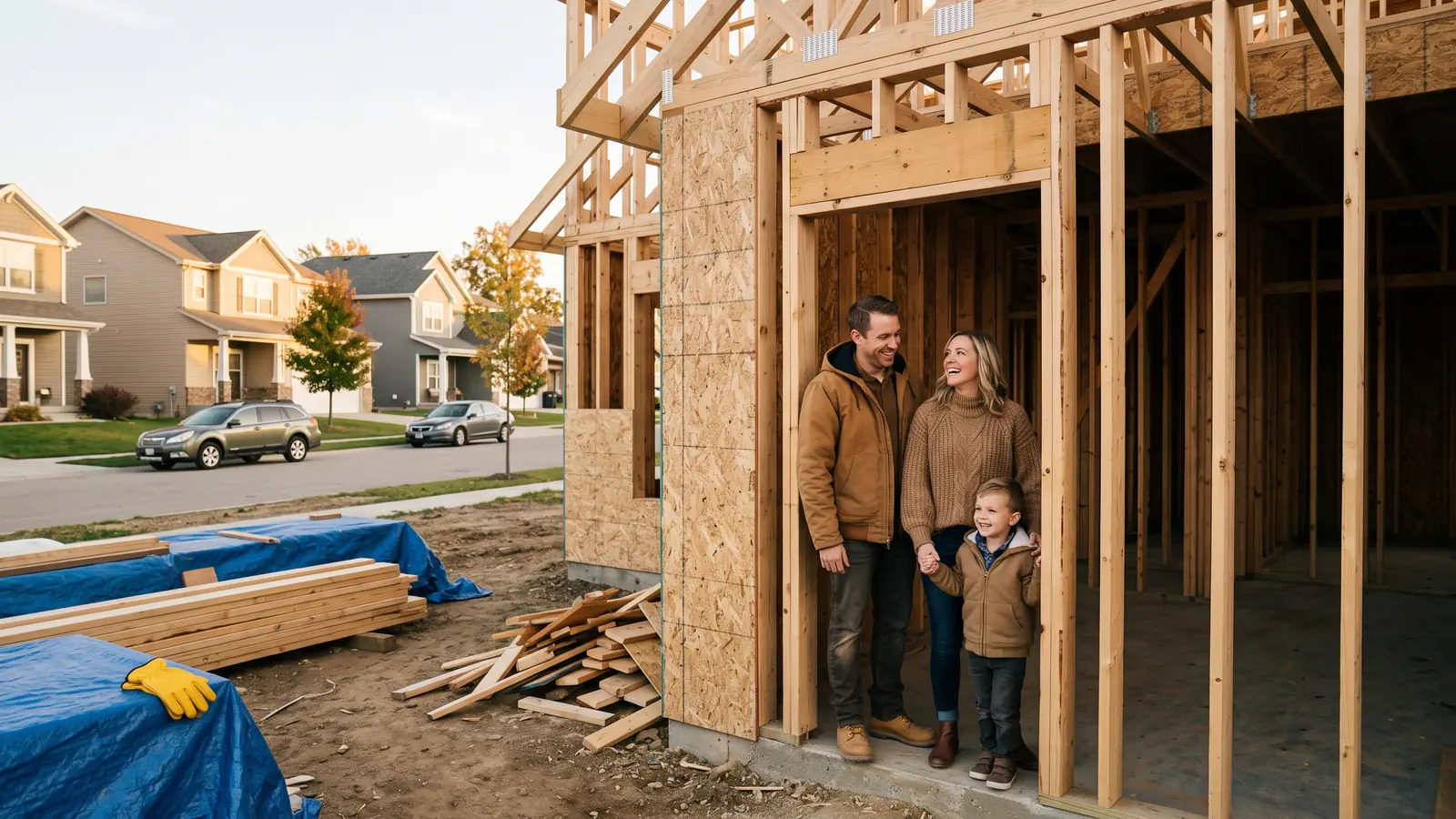
Buying a new construction home typically takes 6 – 12 months from contract to move-in, and the path is predictable: research builders and communities, sign a purchase agreement, secure financing, make design selections, track construction milestones, then complete a final walkthrough and closing. The build itself is usually faster than buyers expect, single-family homes finished in 2025 averaged 7.4 months from groundbreaking to completion, and homes builders put up for sale averaged just 6.1 months, according to the U.S. Census Bureau’s Survey of Construction.
Budget well past the base price. Landscaping, fencing, window treatments, some appliances, design-center upgrades, and HOA dues usually sit outside the advertised number. And builder pricing is more negotiable than a sales office lets on, just not in the way most buyers expect.
Learn what to expect with new home construction, including how long each phase takes, which contract clauses to read before you sign, and how to weigh a builder’s financing incentive against outside offers. If you’re earlier in the process, start with our Home Buying guide.
Key takeaways:
- Plan on 6 – 12 months from contract to keys: Census Bureau data puts the average single-family build at 7.4 months from start to completion, with permitting, design selections, and closing on either side of that window.
- Most new homes aren’t built from scratch for you: Of the 678,000 new single-family homes sold in 2025, about 58% were already finished on the day they sold and only about 10% sold before ground broke.
- Builders negotiate incentives before they cut price: With a 9.3-month supply of new homes on the market as of June 2026, closing-cost credits, free upgrades, and rate buydowns are the levers most builders actually pull.
What are the steps in the new home construction process?
New construction moves through five phases, and the full sequence usually takes 6 – 12 months from the day you sign. The two phases that most often cost buyers money, the contract and the design center, come early.
| Phase | Typical duration | What happens |
|---|---|---|
| 1. Research and builder selection | 2 – 8 weeks | Tour models, compare communities and floor plans, vet the builder’s finished work. |
| 2. Contract and financing | 1 – 3 weeks | Sign, deposit, and lock financing. Get preapproved before this step, not after. |
| 3. Design selections | 2 – 6 weeks | Choose finishes and approve upgrades. Most pricing decisions become permanent here. |
| 4. Permitting and construction | 6 – 12 months | Site work, foundation, framing, rough-ins, drywall, finishes, municipal inspections. |
| 5. Walkthrough and closing | 1 – 2 weeks | Final walkthrough, punch list, Closing Disclosure review, funding, keys. |
The clock varies more by who is building than by anything else. In 2025, homes built for sale by production builders averaged 6.1 months start to completion, contractor-built homes on an owner’s lot averaged 10.5 months, and owner-built homes averaged 12.8 months. A spec home from a national builder puts you on the fast end; a custom plan on your own land puts you on the slow end, and our construction loan guide covers how the money works when there’s no finished house to lend against yet.
A true ground-up build is also the exception. Of the 678,000 new single-family homes sold in 2025, roughly 396,000 were already completed at the time of sale and only about 67,000 sold before construction started, per U.S. Census Bureau new residential sales data. Most new construction buyers choose from inventory, not from a lot map.
Watch out: A builder’s schedule is a forecast, not a promise. Don’t give notice on a lease or schedule movers until the house is drywalled and the builder has confirmed a closing window in writing.
How do you choose a builder and a community?
Tour at least three of a builder’s finished communities before you write a deposit check. A model home is a marketing asset with every upgrade installed; the houses two streets over, occupied for three years, tell you what the builder actually delivers.
- Reputation: Read reviews, check state licensing and complaint records, and knock on doors in a community the builder finished two or three years ago. Ask what broke and how fast it got fixed.
- Transparency: A builder who gives you a written inclusions list, a milestone schedule, and a named contact before you sign usually behaves the same way during the build.
- Community type: Master-planned communities bundle amenities and charge HOA dues to maintain them. Get the current dues figure and the HOA’s reserve status in writing.
- Lot: Cul-de-sac, walkout, wooded, and water-view lots carry premiums that sit outside the base price. Corner and busy-street lots are cheapest for a reason.
Decide early whether a production build is even the right format. Semi-custom builders give you fixed plans with real finish choices, full custom buys control at the cost of time and money, and factory-built construction is its own path, weigh the benefits of modular homes before assuming site-built is the only option. More tactics live in our Buying Strategies & Situations hub.
Watch out: Unanswered warranty complaints in reviews and a refusal to name a completion window are both reasons to walk before you’re contractually committed.
What should you look for in a builder contract?
Builder contracts are written by the builder’s attorney and are negotiable in more places than buyers realize. Read these six clauses before you sign, and have a real estate attorney review the agreement, it looks nothing like the standard resale contract your agent uses.
| Clause | What to check | Why it matters |
|---|---|---|
| Price escalation | Whether the builder can raise the price for cost increases, and whether it’s capped | An uncapped clause makes your price a moving target you must still qualify for. |
| Completion timeline | Whether a date is guaranteed, what counts as an excused delay, your remedy | Most contracts excuse weather, supply, and labor delays. |
| Included features | A written, itemized list of what the base price covers | “Standard” varies enormously between builders; the list is your defense against surprises. |
| Allowances and change orders | Allowances for flooring, lighting, and appliances, plus the fee to change your mind | Thin allowances push you into upgrades, and change fees hit even small revisions. |
| Warranty | What’s covered, for how long, and who administers claims | Coverage commonly runs one year on workmanship, two on systems, ten on structural, but terms vary. |
| Deposit and dispute resolution | Whether your deposit is refundable and escrowed, and whether disputes go to arbitration | Non-refundable deposits and mandatory arbitration are common and limit your options. |
Then get clear on what the base price excludes. Commonly outside the number: full-yard landscaping and sod, fencing, window treatments, the refrigerator and washer/dryer, garage door openers, deck extensions, basement finishing, lot premiums, and nearly every design-center choice beyond builder-grade. Our guide to the cost of building a house works through whether the all-in number pencils out against resale.
For perspective on where the money goes, the National Association of Home Builders 2024 Construction Cost Survey, a builder-reported sample, not a count of every home built, broke a typical new home’s $665,298 sales price into $428,215 of construction cost, $91,057 for the finished lot, $72,971 of builder profit, and the rest in financing, overhead, and commission. Everything you add after closing sits on top of that stack.
Watch out: If a salesperson promises it, get it in the contract or an addendum. Verbal commitments about upgrades, lot grading, or completion timing are unenforceable, and the person who made the promise may not work there in nine months.
How much should you budget for design selections and upgrades?
Set your upgrade ceiling in writing before the design-center appointment and treat it as hard. The design center is a sales environment where every choice is presented as a small incremental cost, and buyers routinely leave having approved five figures they hadn’t planned to spend.
Do the math once, slowly. If your base price is $400,000 and you approve $40,000 in upgrades, you’re financing a $440,000 home, a 10% increase you carry for the life of the loan, plus a larger down payment and larger closing costs.1 An appraiser also may not credit those upgrades dollar-for-dollar, which matters if the appraisal has to support the contract price.
- Splurge on what’s hard to change later: Structural options, window placement, rough-in plumbing, extra electrical, and insulation are expensive or impossible to retrofit.
- Save on what’s easy to change: Light fixtures, faucets, mirrors, backsplash tile, and window treatments cost less after closing than the design center charges.
- Keep resale in view: Neutral, durable finishes hold value; highly personal choices rarely return what they cost.
- Reserve a contingency: Plan for post-closing costs the builder never quoted, blinds, a fence, back-yard landscaping, and excluded appliances.
Our guide to building a home on a budget goes deeper on which upgrades are worth negotiating rather than buying.
What happens during the construction phase?
Construction runs in a fixed order. Permits and site work, foundation, framing, rough-in of plumbing, electrical, and HVAC, insulation and drywall, then finishes, and each stage triggers a municipal inspection before the next can start. Ask for a milestone schedule and a single point of contact; a check-in every two to three weeks is generally enough.
Delays are normal and mostly outside your builder’s control: weather, permit backlogs, material lead times, and subcontractor availability. Raise problems the moment you see them. A framing question is cheap to answer before drywall and expensive after.
Independent inspections on new construction
Hire your own inspector even though the city already inspects the house. Municipal inspections verify code compliance, not workmanship, and independent inspectors regularly find real defects in brand-new homes, missing insulation, improperly flashed roofs and windows, unsupported ductwork, and grading that pitches toward the foundation.
- Pre-drywall inspection: After rough-ins, before insulation closes the walls. The only time framing, wiring, plumbing, and duct runs are visible.
- Pre-closing inspection: Before your final walkthrough, so defects land on the punch list while the builder still holds your money.
- Eleven-month warranty inspection: Just before a one-year workmanship warranty expires, when settling cracks and HVAC balance problems have had time to appear.
Each costs a few hundred dollars, small insurance against a defect the builder’s own quality check missed. Our guide to home inspections for new construction covers what a good inspector looks for at each stage.
How do you finance a new construction home?
Buying a completed or in-progress home from a builder takes an ordinary purchase mortgage, the builder carries the construction financing and you close once, at completion. Building from scratch on your own lot takes financing that funds in draws and then converts, and our guide to construction-to-permanent loans explains how the single-close version works.
The bigger decision for most buyers is the builder’s preferred lender. Builders frequently attach real money to using their affiliated lender, closing-cost credits, free upgrades, or a rate buydown, and those incentives are legal and often genuinely valuable. Two things to know:
- You can’t be required to use them: Under RESPA, a builder generally can’t condition the sale on your use of a particular settlement service provider, and any affiliated business arrangement must be disclosed in writing at or before the referral.
- The incentive isn’t automatically the better deal: A $10,000 closing-cost credit can be worth less than a lower rate and lower fees over the years you keep the loan. The only way to know is to compare Loan Estimates.
That’s what the disclosure system is built for. A lender must give you a Loan Estimate within three business days of receiving your application, and the form is standardized so competing offers line up side by side, see the CFPB on comparing Loan Estimates from multiple lenders. Get the builder lender’s estimate, get at least one outside estimate for the same loan type and terms, then compare rate, lender fees, and total cash to close together. Hand the better outside offer back and ask the builder’s lender to match it. Incentives are frequently negotiable when the builder wants the sale, which is worth knowing when you’re navigating a buyer’s market.
One timing item: a long build can outrun a standard rate lock. Lenders in Align’s network offer extended lock programs that hold a rate for several months to roughly a year, usually for an upfront fee or a pricing adjustment, and some include a one-time float-down.2 Ask about lock length before you sign, not at month seven.
What happens at the final walkthrough and closing?
Budget two to three hours for the final walkthrough and bring a written list, a phone for photos, and a charger to test outlets. This is your leverage point: once you close, unresolved items move from “fix before funding” to “file a ticket.”
- Build the punch list: Document every defect, misaligned door, paint gap, and non-working fixture, and get it signed by the builder’s representative with correction dates.
- Test everything that runs: Outlets, switches, faucets, drains, appliances, windows, exterior doors, the garage opener, and HVAC in both heating and cooling modes.
- Confirm the paperwork: Certificate of occupancy, final survey, warranty documents, and a written subcontractor list for claims.
- Review the Closing Disclosure early: Compare it line by line against your most recent Loan Estimate and raise discrepancies before closing day.
Then start the warranty clock deliberately: note the date your one-year workmanship coverage expires, calendar the eleven-month inspection now, and submit every claim in writing.
How Align fits your buying strategy
Local real estate agents bring Samantha in for a second opinion when their buyer arrives preapproved somewhere else. She regularly finds a lower rate or less cash to close, whichever helps the buyer more.
That comes from the broker model. One application goes to multiple wholesale lenders, so your offer is built on the loan that fits your situation, not the only one a single bank sells. A 2024 Polygon Research analysis of federal mortgage data found broker borrowers paid about $10,662 less over the life of a $400,000 loan than borrowers at nonbank retail lenders.
FAQ: Buying a new construction home
Here are answers to common questions about new home construction.
Can you negotiate the price of a new construction home?
Yes. Builders often resist cutting the base price because it lowers the comps for every remaining home in the community, but they routinely negotiate closing-cost credits, free design upgrades, premium lots, or a rate buydown, especially on completed inventory homes or at the end of a quarter. An agent who specializes in new construction knows which levers each builder actually pulls, and knowing how to read a buyer’s market as a home buyer tells you how much room you have.
How long does it take to build a new construction home?
Most production homes take 6 – 12 months from contract to completion, and Census Bureau data puts the 2025 average build at 7.4 months from start to finish. Semi-custom and custom builds run longer, and permitting, weather, supply-chain issues, and labor shortages can all extend the timeline. Ask for a milestone schedule and whether the contract offers any remedy for extended delays, and if you’re building on your own lot, look at construction-to-permanent loans built for a longer runway.
Do you need a home inspection on new construction?
Yes. New does not mean flawless. Municipal inspections check code compliance, not workmanship, and independent inspectors regularly find problems in new builds, from missing insulation to improperly flashed roofs. Many buyers schedule three: pre-drywall, pre-closing, and one just before the one-year builder warranty expires. Our guide to home inspections for new construction covers what each one should catch.
What is usually not included in a new construction base price?
Commonly excluded: full-yard landscaping and sod, fencing, window treatments, some appliances (often the refrigerator and washer/dryer), garage door openers, deck or patio extensions, basement finishing, and nearly every design-center upgrade beyond builder-grade finishes. Lot premiums and HOA dues add more. Get a written inclusions list before you sign, and read the cost of building a house to see how those extras change the comparison against resale.
The bottom line on buying new construction
New home construction typically runs 6 – 12 months from contract to move-in, with Census Bureau data putting the average single-family build at 7.4 months from start to completion. The two phases that decide how the deal turns out come early: the contract, where price escalation, completion timing, included features, and warranty terms are still negotiable, and the design center, where upgrades get financed for thirty years. Budget past the base price, hire your own inspector at pre-drywall and again before closing, and treat the builder’s financing incentive as one offer to compare rather than the answer.
If you’re ready to buy or build new construction, talk to Align Lending. We’ll shop your scenario across our wholesale lender network and put the builder’s incentive next to competing offers so you can see which one actually wins. Call 248-506-5727 or start online today.
Footnotes:
1. Example figures are hypothetical and for educational purposes only; they do not constitute an advertisement of credit terms or a rate quote under federal or state lending laws. Your loan amount, upgrade pricing, appraised value, down payment, and cash to close depend on your application, your builder’s pricing, the property, and market conditions. Return to text.
2. Align Lending is a broker and does not set lender program terms. Extended rate lock availability, lock periods, fees, pricing adjustments, and float-down features are set by individual wholesale lenders, vary by lender and loan program, and are subject to change without notice. Nothing here is a rate quote or an offer of credit. Return to text.
Sources: average length of time from start to completion for single-family homes (7.4 months in 2025; 6.1 months built for sale, 10.5 months contractor-built, 12.8 months owner-built), U.S. Census Bureau, Survey of Construction, Average Length of Time from Start to Completion. New single-family homes sold in 2025 by stage of construction (678,000 total; 396,000 completed, 215,000 under construction, 67,000 not started) and months’ supply of new homes (9.3 months, June 2026), U.S. Census Bureau and U.S. Department of Housing and Urban Development, New Residential Sales. Single-family price and cost breakdown ($665,298 average sales price; $428,215 construction cost; $91,057 finished lot; $72,971 builder profit), National Association of Home Builders, Cost of Constructing a Home, 2024. Loan Estimate delivery within three business days of application and guidance on comparing Loan Estimates, Consumer Financial Protection Bureau. Prohibition on required use of a particular settlement service provider and affiliated business arrangement disclosure timing, Real Estate Settlement Procedures Act and Regulation X, 12 CFR 1024.15 and 1024.16.
This article is for informational purposes only and is not intended to provide legal, financial, or tax advice. Builder purchase agreements, warranty terms, arbitration clauses, and deposit provisions should be reviewed by a licensed real estate professional or attorney in your state before you sign. Consult a qualified professional about your situation. Program terms and figures shown are illustrative, are not a rate quote or an offer of credit, and are subject to change. Align Lending is an independent Michigan mortgage broker, NMLS #2041154.
Related resources

11-minute read
How to create a competitive offer on a house in a seller’s market
Learn how to create a competitive offer on a house, from preapproval and pricing to contingencies and appraisal gap coverage, and win in a hot market.

12-minute read
Advantages of buying a fixer-upper: 7 key benefits (and the tradeoffs)
Discover the advantages of buying a fixer-upper, from lower prices and less competition to renovation loans that roll repair costs into your mortgage.

12-minute read
Guide to Negotiating a Home Purchase
Learn proven strategies for negotiating a home purchase, from using inspection findings and seller concessions to crafting offers that win without overpaying.
