
Buying a cul-de-sac house: The pros and cons to weigh before you offer
A cul-de-sac house sits on a dead-end street that ends in a rounded turnaround, so the block has exactly 1 way in and 1 way out and carries zero through traffic. Everything buyers love and everything they complain about traces back to that one design decision: a quieter block with no through traffic on one side; a price premium, tight parking, less privacy and slower snow plowing on the other.
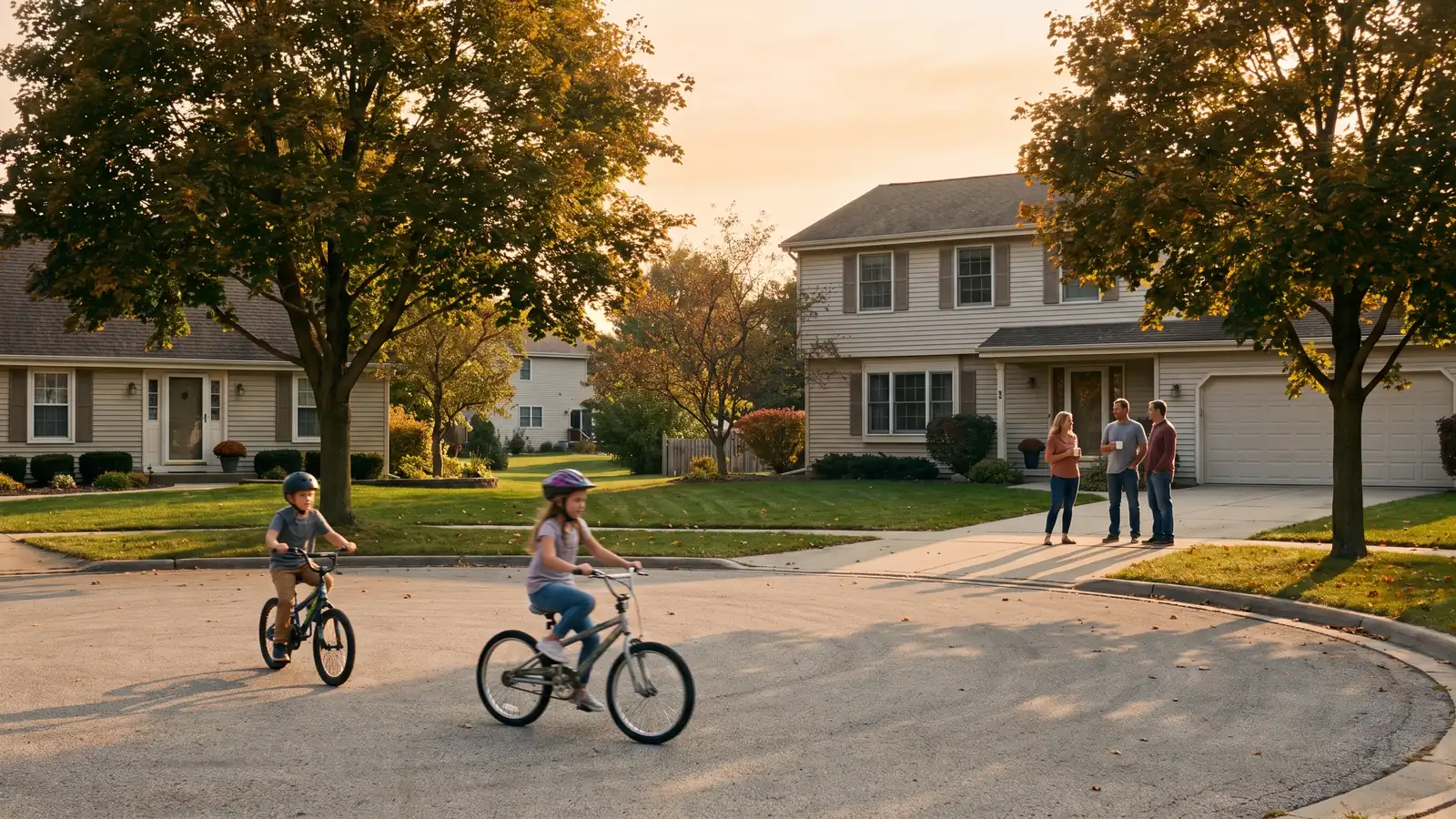
The premium is real, but it’s local. The only figure that should move your offer is the gap between recent cul-de-sac sales and comparable through-street sales in the same subdivision.
Learn the pros and cons of buying a cul-de-sac house, including how the lot geometry reshapes your yard and your parking, what the price premium does to your appraisal, and the questions to ask before you write an offer. If you’re still narrowing down what kind of home you want, start with our Home Types & Living guide.
Key takeaways:
- One way in, one way out: A cul-de-sac dead-ends at a turnaround, so the only vehicles on it are residents, their guests and service trucks. Zero through traffic, which is the entire basis of the quiet-and-safety case.
- Five trade-offs to price in: A purchase-price premium, limited street parking, reduced privacy from the neighbors facing you, snow removal that arrives after the through streets, and awkward access for moving vans and RVs.
- Pull 2 sets of comps before you offer: Compare recent cul-de-sac sales against comparable through-street sales in the same subdivision. That gap is the only reliable read on what the location is worth where you’re buying, and it’s what your appraiser works from too.
What is a cul-de-sac house?
A cul-de-sac house is a home on a residential street that dead-ends in a circular or teardrop-shaped turnaround, with the houses arranged around the bulb instead of strung along a corridor. The name is French for “bottom of the bag,” which describes the traffic pattern well: cars enter, they stop, they come back out the way they came.
Two structural facts follow from the shape, and they drive most of this article.
- Traffic is residential only: Nobody drives on a street that connects to nothing unless they live there, are visiting someone who does, or are delivering something. Commuter shortcuts, what makes an ordinary through street loud, are geometrically impossible.
- Lots are usually pie-shaped: Homes on the bulb sit on wedges that are narrow at the street and widen toward the rear, producing a larger, more private backyard than a rectangular lot of the same size, plus less street frontage. Which is why parking gets tight.
The turnaround exists so fire trucks, garbage trucks and school buses can reverse direction, and each municipality’s street standards set the minimum radius. One quirk to notice on a tour: because the houses ring a circle, two neighbors can face opposite directions, and orientation drives sun exposure, heating and cooling load and whether rooftop solar is worth pricing, the DOE Energy Saver guidance on home orientation is a useful primer. Cul-de-sacs span every architectural era, from postwar ranches to the Craftsman revival homes in newer subdivisions, so the street tells you nothing about the house.
How do cul-de-sac lots compare with typical new-home lots?
The Census Bureau does not count cul-de-sac lots separately, but according to the Census Bureau’s lot size table for new single-family houses built for sale (file updated May 2026), the median lot for homes completed in 2025 was 8,427 square feet nationally and 8,775 square feet in the Midwest, the Census region that includes Michigan.
| Lot size, new single-family homes built for sale, completed 2025 | United States | Midwest |
|---|---|---|
| Under 7,000 sq ft | 41% | 20% |
| 7,000 to 8,999 sq ft | 25% | 38% |
| 9,000 to 10,999 sq ft | 7% | 13% |
| 11,000 to 21,999 sq ft | 18% | 22% |
| 22,000 sq ft and over | 9% | 8% |
| Median lot | 8,427 sq ft | 8,775 sq ft |
Source: U.S. Census Bureau, Survey of Construction, Lot Size of New Single-Family Houses Completed: Built for Sale, 2025 annual figures, file updated May 2026. Excludes condominiums; components may not add to 100% because of rounding.
Lots have been getting smaller. The same Census table puts the Midwest median for built-for-sale homes at 9,960 square feet in 2009 and 11,380 square feet in 2014, against 8,775 square feet in 2025. Measure a wedge lot rather than assume it: the recorded plat shows each lot’s lines and dimensions, as our guide to reading a plat map explains, and a new-construction lot deserves the checks in our guide to home inspections for new construction.
What are the pros of buying a cul-de-sac house?
The advantages are real, but only one is structural, the traffic. The rest are consequences of it, so they hold up better on some streets than others.
Less traffic and a safer street
Zero through traffic is the headline benefit, and you can verify it by parking on the street for 20 minutes at rush hour. Fewer vehicles means less road noise, and the ones that are there move slowly because they’re arriving home or turning around. That’s what makes a cul-de-sac the classic street for kids on bikes.
The security case is a design argument. Planners call it natural surveillance: when homes face a shared circle, residents see the whole street from their front windows, and an unfamiliar car has no innocent reason to be there. Treat that as a plausible deterrent, not a guarantee, plenty besides street shape drives neighborhood crime, so evaluate the area on its own terms using our guide to how to evaluate a property’s location.
A stronger sense of neighborhood
Cul-de-sacs concentrate a handful of households around one shared space they all have to look at, which produces more interaction than a long block does: kids find each other, driveways become gathering spots, neighbors notice a package left out overnight. Turnover is usually lower too, so you’re buying into a more stable set of neighbors.
Lot size, privacy in back and resale demand
The pie-shaped lot is the underrated advantage: a wider rear yard means more usable outdoor space, more distance from the neighbors behind you and more room for a deck or a play set than a rectangular lot of the same square footage.
That combination, quiet street, big backyard, low traffic, is why cul-de-sac lots hold demand at resale. Builders price it in from day one, commonly selling a cul-de-sac lot at a premium over the base house price alongside walkout and wooded lots. The size of that premium varies by builder, subdivision and market, and no national percentage is worth quoting.1 The supply logic is simple: a subdivision has a fixed number of cul-de-sac lots and can never make more. That scarcity behaves differently in dense city neighborhoods than in outer-ring subdivisions, as our comparison of urban vs. suburban housing markets explains.
What does research on street layouts say about cul-de-sacs?
In Reconsidering the Cul-de-Sac, a 2003 Access Magazine article, Michael Southworth and Eran Ben-Joseph reported on a comparison of nine California neighborhoods with grid, loop and cul-de-sac layouts that were matched demographically. According to that report, cul-de-sac streets, and especially the lots at the end, “perform better than grid or loop patterns” on the measures studied: traffic safety, privacy, and safety for play.
The same Access Magazine article describes the Five Oaks district of Dayton, Ohio, where many local streets were converted to cul-de-sacs. Within a short time, it reported, traffic declined 67% and traffic accidents fell 40%, and home sales and values increased. That is one district, not a rule, and our guide on how to assess a home’s resale potential covers the other factors a future buyer will weigh.
The exposure a dead-end street does not remove is the driveway. According to the rear visibility rule NHTSA published in the Federal Register on April 7, 2014, backover crashes cause 267 deaths and 15,000 injuries a year, 210 of those deaths involve vehicles of 10,000 pounds or less, and children under 5 account for 31% of the deaths. The rule required rear visibility systems on new light vehicles, with full compliance on May 1, 2018. Where several driveways share one bulb, sit in the driver’s seat at the end of the driveway during a showing and check what you can see behind the car.
What are the cons of a cul-de-sac home?
Five drawbacks come up consistently, and the first one shows up in your loan amount.
- A purchase-price premium: You’re usually paying more than a comparable home on a through street in the same subdivision. A higher price means a larger down payment in dollars, a larger loan and a higher monthly payment for the same house.
- Limited street parking: Short frontages and a circle that can’t be blocked leave very little legal curb space. A dinner party or a contractor with a trailer becomes a logistics problem, and many subdivisions restrict parking in the turnaround outright.
- Reduced privacy in front: The geometry that creates natural surveillance also means your front windows, your driveway and everyone who visits are visible to the whole circle. Your backyard gains privacy; your front yard loses it.
- Snow removal comes later: Plow routes generally clear main and through streets before residential dead ends, and a bulb takes more passes than a straight run. Ask for the plow-priority map, or the snow contract in an association-maintained subdivision.
- Large vehicles struggle: Moving vans, delivery trucks, RVs and boat trailers all need room to turn, and on a tight older turnaround a semi-trailer delivery may not be possible, a real constraint if you’re considering a factory-built home, since prefab and modular houses arrive on tractor-trailers and are set by crane.
There’s a social version of the same trade: the close-knit dynamic families love can feel like an obligation if you’d rather keep to yourself. If an association governs the subdivision, read the rules on parking, trailers and exterior changes closely, the pros and cons of buying a home with an HOA apply with extra force on a street this small. Snow, upkeep and dues all land in the same monthly budget, which our Homeownership guide walks through.
How do sun exposure and drainage play out on a wedge-shaped lot?
The U.S. Department of Energy’s Energy Saver fact sheet on passive solar design (August 2021) says windows should face within 30 degrees of true south and, during winter months, should not be shaded from 9 a.m. to 3 p.m.. A phone compass at the back door shows which way the rear glass faces; if panels are on the roof or in your plans, see our guide to buying a home with solar panels.
For drainage, FEMA’s flood map guidance for homeowners lets you enter a street address to see which flood zone it is in, and it notes that high-risk zones are the areas beginning with the letters A or V on its maps. If the address falls in one, our guide to buying a home in a flood zone covers insurance and cost.
Cul-de-sac vs. through street: a side-by-side comparison
Six factors separate the two, and most buyers only think about the first before they tour.
| Factor | Cul-de-sac home | Comparable through-street home |
|---|---|---|
| Traffic and noise | Residents, guests and service vehicles only; no cut-through route | Carries pass-through traffic, at higher speeds |
| Purchase price | Typically a premium, often a builder lot premium over base price | The baseline the premium is measured against |
| Parking | Short frontage, little curb space, turnaround must stay clear | Longer frontage, more continuous street parking |
| Privacy | Bigger, more private backyard; front exposed to the whole circle | More front-yard anonymity; narrower rear yard |
| Resale demand | Limited supply, strong family-buyer appeal; premium varies by market | Wider buyer pool, no location premium to defend at appraisal |
| Snow and large vehicles | Plowed after through streets; radius can limit trucks and trailers | Earlier on plow routes; straight-run access at any size |
Read the table as preferences, not a score. Nothing in the right column is a defect, and nothing in the left column is worth paying for if it doesn’t match how you live, the same lens that runs through our guide to the different types of houses by structure and style.
Who should buy on a cul-de-sac?
Fit decides this more than any feature does, the same as with any other home type and living situation. The pattern sorts cleanly into two lists.
A cul-de-sac tends to fit if:
- You have young children: The traffic argument is the whole reason cul-de-sacs command a premium, and it matters most during the years kids play outside.
- You want neighbors, not just houses nearby: The shared circle produces the interaction, and that’s value the premium doesn’t capture.
- You’re planning to stay a long time: A location premium is easiest to recover over a longer hold, and lower turnover means the street you buy into is the street you keep.
- You value backyard space over street frontage: The pie lot is a straight trade, and the back half is where most people spend time.
A through street may fit better if:
- Privacy is your priority: Facing a circle means being seen, and no landscaping fully solves it.
- You park more than 2 vehicles or own a trailer, RV or boat: Curb space and turning room are what a cul-de-sac has least of.
- You’d rather not be socially involved on your street: Opting out is harder when there are only a handful of front doors.
- You’re buying short-term or as a rental: A premium you may not recoup works against you, and tenants rarely pay extra for a quiet circle.
How does an appraiser handle a cul-de-sac location?
Fannie Mae’s Selling Guide, in the edition published October 7, 2026, names the cul-de-sac directly. Its neighborhood section guidance, B4-1.3-03, lists “street patterns or design (such as one-way street, cul-de-sac, or court)” among the neighborhood characteristics an appraiser can describe. Its comparable sales rules, B4-1.3-08, require a minimum of three closed comparables, say sales that closed within the last 12 months should be used, and note that comparable sales from the same location should reflect the same positive and negative location characteristics as the home being appraised.
For a home in a new subdivision, B4-1.3-08 adds that it must be compared to other properties in the same market area and to properties within the subdivision itself. If every recent sale there sat on a through street, the appraiser has less direct evidence for a cul-de-sac premium. See the home appraisal process for the rest of the report.
When the value comes in under the contract price, the CFPB’s answer on an appraisal that is less than the sale price (last reviewed September 11, 2024) says it is very risky to buy for more than the appraised value, that the lender is required to send you a copy of the appraisal, and that you can often use the lower value to negotiate a reduction in the price. Hypothetical example, not an offer: a buyer agrees to $412,000 for a cul-de-sac home and the appraisal comes back at $400,000. If the seller will not move, the $12,000 difference is cash the buyer brings to closing on top of everything else, which is why the appraisal contingency in our guide to contingencies in home offers matters on a premium lot. If a relevant cul-de-sac sale was missed, see how to appeal a low appraisal.
Questions to ask before you offer
Six questions turn a gut feeling about a street into something you can price. Work through them inside your due diligence window, not after.
- What do the two sets of comps say? Have your agent pull recent sales of cul-de-sac homes and comparable through-street homes in the same subdivision. The difference is the premium in your market, and a list price well above that gap is a negotiating argument.
- Can the appraisal support the premium? Location premiums have to be evidenced by comparable sales, and lenders in Align’s network base the loan amount on the appraised value rather than the contract price.2 Any gap gets covered in cash, so know that before you waive an appraisal contingency.
- Where does the lot line run? Pie-shaped lots are easy to misjudge from the driveway. Get the survey, confirm the rear boundary and check which way the lot drains. Wedge lots often slope toward the wide back edge, which belongs on your home inspection checklist.
- What are the parking rules? Ask whether overnight street parking, trailers and RVs are permitted and whether the bulb must stay clear. Get it in writing before you assume a third vehicle is fine.
- Who plows it, and when? Confirm whether the street is municipal or association-maintained and where it sits on the priority list. It’s a winter question nobody asks in June.
- What’s planned nearby? A cul-de-sac’s value comes from being the end of the road, so check the planning and zoning agenda for road extensions. A future connection removes the exact feature you paid extra for.
Weight the last one heavily. A cul-de-sac’s value is its quiet, and a future road extension is the one thing that can take that away after you’ve paid for it. The CFPB’s home buying tools and resources cover the rest of the due diligence sequence, and our 15 first-time home buyer tips cover what to do with the answers.
What should you check on a cul-de-sac in Michigan?
Is the circle a county road, a city street or a private road?
Under MCL 247.669, a county road commission takes over as county roads the streets outside incorporated cities and villages that are dedicated to the public in recorded plats it approved, within 30 days after the plat is recorded. The Road Commission for Oakland County notes on its subdivision paving page that subdivisions in cities and villages are under the jurisdiction of those municipalities. Some developments keep their streets private, and Fannie Mae’s Selling Guide (B4-1.3-04, published October 7, 2026) then requires an adequate, legally enforceable maintenance agreement or covenant recorded in the land records, covering each party’s share of repairs, remedies if someone does not pay, and a term that in most cases should be perpetual, unless state law already defines owners’ maintenance duties. USDA’s 7 CFR 3555.201 also requires legally enforceable street maintenance arrangements.
In Oakland County, the Register of Deeds plat review office checks and processes all subdivision plats, preliminary and final, before they are recorded. Your title commitment should show the dedication and any road easements, which our guide on why title insurance matters explains. If an association owns the street, read its budget with our guide to navigating HOA regulations.
Where does a subdivision cul-de-sac fall on the plow list?
The Road Commission for Oakland County (RCOC) ranks winter work in six tiers, and subdivision streets come last.
| RCOC priority | Roads included |
|---|---|
| Critical | More than 10,000 vehicles per day per lane, or 40,000 vehicles per day total |
| Priority I | Between 2,500 and 10,000 vehicles per day per lane |
| Priority II | Other paved county primary roads on RCOC’s salt route maps |
| Priority III | Other paved roads that give access to hospitals, schools or other significant traffic generators |
| Priority IV | Mile-type local roads and primary gravel roads |
| Priority V | All other roads, including subdivision streets |
Source: Road Commission for Oakland County, Plowing Subdivisions in Oakland County, updated October 2026.
According to the same brochure, RCOC does not plow subdivision streets unless at least four inches of snow have fallen; after a major storm of six or more inches in less than 24 hours, township subdivision streets may not be plowed for several days, and several heavy snowfalls in a row can stretch that to four or more days. RCOC reports about 109 salt trucks and plows for more than 2,700 miles of roads, plus heavy-duty pickup plows added for the tight turns and cul-de-sacs in many subdivisions. Its snow plowing page puts more than 1,300 miles of subdivision streets after more than 1,400 miles of major county roads and 230 miles of state highways. In Wayne County, CBS Detroit reported on February 13, 2025, township subdivisions come last and only after six inches or more of snow.
The National Weather Service’s 1991 to 2020 climate normals for Southeast Michigan list Detroit’s average snowfall at 8.9 inches in December, 14.0 in January, 12.5 in February and 6.2 in March, with Flint at 15.1 inches in January. RCOC’s brochure says its trucks cannot plow the ends of driveways, so that berm is yours; see winterizing your home.
How does the sale price feed into your Michigan property tax?
In Michigan, a home’s taxable value is capped while one owner holds it. The year after it sells, that cap comes off and taxable value resets to the state equalized value, which is half of the assessor’s estimate of market value, not automatically half of what you paid. The Michigan Department of Treasury’s page on changes in ownership and uncapping says a transfer of ownership causes taxable value to uncap in the calendar year following the transfer, so the seller’s current bill does not carry over to you. The tax that follows comes from the assessor’s estimate and the county’s equalization, which our guide to how property tax assessments work explains. To see the published millage for a specific address, use the Michigan property tax calculator.
How Align matches the loan to the property
Lenders do not treat every property the same. Condos, including non-warrantable ones, and homes with two to four units each come with rules that vary from one lender to the next.
Because Align is a broker, Samantha can take your file to the wholesale lender whose guidelines fit the property, instead of forcing it into one bank's box. One application, multiple lenders, and one person on your file from start to finish.
FAQ: Buying a cul-de-sac house
Here are answers to common questions about buying a cul-de-sac house.
Is a cul-de-sac house worth more money?
Often, yes. Cul-de-sac lots are limited in supply and popular with families, so they frequently command a price premium over similar homes on through streets, and many hold value well at resale for the same reason. The premium varies by market and neighborhood, so compare recent sales of cul-de-sac and non-cul-de-sac homes in the same subdivision before you offer. That gap is also what your negotiation should be built on, as our guide to creating a competitive offer explains.
What are the disadvantages of living on a cul-de-sac?
The most common complaints are limited street parking, less privacy because neighboring homes face the circle, slower snow plowing since plows service through streets first, and tight turnarounds for delivery trucks, moving vans and RVs. Some buyers also find the close-knit social dynamic a drawback if they prefer to keep to themselves. Where an association governs the street, several of those become written rules, see the pros and cons of buying a home with an HOA.
Are cul-de-sacs safer for kids?
Generally, yes. Because a cul-de-sac dead-ends, only residents and their guests drive on it, which cuts traffic volume and speed significantly. Neighbors also provide natural surveillance since homes face the circle. That said, kids playing in the turnaround can be hard to see when drivers back out, so driveway visibility still matters, visit at different times of day before you decide, one of the habits in our first-time home buyer tips.
Do cul-de-sac homes have bigger lots?
Frequently. Pie-shaped cul-de-sac lots are narrow at the street and widen toward the back, which often produces larger, more private backyards than rectangular lots on through streets. The trade-off is a smaller front yard and less driveway frontage, which contributes to the parking constraints cul-de-sac residents commonly mention. Confirm the boundaries and the drainage with a survey and a thorough home inspection before closing.
How big is a typical cul-de-sac?
Usually short. In their 2003 Access Magazine article Reconsidering the Cul-de-Sac, Michael Southworth and Eran Ben-Joseph describe the typical suburban cul-de-sac as usually less than 1,000 feet long and serving up to 20 dwellings, with a circular end that has a typical radius of 35 to 40 feet so service and emergency vehicles can turn around. Counting the driveways on the circle tells you how many households share it.
What is the difference between a cul-de-sac and a loop street?
Both discourage through traffic because neither goes anywhere except to the homes along it. The difference is access: according to Southworth and Ben-Joseph’s 2003 article, a loop street has two access points, so it is usually longer than a cul-de-sac, which has one. They note that loops and cul-de-sacs are often found in the same development, so a subdivision may offer both.
Can you park on a cul-de-sac in Michigan?
Yes, where curb space is legal, but a bulb leaves little of it. Michigan’s MCL 257.674 bars parking in front of a public or private driveway and within 15 feet of a fire hydrant, among other places. RCOC’s subdivision plowing brochure also asks residents to remove vehicles from streets during and after snowfalls. Local ordinances and association rules can add limits.
Who pays to rebuild a subdivision street in a Michigan township?
Often the homeowners. Bloomfield Township says state road funds under PA 51 cannot pay to replace or reconstruct subdivision roads, so a Special Assessment District is necessary, which puts that cost on the homeowners. It says those costs may range from $11,000 to $35,000 per lot and puts the typical life span of a road at 20 years. RCOC handles township subdivision paving assessments under Public Act 246 of 1931, per its special assessment page.
Why do developers build so many cul-de-sacs?
According to Southworth and Ben-Joseph’s Access Magazine article, the pattern is popular with developers because it sells well and because infrastructure costs are significantly lower than for a traditional interconnected grid, which requires up to 50% more road construction. The same article notes the pattern has been strongly encouraged by traffic engineering and subdivision standards.
The bottom line on buying a cul-de-sac house
A cul-de-sac house sits on a dead-end street with 1 way in and 1 way out and zero through traffic, and that single fact produces both sides of the ledger. You get a quieter block, slower cars, a bigger and more private backyard, and a location that stays in demand with family buyers. You pay for it with a price premium, limited street parking, an exposed front yard, snow removal that arrives after the through streets, and a turnaround not every large vehicle can use. Pull the two sets of comps before you offer, confirm the appraisal supports the premium, and check what the municipality has planned for the road.
If you’re ready to buy on a cul-de-sac, talk to Align Lending. We’ll shop your scenario across our lender network, show you what the location premium does to your monthly payment, and put the options side by side. Call 248-506-5727 or start online. For everything that comes after the keys, our Homeownership guide picks up where this one leaves off.
Footnotes:
1. The cul-de-sac price premium described here is a general market observation drawn from common listing and new-construction lot-pricing practice, not a measured statistic. No percentage or dollar figure is given because none applies broadly. The premium depends on the subdivision, the builder’s lot-premium schedule, local demand and the specific lot. Ask your agent for a side-by-side comparable sales analysis of cul-de-sac and through-street homes in the neighborhood you’re considering, and treat that local figure as the only one relevant to your offer. Return to text.
2. Align Lending is an independent mortgage broker and does not set loan terms. Loan amounts, appraisal requirements, down payment minimums, credit standards and program eligibility are set by the individual wholesale lenders in Align’s network and are subject to change, credit approval and property eligibility. Nothing here is an offer of credit or a commitment to lend. Return to text.
Sources: home orientation and its effect on heating, cooling and solar suitability, U.S. Department of Energy, Energy Saver. Home buying due diligence sequence and buyer resources, Consumer Financial Protection Bureau, Owning a Home. Cul-de-sac traffic patterns, lot geometry, parking, privacy, snow-plow priority and large-vehicle access limits describe how these streets are designed and commonly maintained; they are not measured statistics. Turnaround dimensions are set by each municipality’s street design and fire access standards, confirm the applicable standard locally.
This article is for informational purposes only and is not intended to provide legal, financial, tax or appraisal advice. Property values, lot premiums, parking and snow-removal rules, covenants and municipal street standards vary by market and change over time, verify current details with your agent, your municipality and the association before you write an offer. Figures shown are illustrative, are not a rate quote or an offer of credit, and are subject to change. Align Lending is an independent Michigan mortgage broker, NMLS #2041154.
Sources
Every outside source this guide links to, in the order it appears. How we choose and check sources
- The DOE Energy Saver guidance on home orientationU.S. Department of Energy
- Lot size table for new single-family houses built for saleU.S. Census Bureau
- Reconsidering the Cul-de-Sacweb.mit.edu
- Federal Register on April 7, 2014govinfo.gov
- Plow routes generally clear main and through streets before residential dead endsrcocweb.org
- Flood map guidance for homeownersFederal Emergency Management Agency
- Neighborhood section guidance, B4-1.3-03Fannie Mae Selling Guide
- Comparable sales rules, B4-1.3-08Fannie Mae Selling Guide
- An appraisal that is less than the sale priceConsumer Financial Protection Bureau
- CFPB’s home buying tools and resourcesConsumer Financial Protection Bureau
- MCL 247.669Michigan Legislature
- Subdivision paving pagercocweb.org
- B4-1.3-04Fannie Mae Selling Guide
- 7 CFR 3555.201Electronic Code of Federal Regulations
- Register of Deeds plat review officeoaklandcountymi.gov
- Plowing Subdivisions in Oakland Countyrcocweb.org
- CBS Detroit reportedcbsnews.com
- 1991 to 2020 climate normals for Southeast Michiganweather.gov
- Page on changes in ownership and uncappingState of Michigan
- MCL 257.674Michigan Legislature
- Bloomfield Townshipbloomfieldtwpmi.gov
Related resources
20-minute read
Condo vs. Co-op: Similarities and Differences Every Urban Buyer Should Know
Compare condo vs. co-op ownership, monthly fees and board approval rules so you can choose the urban home type that fits your budget and lifestyle.

20-minute read
The pros and cons of buying a condo: Is it right for you?
Compare the pros and cons of buying a condo, from lower prices and low-maintenance living to HOA fees and rules, so you can decide if condo life fits you.

20-minute read
Benefits of modular homes: Cost savings, faster builds and sustainability
See how modular homes are built and financed, what the advertised 10% to 20% savings leave out, and what McKinsey found about build times.
