
Winterizing your home: how to seal, insulate and protect before the first freeze
Winterizing a home means sealing air leaks, protecting plumbing from freezing, servicing the heating system and securing everything outdoors before the first hard freeze. The one number to hold onto is 55 degrees. The interior temperature you should never let the house fall below, because that’s what keeps supply lines inside walls and floor cavities from freezing.
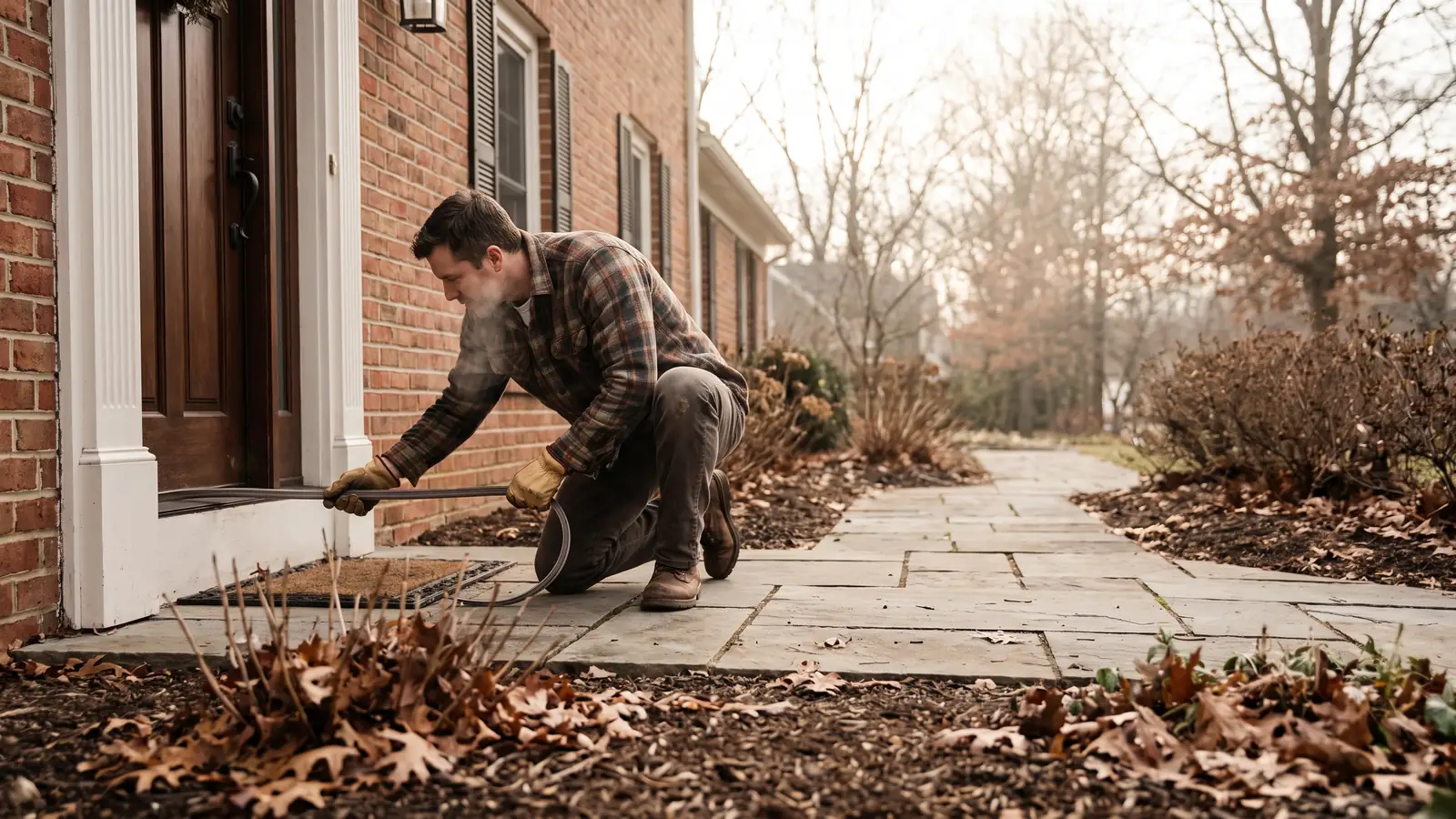
The highest-value jobs are also the cheapest: weatherstripping and caulk, foam sleeves on pipes running through unheated space, and a fresh furnace filter. Together they prevent the two failures that wreck a winter, a burst pipe and a furnace that quits in January.
Learn how to winterize your home step by step, including which jobs to do first on a tight budget, how to keep pipes from freezing, and what Michigan winters demand. It’s one chapter of a year-round calendar, our Home Maintenance guide covers the other seasons.
Key takeaways:
- Sealing and insulating pay best per dollar: ENERGY STAR models the average national savings from air sealing plus added insulation at about 15% of heating and cooling costs, or roughly 11% of a household’s total energy bill.
- 55 degrees is the line you don’t cross: Frozen pipes are the most expensive winter failure and the most preventable, drain exterior faucets, sleeve every exposed line, and never let interior temperature drop below 55 degrees.
- Book heating work in early fall: Heating equipment is the second leading cause of home fires, so change the filter, schedule the tune-up, have the chimney inspected once a year, and keep anything that burns at least 3 feet from every heat source.
What should you winterize first?
Do the sealing and plumbing jobs first, they cost the least and prevent the most expensive failures. The table runs from cheapest-highest-impact down to jobs needing a contractor quote.
| Job | Relative cost | What it prevents | DIY? |
|---|---|---|---|
| Drain exterior faucets, disconnect hoses | Free | A burst spigot and flooded wall | Yes |
| Weatherstrip doors, caulk window gaps | Materials only | Drafts and lost heat | Yes |
| Foam sleeves on exposed pipes | Materials only | Split supply lines | Yes |
| Replace the furnace filter | Low | Restricted airflow, an overworked furnace | Yes |
| Clean gutters, extend downspouts | Low DIY, moderate hired | Ice dams and meltwater under shingles | Either |
| Furnace tune-up, chimney inspection | Moderate, per visit | Mid-winter breakdowns and heating fires | Hire it |
| Air seal and add attic insulation | Moderate to high | The biggest path heat takes out | Either |
| Storm or replacement windows | Highest | Heat loss through single-pane glass | Hire it |
Those labels are relative rankings, not quotes, get 2 to 3 local quotes on anything below the DIY line. Our seasonal home maintenance checklist spreads these jobs across the year, and Family Handyman publishes a step-by-step winterization walkthrough.
How do I stop drafts and heat loss?
Seal the leaks first, then insulate, insulation over a leaky assembly still lets air move through it. ENERGY STAR estimates that doing both saves an average of 15% on heating and cooling costs nationally, or about 11% of total household energy costs, with the range running from roughly 7% to 20% by climate zone.1
Seal the leaks you can feel
Walk the house on the first cold, windy day and use the back of your hand.
- Door thresholds and jambs: Replace compressed weatherstripping and add a sweep wherever you see daylight.
- Window sashes and trim: Caulk where trim meets drywall inside and where the frame meets siding outside.
- Attic hatches and recessed lights: Warm air rises and leaves through the ceiling. Weatherstrip the hatch and use rated covers over fixtures.
- Penetrations and rim joists: Dryer vents, hose bibs, cable and electrical entries, and the framing band where the basement meets the first floor.
Insulate the attic first
If you’re adding insulation anywhere, add it in the attic. Heat leaves through the ceiling faster than through walls, and it’s the least invasive insulation job. Air seal the ceiling plane first, then add depth. ENERGY STAR’s sealing and insulating guidance gives recommended levels by region, and our guide to energy-efficient home upgrades ranks insulation against competing projects.
Not sure where your house leaks? A home energy audit uses a blower door and infrared camera to produce a prioritized list instead of a guess.
How do I protect my plumbing from freezing?
Three moves prevent almost every frozen pipe: drain what’s outside, insulate what runs through unheated space, and hold the thermostat at 55 degrees or higher. A split supply line is the most expensive thing that happens to a house in winter.
Shut down the exterior faucets
Disconnect and drain every garden hose, close the interior shutoff feeding each outdoor spigot, then open the spigot and leave it open all winter. Frost-free sillcocks still need the hose off, a connected hose traps water in the barrel and defeats the design.
Sleeve every pipe in unheated space
Foam pipe insulation costs a few dollars a length and installs in minutes on any line running through a basement, garage, attic or crawl space. Heat tape is the step up for the worst-exposed runs. Use UL-listed products only, and don’t run it over foam unless the product allows it.
Hold the thermostat at 55 degrees
Never set back below 55 degrees, even when the house is empty.2 The savings from a deeper setback are small; the downside is a burst pipe and a five-figure water damage claim. On the coldest nights, open cabinet doors under sinks on exterior walls and let the most exposed faucet drip, which relieves the pressure that splits a pipe.
How often do frozen pipes turn into insurance claims?
Often. According to the Insurance Information Institute’s homeowners and renters insurance statistics, which draw on ISO data for homeowners multiple peril policies, “water damage and freezing” made up 22.6% of homeowners losses in 2023, second only to wind and hail. Over 2019 to 2023, the same category averaged 1.50 claims per 100 insured homes a year, and the average paid claim was $15,400.
| Year | Water damage and freezing, share of homeowners losses | Wind and hail, share of homeowners losses |
|---|---|---|
| 2019 | 28.7% | 38.1% |
| 2020 | 19.8% | 47.7% |
| 2021 | 23.7% | 38.9% |
| 2022 | 25.8% | 45.4% |
| 2023 | 22.6% | 42.5% |
Source: Insurance Information Institute, Facts + Statistics: Homeowners and renters insurance, table “Homeowners Insurance Losses By Cause, 2019-2023,” from ISO, a Verisk Analytics business. The category includes covered mold damage.
Michigan’s insurance regulator names frozen pipes first on its winter list. In a January 22, 2026 release, the Michigan Department of Insurance and Financial Services (DIFS) said frozen pipes, roof collapses and ice dams are among the most common winter insurance claims, and told homeowners to keep the heat set above 55°F and insulate exposed pipes. Our guides to handling water damage, insurance deductibles and evaluating home insurance cover what happens after a pipe lets go.
Which pipes freeze first?
The American Red Cross frozen pipe guidance names lines exposed to severe cold, such as hose bibs, pool supply lines and sprinkler lines; supply pipes in unheated spaces, including kitchen cabinets; and pipes against poorly insulated exterior walls. Three of its steps go past the usual checklist:
- Pool and sprinkler lines: drain them following the manufacturer’s or installer’s directions, and do not put antifreeze in them unless directed.
- Garage doors: keep them closed when water supply lines run through the garage.
- No night setback in a cold snap: hold one temperature day and night while the weather is very cold.
How do I prep my heating system?
Heating prep is maintenance, not an emergency, and the calendar is the point: heating equipment is the second leading cause of home fires in the United States, with an estimated 32,200 home heating fires reported in 2021 causing roughly 190 deaths, 625 injuries and $442 million in property loss.3 Book the work in early fall.
Filters, the tune-up and the thermostat
Replace the furnace filter before the first sustained run, then check it monthly, a loaded filter chokes airflow and makes the furnace work harder. Schedule a professional tune-up: the technician checks the heat exchanger, burners, flue draft, blower and safety controls, the things that become carbon monoxide problems.
A programmable or smart thermostat automates the setbacks you’d otherwise forget, with one hard floor: 55 degrees.
Chimneys, fireplaces and space heaters
Have chimneys and heating equipment professionally cleaned and inspected once a year, per U.S. Fire Administration heating safety guidance. Creosote buildup and blocked flues are what a glance won’t catch. Then the rule for every heat source: keep anything that can burn at least 3 feet from fireplaces, wood stoves, radiators, space heaters and candles. Portable heaters were only 3% of home heating fires annually from 2017 to 2019 but accounted for 41% of the fatal ones. Turn them off when you leave the room, and never run a generator or grill indoors.
How have home heating fires changed over the last decade?
They have fallen, but not to zero. The U.S. Fire Administration’s Residential Building Heating Fire Trends (2014-2023) estimates 27,900 residential building heating fires in 2023, with 115 deaths, 525 injuries and $488.0 million in dollar loss.
| Year | Heating fires | Deaths | Injuries | Dollar loss |
|---|---|---|---|---|
| 2014 | 47,600 | 245 | 850 | $777.7 million |
| 2022 | 34,800 | 110 | 650 | $587.8 million |
| 2023 | 27,900 | 115 | 525 | $488.0 million |
Source: U.S. Fire Administration, Residential Building Heating Fire Trends (2014-2023). Our fire safety guide for homeowners covers smoke alarms and escape plans.
What does carbon monoxide add to the winter checklist?
A fuel-burning furnace, water heater or fireplace can leak carbon monoxide without any fire at all. According to the Centers for Disease Control and Prevention, more than 400 Americans die each year from unintentional carbon monoxide poisoning not linked to fires, more than 100,000 visit an emergency department and more than 14,000 are hospitalized. The CDC calls for battery-operated or battery back-up CO detectors near every sleeping area, replacing a detector per the manufacturer’s instructions or every 5 years, and never heating a house with a gas oven.
What outdoor work has to happen before the freeze?
Outdoor prep comes down to one principle: keep water moving away from the house.
Gutters, downspouts and ice dams
Clear every gutter run and confirm downspouts discharge several feet from the foundation. Clogged gutters are where ice dams start, and the mechanism matters because most people treat the symptom. Heat escaping through the ceiling warms the roof deck, snow melts from underneath, and the meltwater refreezes into a ridge of ice at the cold eave. Water then backs up behind that ridge and works under the shingles.
So ice dams are an insulation and air-sealing problem wearing a gutter costume. Clean gutters help meltwater leave; a sealed, insulated, well-ventilated attic keeps the roof deck cold enough that snow doesn’t melt at all.
Furniture, equipment and landscaping
Store patio furniture, cushions, grills and garden tools, or use waterproof covers. Drain fuel from mowers or add stabilizer, and keep propane tanks outdoors and upright. Wrap tender shrubs in burlap, mulch beds against freeze-thaw heaving, and mark the driveway edges before the first snow. Our seasonal checklist has the full fall version.
How much snow do Michigan’s snowbelts get, and when is a roof in trouble?
Snowfall in Michigan depends heavily on where the lake-effect bands set up. According to Michigan State University’s geography project on the state’s snowbelts, the Keweenaw Peninsula averages about 180 inches a year, the highest average statewide, and as much as two-thirds of it may be lake-effect snow. The northeastern Lower Peninsula and southern Upper Peninsula see a relatively low 50 to 60 inches. Snowfall in Otsego and Antrim Counties may be at least 50% lake-effect.
Ice dams do not need a snowbelt winter. Pacific Northwest National Laboratory’s Building America Solution Center says an ice dam can form with as little as 2 inches of snow on a roof, and that icicles at the eaves are often a sign that more liquid water is building up behind the dam, where capillary action can draw it under the shingles. Our roof maintenance guide covers pre-snow checks.
What warning signs does FEMA list for an overloaded roof?
FEMA’s Snow Load Safety Guidance flyer (FEMA P-957) lists signs that a roof is overstressed during a snow event. The ones a homeowner can spot from inside:
- Sagging ceiling boards or sagging roof sheathing
- Popping, cracking and creaking noises
- Doors or windows that can no longer be opened or closed
- Cracks in walls or masonry, or cracked or split wood framing
- Severe roof leaks
If any of them appear, FEMA says the building should be evacuated promptly and a local building authority or qualified design professional should inspect the structure. The flyer also names drifting and sliding snow, rain on snow, and blocked roof drainage as causes of overload.
How to winterize a vacant or seasonal home
A house nobody is checking needs one of two strategies: keep it heated and monitored, or drain it completely. Half measures produce the worst claims.
- Shut off the water at the main: Close the main supply valve where the line enters the house. This step caps your worst-case loss.
- Drain from the bottom down: Open the lowest faucet, then every faucet above it, and flush all toilets. Drain the water heater and shut off its power or gas.
- Protect the traps: Pour nontoxic RV plumbing antifreeze, never automotive antifreeze, into sink, tub, shower and floor drains and into toilet bowls and tanks.
- Or keep the heat on, with eyes on it: If draining isn’t practical, hold 55 degrees or higher and add a temperature sensor that alerts your phone if the heat fails.
- Call your insurer first: Many policies impose conditions on vacant properties, and some restrict coverage past a set number of unoccupied days.
Have someone check the house and keep the drive cleared, an unshoveled driveway advertises an empty house. Our Homeownership guide covers what a second property costs beyond the mortgage.
What Michigan homeowners should know
Michigan winters run hard from November into March, with freeze-thaw cycling that punishes anything holding water and lake-effect snow that loads roofs hardest on the west side of the state.
- Ice dams are the state’s signature winter claim: Heavy snow plus repeated thaws is the recipe that builds ice ridges at the eaves. The durable fix is air sealing and insulating the attic, and an energy audit pinpoints where that heat escapes.
- Snow load and roof edges: Shallow-pitch roofs, porch roofs and additions shed snow poorly. Clear the lower edge from the ground with a roof rake, keep gutters clear, and never climb onto a snow-covered roof.
- The Home Heating Credit: Michigan runs a Home Heating Credit for income-qualified households. Eligibility, credit amounts and the deadline are set by the Michigan Department of Treasury and change year to year, so confirm current rules with a tax professional.
- Michigan Saves financing: Michigan Saves is a Lansing-based nonprofit green bank that arranges home energy financing through authorized contractors. Rates, terms and amounts vary by lender and creditworthiness, so compare any offer against your other options.4
Envelope work pays off more in a cold climate, because savings scale with how hard your furnace runs. That’s why insulation sits near the top of a Michigan efficiency project list.
What will heating cost this winter in Michigan?
It depends first on your fuel. In an October 7, 2026 analysis, the U.S. Energy Information Administration said it expects energy expenditures this winter to fall 9% on average in homes heating with natural gas and 3% in homes heating with propane, while electricity bills rise 4% on average and spending on heating oil rises 21%. These are national household averages; EIA expects Midwest temperatures similar to last winter.
Most Michigan homes are in the natural gas group. The Michigan Public Service Commission’s 2025-2026 Winter Energy Appraisal, released December 9, 2025, reported that natural gas heats about 77% of Michigan homes and about 8% use propane. It put the projected weighted average commodity price for residential customers of regulated Michigan utilities at $3.53 per Mcf for that season, 12% above the prior year’s $3.15. Residential propane averaged $2.16 a gallon in October 2025, and heating oil started the season at $3.13 a gallon.
Propane is a bigger deal here than in most states. The MPSC’s propane and petroleum page says that, according to the EIA, Michigan uses more propane in the residential sector than any other state, and that an estimated 320,000 Michigan households use propane as their primary heating fuel. On propane or heating oil, confirm your supplier’s delivery schedule before the first cold snap; our solar panel guide covers another way a house’s energy setup shapes its costs.
Which Michigan programs help pay for heat and furnace repairs?
How does the Home Heating Credit work?
The Michigan Department of Treasury’s Home Heating Credit information says the credit helps low-income Michigan homeowners and renters with heating costs and is based on total household resources, household size, and a comparison between a standard credit allowance and actual heating costs. Claims are made on Form MI-1040CR-7, and the deadline for the 2025 tax year claim was September 30, 2026. Treasury’s 2025 limits:
| Exemptions | Standard allowance (Table A) | Income ceiling (Table A) | Maximum income, alternate computation (Table B) |
|---|---|---|---|
| 0 to 1 | $604 | $17,243 | $18,592 |
| 2 | $815 | $23,271 | $25,018 |
| 3 | $1,027 | $29,329 | $31,449 |
| 4 | $1,239 | $35,385 | $34,227 (4 or more) |
| 5 | $1,451 | $41,443 | $34,227 (4 or more) |
| 6 | $1,662 | $47,471 | $34,227 (4 or more) |
Source: Michigan Department of Treasury, Table A: 2025 Home Heating Credit Standard Allowance (plus $212 allowance and $6,057 ceiling for each exemption over 6) and Table B: 2025 Alternate Credit Computation.
Hypothetical example, not an offer. A household with two exemptions and $24,000 of total household resources would sit above the $23,271 Table A ceiling but below the $25,018 Table B maximum in the Treasury tables. Because the two tables use different limits, a household near the line should complete the MI-1040CR-7 rather than assume it does not qualify.
What does State Emergency Relief pay for?
The Michigan Department of Health and Human Services’ State Emergency Relief home repair program can pay to repair or replace a non-functioning furnace when the repair removes a direct threat to health or safety. Energy-related furnace repairs carry a lifetime maximum of $4,000 per family group. The applicant must own or be buying the home and live there, the home cannot be listed for sale, and total housing costs cannot exceed 75% of the group’s net income. For heating fuel, MDHHS lists an annual maximum of $450 to $850 depending on the fuel type.
Who runs weatherization and the Michigan Energy Assistance Program?
The MDHHS energy and weatherization page describes the Weatherization Assistance Program as free home energy conservation services for low-income homeowners and renters, such as attic and wall insulation and air leakage reduction, for households at or below 200% of the federal poverty guidelines. MDHHS estimates weatherization could reduce heating costs by 20% to 25%, about $450 a year. Nationally, the U.S. Department of Energy’s Weatherization Assistance Program page says DOE funds weatherize approximately 32,000 homes every year, with average savings of $372 or more a year according to a national evaluation.
The Michigan Energy Assistance Program (MEAP) helps eligible low-income households pay electric, natural gas, propane, heating oil and other deliverable fuel bills, per the MPSC’s MEAP page. On April 17, 2026, the MPSC adopted a funding factor of $1.50 per meter per month for participating electric utilities, effective beginning with the September 2026 billing month, and its fiscal year 2027 MEAP grant offering listed estimated total funding of $93,000,000. MEAP is paid from the low-income energy assistance fund that MCL 460.9t creates in the state treasury. One caution from the federal LIHEAP program page: LIHEAP does not provide direct grants to individuals or charge a fee for a benefit, and anyone who gets a message offering a LIHEAP grant or asking for a fee should contact the HHS Fraud Hotline at 1-800-447-8477.
How can you pay for a winter repair that cannot wait?
Check the state programs above first if your income fits. Beyond them, the job size and your equity decide: a home equity line of credit (HELOC) lets you draw as invoices arrive, refinancing for home improvements or a cash-out refinance folds the work into one loan, and a renovation loan finances a purchase and its repairs together. Our home equity loan tips and overview of home renovation financing options compare them.
For energy work tied to a mortgage, Freddie Mac’s GreenCHOICE Mortgages page lists caulking or weather stripping, added ceiling, wall or floor insulation, air sealing, high-efficiency heating replacement and replacement windows and doors among eligible basic improvements. It requires no energy report when those improvements total $6,500 or less, and caps energy financing at 15% of the property’s “as completed” value. See renovation permits and insurance and renovations.
Samantha Shelton, Align’s founder, puts it this way: “You’re not just financing the house. You’re financing the plan for the house.” Align’s guidance: for a winter repair, that plan starts with a contractor’s written estimate. Our maintenance budgeting guide and first-year guide plan for the next one; a lake place has its own list in our second home guide; and our calculators page runs your numbers.
How Align helps when a repair is bigger than your savings
Most repairs belong in a savings account, not a loan. When one does not, like a roof or a furnace, Samantha looks at whether a home equity line, a home equity loan or waiting makes more sense for you.
Align places standalone HELOCs and home equity loans, so you can keep your first mortgage and its rate in place. She explains the payment and the risk before you borrow against your home.
FAQ: Winterizing your home
Here are answers to common questions about winterizing your home.
When should I start winterizing my home?
Late fall, before the first sustained freeze, is the target. Schedule the furnace tune-up and chimney inspection in early fall, since HVAC calendars fill fast once temperatures drop. Exterior tasks like draining faucets, cleaning gutters and storing furniture should be done while the weather still lets you work outside comfortably, our seasonal maintenance checklist puts each job in its month.
What temperature should I set my thermostat to when I am away in winter?
No lower than 55 degrees. That threshold keeps interior wall and floor cavities warm enough that supply lines do not freeze. Lower settings save a little on heating but risk a burst pipe that can cause tens of thousands of dollars in damage. If the home will be empty for weeks, add a temperature sensor that alerts your phone if the heating system fails.
How do I keep my pipes from freezing?
Shut off and drain exterior faucets and disconnect garden hoses, insulate any pipe running through an unheated basement, garage, attic or crawl space with foam sleeves or heat tape, open sink cabinet doors on exterior walls so warm air circulates, and hold interior temperature at 55 degrees or higher. During extreme cold, a slow drip on the most vulnerable faucet relieves pressure.
Do I need to winterize a home I will not be living in?
Yes, and more thoroughly. Vacant homes need the water supply shut off at the main and lines drained, or heat maintained continuously with a monitored temperature alarm. Many insurance policies impose specific conditions on vacant or seasonal properties, so confirm what your carrier requires before you leave for the season. Our Home Maintenance guide covers the checks a caretaker should run.
How do I thaw a frozen pipe safely?
Keep the faucet open and apply gentle heat to the frozen section until full water pressure returns. The American Red Cross suggests an electric heating pad, a hair dryer, a portable space heater kept away from anything flammable, or towels soaked in hot water, and warns never to use a blowtorch, kerosene or propane heater, charcoal stove or other open flame.
Does homeowners insurance cover burst pipes in Michigan?
Usually, when the damage is sudden. The Michigan Department of Insurance and Financial Services said in a December 3, 2024 release that homeowners policies usually cover sudden events like burst pipes, ice dams, wind damage or a collapse caused by the weight of ice or snow, while power outage losses may be covered only when a covered event caused the outage. DIFS takes questions at 877-999-6442.
Do I have to file a Michigan tax return to get the Home Heating Credit?
No. MDHHS says you do not need to file a state income tax return to receive the Home Heating Credit and may apply for the credit only. Forms are mailed automatically to households that received a credit the year before, and applications are available from mid to late January through September 30.
How far from the house should a portable generator run?
More than 20 feet from any window, door or vent, according to the Centers for Disease Control and Prevention. The CDC says never to use a generator inside a home or garage, even with doors and windows open. Pick its spot before a storm.
Is it safe to rake snow off my roof?
It can be, if you stay on the ground. FEMA’s FEMA P-957 guidance recommends leaving roof snow removal to qualified individuals, but says a long-handled non-metallic snow rake can sometimes be used from the ground. It warns that metal rakes can damage roofing and pose an electrocution risk, that a couple of inches of snow should stay on the roof to protect the covering, and that roof snow can slide at any moment.
The bottom line on winterizing your home
Winterizing means sealing air leaks, protecting plumbing, servicing the heating system and securing the outdoors before the first hard freeze. Start with the cheap, high-impact jobs: weatherstripping and caulk, foam sleeves on exposed pipes, drained exterior faucets and a fresh furnace filter. Never let the interior temperature fall below 55 degrees. Then work up to gutters, a furnace tune-up, an annual chimney inspection, and attic air sealing and insulation, which ENERGY STAR models at about 15% of heating and cooling costs.
If you’re ready to take on the bigger work, a furnace replacement, new windows, or whole-house insulation a credit card can’t absorb, talk to Align Lending. We’ll shop your scenario across our lender network and show you the financing options side by side. Call 248-506-5727 or start online.
Footnotes:
1. The 15% and 11% figures are ENERGY STAR’s modeled national averages for air sealing plus added insulation, not measured results from any one home. Modeled savings run roughly 7% to 20% of heating and cooling costs depending on climate zone, and your results depend on construction, insulation, fuel type and utility rates. Return to text.
2. The 55-degree minimum is the threshold consistently recommended across property insurer and home services winterization guidance. It is a rule of thumb, not a code requirement. Pipes in poorly insulated walls or unheated crawl spaces can still freeze at higher temperatures. Check your own policy for vacant-property heat conditions. Return to text.
3. Home heating fire figures are U.S. Fire Administration estimates for 2021. The portable heater shares, 3% of home heating fires but 41% of the fatal ones, cover 2017 through 2019. These are national estimates, not a description of risk in any one home. Return to text.
4. Align Lending is an independent mortgage broker and does not set loan terms. Renovation, home equity and cash-out refinance terms, eligibility and loan amounts are set by the individual wholesale lenders in Align’s network and are subject to change and credit approval. Nothing here is an offer of credit. Michigan Saves financing runs through that organization’s own contractor and lender network, not Align Lending. Return to text.
Sources: savings percentages and climate-zone ranges, U.S. Environmental Protection Agency, ENERGY STAR (“Seal and Insulate with ENERGY STAR” methodology). Heating fire estimates, the annual inspection recommendation and the 3-foot clearance rule, U.S. Fire Administration (“Heating fires”). The 55-degree minimum, property insurer and home services winterization guidance.
This article is for informational purposes only and is not legal, financial, tax, insurance or engineering advice. Costs, state program rules, tax credit eligibility and insurance conditions vary by location and carrier, verify current details and get local quotes. Electrical, gas, HVAC, chimney and plumbing work should be performed by a licensed contractor under local code and permitting requirements. Align Lending is an independent Michigan mortgage broker, NMLS #2041154.
Sources
Every outside source this guide links to, in the order it appears. How we choose and check sources
- A step-by-step winterization walkthroughFamily Handyman
- ENERGY STAR estimatesENERGY STAR
- ENERGY STAR’s sealing and insulating guidanceENERGY STAR
- Insurance Information Institute’s homeowners and renters insurance statisticsInsurance Information Institute
- January 22, 2026 releaseState of Michigan
- American Red Cross frozen pipe guidanceredcross.org
- U.S. Fire Administration heating safety guidanceU.S. Fire Administration
- Residential Building Heating Fire Trends (2014-2023)U.S. Fire Administration
- Centers for Disease Control and Preventioncdc.gov
- Michigan State University’s geography project on the state’s snowbeltsproject.geo.msu.edu
- Pacific Northwest National Laboratory’s Building America Solution Centerbasc.pnnl.gov
- Snow Load Safety Guidance flyer (FEMA P-957)Federal Emergency Management Agency
- Michigan runs a Home Heating Credit for income-qualified householdsState of Michigan
- Michigan Saves is a Lansing-based nonprofit green bankmichigansaves.org
- October 7, 2026 analysiseia.gov
- 2025-2026 Winter Energy AppraisalState of Michigan
- Propane and petroleum pageState of Michigan
- Table A: 2025 Home Heating Credit Standard AllowanceState of Michigan
- Table B: 2025 Alternate Credit ComputationState of Michigan
- State Emergency Relief home repair programState of Michigan
- MDHHSState of Michigan
- Weatherization Assistance Program pageU.S. Department of Energy
- MPSC’s MEAP pageState of Michigan
- MCL 460.9tMichigan Legislature
- LIHEAP program pageacf.gov
- GreenCHOICE Mortgages pageFreddie Mac
- December 3, 2024 releaseState of Michigan
Related resources
12-minute read
Seasonal home maintenance checklist for every season
Find a seasonal home maintenance checklist covering exterior, interior, HVAC and plumbing tasks for all four seasons, keeping repairs small and planned.
12-minute read
Home maintenance for first-time homeowners: A full checklist
Learn what home maintenance for first-time homeowners involves, with monthly, seasonal, and annual tasks plus how much to budget each year for upkeep.
11-minute read
How to address water damage in your home: A step-by-step plan
Learn how to address water damage in your home fast, from shutting off water and power to drying materials before mold starts growing in 24 to 48 hours.
