
How to prepare for a home appraisal and support your price
Preparing for a home appraisal means fixing what the appraiser can see and documenting what they can’t, because on a financed sale the loan gets sized against the lower of the contract price or the appraised value. Appraisals are a real closing risk: in the National Association of REALTORS® July 2026 Confidence Index Survey, 12% of contracts had a delayed settlement over the prior three months, and 6% of those delayed contracts had appraisal issues.

Condition isn’t a vibe the appraiser forms. It’s a score. Fannie Mae and Freddie Mac require the appraiser to assign your house one overall condition rating from C1 to C6 using published definitions, and the distance between a C4 (adequately maintained, with only minor or cosmetic deferred maintenance) and a C3 (well-maintained, with limited wear and tear and updated major components) is largely the list of small repairs you did or didn’t get to.
Learn how to prepare for a home appraisal step by step: what the appraiser is actually scoring, the walk-the-property fixes that move a condition rating, and the one-page improvement sheet that earns you credit for work nobody can see. If you’re earlier in the process, start with our Selling a Home guide.
Key takeaways:
- Condition gets scored on a 6-point scale: Appraisers assign one rating from C1 to C6, and a C5 turns on obvious deferred maintenance and significant needed repairs. Visible deferred maintenance is the part of your value you can still change in a weekend.
- One page of documentation earns credit for hidden work: An appraiser reports what’s observable on a single site-visit date, so a 2019 roof, new drain tile or a rebuilt septic count only if you list them with month, year, approximate cost and permit number.
- FHA and VA appraisals add a condition floor: FHA requires correction of defective paint surfaces on structures built before January 1, 1978, and VA’s basic property requirements include a roof that keeps moisture out and a crawl space that is clear of debris and properly vented. Those aren’t preferences. They hold up the closing.
Why does the appraisal matter to you as the seller?
Because the lender sizes the loan on the lower of two numbers, not on the one you negotiated. Fannie Mae’s rule for a purchase loan is plain: the value used in determining the loan-to-value ratio is the lower of the sales price or the appraised value. Hypothetical example, not an offer: say your contract is $320,000 and the appraisal lands at $305,000. The lender underwrites to $305,000, and your buyer has to cover the $15,000 gap in cash, renegotiate, or walk, depending on how the appraisal contingency was written.1
That’s the part sellers most often get backwards. A low appraisal is a financing problem before it’s a pricing problem. It doesn’t prove your house isn’t worth the contract price. It proves the loan can’t stretch that far on this file, with these comparable sales, on this date. Our walkthrough of why home appraisals matter covers the downstream effects, and how to sell a home with a low appraisal covers your options when the number comes in short.
Some buyers absorb that risk themselves: 21% waived the appraisal contingency in NAR’s July 2026 survey. A waiver shifts the gap onto the buyer contractually, but it doesn’t conjure the cash, so a shortfall can still unwind your deal.
What is the appraiser actually scoring?
Six things drive the number in the report, and you can meaningfully influence three of them. The full sequence, from order to delivered report, is in our home appraisal process guide.
- Gross living area: Measured to the ANSI Z765-2021 standard on conventional loans sold to Fannie Mae, required for appraisals with effective dates of April 1, 2022 or later. Only finished above-grade area counts toward GLA.
- Condition rating (C1 to C6): One rating for the whole dwelling, on published definitions. This is the lever you control.
- Quality rating (Q1 to Q6): Construction quality and materials, judged on an absolute basis, not against the neighbors. Documented upgrades feed this.
- Bedroom and bathroom count: Fixed by the floor plan. A below-grade bedroom generally won’t count above grade.
- Comparable sales: Recent sales of similar homes nearby. You can supply candidates through your agent, but you cannot select them.
- Location and functional issues: Busy road, odd layout, deferred structural problems. A few are fixable, most aren’t.
Here’s what the condition scale covers, paraphrased from the Fannie Mae and Freddie Mac Uniform Appraisal Dataset definitions. Read it as a scoring rubric, and check the published definitions for the exact wording.
| Rating | What it means | What typically puts a house there |
|---|---|---|
| C1 | 100% newly constructed, completed within 12 months, never occupied, no signs of wear | New construction only |
| C2 | Like-new; built or fully remodeled within 36 months; no deferred maintenance, no repair needed | Studs-out renovation or a model home |
| C3 | Well-maintained, only minimal wear and tear; most major components updated or renovated | Newer roof, some newer mechanicals, remodeled kitchen or bath |
| C4 | Adequately maintained, moderate wear; deferred maintenance is minor or cosmetic | Minor wall or trim damage, worn carpet, dated but functional kitchen |
| C5 | Significant wear from inadequate maintenance; soundness still supports occupancy | Badly worn roofing with no active leak, damaged or missing floor coverings |
| C6 | Extreme lack of maintenance; damage affects soundness or structural integrity; not suitable for occupancy | Active roof leaks, failing foundation, no functional kitchen or bath |
Notice what moves you between C4 and C3: not staging, not decor, not fresh flowers on the island. Newer roof. Newer mechanicals. Updated kitchen or bath. Repaired trim and floors. The work owners skip because “the buyer will change it anyway” is the work sitting inside the definition.
Fix what the appraiser can see
Walk your property from the street inward, in daylight, with a notepad, about two weeks before the visit. You’re hunting for anything that reads as not kept up, which is the territory the C4 and C5 definitions describe.
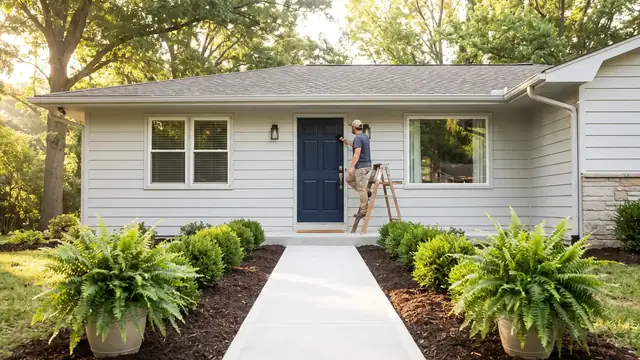
- The approach: Mow, edge, trim what’s touching the siding, and clear the driveway and walks. It’s the first thing photographed, and it costs little compared with the rest of this list. Our guide to improving your home’s curb appeal goes deeper.
- Exterior envelope: Loose or missing shingles, damaged fascia, failed caulk, rotted trim, peeling paint on siding and sills. Anything that reads as “water gets in” pushes toward the C5 and C6 end of the scale, so it is expensive.
- Grading and drainage: Downspouts extended away from the foundation, no standing water against the house. Excessive dampness or ponding in a crawl space has to be corrected under VA’s requirements.
- Foundation and structure: Photograph any crack and get a written engineer or contractor opinion if there’s doubt. Concealing a known structural defect is not an option in Michigan.
- Safety items: Handrails on stairways, secure deck railings, GFCI outlets where local code requires them, no exposed wiring, working smoke and CO detectors.
- Systems and access: Furnace, water heater, electrical panel and attic hatch all reachable without moving boxes. An appraiser reports what’s readily observable on the site-visit date, so a blocked panel is an unobserved panel.
- Interior wear: Patch and paint damaged drywall, re-caulk tubs, replace cracked switch plates and broken fixtures, and address worn floor coverings if the budget allows. These are the exact C4 examples.
Clean thoroughly, but be clear on what cleaning does. It doesn’t add value on its own. It removes the visual cues that push a rating down and clears the path to the mechanicals, which is why decluttering before selling pays off twice. If you want the defect list before anyone else has it, a pre-listing home inspection finds it on your schedule.
Which small repairs does Fannie Mae name, and what happens at C6?
Fannie Mae’s Selling Guide lists the kind of minor deferred maintenance that keeps a house in the middle of the scale, and three items on its list are easy to miss on a walk-through: minor plumbing leaks, holes in window screens and cracked window glass, per its property condition topic (dated June 4, 2025).
The same topic draws the line that matters for a sale: homes rated C1, C2, C3, C4 or C5 are eligible “as is,” while a C6 house must be appraised “subject to” completion of the deficient items, with a minimum resulting condition rating of C5. See handling buyer repair requests.
Built before 1978?
The EPA’s Lead-Based Paint Disclosure Rule requires sellers of most housing built before 1978 to give buyers the Protect Your Family From Lead In Your Home pamphlet, disclose any known lead-based paint and hazards, and provide available records before the buyer signs a contract, according to the EPA’s real estate disclosure page. Housing built after 1977 and foreclosure sales are among the exceptions. Our guide to handling seller disclosures covers the paperwork.
What FHA and VA appraisals require on top of value
Government-backed appraisals do two jobs at once: they estimate value and they verify the property meets minimum standards.
FHA: Under HUD’s Single Family Housing Policy Handbook 4000.1, required repairs protect the health and safety of the occupants (Safety), protect the security of the property (Security), and correct physical deficiencies or conditions affecting structural integrity (Soundness). For structures built before January 1, 1978, correction of all defective paint surfaces is required under 24 CFR Part 35. HUD publishes a consumer overview of FHA lending.2
VA: The basic minimum property requirements in the VA Lender’s Handbook include mechanical systems that are safe to operate, heating adequate for healthful and comfortable living, a continuing supply of safe and potable water, a roof covering that prevents the entrance of moisture, a crawl space with adequate access that is clear of debris and properly vented, natural ventilation of attics and crawl spaces, and electricity for lighting and necessary equipment.3
If your buyer is using FHA or VA financing, treat these as a pre-listing punch list, not a closing surprise.
Build the one-page improvement sheet
Hidden work is worth zero unless the appraiser can attribute it, so put it on one page and hand it over at the door. Dates and permit numbers beat adjectives: an appraiser can cite a permitted 2021 electrical service upgrade and cannot cite “we’ve kept it really nice.”
| Improvement | Month and year | Approximate cost | Permitted? |
|---|---|---|---|
| Roof, full tear-off, 30-year architectural shingle | June 2021 | $14,500 | Yes, #_____ |
| Furnace and A/C replacement, 96% AFUE | October 2023 | $9,200 | Yes, #_____ |
| Interior drain tile and sump pump | August 2022 | $8,900 | No |
| Kitchen remodel, cabinets, counters, appliances | May 2024 | $27,000 | Yes, #_____ |
Hypothetical example, not an offer. The figures above are illustrative placeholders, not an estimate of what any project returns. Bring the same folder with a survey or plot plan, HOA documents, any prior appraisal, and your agent’s comparable sales. The FHFA House Price Index publishes state, metro and county price trends for context. For where this fits in the listing sequence, see our Pricing and Preparing hub.
One honest caveat about remodeling returns: cost-versus-value figures circulate constantly, and most come from opinion surveys of agents, not measured sale outcomes. Treat any “this project returns X%” claim as an estimate with a named publisher and year attached, or ignore it. What holds up is duller. Documented, permitted, recent work on major components is what an appraiser can cite. The Appraisal Institute publishes standards and education on how professional appraisers develop an opinion of value.
How does the appraiser choose and adjust comparable sales?
Fannie Mae’s comparable sales topic (dated June 4, 2025) requires a minimum of three closed comparables in the sales comparison approach and says sales that closed within the last 12 months should be used, while noting that the most appropriate sale is not always the most recent one. Current listings and homes under contract can be used as supporting data, if appropriate, but they are not the three closed sales, so a house down the street listed above your contract price does not set your value.
Every difference between your house and a comparable gets a dollar adjustment, and the adjustments topic says those adjustments must reflect the market’s reaction to the difference. Its own example: a $20 per square foot adjustment for finished above-grade area is inappropriate when market analysis indicates the adjustment should be $100 per square foot. The same topic says positive adjustments for sales or financing concessions are not acceptable, and that home price indices may support time adjustments.
Seller credits do not add value: Because a concession can never be adjusted upward, a price raised to fund a closing cost credit still needs closed sales that support it. See seller-paid closing costs.
What can you say to the appraiser, and what can’t you?
You can provide information. You cannot push for a number, and neither can anyone else in the transaction. Federal valuation-independence rules under 12 CFR § 1026.42 prohibit any covered person from attempting, directly or indirectly, to cause a home’s assigned value to rest on anything other than the appraiser’s independent judgment, through coercion, bribery, intimidation, instruction or collusion. A creditor that knows of a violation generally can’t extend credit based on that valuation. So on the day of the visit:
- Be available, not attached: Greet the appraiser, hand over the folder, offer to point out anything not visible, then get out of the way. Following someone room to room reads as pressure.
- Route documents through your agent: Comparable sales and improvement lists are ordinary supporting information. Delivering them as a packet rather than a pitch keeps the interaction clean.
- Flag the invisible: New septic field, rebuilt well, spray foam in the rim joist, replaced sewer lateral. Say it once, on paper, with the date.
- Skip the number: Naming the price you “need” is the one sentence that can taint a report. Your contract price is already in the file.
Your buyer gets a copy of the report by law. Under the ECOA valuations rule at 12 CFR § 1002.14, a creditor must provide a copy of each appraisal and other written valuation promptly upon completion, or three business days before consummation, whichever is earlier. If the number comes in low, your path runs through appealing a low appraisal with the buyer’s lender, or through what to do if your home doesn’t appraise.
What can the buyer’s lender do if the appraisal comes in low?
It can ask the appraiser for a reconsideration of value, or ROV. On July 18, 2024, the OCC, the Federal Reserve Board, the Consumer Financial Protection Bureau, the FDIC and the National Credit Union Administration issued final interagency guidance on ROVs, according to the OCC’s bulletin. The Federal Reserve’s release says the guidance covers letting consumers provide information that may not have been considered during the appraisal. The federal valuation rule allows this: 12 CFR 1026.42(c)(3) lists asking an appraiser to consider additional, appropriate property information, including information about comparable properties, and asking an appraiser to correct errors as permitted actions.
FHA writes the steps down. HUD Mortgagee Letter 2024-07, dated May 1, 2024 and required for FHA case numbers assigned on or after September 2, 2024, says a borrower-initiated ROV may include up to five alternative comparable sales, only one borrower-initiated ROV request is permitted per appraisal, no ROV costs may be charged to the borrower, and the ROV must be resolved before loan closing. See our FHA loans guide.
How a shortfall can be split
Hypothetical example, not an offer. Using the same $320,000 contract and $305,000 appraisal from above, here is where the $15,000 gap lands under four common outcomes. Which ones are open to you depends on how the appraisal contingency was written; our guide to contingencies in home offers explains the usual versions.
| Outcome | Final price | Seller gives up | Buyer’s cash above the appraised value |
|---|---|---|---|
| Price cut to the appraised value | $305,000 | $15,000 | $0 |
| Gap split evenly | $312,500 | $7,500 | $7,500 |
| Buyer covers the gap | $320,000 | $0 | $15,000 |
| ROV raises the value to $315,000, rest split | $317,500 | $2,500 | $2,500 |
Hypothetical figures for illustration only, not an estimate of any appraisal or negotiation outcome.
Each row changes your net proceeds, which you can test on the seller net sheet calculator. See also negotiating house prices.
What do current market numbers say about appraisal risk?
Appraisal trouble is steady rather than rare. In the REALTORS® Confidence Index for September 2026, published October 13, 2026, agents reported that 5% of contracts were delayed because of appraisal issues, similar to recent levels, and that 16% of contracts had a delayed settlement. The same survey found 7% of contracts terminated in the last three months and 18% of buyers waiving the appraisal contingency, down from 22% the month before. Homes selling above list price held at 16%, down from 21% a year earlier. These are agent-reported survey figures.
The NAR existing-home sales report for September 2026 put the national median existing-home price at $417,500, up 1.3% from $412,300 a year earlier, with a 4.8-month supply compared with 4.5 months a year before. In the Midwest, the same report shows a median price of $329,600, up 3.1% year over year, and sales at an annual rate of 930,000, down 2.1%.
New construction competes for the same buyers: the Census Bureau reported a median new-home sales price of $400,400 in September 2026, with an 8.4-month supply at the current sales rate. See housing market trends.
What Michigan sellers should know
Michigan adds four wrinkles that regularly surprise sellers.
- Your assessment is not your value: The Michigan Constitution caps assessments at 50% of true cash value, and MCL 211.27a implements it, so your state equalized value is roughly half of market value by design. Doubling your SEV is not an appraisal, and taxable value is capped separately and usually lower still.
- Finished basements don’t count where owners think they do: Under ANSI Z765-2021, a level is below grade if any portion of it is below grade, regardless of finish quality or window area. A walk-out basement bedroom won’t land in the above-grade room count. It still adds value, but as a below-grade line, not as square footage.
- Comparable sales thin out fast: Michigan has about 3,300 miles of Great Lakes shoreline and 10,899 inland lakes of five acres or more, so waterfront and acreage homes often have few true matches nearby. Expect wider search parameters, older sales, larger adjustments and longer turnaround on rural and lakefront files, and don’t assume a drive-by appraisal on one.
- Disclosure is law, not strategy: Michigan’s Seller Disclosure Act applies to transfers of not fewer than one and not more than four residential dwelling units, and the transferor must deliver the written disclosure statement. Known defects get disclosed. Selling “as-is” does not waive that statutory duty, and failing to deliver a signed statement can let a buyer terminate an otherwise binding purchase agreement.
Michigan appraisers are licensed through LARA. A certified residential appraiser completes 200 hours of prelicensure education and 1,500 hours of experience over no fewer than 12 months.
How have Michigan home prices moved ahead of your appraisal?
Michigan house prices rose 3.80% from the second quarter of 2025 to the second quarter of 2026, ranking 14th among the states, according to the FHFA House Price Index quarterly report released August 25, 2026. These are purchase-only, seasonally adjusted index changes, so they show direction across a market, not the value of one house.
| Area | 1 year | Last quarter | 5 years | Since 1991 |
|---|---|---|---|---|
| Michigan | 3.80% | 0.39% | 38.80% | 292.88% |
| Detroit-Dearborn-Livonia | 4.90% | 0.38% | 39.74% | 257.88% |
| Warren-Troy-Farmington Hills | 3.26% | 1.64% | 33.00% | 268.27% |
| Grand Rapids-Wyoming-Kentwood | 3.18% | -0.05% | 40.91% | 359.51% |
Source: FHFA House Price Index, quarterly report for the period ended 2026Q2 (purchase-only, seasonally adjusted, nominal; the state table measures from 1991Q1), released August 25, 2026.
What Michigan rules apply to repairs before the appraisal?
- Permits come before the work: Under MCL 125.1510, before construction of a building or structure the owner, or the owner’s builder, architect, engineer or agent, applies in writing to the enforcing agency for a building permit. That permit number goes on your improvement sheet; see home renovation permits.
- Who has to be licensed: Michigan’s residential builder statute, MCL 339.2403, exempts an owner working on a structure for the owner’s own use and occupancy, and a person on one project whose aggregate contract price is less than $600.00. Michigan’s consumer protection advice for homeowners says residential builders and maintenance and alteration contractors are licensed by LARA’s Bureau of Professional Licensing.
- Call before you dig: Burying downspout extensions or regrading against the foundation means digging. MISS DIG 811 says Michigan law requires that all utility lines be flagged before beginning any excavation project, and its notification service is free.
LARA’s appraiser licensing page says the department oversees approximately 6,011 limited real estate appraisers, state licensed appraisers, certified general appraisers and certified residential appraisers (the page gives no date for the count; viewed October 2026). The federal Appraisal Subcommittee provides federal oversight of state appraiser programs and keeps a national appraiser registry.
After closing, under MCL 211.27, the purchase price paid in a transfer is not the presumptive true cash value of the property, so neither your contract price nor the appraisal sets the assessment by itself. Per Michigan Treasury’s transfer of ownership guidance: The year after a Michigan home sells, its taxable value resets to half of the assessor’s market value, so the seller’s tax bill is not your tax bill. Buying your next Michigan home? The Michigan property tax calculator and our guide to property tax assessments show what that reset means.
How Align helps before you list
If you are buying your next home too, talk to Samantha before you list. Knowing your buying power and your timeline first lets you price and prepare your home with a plan, not a guess.
Your closing date is set by your purchase agreement. Her job is to have your loan ready well before it.
FAQ: Preparing for a home appraisal
Here are answers to common questions about preparing for a home appraisal.
Does cleaning my house raise the appraised value?
Not directly, but it affects the condition rating, and condition ratings move value. The C4 rating covers homes that are adequately maintained with only minor or cosmetic deferred maintenance, so a home that reads as cared for supports a higher rating than an identical home with stained carpet and damaged drywall. Cleaning also clears access to the furnace, panel and attic hatch, which an appraiser has to observe on the visit date. Our home appraisal process guide walks through the visit itself.
Should I be present during the appraisal?
Being available is fine. Following the appraiser room to room is not. Greet them, hand over your improvement sheet and your agent’s comparable sales, point out anything not visible such as a new furnace or rebuilt septic, then step back. Federal rules bar anyone in the transaction from trying to influence the value through instruction or intimidation, so hovering can only hurt you. See why home appraisals matter for what rides on the report.
What documents should I give the appraiser?
A one-page improvement list with dates, approximate costs and permit numbers, plus permits for major work, a survey or plot plan, HOA fee and covenant information, any prior appraisal, and your agent’s comparable sales. Documentation of hidden systems matters most, since an appraiser cannot credit a new roof or drain tile they cannot see. Our pricing and preparing guide covers what else to assemble before listing.
How long does a home appraisal take?
The reliable deadline isn’t the site visit, it’s the delivery rule: your buyer’s lender must provide a copy of each appraisal promptly upon completion or at least three business days before closing, whichever comes first. On-site time varies and no authority publishes a standard duration; rural and lakefront files take longest because the comparable sales sit farthest away. Median days to close was 30 in NAR’s July 2026 Confidence Index Survey, unchanged from a year earlier. If the number lands short, start with selling a home with a low appraisal.
Is a home appraisal the same as a home inspection?
No. HUD’s For Your Protection notice (HUD-92564-CN, 02/09/2023) says an appraisal does not replace a home inspection, FHA does not perform home inspections, and FHA does not guarantee value or condition. The CFPB says buyers generally need both, and a satisfactory-inspection contingency lets a buyer cancel without penalty. See our guide to choosing a home inspector.
What happens on a VA loan if the appraisal is below the price?
The buyer can walk away without losing earnest money. VA’s rule at 38 CFR 36.4303 requires the purchase contract to say the purchaser will not forfeit earnest money or be obligated to complete the purchase if the price exceeds the reasonable value VA establishes. The clause also lets the buyer proceed anyway. See our VA loans guide.
Is my agent’s market analysis the same as an appraisal?
No. Michigan’s occupational code, MCL 339.2601, defines an appraisal as an opinion, conclusion or analysis relating to the value of real property, then carves out a licensee’s market analysis. A broker’s analysis prepared for a fee outside a federally related transaction must state in bold that it is a market analysis, not an appraisal. See pricing your home for a quick sale.
Does radon affect my home appraisal?
Not directly: the appraiser estimates value and does not test radon. HUD’s FHA notice, For Your Protection: Get a Home Inspection, says an appraisal does not replace a home inspection and that the Environmental Protection Agency and the Surgeon General recommend that all houses be tested for radon. If you install a mitigation system before listing, put its install date and receipt on your improvement sheet. Our guide to reading a home inspection report shows where radon appears.
The bottom line on preparing for your appraisal
Preparing for a home appraisal comes down to two jobs: repair what the appraiser can see, and document what they can’t. Condition is scored on a published C1 to C6 scale, and the gap between C4 and C3 is newer major components and no visible deferred maintenance, not decor. Hand over one page listing every improvement with month, year, approximate cost and permit number. If your buyer is using FHA or VA financing, clear the safety and soundness items first, because those hold up the closing regardless of value. And remember the rule underneath all of it: the loan is sized on the lower of the contract price or the appraised value.
If you’re ready to plan the financing on the other side of this sale, talk to Align Lending. We’re an independent Michigan mortgage broker, so we’ll shop your next purchase or a bridge loan across our lender network and show you the numbers side by side, including what a shortfall here would mean for your buying power. Call 248-506-5727 or start online.
Footnotes:
1. Example figures in this article, including the contract price, appraisal gap and improvement-sheet costs, are hypothetical and for educational purposes only. They do not constitute an advertisement of credit terms, a rate quote, or an estimate of the value any project adds to a specific home. Your appraised value depends on your property, its condition, and the comparable sales available on the effective date of the appraisal. Return to text.
2. Align Lending is not acting on behalf of or at the direction of FHA or HUD. FHA minimum property requirements are set by HUD in Single Family Housing Policy Handbook 4000.1 and are subject to change. Return to text.
3. Align Lending works with VA-approved lenders and is not endorsed or sponsored by the Dept. of Veterans Affairs or any government agency. VA minimum property requirements are set by VA in the Lender’s Handbook, Pamphlet 26-7, Chapter 12, and are subject to change. Return to text.
Sources: 12% of contracts with a delayed settlement in the past three months, 6% terminated, 6% of contracts with a delayed settlement that had appraisal issues, 21% of buyers who waived the appraisal contingency, and median days to close of 30, National Association of REALTORS®, July 2026 REALTORS® Confidence Index Survey (2,019 respondents to an online survey fielded August 1 to 5, 2026; agent-reported survey data, not measured transaction records). Condition rating definitions C1 through C6 (paraphrased), Fannie Mae and Freddie Mac Uniform Appraisal Dataset (UAD), Condition and Quality Ratings Definitions. Loan-to-value ratio for a purchase money loan determined using the lower of the sales price or the appraised value, Fannie Mae Selling Guide B2-1.2-01. ANSI Z765-2021 measuring standard required for appraisals with effective dates of April 1, 2022 or later, and below-grade levels excluded from above-grade square footage and room count, Fannie Mae Standardized Property Measuring Guidelines and Selling Guide B4-1.3-05. Required repairs limited to Safety, Security and Soundness, and correction of defective paint surfaces on structures built before January 1, 1978 under 24 CFR Part 35, HUD Single Family Housing Policy Handbook 4000.1. Basic minimum property requirements for mechanical systems, heating, water supply and sanitary facilities, roof covering, crawl space, ventilation and electricity, VA Lender’s Handbook, Pamphlet 26-7, Chapter 12 (Basic MPR Checklist). Prohibition on coercion, intimidation, instruction or collusion to influence an assigned value, 12 CFR § 1026.42(c). Copy of each appraisal and written valuation promptly upon completion or three business days before consummation, whichever is earlier, 12 CFR § 1002.14(a)(1). Assessments capped at 50% of true cash value, Michigan Constitution of 1963, Article IX, § 3, and MCL 211.27a. Seller disclosure requirements applying to transfers of not fewer than one and not more than four residential dwelling units, and buyer termination right for failure to deliver a signed statement, Michigan Seller Disclosure Act, Act 92 of 1993, MCL 565.951 et seq. Approximately 3,300 miles of Great Lakes shoreline and 10,899 inland lakes of five acres or more, Michigan Department of Environment, Great Lakes, and Energy. Certified residential appraiser licensure requiring 200 hours of prelicensure education and 1,500 hours of experience in no fewer than 12 months, Michigan Department of Licensing and Regulatory Affairs.
This article is for informational purposes only and is not intended to provide legal, financial, or tax advice. Appraisal outcomes, property standards, program rules and Michigan disclosure obligations change and vary by property, county and loan program; confirm requirements with your appraiser, your real estate attorney, and your buyer’s lender, and consult a qualified professional about your situation. Figures shown are illustrative, are not a rate quote or an offer of credit, and are subject to change. Align Lending is an independent Michigan mortgage broker, NMLS #2041154, and is not a real estate listing brokerage.
Sources
Every outside source this guide links to, in the order it appears. How we choose and check sources
- Property condition topicFannie Mae Selling Guide
- EPA’s real estate disclosure pageU.S. Environmental Protection Agency
- Consumer overview of FHA lendingU.S. Department of Housing and Urban Development
- FHFA House Price IndexFederal Housing Finance Agency
- Appraisal Institute
- Comparable sales topicFannie Mae Selling Guide
- Adjustments topicFannie Mae Selling Guide
- Under 12 CFR § 1026.42 prohibitElectronic Code of Federal Regulations
- The ECOA valuations rule at 12 CFR § 1002.14Electronic Code of Federal Regulations
- OCC’s bulletinocc.gov
- Federal Reserve’s releaseFederal Reserve Board
- HUD Mortgagee Letter 2024-07U.S. Department of Housing and Urban Development
- REALTORS® Confidence IndexNational Association of Realtors
- NAR existing-home sales reportNational Association of Realtors
- Census BureauU.S. Census Bureau
- MCL 211.27a implements itMichigan Legislature
- Michigan’s Seller Disclosure ActMichigan Legislature
- FHFA House Price Index quarterly reportFederal Housing Finance Agency
- MCL 125.1510Michigan Legislature
- MCL 339.2403Michigan Legislature
- Consumer protection advice for homeownersState of Michigan
- MISS DIG 811
- Appraiser licensing pageState of Michigan
- Appraisal Subcommitteeasc.gov
- MCL 211.27Michigan Legislature
- Michigan Treasury’s transfer of ownership guidanceState of Michigan
- For Your Protection noticeU.S. Department of Housing and Urban Development
- CFPBConsumer Financial Protection Bureau
- 38 CFR 36.4303Electronic Code of Federal Regulations
- MCL 339.2601Michigan Legislature
Related resources
18-minute read
How to improve your home’s curb appeal before you list
Discover how to improve your home’s curb appeal with paint, cleaning, landscaping and lighting upgrades that photograph well and bring buyers to the door.

20-minute read
Benefits of a pre-listing home inspection: what sellers gain
See how a pre-listing home inspection helps you price accurately, control repairs and avoid renegotiation, plus what it costs and when to order one.

20-minute read
How to sell a home with a low appraisal and keep the deal together
Learn how to sell a home with a low appraisal, from a reconsideration of value to splitting the gap with your buyer or restructuring the financing.
