
How to choose a home security system: 7 factors that matter
Choosing a home security system comes down to three decisions: what you need covered, who installs it, and who monitors it. A basic do-it-yourself kit covering a few doors and windows commonly sells for under $200 with no monthly fee, while professional monitoring adds anywhere from under $10 a month to $45 or more on top of the equipment.
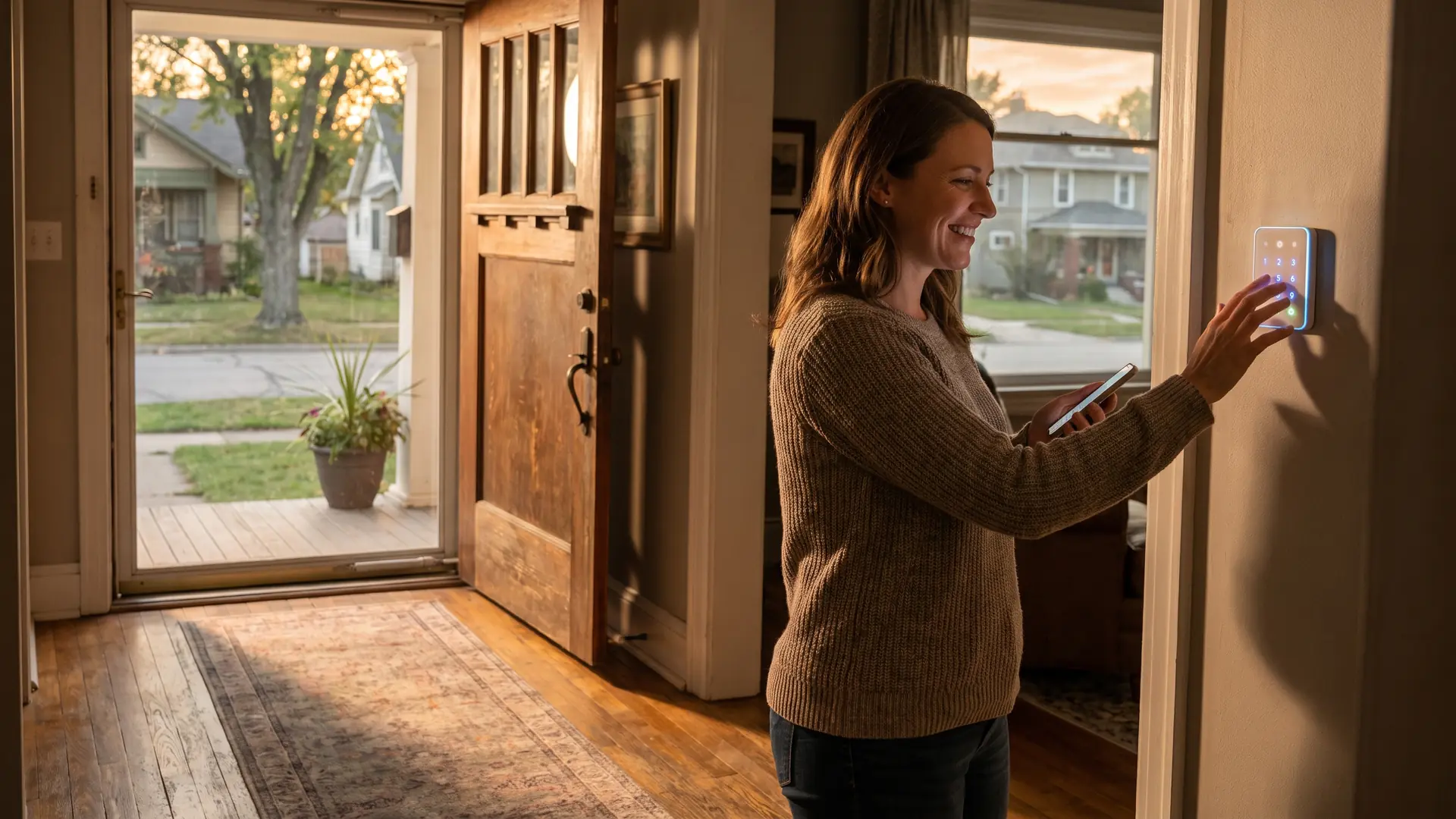
Coverage is the first fork: entry-point monitoring handles most homes, while cameras, glass-break sensors, and smart-home integration add cost and complexity. Installation is the second, and DIY kits skip labor fees and long contracts but put setup and troubleshooting on you. Monitoring is the third, and it’s the one that changes what actually happens at 2 a.m. when a sensor trips.
Learn how to choose a home security system, including how much coverage you need, what DIY and professionally monitored setups cost over three years, and the insurance discount a monitored system can earn. Our Insurance & Protection guide covers the other ways homeowners protect what they’ve financed.
Key takeaways:
- Start with coverage: Decide between entry-point monitoring and whole-home coverage with cameras and glass-break sensors before you compare brands, because that one choice drives most of the distance between a sub-$200 starter kit and a fully equipped professionally installed system.
- DIY versus professional: DIY systems install in an afternoon at no labor cost and usually avoid contracts, while professional installation commonly runs $80 to $150 and adds expert sensor placement plus 24/7 monitoring for a recurring monthly fee.
- Count the total cost: Compare equipment, monitoring, contract length, and warranty across 3 years, then subtract the insurance discount, usually at least 5% for a burglar alarm and as much as 15% to 20% for a monitored fire and burglar alarm paired with a sprinkler system.
What level of security coverage do you need?
Most homes need entry-point coverage first: a contact sensor on every exterior door, sensors on reachable windows, one motion sensor covering the main living area, and a keypad by the door you use most. That layer catches the ordinary break-in and it’s the cheapest part of any system. Count your openings before you shop, because sensor count, not brand, is what moves a quote.
- Entry-point coverage: Door and window contacts plus one or two motion sensors. The baseline nearly every household should have.
- Whole-home coverage: Adds glass-break sensors, interior motion detection, and indoor cameras, so the system still registers an entry that skips a monitored opening.
- Perimeter coverage: Outdoor cameras, a video doorbell, and motion-triggered lighting. Good for evidence and deterrence, but it watches outside rather than a break-in in progress.
- Environmental coverage: Smoke, carbon monoxide, water leak, and freeze sensors, the hazards that damage a house without anyone breaking in.
Deterrence does part of this work for free. Lighting, sight lines, solid locks, and a few habits change the odds before any sensor is involved.
Do alarms change what a burglar decides?
Burglary is common enough to plan around. According to the Bureau of Justice Statistics report Criminal Victimization, 2024, published September 2025, U.S. households experienced 1,103,790 burglaries in 2024, a rate of 8.2 per 1,000 households, and 943,900 households, or 0.71%, had at least one. The same report found that 40.7% of burglaries in 2024 were reported to police.
Many entries do not involve a broken door. An earlier Bureau of Justice Statistics report, Victimization During Household Burglary (September 2010), estimated 3.7 million household burglaries a year on average from 2003 to 2007, with unlawful entry without force (1,949,520 a year) outnumbering forcible entry (1,134,230). A household member was present in about 28% of them, so arm the entry sensors at night, not only when you leave.
The deterrence evidence comes from burglars themselves. In a UNC Charlotte survey of 422 incarcerated burglars in three states, published May 15, 2013 and funded by the alarm industry’s research foundation (AIREF), about 83% said they would try to determine whether an alarm was present before a burglary, and 60% said they would seek another target if one was. Among those who discovered an alarm mid-attempt, half reported they would stop, 31% said they would sometimes retreat, and only 13% said they would always continue.
7 factors that decide which home security system fits
Once you know how much of the house you’re covering, seven factors separate one system from another. The first three settle most of the decision; the last four settle whether you’ll still like the system in year three.
1. Installation: DIY or professional
DIY installation costs nothing but an afternoon, while professional installation commonly runs $80 to $150 on top of equipment.1 Most current DIY kits are wireless and adhesive-mounted, so the job is sensor placement and app pairing, not wiring.
Professional installation earns its fee in three situations: large or oddly shaped homes where placement isn’t obvious, hardwired or takeover systems replacing a legacy panel, and households where nobody wants to own the troubleshooting. Our walkthrough of DIY home security upgrades shows what a self-install involves.
2. Monitoring: self-monitored, professionally monitored, or unmonitored
Professional monitoring runs from under $10 a month at the cheapest plans to $45 or more at the top, and self-monitoring is usually free, but the real difference isn’t price. It’s what happens when you can’t answer your phone.
- Self-monitoring: The system pushes alerts to your phone and you decide whether to call police. No monthly fee, and no help if you’re asleep or out of signal.
- Professional monitoring: A staffed center receives the signal, tries to reach you, and requests dispatch. Ask whether the center is UL-listed under UL 827, the standard for central-station alarm services; listed centers are inspected annually against requirements covering backup power, redundant communications, and operator staffing.
- Unmonitored: A local siren and nothing else. It can scare someone off, but no one is notified and nothing is recorded for a claim.
Professional monitoring is also usually what qualifies a system for an insurance discount.
3. Sensors and cameras: what actually detects a break-in
Sensors do the detecting; cameras do the documenting. Buy in that order.
- Door and window contacts: Two-piece magnetic sensors that trigger when an opening separates, cheap, reliable, and the backbone of every system.
- Motion sensors: Cover interior paths between rooms. With pets, confirm the sensor is rated for their weight range before you buy, not after the first false alarm.
- Glass-break sensors: Listen for the frequency of breaking glass, catching an entry that never separates a monitored contact. Worth adding on sliders and large windows.
- Cameras and video doorbells: Decide up front between cloud recording, which commonly carries a subscription of about $3 to $13 a month, and local storage, which doesn’t.
- Smart locks: Grant and revoke access without copying keys. Confirm the lock talks to your panel rather than living in a separate app.
To get sensors, cameras, and locks working as one system rather than five apps.
4. Backup: cellular signal and battery power
A system that dies with your power or your internet isn’t a security system. Two backups matter: a battery in the panel and a cellular radio that carries the signal when broadband is down.
Fire alarm codes set a useful benchmark. NFPA 72, the National Fire Alarm and Signaling Code, requires a fire alarm system’s secondary power supply to carry the system for at least 24 hours in standby. Burglar alarm panels aren’t governed by that code, so ask the manufacturer how many hours the panel runs on battery, whether the cellular radio is standard or a paid upgrade, and what network it uses, a panel on a retired cellular generation stops reporting.
5. Life-safety sensors: smoke, carbon monoxide, and water
The cheapest sensors in the catalog cover the losses most likely to happen. The U.S. Fire Administration recommends putting smoke alarms inside and outside each bedroom and sleeping area and on every level of the home, choosing interconnected alarms so that when one sounds they all sound, testing monthly, and replacing the entire alarm every 10 years, detail in the U.S. Fire Administration guidance on smoke and fire detection.
Add carbon monoxide alarms wherever you burn fuel, and put water leak sensors under the water heater and behind the washing machine. A sensor that catches a failure in hour one instead of day three is a low-cost device that limits how long water runs before anyone knows.
6. Contract, warranty, and support terms
Contract length runs from month-to-month to five years, and three-year minimums are common among providers that bundle equipment into the monthly fee. A long agreement isn’t automatically bad, it’s how some companies subsidize hardware, but it locks you in if service slips.
- Early termination: Ask what canceling costs in month 7 and whether the contract balance accelerates.
- Equipment ownership: Find out whether you own the hardware or lease it, and whether a leased panel must be returned.
- Moving: Ask whether the system transfers to a new address and what relocation costs, since many buyers install around a move.
- Warranty: Compare warranty length and what a service visit costs once it lapses.
7. App quality and smart-home compatibility
You’ll touch the app daily and the sensors almost never, so app quality matters more than the spec sheet suggests. Check that it delivers alerts reliably, arms and disarms quickly, supports separate user codes, and keeps a reviewable event history. If you already run lights, locks, or a thermostat on a platform, confirm the security system speaks to it rather than sitting beside it, our guide to smart home technology for homeowners explains which connection standards travel best across brands, and this independent comparison of home security system types tests systems side by side.
DIY vs. professionally installed security systems compared
Three configurations cover almost every real purchase. The gap between them is monthly cost and who responds, not detection quality.
| Feature | DIY, self-monitored | DIY, professionally monitored | Professionally installed and monitored |
|---|---|---|---|
| Upfront equipment | Often under $200 for a starter kit | Same kit, sometimes discounted with a plan | Higher; quoted by sensor count and home size |
| Installation cost | $0, your afternoon | $0, your afternoon | Commonly $80 to $150 |
| Monthly fee | $0, plus any video storage | Lower end of the monitoring range | Upper end of the monitoring range |
| Contract | None | Usually month-to-month | Month-to-month up to 5 years; 3-year minimums common |
| Who responds | You, from your phone | A staffed monitoring center | A staffed monitoring center |
| Insurance discount | Rarely qualifies | Usually qualifies | Usually qualifies |
| Best for | Renters, condos, hands-on owners | Most single-family homes | Large homes, hardwired or takeover jobs |
How do you lock down the app that controls your alarm?
The security company’s app account can disarm the whole system, so protect it like a bank login. The Cybersecurity and Infrastructure Security Agency’s Cybersecurity Awareness Month page lists four core steps for everyone: avoid and report phishing scams, use strong passwords, use multifactor authentication and a password manager, and update software. Apply all four to the alarm app and to every camera, and replace any default password a device shipped with.
According to the Federal Communications Commission’s U.S. Cyber Trust Mark page, the FCC adopted rules in March 2024 for a voluntary cybersecurity label, with internet-connected home security cameras among the eligible products and wired devices excluded. Per the FCC, the label’s QR code will link to details such as the product’s support period and whether security updates are automatic.
How quickly do fire and carbon monoxide become dangerous?
According to the U.S. Fire Administration’s residential fire estimates, U.S. residential buildings had 344,600 fires in 2023, with 2,890 deaths, 10,400 injuries and $11,266,200,000 in dollar loss.
Ready.gov’s home fires page (last updated February 26, 2026) says a fire can become life-threatening in just two minutes and a residence can be engulfed in flames in five minutes. Our guide to fire safety tips for homeowners covers the escape plan itself.
According to the U.S. Consumer Product Safety Commission’s Carbon Monoxide Information Center, more than 200 people in the United States die every year from accidental non-fire related CO poisoning associated with consumer products. The CPSC recommends battery-operated CO alarms, or alarms with battery backup, on every level of the home and outside sleeping areas.
According to the Centers for Disease Control and Prevention’s carbon monoxide poisoning basics (last reviewed October 26, 2026), more than 400 Americans die each year from unintentional CO poisoning not linked to fires. The CDC reports that people who are sleeping or intoxicated can die before they have symptoms. Per the CDC, replace a CO detector following the manufacturer’s instructions or every 5 years.
What does a home security system cost over three years?
Sticker price is the smallest part of the number. Run every option out to 36 months, because monitoring fees pass equipment cost quickly. Hypothetical example, not an offer. Here is one house priced three ways, using round figures inside the ranges above.2
- DIY, self-monitored: A $200 kit with no monthly fee costs $200 over three years. Add cloud video at $6 a month and it’s $416.
- DIY, professionally monitored: The same $200 kit plus $20 a month is $200 + $720, or $920 over three years.
- Professionally installed and monitored: $400 in equipment, $150 to install, and $45 a month is $400 + $150 + $1,620, or $2,170 over three years.
The spread between cheapest and most expensive is about $1,970 over three years. Roughly $55 a month for expert placement and a staffed center that dispatches when you can’t. That’s the actual trade. Then adjust twice: subtract any insurance discount, and add the costs hiding outside the monitoring line, like cloud video storage and cellular fees.
Does a monitored security system lower your homeowners insurance?
Often, yes, and the discount is bigger than most buyers expect. According to the Insurance Information Institute, homeowners can usually get discounts of at least 5% for a smoke detector, burglar alarm, or deadbolt locks, and some insurers cut premiums by as much as 15% or 20% for a sophisticated sprinkler system paired with a fire and burglar alarm that rings at a police station, fire station, or other monitoring station.3 The Institute’s own advice: find out what system your insurer recommends, what it costs, and how much you’d actually save before you buy.
Run the math on your own premium rather than a national figure. Hypothetical example, not an offer. If your policy costs $1,800 a year, a 5% discount is $90 a year, or $270 across the three-year window above, enough to cover a starter kit outright.
- Documentation is usually required: Carriers commonly want a monitoring certificate from the provider, not a photo of the panel. Ask what form yours accepts.
- Self-monitoring often doesn’t count: Discounts generally attach to systems monitored by a central station, since that’s what shortens response time.
- The amount varies by carrier and state: There is no standard discount, and two carriers can treat the same system very differently, one more reason to shop. See our guide to evaluating home insurance options and the broader Insurance & Protection hub.
Can you cancel a security system sold at your door?
Federal law gives a short window to back out of an in-home sale. Under the Federal Trade Commission’s Cooling-Off Rule, 16 CFR Part 429, a door-to-door sale is one with a purchase price of $25 or more at the buyer’s residence, or $130 or more at temporary locations such as hotel rooms or fairgrounds. The seller must tell you orally about your right to cancel when you sign, and after a valid cancellation it has 10 business days to refund all payments.
How to compare home security systems before you buy
Four checks catch nearly every expensive mistake here. Run them before the first order, not the third.
- Price the whole 36 months: Equipment, installation, monitoring, video storage, and fees, minus the insurance discount. Compare that total, never the box price.
- Get the terms in writing: Contract length, early termination cost, auto-renewal, price increases after a promotional period, whether you own or lease the hardware, and whether cellular backup is included or extra.
- Check your city’s alarm ordinance: Many municipalities require you to register an alarm with the police department and limit free false-alarm responses before fees apply. Rules vary widely by city, so look yours up before installation day.
- Sequence it with other projects: When security hardware rides along with a larger renovation, windows and doors, a rewire, an addition, that’s a financing question, and lenders in Align’s network offer renovation and cash-out refinance options that fold the cost into the mortgage.4
Worth saying plainly: Align Lending doesn’t sell security equipment or monitoring and has no stake in which brand you choose. Where this meets our work is financing the larger projects a security upgrade sits inside, covered in our Homeownership guide.
What do Michigan laws say about alarm companies, contracts and insurance?
Does an alarm company need a Michigan license?
Yes, if it installs, services or monitors. Michigan’s Private Security Business and Security Alarm Act, MCL 338.1053, requires a state license to offer security alarm contracting, and violating it is a felony punishable by up to 4 years in prison, a fine of up to $1,000, or both. The Act’s definitions, MCL 338.1052, name the Department of Licensing and Regulatory Affairs as the regulator and cover anyone engaged in the installation, maintenance, alteration, monitoring or servicing of security alarm systems. Ask any installer for its Michigan license before signing.
How long do you have to cancel a security contract in Michigan?
If the salesperson signed you up in your own home, Michigan’s Home Solicitation Sales Act, MCL 445.112, lets you back out by giving the company written notice, mailed or handed over, no later than midnight on the third business day after you sign. According to the Michigan Department of Attorney General’s contract cancellation guide, the Act covers goods or services worth more than $25, and you do not have a right to cancel most other contracts. The guide adds that a contract may set the amount you owe if you cancel, called liquidated damages, and that a term fixing unreasonably large liquidated damages is likely void as a penalty.
Does Michigan require a carbon monoxide alarm when you renovate?
It can. Michigan’s construction code act, MCL 125.1504f (in effect since March 23, 2009), lets the state provide for at least 1 operational, approved carbon monoxide device at the time of a permitted renovation of a single-family home or when a bedroom is added. Where a device is required, the statute places it in the vicinity of the bedrooms, in areas next to an attached garage and next to fuel-burning appliances, and an approved device is one listed under ANSI/UL 2034 or ANSI/UL 2075. If an alarm installer is also doing permitted work, ask how the CO requirement will be met; our guide to home renovation permits explains which projects need one.
How do Michigan insurers treat alarms and break-in claims?
The Michigan Department of Insurance and Financial Services’ homeowners insurance guide lists protective devices, naming smoke detectors, fire extinguishers, burglar alarms and heavy duty locks, among the discounts many companies offer, and says each insurance company sets the amount of its discounts. DIFS adds that most companies cap total discounts; in the guide’s example, discounts adding up to over 90% of the premium may be limited to 50%.
After a break-in, DIFS’s claim guide, How to Claim What is Yours (April 2020), lists notifying the police in the event of a theft among your duties and says that under the Michigan Insurance Code the insurer must tell you within 30 days what proof of loss it needs and pay within 60 days of receiving it, with overdue amounts earning 12 percent simple interest. How a theft claim interacts with your deductible is covered in our guide to homeowners insurance deductibles.
A leak sensor can warn you that water is coming up through a floor drain, but whether the policy pays for the cleanup is a separate question: Michigan DIFS’s Water and Sewer Backup Coverage sheet says that protection is an add-on you have to ask your agent for. If a sensor does alert, our guide to how to address water damage in your home covers the first steps.
How do you pay for security work that rides along with a bigger project?
A starter kit is a household purchase; new exterior doors, impact-resistant windows or a hardwired panel during a rewire are home improvements, and they follow the improvement’s financing and paperwork. Work through these steps in order.
- Price the whole project first: Our guide to financing home renovations compares the main routes.
- Match the loan to the timing: Buying a home that needs the work points to a renovation loan; an owner with equity can look at a cash-out refinance, a home equity line of credit or refinancing for home improvements.
- Tell your insurer what changed: New doors, wiring and monitoring can change both coverage and discounts; see home insurance and renovations.
- Put the monthly fee in the budget: Monitoring and video storage are recurring costs; budgeting for home maintenance shows how to carry them, and the seasonal home maintenance checklist is a natural place to schedule sensor tests and battery changes.
- Reset everything after a move: New owners should change every keypad code, app login and garage code the previous owner set; moving and settling and home maintenance for first-time homeowners cover the first weeks in a new house, and the home inspection checklist helps you note an existing panel.
Buyers still shopping can start with our first-time home buyer guide, and the home improvement hub collects the rest of the upgrade guides.
How Align handles insurance and taxes in your payment
Insurance is part of your monthly cost whether it is escrowed or not, so Samantha prices the full payment before you commit, not just principal and interest.
She also builds in Michigan's tax uncapping. The year after a Michigan home sells, its taxable value resets to half of the assessor's market value, so the seller's tax bill is not your tax bill. She quotes your number, not theirs.
Get a homebuying budget review
Sources: Michigan Treasury, transfer of ownership and uncapping.
FAQ: Choosing a home security system
Here are answers to common questions about choosing a home security system.
Is a DIY or professionally installed security system better?
It depends on your home and your tolerance for setup. DIY kits cost less upfront, install in an afternoon, and usually avoid contracts, which suits renters, smaller homes, and tech-comfortable owners. Professional installation is worth it for large or complex homes, hardwired systems, and anyone who wants placement handled by an expert and 24/7 monitoring included. Our guide to DIY home security upgrades shows what a self-install involves.
Do I need professional monitoring?
Not necessarily, but it changes what happens when an alarm trips. Self-monitoring sends alerts to your phone and relies on you to act; professional monitoring means a person calls you and requests emergency dispatch even if your phone is unavailable. Professional monitoring is also usually what qualifies you for a homeowners insurance discount.
Does a home security system lower homeowners insurance?
Often, yes. Most insurers offer a discount for a monitored alarm system, and some add discounts for smoke and water sensors. The size varies by carrier and policy, so ask your agent what documentation they require before you buy. Over several years, the discount can offset a meaningful share of monitoring costs, our guide to evaluating home insurance options covers how to compare carriers on more than price.
What features matter most in a home security system?
Reliable entry-point sensors, a smartphone app with real-time alerts, a cellular or battery backup so the system survives a power or internet outage, and clear warranty and support terms. Cameras and smart-home integration are useful but secondary. Contract length matters too, since a long agreement locks you in if service quality drops.
Should smoke alarms be ionization or photoelectric?
Both. The U.S. Fire Administration’s smoke alarm guidance (page last reviewed October 13, 2026) says the two types detect different kinds of fires, and since no one can predict which fire a home will have, it recommends either both ionization and photoelectric alarms or dual-sensor alarms that contain both. It also notes alarms for people with hearing loss that flash a strobe or vibrate.
Is it legal to record audio on a home security camera in Michigan?
Video has a home exception; audio does not. MCL 750.539d bars recording in a private place without consent, but its subsection (2) exempts security monitoring in a residence by or at the direction of the owner or principal occupant, unless for a lewd or lascivious purpose. MCL 750.539c separately makes eavesdropping on a private conversation without all parties’ consent a felony punishable by up to 2 years or $2,000. Turn audio off, or ask an attorney.
Can you deduct a home security system on your taxes?
Only the business part, and only if you qualify to deduct business use of your home. According to IRS Publication 587 (2025), if a security system protects all the doors and windows in your home, you can deduct the business part of the expenses to maintain and monitor it, and depreciate the business part of its cost. The personal share of a home system is not covered there. Confirm with a tax professional.
What is the U.S. Cyber Trust Mark on smart home devices?
It is a federal labeling program for internet-connected consumer devices. According to the National Institute of Standards and Technology, the White House announced the U.S. Cyber Trust Mark on July 18, 2023, with participation by the Federal Communications Commission and the Departments of Energy and State. NIST’s baseline for consumer device security, NIST IR 8425, was finalized September 19, 2022. Treat the label as one check, not a guarantee.
The bottom line on choosing a home security system
Choosing a home security system is three decisions in order: what you cover, who installs it, and who monitors it. Start with entry-point coverage on every exterior door and reachable window, then decide whether cameras and glass-break sensors earn their cost. A DIY kit commonly runs under $200 with no monthly fee, professional installation commonly runs $80 to $150, and professional monitoring adds anywhere from under $10 a month to $45 or more. Price every option across 36 months, then subtract the insurance discount, usually at least 5% for a burglar alarm, and as much as 15% to 20% for a monitored fire and burglar alarm paired with a sprinkler system.
If you’re ready to take on the larger project a security upgrade belongs to, new windows and doors, a rewire, or a full renovation, talk to Align Lending. We’ll shop your scenario across our lender network and show you the options side by side. Call 248-506-5727 or start online.
Footnotes:
1. Equipment, installation, monitoring, contract-length, and cloud-storage figures reflect ranges published in Security.org’s home security system comparison as of August 2026, and are typical ranges rather than quotes. Pricing, promotional offers, and contract terms change frequently and vary by provider, package, home size, and region, confirm current pricing with any provider before you buy. Return to text.
2. The three-year cost comparisons and the insurance-discount math are illustrative arithmetic using round figures inside the ranges cited above, not quotes, estimates, or averages for any household. The $1,800 annual premium is hypothetical, used only to show how a percentage discount converts to dollars; it is not a representation of typical premiums in any state or market. Return to text.
3. Discount figures are the Insurance Information Institute’s general guidance on lowering homeowners insurance costs and describe what some insurers offer, not a discount any carrier is obligated to provide. Availability, size, qualifying equipment, and required documentation vary by insurer, policy, and state. Align Lending does not sell insurance and does not underwrite, quote, or set premiums, confirm any discount with your insurer or agent before purchasing equipment. Return to text.
4. Align Lending is an independent mortgage broker and does not set loan terms. Renovation and cash-out refinance program terms, eligibility, and available loan amounts are set by the individual wholesale lenders in Align’s network and are subject to change, credit approval, property eligibility, and equity requirements. Nothing here is an offer of credit or a commitment to lend. Return to text.
Sources: equipment, installation, monitoring, contract-length, and cloud-storage ranges, Security.org, “How to Choose a Home Security System” (accessed August 2026). Discount figures of at least 5% and as much as 15% or 20%, Insurance Information Institute, “12 Ways to Lower Your Homeowners Insurance Costs”, see the Insurance Information Institute on home security premium discounts. Smoke alarm placement, interconnection, monthly testing, and 10-year replacement guidance, U.S. Fire Administration. Twenty-four-hour secondary power standby requirement for fire alarm systems, NFPA 72, National Fire Alarm and Signaling Code. Central-station alarm service requirements, UL 827, Standard for Central-Station Alarm Services.
This article is for informational purposes only and is not intended to provide legal, financial, tax, insurance, or engineering advice. Security equipment pricing, monitoring plans, contract terms, insurance discounts, and municipal alarm ordinances change frequently and vary by provider, carrier, and location, verify current details before you buy. Electrical and low-voltage work should be performed by a licensed contractor under local code and permitting requirements. Align Lending is an independent Michigan mortgage broker, NMLS #2041154.
Sources
Every outside source this guide links to, in the order it appears. How we choose and check sources
- Criminal Victimization, 2024bjs.ojp.gov
- Victimization During Household Burglarybjs.ojp.gov
- UNC Charlotte survey of 422 incarcerated burglarsinside.charlotte.edu
- U.S. Fire Administration guidance on smoke and fire detectionU.S. Fire Administration
- Independent comparison of home security system typessecurity.org
- Cybersecurity Awareness Month pagecisa.gov
- U.S. Cyber Trust Mark pagefcc.gov
- Residential fire estimatesU.S. Fire Administration
- Home fires pageReady.gov
- Carbon Monoxide Information Centercpsc.gov
- Carbon monoxide poisoning basicscdc.gov
- According to the Insurance Information InstituteInsurance Information Institute
- 16 CFR Part 429Electronic Code of Federal Regulations
- MCL 338.1053Michigan Legislature
- MCL 338.1052Michigan Legislature
- MCL 445.112Michigan Legislature
- Contract cancellation guideState of Michigan
- MCL 125.1504fMichigan Legislature
- Homeowners insurance guideState of Michigan
- How to Claim What is YoursState of Michigan
- Water and Sewer Backup CoverageState of Michigan
- Smoke alarm guidanceU.S. Fire Administration
- MCL 750.539dMichigan Legislature
- MCL 750.539cMichigan Legislature
- IRS Publication 587Internal Revenue Service
- National Institute of Standards and Technologynist.gov
- Insurance Information Institute on home security premium discountsInsurance Information Institute
Related resources

20-minute read
How to evaluate home insurance options: Coverage, limits and quotes
Learn how to evaluate home insurance options by comparing dwelling limits, deductibles, exclusions and discounts so your coverage truly rebuilds your home.
20-minute read
Homeowners insurance deductibles: How they work and how to choose one
Learn how homeowners insurance deductibles work, why percentage deductibles can cost thousands more, and how to pick an amount that fits your savings.

20-minute read
Flood insurance: When it’s required, what it covers and what it costs
Find out when flood insurance is required, why a quarter of claims come from low-risk areas, and how the 30-day NFIP waiting period affects your closing.
Also worth reading
- Installing a home fire sprinkler systemLearn how home fire sprinklers work, what installation costs in new builds versus retrofits, and how much they cut fire death and property damage risk.
