
Home maintenance: What to do, when to do it, and what it costs
Home maintenance is the scheduled upkeep that keeps a house’s major systems, roof, foundation, plumbing, electrical, and the exterior envelope, working before they fail, plus the recovery work when something fails anyway. The standard budgeting rule is 1% – 4% of your home’s value per year, so a $300,000 home in Waterford means roughly $3,000 – $12,000 set aside annually, with older homes sitting at the top of that range.1
Most of the work is seasonal and predictable: gutters, heating, and shutoffs in fall; roof, grading, and drainage in spring.
Learn more about home maintenance, including the seasonal checklist, the five systems worth watching, and what to do after water or smoke damage.
Key takeaways:
- Budget 1% – 4% of your home’s value every year: On a $300,000 home that’s $3,000 – $12,000 annually, and homes over 30 years old belong at the top of the range, not the bottom.
- Water is what actually destroys houses: Gutters, grading, roof flashing, and plumbing shutoffs account for most catastrophic homeowner claims, and all four are cheap to maintain and expensive to ignore.
- Deferred maintenance shows up on your appraisal: A roof at end of life or an unpermitted electrical panel can hold up a refinance or a sale. Which is why a renovation loan or cash-out refinance is often cheaper than a credit card when a big repair lands.
How much does home maintenance cost per year?
Plan on 1% – 4% of your home’s value each year, $3,000 – $12,000 on a $300,000 home. That’s the rule most lenders, agents, and financial planners use, and it’s the single largest controllable slice of what homeownership costs after closing. A second rule of thumb, $1 per square foot per year, gets used just as often. The two rules frequently disagree, and knowing which one to trust is the whole trick.
Four things move your number inside that range:
- Age of the home: A house built in the last decade is still living on original components and warranties. A 1960s home has already replaced some systems once and is due to replace others, which pushes it toward the 3% – 4% end.
- Roof and mechanical life stage: Where your roof, furnace, and water heater sit on their service lives matters more than the home’s age on paper. Three components at year 18 means a very expensive three-year window ahead.
- Climate exposure: Freeze-thaw cycles, ice, wind, and heavy tree cover all raise the bill. Michigan homes carry a real weather premium that a rule of thumb calculated for a national average does not.
- DIY versus hired out: Gutters, filters, caulk, and winterizing are afternoons if you do them and invoices if you don’t. Labor is usually the larger half of a small repair.
Here’s the disagreement in practice. Take a $300,000, 1,800-square-foot 1968 ranch in Waterford. The 1% rule says $3,000 a year. The $1-per-square-foot rule says $1,800. The square-foot rule undercounts badly on older homes because square footage says nothing about the age of the roof over it, and on a home this age, a 3% budget of $9,000 is closer to reality once you spread a roof and a furnace across a decade. Use the percentage rule, set the percentage by the home’s age, and treat the square-foot rule as a floor rather than a target.
Whichever number you land on, park it somewhere separate from the checking account. Our taxes and money hub covers how homeowners structure reserves alongside escrow and property taxes, and if you closed in the last year or two, start with home maintenance for first-time homeowners before you build the budget.
The seasonal home maintenance calendar
Roughly 80% of routine upkeep falls into four short seasonal passes, each of which takes an afternoon. Running them on schedule is what turns a $200 service call into the thing that didn’t become a $9,000 claim. Our seasonal home maintenance checklist is the printable version; here’s the shape of it.
- Spring: Inspect the roof and flashing after winter, walk the grading to confirm the ground still slopes away from the foundation, extend downspouts at least 4 – 6 feet from the wall, and get the air conditioner serviced before the first hot week. AC service commonly runs $80 – $200.
- Summer: Re-caulk windows and doors, touch up exterior paint before bare wood weathers, seal the driveway and deck, and cut back the vegetation touching the siding. Contact with the wall is how both moisture and insects get in.
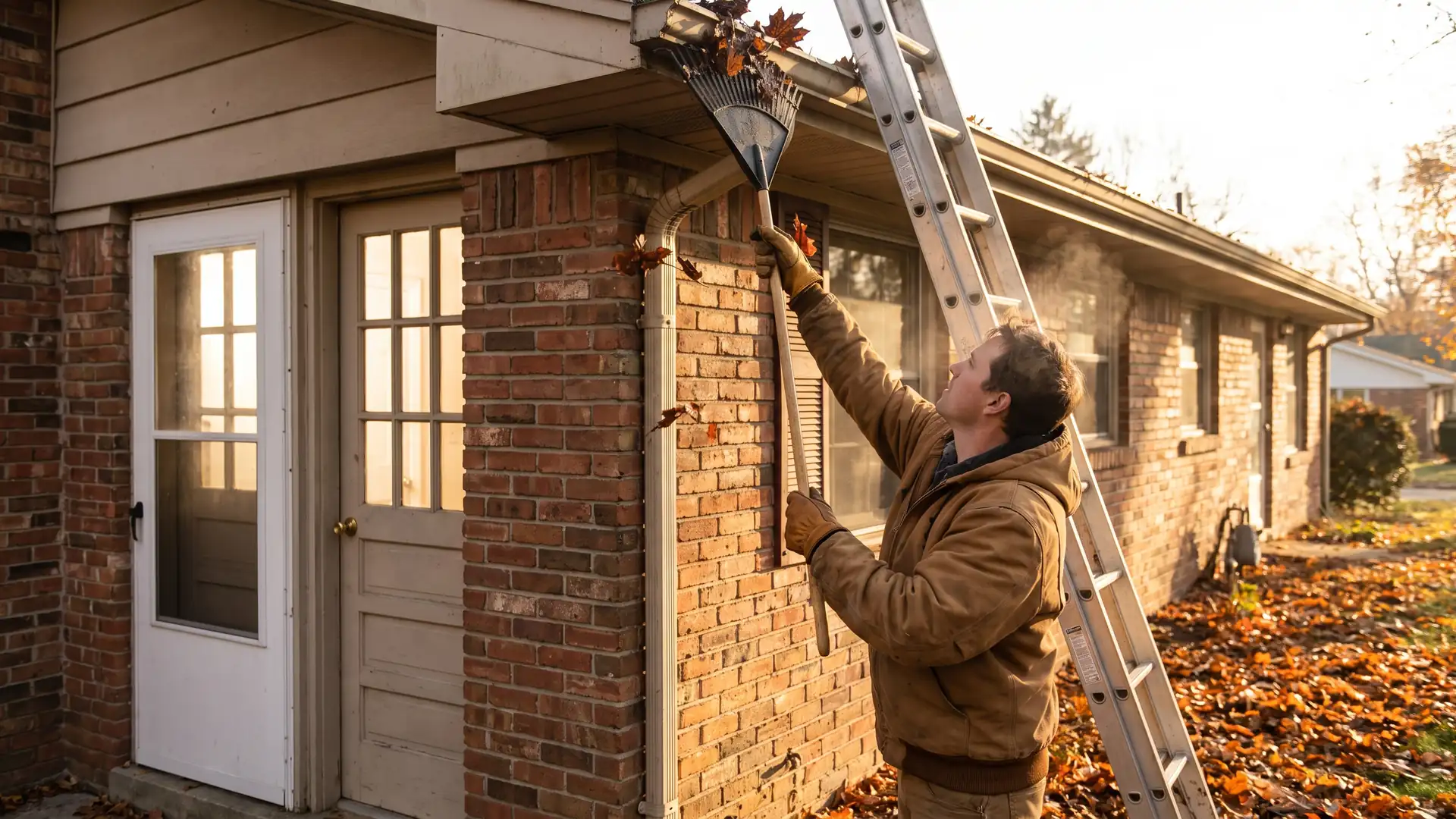
- Fall: This is the season that matters most in Michigan. Clean the gutters, service the furnace, shut off and drain the exterior hose bibs, and have the chimney inspected if you burn wood. A furnace tune-up typically runs $80 – $200; professional gutter cleaning commonly runs $150 – $350 on a single-story home, and our guide to cleaning gutters: DIY vs. professional covers when the ladder isn’t worth it.
- Winter: Watch for ice dams after every thaw, check that the attic is cold and well ventilated rather than warm and sealed, keep indoor humidity low enough that windows aren’t sweating, and clear snow off flat or low-slope roofs and away from furnace and dryer vents. The full routine lives in winterizing your home.
Now that the calendar is set, here’s how to tell which of your systems is closest to needing real money.
System by system: the five things worth watching
Every expensive part of a house has a known service life, which means you can put your own home on a timeline today. Asphalt shingle roofs typically last 15 – 30 years, with most Michigan roofs replaced somewhere around year 20 – 25. Water heaters last 8 – 12 years. Furnaces and central air run 15 – 20. Write down the install year of each and you’ve built a replacement calendar most homeowners never have.
- Roof: Full replacement commonly runs $8,000 – $25,000 depending on size, pitch, and material, so a $400 flashing repair at year 18 is the highest-return maintenance dollar in the house. Inspect after every major wind or hail event, see maintaining your home’s roof.
- Foundation and drainage: Most foundation problems are drainage problems that were ignored for a decade. Grading, gutters, downspout extensions, and a working sump pump cost a few hundred dollars; structural repair runs into five figures. Our guide to dealing with foundation issues explains which cracks are cosmetic and which ones aren’t.
- Plumbing: Know where your main shutoff is before you need it, because a burst supply line can put hundreds of gallons into a finished basement in an hour. Replace rubber washing-machine hoses with braided stainless every 5 – 7 years. Our guide to maintaining your home’s plumbing system covers the annual walkthrough.
- Electrical panel: Panel capacity, not age, is what limits you, a 100-amp panel struggles with a modern kitchen, an EV charger, and central air at once. Certain older panel brands are also a known insurability problem. Start with understanding your home’s electrical panel.
- Exterior envelope: Siding, windows, doors, caulk, and flashing are one continuous barrier, and every failure in it costs you twice, once in energy and once in moisture. Walk it twice a year, as covered in maintaining your home’s exterior.
- Septic: The EPA recommends pumping a household septic tank every 3 – 5 years and having the system inspected at least every 3 years. Pumping typically costs $250 – $500; replacing a failed conventional system runs $5,000 – $15,000. Rural Michigan readers should start with maintaining a septic system.
Maintenance protects the value you already have; renovation is a different budget with different math. Our home improvement and design hub covers the projects worth doing once the house is holding its own.
When something goes wrong: damage recovery
The first 24 – 48 hours decide what the repair costs. The EPA advises drying water-damaged areas and materials within 24 – 48 hours specifically because that’s the window before mold takes hold, and mold is what turns a plumbing repair into a remediation project. Work the list in this order.
- Water damage: Stop the source, kill the power to affected circuits, photograph everything before you move it, then dry aggressively with fans and a dehumidifier. Sudden and accidental damage is generally covered; gradual seepage and surface flooding generally are not, and flood requires a separate policy through the National Flood Insurance Program or a private carrier. Our guide to how to address water damage in your home covers the documentation that protects a claim.
- Mold: Under about 10 square feet, roughly a 3-by-3-foot patch, EPA guidance says most homeowners can handle cleanup themselves. Above that, or after significant water damage, it’s a professional remediation job. Either way the moisture source has to be fixed first or it comes back. See addressing mold issues in your home.
- Smoke and fire damage: Soot is acidic and keeps eating metal, plastic, and finishes for weeks, so speed matters, but don’t clean or discard anything before the adjuster documents it. Smoke damage from a covered fire is typically covered; smoke from a neighboring property or a wildfire may be treated differently. Read coping with smoke damage first.
- Pests: Termites and carpenter ants are structural, not cosmetic, and standard homeowners policies almost universally exclude them as a maintenance issue. That makes prevention, moisture control, no wood-to-soil contact, sealed entry points, the only coverage you get. See protecting your home from pests.
The coverage lines above are where most homeowners get surprised, and they vary by policy. Our insurance and protection hub covers what a standard policy includes, what it excludes, and which endorsements are worth adding.
Storms, extreme weather, and homes you’re not living in
Storm prep is cheap and the coverage gaps are expensive, which is the whole argument for doing it in advance. The universal playbook is short: trim limbs that overhang the roof, know how to shut off gas and water, put the sump pump on a battery backup, keep a current photo or video inventory of the house off-site, and store the policy number somewhere you can reach it without power. Our guide to preparing your home for extreme weather covers the full checklist.
Worth being straight about geography: hurricane preparation is a real and separate discipline, but it applies to readers with coastal or out-of-state property. Michigan’s equivalents are ice storms, straight-line winds, lake-effect snow load, and spring flooding, different hazards, same principle that the prep costs less than the deductible.
Vacant and seasonal properties carry an extra risk most owners never read about: many homeowners policies limit or exclude coverage once a home has been unoccupied beyond a set number of days, usually somewhere between 30 and 60. Winterize an unoccupied Michigan property completely, keep the heat on rather than shutting it off, add a freeze and water-leak sensor, and tell your insurer the home is seasonal so the policy is written for it. Our vacation home maintenance tips cover remote monitoring and the shut-down routine.
What Michigan homeowners should know
Michigan’s freeze-thaw climate creates maintenance obligations that simply don’t exist in most of the country, and two of them, ice dams and radon, are routinely misdiagnosed.
- Freeze-thaw cycles: Michigan winters cross the freezing line repeatedly rather than staying cold, and each cycle drives water into cracks and then expands it. That’s what breaks up driveways, mortar joints, and poured foundation walls. Sealing cracks in the fall isn’t optional maintenance here; it’s the cheapest structural work you’ll ever do.
- Ice dams: Ice dams are an attic heat-loss problem, not a gutter problem. Warm air escaping into the attic melts snow at the ridge, the water refreezes at the cold eave, and the backup pushes under the shingles. The real fix is air sealing, insulation, and ventilation. Plus the ice-and-water barrier membrane at the eaves that cold-climate roofing in Michigan is built around. Cleaning your gutters harder does nothing.
- Radon: This is Michigan’s quiet one. EPA recommends fixing any home testing at 4 pCi/L or higher, and Michigan’s Department of Environment, Great Lakes, and Energy expects one in every four Michigan homes to exceed that level against the EPA’s national estimate of roughly one home in 15. Elevated results have turned up in every Michigan county, and the state residential building code requires radon-resistant construction techniques in nine of them. EGLE puts a Michigan mitigation system at $800 – $2,500 depending on where you are and who you hire. Test kits cost a fraction of that.
- Septic and well: Michigan has no statewide point-of-sale inspection rule, but local health departments write their own sanitary codes and a number of Michigan counties and townships do require a septic and well inspection at transfer. Check with your county health department before you list, and keep pumping on the 3 – 5 year schedule regardless, because a failed system discovered mid-transaction is a closing delay on top of a repair bill.
FAQ: Home maintenance
Here are answers to common questions about home maintenance.
How often should I have my roof and furnace inspected?
Annually for the furnace, every one to two years for the roof, and after any major wind or hail event. A furnace tune-up typically runs $80 – $200 and catches the heat-exchanger and ignition problems that cause mid-January failures; a roof inspection catches flashing and shingle damage while it’s still a repair instead of a replacement. An inspector checks flashing, valleys, vent boots, and the condition of the shingle granules.
Does homeowners insurance cover water damage?
It depends on where the water came from. Sudden and accidental damage, a burst pipe, a failed water heater, is generally covered; gradual leaks, seepage, poor maintenance, and surface flooding generally are not, and flooding requires a separate flood policy. Sewer and drain backup is usually an add-on endorsement. Photograph everything before you move it, and keep receipts for the drying equipment. That documentation is what protects the claim.
Can I finance a major home repair?
Yes, and there are usually three or four ways. A cash-out refinance replaces your mortgage and pulls equity out, a home equity loan or HELOC leaves your first mortgage alone, and an FHA 203(k) or conventional renovation loan rolls the repair into the loan itself. Which one wins depends on your current rate and equity. As a broker, Align prices all of them across multiple wholesale lenders instead of steering you to one product.
Is a home warranty worth buying?
It depends on the age of your systems. A warranty running $400 – $900 a year plus a $75 – $125 service fee per visit tends to pay off on homes with aging furnaces, water heaters, and appliances, and tends to lose money on newer homes still under manufacturer coverage. Read the exclusion list before you buy. Pre-existing conditions and improperly maintained equipment are the two most common denials. A maintenance reserve you control is often the better default.
The bottom line on home maintenance
Budget 1% – 4% of your home’s value every year for upkeep. Roughly $3,000 – $12,000 annually on a $300,000 home, at the top of that range if the house is older than 30 years. Water is what actually destroys houses, so gutters, grading, roof flashing, and a shutoff you can find in the dark earn their keep every year. Run the four seasonal passes, write down the install year of your roof, furnace, and water heater, and the expensive surprises stop being surprises.
If you’re ready to fund a major repair without draining your savings, talk to Align Lending, we’ll shop cash-out, HELOC, and renovation loan options across our lender network and show you the numbers side by side. Call 248-506-5727 or start online today.
1 Cost figures are educational estimates and vary by home, region, and contractor; they are hypothetical, do not constitute an advertisement of credit terms or a rate quote under federal or state lending laws, and your rate and terms will depend on your application and market conditions. Back to text
Every Home Maintenance guide in the Learn Center
The full home maintenance library, so you can go straight to the question you actually have.
- Home maintenance tips for new owners: Monthly to yearly
- Preparing Your Home for a Hurricane: The Complete Season Checklist
- Seasonal home maintenance: what to do in each season
- Tips for maintaining a home's foundation and preventing damage
This article is for informational purposes only and is not intended to provide legal, financial, or tax advice. Consult a qualified professional about your situation. Align Lending works with FHA-approved lenders and is not acting on behalf of or at the direction of FHA or HUD.
More on Homeownership

Featured resources

11-minute read
Home maintenance for first-time homeowners: A full checklist
Learn what home maintenance for first-time homeowners involves, with monthly, seasonal, and annual tasks plus how much to budget each year for upkeep.
