
How to install a home EV charger: Costs, permits and steps
Installing a home EV charger almost always means one thing: a Level 2 unit on a dedicated 240-volt circuit, most often protected by a 40- or 50-amp breaker. That circuit is the entire point: Level 2 charging adds roughly 10 to 20 miles of range per hour, while the Level 1 cord that came with your car adds about 2 to 5 miles per hour from a standard 120-volt outlet.1
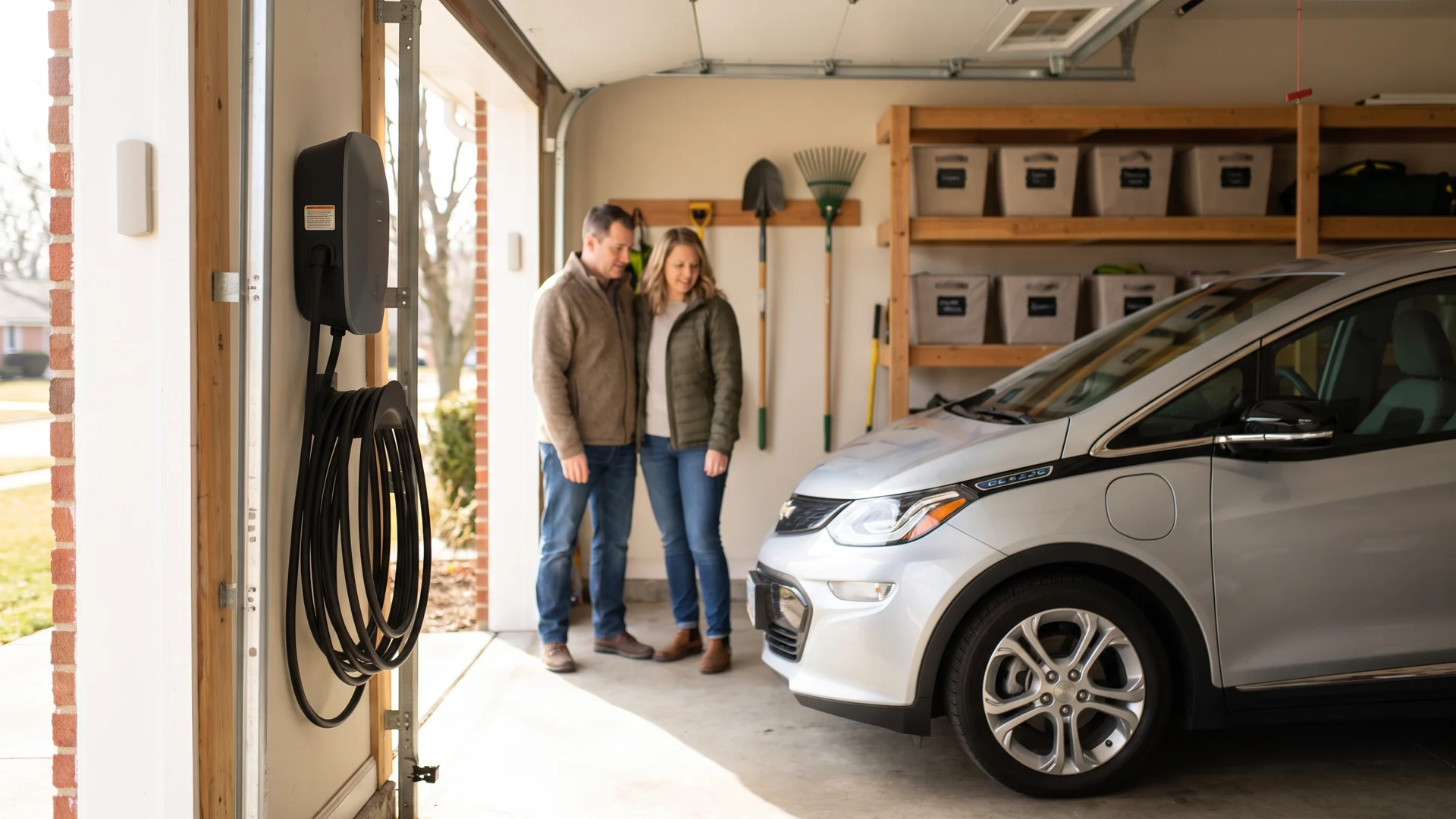
That circuit is also what turns this from a weekend project into a permitted job, and your two biggest cost variables are the distance from panel to parking spot and whether the panel has spare capacity at all.
Learn how to check your panel before you shop, what the electrician handles versus what you can, and which Michigan rebates are still on the table. Our Home Improvement & Design guide covers the rest of the project list.
Key takeaways:
- Level 2 is the home standard: A Level 2 charger on a dedicated 240-volt circuit adds roughly 10 to 20 miles of range per hour versus 2 to 5 from a 120-volt outlet, which is why it refills most EVs overnight.
- Panel capacity sets the budget: 200-amp service usually has room for a 40- or 50-amp charger circuit; 100-amp service may need load management, a subpanel, or a service upgrade.
- Permits and code are not optional: Michigan’s Part 8 rules, effective March 12, 2024, adopt the 2023 National Electrical Code, which sizes the breaker at 125% of the charger’s output.
Why install a Level 2 charger instead of using the included cord?
Because the included cord is roughly four to five times slower. Level 1 runs on a standard 120-volt outlet and adds about 2 to 5 miles of range per hour, according to the U.S. Department of Energy. Level 2 runs on a 240-volt circuit, the class of circuit a clothes dryer uses, and adds roughly 10 to 20 miles per hour, with faster vehicles and higher-output equipment reaching considerably more.2
In an overnight window, eight hours on Level 1 gets a mid-size EV about 40 miles of range, which is why the Department of Energy describes only Level 2 as capable of charging a typical EV battery overnight. That said, Level 1 isn’t useless: if you drive 20 or 30 miles a day and have a dedicated 120-volt circuit near the car, the cord in the trunk may be enough. A longer commute or a second EV changes that, and it’s cheaper to run the circuit once than twice.
One honest caveat: a Level 2 charger doesn’t make electricity cheaper by itself. Charging on an off-peak rate does. That’s the logic behind most energy-efficient home upgrades, the equipment creates the opportunity, the settings capture the savings.
Is Level 1 charging enough for how far you drive?
ENERGY STAR draws the line at daily mileage. Its EV charger buying page says a driver who covers less than 40 miles per day, or anyone with a plug-in hybrid, can use a charger that plugs into a standard 120-volt wall outlet. Past that point, the same page steers fully electric drivers toward Level 2.
Real driving often runs past that line. The Department of Energy’s Fact of the Week #1332, published March 4, 2024 from the Federal Highway Administration’s 2022 National Household Travel Survey, reported that the vehicle in a one-vehicle household averages about 50 miles a day, and the first vehicle in a two-vehicle household averages nearly 60. In that survey, second and later vehicles drove less than 60% of the first vehicle’s daily miles. Both first-vehicle averages sit above ENERGY STAR’s 40-mile mark, so a household that leans on one EV should price a Level 2 circuit, while a second EV used for short errands may manage on Level 1.
Can your electrical panel handle an EV charger?
Check this before you pick a charger, because your panel determines what you’re allowed to install. A Level 2 charger is a continuous load under the National Electrical Code, so the breaker and conductors must be rated at 125% of its maximum continuous output: a 32-amp charger takes a 40-amp circuit, a 40-amp charger takes a 50-amp circuit, and a 48-amp charger takes a 60-amp circuit.
The tool that answers the question is a load calculation, an electrician’s inventory of everything your service already feeds, measured against the capacity of the service itself. It takes one visit and it’s the most useful thing you can buy before shopping.
If you have 200-amp service
You most likely have room. A 200-amp panel usually absorbs a 40- or 50-amp charger circuit without drama, assuming two adjacent open breaker spaces and a panel in good condition. The remaining variables are physical: how far the charger sits from the panel, and what the wire has to pass through.
If you have 100-amp service
You have a decision to make, and it usually has three exits.
- Load management: A load-management device lets a charger share existing capacity by throttling when the rest of the house draws heavily. It’s often the cheapest path on a constrained panel and avoids a service upgrade entirely.
- A lower-amperage charger: Not every install needs 48 amps. A 16- or 32-amp charger still delivers multiples of Level 1 speed and may fit a panel a 60-amp circuit would not.
- A subpanel or service upgrade: If the load calculation says the service is maxed out, you’re upgrading, a bigger project involving the utility and the meter, worth doing once with future loads in mind.
If a heat pump, an induction range, or a second EV is in your five-year plan, tell the electrician now, sizing the service once costs far less than three trips. The National Association of Home Builders makes the same plan-ahead point in its electric vehicle policy, which supports the voluntary pre-wiring of homes for future EV charger installation.
Hardwired vs. plug-in: how to choose a home EV charger
The first real decision is connection type. It drives amperage, code requirements, and whether the unit moves with you.
| Feature | Hardwired | Plug-in (NEMA 14-50) |
|---|---|---|
| Typical amperage | Up to 48 amps or more, on a 60-amp circuit | Capped at 40 amps continuous, on a 50-amp circuit |
| Outdoor installation | Preferred, and required in some jurisdictions | Allowed where code permits; needs a rated enclosure |
| Portability | Stays with the house; removal needs an electrician | Unplugs; moves with you or swaps out |
| GFCI considerations | Fewer receptacle-specific requirements | Receptacle rules apply; stacked GFCI can nuisance-trip |
| Smart features | Scheduling, usage tracking, utility enrollment | Same feature set on comparable models |
The 2023 NEC tightened ground-fault protection requirements around receptacle outlets used for EV charging, and jurisdictions adopt code editions on different schedules. Before buying a plug-in unit, ask your electrician which edition your inspector enforces. The receptacle, not the charger, is where those rules land.
Beyond connection type, three specs separate models. Output in amps should match what your car can accept, paying for 48 amps when the vehicle tops out at 32 buys nothing. Cable length decides whether you can reach the charge port; 20 to 25 feet covers most garages. Certification is the one to check in writing, since many utility rebates require an ENERGY STAR certified and UL-listed unit or one supplied by your automaker. Certified chargers also draw about 40% less power in standby, and chargers sit idle roughly 85% of the time. Start from ENERGY STAR’s EV charger page to see which models carry the label.
Smart features earn their place for one reason: they automate off-peak charging, and on many utility programs they’re what makes you eligible at all. The same connectivity behind smart home technology for homeowners applies here.
What the installation process looks like
A straightforward install is usually a single day’s work, split between what you decide and what a licensed electrician executes.
What you handle
- Choosing the location: Measure from your car’s charge port to the wall with the vehicle parked where it normally sits, accounting for backing in versus pulling in.
- Picking the unit: Confirm amperage, enclosure rating, cable length, and certification against your rebate program’s requirements before ordering.
- Mounting the charger: Most units hang on a bracket anchored to a stud at roughly chest height. Find the stud, mark it, and mount level.
What the licensed electrician handles
- The load calculation: Verifying your service can carry the new circuit, and specifying load management if it can’t.
- The circuit: Sizing the breaker and conductors at 125% of the charger’s output, running the wire, grounding it, and adding a disconnect where code requires one.
- Permit and inspection: Pulling the permit, meeting the inspector, and closing it out. An open permit follows the house and surfaces when you sell.
Then test it. Charge once at full output and confirm the charger reports the amperage you paid for. Set the off-peak schedule that same evening, that’s the setting that produces the savings, and the one people forget.
Permits, code and inspection: what’s actually required
A permit is required, and it isn’t a formality. Michigan law requires one before anyone installs, alters, or adds to electrical conductors or equipment, and the state’s Part 8 rules, effective March 12, 2024, adopt the 2023 National Electrical Code with state amendments. Permits are issued through Michigan’s Bureau of Construction Codes, or your municipality where local enforcement applies.
Two people can pull that permit: a licensed electrical contractor, or a homeowner doing the work in a single-family home they own and occupy. That exemption is real but narrow. It doesn’t cover rental property or work performed for compensation, and the job still has to pass inspection against the same code.
Skipping the permit creates problems that outlast the charger. Unpermitted work can complicate an insurance claim after a fire, void equipment warranties, and reliably becomes a negotiating point when you sell. It’s also the only independent check that a 50-amp circuit in your garage was done right.
Where do you apply for an electrical permit in Michigan, and who sets the fee?
LARA’s Electrical Permit Information page tells applicants to review the Statewide Jurisdiction List first, because electrical code enforcement may be conducted by the state, a county or a local unit of government, and the application must go to the agency that enforces where you live. Where the state handles it, permits can be checked and obtained online, or by mail, which LARA warns may cause delays. Permit questions go to the Building Trades Section at 517-241-9313.
Fees are local by law. Michigan’s construction code act, at MCL 125.1522, directs the legislative body of each governmental subdivision to establish reasonable fees for its enforcing agency, intended to bear a reasonable relation to the cost, including overhead. That is why neighboring townships can charge different fees for the same circuit.
The electrical rules themselves are under review. LARA’s currently open rules page lists a 2026 rule set for Part 8, the Michigan Electrical Code, and a public advisory meeting on the proposed draft held August 27, 2026. A permit is inspected against the rules in force when it is issued, so ask the inspector which edition applies to yours. See our guides to home renovation permits and home insurance and renovations, and if you plan to sell, pre-listing inspections for finding open items before buyers do.
What does it cost to install a home EV charger?
Two line items: the charger and the electrical work. Hardware is the predictable half; the electrical work is where quotes diverge, and four things move it.
- Distance from the panel: The largest driver. A charger on the garage wall directly behind the panel is the cheapest scenario.
- What the wire passes through: Unfinished basement or exposed framing is fast. Fishing wire through finished walls is slow, and slow is expensive.
- Whether the panel needs work: A spare double space costs nothing, load management is modest, and a subpanel or service upgrade is the largest variable in the project.
- Detached versus attached garage: A detached garage may need trenching and a buried feeder, a different category of job entirely.
Prices vary too much by region, home age, and labor market for a national average to help you. Get three itemized quotes that each separate the charger, the circuit, panel work, and the permit fee. Angi’s published electrical project cost ranges by region are a reasonable check on whether a bid is in the right neighborhood.
One incentive has changed, and it matters. The federal Alternative Fuel Vehicle Refueling Property Credit under Section 30C, claimed on IRS Form 8911, applied only to eligible property placed in service from January 1, 2023 through June 30, 2026, and only in a qualifying low-income or non-urban census tract. It does not apply to property placed in service after June 30, 2026, so a charger installed today does not qualify.3 Utility rebates are where the remaining money is.
How much does it cost to charge an EV at home in Michigan?
Michigan electricity costs more than the national average, and the gap has grown. The U.S. Energy Information Administration’s Electric Power Monthly table 5.6.A, released October 23, 2026, puts Michigan’s average residential price at 22.99 cents per kilowatt-hour in August 2026, up from 20.73 cents in August 2025, an increase of about 10.9% in a year. The U.S. residential average was 18.16 cents in August 2026. EIA marks the 2026 figures as preliminary.
The Department of Energy’s home charging page uses a car that consumes 27 kWh per 100 miles in its own cost example; the table applies that figure to the EIA prices.
| EIA price basis | Price per kWh | Per 100 miles at 27 kWh | Per 100 miles in deep cold (about 44.3 kWh) | One 50-mile day |
|---|---|---|---|---|
| Michigan, August 2026 | $0.2299 | $6.21 | $10.18 | $3.10 |
| Michigan, August 2025 | $0.2073 | $5.60 | $9.18 | $2.80 |
| U.S. average, August 2026 | $0.1816 | $4.90 | $8.04 | $2.45 |
Hypothetical example, not an offer. Prices: U.S. Energy Information Administration, Electric Power Monthly table 5.6.A, released October 23, 2026 (August 2026 preliminary, August 2025 final). Consumption: 27 kWh per 100 miles from the Department of Energy’s home charging cost example. Deep cold divides 27 kWh by 0.61 for the roughly 39% fuel economy drop at 20 degrees Fahrenheit with the heater on, per fueleconomy.gov. The 50-mile day is the one-vehicle household average from Fact of the Week #1332. Excludes charging losses and fixed charges.
For example, at the August 2026 Michigan price, a 50-mile day in that 27 kWh car costs about $3.10, or roughly $93 over a 30-day month, before charging losses and the fixed service charge on your bill. On a 20-degree day with the heater running, the same 50 miles cost closer to $5.09.
Rooftop solar changes this math; see our guide to buying a home with solar panels.
What Michigan homeowners should know
Michigan’s two large utilities both pay toward a home charger, and both tie that money to an overnight rate.
- Consumers Energy: The PowerMIDrive program pays $500 toward a qualifying Level 2 home charger installation, or up to $1,000 for income-qualified customers. The charger must top out at 9.6 kW, a 50-amp circuit, 40 amps of output, and be ENERGY STAR rated and UL-certified or supplied by your automaker.
- DTE Energy: DTE runs its own residential charger rebate, with household income thresholds on the current program. The charger must be ENERGY STAR certified or share a manufacturer with your EV, and you apply within six months of installation.
- Off-peak rates: Both rebates come attached to a rate plan. Consumers Energy enrolls recipients in its Nighttime Savers Rate and asks for proof the vehicle charges between 11 p.m. and 6 a.m. on weekdays. DTE’s EV-friendly options include Overnight Savers and its 11 a.m. to 7 p.m. Time of Day rate.
- Cold weather raises the stakes: At 20 degrees Fahrenheit with the heater running, EV range drops roughly 41% in mixed city and highway driving, with about two-thirds of that extra energy heating the cabin rather than the battery. Michigan winters mean planning around a smaller usable battery. Exactly when refilling every night stops being optional.
Program amounts, income limits, and rate schedules change, and eligibility often depends on which charger you bought. Confirm terms before ordering.
How do DTE and Consumers Energy decide who gets the charger money?
DTE’s rebate is income-qualified. Its Home EV Charger Rebate page, as opened November 1, 2026, says the rebate may cover the cost of a Level 2 charger and its installation for current DTE residential electric customers whose account is in good standing with no outstanding balance, up to these maximum annual household incomes:
| People in household | Maximum qualified annual income |
|---|---|
| 1 | $31,920 |
| 2 | $43,280 |
| 3 | $54,640 |
| 4 | $66,000 |
| 5 | $77,360 |
| 6 | $88,720 |
| 7 | $100,080 |
| 8 | $111,440 |
| 9 | $122,800 |
| 10 | $134,160 |
| 11 | $145,520 |
| 12 | $156,880 |
Source: DTE Energy, Home EV Charger Rebate, maximum qualified annual income by household size, page opened November 1, 2026.
According to DTE, household size follows your tax return. Enrollment in an energy assistance program within the last 12 months, such as the Home Heating Credit or State Emergency Relief, qualifies you; otherwise DTE’s verifier reviews each adult’s most recent tax transcript. The page publishes no fixed rebate amount, so get it in writing before you order.
Consumers Energy adds a payment for how you charge, not only for the install. Its electric vehicle page, as opened November 1, 2026, offers $120 per EV for charging during specific off-peak times, with the qualifying hours linked from that page.
Can Michigan’s MiHER rebates help pay for panel and wiring work?
Possibly, for income-qualified households, and only through the state’s program. The Department of Energy’s home upgrades page lists a High-Efficiency Electric Home Rebate of up to $4,000 for an electrical panel and up to $2,500 for electrical wiring, and says your state, territory or Tribe manages those rebates.
In Michigan the program is MiHER, the Michigan Home Energy Rebates program, run by EGLE. EGLE’s August 20, 2026 program update says MiHER has two rebate pathways that each received just over $105 million in federal funding, that the HEAR electrification rebates are available to households with incomes at or below 150% of Area Median Income, and that the program’s goal is to fund upgrades for approximately 15,000 Michigan homes.
Ask whether panel work can be approved through MiHER before the electrician starts; a home energy audit helps if other electrification work is on the list.
How do you protect range when charging in deep cold?
Use the charger to warm the car before you unplug. According to fueleconomy.gov’s cold weather guidance, preheating the cabin while plugged into the charger can extend your vehicle’s range, and using the seat warmers instead of the cabin heater can save energy and extend range. The heat then comes from the house circuit, not the battery. See our guide to winterizing your home.
Fueleconomy.gov also separates cold from heater use: at 20 degrees Fahrenheit with the heater off, EV range is about 12% lower than at 75 degrees, citing a 2019 AAA study. Most of the gap between that and the 41% loss described above is cabin heat, which is why a plugged-in warm-up helps.
How do you pay for a panel or service upgrade?
Start with the reason. Samantha Shelton puts it plainly: “Your house isn’t an ATM. Equity is valuable. So there should be a reason behind using it.” A charger circuit on its own is usually a single day’s electrician work. Borrowing against the house tends to come up only when the electrician says the service itself has to grow, and the same new panel is meant to carry a heat pump or an induction range later.
A panel upgrade is billed once, so a lump-sum home equity loan (usually a fixed rate, per the CFPB) fits it more naturally than a home equity line of credit, which the CFPB describes as a line of credit with a usually adjustable rate. That changes if the panel is phase one of a staged electrification plan, with the heat pump and range wired in later years. A cash-out refinance replaces the whole mortgage and often comes with closing costs, per the CFPB, so it rarely makes sense for a job this size on its own. For the home equity loan, the CFPB warns that if you cannot pay it back, the lender could foreclose on your home.
If you are buying a home that needs the service upgrade, a renovation mortgage can fold the electrical work into the purchase loan. Fannie Mae’s HomeStyle Renovation guide names energy improvements among the work lenders may include in the loan amount, and HUD’s 203(k) program page describes financing to repair, improve or upgrade a home (our 203(k) guide has the program limits). Align Lending is not acting on behalf of HUD, FHA or Fannie Mae.
Our guides to home equity loans, HELOCs, cash-out refinancing with its closing costs, and renovation financing go further, and the Loan Estimate check helps you compare offers line by line.
How Align finances a renovation
You are not just financing the house. You are financing a plan for it. Align places HomeStyle and FHA 203(k) renovation loans, standalone HELOCs and home equity loans, so the project can be paid for the way that fits it, not the way one bank prefers.
Samantha starts with why: what the work is, what it should cost, and whether your equity or a renovation loan is the better tool. Then one application goes to multiple wholesale lenders.
FAQ: Installing a home EV charger
Here are answers to common questions about installing a home EV charger.
Do I need an electrician to install a home EV charger?
For the circuit, yes in practice. Running a new 240-volt circuit, sizing the breaker, and performing a load calculation are licensed-electrician work in most jurisdictions, and a permit and inspection are required either way. Michigan does let a homeowner pull the permit and do the work in a single-family home they own and occupy, but it still has to pass inspection against the 2023 National Electrical Code.
Can my electrical panel handle an EV charger?
It depends on your service size and existing load. Homes on 200-amp service usually have room for a 40- or 50-amp charger circuit. Homes on 100-amp service often need a load calculation first and may need a load-management device, a subpanel, or a full service upgrade. An electrician can run that calculation in one visit, before you buy hardware you can’t power.
How much does it cost to install a Level 2 charger at home?
It depends almost entirely on the electrical work, not the charger. Costs climb with the distance between your panel and the parking spot, whether the wire passes through finished walls, and whether the panel needs upgrading. A unit mounted next to the panel in an attached garage is the cheapest scenario; a detached garage requiring a trench is the most expensive. Get three itemized quotes rather than relying on a national average, and budget it alongside your other home improvement and design projects.
Should I install a hardwired charger or a plug-in unit?
Hardwired units run at higher amperage, are preferred or required outdoors in some jurisdictions, and look cleaner on the wall. Plug-in units on a NEMA 14-50 receptacle cap out at 40 amps continuous, but can be swapped or taken with you when you move. The deciding factor is often local code, since receptacle installations carry ground-fault protection requirements that hardwired ones don’t. Confirm your charger’s manual and your inspector’s code edition before ordering, and check that the model supports the scheduling features your connected home setup and utility program require.
Can I claim the EV charger tax credit on my 2026 tax return?
Yes, if the charger was placed in service at your main home between January 1 and June 30, 2026, in an eligible census tract. The IRS credit page sets the credit at 30% of the cost, up to $1,000 per item, and each charging port counts as one item. Property placed in service in 2025 or 2026 is checked against the 2020 census tract list. The IRS form page says you figure it on Form 8911 with its Schedule A.
Can I install an EV charger outside?
Yes. The Department of Energy’s home charging guidance says residential equipment is frequently installed in garages, but outdoor installation and use are also safe, even when the vehicle is charging in the rain, as long as the equipment is rated for outdoor use. The same page notes that in many areas a site installation plan must be submitted to the permitting authority for approval before installation, so settle the mounting spot before the permit is filed.
Can I install an EV charger at a condo or apartment?
Often, but it is a building decision as much as an electrical one. The Department of Energy’s Alternative Fuels Data Center says charging at multifamily housing requires additional considerations and may be more like public charging than charging at a single-family home. The EPA’s EV myths page, updated June 10, 2026, notes that charging stations are becoming a more common amenity in apartment and condominium buildings. Ask the association or landlord who controls the parking space and wiring first.
Are EV chargers sold online safety certified?
Not always. ENERGY STAR’s EV charger page warns that not all EV chargers for sale are safety certified, including some sold by large online and storefront retailers. Its remedy is to choose a unit that has earned the ENERGY STAR label, because every certified charger is tested for safety by a nationally recognized testing laboratory. Look for the testing lab’s mark on the unit and its paperwork, not only on the product listing, before the electrician mounts it.
The bottom line on installing a home EV charger
Installing a home EV charger means adding a Level 2 unit on a dedicated 240-volt circuit, usually on a 40- or 50-amp breaker. That circuit is worth the trouble because Level 2 adds roughly 10 to 20 miles of range per hour against 2 to 5 from a 120-volt outlet, the difference between refilling overnight and never quite catching up. Check your panel first: 200-amp service usually has room, while 100-amp service may need load management, a subpanel, or an upgrade. Then pull the permit, use a licensed electrician, and confirm your charger qualifies for your utility’s rebate before you order.
If the electrical work turns out to be a service upgrade rather than a simple circuit, that becomes a financing question, one our Homeownership guide touches on. If you’re ready to price that work, talk to Align Lending: we’ll shop renovation and cash-out options across our lender network and show you the numbers side by side.4 Call 248-506-5727 or start online.
Footnotes:
1. Charging speeds are U.S. Department of Energy general estimates and are not a specification for any particular vehicle. Actual miles of range added per hour depend on your vehicle’s onboard charger capacity, the output of the charging equipment, the state of charge of the battery, and ambient temperature. Verify your vehicle’s maximum AC charging rate before selecting equipment. Return to text.
2. The Department of Energy notes that Level 2 charging speed varies considerably among vehicles, from a few miles of range per hour to roughly 40 miles per hour at the high end. The 10 to 20 mile-per-hour figure is a typical residential range, not a guaranteed rate. Return to text.
3. Tax information here is general and current as of the date shown above; it is not tax advice. The Section 30C Alternative Fuel Vehicle Refueling Property Credit applied to eligible property placed in service January 1, 2023 through June 30, 2026, was subject to census tract eligibility, and does not apply to property placed in service after June 30, 2026. Tax law and utility program terms change. Consult a qualified tax professional about your specific situation. Return to text.
4. Align Lending is an independent mortgage broker and does not set loan terms. Renovation and cash-out refinance program terms, eligibility, and available loan amounts are set by the individual wholesale lenders in Align’s network and are subject to change, credit approval, property eligibility, and equity requirements. Nothing here is an offer of credit or a commitment to lend. Return to text.
Sources: Level 1 and Level 2 charging speeds, 240-volt residential service, and overnight charging capability, U.S. Department of Energy, Alternative Fuels Data Center (“Charging Electric Vehicles at Home” and “Electric Vehicle Charging Stations”). Continuous-load breaker and conductor sizing at 125%, National Electrical Code Article 625 and related articles. Michigan permit requirement, homeowner permit eligibility, and adoption of the 2023 National Electrical Code effective March 12, 2024, Michigan Department of Licensing and Regulatory Affairs, Bureau of Construction Codes (2023 Part 8 Michigan Electrical Code rules). Section 30C credit amounts, census tract eligibility, and the June 30, 2026 placed-in-service deadline, Internal Revenue Service (“Alternative Fuel Vehicle Refueling Property Credit for Individuals” and Instructions for Form 8911). PowerMIDrive rebate amounts, charger output limits, and Nighttime Savers Rate requirements, Consumers Energy. Residential charger rebate eligibility, ENERGY STAR or automaker charger requirement, and six-month application window, DTE Energy. Cold-weather range reduction of roughly 41% at 20 degrees Fahrenheit in mixed city and highway driving, U.S. Department of Energy and U.S. Environmental Protection Agency, fueleconomy.gov (“Fuel Economy in Cold Weather“), citing AAA Electric Vehicle Range Testing. ENERGY STAR standby power savings and standby duty cycle for certified EV chargers, ENERGY STAR.
This article is for informational purposes only and is not intended to provide legal, financial, tax, or engineering advice. Consult a qualified professional about your situation. Charger pricing, utility rebate amounts, income limits, rate schedules, and adopted code editions change frequently and vary by utility and jurisdiction, verify current details before you buy. All electrical work should be performed under a valid permit and in compliance with the electrical code adopted by your local authority having jurisdiction. Align Lending is an independent Michigan mortgage broker, NMLS #2041154.
Sources
Every outside source this guide links to, in the order it appears. How we choose and check sources
- The Department of Energy describes only Level 2U.S. Department of Energy
- EV charger buying pageENERGY STAR
- Fact of the Week #1332U.S. Department of Energy
- Electric vehicle policyNational Association of Home Builders
- Michigan’s Bureau of Construction CodesState of Michigan
- MCL 125.1522Michigan Legislature
- Currently open rules pageState of Michigan
- Alternative Fuel Vehicle Refueling Property Credit under Section 30CInternal Revenue Service
- IRS Form 8911Internal Revenue Service
- Electric Power Monthly table 5.6.Aeia.gov
- Home charging pageU.S. Department of Energy
- Fueleconomy.gov
- The PowerMIDrive programconsumersenergy.com
- DTE runs its own residential charger rebatedteenergy.com
- Home upgrades pageU.S. Department of Energy
- August 20, 2026 program updateState of Michigan
- Home equity loanConsumer Financial Protection Bureau
- Home equity line of creditConsumer Financial Protection Bureau
- Cash-out refinanceConsumer Financial Protection Bureau
- HomeStyle Renovation guideFannie Mae Selling Guide
- 203(k) program pageU.S. Department of Housing and Urban Development
- EV myths pageU.S. Environmental Protection Agency
Related resources

20-minute read
Energy-efficient home upgrades in Michigan: What to do first, and how to pay for it
See which energy-efficient upgrades pay off first in a Michigan home, what they cost, and how to pay for them in 2026 with rebates, loans and mortgages.

20-minute read
DIY home renovation projects: 12 upgrades you can actually finish
Discover DIY home renovation projects that upgrade your space on a budget, from peel-and-stick backsplashes to floating shelves and smart lighting.
20-minute read
The benefits of a home energy audit and what it includes
Learn what a home energy audit finds, how blower door and infrared tests work, and why the Department of Energy ties audits to 5% to 30% savings.
