
Dealing with foundation issues: Signs, causes and repairs
Foundation problems announce themselves through a specific set of signs: stair-step or diagonal cracks in masonry, doors and windows that stick, sloping floors, gaps opening at trim, and horizontal cracks in a basement wall. Repairs commonly run from roughly $2,000 for drainage correction and crack sealing to well over $10,000 for piering or wall stabilization. Crack direction is the fastest triage tool you have. Thin vertical cracks in poured concrete are often normal curing shrinkage, while a horizontal crack signals soil pressure pushing the wall inward and needs a professional now.
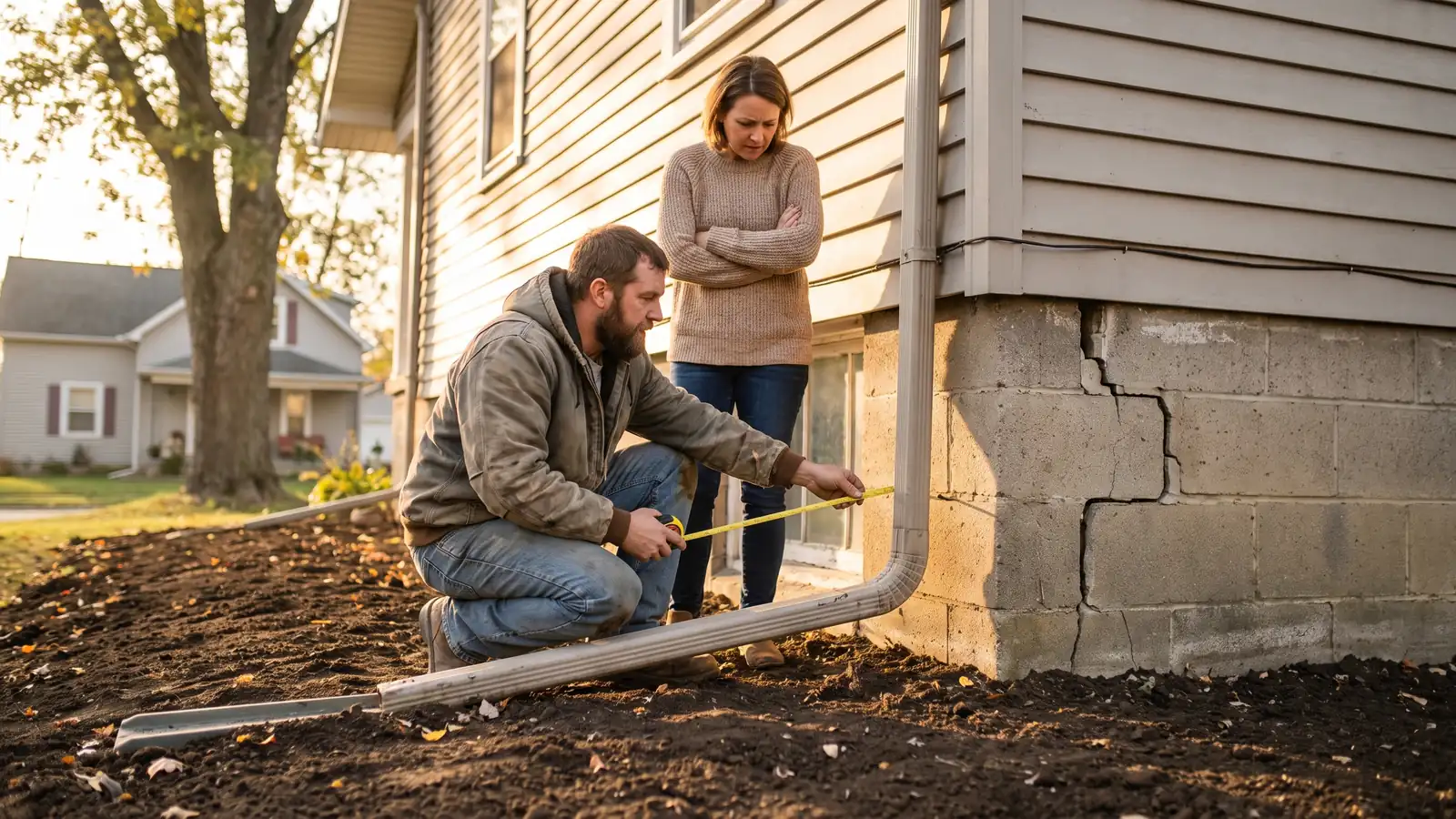
Almost every lasting fix starts with water, because soil moisture change is the underlying cause in most foundation failures. A contractor who quotes you piers without ever mentioning your gutters and grading is selling half a repair.
Learn how to deal with foundation issues: how to read each crack type, what the six common repair methods actually fix, and the water-management checklist that keeps damage from returning, one of the higher-stakes items in our Home Maintenance guide.
Key takeaways:
- Crack direction is the triage: Of the 4 common crack patterns, horizontal cracks are the urgent one, they mean lateral soil pressure, not normal settling, and stair-step cracks wider than about a quarter inch need a professional evaluation.
- Water is the root cause: Soil moisture change drives most foundation movement, so 5 drainage checks, gutters, downspout extensions, grading, sump pump and window wells, belong in any durable repair.
- Repairs scale with severity: The 6 standard methods run from crack injection and drainage correction around $2,000 up to piering above $10,000, get at least 3 quotes, each naming the underlying cause.
What are foundation issues?
Foundation issues are any movement, cracking or deterioration in the structure your house sits on, the footings, walls and slab that carry the building’s load into the soil. What usually fails isn’t the foundation but the soil under it, which swells when wet, shrinks when dry and heaves when it freezes, moving the house unevenly along with it.
Four patterns cover nearly everything a homeowner sees: settlement, where part of the foundation drops as soil compresses; heave, where expanding soil pushes a slab upward; lateral pressure, where saturated soil bows a basement wall inward; and deterioration of old mortar or spalling block. Which one you have determines the right repair.
What are the signs of foundation problems?
Start with the cracks, because the pattern tells you more than the width does. Read the table against what you see, then check the secondary signs below it.
| Crack type | Likely cause | Severity | What to do |
|---|---|---|---|
| Thin vertical, in poured concrete | Normal shrinkage as concrete cured | Low | Monitor; seal it if water seeps through |
| Diagonal, from a window or door corner | Differential settlement, one section dropping faster | Moderate | Mark and date each end, re-measure in 60 to 90 days |
| Stair-step, following mortar joints in block or brick | Settlement or lateral pressure tracking the weakest path | Moderate to high above about 1/4 inch | Professional evaluation, especially if widening |
| Horizontal, across a basement or crawl space wall | Lateral soil or hydrostatic pressure pushing the wall in | High, urgent | Stop; call a structural engineer |
A wall that visibly bows inward outranks all four: it’s carrying load it was never built to carry, so it gets evaluated immediately, not monitored. For photos of each pattern, see this illustrated guide to foundation damage types.
These are the quieter signals:
- Doors and windows that stick: Openings that suddenly bind, or latches that no longer line up, mean the frame has racked out of square.
- Sloping floors: Set a marble down mid-room. Consistent roll across several rooms points at the structure, not the flooring.
- Gaps at trim: Baseboards pulling off the wall, molding separating at corners, or a countertop drifting off its backsplash.
- Water where it wasn’t: Efflorescence on block, a musty smell, or seepage after storms often precedes visible cracking. Our guide on how to address water damage in your home covers drying the space out first.
One sign alone is usually nothing; two or three together, or any one worsening, is the threshold for a professional look. New owners should photograph the foundation on the first walkthrough to set a baseline, a habit from our home maintenance tips for new owners.
What causes foundation problems?
Water, directly or indirectly, is behind most of it. Each cause below is either a way water reaches your footings or a way the soil was compromised before you owned the house.
- Expansive clay soil: Clay swells when wet and shrinks when dry, moving soil under your footings repeatedly, the driver behind most seasonal crack widening.
- Poor drainage and grading: Soil sloping toward the house, a downspout dumping at the wall, or a gutter overflowing in one spot concentrates water where you least want it.
- Plumbing leaks: A slow supply or sewer leak under a slab saturates soil invisibly for years, until the floor above it moves.
- Tree roots: Large trees near the house pull moisture from the soil in dry months, causing localized shrinkage.
- Construction shortcuts: Backfill that was never properly compacted settles on its own schedule, however well you maintain the house.
- Age and freeze-thaw: Mortar softens, block spalls, and repeated freezing and thawing works cracks wider each season in northern climates.
Working out which applies is the entire job of the diagnosis. A repair aimed at the wrong cause, sealing a crack that is really a drainage problem, buys a season before it reopens.
How is foundation damage repaired?
Six methods cover nearly every residential job, and they aren’t interchangeable, each fixes a specific failure and leaves the others untouched.
| Method | What it fixes | What it doesn’t fix | Relative cost |
|---|---|---|---|
| Crack injection (epoxy or polyurethane) | Seals non-structural cracks and stops seepage | Ongoing movement, or the water source outside | Lowest |
| Drainage correction (gutters, regrading, drain tile, sump) | Removes the water driving soil movement | Damage already done to wall or footing | Low to moderate |
| Carbon fiber straps | Keeps a slightly bowed wall from moving further | Won’t straighten a wall or lift settlement | Moderate |
| Wall anchors or steel braces | Stabilizes seriously bowed walls; may recover movement | Vertical settlement; anchors need yard access | Moderate to high |
| Slabjacking or polyurethane foam lifting | Raises a sunken slab or garage floor toward level | Wall cracking, bowing or footing failure | Moderate |
| Piering or underpinning (push or helical piers) | Transfers load to stable soil, halting settlement | Lateral pressure on walls; water intrusion | Highest |
Cost tracks the method, not the crack. Piering sits at the top because each pier is priced individually and driven until it reaches load-bearing soil, a depth nobody knows until they start. Published foundation repair cost ranges by method help with orientation, but they’re national averages; your number depends on access, depth, wall length and local labor. Price the actual scope locally.
What to expect when you hire a foundation pro
Expect two visits before work starts, and expect the diagnosis to cost something. Free inspections from companies that sell only one repair method tend to find that method necessary.
1. Get an independent assessment
A licensed structural engineer works for you, not a repair crew, and writes up cause, severity and remedy in a report you can hand to bidders. On a purchase, the inspector’s report is the starting point, if yours flagged the foundation, our guide on how to read a home inspection report explains which findings escalate. You can also find a certified home inspector for a second look.
2. Collect at least three detailed quotes
Require every bid to name the underlying cause, not just the fix. A quote listing 8 piers with no explanation of why the soil failed is a price, not a plan. Confirm each bid includes drainage work if water is implicated.
3. Verify credentials, then plan the sequence
Check licensing and insurance, ask for local references on jobs 3 or more years old, and read the warranty closely: whether it transfers to a buyer, what voids it, and whether the company will still be around to honor it. Walk away from bids that expire in 48 hours or follow unsolicited door-knocking. When work starts, water management goes first or alongside the structural repair, never after, and budget cosmetic fixes like drywall as a separate trade once the structure stops moving.
How to prevent foundation problems
Prevention is water management, and it comes down to 5 checks you can run in an afternoon. Do these before spending anything on structural work; they also protect whatever you repair.
- Gutters: Clean them at least twice a year and after heavy leaf drop. One overflow point sends concentrated runoff into the same patch of soil every season.
- Downspout extensions: Discharge well away from the wall, several feet at minimum, farther on flat lots. Splash blocks alone rarely suffice.
- Grading slope: Soil should fall away from the foundation in every direction. Settled backfill that now slopes toward the house is the most common fixable cause of seepage.
- Sump pump: Pour water into the pit to test it, confirm the discharge runs away from the house and isn’t crushed, and add a battery backup if the basement is finished.
- Window wells: Keep them clear of debris, confirm each has a working drain, and add covers where they fill during storms.
Two habits round it out: keep soil moisture even during dry spells instead of letting clay shrink hard and then soaking it, and re-measure any crack you’re tracking.
What foundation issues mean for value and financing
Documented, professionally repaired damage with a transferable warranty is a manageable disclosure. Unexplained cracking with no paperwork is what costs you at closing, because buyers and appraisers price uncertainty at the top of the range.
Condition also drives loan eligibility. Appraisers rate property condition on a C1 through C6 scale, and a C6 property, one with substantial damage affecting structural integrity, isn’t eligible for sale to Fannie Mae until it’s repaired to at least C5. FHA applies its own Minimum Property Requirements: insured homes must be safe, sound and secure, and the appraiser must note each instance of noncompliance with the repairs and estimated cost.1 VA loans carry parallel minimum property requirements.2 In practice, cosmetic cracking rarely stops a loan; a flagged structural defect usually must be resolved before closing.
That’s solvable. Renovation mortgages finance the purchase and the repair in one loan, underwritten against the home’s value after the work is done. FHA’s Standard 203(k) is the version built for structural work. It requires a HUD-approved 203(k) Consultant and at least $5,000 in rehabilitation costs, while the Limited 203(k) caps at $75,000 and covers minor, non-structural work only. Fannie Mae HomeStyle Renovation and Freddie Mac CHOICERenovation do the same job conventionally.
Say a $260,000 house needs $28,000 of foundation and drainage work: a Standard 203(k) would let you finance roughly $288,000 and take ownership of a repaired home, instead of closing and then hunting for $28,000 in cash.3 If you’re selling and weighing repair against a price cut, our guide on how to sell a home with foundation issues lays out both paths, and our Homeownership guide covers the financing side.
What Michigan homeowners should know
Michigan stresses foundations differently than warmer states, and the difference is freeze-thaw acting on clay-heavy soil.
- A long freezing season: Michigan’s frost-free season runs from roughly 80 days in parts of the Upper Peninsula to about 170 days in the Lower Peninsula. The rest of the year, soil around your footings freezes, thaws and moves. Which is why cracks here widen in visible steps each spring.
- Footings must sit below the frost line: The Michigan Residential Code, which adopts the 2015 International Residential Code, requires footings to extend below frost depth. That depth is enforced locally, so ask your building department for the number that applies to your parcel rather than trusting a figure you read online. Older homes sometimes sit shallower than current code allows.
- Basements change the failure mode: Full basements are the norm across much of Michigan, so the common problem isn’t a settling slab. It’s a block wall bowing or cracking horizontally under saturated-soil pressure, which is why drain tile, sump performance and grading matter so much here.
- Verify the license: Michigan licenses residential builders and maintenance and alteration contractors through the Department of Licensing and Regulatory Affairs. Confirm a contractor’s license and insurance are current, and ask whether your municipality requires a permit for the work.
How Align helps when a repair is bigger than your savings
Most repairs belong in a savings account, not a loan. When one does not, like a roof or a furnace, Samantha looks at whether a home equity line, a home equity loan or waiting makes more sense for you.
Align places standalone HELOCs and home equity loans, so you can keep your first mortgage and its rate in place. She explains the payment and the risk before you borrow against your home.
FAQ: Foundation issues in a home
Here are answers to common questions about foundation issues in a home.
Which foundation cracks are serious?
Horizontal cracks in a basement or crawl space wall are the most serious, because they indicate soil or water pressure pushing the wall inward. Stair-step cracks in block or brick wider than about a quarter inch, cracks that grow over time, and cracks accompanied by sloping floors or sticking doors also warrant a professional evaluation. Thin vertical cracks in poured concrete are frequently shrinkage and less alarming. Our guide on how to read a home inspection report explains how inspectors phrase severity.
How much does foundation repair cost?
Costs track with the method. Sealing a crack and correcting drainage is the least expensive path, wall anchors and carbon fiber straps sit in the middle, and underpinning with piers is the most expensive because each pier is priced individually and driven to load-bearing soil. Get at least three quotes, and require that each one names the underlying cause, not just the repair.
Can you get a mortgage on a house with foundation issues?
It depends on severity and loan type. Cosmetic cracking usually is not an obstacle, but structural damage flagged by an appraiser can trigger a repair requirement before closing, particularly on FHA and VA loans that require the property to be safe, sound and structurally secure. Renovation loan programs exist to finance the purchase and repair together, see the advantages of buying a fixer-upper for how that math works.
Does homeowners insurance cover foundation problems?
Usually not when the cause is settling, soil movement, poor drainage or long-term water seepage, which policies typically exclude as earth movement or maintenance. Coverage is more likely when a sudden covered peril causes the damage, such as a burst supply line washing out soil beneath the footing. Read your policy’s earth movement exclusion carefully, and ask about separate endorsements.
The bottom line on foundation issues
Foundation problems show up as stair-step or diagonal cracks, sticking doors, sloping floors and horizontal cracks in basement walls, and crack direction is your fastest triage. Vertical hairlines in poured concrete are often harmless shrinkage; horizontal cracks mean soil pressure and need immediate evaluation. Repairs commonly run from roughly $2,000 for drainage correction and crack sealing to well over $10,000 for piering or wall stabilization. Whatever method you choose, fix the water first.
If you’re ready to buy or refinance a home that needs structural work, talk to Align Lending. We’ll shop renovation and cash-out options across our lender network and show you the numbers side by side. Call 248-506-5727 or start online.
Footnotes:
1. Align Lending is not acting on behalf of or at the direction of FHA or HUD. FHA Minimum Property Requirements are set by HUD in Handbook 4000.1 and are subject to change. Appraiser condition ratings and eligibility standards are set by Fannie Mae in its Selling Guide and may be applied differently by individual lenders. Return to text.
2. Align Lending works with VA-approved lenders and is not endorsed or sponsored by the Dept. of Veterans Affairs or any government agency. VA minimum property requirements are set by the Department of Veterans Affairs and are subject to change. Return to text.
3. Example figures are hypothetical and for educational purposes only; they do not constitute an advertisement of credit terms or a rate quote under federal or state lending laws. The $260,000 purchase price and $28,000 repair cost are illustrative round numbers chosen to show how a renovation loan combines the two. They are not an estimate of what any repair costs or what any borrower would be approved for. Renovation loan amounts are limited by program rules, appraised after-improved value, and lender requirements. FHA 203(k), Fannie Mae HomeStyle Renovation and Freddie Mac CHOICERenovation figures cited are agency program parameters, not lender commitments. Nothing here is an offer of credit or a commitment to lend. Return to text.
Sources: foundation repair cost ranges by method, and the general range of roughly $2,000 for limited drainage and sealing work to more than $10,000 for piering or structural stabilization, home repair cost research as reported by Angi and Bob Vila; these are national orientation ranges, not quotes. Crack pattern descriptions and severity guidance, Bob Vila, “Signs of Structural Damage You Should Never Ignore.” Home inspector certification and standards of practice, American Society of Home Inspectors. FHA Minimum Property Requirements that all insured homes be safe, sound and secure, and the appraiser’s duty to note each instance of noncompliance together with repairs and estimated cost, HUD Handbook 4000.1. Appraiser condition ratings C1 to C6, the C6 definition, and ineligibility of C6 properties absent repair to at least C5, Fannie Mae Selling Guide B4-1.3-06. VA minimum property requirements, VA Lender’s Handbook (VA Pamphlet 26-7), Chapter 12. FHA 203(k) Limited maximum of $75,000 for minor non-structural work, and the Standard 203(k) minimum rehabilitation cost of $5,000 and HUD-approved 203(k) Consultant requirement, U.S. Department of Housing and Urban Development, “203(k) Rehabilitation Mortgage Insurance Program Types.” Renovation lending against as-completed value, Fannie Mae HomeStyle Renovation and Freddie Mac CHOICERenovation program guidelines. Michigan frost-free season of roughly 80 days in parts of the Upper Peninsula to about 170 days in the Lower Peninsula, Michigan State University Extension. Michigan Residential Code adoption of the 2015 International Residential Code, Mich. Admin. Code R 408.30500 et seq., administered by the Bureau of Construction Codes, Michigan Department of Licensing and Regulatory Affairs; the required footing depth below the frost line is enforced locally and is deliberately not stated here as a number, confirm it with your municipality. Residential builder and maintenance and alteration contractor licensing, Michigan Department of Licensing and Regulatory Affairs. Homeowners insurance earth movement exclusions are policy-specific; consult your carrier and your policy language.
This article is for informational purposes only and is not intended to provide legal, financial, tax, or engineering advice. Structural diagnosis and repair should be performed by a licensed structural engineer or foundation contractor under local code and permitting requirements, and insurance coverage questions should be directed to your carrier. Repair costs, program terms and figures shown are illustrative, are not a rate quote or an offer of credit, and are subject to change. Align Lending is an independent Michigan mortgage broker, NMLS #2041154.
Related resources
12-minute read
Seasonal home maintenance checklist for every season
Find a seasonal home maintenance checklist covering exterior, interior, HVAC and plumbing tasks for all four seasons, keeping repairs small and planned.

12-minute read
Home maintenance for first-time homeowners: A full checklist
Learn what home maintenance for first-time homeowners involves, with monthly, seasonal, and annual tasks plus how much to budget each year for upkeep.

11-minute read
How to address water damage in your home: A step-by-step plan
Learn how to address water damage in your home fast, from shutting off water and power to drying materials before mold starts growing in 24 to 48 hours.
