
How to address water damage in your home: A step-by-step plan
When you find water damage, the first two moves are stopping the water at its source and cutting power to the affected area. After that, one number governs everything: 24 to 48 hours. That’s the window the U.S. Environmental Protection Agency gives for drying water-damaged areas and items. Dry them inside it and, in most cases, mold will not grow.
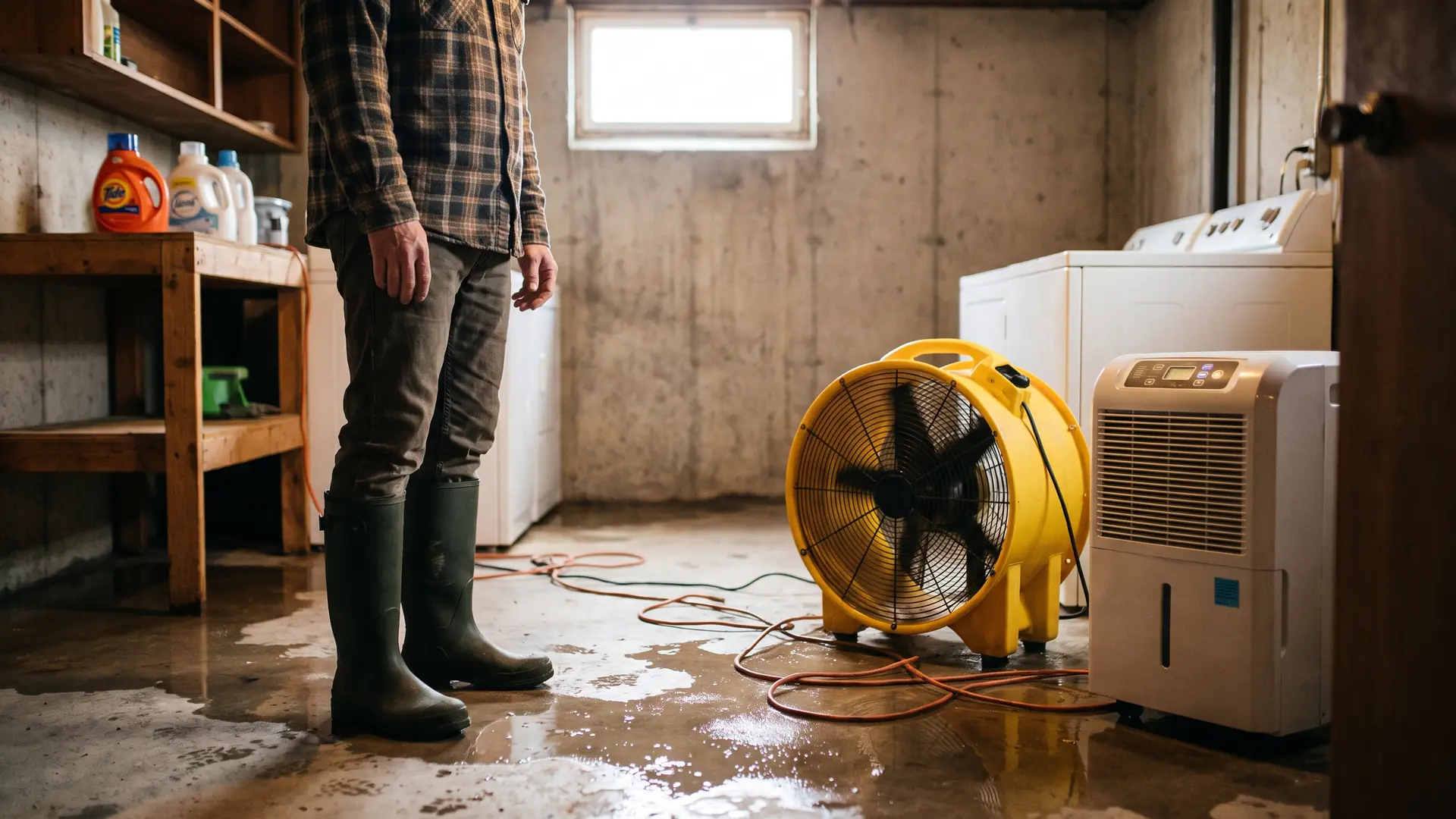
Photograph everything before you move or discard a single item, because your insurer settles on the evidence you preserved. Contaminated water is the exception to every instruction below: sewage backup means you leave the area and call a licensed restoration contractor.
Learn the first-hour safety sequence, how to dry the cavities you can’t see, when to call a professional, and what a standard homeowners policy pays for. Our Home Maintenance guide covers the rest of the repair list.
Key takeaways:
- Two moves come first: Stop the water and cut power to the affected area before you step into standing water. Those 2 steps come before cleanup or any call to your insurer.
- The 24-to-48-hour clock: The EPA advises drying water-damaged areas and items within 24 to 48 hours, because materials dried inside that window usually don’t grow mold.
- Document, then check coverage: Standard policies pay for sudden and accidental discharge, not gradual leaks. Surface flooding needs a federal flood policy, capped at $250,000 of building and $100,000 of contents coverage.
What should you do in the first hour after finding water damage?
Five actions, in this order. Skipping step 2 is how a manageable problem turns fatal.
- 1. Stop the water: Shut the closest valve you can reach, the angle stop under a sink, the valve on a water heater or washer. If you can’t isolate it, close the main.
- 2. Cut the power to the affected area: Turn off the breakers feeding the wet rooms before you set foot in standing water. If the panel sits in the flooded area, stay out and call an electrician.
- 3. Decide whether it’s safe to stay: Leave if you see a sagging ceiling, a floor that flexes underfoot, contaminated water, or a hazard you can’t isolate. A ceiling holding pooled water can drop without warning.
- 4. Photograph everything before you move it: Wide shots of each room, close-ups of every damaged item, and the water line on the walls. Keep receipts, and throw nothing away until your insurer says so.
- 5. Move what you can still save: Get furniture, electronics, documents, and rugs out of the wet zone. Papers and photos you can’t dry within two days go in the freezer.
How do you dry out a home after water damage?
You have 24 to 48 hours. The EPA’s guidance is direct: dry water-damaged areas and items inside that window and, in most cases, mold will not grow.1
Remove standing water first
Fans do nothing while there’s a pool on the floor. Pull bulk water with a wet/dry vacuum or a submersible pump. In a basement a working sump pump does most of this, which is why its failure is so often the cause. Wet carpet padding comes out.
Dry the cavities, not just the surfaces
Aim fans across wet surfaces rather than at them, run a dehumidifier in a closed room, and raise the heat, since warm air holds more moisture. Then open the assemblies: pull baseboards, cut inspection holes low in wet drywall so air reaches the stud bays, and remove soaked insulation.
Confirm dryness before you close anything up
Borrow a moisture meter, read a dry part of the house for a baseline, then keep drying until the wet areas match. And don’t paint over a damp or moldy surface: the EPA is explicit that paint applied over mold is likely to peel.
What causes water damage, and what kind do you have?
Most water damage traces to one of five sources, and the source drives both the repair and the insurance answer.
- Plumbing failures: Burst supply lines and cracked drains; washer hoses and water heater tanks fail most often.
- Appliance leaks: Dishwashers, ice makers, and washers that seep unnoticed until the flooring shows it, the case for the sensors in our guide to improving your home’s water efficiency.
- Roof and envelope leaks: Failed flashing, ice dams, clogged gutters, unsealed windows.
- Groundwater intrusion: Pressure through foundation walls and window wells, worsened by grading that slopes toward the house.
- Sewer and drain backup: Main surcharge, a blocked lateral, or tree roots.
Pros sort the water itself into three categories under the IICRC S500 standard. Category 1 is clean water from a sanitary source, the only kind most homeowners should handle alone. Category 2, gray water, is contaminated appliance or toilet discharge. Category 3, black water, means sewage or floodwater and always calls for a professional. Categories degrade downward as water sits.
How do you assess and repair water-damaged materials?
Work from the ceiling down: anything above a damaged area is also suspect, and anything you fix below will just get wet again.
Find the damage, including what you can’t see
Look for staining and sagging on ceilings, soft spots and bubbling paint on walls, cupping on floors, and swollen baseboards. Push gently on suspect drywall; if it gives like wet cardboard, it’s coming out. A musty smell in a room that looks fine is the surest sign of hidden moisture, which hides in wall cavities, under flooring, in insulation, and behind cabinets.
Repair, replace, and seal the source
Drywall that stayed wet under a day and kept its strength can sometimes dry and be repainted; drywall that crumbles or was soaked by gray or black water gets cut back to the nearest stud above the water line. Cupped hardwood may flatten and refinish, while engineered wood and laminate with swollen cores generally can’t be saved. Structural, electrical, and plumbing work usually needs a permit, check home renovation permits first. And with the walls open, it’s the cheapest moment for other renovations that boost home value.
When should you call a water damage restoration professional?
Call one whenever contaminated water is involved, the water sat more than a day, or it reached wall cavities, subfloor, or ductwork. The EPA’s mold threshold is a useful proxy: under about 10 square feet, roughly a 3-foot by 3-foot patch, most homeowners can handle it themselves. Bigger than that, see addressing mold issues in your home.
| Situation | DIY is usually acceptable | Call a professional |
|---|---|---|
| Clean water (Category 1) | Small spill caught immediately | Any loss crossing rooms or reaching a finished basement |
| Gray water (Category 2) | Contained discharge on hard surfaces you can disinfect | Anything absorbed into carpet, drywall, or cabinetry |
| Sewage or floodwater (Category 3) | Never | Always, evacuate and call a licensed remediation contractor |
| Standing time | Found and dried within hours | Water present more than 24 hours, or unknown duration |
| Materials affected | Tile, sealed concrete, surfaces you can reach | Wall cavities, insulation, subfloor, ductwork, framing |
You’re buying equipment and evidence: commercial air movers, thermal imaging, and a drying log insurers accept more readily than your word. Costs swing widely, so skim typical water damage restoration cost ranges, then get two written estimates.
Does homeowners insurance cover water damage?
It depends on the source, and the line is sudden and accidental versus gradual. The HO-3 special form most Michigan homeowners carry covers accidental discharge or overflow from a plumbing, heating, air conditioning, or sprinkler system, or from a household appliance. A pipe that bursts at 2 a.m. is the textbook covered claim.2 What it generally won’t pay for:
- Gradual leaks and seepage: Continuous seepage, deterioration, and deferred-maintenance damage are standard exclusions.
- Flood: Surface water from outside is excluded entirely and requires separate flood insurance.
- Sewer and drain backup: Not automatic. Per Insurance Information Institute guidance on water damage claims, most providers sell backup coverage for a nominal cost, but you must ask for the endorsement.
- Frozen pipes you didn’t guard against: The National Association of Insurance Commissioners notes a burst-pipe claim may be denied if your insurer finds you skipped preventive measures.
- The failed part: Policies pay for the damage, not the water heater that caused it.
Flood is its own program. Through the National Flood Insurance Program, a one-to-four-family home can carry up to $250,000 in building coverage and $100,000 in contents coverage, and a new policy generally takes 30 days to take effect with exceptions, including no wait when you buy it alongside a mortgage. Read FEMA’s National Flood Insurance Program on what flood coverage includes first. In a Special Flood Hazard Area with a federally backed mortgage it isn’t optional: federal law requires it, as our guide to buying a home in a flood zone explains.
NFIP basement coverage is narrow: below grade, building coverage reaches a set list, furnaces, water heaters, central air conditioners, electrical outlets, stairways, sump pumps, while personal property kept in a basement generally isn’t covered at all, apart from a short list of appliances such as clothes washers and dryers and food freezers. Finished walls and the belongings around them fall outside it. And a flood zone isn’t a prerequisite for a flood: of the more than $8.8 billion in U.S. flood damage to homes and businesses in 2024, roughly $3.9 billion happened in communities not considered high-risk.
Before you file, run the math: your deductible comes off every claim and a claim can affect renewal pricing, so a small loss is sometimes cheaper to absorb. Our guide to homeowners insurance deductibles works through that trade-off. Where the settlement leaves a gap, lenders in Align’s network offer renovation and cash-out options that fold repair costs into your mortgage,3 as our Homeownership guide covers.
How often do homeowners file water damage claims, and what do they cost?
Often, and the checks are large. According to the Insurance Information Institute’s homeowners insurance statistics, insurers recorded 1.50 water damage and freezing claims per 100 insured house-years from 2019 to 2023, and paid an average of $15,400 per claim. Only wind and hail produced claims more often.
| Cause of loss | Claims per 100 insured house-years | Share of property damage claims | Average paid per claim |
|---|---|---|---|
| Wind and hail | 2.80 | 51% | $14,747 |
| Water damage and freezing | 1.50 | 27% | $15,400 |
| All other, including vandalism | 0.88 | 16% | $9,043 |
| Fire and lightning | 0.23 | 4% | $88,170 |
| Theft | 0.12 | 2% | $5,524 |
| All property damage | 5.53 | 100% | $16,857 |
| Liability claims | 0.09 | Not a property claim | $29,880 |
| All claims, property and liability | 5.64 | Not applicable | $17,059 |
Source: Insurance Information Institute, Facts + Statistics: Homeowners and renters insurance, average homeowners losses 2019 to 2023, data from ISO, a Verisk Analytics business. The share column is Align’s arithmetic from the frequency column, rounded.
The same statistics page reports that 5.3% of insured homes had a claim in 2023, compared with 6.4% in 2020, or about one insured home in 18 in a typical year.
Hypothetical example, not an offer. The deductible comes off first: with a $2,500 deductible, a $6,000 covered repair returns $3,500, and a $2,300 repair returns nothing at all. See our guide to evaluating home insurance options.
Why is your mortgage company’s name on the insurance check?
Because your loan documents usually require it. The Consumer Financial Protection Bureau notes that many mortgage agreements require insurance checks to be made out to both you and the mortgage company or servicer, and that your mortgage company could release portions of the money as repair work progresses. Ask both how the money will be paid out before you sign with a contractor.
For loans owned by Fannie Mae, the Fannie Mae Servicing Guide, topic B-5-01 (dated July 12, 2023) sets the release for a loan that is current or less than 31 days delinquent. The servicer may release a first payment of up to the greatest of three amounts: $40,000; 33% of the insurance proceeds; or the amount by which the proceeds exceed what is still owed on the loan, meaning the unpaid principal balance plus accrued interest and advances. The rest follows periodic inspections of the repair work. Receipts are not required when the proceeds are $40,000 or less, money held back goes into an interest-bearing custodial account for your benefit, and payments for contents or living expenses go to you by check.
Hypothetical example, not an offer. A covered pipe burst produces a $90,000 building settlement on a current Fannie Mae loan with $180,000 still owed. 33% of that settlement is $29,700, and the settlement does not exceed the loan balance, so under B-5-01 the servicer may release up to $40,000 at first. The rest, at least $50,000, follows in stages after inspections.
Other investors set their own rules, so call your servicer’s loss draft department next. Our guide to payments, escrow and servicing covers the servicer’s role.
What should you do if your house flooded?
Stay out until officials clear the area, then work the claim on the flood policy’s terms, which are stricter than a homeowners claim. Ready.gov’s flood guidance, updated October 20, 2026, warns that six inches of moving water can knock you down and one foot can sweep a vehicle away. Once you are back inside, the CDC’s advice on returning home after a flood is to run generators, charcoal grills and pressure washers outdoors at least 20 feet from any doors, windows or vents, and to use a battery-powered carbon monoxide detector.
The claim runs on the Standard Flood Insurance Policy, whose dwelling form is published as federal regulation at 44 CFR Part 61, Appendix A(1). Under its “Requirements in Case of Loss,” you must:
- Give prompt written notice: In writing, not only by phone.
- Separate the damaged from the undamaged: As soon as reasonably possible, put property in order so it can be examined.
- Build an inventory: Show the quantity, description, actual cash value and amount of loss for each damaged item, with bills and receipts attached.
- Send a proof of loss within 60 days: A signed and sworn statement of what you are claiming, due within 60 days after the loss even if the adjuster never hands you the form.
The same form says the adjuster has no authority to decide the claim, and that a lawsuit over a denial must start within one year of the written denial. FEMA reports 4.7 million policyholders in 22,600 participating communities, with nearly $1.3 trillion in coverage, on its flood insurance page updated October 20, 2026.
Does unrepaired water damage affect selling or refinancing your home?
It can, because the appraisal reports it. Per the Fannie Mae Selling Guide, section B4-1.3-06 (dated June 4, 2025), if the appraisal indicates evidence of dampness, the appraiser must comment on the effect on the property’s value and marketability. A C5 condition rating means obvious deferred maintenance in need of some significant repairs; C6 means substantial damage or deferred maintenance severe enough to affect the safety, soundness or structural integrity of the home. Loans on C6 properties are not eligible for sale to Fannie Mae, and a C6 appraisal must be completed “subject to” the repairs, with a resulting rating of at least C5.
That sets the order: dry it, document it, repair it, then list or refinance. See our guides to the home appraisal process and selling a home as-is.
When the repair bill outruns the settlement, the financing follows the repair plan. Samantha has said it plainly about renovation financing: “You’re not just financing the house. You’re financing the plan for the house.” Renovation loans, the 203(k) among them, can fold repairs into a purchase or a refinance, while a cash-out refinance or a home equity line of credit draws on equity you already hold. Compare them in our guides to renovation loans, FHA 203(k) loans, cash-out refinancing and home equity lines of credit, and see planning for unexpected home repairs.
How do you prevent the next water loss?
Four habits cover most of it: inspect supply lines and the water heater once a year, swapping rubber washer hoses for braided steel; clean gutters twice a year and run downspouts 4 to 6 feet out; test the sump pump each spring and fall; and add leak sensors under sinks and appliances.
How do you find a hidden leak before it becomes water damage?
Start with the meter and the bill. According to EPA WaterSense statistics (page updated March 11, 2026), the average family can waste 180 gallons a week, or 9,400 gallons a year, from household leaks. The agency’s Fix a Leak Week page, updated March 13, 2026, reports that household leaks can waste nearly 1 trillion gallons nationwide each year and that 9% of homes have leaks wasting 50 gallons or more per day. Three checks from that page:
- The two-hour meter test: Read the water meter before and after a two-hour period when no water is being used. If it moves at all, you probably have a leak.
- The winter bill test: Look at January or February use. If a family of four exceeds 12,000 gallons per month, there could be serious leaks.
- The toilet dye test: Put a few drops of food coloring in the tank. Color in the bowl after 10 minutes means the flapper leaks. A faucet dripping once per second wastes more than 3,000 gallons per year.
The EPA’s guide to mold and moisture, last updated February 18, 2026, advises keeping indoor humidity below 60%, ideally 30 to 50% relative humidity. For the seasonal side of this, see winterizing your home, the seasonal home maintenance checklist, maintaining your roof and dealing with foundation issues.
What Michigan homeowners should know
In Michigan this usually happens in the basement: spring thaw over still-frozen ground, summer storms that surcharge municipal sewers, and a housing stock full of deep basements.
- Backup coverage is not automatic: The Michigan Department of Insurance and Financial Services states that water and sewer backup is not automatically covered under a homeowners or renters policy. Endorsements add limited coverage for backup and sump pump overflow, though DIFS notes they typically won’t replace the pump.
- Flood is a separate purchase here too: DIFS states that most homeowners and renters policies do not cover flood damage, and that a home in a mapped high-risk zone with a mortgage must carry flood insurance for the term of the loan. Questions about what your policy actually covers go to the DIFS consumer call center at 877-999-6442.
- A municipal sewer backup starts a 45-day clock: If a public sewage system backed up into your home, Michigan law requires written notice to the agency within 45 days of discovering the damage.
- Power and pumps fail together: The storm that overwhelms your sump pit also drops the line feeding your pump.
What should a water damage proof of loss include so Michigan’s payment clock starts?
Under Michigan’s Insurance Code, MCL 500.2006, payment timing runs from a satisfactory proof of loss, and the insurer has 30 days after your claim to say in writing what that proof must contain. For water damage, expect photos taken before anything wet is torn out, the drying company’s moisture readings and invoices, and a statement of the source (a burst supply line, a sewer backup), because the cause decides which coverage responds. Late benefits earn 12% simple interest a year from 60 days after that proof arrived, separate from the flood policy’s 60-day deadline above. More in evaluating home insurance options.
The state’s DIFS guide to homeowners insurance for Michigan consumers adds two points for the days after a loss: make only temporary repairs to protect your house and belongings from further damage, and know that the additional living expenses portion of a policy pays the extra costs of living away from home following an insured risk.
Can you make a claim against a Michigan city for a sewer backup?
Yes, but the statute sets a narrow path. Under MCL 691.1417(3), a claimant recovers for a sewage disposal system event only by showing all five of these existed at the time:
- The governmental agency was an appropriate governmental agency.
- The sewage disposal system had a defect.
- The agency knew, or in the exercise of reasonable diligence should have known, about the defect.
- The agency, having the legal authority to do so, failed to take reasonable steps in a reasonable amount of time to repair, correct or remedy it.
- The defect was a substantial proximate cause of the event and the damage.
The written notice is short. According to MCL 691.1419, it gives your name, address and telephone number, the affected property’s address, the date you discovered the damage and a brief description of the claim, and it goes to the person the agency designates. The agency may inspect the damaged property, which you may not unreasonably refuse, and if you have not agreed on compensation within 45 days after it receives the notice, you may file suit.
How do you hire a water damage contractor in Michigan?
Check the license before anyone opens a wall. In its consumer tips on home improvement projects (May 9, 2019), Michigan’s Department of Licensing and Regulatory Affairs tells homeowners to make sure the people working on the home are properly licensed, to ask for a copy of the license and look it up online, and to get a detailed written contract that states the work, the quality of materials, warranties, start and completion dates, total cost and a payment schedule. LARA also advises asking the contractor, subcontractors and suppliers for a completed and signed waiver of lien form, and never signing a contract with blank spaces.
The Consumer Financial Protection Bureau warns about contractors selling repairs door-to-door, especially when they ask for payment up front or offer deep discounts.
How Align helps when a repair is bigger than your savings
Most repairs belong in a savings account, not a loan. When one does not, like a roof or a furnace, Samantha looks at whether a home equity line, a home equity loan or waiting makes more sense for you.
Align places standalone HELOCs and home equity loans, so you can keep your first mortgage and its rate in place. She explains the payment and the risk before you borrow against your home.
FAQ: Water damage in your home
Here are answers to common questions about water damage in your home.
What should I do first when I find water damage?
Stop the water and cut the power. Shut off the supply valve or the main, then turn off the breaker to the affected area before stepping into standing water. Once it is safe, photograph everything, move undamaged belongings out, and begin removing water. Skipping the electrical step is the most common way a manageable water problem becomes a life-threatening one.
How long does it take for mold to grow after water damage?
Mold can start within 24 to 48 hours on wet drywall, carpet padding, insulation, and framing. That window is why drying is urgent and why surface dryness is not enough; moisture trapped inside wall cavities keeps feeding growth. A moisture meter confirms materials are dry before anything gets closed back up. Soaked batts rarely dry in place, so plan on replacing the insulation.
Which kinds of water damage does homeowners insurance pay for?
It depends on the source. Sudden and accidental events such as a burst pipe or an overflowing water heater are typically covered. Gradual leaks, long-term seepage, and maintenance neglect usually are not, and surface flooding from outside requires separate flood insurance. Sewer backup often needs its own endorsement. Read your declarations page before you assume coverage.
When should I hire a water damage restoration professional?
Call one for contaminated water, for anything covering more than a small area, for water that has been sitting more than a day, and any time it has reached wall cavities, subfloor, or HVAC ducts. Professionals have commercial dehumidifiers, moisture mapping, and antimicrobial treatment. Insurers also accept documented professional mitigation more readily than homeowner cleanup. The same logic applies to coping with smoke damage after a fire.
Can you deduct water damage on your taxes?
Usually not. IRS Publication 547 (2025) says loss from progressive deterioration isn’t deductible as a casualty loss, and uses a water heater that bursts as its example, though the water damage it causes to rugs and drapes does qualify as a casualty. For 2025 returns, personal-use casualty losses are deductible only when attributable to a federally declared disaster, reduced by $100 per casualty and by 10% of adjusted gross income. Ask a qualified tax professional before you claim one.
Can mold from water damage make you sick?
For some people, yes. The CDC says mold can cause a stuffy nose, sore throat, coughing or wheezing, burning eyes, or skin rash. People with asthma or who are allergic to mold may have severe reactions, and immune-compromised people and people with chronic lung disease may get lung infections from mold. Its prevention advice is to fix leaks in the roof, walls or plumbing so mold has no moisture to grow.
How long does a water damage claim stay on your insurance record?
Up to seven years in the main claims database. According to the CFPB list of consumer reporting companies (2025), LexisNexis C.L.U.E., the Comprehensive Loss Underwriting Exchange, collects and reports up to seven years of auto and personal property claims to inform insurance pricing and underwriting. It provides one free report every 12 months on request and will freeze your report if you ask.
Does a Michigan seller have to disclose past water damage?
The disclosure form asks directly. Under MCL 565.957, the seller answers whether there has been evidence of water in the basement or crawl space, roof leaks, settling, flooding, drainage or grading problems, and major damage from fire, wind, floods or landslides. The statement is not a warranty and not a substitute for inspections. See our guides to the seller’s disclosure and the buyer inspection checklist.
Does flood insurance pay to protect your home before a flood?
Within limits. The NFIP dwelling policy pays up to $1,000 for sandbags, fill for temporary levees, pumps, and plastic sheeting and lumber used with them, plus up to $1,000 to move insured property out of harm’s way, covered at the new location for 45 consecutive days. Sandbag coverage needs imminent flood damage and either flooding nearby or an official evacuation order, and no deductible applies.
The bottom line on addressing water damage
Stop the water, cut the power, then race the clock: the EPA advises drying water-damaged areas and items within 24 to 48 hours, because materials dried inside that window usually don’t grow mold. Photograph everything first, since your insurer settles on the evidence you kept. Dry the cavities, not just the surfaces, and confirm it with a moisture meter. Contaminated water belongs to a licensed contractor.
If you’re facing a repair bill your settlement doesn’t cover, talk to Align Lending. We’ll shop renovation and cash-out options across our lender network and show you the numbers side by side. Call 248-506-5727 or start online.
Footnotes:
1. The 24-to-48-hour figure is EPA guidance, not a guarantee: growth doesn’t always begin at 48 hours, and mold can already have taken hold in materials dried inside the window. Drying also doesn’t fix the cause. The EPA notes mold returns if the water problem isn’t solved. Return to text.
2. This describes how a standard HO-3 form and common endorsements typically work. Forms, exclusions, sub-limits, and deductibles vary by carrier and policy, and coverage turns on the facts of each loss. Your declarations page controls. Align Lending does not sell or adjust insurance. Return to text.
3. Align Lending is an independent mortgage broker and does not set loan terms. Renovation and cash-out program terms, eligibility, and loan amounts are set by the wholesale lenders in Align’s network, subject to credit approval and property eligibility. Return to text.
Sources: mold timing, the 10-square-foot threshold, and painting over mold, U.S. Environmental Protection Agency. Coverage limits of $250,000 building and $100,000 contents, the 30-day waiting period and its exceptions, basement and below-grade coverage, exclusion of personal property kept in basements, and 2024 flood damage of more than $8.8 billion nationally with about $3.9 billion of it outside high-risk communities, FEMA National Flood Insurance Program (FloodSmart.gov). Flood exclusion from standard homeowners policies and the Special Flood Hazard Area purchase requirement, FEMA and Michigan DIFS (“Flood Insurance: What You Need to Know,” FIS-PUB 0215). Frozen-pipe exclusion, National Association of Insurance Commissioners. Backup endorsements, Insurance Information Institute. Water and sewer backup not being automatically covered, sump overflow endorsements and their exclusion of pump repair or replacement, Michigan DIFS (“Water and Sewer Backup Coverage,” FIS-PUB 6380). DIFS consumer call center, 877-999-6442. Notice to a governmental agency within 45 days of discovering sewage-backup damage, MCL 691.1419. Water categories, IICRC S500.
This article is for informational purposes only and is not legal, insurance, or financial advice. Coverage and claim outcomes vary by policy, carrier, and state, review your declarations page and consult a licensed insurance professional. Align Lending is an independent Michigan mortgage broker, NMLS #2041154.
Sources
Every outside source this guide links to, in the order it appears. How we choose and check sources
- The EPA’s guidance is directU.S. Environmental Protection Agency
- Insurance Information Institute guidance on water damage claimsInsurance Information Institute
- The National Association of Insurance Commissioners notesNational Association of Insurance Commissioners
- FEMA’s National Flood Insurance Program on what flood coverage includesFEMA, National Flood Insurance Program
- $8.8 billion in U.S. flood damage to homes and businesses in 2024FEMA, National Flood Insurance Program
- Insurance Information Institute’s homeowners insurance statisticsInsurance Information Institute
- Consumer Financial Protection Bureau
- Fannie Mae Servicing Guide, topic B-5-01servicing-guide.fanniemae.com
- Ready.gov’s flood guidanceReady.gov
- CDC’s advice on returning home after a floodcdc.gov
- 44 CFR Part 61, Appendix A(1)law.cornell.edu
- Flood insurance pageFederal Emergency Management Agency
- Fannie Mae Selling Guide, section B4-1.3-06Fannie Mae Selling Guide
- EPA WaterSense statisticsU.S. Environmental Protection Agency
- Fix a Leak Week pageU.S. Environmental Protection Agency
- DIFS states that most homeowners and renters policies do not cover flood damageState of Michigan
- Michigan law requires written notice to the agency within 45 daysMichigan Legislature
- MCL 500.2006Michigan Legislature
- DIFS guide to homeowners insurance for Michigan consumersState of Michigan
- MCL 691.1417(3)Michigan Legislature
- Consumer tips on home improvement projectsState of Michigan
- IRS Publication 547Internal Revenue Service
- CDCcdc.gov
- CFPB list of consumer reporting companiesConsumer Financial Protection Bureau
- MCL 565.957Michigan Legislature
Related resources

20-minute read
Seasonal home maintenance checklist for every season
Find a seasonal home maintenance checklist covering exterior, interior, HVAC and plumbing tasks for all four seasons, keeping repairs small and planned.

20-minute read
Home maintenance for first-time homeowners: A full checklist
Learn what home maintenance for first-time homeowners involves, with monthly, seasonal, and annual tasks plus how much to budget each year for upkeep.

20-minute read
Winterizing your home: how to seal, insulate and protect before the first freeze
Learn how to winterize your home step by step, from sealing drafts to insulating pipes and prepping the furnace, so you avoid frozen pipes this winter.
