
How to address water damage in your home: A step-by-step plan
When you find water damage, the first two moves are stopping the water at its source and cutting power to the affected area. After that, one number governs everything: 24 to 48 hours. That’s the window the U.S. Environmental Protection Agency gives for drying water-damaged areas and items. Dry them inside it and, in most cases, mold will not grow.
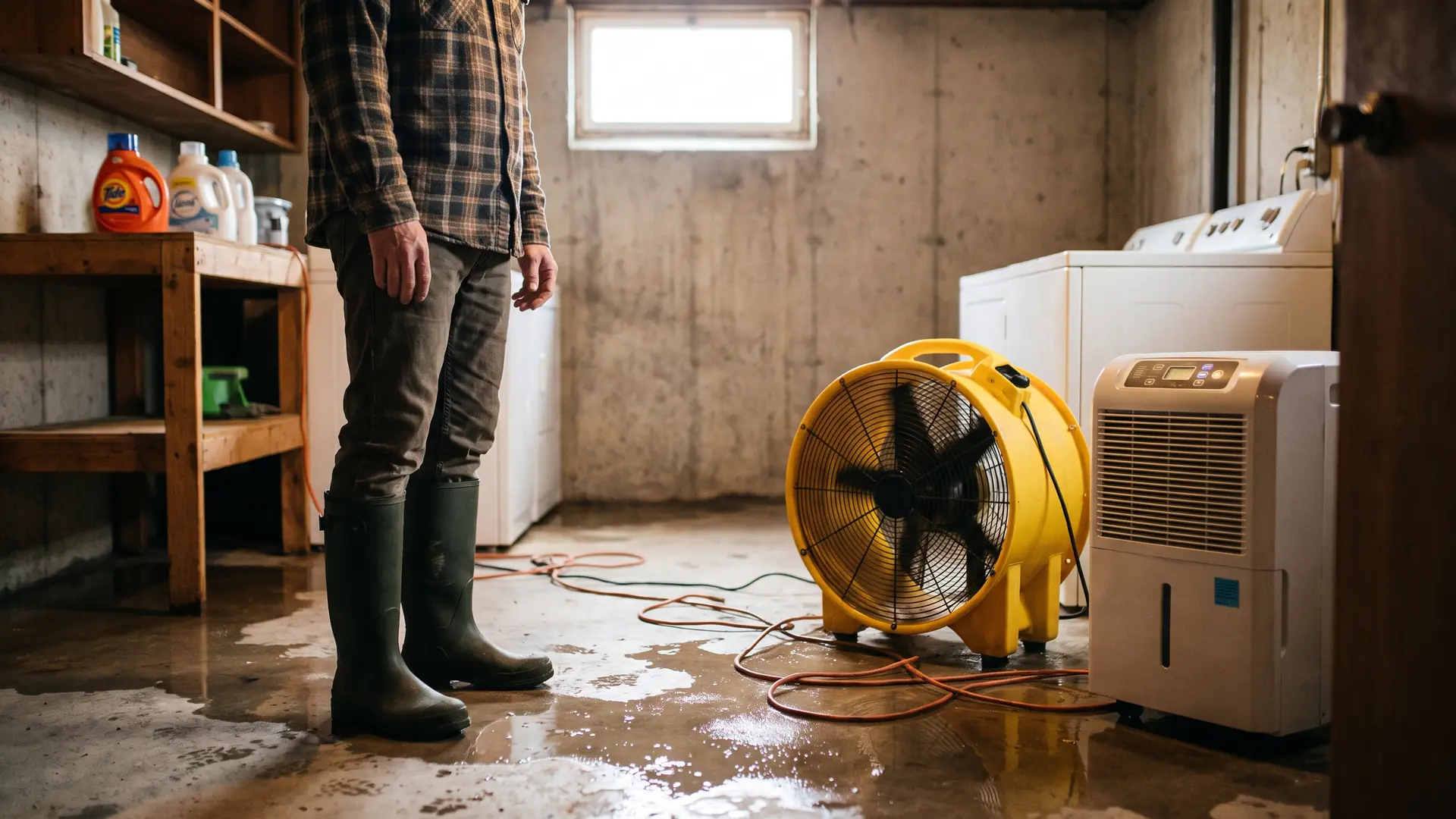
Photograph everything before you move or discard a single item, because your insurer settles on the evidence you preserved. Contaminated water is the exception to every instruction below: sewage backup means you leave the area and call a licensed restoration contractor.
Learn the first-hour safety sequence, how to dry the cavities you can’t see, when to call a professional, and what a standard homeowners policy pays for. Our Home Maintenance guide covers the rest of the repair list.
Key takeaways:
- Two moves come first: Stop the water and cut power to the affected area before you step into standing water. Those 2 steps come before cleanup or any call to your insurer.
- The 24-to-48-hour clock: The EPA advises drying water-damaged areas and items within 24 to 48 hours, because materials dried inside that window usually don’t grow mold.
- Document, then check coverage: Standard policies pay for sudden and accidental discharge, not gradual leaks. Surface flooding needs a federal flood policy, capped at $250,000 of building and $100,000 of contents coverage.
What should you do in the first hour after finding water damage?
Five actions, in this order. Skipping step 2 is how a manageable problem turns fatal.
- 1. Stop the water: Shut the closest valve you can reach, the angle stop under a sink, the valve on a water heater or washer. If you can’t isolate it, close the main.
- 2. Cut the power to the affected area: Turn off the breakers feeding the wet rooms before you set foot in standing water. If the panel sits in the flooded area, stay out and call an electrician.
- 3. Decide whether it’s safe to stay: Leave if you see a sagging ceiling, a floor that flexes underfoot, contaminated water, or a hazard you can’t isolate. A ceiling holding pooled water can drop without warning.
- 4. Photograph everything before you move it: Wide shots of each room, close-ups of every damaged item, and the water line on the walls. Keep receipts, and throw nothing away until your insurer says so.
- 5. Move what you can still save: Get furniture, electronics, documents, and rugs out of the wet zone. Papers and photos you can’t dry within two days go in the freezer.
How do you dry out a home after water damage?
You have 24 to 48 hours. The EPA’s guidance is direct: dry water-damaged areas and items inside that window and, in most cases, mold will not grow.1
Remove standing water first
Fans do nothing while there’s a pool on the floor. Pull bulk water with a wet/dry vacuum or a submersible pump. In a basement a working sump pump does most of this, which is why its failure is so often the cause. Wet carpet padding comes out.
Dry the cavities, not just the surfaces
Aim fans across wet surfaces rather than at them, run a dehumidifier in a closed room, and raise the heat, since warm air holds more moisture. Then open the assemblies: pull baseboards, cut inspection holes low in wet drywall so air reaches the stud bays, and remove soaked insulation.
Confirm dryness before you close anything up
Borrow a moisture meter, read a dry part of the house for a baseline, then keep drying until the wet areas match. And don’t paint over a damp or moldy surface: the EPA is explicit that paint applied over mold is likely to peel.
What causes water damage, and what kind do you have?
Most water damage traces to one of five sources, and the source drives both the repair and the insurance answer.
- Plumbing failures: Burst supply lines and cracked drains; washer hoses and water heater tanks fail most often.
- Appliance leaks: Dishwashers, ice makers, and washers that seep unnoticed until the flooring shows it, the case for the sensors in our guide to improving your home’s water efficiency.
- Roof and envelope leaks: Failed flashing, ice dams, clogged gutters, unsealed windows.
- Groundwater intrusion: Pressure through foundation walls and window wells, worsened by grading that slopes toward the house.
- Sewer and drain backup: Main surcharge, a blocked lateral, or tree roots.
Pros sort the water itself into three categories under the IICRC S500 standard. Category 1 is clean water from a sanitary source, the only kind most homeowners should handle alone. Category 2, gray water, is contaminated appliance or toilet discharge. Category 3, black water, means sewage or floodwater and always calls for a professional. Categories degrade downward as water sits.
How do you assess and repair water-damaged materials?
Work from the ceiling down: anything above a damaged area is also suspect, and anything you fix below will just get wet again.
Find the damage, including what you can’t see
Look for staining and sagging on ceilings, soft spots and bubbling paint on walls, cupping on floors, and swollen baseboards. Push gently on suspect drywall; if it gives like wet cardboard, it’s coming out. A musty smell in a room that looks fine is the surest sign of hidden moisture, which hides in wall cavities, under flooring, in insulation, and behind cabinets.
Repair, replace, and seal the source
Drywall that stayed wet under a day and kept its strength can sometimes dry and be repainted; drywall that crumbles or was soaked by gray or black water gets cut back to the nearest stud above the water line. Cupped hardwood may flatten and refinish, while engineered wood and laminate with swollen cores generally can’t be saved. Structural, electrical, and plumbing work usually needs a permit, check home renovation permits first. And with the walls open, it’s the cheapest moment for other renovations that boost home value.
When should you call a water damage restoration professional?
Call one whenever contaminated water is involved, the water sat more than a day, or it reached wall cavities, subfloor, or ductwork. The EPA’s mold threshold is a useful proxy: under about 10 square feet, roughly a 3-foot by 3-foot patch, most homeowners can handle it themselves. Bigger than that.
| Situation | DIY is usually acceptable | Call a professional |
|---|---|---|
| Clean water (Category 1) | Small spill caught immediately | Any loss crossing rooms or reaching a finished basement |
| Gray water (Category 2) | Contained discharge on hard surfaces you can disinfect | Anything absorbed into carpet, drywall, or cabinetry |
| Sewage or floodwater (Category 3) | Never | Always, evacuate and call a licensed remediation contractor |
| Standing time | Found and dried within hours | Water present more than 24 hours, or unknown duration |
| Materials affected | Tile, sealed concrete, surfaces you can reach | Wall cavities, insulation, subfloor, ductwork, framing |
You’re buying equipment and evidence: commercial air movers, thermal imaging, and a drying log insurers accept more readily than your word. Costs swing widely, so skim typical water damage restoration cost ranges, then get two written estimates.
Does homeowners insurance cover water damage?
It depends on the source, and the line is sudden and accidental versus gradual. The HO-3 special form most Michigan homeowners carry covers accidental discharge or overflow from a plumbing, heating, air conditioning, or sprinkler system, or from a household appliance. A pipe that bursts at 2 a.m. is the textbook covered claim.2 What it generally won’t pay for:
- Gradual leaks and seepage: Continuous seepage, deterioration, and deferred-maintenance damage are standard exclusions.
- Flood: Surface water from outside is excluded entirely and requires separate flood insurance.
- Sewer and drain backup: Not automatic. Per Insurance Information Institute guidance on water damage claims, most providers sell backup coverage for a nominal cost, but you must ask for the endorsement.
- Frozen pipes you didn’t guard against: The National Association of Insurance Commissioners notes a burst-pipe claim may be denied if your insurer finds you skipped preventive measures.
- The failed part: Policies pay for the damage, not the water heater that caused it.
Flood is its own program. Through the National Flood Insurance Program, a one-to-four-family home can carry up to $250,000 in building coverage and $100,000 in contents coverage, and a new policy generally takes 30 days to take effect with exceptions, including no wait when you buy it alongside a mortgage. Read FEMA’s National Flood Insurance Program on what flood coverage includes first. In a Special Flood Hazard Area with a federally backed mortgage it isn’t optional: federal law requires it, as our guide to buying a home in a flood zone explains.
NFIP basement coverage is narrow: below grade, building coverage reaches a set list, furnaces, water heaters, central air conditioners, electrical outlets, stairways, sump pumps, while personal property kept in a basement generally isn’t covered at all, apart from a short list of appliances such as clothes washers and dryers and food freezers. Finished walls and the belongings around them fall outside it. And a flood zone isn’t a prerequisite for a flood: of the more than $8.8 billion in U.S. flood damage to homes and businesses in 2024, roughly $3.9 billion happened in communities not considered high-risk.
Before you file, run the math: your deductible comes off every claim and a claim can affect renewal pricing, so a small loss is sometimes cheaper to absorb. Our guide to homeowners insurance deductibles works through that trade-off. Where the settlement leaves a gap, lenders in Align’s network offer renovation and cash-out options that fold repair costs into your mortgage,3 as our Homeownership guide covers.
How do you prevent the next water loss?
Four habits cover most of it: inspect supply lines and the water heater once a year, swapping rubber washer hoses for braided steel; clean gutters twice a year and run downspouts 4 to 6 feet out; test the sump pump each spring and fall; and add leak sensors under sinks and appliances.
What Michigan homeowners should know
In Michigan this usually happens in the basement: spring thaw over still-frozen ground, summer storms that surcharge municipal sewers, and a housing stock full of deep basements.
- Backup coverage is not automatic: The Michigan Department of Insurance and Financial Services states that water and sewer backup is not automatically covered under a homeowners or renters policy. Endorsements add limited coverage for backup and sump pump overflow, though DIFS notes they typically won’t replace the pump.
- Flood is a separate purchase here too: DIFS states that most homeowners and renters policies do not cover flood damage, and that a home in a mapped high-risk zone with a mortgage must carry flood insurance for the term of the loan. Questions about what your policy actually covers go to the DIFS consumer call center at 877-999-6442.
- A municipal sewer backup starts a 45-day clock: If a public sewage system backed up into your home, Michigan law requires written notice to the agency within 45 days of discovering the damage.
- Power and pumps fail together: The storm that overwhelms your sump pit also drops the line feeding your pump.
How Align helps when a repair is bigger than your savings
Most repairs belong in a savings account, not a loan. When one does not, like a roof or a furnace, Samantha looks at whether a home equity line, a home equity loan or waiting makes more sense for you.
Align places standalone HELOCs and home equity loans, so you can keep your first mortgage and its rate in place. She explains the payment and the risk before you borrow against your home.
FAQ: Water damage in your home
Here are answers to common questions about water damage in your home.
What should I do first when I find water damage?
Stop the water and cut the power. Shut off the supply valve or the main, then turn off the breaker to the affected area before stepping into standing water. Once it is safe, photograph everything, move undamaged belongings out, and begin removing water. Skipping the electrical step is the most common way a manageable water problem becomes a life-threatening one.
How long does it take for mold to grow after water damage?
Mold can start within 24 to 48 hours on wet drywall, carpet padding, insulation, and framing. That window is why drying is urgent and why surface dryness is not enough; moisture trapped inside wall cavities keeps feeding growth. A moisture meter confirms materials are dry before anything gets closed back up. Soaked batts rarely dry in place, so plan on replacing the insulation.
Which kinds of water damage does homeowners insurance pay for?
It depends on the source. Sudden and accidental events such as a burst pipe or an overflowing water heater are typically covered. Gradual leaks, long-term seepage, and maintenance neglect usually are not, and surface flooding from outside requires separate flood insurance. Sewer backup often needs its own endorsement. Read your declarations page before you assume coverage.
When should I hire a water damage restoration professional?
Call one for contaminated water, for anything covering more than a small area, for water that has been sitting more than a day, and any time it has reached wall cavities, subfloor, or HVAC ducts. Professionals have commercial dehumidifiers, moisture mapping, and antimicrobial treatment. Insurers also accept documented professional mitigation more readily than homeowner cleanup. The same logic applies to coping with smoke damage after a fire.
The bottom line on addressing water damage
Stop the water, cut the power, then race the clock: the EPA advises drying water-damaged areas and items within 24 to 48 hours, because materials dried inside that window usually don’t grow mold. Photograph everything first, since your insurer settles on the evidence you kept. Dry the cavities, not just the surfaces, and confirm it with a moisture meter. Contaminated water belongs to a licensed contractor.
If you’re facing a repair bill your settlement doesn’t cover, talk to Align Lending. We’ll shop renovation and cash-out options across our lender network and show you the numbers side by side. Call 248-506-5727 or start online.
Footnotes:
1. The 24-to-48-hour figure is EPA guidance, not a guarantee: growth doesn’t always begin at 48 hours, and mold can already have taken hold in materials dried inside the window. Drying also doesn’t fix the cause. The EPA notes mold returns if the water problem isn’t solved. Return to text.
2. This describes how a standard HO-3 form and common endorsements typically work. Forms, exclusions, sub-limits, and deductibles vary by carrier and policy, and coverage turns on the facts of each loss. Your declarations page controls. Align Lending does not sell or adjust insurance. Return to text.
3. Align Lending is an independent mortgage broker and does not set loan terms. Renovation and cash-out program terms, eligibility, and loan amounts are set by the wholesale lenders in Align’s network, subject to credit approval and property eligibility. Return to text.
Sources: mold timing, the 10-square-foot threshold, and painting over mold, U.S. Environmental Protection Agency. Coverage limits of $250,000 building and $100,000 contents, the 30-day waiting period and its exceptions, basement and below-grade coverage, exclusion of personal property kept in basements, and 2024 flood damage of more than $8.8 billion nationally with about $3.9 billion of it outside high-risk communities, FEMA National Flood Insurance Program (FloodSmart.gov). Flood exclusion from standard homeowners policies and the Special Flood Hazard Area purchase requirement, FEMA and Michigan DIFS (“Flood Insurance: What You Need to Know,” FIS-PUB 0215). Frozen-pipe exclusion, National Association of Insurance Commissioners. Backup endorsements, Insurance Information Institute. Water and sewer backup not being automatically covered, sump overflow endorsements and their exclusion of pump repair or replacement, Michigan DIFS (“Water and Sewer Backup Coverage,” FIS-PUB 6380). DIFS consumer call center, 877-999-6442. Notice to a governmental agency within 45 days of discovering sewage-backup damage, MCL 691.1419. Water categories, IICRC S500.
This article is for informational purposes only and is not legal, insurance, or financial advice. Coverage and claim outcomes vary by policy, carrier, and state, review your declarations page and consult a licensed insurance professional. Align Lending is an independent Michigan mortgage broker, NMLS #2041154.
Related resources
12-minute read
Seasonal home maintenance checklist for every season
Find a seasonal home maintenance checklist covering exterior, interior, HVAC and plumbing tasks for all four seasons, keeping repairs small and planned.

12-minute read
Home maintenance for first-time homeowners: A full checklist
Learn what home maintenance for first-time homeowners involves, with monthly, seasonal, and annual tasks plus how much to budget each year for upkeep.
12-minute read
Dealing with foundation issues: Signs, causes and repairs
Learn how to spot foundation problems, which cracks are serious, what common repairs cost, and how to fix the drainage issues that caused the damage.
