
Preparing Your Home for a Hurricane: The Complete Season Checklist
Preparing your home for a hurricane happens in three waves: weeks ahead you review insurance and document your possessions, days ahead you protect openings and clear the yard, and hours ahead you shut off utilities and shelter. Plan on at least 1 gallon of water per person per day for several days, and cover windows with permanent storm shutters or 5/8-inch exterior-grade plywood. Never tape, which does nothing against wind-borne debris.
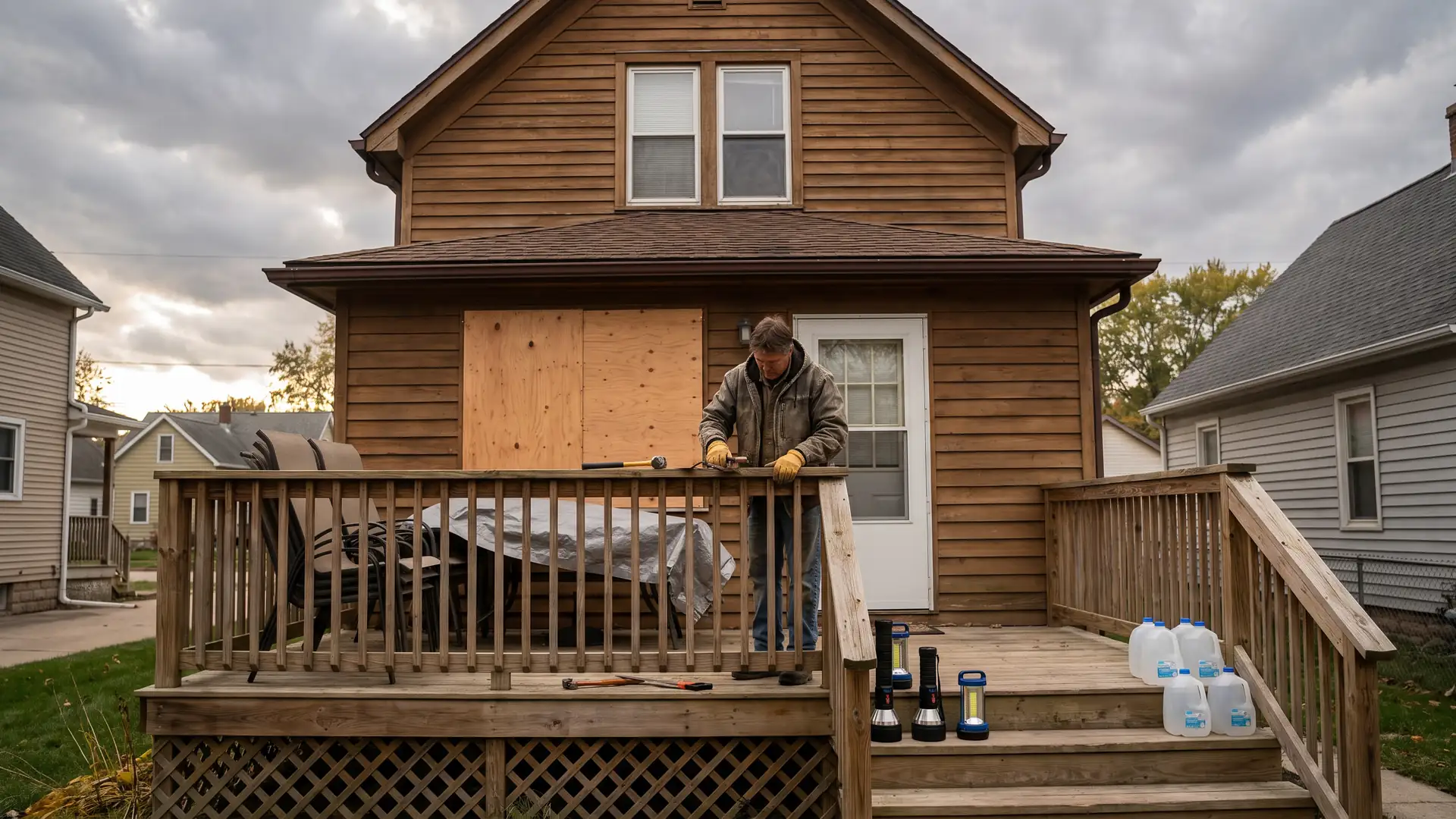
Timing matters more than the checklist itself. The Atlantic hurricane season runs June 1 through November 30, peaking around September 10, so the preparation window opens in spring, not when a storm gets a name. Insurers generally suspend new policies and coverage changes once a watch covers your area, and a new flood policy carries a 30-day waiting period.1
Learn how to prepare your home for a hurricane, including what to do at each stage of the countdown, how to protect openings and roof, what belongs in a supply kit, and what insurance will and won’t pay for. For the wider calendar this sits inside, start with our Homeownership guide and Home Maintenance hub.
Key takeaways:
- Insurance runs on a 30-day clock: A new National Flood Insurance Program policy generally takes effect 30 days after purchase, and most carriers stop writing coverage the moment a tropical storm or hurricane watch covers your area.
- Openings fail first: The National Weather Service says to cover every window, permanent storm shutters first, 5/8-inch exterior-grade or marine plywood cut to fit second, and the garage door, the largest opening on most houses, needs bracing of its own.
- Build the kit in weeks, not days: Ready.gov’s baseline is at least 1 gallon of water per person per day for several days plus a matching food supply; if you plan to shelter at home rather than evacuate, stock closer to 2 weeks of supplies and some cash.
When should you start preparing for a hurricane?
Start in spring, before June 1. Nearly everything that actually protects a house, an insurance review, roof repairs, shutters, tree work, takes weeks to schedule and becomes impossible to buy once a storm is named.
Weeks out: before a storm has a name
This is the only window where money still solves problems.
- Review every policy line by line: Confirm your dwelling coverage, your deductibles, whether you carry a separate hurricane or windstorm deductible, and whether you have flood coverage.
- Buy flood coverage early: A new National Flood Insurance Program policy generally does not pay out for 30 days, so a policy bought during a watch will not cover that storm.
- Document the house and its contents: Photograph every room, every exterior elevation, and the serial numbers on major appliances. Store it in the cloud, not on a laptop that may end up underwater.
- Book the trades now: Roofers, shutter installers and arborists develop months-long waiting lists once a storm is named. Get local quotes in spring, while they’re competing for work rather than triaging emergencies.
- Cut, drill and label panels once: If you’re using plywood, cut each panel to its window, label it, and pre-drill the anchor holes in April. Installation later takes minutes.
Days out: when a watch is issued
A hurricane watch means hurricane conditions are possible and is issued about 48 hours before tropical-storm-force winds arrive; a warning means they’re expected and comes about 36 hours out. Once winds reach tropical storm force, sustained 39 mph, outdoor work stops being safe, so the watch is your deadline.
In this window: install panels, clear the yard, fill gas tanks and prescriptions, get cash, charge every battery, fill bathtubs for washing, and move valuables and documents to the highest floor.
Hours out: the last pass
Turn refrigerators and freezers to their coldest settings, unplug electronics, shut off propane, and run the utility shutoffs below if officials advise it. Then move to your safe room with your kit and a hand-crank radio.
How do I protect windows and doors?
Cover every piece of glass with something built to stop debris. The National Weather Service’s order of preference is explicit: permanent storm shutters offer the best protection, and the second option is to board up windows with 5/8-inch exterior-grade or marine plywood, built to fit and ready to install. Impact-rated windows do the same job permanently. Cut and fit the panels before the season, and anchor them to the frame or masonry with proper fasteners rather than nails driven into siding.
Do not tape your windows. Tape adds no strength to glass and no protection against flying debris, and it can leave larger, more dangerous shards when a window does break. Notice that federal preparedness guidance never lists tape as a window protection measure at all, only shutters and plywood.
- The garage door: It’s the largest opening on most houses and usually the weakest. When it fails, wind pressurizes the interior and pushes outward on walls and roof. A bracing kit from the door’s manufacturer reinforces that weak point.
- Entry doors: Check for at least three solid hinges and a deadbolt that throws a full inch into a strike plate anchored to the framing. Double doors need head and foot bolts on the inactive leaf.
- Water intrusion: Fresh caulk around frames and a sweep under exterior doors keep wind-driven rain out of gaps that look harmless in fair weather.
Costs for shutters, impact glass and bracing kits vary widely by opening size, product rating and local labor, so get at least three local quotes rather than a national average.
How do I protect my roof and yard?
A roof fails at its connections, not in the middle of the field. Hurricane straps, galvanized metal ties fastening the roof structure to the wall framing, keep the two attached under uplift, and retrofitting them from inside the attic is standard contractor work.
- Fix loose material first: Missing, curled or lifted shingles are the starting point for a peel-back failure. Have a roofer walk it in spring, and weigh roofing materials by wind performance if it’s near replacement.
- Clean gutters and downspouts: Ready.gov’s “strengthen your home” step leads with de-cluttering drains and gutters, for a reason. Blocked drainage sends water into soffits, walls and foundations during a multi-inch rainfall.
- Trim or remove hazard trees: Limbs overhanging the roof and dead or leaning trees can cause serious damage in wind events. That’s an arborist’s job, not a ladder-and-chainsaw job.
- Clear the yard: Patio furniture, grills, planters, bins and umbrellas all become projectiles at 74 mph. Anything you can’t bring inside should be anchored or taken down.
Most of this belongs on a recurring calendar, our seasonal home maintenance checklist slots gutter cleaning, roof inspection and tree work into the right months. Plan for the aftermath too: standing water and debris draw pests toward the house.
What goes in a hurricane supply kit?
Start from the Ready campaign’s baseline: at least 1 gallon of water per person per day for several days, for drinking and sanitation, plus a several-day supply of non-perishable food. Then scale up. If you plan to shelter at home rather than evacuate, build toward roughly two weeks of supplies and keep cash on hand, because power, water and road access commonly stay disrupted long after the wind stops.
| Category | What to stock | How much |
|---|---|---|
| Water and food | Bottled water, canned goods, dry mixes, shelf-stable milk, pet food, manual can opener, utensils | 1 gallon per person per day; several days minimum, 2 weeks if sheltering at home |
| Light and power | Flashlights, hand-crank NOAA Weather Radio, extra batteries, power banks, car chargers | One flashlight per person; batteries for every device |
| Tools | Multi-tool, wrench sized to your utility shutoffs, duct tape, plastic sheeting, work gloves, fire extinguisher | One set staged with the kit, not scattered in the garage |
| Health and hygiene | First aid kit, prescription and over-the-counter medications, soap, sanitizer, wet wipes, garbage bags, waste bags | A 2-week supply of prescriptions where your plan allows |
| Documents and cash | Policies, IDs, deed or mortgage statement, medical records, contact list, inventory backup in a waterproof container | Small bills; card readers and ATMs stop working without power |
What does homeowners insurance cover in a hurricane, and what doesn’t?
A standard HO-3 homeowners policy typically covers wind damage but excludes flood entirely, and flood includes storm surge, the most destructive force in most landfalling hurricanes. That coverage comes from a separate National Flood Insurance Program or private flood policy. Understanding when and why you need flood insurance is the difference between a covered loss and an uncovered one.
| Damage type | Standard HO-3 policy | What you need instead |
|---|---|---|
| Wind, and rain entering through a wind-created opening | Typically covered | Often subject to a separate percentage deductible |
| Storm surge, rising water, flash flooding | Excluded | NFIP or private flood policy, 30-day waiting period |
| Sewer or drain backup | Excluded unless endorsed | A water or sewer backup endorsement |
| Detached structures, fences, pools | Usually limited | Check your Coverage B limit; schedule higher if needed |
The second surprise is the deductible. Many coastal policies set the hurricane, named storm or windstorm deductible as a percentage of the home’s insured value rather than a flat dollar amount. The Insurance Information Institute puts the range at generally 1% to 5% of the insured value of the structure. Hypothetical example, not an offer: on a home insured for $200,000, a 2% hurricane deductible means the first $4,000 of repairs is yours. Named storm deductibles trigger at tropical storm strength, 39 mph; hurricane deductibles at 74 mph. Read how hurricane and windstorm deductibles work before assuming your flat deductible applies, and see our breakdown of how homeowners insurance deductibles are structured.
If your home sits in a mapped high-risk flood zone and carries a federally backed mortgage, flood insurance isn’t optional. Federal law requires it for the life of the loan, and your servicer can force-place coverage if yours lapses.2 Our guides to buying a home in a flood zone and buying waterfront property cover what that does to your monthly cost. Price coverage through the National Flood Insurance Program and its 30-day waiting period and compare it against private flood carriers.
How do hurricane deductibles differ from state to state?
According to the Insurance Information Institute’s background on hurricane and windstorm deductibles, 19 states and the District of Columbia have hurricane deductibles.
Florida writes the choices into law. Under section 627.701 of the 2026 Florida Statutes, before issuing a personal residential property policy an insurer must offer alternative hurricane deductibles equal to $500, 2%, 5% and 10% of the policy dwelling limit, unless the percentage works out to less than $500. The written offer must also say which hurricane deductible applies if the applicant does not choose one, so read that notice instead of letting the default decide for you.
Hypothetical example, not an offer. Here is how those four Florida options compare on a dwelling limit of $350,000:
| Deductible option | How it is set | Your share of a hurricane loss before the policy pays |
|---|---|---|
| Flat | $500 | $500 |
| 2% of dwelling limit | 2% x $350,000 | $7,000 |
| 5% of dwelling limit | 5% x $350,000 | $17,500 |
| 10% of dwelling limit | 10% x $350,000 | $35,000 |
Source: deductible options from Florida Statutes section 627.701(3)(a), The Florida Senate, 2026 Florida Statutes. The $350,000 dwelling limit is a hypothetical illustration.
Whatever percentage you pick is cash you need on hand the week after a storm. Our guides to planning for unexpected home repair costs and budgeting for home maintenance show how to build that reserve before the season.
How do you prepare utilities, a generator and a safe room?
Find and label all three shutoffs before the season, main breaker, main water valve, gas or propane, and hang the correct wrench next to the gas valve. Hunting for a shutoff by flashlight in rising water is how people get hurt.
- Electricity: Never touch a breaker panel while standing in water, and never restore power to a flooded system before an electrician clears it.
- Water: Closing the main valve protects your plumbing from a contaminated supply and stops a broken line from flooding the house while you’re gone.
- Gas and propane: Turn tanks off at the tank. Only your utility should turn natural gas back on. Relighting pilots yourself is a code and safety issue.
- Generators: Run portable generators outdoors only, at least 20 feet from the house, exhaust pointed away and clear of windows, doors and vents. Never in a garage, basement, crawlspace or on a porch. Opening a window does not provide enough ventilation. The Consumer Product Safety Commission counted at least 1,332 carbon monoxide deaths involving portable generators from 2004 through 2021, an average of about 74 a year, and 85 a year across 2017 to 2019. Install battery-operated CO alarms on every level.
For the safe room, pick a windowless interior room on the lowest floor that sits above any expected flooding. Stock it with your kit, bedding, shoes and a charged phone. If you’re in an evacuation zone, none of this substitutes for leaving when told to.
What should you do in the first days after a hurricane passes?
The Michigan Department of Insurance and Financial Services’ consumer guide to homeowners insurance lays out steps that apply in any state:
- Report the loss right away: Notify your agent or insurer immediately and tell them where they can reach you if you are staying somewhere else.
- Photograph before you fix: Make a detailed, itemized list of damaged property and photograph or video the damage before making any repairs.
- Make only temporary repairs: Tarp the roof and board the broken window, save the receipts, and submit them for reimbursement. DIFS says not to make permanent repairs until the insurer has inspected the damage.
- Keep a call log: Write down the date, name and title of everyone you speak with at the insurance company and what was said.
Water is the clock you cannot negotiate with. After a storm surge or a torn roof, carpet, drywall and insulation start the mold count the day they get wet. The Centers for Disease Control and Prevention says to dry out a flooded home within 24 to 48 hours, and the U.S. Environmental Protection Agency’s guide to mold and moisture says that when wet materials are dried in that window, mold usually will not grow. Photograph what cannot dry in time, such as soaked drywall and padding, for the claim before it goes to the curb. Our guides on addressing water damage in your home, dealing with mold and roof care after storm season pick up from there.
Can you deduct uninsured hurricane damage on your taxes?
Sometimes, and only for a declared disaster. Per IRS Publication 547 (2025), Casualties, Disasters, and Thefts, for tax years beginning after 2017 a casualty loss on personal-use property is deductible only if it is attributable to a federally declared disaster. Those losses are reduced by $100 per casualty and by 10% of your adjusted gross income. For a loss that meets the publication’s definition of a qualified disaster loss, the $100 reduction rises to $500 and the 10% of income reduction does not apply.
Two more rules from the publication matter after a hurricane. First, you can elect to claim a disaster area loss on the prior year’s return, which can bring a refund sooner. Second, file a timely insurance claim: the part of a loss your policy would have covered is not deductible if you never claim it, while the part insurance does not cover, such as your hurricane deductible, can still count.
Hypothetical example, not an offer. A household with adjusted gross income of $90,000 has $20,000 of damage left after insurance reimbursement from a federally declared disaster. Subtract $100, leaving $19,900, then subtract 10% of income, $9,000, for a deductible loss of $10,900 under the general rule. This is not tax advice; a tax professional should run your actual numbers. Our overview of how tax law changes affect homeowners covers the wider picture.
What happens with your mortgage servicer if your homeowners insurance lapses?
Your mortgage requires hazard coverage even when a storm season brings cancellations or nonrenewals. Federal servicing rules under the Consumer Financial Protection Bureau’s Regulation X, 12 CFR 1024.37 limit how a servicer can buy coverage for you and bill you for it:
- A reason first: A servicer may not charge for force-placed insurance unless it has a reasonable basis to believe you failed to keep the required hazard insurance.
- Two written notices: The first notice must go out at least 45 days before any charge. A reminder must follow at least 15 days before the charge, and not until at least 30 days after the first notice.
- A refund when you prove coverage: Within 15 days of receiving evidence that you had coverage, the servicer must cancel the force-placed policy and refund premiums and fees for any overlap.
Those notice rules cover hazard insurance only. The same section says flood insurance required by the Flood Disaster Protection Act of 1973 is not force-placed insurance under it, so required flood coverage follows its own rules. If your premiums are paid through your loan, our guides to mortgage escrow accounts and payments, escrow and servicing explain how a premium change works its way into your monthly bill.
How do you pay for storm repairs that insurance won’t cover?
For a home in a declared disaster area, the U.S. Small Business Administration’s disaster loan program lends to homeowners as well as businesses. The SBA states that homeowners may apply for up to $500,000 to repair or replace their primary residence, and that renters and homeowners may borrow up to $100,000 to replace or repair personal property such as clothing, furniture, cars and appliances. Insurance proceeds on the home or property may be deducted from the eligible amount, so file your claim first.
Outside a declaration, or for upgrades beyond putting things back, our guides compare a home equity line of credit, a renovation loan, a 203(k) loan and other ways to finance home renovations. Then check how renovations affect your home insurance.
What Michigan homeowners should know
Michigan doesn’t get landfalling hurricanes, but it gets their leftovers more often than residents expect. National Weather Service Detroit/Pontiac documents eight tropical or post-tropical systems reaching southeast Michigan since 2004, Arlene and Dennis in 2005, Gustav and Ike in 2008, Alberto in 2018, Olga in 2019, Cristobal in 2020 and Beryl in 2024, roughly four a decade.
- The rainfall is the hazard, not the wind: When Hurricane Beryl’s remnants crossed southeast Michigan on July 9 to 10, 2024, the region measured 2 to 6 inches of rain, with about 7 inches east of Flint in Genesee County. Flint Bishop Airport recorded 3.27 inches on July 10, breaking a daily record of 1.63 inches set in 1970.
- Your homeowners policy still excludes flood: The Michigan Department of Insurance and Financial Services states that most homeowners and renters insurance policies do not cover flood damage, and that a home in a Special Flood Hazard Area with a mortgage must carry flood insurance for the term of the loan. Sewer and water backup, the classic Michigan basement loss, needs its own endorsement, usually capped well below your dwelling limit.
- The 30-day clock applies here too: Michigan homeowners outside mapped high-risk zones can still buy NFIP coverage, and the same waiting period applies. March beats July.
- Prepping a coastal second home from 900 miles away: If you own a second home in Florida or the Carolinas, build a local bench before June, a neighbor with a key, a shutter installer, and a roofer who returns calls. Keep policy numbers, photos and inventory in the cloud so you can file from Michigan.
How do Michigan’s power outage credits work after a storm?
When a storm leaves a Michigan home dark for days, the state’s utility rules can put money back on the bill. The Michigan Public Service Commission’s Power Outage Credit sheet, revised October 2026, says you receive a $44 outage credit if you lose power for:
- 16 hours when 1% or less of your utility’s customers have an outage
- 48 hours when more than 1% but less than 10% of customers have an outage
- 96 hours when 10% or more of customers have an outage
Source: thresholds from the Michigan Public Service Commission, Power Outage Credit (Rev. 10/26).
Once an outage qualifies, the MPSC says you receive an additional $44 for each day it continues, and a separate $44 credit applies after 6 or more interruptions in 12 months that each last at least 5 minutes. The utility applies the credit automatically, as a penalty for missing required service standards.
Hypothetical example, not an offer. If a storm knocks out 12% of a utility’s customers and your power is off for 120 hours, the outage qualifies at 96 hours for $44, and the extra 24 hours adds another $44, for $88 in credits.
The credit does not replace a plan for running a generator safely. The Michigan Department of Health and Human Services’ carbon monoxide fact sheet for power outages (MDHHS-Pub-1949, revised September 2026) says one portable generator produces hundreds of times more carbon monoxide than one car, and that the gas can build up and linger for hours even after the generator is shut off.
How Align helps when a repair is bigger than your savings
Most repairs belong in a savings account, not a loan. When one does not, like a roof or a furnace, Samantha looks at whether a home equity line, a home equity loan or waiting makes more sense for you.
Align places standalone HELOCs and home equity loans, so you can keep your first mortgage and its rate in place. She explains the payment and the risk before you borrow against your home.
FAQ: Preparing your home for a hurricane
Here are answers to common questions about preparing your home for a hurricane.
When should I start preparing my home for hurricane season?
Start in spring, before June 1. Insurance reviews, roof and shutter work, tree trimming and generator servicing all take weeks and get harder to schedule once a storm is forecast. Flood insurance carries a standard 30-day waiting period, so a policy bought during a watch will not cover that storm. Folding this into your seasonal home maintenance checklist keeps it from becoming an emergency errand.
Does taping windows help during a hurricane?
No. Tape does not strengthen glass and can create larger, more dangerous shards when a window breaks. Use permanent storm shutters, impact-rated glass, or 5/8-inch exterior-grade or marine plywood cut to fit and anchored to the frame with proper fasteners, the National Weather Service’s two recommended options. Pre-cut and label the panels before the season starts.
Should I turn off utilities before evacuating?
Yes, if officials advise it or flooding is expected. Shut off electricity at the main breaker, close the main water valve, and turn off propane tanks. Unplug appliances and electronics to protect them from surges when power returns. Our Home Maintenance hub covers locating and labeling every shutoff before you need it in the dark.
What does homeowners insurance cover in a hurricane?
Standard policies typically cover wind damage but exclude flood, which includes storm surge. That requires a separate NFIP or private flood policy. Many coastal policies also carry a percentage-based hurricane or windstorm deductible rather than a flat dollar amount, commonly 1% to 5% of insured value. Photograph everything beforehand, and review how to evaluate your home insurance options while the market is calm.
Does homeowners insurance pay for a hotel if a hurricane makes my home unlivable?
Usually, if the damage comes from a covered peril such as wind. Michigan DIFS’s homeowners insurance guide says additional living expenses coverage pays hotel or apartment bills, restaurant meals and even lost rent, and is typically 20% of the insurance on your house. Flood is different: the National Flood Insurance Program does not cover temporary housing or additional living expenses while your home is repaired.
Does flood insurance cover my basement?
Only partly. The National Flood Insurance Program says personal property kept in basements is not covered, whatever caused the flooding, and neither are landscaping, decks, patios, fences or pools outside the building. Its residential policies cover up to $250,000 for the building and up to $100,000 for belongings kept inside the home, bought as separate building and contents coverage.
If forecasters expect a quiet hurricane season, can I skip preparing?
No. NOAA’s updated Atlantic hurricane outlook, issued August 6, 2026, gave the 2026 season a 75% chance of being below normal, 20% near normal and 5% above normal. The same outlook says it is not a landfall forecast and does not predict activity for any particular location, and that one hurricane or tropical storm is enough to cause a disaster.
What kind of carbon monoxide detector should I have if I use a generator?
Michigan’s health department recommends 10-year lithium battery CO detectors on every level of the home and near all sleeping areas, tested at least monthly, with alkaline batteries replaced twice a year if you use that type, per its power outage fact sheet. The Consumer Product Safety Commission adds that interconnected alarms help because when one sounds, they all sound.
The bottom line on hurricane preparation
Hurricane prep runs in three waves: weeks out you fix coverage and document the house, days out you protect openings and clear the yard, hours out you shut off utilities and shelter. Stock at least 1 gallon of water per person per day for several days, and closer to two weeks if you’ll shelter at home. Cover glass with permanent shutters, impact-rated windows or 5/8-inch exterior-grade plywood, never tape. And buy flood coverage in spring: the 30-day waiting period means a policy purchased during a watch protects you from nothing. Read FEMA’s home hurricane preparation guidance alongside this checklist.
If you’re ready to finance a second home in a coastal market, or to fund storm-hardening upgrades on the home you already own, talk to Align Lending. We’ll shop your scenario across our lender network and show you the numbers side by side. Call 248-506-5727 or start online.
Footnotes:
1. The 30-day waiting period is the National Flood Insurance Program’s general rule for new policies, and exceptions exist: it does not apply when flood insurance is required by a federally regulated or insured lender in connection with making, increasing, extending or renewing a loan, and it does not apply when you change coverage at policy renewal. A 1-day waiting period applies to a property newly designated in a Special Flood Hazard Area when coverage is purchased within 12 months of the map update, and to certain properties affected by flooding on burned federal land when coverage is purchased within 60 days of fire containment. Confirm the effective date in writing with your insurer, a lapsed policy restarts the 30-day clock. Return to text.
2. Align Lending is an independent mortgage broker and does not set loan terms. Second-home, investment-property and renovation program terms, eligibility and available loan amounts are set by the individual wholesale lenders in Align’s network and are subject to change, credit approval, property eligibility and equity requirements. Properties in mapped high-risk flood zones securing federally backed loans require flood insurance for the life of the loan, which affects qualifying costs. Nothing here is an offer of credit or a commitment to lend. Return to text.
Sources: Atlantic hurricane season dates of June 1 through November 30 and the September 10 statistical peak, NOAA National Hurricane Center. Hurricane watch issued 48 hours and hurricane warning issued 36 hours in advance of anticipated tropical-storm-force winds, and tropical storm strength at 39 mph and hurricane strength at 74 mph, NOAA National Hurricane Center / National Weather Service. At least one gallon of water per person per day for several days for drinking and sanitation, a several-day supply of non-perishable food, and de-cluttering drains and gutters as a home-strengthening step, FEMA Ready campaign (“Build A Kit,” “Water,” “Hurricanes”). The two-week shelter-at-home supply and cash figure is presented as general preparedness practice, not as a federal recommendation. Permanent storm shutters as the best window protection and 5/8-inch exterior-grade or marine plywood built to fit as the second option, NOAA National Weather Service (“Hurricane Safety, Take Action”). The warning against taping windows is stated as this article’s guidance; federal window-protection guidance lists shutters and plywood only. Hurricane and windstorm deductibles generally 1% to 5% of the insured value of the structure, Insurance Information Institute (“Hurricane Season Insurance Guide”); the $200,000 home at 2% is our own illustration, not the Institute’s. Flood and storm surge excluded from standard homeowners policies, NFIP coverage limits, the 30-day waiting period and its exceptions, FEMA National Flood Insurance Program (FloodSmart.gov). Mandatory flood insurance purchase requirement for federally backed loans in Special Flood Hazard Areas, FEMA and Michigan DIFS. Portable generator placement at least 20 feet from the home, and at least 1,332 carbon monoxide deaths involving portable generators from 2004 through 2021, an average of about 74 annually, and 85 per year for 2017 through 2019, U.S. Consumer Product Safety Commission, Safety Standard for Portable Generators, 88 FR (April 20, 2023). Eight tropical or post-tropical systems documented as reaching southeast Michigan since 2004, and July 9 to 10, 2024 Hurricane Beryl remnant rainfall of 2 to 6 inches with about 7 inches east of Flint and a record 3.27 inches at Flint Bishop Airport breaking the prior 1.63 inches from 1970, NOAA National Weather Service Detroit/Pontiac. Most homeowners and renters policies not covering flood damage, the flood insurance requirement for the term of a mortgage in a Special Flood Hazard Area, and water and sewer backup endorsements, Michigan Department of Insurance and Financial Services (FIS-PUB 0215 and FIS-PUB 6380).
This article is for informational purposes only and is not intended to provide legal, financial, tax, insurance, or engineering advice. Insurance coverage, exclusions, deductibles and eligibility vary by carrier, policy form and state, read your own policy and talk with your agent about your situation. Costs for shutters, impact glass, roof retrofits and tree work vary widely by market and product rating; get local quotes. Structural, roofing, electrical and gas work should be performed by a licensed contractor under local code and permitting requirements. Follow the instructions of local emergency management officials during any storm. Align Lending is an independent Michigan mortgage broker, NMLS #2041154.
Sources
Every outside source this guide links to, in the order it appears. How we choose and check sources
- The Atlantic hurricane season runs June 1 through November 30, peaking around September 10nhc.noaa.gov
- Ready.gov’s baselineReady.gov
- A hurricane watch means hurricane conditions are possibleweather.gov
- Ready.gov’s “strengthen your home” stepReady.gov
- How hurricane and windstorm deductibles workInsurance Information Institute
- The National Flood Insurance Program and its 30-day waiting periodFEMA, National Flood Insurance Program
- The 2026 Florida Statutesflsenate.gov
- Opening a window does not provide enough ventilationcpsc.gov
- Consumer guide to homeowners insuranceState of Michigan
- Centers for Disease Control and Preventioncdc.gov
- Guide to mold and moistureU.S. Environmental Protection Agency
- IRS Publication 547 (2025), Casualties, Disasters, and TheftsInternal Revenue Service
- Regulation X, 12 CFR 1024.37Consumer Financial Protection Bureau
- Disaster loan programsba.gov
- Power Outage Credit sheetState of Michigan
- Carbon monoxide fact sheet for power outagesState of Michigan
- Does not cover temporary housingFEMA, National Flood Insurance Program
- Updated Atlantic hurricane outlookcpc.ncep.noaa.gov
- FEMA’s home hurricane preparation guidanceFederal Emergency Management Agency
Related resources
20-minute read
Seasonal home maintenance checklist for every season
Find a seasonal home maintenance checklist covering exterior, interior, HVAC and plumbing tasks for all four seasons, keeping repairs small and planned.

20-minute read
Home maintenance for first-time homeowners: A full checklist
Learn what home maintenance for first-time homeowners involves, with monthly, seasonal, and annual tasks plus how much to budget each year for upkeep.
20-minute read
Winterizing your home: how to seal, insulate and protect before the first freeze
Learn how to winterize your home step by step, from sealing drafts to insulating pipes and prepping the furnace, so you avoid frozen pipes this winter.
