
Addressing mold issues in your home: Detection and removal
The Environmental Protection Agency’s dividing line is size: a moldy area smaller than about 10 square feet, roughly a 3-foot by 3-foot patch, can usually be cleaned by a homeowner with proper protection, while anything larger calls for a professional remediation contractor. Detection starts with your eyes and nose rather than a test kit, because visible discoloration and a musty odor are the most reliable indicators.
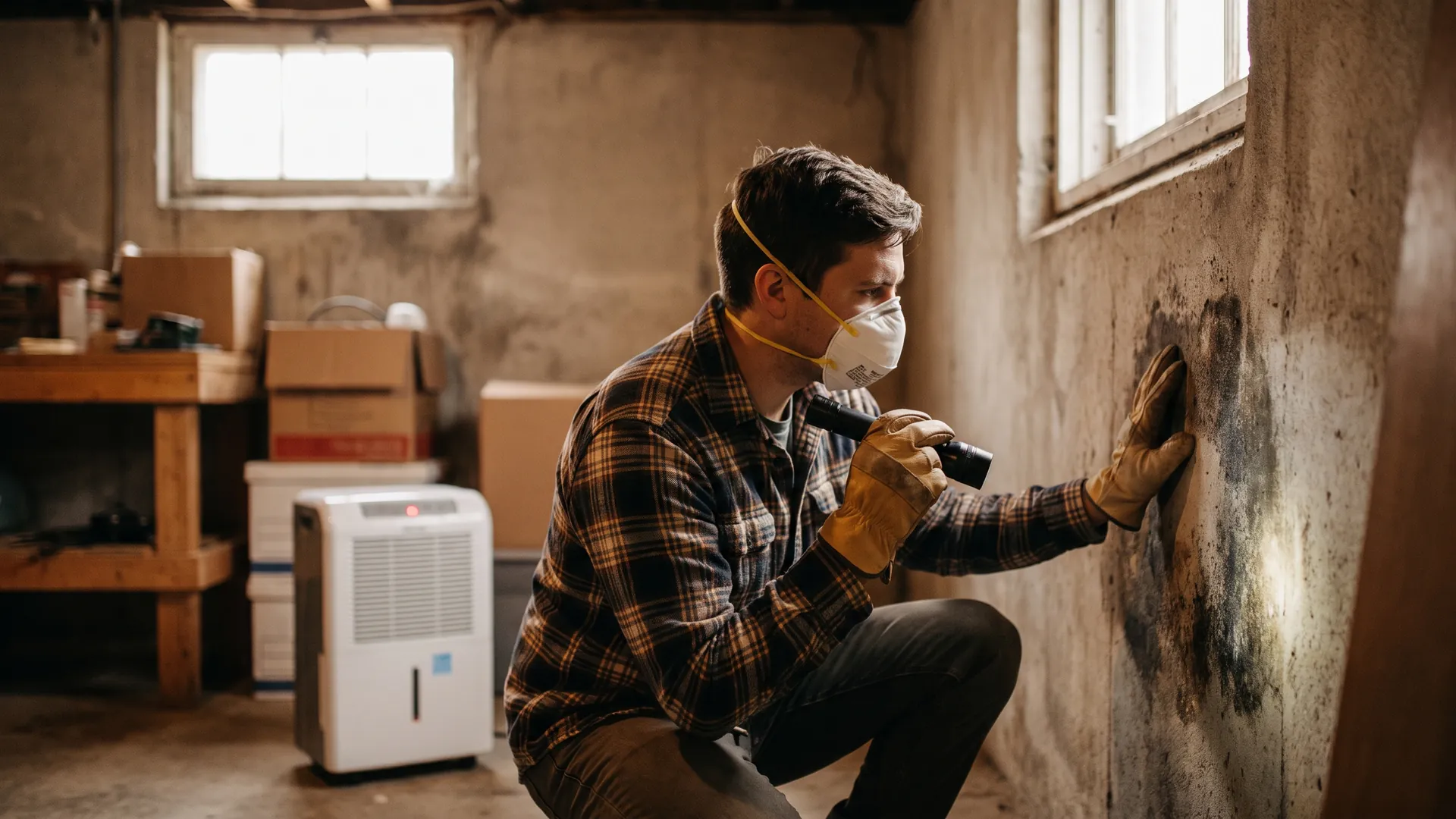
Testing rarely changes the plan. The EPA and the Centers for Disease Control and Prevention both say it isn’t necessary to identify the species, because all indoor mold gets removed the same way. The permanent fix is always moisture: mold can’t grow without water, so any cleanup that ignores the source will fail.
Learn how to address mold issues in your home: how to spot growth, when to hire out, and how to keep it from returning. Mold is part of the larger home maintenance job of keeping water where it belongs, our Homeownership guide has the rest.
Key takeaways:
- 10 square feet is the trigger: EPA guidance treats a moldy patch under about 10 square feet as a job most homeowners can handle, and anything larger as work for a remediation contractor.
- Testing usually wastes money: No federal limits exist for mold in indoor air, and the CDC doesn’t recommend testing, because every species gets the same 2-step response: remove the growth, fix the water.
- You get 24 to 48 hours: Dry wet material within 24 to 48 hours of a leak and mold usually won’t grow at all; holding indoor humidity between 30% and 50% keeps it away.
What is mold, and why does it matter in your home?
Mold is a fungus that grows on damp material, and it becomes a problem only when spores land on something wet and start feeding. Drywall paper, wood framing, carpet backing, and insulation facing all qualify. Spores are everywhere and can’t be eliminated from indoor air; what you control is whether they find water.
The EPA reports that molds produce allergens and irritants that can cause allergic reactions, asthma attacks in people allergic to mold, and irritation of the eyes, skin, nose, throat, and lungs. Mold also digests what it grows on, and the water feeding it is usually rotting framing, which is why selling a home with mold issues is harder than fixing it while you live there.
One myth worth retiring: “toxic black mold.” The CDC states plainly that molds themselves are not toxic or poisonous, and that mycotoxin-producing molds should be treated the same as any other mold. You never have to know the species to know what to do.
What does the research say about damp homes and health?
The Institute of Medicine’s 2004 report Damp Indoor Spaces and Health found sufficient evidence of an association between damp indoor environments and some upper respiratory tract symptoms, coughing, wheezing, and asthma symptoms in sensitized persons. The 2009 WHO guidelines for indoor air quality: dampness and mould name preventing persistent dampness as the most important protection.
How do you know if you have mold in your home?
You find mold with your eyes and your nose, in that order. The EPA’s position: if you can see mold growth, you already have what you need to act.
Visible signs and the musty smell
Mold appears as discoloration in patches rather than uniform staining, and color isn’t diagnostic, black, green, gray, white, brown, orange, and pink all occur. Check the edges of water stains, the bottom few inches of drywall, window sills, grout and caulk joints, and the cold side of exterior walls. Paint that bubbles or blisters in one spot almost always means moisture behind it. For a photo-driven look at growth on different materials, a homeowner’s guide to identifying household mold helps.
A damp, cellar-like odor that strengthens when you close up the house usually means growth you can’t see. Smell is directional: walk the room, get low, open cabinets, pull a register cover. Odor with no visible growth is the one case where an inspection is worth paying for.
Where mold hides
Four places account for most of it: basements and crawl spaces, bathrooms, concealed cavities behind appliance water lines and under sinks, and attics where bath fans vent indoors. If water got in first, work that problem in parallel, our guide to addressing water damage in your home covers the drying sequence that decides whether mold appears at all.
How common are mold and leaks in American homes?
Leaks are far more common than reported mold. According to the U.S. Census Bureau and HUD’s 2021 American Housing Survey, 3.8 million of the 128.5 million occupied housing units reported mold in the previous 12 months, while 10.5 million reported water leakage from inside the home and 11.4 million from outside it.
| Housing quality item, 2021 | Occupied units | Share of 128.5 million occupied units |
|---|---|---|
| Reported mold in the last 12 months | 3.8 million | 3.0% |
| Water leakage from inside the home | 10.5 million | 8.2% |
| Water leakage from outside the home | 11.4 million | 8.9% |
| Crumbling or an open crack or hole in the foundation | 5 million | 3.9% |
Source: U.S. Census Bureau and HUD, 2021 American Housing Survey, Housing Quality. Shares calculated from its counts.
Do you need mold testing?
In most cases, no. The EPA’s position is that where visible mold growth is present, sampling is unnecessary, and because no federal limits have been set for mold or mold spores, sampling can’t check a building against a federal standard. There isn’t one. The CDC goes further and doesn’t recommend mold testing at all, because health effects differ too much between people for sampling to predict who gets sick.
Testing earns its keep in 4 situations: you smell mold but need a moisture meter to find it inside an assembly; a claim or dispute needs documentation; a sale needs verification that remediation happened; or a household member’s physician wants an exposure characterized.
Separate the inspection from the remediation, so the person diagnosing the problem isn’t the one selling the cure. You can find a certified home inspector through the American Society of Home Inspectors.
Should you remove mold yourself or hire a professional?
Start with the 10-square-foot line, then adjust for 3 things: what the mold grows on, whether you know where the water came from, and who lives there.1
| Affected area | Surface type | Moisture source | Recommended action |
|---|---|---|---|
| Under about 10 sq. ft. | Hard, non-porous, tile, glass, metal, sealed concrete | Known and repaired | Do it yourself with gloves, goggles, and an N-95 respirator. |
| Under about 10 sq. ft. | Porous, drywall, carpet, ceiling tile, insulation | Known and repaired | Do it yourself only if you’ll cut out and replace the material. |
| Any size | Any | Unknown or still active | Diagnose the water first. Cleaning before the leak is fixed guarantees a repeat. |
| More than about 10 sq. ft. | Any | Any | Hire a contractor. Containment and negative air pressure keep spores out of the rest of the house. |
| Any size | Inside HVAC ductwork, or water contaminated by sewage | Any | Hire a professional regardless of area. Ducts spread spores everywhere. |
What professional remediation involves
A competent remediation runs 5 phases: assessment that traces the moisture with meters and infrared cameras; containment with barriers and negative air pressure under HEPA filtration; removal of porous material cut past the visible growth line; drying, then the real repair. Plumbing, grading, flashing; and verification by someone who didn’t do the work. A contractor who skips the first or last phase is selling a cleaning.
Costs vary enormously. Get 3 written quotes that break out remediation, moisture repair, and rebuild separately, and be skeptical of any bid that never names the water source.
What do the EPA’s size tiers mean for a bigger job?
Above 10 square feet, the EPA’s Mold Cleanup in Your Home page points to its guide Mold Remediation in Schools and Commercial Buildings, which it says applies to other building types. Table 2 of that guide sets two larger tiers.
| Size | Total surface area affected | Personal protective equipment | Containment |
|---|---|---|---|
| Medium | Between 10 and 100 sq. ft. | Limited or full, by professional judgment | Limited, by professional judgment |
| Large | Greater than 100 sq. ft., or significant exposure expected during the work | Full | Full |
Source: U.S. Environmental Protection Agency, Mold Remediation in Schools and Commercial Buildings, Table 2: Mold Remediation Guidelines.
Per the guide, the tiers are based on area “to make it easier for remediators to select appropriate techniques, not on the basis of health effects,” and water carrying sewage or chemical or biological pollutants brings OSHA protective equipment and containment requirements. For the small tier, the EPA’s brief guide says an N-95 respirator is sold at many hardware stores and costs about $12 to $25.
What can be dried instead of torn out?
The EPA’s Table 1: Water Damage, Cleanup and Mold Prevention covers materials wet for less than 48 hours with no visible growth. Wallboard “may be dried in place if there is no obvious swelling and the seams are intact”; ceiling tiles and cellulose or fiberglass insulation are discarded. It also says not to use fans before determining that the water is clean or sanitary.
How do you hire a mold remediation contractor?
The EPA’s Mold Cleanup in Your Home page says to confirm the contractor has mold cleanup experience, check references, and ask that the work follow the EPA’s remediation guide.
The Federal Trade Commission’s Hiring a Contractor booklet asks for names, addresses and phone numbers of at least three clients with similar projects. Before you sign, it says the contract should list the license number if required, start and completion dates, the payment schedule, the duty to get all necessary permits, how change orders are handled, and, if you sign at home, your right to cancel within three business days. To budget for the next repair, see planning for unexpected home repairs.
How to clean up a small mold problem safely
A do-it-yourself cleanup is 5 steps. Step 1 isn’t cleaning.
- 1. Fix the water first: Stop the leak or dry the area before you scrub anything. Clean up mold without fixing the water and it comes back.
- 2. Put on real protection: The EPA’s minimum is long gloves to mid-forearm, goggles without ventilation holes, and an N-95 respirator, which filters 95% of airborne particulates and works only if it seals to your face.
- 3. Scrub hard surfaces with detergent and water: That’s the EPA’s actual recommendation. Chlorine bleach isn’t advised as a routine practice, and never mix bleach with an ammonia-containing cleaner, the combination produces toxic fumes.
- 4. Throw out porous material you can’t clean: Mold grows into the crevices of absorbent materials, so ceiling tiles, carpet, and drywall usually get cut out and replaced.
- 5. Dry completely, then look again: Dead mold still causes allergic reactions, so killing it isn’t enough. It must be removed. Re-inspect two weeks later; regrowth means you missed the water.
Common types of indoor mold
Species doesn’t change the plan. The CDC’s guidance is that all molds get treated the same for health risks and removal, and that it isn’t necessary to determine the type.
| Mold | Typical appearance | Where it shows up | What it changes |
|---|---|---|---|
| Cladosporium | Olive-green to brown or black, suede-like | Fabrics, wood, painted surfaces, supply ducts | Nothing. Remove it. |
| Penicillium | Blue-green, velvety | Water-damaged carpet, wallpaper, insulation | Nothing. Remove it. |
| Aspergillus | Varies widely; often powdery | House dust, damp basements, attics, HVAC | Nothing. Remove it. |
| Stachybotrys chartarum (“black mold”) | Greenish-black, often slimy | Chronically saturated drywall paper, cardboard | Nothing about removal. It signals sustained saturation. |
Find the water, or the mold comes back
Mold can’t grow without moisture, which makes moisture control the whole prevention strategy. The EPA’s benchmark: keep indoor humidity below 60% and ideally between 30% and 50% relative humidity, and dry any wet or damp material within 24 to 48 hours of a leak. Hit that window and in most cases mold will not grow at all.
- Hold humidity in the 30% to 50% band: An inexpensive hygrometer tells you where you stand. Run a dehumidifier through humid months, plumbed to a drain.
- Vent moisture outdoors: Bath and kitchen fans should exhaust outside, not into the attic, and the bath fan should run after a shower until the mirror clears.
- Move water away from the foundation: Extend downspouts several feet out, keep gutters clear, and keep soil sloping away. Most chronic basement moisture is a gutter and grading problem, not a waterproofing one.
- Put inspections on a schedule: Basements, crawl spaces, attics, and under-sink cabinets deserve a seasonal look, build them into your seasonal home maintenance checklist.
Slow leaks from supply lines, wax rings, and water heaters do more damage than dramatic failures, because nobody notices them. Every contamination cleanup shares this logic.
How do you size a dehumidifier for a damp basement?
Match capacity to how wet the space is. ENERGY STAR’s dehumidifier buying guidance rates capacity in pints per 24 hours and sizes a portable unit by condition and floor area.
| Condition without dehumidification | Relative humidity | Room under 2,000 sq. ft. | Room over 2,000 sq. ft. |
|---|---|---|---|
| Slightly to moderately damp: musty odor that may be intermittent | 50% to 75% | 20 to 30 pints a day | 30+ pints a day |
| Very damp: damp spots appear on walls and floors | 75% to 90% | 25 to 40 pints a day | 40+ pints a day |
| Wet: walls or floor sweat, or seepage is present | 90% to 100% | 30 to 50 pints a day | 50+ pints a day |
Source: ENERGY STAR, Dehumidifiers: Buying Guidance.
Which water lines deserve a scheduled replacement?
The Insurance Information Institute’s mold prevention guide suggests replacing hoses to major appliances such as the washer and dishwasher every five years, noting a typical hose costs as little as $10, and advises against carpet in damp areas such as basements.
Mold, insurance, and your loan
Coverage depends on what caused the water: sudden versus gradual. According to the Insurance Information Institute, standard homeowners policies cover disasters that are sudden and accidental, so when mold results directly from a covered peril such as a burst pipe there may be coverage for eliminating it, typically up to a policy limit. Mold traced to a slow leak, chronic humidity, or deferred maintenance is excluded as a maintenance failure.
- The mold limitation is close to universal: After the mold claims wave of the early 2000s, insurers added mold limitation and exclusion language to standard homeowners forms in nearly every state, capping or excluding mold coverage unless the growth results directly from a covered peril. The exact sublimit is set by your carrier’s state-approved form, so the number that matters is the one on your declarations page.
- Flood is a separate policy: Homeowners policies don’t cover flood, and the National Flood Insurance Program’s Standard Flood Insurance Policy excludes mold and moisture damage within the policyholder’s control, including failing to inspect and maintain the property after floodwaters recede, which makes the 24 to 48 hour drying rule a claims issue too.
- An endorsement may be available: Some carriers sell added mold coverage or a higher sublimit. Weigh it against your other coverage in our guide to evaluating home insurance options, and read the Insurance Information Institute on how homeowners policies treat mold claims.2
Mold touches financing too. FHA requires the appraiser to note repairs needed to protect occupant health and safety and the soundness of the property, and Fannie Mae assigns a C6 condition rating where deficiencies affect safety, soundness, or structural integrity. Loans on C6 properties aren’t eligible for sale until repairs bring them to at least C5. Across Align Lending’s lender network, the conditions that most often become financing conditions are the ones an appraiser can see: roof, water intrusion, and mechanicals.3
That cuts both ways. Buying a house with a known mold problem, you can often finance the repair: FHA’s Limited 203(k) program allows total rehabilitation costs of up to $75,000 on case numbers assigned on or after November 4, 2024, with a nine-month rehabilitation period.4 FHA reviews that cost limit annually alongside its forward mortgage loan limits, so confirm the current figure before you plan a scope around it.
What does flood insurance pay for in a flooded basement?
Mold treatment can be covered; finished basement walls and floors are not. FEMA’s fact sheet What Does Flood Insurance Cover in a Basement?, released October 21, 2021, lists cleanup costs that can include treatment for mold and mildew and structural drying of salvageable interior foundation elements. It excludes “Basement improvements (such as finished flooring, finished walls, bathroom fixtures, and other built-ins)” and the removal of non-covered items such as basement carpet.
Per FloodSmart, the National Flood Insurance Program’s consumer site, coverage starts 30 days after purchase, with exceptions that include no wait when bought while making, increasing, extending or renewing a mortgage. Homeowner building policies cover up to $250,000 and contents policies up to $100,000, and personal property kept in basements is not protected no matter the cause. See buying a home in a flood zone.
How does a mold sublimit play out on a claim?
Hypothetical example, not an offer. A supply line bursts behind a finished basement wall, the homeowners policy carries a $10,000 mold sublimit, and remediation runs $14,000. The policy might pay up to $10,000, leaving the owner $4,000 plus the deductible. If the same mold came from a slow drip, the owner could pay all $14,000: the Insurance Information Institute’s mold guide calls mold a maintenance issue standard policies generally exclude, though the cost of eliminating it may be covered when it results directly from a covered peril such as a burst pipe. See homeowners insurance deductibles.
Can a Limited 203(k) loan cover mold and the repair behind it?
Only for minor, nonstructural work. HUD’s Mortgagee Letter 2024-13, dated July 9, 2024, says the Limited 203(k) “may only be used for minor remodeling and nonstructural repairs” and does not require a 203(k) Consultant. Rotted framing found during remediation is likely structural, which puts it outside the Limited version.
FHA revised the test for a major repair in Mortgagee Letter 2026-06, dated June 23, 2026. It allows up to four draws per contractor, up from two, and treats a repair as major when it is expected to take more than nine months, needs more than four draws per contractor, needs a Consultant to write the repair specification or needs plans or architectural exhibits, or keeps the borrower out of the home for more than a total of 30 days. Completed work with total repair costs of $15,000 or less can be confirmed with receipts or a signed Borrower’s Letter of Completion; above $15,000 the lender must inspect it or use a third-party inspection.
How might a mold repair fit those rules?
Hypothetical example, not an offer. An appraisal notes mold on basement drywall from a failed water heater. Three contractors bid $9,000 for remediation, $6,500 for the water heater and drain line, and $4,500 for drywall. The $20,000 total is under the $75,000 limit, and because it tops $15,000 the finished work gets an inspection under ML 2026-06. Rotted sill plates needing plans would make it a major repair. Approval still depends on the lender, borrower and property; see managing home repairs during escrow.
Our guides to FHA 203(k) loans and renovation loans compare the options, and financing home renovations covers equity-based routes such as a home equity line of credit or a cash-out refinance.
What Michigan homeowners should know
Michigan’s housing stock and disclosure law both push mold toward the basement.
- The disclosure duty is statutory: Michigan’s Seller Disclosure Act, 1993 PA 92, covers transfers of 1 to 4 residential dwelling units, and the seller must deliver the written statement before executing a binding purchase agreement. The form asks whether there has been evidence of water in the basement or crawl space, and calls for disclosure of environmental problems, a list the statute writes as “such as, but not limited to.” Sellers answer from what they know, so mold and the water behind it belong on the form.5
- A late disclosure runs on an hour clock: Arriving after the seller signed a binding purchase agreement, it gives the buyer 72 hours to terminate in writing if hand-delivered, 120 hours by registered mail.
- Basements and freeze-thaw drive the moisture: Full basements are the norm here, surrounded by soil that freezes and thaws all winter, then carries spring melt. Gutters, downspout extensions, grading, and a working sump pump are the first 4 things to check, in that order.
Michigan doesn’t license mold remediation as its own trade, so confirm any contractor doing structural repair carries a Michigan residential builder or maintenance-and-alteration license. Selling after a remediation? Keep the invoices and moisture-repair scope together.
What else do Michigan disclosure, licensing and flood rules ask of owners?
The state’s disclosure form in MCL 565.957 also asks “Roof: Leaks?”, about “Settling, flooding, drainage, structural, or grading problems?”, whether the sump pump is in working order, and “Do you have flood insurance on the property?” It tells buyers to get professional advice and inspections of the property that take indoor air and water quality into account, including evidence of unusually high levels of household mold, mildew and bacteria. See the seller disclosure, handling seller disclosures and a home inspection checklist.
According to LARA’s Bureau of Construction Codes, since June 1, 2008 an applicant for a Michigan residential builder or maintenance and alteration contractor license must complete 60 hours of approved prelicensure education, including the Michigan Residential Code and MIOSHA construction safety standards, before the examination.
After the August 2023 state emergency for Wayne and Monroe counties, the Michigan Department of Health and Human Services encouraged residents who get drinking water from wells to test it after a flood (hotline 844-934-1315); see how well water affects a home.
In winter, ENERGY STAR says humidity in colder climates should stay at 30% to 40% during the heating season to prevent window condensation; a home energy audit can find the cold spots where it collects.
How Align helps when a repair is bigger than your savings
Most repairs belong in a savings account, not a loan. When one does not, like a roof or a furnace, Samantha looks at whether a home equity line, a home equity loan or waiting makes more sense for you.
Align places standalone HELOCs and home equity loans, so you can keep your first mortgage and its rate in place. She explains the payment and the risk before you borrow against your home.
FAQ: Mold in your home
Here are answers to common questions about mold in the home.
Should I get my home tested for mold?
Usually not. Testing doesn’t change the response, since all indoor mold should be removed regardless of type, and sampling is expensive and easy to misread. It’s most useful in a dispute, a claim, or when you smell mold but can’t locate it. Otherwise, spend the money on a moisture investigation, and fold routine checks into your home maintenance routine.
Can I clean mold myself with bleach?
For a small area on a hard, non-porous surface like tile or glass, detergent and water work as well as bleach and are safer. Bleach doesn’t penetrate porous materials such as drywall or wood, so it lightens the stain while leaving growth behind. Those materials need cutting out, the approach our guide to addressing water damage in your home takes with saturated materials.
Does homeowners insurance cover mold damage?
Coverage is usually limited and depends on the cause. Most policies cover mold from a sudden covered event, such as a burst pipe, often with a dollar cap. Mold from long-term leaks, humidity, or deferred maintenance is typically excluded. Read your policy’s mold sublimit and consider whether an endorsement makes sense, using our guide to evaluating home insurance options as a checklist.
Do I have to disclose mold when selling my house?
In most states, yes. Seller disclosure laws generally require you to report known material defects, and mold and water intrusion fall into that category on standard forms. Documenting professional remediation, including the moisture repair, beats staying silent, because an undisclosed problem found at inspection can kill a deal.
Do I need a whole-house dehumidifier to prevent mold?
Only if the whole house runs damp. ENERGY STAR points whole-home dehumidifiers at relatively well sealed homes with central air that see humidity readings above 55% consistently throughout the house. Certified dehumidifiers use 20% less energy than similarly sized conventional units, per ENERGY STAR, under a specification effective October 1, 2025. Take readings on each level for a week or two before choosing between a whole-home system and a portable unit.
How do I measure the humidity in my house?
Use a humidity meter, also called a hygrometer. The EPA’s Brief Guide to Mold, Moisture and Your Home describes it as a small, inexpensive ($10 to $50) instrument available at many hardware stores. ENERGY STAR adds that every certified dehumidifier has a built-in humidistat, and suggests hanging a separate hygrometer near any unit whose humidistat does not show the relative humidity reading.
Is black mold more dangerous than other mold?
The evidence does not show it. The CDC’s Facts About Stachybotrys chartarum, dated May 29, 2024, says no test exists that proves an association between Stachybotrys chartarum and particular health symptoms. It also says a possible association between this mold and acute idiopathic pulmonary hemorrhage among infants has not been proven. A lab report naming the species does not change how it is removed.
Is a mold air test more accurate than a visual inspection?
No. The CDC’s National Institute for Occupational Safety and Health reports that thorough visual inspections or detecting problems by musty odors are more reliable than air sampling. It adds that the results of short-term samples, especially negative findings, may not represent actual exposures. For a structured walk-through instead, NIOSH developed the Dampness and Mold Assessment Tool (DMAT) for schools and general buildings.
The bottom line on addressing mold in your home
Use the EPA’s 10-square-foot line: a moldy area under about 10 square feet is usually a homeowner job with gloves, goggles, and an N-95 respirator, and anything larger belongs to a remediation contractor. Skip the test kit, because no federal limits exist for mold in indoor air and every species gets removed the same way. Scrub hard surfaces with detergent and water, cut out porous material you can’t clean, and fix the water, dry it within 24 to 48 hours and hold humidity between 30% and 50%, or the mold returns.
If you’re ready to finance the remediation and the repairs behind it, talk to Align Lending. We’ll shop your scenario across our lender network and show you the numbers side by side. Call 248-506-5727 or start online.
Footnotes:
1. The 10-square-foot figure is EPA guidance for homeowners, not a regulation, and describes roughly a 3-foot by 3-foot patch. No federal standards or limits exist for mold or mold spores in indoor air, so no square-footage number carries legal force. EPA also directs homeowners to consult a specialist when the water came from sewage or other contaminated water, when mold is inside HVAC equipment, or when a household member has asthma, a mold allergy, a weakened immune system, or another condition that mold exposure could aggravate. Consult a physician about health symptoms and a qualified remediation professional about your property. Return to text.
2. Insurance coverage descriptions here are general and educational. Mold coverage, sublimits, exclusions, and endorsement availability are set by your individual policy form, your carrier, and your state’s approved filings, and they change. Align Lending does not sell insurance and does not adjust claims. Read your own policy and speak with your agent or carrier about your situation. Return to text.
3. Align Lending is an independent mortgage broker and does not set loan terms or appraisal standards. Renovation, rehabilitation, and cash-out refinance program terms, eligibility, and available loan amounts are set by FHA, the government-sponsored enterprises, and the individual wholesale lenders in Align’s network, and are subject to change, credit approval, property eligibility, and equity requirements. Appraisal outcomes rest on the appraiser’s independent judgment. Nothing here is an offer of credit or a commitment to lend. Return to text.
4. Align Lending is not acting on behalf of or at the direction of FHA or HUD. FHA program requirements are set by HUD in the Single Family Housing Policy Handbook 4000.1 and in mortgagee letters, and are subject to change. Return to text.
5. Summaries of the Michigan Seller Disclosure Act are provided for general information only and are not legal advice. Statutory requirements, exemptions, form contents, and deadlines are set by Michigan law and are subject to change, and disclosure obligations in other states differ. Consult a licensed Michigan real estate attorney about your transaction. Return to text.
Sources: the roughly 10-square-foot (about 3 ft. by 3 ft.) homeowner-cleanup threshold; scrubbing mold off hard surfaces with detergent and water; absorbent or porous materials such as ceiling tiles and carpet possibly having to be thrown away; chlorine bleach not recommended as a routine practice during mold cleanup and never mixed with ammonia-containing cleaners; indoor humidity below 60% and ideally 30% to 50% relative humidity; drying wet or damp materials within 24 to 48 hours so that in most cases mold will not grow; sampling being unnecessary where visible mold growth is present and no EPA or other federal limits having been set for mold or mold spores; dead mold still causing allergic reactions and requiring removal rather than only killing; minimum protective equipment of long gloves, non-vented goggles and an N-95 respirator filtering 95% of airborne particulates; and the allergen, irritant, asthma and eye, skin, nose, throat and lung effects, U.S. Environmental Protection Agency, “Mold Cleanup in Your Home,” “A Brief Guide to Mold, Moisture and Your Home,” “Mold and Health,” and “Should I use bleach to clean up mold?” CDC not recommending mold testing, health effects varying by person, molds themselves not being toxic or poisonous, mycotoxin-producing molds such as Stachybotrys chartarum being considered the same as other molds, and all molds being treated the same for potential health risks and removal, U.S. Centers for Disease Control and Prevention, “Mold,” “Mold, Testing, and Remediation,” and “Facts About Stachybotrys chartarum.” Discarding flood-wet items that cannot be cleaned and dried within 24 to 48 hours, Federal Emergency Management Agency mold and flood-cleanup guidance. Exclusion of water, moisture, mildew or mold damage within the policyholder’s control, including failure to inspect and maintain the property after floodwaters recede, National Flood Insurance Program Standard Flood Insurance Policy. Standard homeowners policies covering sudden and accidental losses, and possible coverage up to policy limits for mold resulting directly from a covered peril such as a burst pipe, Insurance Information Institute. The prevalence of mold limitation and exclusion language on homeowners forms is described in general terms because state-by-state form adoption is set by carrier filings and changes over time; no state-count is asserted, read your own declarations page for your sublimit. Appraiser reporting of readily observable physical conditions and repairs needed to protect occupant health and safety and property soundness, and properties with defective conditions being unacceptable until remedied, U.S. Department of Housing and Urban Development, FHA Single Family Housing Policy Handbook 4000.1. Condition rating C6, ineligibility of C6 properties for sale to Fannie Mae, and repair to a minimum C5 rating prior to sale, Fannie Mae Selling Guide B4-1.3-06. Limited 203(k) total rehabilitation costs of up to $75,000, a nine-month Limited 203(k) rehabilitation period, annual review of the Limited 203(k) cost limit alongside the forward mortgage loan limits, and applicability to FHA case numbers assigned on or after November 4, 2024, HUD Mortgagee Letter 2024-13. Michigan Seller Disclosure Act, 1993 PA 92, applicability to 1 to 4 residential dwelling units, MCL 565.952; delivery before a binding purchase agreement and the 72-hour and 120-hour termination rights, MCL 565.954; the statutory form, including the basement and crawl space evidence-of-water question and the environmental problems item, MCL 565.957. Residential builder and maintenance and alteration contractor licensing, Michigan Occupational Code, 1980 PA 299, Article 24; Michigan does not license mold remediation as a standalone trade. Conditions most frequently becoming financing conditions, Align Lending broker network appraisal and underwriting observations. Remediation pricing is deliberately not stated as a dollar figure because it varies by region, scope, and reconstruction required, obtain local written quotes.
This article is for informational purposes only and is not intended to provide legal, medical, insurance, financial, or tax advice. Mold health effects vary by individual, consult a physician about symptoms. Remediation methods, contractor licensing, insurance coverage, and disclosure obligations vary by state, carrier, and property; verify current requirements before you act, and hire licensed professionals for structural, plumbing, electrical, and HVAC work under local code and permitting requirements. Align Lending is an independent Michigan mortgage broker, NMLS #2041154.
Sources
Every outside source this guide links to, in the order it appears. How we choose and check sources
- The EPA reportsU.S. Environmental Protection Agency
- The CDC states plainlycdc.gov
- Damp Indoor Spaces and Healthnationalacademies.org
- WHO guidelines for indoor air quality: dampness and mouldwho.int
- A homeowner’s guide to identifying household moldBob Vila
- 2021 American Housing SurveyU.S. Census Bureau
- The EPA’s position is thatU.S. Environmental Protection Agency
- The CDC goes furthercdc.gov
- Find a certified home inspectorAmerican Society of Home Inspectors
- Mold Cleanup in Your HomeU.S. Environmental Protection Agency
- Table 2 of that guideU.S. Environmental Protection Agency
- Table 1: Water Damage, Cleanup and Mold PreventionU.S. Environmental Protection Agency
- Hiring a Contractorgovinfo.gov
- Chlorine bleach isn’t advised as a routine practiceU.S. Environmental Protection Agency
- The CDC’s guidancecdc.gov
- Dehumidifier buying guidanceENERGY STAR
- Mold prevention guideInsurance Information Institute
- How homeowners policies treat mold claimsInsurance Information Institute
- Fannie Mae assigns a C6 condition ratingFannie Mae Selling Guide
- FHA’s Limited 203(k) programU.S. Department of Housing and Urban Development
- What Does Flood Insurance Cover in a Basement?Federal Emergency Management Agency
- FloodSmartFEMA, National Flood Insurance Program
- Mortgagee Letter 2026-06U.S. Department of Housing and Urban Development
- 72 hours to terminate in writingMichigan Legislature
- Michigan residential builder or maintenance-and-alteration licenseState of Michigan
- MCL 565.957Michigan Legislature
- Michigan Department of Health and Human ServicesState of Michigan
Related resources
12-minute read
Seasonal home maintenance checklist for every season
Find a seasonal home maintenance checklist covering exterior, interior, HVAC and plumbing tasks for all four seasons, keeping repairs small and planned.

12-minute read
Home maintenance for first-time homeowners: A full checklist
Learn what home maintenance for first-time homeowners involves, with monthly, seasonal, and annual tasks plus how much to budget each year for upkeep.
11-minute read
How to address water damage in your home: A step-by-step plan
Learn how to address water damage in your home fast, from shutting off water and power to drying materials before mold starts growing in 24 to 48 hours.
