
Creating a minimalist home: A practical room-by-room guide
Creating a minimalist home means keeping only what you use or genuinely love, then designing around clear surfaces, natural light, and a tight color palette. Start by subtracting rather than shopping: the widely used 90/90 rule says that if you haven’t used an item in the past 90 days and won’t use it in the next 90, it goes.
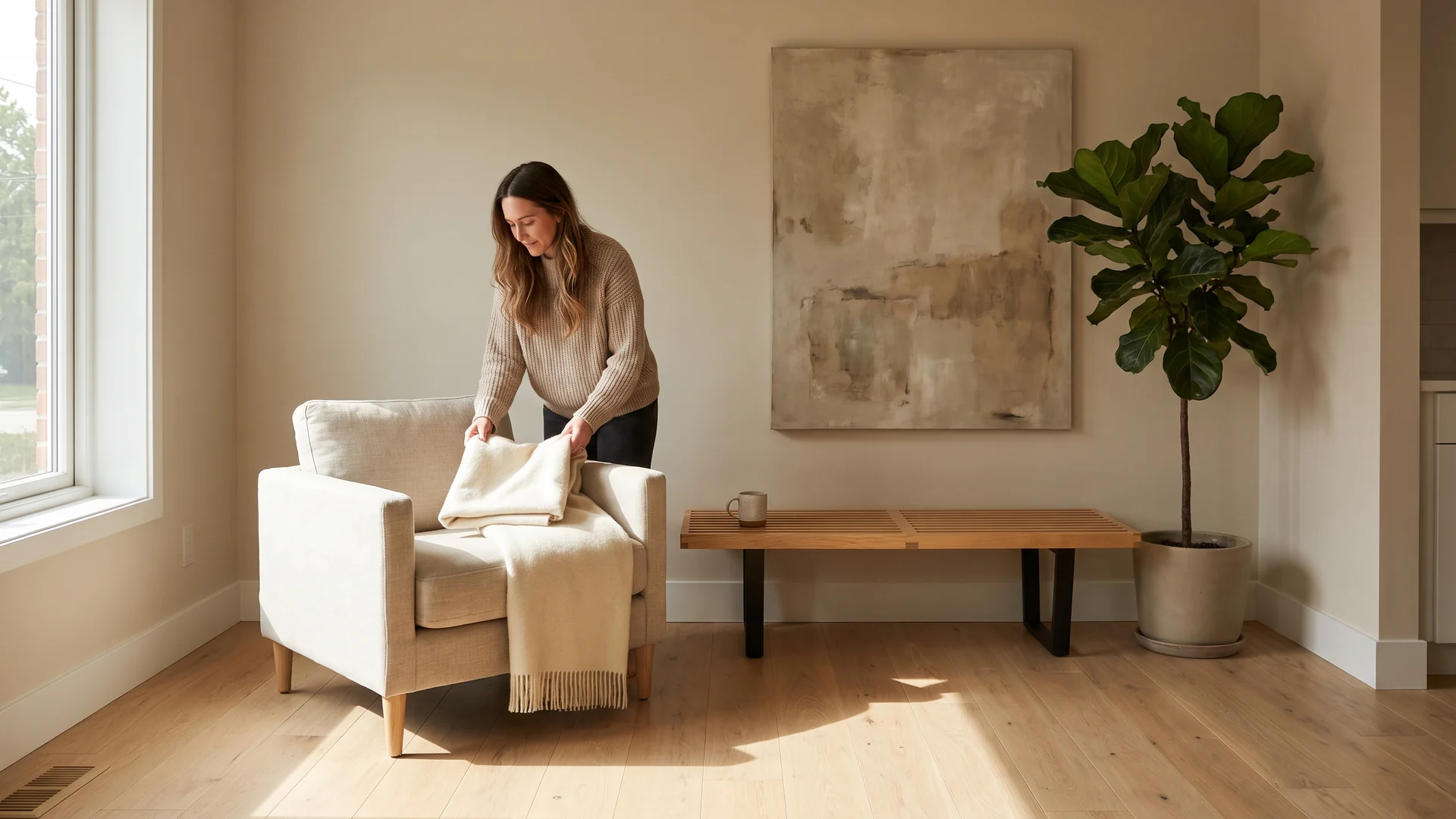
From there, most minimalist rooms follow the 60-30-10 color rule, 60% dominant neutral, 30% secondary tone, 10% accent, and cap each surface at one or two objects that earn their spot. Almost none of this requires construction. The project is a sequence of decisions, not a renovation.
Learn how creating a minimalist home works, including the order to work in, what minimalism looks like room by room, and how to add warmth so a spare room never reads as an empty one. If you’re planning bigger changes around it, our Home Improvement & Design guide covers the rest of the project list.
Key takeaways:
- Subtract before you shop: Run one full declutter pass first, the 90/90 filter, meaning unused in the last 90 days and unneeded in the next 90, before you buy a single bin, shelf, or sofa.
- A tight palette does the visual work: The 60-30-10 split of 60% dominant neutral, 30% secondary tone, and 10% accent keeps a pared-back room from reading flat or unfinished.
- Warmth prevents the empty-room trap: Layer 3 or 4 natural textures, wood, wool, linen, stone, ceramic, leather, and hold each surface to one or two meaningful objects, which matters far more than how much you removed.
Understanding minimalism: more than just decluttering
Decluttering is step one, not the whole method. A decluttered room still looks busy if the palette is scattered.
What is minimalism in home design?
Minimalist home design reduces a room to the pieces that serve a clear purpose or carry real meaning, then lets space, light, and material quality do the decorating. The organizing idea is quality over quantity: fewer objects, chosen more carefully, given room to be seen.
In practice that means clean lines, open floor area, restrained ornamentation, and deliberate empty space. It overlaps with contemporary style without being identical. One correction worth making early: a room stripped to nothing is a failed minimalist room, not a pure one.
Why choose a minimalist home?
The first payoff is maintenance. Fewer objects means fewer surfaces to clean around, fewer things to store, and a room that resets in minutes instead of an afternoon.
The second is spatial. The median new single-family home completed in 2025 measured 2,142 square feet, according to the Census Bureau’s Characteristics of New Housing report, and new-home sizes have drifted down from their mid-2010s peak; the Bureau’s new residential sales data tracks how many new homes sell and their prices. Minimalism runs the same direction, treating square footage you own as something to open up rather than fill, the operating system behind small space living.
Third, minimalism pushes you to buy less, which overlaps neatly with sustainable home design. Be honest about the limits, though: minimalism won’t fix a bad floor plan or storage a house doesn’t have.
How does minimalism fit the homes being built now?
New homes are not getting roomier, so the square footage you keep clear does more work. According to the Census Bureau’s Highlights of 2025 Characteristics of New Housing, 1,005,000 single-family homes were completed in 2025, and the median new single-family home sold that year measured 2,194 square feet. The same report found that 41% of homes built for sale sat on a lot under 7,000 square feet, and 31% of owner-built homes had two or fewer bedrooms.
Do home buyers care about storage?
They do, according to the National Association of Home Builders. Its What Home Buyers Really Want, 2024 Edition, based on a national survey of more than 3,000 recent and prospective home buyers, found a laundry room and a patio each wanted by 86% of buyers, and garage storage, ceiling fans and main-level hardwood each rated essential or desirable by 81%. It gives no figure for minimalist design itself. If resale matters to you, see how to assess a home’s resale potential and renovation ideas that add value.
How to create a minimalist home in 7 steps
Work in this order. Decluttering comes first because every later decision, palette, furniture scale, storage, changes once you know what you’re keeping. If the project widens into construction, our home improvement and design guide picks up there.
| Step | What to do | Time needed (typical) |
|---|---|---|
| 1. Declutter | Keep, donate, discard, one room at a time | A weekend per room |
| 2. Set the palette | Pick 3 colors on a 60-30-10 split | An afternoon |
| 3. Edit the furniture | Remove first, replace only what’s missing | One room at a time |
| 4. Clear floors and surfaces | Cap each surface at 1 or 2 objects | 1 to 2 hours per room |
| 5. Add intentional decor | One statement piece, greenery, one artwork | Over months |
| 6. Improve the light | Sheer coverings, mirrors, warm bulbs | An afternoon |
| 7. Build in storage | Closed storage for what you kept | Days to weeks if built in |
1. Declutter one room at a time
Finish one room before you open a second. Whole-house decluttering weekends usually end with four half-sorted rooms and a pile in the hallway.
Sort into keep, donate, and discard, and run every borderline item through two questions: do I use this, and does it add something to my life? The 90/90 rule is the tiebreaker for items that stall you.1 Duplicates, unused kitchen gear, and clothes unworn for a year are where the volume lives.
2. Choose a neutral palette using the 60-30-10 rule
Pick 3 colors and hold the line: 60% dominant neutral on walls and large upholstery, 30% secondary tone on rugs, curtains, and a second furniture piece, 10% accent in pillows, art, or a single chair. That ratio is why a restrained room reads intentional rather than unfinished.
Warm neutrals, oatmeal, greige, clay, soft black, age better than the cool grays that dominated the 2010s. A monochromatic scheme works too, as long as you vary finish and texture.
3. Buy furniture for function and clean lines
Remove first, then replace only what’s genuinely missing. Most rooms hold more pieces than they need.
- Clean lines over ornament: Straight edges and exposed legs read lighter because you can see floor underneath them.
- Multi-function where it earns its keep: Storage ottomans, lift-top tables, and platform beds with drawers do two jobs in one footprint.
- Scale to the room, not the showroom: Oversized sectionals are the most common minimalism killer in mid-sized rooms.
- Wall-mount what you can: Floating shelves, wall-hung nightstands, and mounted TVs keep the floor plane uninterrupted.
4. Keep floors and surfaces clear
Cap every horizontal surface at one or two objects. Countertops, coffee tables, dressers, and entry consoles are where clutter reassembles fastest, because they’re where you set things down. Clear floors matter even more, which is why baskets and floor-standing anything work against you. Give keys, mail, chargers, and bags one closed home each.
5. Add intentional decor, not more decor
Choose one statement piece per room and let it carry the space. A single oversized canvas beats a gallery wall, one large plant beats five small ones, one sculptural vase beats a shelf of ceramics. The test: if you wouldn’t buy it again today, it isn’t earning its surface.
6. Let in more natural light
Light is the cheapest material in minimalism and the one most people leave on the table. Swap heavy drapes for sheers or roller shades, keep the sill clear, and place a mirror perpendicular to the window rather than opposite it.
After dark, use warm bulbs in the 2700K to 3000K range. ENERGY STAR’s Light Bulb Purchasing Guide (March 16, 2020) calls 2200K to 3000K soft and warm white bulbs ideal for most indoor applications; the cool 4000K-and-up bulbs that read crisp in a garage are what make a room feel clinical.
7. Build storage that hides what you keep
Minimalism doesn’t eliminate belongings; it hides them. Under-bed drawers, wall-mounted cabinetry, benches with lids, and a proper closet system are what let clear surfaces survive a normal week.
Built-ins cost more than freestanding furniture but reclaim wall depth you’re otherwise wasting. Compare local cost data for closet systems and built-in storage and get at least 3 written quotes, since pricing swings by region and scope. If the work moves a wall or adds a circuit, confirm permit requirements with your building department first.
Where should the things you remove go?
Decide the exit before you start, or the donate pile becomes a new kind of clutter in the garage. University of Georgia Extension’s decluttering tips, published Aug. 21, 2026, add a fourth pile, recycle, to keep, donate and trash, set up as bags or boxes before you begin. The same list advises getting donations out of the house promptly to prevent second-guessing, selling only if you are willing to invest the time and effort, and a container method: give a category one shelf or bin and keep only what fits.
The national numbers show why the exit matters. According to the EPA’s durable goods data, Americans generated 12.1 million tons of furniture and furnishings as municipal solid waste in 2018, 4.1% of the total and up from 2.2 million tons in 1960, and 80.1% of it was landfilled. The EPA’s textiles data puts textile generation at 17 million tons in 2018, with a recycling rate of 14.7% and 11.3 million tons sent to landfills; textiles in clothing and footwear were recycled at 13%.
| Material, 2018 | Generated | Share of municipal solid waste | Where it went |
|---|---|---|---|
| Furniture and furnishings | 12.1 million tons | 4.1% | 80.1% landfilled |
| Textiles | 17 million tons | 5.8% | 14.7% recycled; 11.3 million tons landfilled |
Source: U.S. EPA, Durable Goods: Product-Specific Data (page updated October 19, 2026) and Textiles: Material-Specific Data (page updated March 19, 2026), both reporting 2018 data.
Which light bulbs suit a minimalist room?
Pick by color temperature first. ENERGY STAR’s Light Bulb Purchasing Guide (March 16, 2020) sorts bulbs into three bands and says lower Kelvin numbers mean warmer, yellowish light while higher numbers mean cooler, bluer light.
| ENERGY STAR band | Color temperature | Where the guide places it |
|---|---|---|
| Soft white, warm white | 2200K to 3000K | Ideal for most indoor applications |
| Neutral white, cool white | 3500K to 4100K | Good for kitchens and work spaces |
| Daylight | 5000K to 6500K | The coolest, bluest band |
Source: ENERGY STAR, Light Bulb Purchasing Guide, March 16, 2020.
Bulbs carry more weight in a pared-back room because there is less else to look at. According to the Department of Energy’s Consumer Guide to Energy-Efficient Lighting (August 2021), lighting accounts for about 15% of an average home’s electricity use, and LEDs use up to 90% less energy and last up to 25 times longer than incandescent bulbs. For the rest of the house, see energy-efficient home upgrades and the benefits of a home energy audit.
What does a minimalist home look like room by room?
Every room fails in a predictable way, and each has one fix that does most of the work, the logic behind our space-planning guide.
- Living room: The failure is furniture volume. Pull one piece out, float the seating off the walls, run one large rug instead of two, and hang a single oversized artwork. Then hide the cable runs.
- Kitchen: The failure is countertop creep. Leave 1 or 2 appliances out and clear the fridge door. When you replace a machine, check ENERGY STAR ratings for the appliances you keep. A minimalist kitchen holds fewer of them, so each matters more.
- Bedroom: The failure is the nightstand. Hold it to a lamp and one object, skip the pillow pile, and keep bedding in one color family. A capsule closet does more here than any furniture change.
- Bathroom: The failure is product accumulation. Anything you don’t use daily goes behind a door, towels stay in one color, and a wall-mounted vanity keeps the floor visible.
- Entry and home office: The failure is the landing zone. Give the entry one hook rail and one closed bench. For a desk, aim for a clear surface plus a monitor, the discipline that makes small space living workable.
Does a minimalist home cut tip-over and trip hazards?
It can, if the furniture you keep is anchored. The Consumer Product Safety Commission said in a February 5, 2026 release that 217 tip-over deaths were reported from 2013 to mid-2023, that 71% of those killed were children ages one to three, and that emergency departments treated an average of 17,800 tip-over injuries a year from 2020 to 2022. Its advice is to anchor TVs and furniture such as bookcases and dressers securely to the wall. A mounted TV and floating shelves, already part of step 3, take two of the usual tip-over pieces off the floor.
What does the federal dresser standard require?
Under the STURDY Act, the CPSC adopted ASTM F2057-23 as the mandatory standard for clothing storage units, effective September 1, 2023, according to the Federal Register notice of May 4, 2023; the standard’s scope covers units 27 inches or taller and 30 pounds or heavier. The CPSC’s announcement lists tests for stability on carpeting, with loaded drawers and multiple drawers open, and tests that simulate the weight of children up to 60 pounds. The rule applies to units made after that date, so an older dresser you keep is worth anchoring.
Clear floors also matter as people age. According to the CDC’s older adult falls data (reviewed September 4, 2026), over 14 million older adults, 1 in 4, report falling every year. Our guides to buying a home for aging in place and accessibility features in modern homes cover the larger changes.
How do you balance minimalism with comfort and personality?
With texture and restraint used together. Minimalist rooms go cold not because they hold too few things, but because they hold too few kinds of things.
Avoiding the empty-room trap
Layer 3 or 4 natural materials in every room. The working list is short: wood for warmth and grain, wool in rugs and throws, linen in curtains and bedding, stone in surfaces, ceramic in lamps and vessels, and leather in a chair or bench. Three of those in one neutral room will read warm; zero will read like a waiting area.
Four more moves fight the same problem: warm 2700K lighting instead of cool bulbs, one large plant rather than several small ones, a single oversized artwork instead of a gallery wall, and one curve, a round table, an arched mirror, a barrel chair. A room of nothing but right angles is what people mean when they say minimalism feels cold.
Adding personal touches without adding clutter
Personality survives minimalism when it’s curated rather than accumulated. A shelf of books you’ve actually read, a few travel objects displayed together, family photos in matching frames hung as one grouping. Each adds specificity a catalog room never has. The rule is grouping: 10 objects spread across a room is clutter, and the same 10 on one shelf is a collection.
Design for the life you actually live. Keep pet beds and bowls in defined zones, choose performance fabrics over pale linen, and give a shared-room desk a cabinet that closes at 6 p.m.
How do you keep a minimalist home from filling back up?
Maintenance decides whether this lasts, and it runs about an hour a month.
- One in, one out: Every new item displaces an existing one in the same category. This rule outperforms any organizing system.
- A monthly reset: Spend an hour clearing what migrated onto surfaces and pulling anything that stopped earning its place.
- A pause before purchases: Wait a few days on non-essentials. Most impulse buys don’t survive the delay.
- Room to be imperfect: Minimalism is a direction, not a finish line. A house with kids will have a cluttered Tuesday, and the system should recover from it.
Worth saying plainly: Align Lending doesn’t sell furniture, storage, or design services, and we have no stake in your palette. Where this meets our work is the point at which simplifying turns into moving or renovating, covered in our Homeownership guide. If a project outgrows what you’d put on a card, lenders in Align’s network offer renovation and cash-out refinance options that fold the cost into the mortgage.2
How much time does a lighter house give back?
Housework is a daily job for most people, which is why minimalism’s maintenance payoff is worth counting. According to the Bureau of Labor Statistics’ American Time Use Survey for 2025, released June 25, 2026, 81% of people did some household activity on an average day: 87% of women and 75% of men. On the days they did, women spent an average of 2.8 hours on household activities and men 2.1 hours. More people did housework on weekend days than on weekdays, 40% compared with 35%.
The survey does not measure how clutter changes those hours. To shrink the job, UGA Extension’s decluttering tips (Aug. 21, 2026) suggest 10 to 15 minutes a day or a set weekly time with a timer. Pair that with the monthly reset above and a list such as our seasonal home maintenance checklist, and plan for the larger repairs with how to budget for home maintenance.
What should Michigan homeowners know when they declutter, build in storage or downsize?
How do you get rid of household hazardous waste in Michigan?
A full declutter usually turns up old paint, cleaners and batteries. The Michigan Department of Environment, Great Lakes, and Energy (EGLE) said in a May 12, 2026 update that many household hazardous waste drop-off sites start collecting in the spring and commonly close for the year in the fall. EGLE says to look for label words such as warning, caution, flammable, toxic, poison and corrosive, never to pour these products into a storm drain or a home drain, and not to put rechargeable batteries in the trash because they can ignite in a collection truck. The same update lists mattresses, latex paint, small appliances and textiles or carpet among hard-to-recycle items, and says to contact the collection program before the trip to confirm what it takes.
When does a closet or built-in contractor need a Michigan license?
When the job totals $600 or more. According to the Department of Licensing and Regulatory Affairs (LARA) helpful information for homeowners, all contractors offering to do work that totals $600 or more in labor and materials must be licensed by LARA, and contractors and their salespersons must carry a pocket card you can ask to see. LARA recommends a written contract that names the license number and states that all required building permits will be obtained before work begins. If you were solicited at home and signed the contract there, LARA says you have three days to cancel by registered letter.
New wiring for closet or under-cabinet lighting is a separate permit. LARA’s electrical permit information says a person may not add to or alter electrical conductors or equipment without a permit, and lets a homeowner pull one for work in a single-family home they own and occupy. See home renovation permits and, if you plan to do the work yourself, DIY home renovation projects.
What happens to property taxes if simplifying leads to a smaller home?
In Michigan, a home’s taxable value is capped while one owner holds it. The year after it sells, that cap comes off and taxable value resets to the state equalized value, which is half of the assessor’s estimate of market value, not automatically half of what you paid. Under MCL 211.27a, subsection (3) sets that reset after a transfer of ownership, and while you own the home, subsection (2) limits the yearly change to the prior taxable value multiplied by the lesser of 1.05 (a 5% increase) or the inflation rate, plus additions. Treasury’s changes in ownership page adds that some transfers listed in section 211.27a(7) do not uncap. So a smaller home you buy can carry a larger tax bill than the house you leave. The Michigan property tax calculator looks up the published millage for an address.
When does simplifying turn into a move or a renovation?
Often after the first full declutter, when you can see how much house you actually use. If the answer is less house, our guides to downsizing your home and the emotional side of leaving an old home cover the plan and the harder part; hiring movers and moving and settling in cover the move. A cleared, neutral house is also where staging starts, covered in the impact of home staging on sale price and tips for first-time home sellers, and the seller net sheet calculator shows what a sale leaves you after costs.
If the answer is a better-built house rather than a smaller one, built-in storage and new lighting are renovation projects. Samantha Shelton, Align’s founder, frames renovation financing this way in her interview answers: “You’re not just financing the house. You’re financing the plan for the house.” Write the plan down first: what gets built in, where light goes, what stays freestanding.
Ways to pay are covered in financing home renovations, what a renovation loan is, what a cash-out refinance is and home equity lines of credit. The Consumer Financial Protection Bureau explains that a HELOC is a revolving line you can draw on more than once up to a maximum, usually with an adjustable rate, and that if you already have a mortgage, a HELOC or home equity loan is a second mortgage you pay in addition to the first.
How Align finances a renovation
You are not just financing the house. You are financing a plan for it. Align places HomeStyle and FHA 203(k) renovation loans, standalone HELOCs and home equity loans, so the project can be paid for the way that fits it, not the way one bank prefers.
Samantha starts with why: what the work is, what it should cost, and whether your equity or a renovation loan is the better tool. Then one application goes to multiple wholesale lenders.
FAQ: Creating a minimalist home
Here are answers to common questions about creating a minimalist home.
Do I have to get rid of everything to have a minimalist home?
No. Minimalism is about intent, not scarcity. The goal is that every item earns its place because you use it, need it, or love looking at it. Most people who convert to a minimalist home remove duplicates, broken items, unused kitchen gear, and clothing they haven’t worn in a year, then keep the sentimental pieces that matter.
Can you have a minimalist home with kids?
Yes, with systems instead of restrictions. Give every category of toy a single labeled bin, rotate toys so only a portion is out at a time, and use closed storage in shared living areas so surfaces stay clear. Choose durable, washable materials and low, reachable storage so children can reset a room themselves in a few minutes.
Does minimalism mean everything has to be white?
No. All-white minimalism was a 2010s trend, not a rule. Warm neutrals like oatmeal, greige, clay, and soft black are all standard minimalist palettes, and many minimalist interiors use a single saturated accent. What defines the style is restraint and consistency, not the color.
How do I keep a minimalist home from feeling cold?
Layer texture and natural materials. Wood, wool, linen, stone, ceramic, and leather add visual warmth without adding clutter. Use warm 2700K lighting instead of cool bulbs, add one large plant rather than several small ones, and hang a single oversized piece of art instead of a gallery wall. Curved furniture also softens a spare room.
What is the 20/20 rule in minimalism?
It is a companion to the 90/90 rule from The Minimalists, aimed at just-in-case items. According to their 20/20 rule page, as read in October 2026, anything they get rid of that they truly need, they can replace for less than $20 in less than 20 minutes from where they are. They report replacing such an item fewer than five times between the two of them. Use it for cheap, easy-to-find things, not heirlooms or tools.
Can I deduct clothes and furniture I donate after decluttering?
Possibly, if you itemize. IRS Publication 526 for 2025 says that generally you must itemize on Schedule A to deduct a charitable contribution, and that you can’t deduct clothing or household items unless they are in good used condition or better. An item below that standard counts only if you deduct more than $500 for it and include a qualified appraisal and Form 8283, Section B. Keep receipts and ask a tax professional about your situation.
Is there research linking a cluttered home to stress?
One small study points that way. Researchers analyzed self-guided home tours by 60 dual-income spouses, published in Personality and Social Psychology Bulletin in 2010 (abstract). Wives whose descriptions used more words about clutter and unfinished spaces had flatter daily cortisol slopes, a pattern associated with adverse health outcomes, and rising depressed mood over the day. It shows an association in one group, not proof that clearing a room lowers stress.
Where can Michigan residents recycle old electronics?
Through manufacturer programs and local drop-off sites. EGLE’s December 23, 2025 guidance says manufacturers that sell certain devices in Michigan must have a free recycling program, reached through each maker’s website, and that EGLE grants have helped communities open e-waste sites and events that take computers, printers, cell phones, holiday lights and cables. EGLE puts the average at 45 pounds of e-waste per U.S. resident each year.
The bottom line on creating a minimalist home
Creating a minimalist home means keeping only what you use or genuinely love, then designing around clear surfaces, natural light, and a tight palette. Start with subtraction: run the 90/90 filter, unused in the last 90 days, unneeded in the next 90, one room at a time. Then set 3 colors on a 60-30-10 split, cap each surface at one or two objects, and layer 3 or 4 natural textures so the result reads calm instead of empty. Maintenance is one in, one out, plus about an hour a month.
If simplifying is pointing you toward a smaller home or a renovation, talk to Align Lending. We’ll shop your scenario across our lender network and show you the purchase and refinance numbers side by side. Call 248-506-5727 or start online.
Footnotes:
1. The 90/90 rule is a decluttering heuristic popularized by The Minimalists (Joshua Fields Millburn and Ryan Nicodemus); the 60-30-10 split is a long-standing interior design convention. Neither is a standard or a measured finding. Both are rules of thumb. Return to text.
2. Align Lending is an independent mortgage broker and does not set loan terms. Renovation and cash-out refinance program terms, eligibility, and loan amounts are set by the individual wholesale lenders in Align’s network and are subject to change, credit approval, property eligibility, and equity requirements. Nothing here is an offer of credit or a commitment to lend. Return to text.
Sources: 2025 median size of a completed new single-family home (2,142 square feet) and the decline from the mid-2010s peak, U.S. Census Bureau, Characteristics of New Housing. Indoor lighting color temperature of 2200K to 3000K for most indoor applications, ENERGY STAR Light Bulb Purchasing Guide (2020). The 90/90 rule, The Minimalists.
This article is for informational purposes only and is not legal, financial, tax, or design advice. Contractor costs vary widely, get local written quotes. Electrical, plumbing, and structural work should be performed by a licensed contractor under local code and permitting requirements. Align Lending is an independent Michigan mortgage broker, NMLS #2041154.
Sources
Every outside source this guide links to, in the order it appears. How we choose and check sources
- Characteristics of New Housing reportU.S. Census Bureau
- New residential sales dataU.S. Census Bureau
- What Home Buyers Really Want, 2024 Editioneyeonhousing.org
- Light Bulb Purchasing GuideENERGY STAR
- Decluttering tipsfieldreport.caes.uga.edu
- Durable goods dataU.S. Environmental Protection Agency
- Textiles dataU.S. Environmental Protection Agency
- Consumer Guide to Energy-Efficient LightingU.S. Department of Energy
- ENERGY STAR ratings for the appliances you keepENERGY STAR
- February 5, 2026 releasecpsc.gov
- Federal Register notice of May 4, 2023govinfo.gov
- Announcementanchorit.gov
- Older adult falls datacdc.gov
- American Time Use Surveybls.gov
- May 12, 2026 updateState of Michigan
- Helpful information for homeownersState of Michigan
- Electrical permit informationState of Michigan
- MCL 211.27aMichigan Legislature
- Changes in ownership pageState of Michigan
- ExplainsConsumer Financial Protection Bureau
- 20/20 rule pagetheminimalists.com
- Publication 526Internal Revenue Service
- Abstracteuropepmc.org
- December 23, 2025 guidanceState of Michigan
- Popularized by The Minimaliststheminimalists.com
Related resources

20-minute read
Energy-efficient home upgrades: What to do first, and what it saves
See which energy-efficient home upgrades pay off first, from air sealing and insulation to heat pumps and solar, with real costs and yearly savings.

20-minute read
DIY home renovation projects: 12 upgrades you can actually finish
Discover DIY home renovation projects that upgrade your space on a budget, from peel-and-stick backsplashes to floating shelves and smart lighting.
20-minute read
The benefits of a home energy audit and what it includes
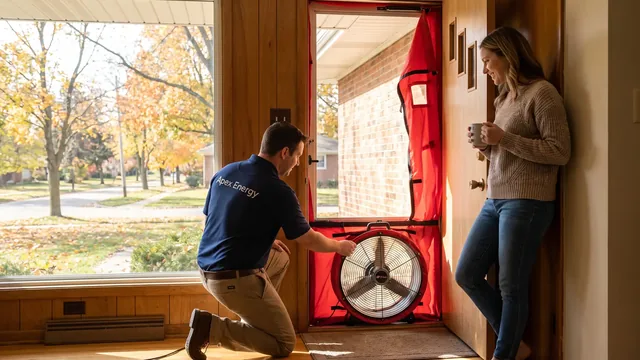
Learn what a home energy audit finds, how blower door and infrared tests work, and why the Department of Energy ties audits to 5% to 30% savings.
