
How to create a sustainable home: A practical room-by-room guide
Creating a sustainable home means cutting the energy, water and materials your household consumes without giving up comfort, and the order you work in decides how much you save. Start with the building envelope: heating and cooling take almost half of the average American household’s annual energy bill, more than $900 a year, and EPA estimates air sealing plus added insulation saves an average of 15% on heating and cooling costs.
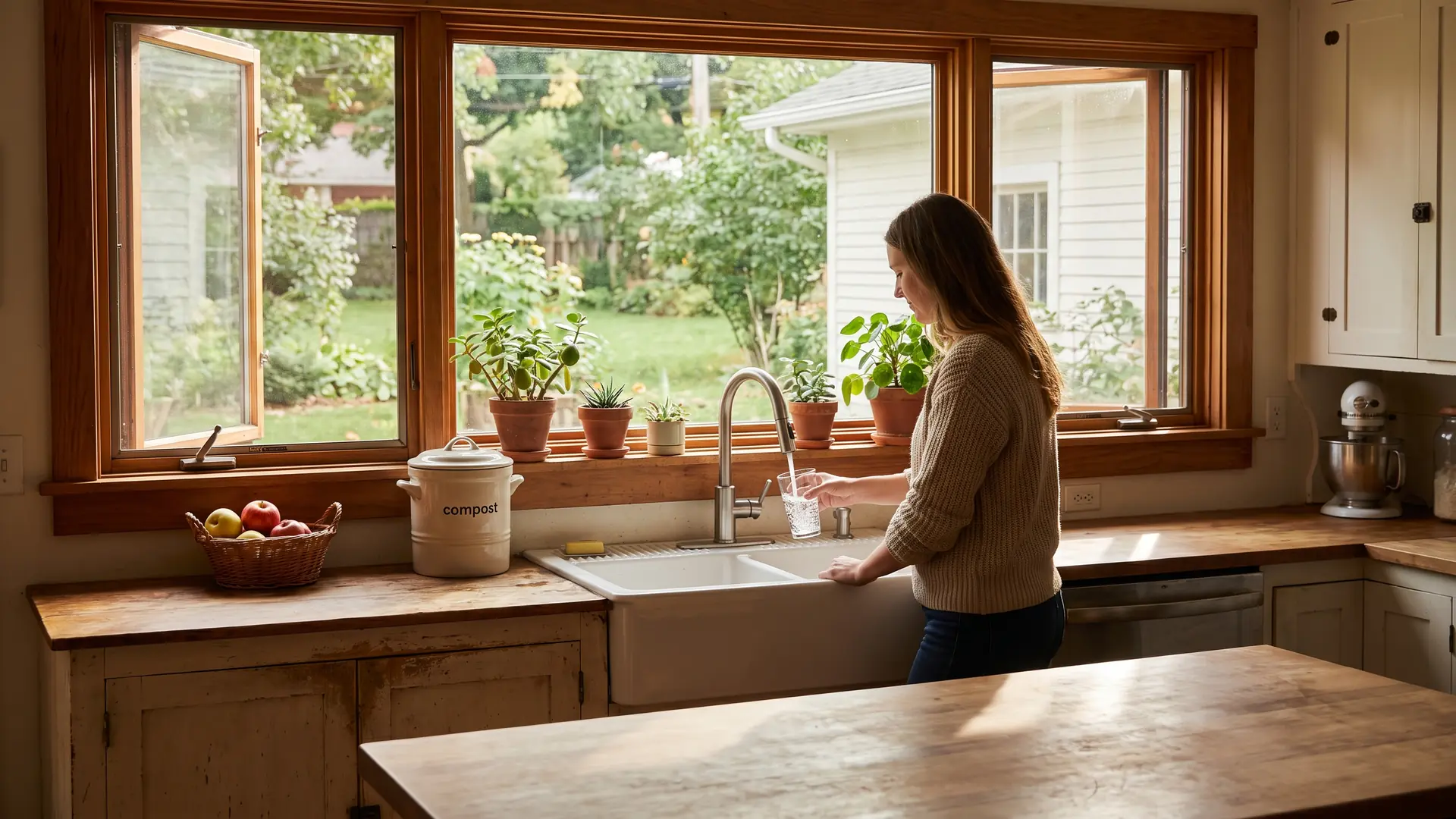
Water comes second, and it splits cleanly in two: indoor fixtures and outdoor irrigation, where outdoor watering alone accounts for roughly 30% of household water use nationally. Materials and habits come last, because every layer costs less when the layer before it is already done.
Learn how to create a sustainable home step by step, including which upgrades pay back fastest, what each tier of work costs, and the highest-value move in every room. If you’re mapping a longer project list, our Homeownership guide covers the rest.
Key takeaways:
- Envelope before equipment: Heating and cooling take almost half of the average household’s annual energy bill, more than $900 a year, and EPA estimates air sealing plus added insulation cuts heating and cooling costs by an average of 15%.
- Water splits in two: Outdoor watering is roughly 30% of household water use nationally, while WaterSense labeled indoor fixtures are independently certified to use at least 20% less water than standard products and perform as well or better.
- Materials are an air-quality decision: EPA exposure studies found about a dozen common organic pollutants at levels 2 to 5 times higher inside homes than outside, which is why low-VOC finishes belong in the plan alongside recycled content.
What makes a home sustainable?
A sustainable home uses less energy, less water and fewer new materials over its lifetime than a comparable house, while staying comfortable and healthy to live in. It isn’t a style, a price point, or a solar panel on the roof. It’s four measurable things: how much heating, cooling and hot water the house demands before you generate a watt of your own; how many of the 300-plus gallons a day the average American family uses are actually doing work; what the materials release indoors; and what leaves as trash.
Location counts too. A walkable neighborhood close to work cuts driving emissions more than most in-home upgrades will, and the research buyers already do when finding a home works for walkability and transit. Housing type matters similarly. A shared-wall condo has less exterior surface to lose heat through than a detached house, one reason our guide to home types and living is worth reading first.
Step 1: How do you stop energy loss?
Seal and insulate before you buy new equipment. EPA estimates homeowners save an average of 15% on heating and cooling costs, or 11% on total energy costs, by air sealing and adding insulation in attics, floors over crawl spaces and basements.1 Doing it first also shrinks every system you buy afterward: a tighter house needs a smaller furnace, heat pump and solar array.
Start with an energy audit
A professional home energy assessment typically costs $250 to $600 or more, and many contractors credit part of it back if you hire them for the work. The core tool is a blower door test: a fan depressurizes the house so outside air rushes in through every gap, and an infrared camera turns those gaps into visible streaks. The Department of Energy estimates acting on what these tests find can save 5% to 30% on a monthly bill.
Older housing stock has the most to gain, since a century-old house was built before anyone measured air changes per hour. The leaks are the same everywhere: rim joists, attic hatches, recessed light cans, plumbing penetrations, and top plates.
Then upgrade the equipment
Once the shell holds heat, replacing equipment finally pays. EPA bundles six high-impact energy efficiency improvements into an ENERGY STAR Home Upgrade; the page gives savings for individual upgrades rather than one total for the set.
- Heat pump water heater: An ENERGY STAR certified model uses at least 70% less energy on average than a conventional electric unit and can save a household of four about $550 a year, per ENERGY STAR. Water heating is nearly 20% of a typical home’s energy use.
- Air source heat pump: One piece of equipment heats and cools, which is why it anchors the list. Size it after the envelope work, or you’ll pay for capacity you no longer need.
- Windows: ENERGY STAR certified windows, doors and skylights can cut heating and cooling costs by an average of up to 13% nationwide compared with non-certified products, but they’re the slowest-paying item here.
- Lighting and controls: ENERGY STAR certified LED bulbs use up to 90% less energy and last 15 times longer than standard bulbs, the cheapest measurable win on this page. A smart thermostat makes setbacks automatic.
For model-level detail, start from ENERGY STAR home efficiency guidance, where certification rests on measured performance rather than marketing. Our guide to energy-efficient home upgrades covers the sequencing in depth.
Where does the energy in a typical home actually go?
Heating and air conditioning lead by a wide margin. According to the U.S. Energy Information Administration’s Use of energy explained: Energy use in homes (last updated December 18, 2023), 52% of a household’s annual energy consumption in 2020 went to space heating and air conditioning, and water heating, lighting and refrigeration together took another 25%.
EPA’s ENERGY STAR program reports that 9 out of 10 homes in the U.S. are under-insulated. The methodology behind EPA’s seal-and-insulate estimate models a typical 1970 to 1989 house with 1,700 square feet of conditioned floor area and 23% total duct leakage, insulated to the 2012 International Energy Conservation Code, and states that estimated savings are higher in the North than the South because of climate.
That is also why the heat pump decision comes after the envelope work. ENERGY STAR’s Air-Source Heat Pumps page puts a typical household energy bill at around $1,900 a year, says a heat pump can deliver up to three times more heat energy to a home than the electrical energy it consumes, and notes that in most zones one can go in as a drop-in replacement when either a central air conditioner or a furnace needs replacing. Our guide to the benefits of a home energy audit explains how an assessor ranks these projects for one specific house, and our seasonal maintenance checklist and guide to budgeting for home maintenance cover the equipment you already own.
Step 2: How do you cut water use?
Split the problem in two, because the fixes are unrelated. The average American family uses more than 300 gallons of water a day at home, and outdoor use accounts for roughly 30% of household use nationally up to 60% in dry climates.2 Indoors, the lever is fixtures. Outdoors, it’s how and when you water.
Indoor fixtures and leaks
Look for the WaterSense label, which certifies a product is at least 20% more water-efficient than standard models and performs as well or better.
- Toilets: WaterSense labeled toilets use 1.28 gallons per flush or less, 20% below the 1.6-gallon federal standard. Anything from before the mid-1990s uses far more.
- Showerheads: A standard showerhead runs 2.5 gallons per minute; a WaterSense labeled one uses no more than 2.0 gpm. Showering is close to 17% of residential indoor water use.
- Faucets and aerators: WaterSense labeled bathroom faucets and aerators use no more than 1.5 gallons per minute, 30% or more below the standard 2.2, and replacing old faucets and aerators with labeled models can save the average family 700 gallons a year.
- Leaks: Household leaks can waste about 9,400 gallons a year for the average family, per EPA WaterSense, and a faucet dripping once per second wastes more than 3,000. Fixing what’s there beats buying new.
The figures and the labeled-product database both live at EPA WaterSense fixture and water savings data.
Outdoor irrigation and landscaping
Outdoor water is the biggest easy reduction, largely because so much of it never reaches a root. EPA WaterSense reports that as much as 50% of the water used outdoors is lost to wind, evaporation and runoff. Watering early, running drip lines instead of overhead spray, and adding a WaterSense labeled controller that skips cycles after rain all attack that waste directly.
The structural fix is the planting plan: native and drought-tolerant species need a fraction of the water a lawn does once established, and shrinking turf shrinks the irrigated footprint permanently.
How much water does each fixture and habit save?
Per EPA’s Residential Toilets page (updated May 29, 2026), toilets account for nearly 30% of an average home’s indoor water consumption, and older, inefficient toilets use as much as 6 gallons per flush. Per the Showerheads page (updated March 3, 2026), showering adds up to nearly 40 gallons per day for the average family.
| Change | What EPA WaterSense reports |
|---|---|
| Replace a clock-based irrigation controller with a WaterSense labeled one | Up to 30% less irrigation water, and up to 15,000 gallons a year for an average home |
| Find and fix household leaks | The average family can waste 180 gallons a week from leaks |
Source: EPA WaterSense, Statistics and Facts, last updated March 11, 2026.
Outdoors, EPA’s WaterSense Outdoors page (updated July 20, 2026) reports that residential outdoor water use across the United States accounts for nearly 8 billion gallons a day, mainly for landscape irrigation, and that the average household uses more water outdoors than for showering and washing clothes combined. EPA also holds an annual Fix a Leak Week, which ran March 16 through 22 in 2026, a useful yearly reminder to check toilets, faucets and hose bibs. If a leak has already soaked a floor or ceiling, our guide on how to address water damage in your home covers the next steps, and homes on a private well have their own questions in how well water affects a home’s value.
Step 3: Which materials matter?
Durability beats novelty, because a material that lasts twice as long halves its lifetime footprint. That rule settles most product arguments faster than a recycled-content percentage does. The second rule: anything touching your indoor air outranks anything that doesn’t. EPA’s Total Exposure Assessment Methodology studies found about a dozen common organic pollutants at levels 2 to 5 times higher inside homes than outside.
- Low-VOC paints, sealants and adhesives: The highest-value material choice in the house, because finishes off-gas into the room you’re standing in. Read the VOC content on the label, not the word “eco” on the front.
- Formaldehyde-free composites: Cabinet boxes, shelving and engineered flooring are where composite wood concentrates. Specify no-added-formaldehyde panels when you’re ordering anyway.
- Reclaimed wood and bamboo: Flooring, beams and cabinetry with no new hardwood harvest. With bamboo, check the adhesive, that’s where the air-quality question lives.
- Recycled steel and cellulose insulation: High recycled content in roles where the material stays put for the life of the building.
- Natural ventilation: Operable windows on opposite sides of a room, ceiling fans and a working range hood cut cooling load and dilute whatever does off-gas.
Verify claims through third-party certification, not packaging language. LEED, Passive House, WELL and the ENERGY STAR and WaterSense labels each measure something different. Circular-economy ideas draw heavy coverage every year, but none outrank a sealed attic and a fixed toilet flapper.
What labels should you check on paint, cabinets and flooring?
For indoor air, EPA’s page on Volatile Organic Compounds’ Impact on Indoor Air Quality (updated June 23, 2026) states that concentrations of many VOCs are consistently higher indoors, up to ten times higher, than outdoors, and that paints, varnishes and wax all contain organic solvents.
For composite wood, EPA’s Formaldehyde Emission Standards for Composite Wood Products page (updated October 23, 2026) says that after March 22, 2019, composite wood products must be labeled as TSCA Title VI compliant. The rule covers hardwood plywood, medium-density fiberboard and particleboard, plus household and other finished goods that contain them, which is what many cabinet boxes and shelves are made of. Look for that label on the panel or the carton.
For marketing words, the Federal Trade Commission’s Green Guides set the rule. Per 16 CFR 260.4, it is deceptive to misrepresent, directly or by implication, that a product offers a general environmental benefit, and marketers should not make unqualified general environmental benefit claims. So a can that says “eco” proves little, while a specific, qualified claim such as a stated VOC content is something you can compare. If the work needs a permit, our guide to home renovation permits covers when, and home insurance and renovations explains what to tell your insurer.
Step 4: What habits actually move the needle?
Habits are free, they start today, and they compound with every upgrade already in place.
- Thermostat discipline: Setbacks while you’re asleep or out apply directly to the largest share of the bill. Automating them removes the only hard part.
- Cold-water laundry: An ENERGY STAR certified clothes washer uses about 20% less energy and 30% less water than a regular washer, roughly 14 gallons per load against about 20. Washing cold and running full loads stacks on top.
- Composting and e-waste: Scraps and yard waste sent to a bin or municipal program produce soil that needs less water. Electronics, batteries and bulbs need dedicated drop-offs, not curbside bins.
- Buy less, buy longer: The most sustainable product is usually the one you already own. When you do replace something, pay for the version that lasts.
For a broader menu of small moves, Bob Vila’s editors keep a running list of practical steps toward a more sustainable house.
What do sustainable home upgrades cost, and how fast do they pay back?
Cost and payback run in opposite directions: the cheapest items pay back fastest, and the priciest are usually bought for comfort rather than return. Use the tiers below to sequence the work, then get local quotes for anything above the fixture line.
| Upgrade | Typical cost tier | Effort | Payback horizon |
|---|---|---|---|
| Habit changes (setbacks, cold laundry, short showers) | None | Start today | Immediate |
| LED lighting throughout | Tens to low hundreds | DIY, one afternoon | Fastest on this list |
| WaterSense faucets, aerators, showerheads | Low hundreds | Mostly DIY | Short |
| Smart thermostat and controls | Low hundreds | DIY, or an HVAC visit without a C-wire | Short |
| Energy audit with blower door test | $250 to $600 or more | Certified assessor | Pays back through what it finds |
| Air sealing and attic insulation | Commonly low thousands | Contractor; parts are DIY-able | Medium, and it shrinks everything below |
| Heat pump HVAC or water heater | Water heater lower; HVAC commonly five figures | Licensed contractor | Medium to long; size after the envelope |
| Replacement windows | Commonly five figures | Contractor | Long; comfort usually justifies it first |
| Rooftop solar | Commonly five figures | Contractor, permitting, interconnection | Long; depends on size, rates and incentives |
Treat those tiers as sequencing guidance, not quotes. Pricing swings by region, house age and whatever incentives are current when you sign. Where a project outgrows what belongs on a credit card, lenders in Align’s network offer renovation and cash-out refinance options that fold efficiency work into the mortgage instead.3
Are federal energy tax credits still available in 2026?
Not for new work. The IRS Energy Efficient Home Improvement Credit page (last reviewed April 28, 2026) says the credit can be claimed for improvements made through December 31, 2025. For qualifying work in 2023 through 2025 it allowed up to $3,200 a year, with a $150 limit for home energy audits. The IRS Residential Clean Energy Credit page (last updated July 4, 2026) says that credit equaled 30% of the cost of new, qualified clean energy property installed from 2022 through December 31, 2025, and is not available for any property placed in service after that date. Excess unused credit already earned can still be carried forward, according to the same page.
A payback estimate for a project planned now should leave the federal credit out. Ask a tax professional about credits from 2025 work; our overview of the impact of new tax laws on homeownership covers other changes.
Can you finance energy upgrades through a mortgage?
Yes, under program rules set by Fannie Mae, Freddie Mac and FHA, each with its own limits. Fannie Mae’s Selling Guide topic B5-3.3-01, HomeStyle Refresh for Improvements on Existing Properties (dated August 5, 2026) covers energy- or water-efficiency upgrades, environmental remediation, and disaster preparedness or resiliency improvements, up to 15% of the “as completed” appraised value for purchases and limited cash-out refinances. The improvements must be completed no later than 180 days from the date of the mortgage note.
Freddie Mac’s GreenCHOICE Mortgages page lists maximum energy financing of 15% of the “as completed” value and says an energy report is not required for basic energy or water efficiency improvements with an aggregate cost of $6,500 or less. HUD’s 203(k) Rehabilitation Mortgage Insurance Program Types page says the Limited 203(k) lets homebuyers and homeowners finance up to $75,000 into the mortgage to repair, improve or upgrade, while the Standard 203(k) requires rehabilitation costing at least $5,000, with the total property value still within the FHA mortgage limit for the area.
For example, on a home appraised at $350,000 “as completed,” a 15% program cap works out to $52,500 of eligible improvements. Hypothetical example, not an offer: the program, the appraisal and the lender decide the actual amount. Align Lending is not affiliated with or endorsed by HUD, FHA, Fannie Mae or Freddie Mac.
For solar, Fannie Mae’s B2-3-04, Special Property Eligibility Considerations (dated October 8, 2025) says a property with panels or other efficiency items financed by a PACE loan is not eligible for delivery to Fannie Mae unless the PACE loan is paid in full at or before closing, and that if ownership is unclear for lack of documentation, no value for the panels may be given on the appraisal. Our guides to renovation loans, financing home renovations, refinancing for home improvements, cash-out refinancing, the home equity line of credit, buying a home with solar panels and renovations that add value go further.
What programs help Michigan homeowners pay for efficiency upgrades?
The Michigan Department of Environment, Great Lakes, and Energy (EGLE) reported on August 20, 2026 that its Michigan Home Energy Rebates (MiHER) program has two rebate pathways, each funded with just over $105 million in federal money, with a goal of funding efficiency and electrification upgrades for about 15,000 Michigan homes. HEAR rebates are available to households with incomes at or below 150% of Area Median Income, and homeowners don’t have to pay up front for the covered rebate amount. The same EGLE article reported that participation in the Detroit district was nearing the single-family funding cap, leading to a temporary pause in approvals there, so check current status before planning around a rebate.
Michigan utilities run their own programs by law. The Michigan Public Service Commission’s October 8, 2026 release on energy waste reduction says the state standard, created in 2008 and amended by the Legislature in 2016 and 2023, requires all electric and natural gas utilities to implement customer programs that lower energy use. Residential offerings include lighting, heating, ventilation and cooling upgrades, home weatherization, energy education and appliance recycling, and the MPSC reported that every $1 utilities spent on these programs generated $2.42 in customer savings last year.
For income-qualified households, the U.S. Department of Energy’s Weatherization Assistance Program serves approximately 32,000 homes a year with DOE funds, and those households save $372 or more a year on average according to a national evaluation the page cites. To see other state, utility and local incentives in one place, the DSIRE database, operated by the N.C. Clean Energy Technology Center at N.C. State University, tracks incentives and policies for renewables and energy efficiency.
Room by room: the highest-value move in each space
If the ladder above is the strategy, this is the punch list, one move per room, chosen for impact rather than visibility.
- Kitchen: Set up composting and fix the faucet. Fix any drip first, then check the gallons-per-minute rating printed on a replacement faucet before you buy.
- Bathroom: Replace the toilet if it predates the 1.6-gallon federal standard and add a 2.0 gpm showerhead. Densest water use in the house, cheapest room to fix.
- Laundry room: Wash cold and run full loads now; buy an ENERGY STAR certified washer when the current one fails, for about 20% less energy and 30% less water per load.
- Attic and basement: Where the 15% heating and cooling savings live. Air seal the attic plane, hatch, can lights, top plates, chases, then insulate over it, and seal the rim joists below.
- Yard: Shrink the irrigated area and water in the morning. Drip lines on native plantings undo most of the evaporation and runoff that wastes up to half of irrigation water.
How Align matches the loan to the property
Lenders do not treat every property the same. Condos, including non-warrantable ones, and homes with two to four units each come with rules that vary from one lender to the next.
Because Align is a broker, Samantha can take your file to the wholesale lender whose guidelines fit the property, instead of forcing it into one bank's box. One application, multiple lenders, and one person on your file from start to finish.
FAQ: Creating a sustainable home
Here are answers to common questions about creating a sustainable home.
What is the first step to making a home more sustainable?
Get an energy audit, then air seal and insulate. Heating and cooling dominate household energy use, and leaks around rim joists, attic hatches, recessed lights and penetrations undercut everything else you do. A blower door test shows exactly where the losses are. Doing this first also lets you size any future heat pump or solar array to a smaller, cheaper load, the sequence our guide to energy-efficient home upgrades lays out.
How much does it cost to make a house sustainable?
It scales with ambition. Habit changes, LED lighting, WaterSense fixtures and a smart thermostat cost a few hundred dollars. Air sealing and attic insulation typically run in the low thousands. Heat pumps, windows and solar are five-figure projects. Most homeowners get the majority of realistic savings from the first two tiers, which is why phasing over several years is standard advice, and why low-cost energy-saving devices are usually the right first purchase.
What are the best sustainable building materials?
Durability usually beats novelty, because a material that lasts twice as long halves its lifetime footprint. Common choices include reclaimed wood, bamboo, recycled steel, cellulose insulation, and low-VOC paints, sealants and adhesives. For flooring and cabinetry, look for formaldehyde-free composites. Verify claims through recognized green building certifications rather than marketing language, and prioritize anything that affects the air you breathe indoors.
Does a sustainable home sell for more?
Documented efficiency helps. Buyers and appraisers respond to evidence, utility bill history, an energy audit report, invoices for insulation and HVAC, and owned solar with production data. Unowned or leased systems complicate the picture and can slow a sale or refinance because the lease must be assumed or bought out. Keep a documentation folder from the first upgrade forward, and watch how sustainable design features are trending with buyers in your market.
Does adding solar panels raise property taxes in Michigan?
Usually not while you own it. Per the Senate Fiscal Agency’s summary of Public Acts 116 to 118 of 2019, which took effect November 15, 2019, installing, replacing or repairing an alternative energy system of not more than 150 kilowatts counts as normal maintenance for taxable value when it is not part of a structural addition, and an assessor may not consider that added value on residential property until it sells. See how property tax assessments work.
Can I get free weatherization help in Michigan?
Possibly, if your household is income-eligible. The Michigan Department of Health and Human Services’ Seeking Weatherization Services page says the program provides energy conservation and related health and safety services for eligible low-income households at no cost to the resident. It is not designed as a repair or rehab program, and a home that received weatherization services in the last 15 years is not eligible. To apply, contact your local Community Action Agency.
How much can a smart thermostat save?
On average, ENERGY STAR’s low- to no-cost tips say a certified smart thermostat can reduce a heating and cooling bill by more than 8%, about $50 a year, and approximately $100 a year in a home that is unoccupied much of the day. Per ENERGY STAR’s smart thermostat page, those models are independently certified on actual field data, so the savings were measured in real homes rather than only modeled.
How often should you water your lawn in Michigan?
Deeply, about once a week or less. University of Minnesota Extension’s guidance for northern lawns advises irrigating one time or less per week with enough water to wet soil six inches deep, in the morning, and mowing at 3 inches or higher. In Southeast Michigan, the Great Lakes Water Authority’s outdoor water use messaging (May 2021) asks residents to water between midnight and 5 a.m. and avoid 5 to 9 a.m. and 5 to 9 p.m.
Where can I recycle batteries and electronics in Michigan?
Start with EGLE’s Recycling page, which offers a Find a Recycling or Hazardous Waste Collection Near You locator for drop-off sites. That is where electronics, batteries and bulbs belong rather than a curbside cart. The same page announces that EGLE’s new Battery Circularity Program has launched. Call the site before you go, because accepted items and hours differ from one location to the next.
The bottom line on creating a sustainable home
Creating a sustainable home is a sequence, not a shopping list. Seal and insulate first, because heating and cooling take almost half of the average household’s annual energy bill, more than $900 a year, and EPA estimates air sealing plus insulation saves an average of 15% on those costs. Then cut water: indoors with WaterSense labeled fixtures certified to use at least 20% less, outdoors where roughly 30% of household water goes. Materials and habits come last and cost the least.
If you’re ready to take on the bigger pieces, insulation, HVAC, windows or solar, talk to Align Lending. We’ll shop your renovation and cash-out scenarios across our lender network and show you the options side by side. Call 248-506-5727 or start online.
Footnotes:
1. The 15% heating-and-cooling and 11% total-energy figures are EPA estimates for air sealing a home and adding insulation in attics, floors over crawl spaces and basements. They are modeled national averages, not a projection for your house: EPA weighted climate zones, construction styles and fuel types using the Department of Energy’s residential energy and cost methodology, and assumed a 25% reduction in total air infiltration was achievable. Your result depends on climate, existing insulation, equipment and how leaky the house was to begin with. Return to text.
2. The roughly 30% outdoor share and the 300-plus gallons per day are EPA WaterSense national averages. Outdoor share varies by climate and landscape and can reach about 60% in dry regions; in cold, wet climates it runs lower and concentrates in summer. WaterSense product figures are certification thresholds measured against federal standards and standard products, not guaranteed reductions on your water bill. Return to text.
3. Align Lending is an independent mortgage broker and does not set loan terms. Renovation and cash-out refinance program terms, eligibility, and available loan amounts are set by the individual wholesale lenders in Align’s network and are subject to change, credit approval, property eligibility, and equity requirements. Nothing here is an offer of credit or a commitment to lend. Return to text.
Sources: heating and cooling at almost half the average household’s annual energy bill and the $900-plus figure, the 15% and 11% seal-and-insulate estimates, the ENERGY STAR Home Upgrade, heat pump water heaters, windows, LED bulbs and clothes washer figures, U.S. Environmental Protection Agency, ENERGY STAR. Household water use, the roughly 30% outdoor share, irrigation losses, and all WaterSense label, toilet, showerhead, faucet, aerator and leak figures, U.S. Environmental Protection Agency, WaterSense. Organic pollutants at 2 to 5 times higher levels indoors, EPA Total Exposure Assessment Methodology studies. Energy assessment cost, blower door methodology, 5% to 30% bill savings, and water heating at nearly 20% of home energy use, U.S. Department of Energy.
This article is for informational purposes only and is not intended to provide legal, financial, tax, engineering, or environmental advice. Product pricing, certification criteria, utility rates and incentives change frequently and vary by manufacturer, utility and location, verify current details before you buy. Electrical, HVAC, plumbing and structural work should be performed by a licensed contractor under local code and permitting requirements. Align Lending is an independent Michigan mortgage broker, NMLS #2041154.
Sources
Every outside source this guide links to, in the order it appears. How we choose and check sources
- EPA estimates homeowners save an average of 15% on heating and cooling costsENERGY STAR
- A professional home energy assessment typically costsU.S. Department of Energy
- ENERGY STAR Home UpgradeENERGY STAR
- ENERGY STAR certified windows, doors and skylightsENERGY STAR
- ENERGY STAR certified LED bulbs use up to 90% less energy and last 15 times longer than standard bulbsENERGY STAR
- ENERGY STAR home efficiency guidanceENERGY STAR
- Use of energy explained: Energy use in homeseia.gov
- Methodology behind EPA’s seal-and-insulate estimateENERGY STAR
- Air-Source Heat Pumps pageENERGY STAR
- The average American family uses more than 300 gallons of water a day at homeU.S. Environmental Protection Agency
- Outdoor use accounts for roughly 30% of household use nationallyU.S. Environmental Protection Agency
- WaterSense labeled toilets use 1.28 gallons per flush or less, 20% below the 1.6-gallon federal standardU.S. Environmental Protection Agency
- A standard showerhead runs 2.5 gallons per minute; a WaterSense labeled one uses no more than 2.0 gpmU.S. Environmental Protection Agency
- WaterSense labeled bathroom faucets and aeratorsU.S. Environmental Protection Agency
- A faucet dripping once per second wastes more than 3,000U.S. Environmental Protection Agency
- EPA WaterSense fixture and water savings dataU.S. Environmental Protection Agency
- WaterSense Outdoors pageU.S. Environmental Protection Agency
- EPA’s Total Exposure Assessment Methodology studies found about a dozen common organic pollutants at levels 2 to 5 times higher inside homes than outsideU.S. Environmental Protection Agency
- Formaldehyde Emission Standards for Composite Wood ProductsU.S. Environmental Protection Agency
- 16 CFR 260.4Electronic Code of Federal Regulations
- An ENERGY STAR certified clothes washer uses about 20% less energy and 30% less water than a regular washerENERGY STAR
- Practical steps toward a more sustainable houseBob Vila
- Energy Efficient Home Improvement CreditInternal Revenue Service
- Residential Clean Energy CreditInternal Revenue Service
- B5-3.3-01, HomeStyle Refresh for Improvements on Existing PropertiesFannie Mae Selling Guide
- GreenCHOICE MortgagesFreddie Mac
- 203(k) Rehabilitation Mortgage Insurance Program TypesU.S. Department of Housing and Urban Development
- B2-3-04, Special Property Eligibility ConsiderationsFannie Mae Selling Guide
- Michigan Home Energy RebatesState of Michigan
- October 8, 2026 release on energy waste reductionState of Michigan
- Weatherization Assistance ProgramU.S. Department of Energy
- DSIRE databasedsireusa.org
- Summary of Public Acts 116 to 118 of 2019Michigan Legislature
- Seeking Weatherization ServicesState of Michigan
- Smart thermostat pageENERGY STAR
- Guidance for northern lawnsextension.umn.edu
- Outdoor water use messagingglwater.org
- Recycling pageState of Michigan
Related resources
20-minute read
Condo vs. Co-op: Similarities and Differences Every Urban Buyer Should Know
Compare condo vs. co-op ownership, monthly fees and board approval rules so you can choose the urban home type that fits your budget and lifestyle.

20-minute read
The pros and cons of buying a condo: Is it right for you?
Compare the pros and cons of buying a condo, from lower prices and low-maintenance living to HOA fees and rules, so you can decide if condo life fits you.

20-minute read
Benefits of modular homes: Cost savings, faster builds and sustainability
See how modular homes are built and financed, what the advertised 10% to 20% savings leave out, and what McKinsey found about build times.
