
Benefits of modular homes: Cost savings, faster builds and sustainability
A modular home is built in finished sections inside a factory, trucked to your lot and craned onto a permanent foundation, and the benefit with the hardest number attached is time. McKinsey & Company’s review of modular construction found projects delivering 20% to 50% faster than traditional methods, with potential construction-cost savings of up to 20% and a real risk of costs running up to 10% higher when logistics or materials go wrong.
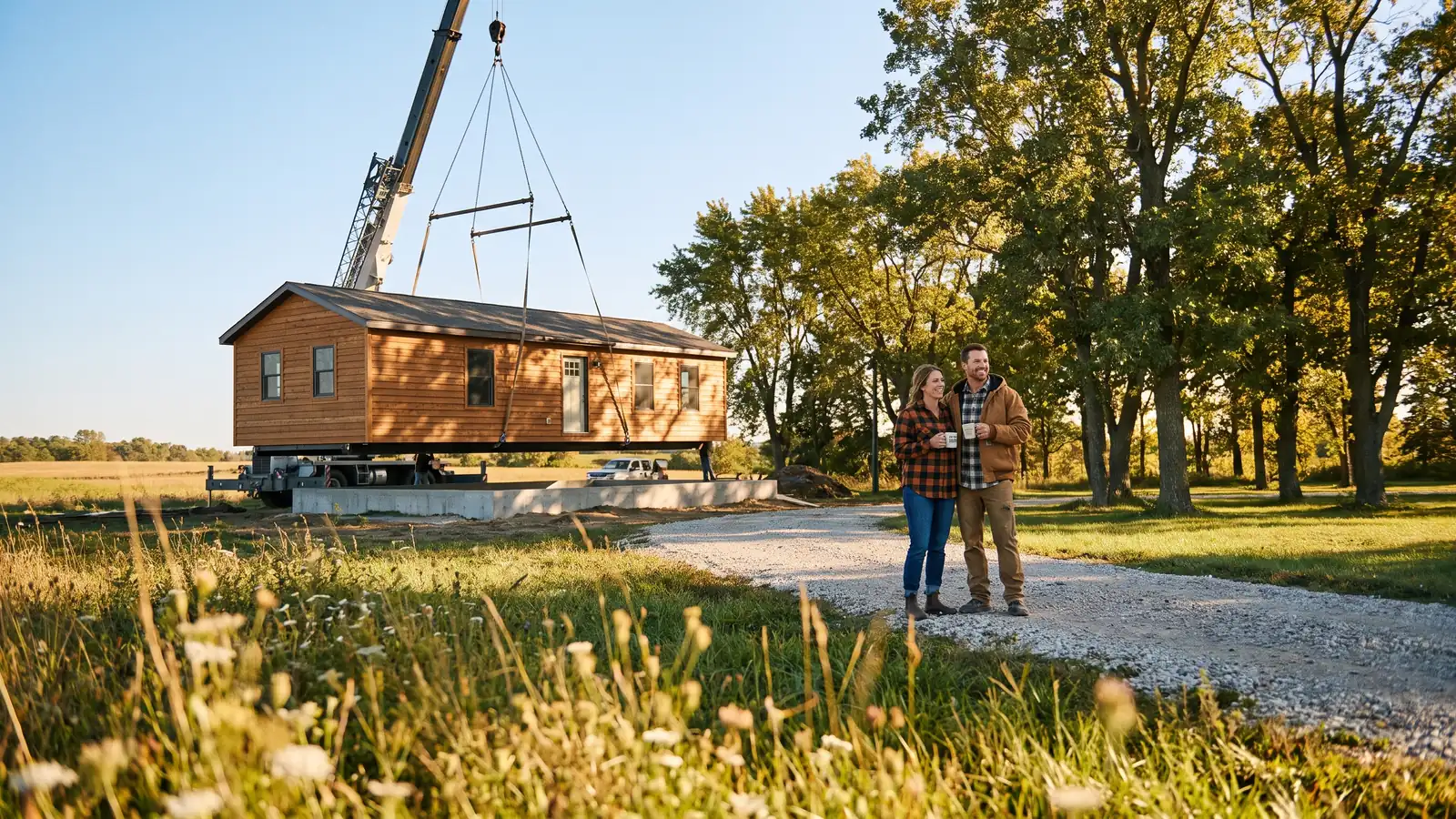
They’re still rare: about 1% of the single-family homes completed in the U.S. in 2025 were modular, and about 3% in the Midwest, which includes Michigan, per the U.S. Census Bureau’s Survey of Construction table by construction method.
Learn how modular homes work, including how they differ from manufactured homes, where the savings come from, and how lenders finance them. Still comparing housing types? Our Home Types & Living guide covers the field.
Key takeaways:
- Speed is the measurable win: Modular projects have delivered 20% to 50% faster than conventional construction in McKinsey’s review of the sector, because factory framing and on-site foundation work run on parallel schedules instead of back to back.
- Cost savings are real but narrower than the pitch: Modular builders commonly advertise 10% to 20% below comparable site-built pricing, and McKinsey found construction-cost savings of up to 20%, but the factory quote isn’t the delivered price, so land, foundation, transport, crane set and finish work still land on your budget.
- Financing works like a site-built house: Once the home is complete on a permanent foundation, conventional, FHA, VA and USDA loans all reach it, and Fannie Mae’s single-closing construction-to-permanent structure allows no single construction period longer than 12 months, with a total period capped at 18 months.
What is a modular home?
A modular home is a house built in finished three-dimensional sections in a factory, transported to your site and assembled on a permanent foundation, and it is built to the same state and local building codes as a site-built house. That last clause is the whole ballgame. Fannie Mae’s Selling Guide requires modular homes to be built under the International Residential Code administered by the state agency where the home is installed, the same code governing the house going up down the street.
Inspection happens in two places. A state-approved third-party agency reviews the plans, inspects units in process and affixes a state certification insignia to each module before it ships. On your lot, your local building department handles the foundation, utility connections, the set and the final inspection.
Modular vs. manufactured vs. site-built homes
Modular versus manufactured is the distinction that decides how a home is titled, financed and appraised. A manufactured home is built to the federal HUD Code, the Manufactured Home Construction and Safety Standards at 24 CFR Part 3280, on a permanent chassis, and sized at 8 body feet or more in width or 40 body feet or more in length in the traveling mode, or 320 or more square feet when erected on site (24 CFR 3280.2), and that standard preempts state construction codes. A modular home has no permanent chassis and answers to your state’s code instead.
| Feature | Modular | Manufactured (HUD Code) | Site-built |
|---|---|---|---|
| Code standard | State and local building codes (IRC) | Federal HUD Code, 24 CFR Part 3280 | State and local building codes |
| Permanent chassis | No | Yes; 8 body feet wide or 40 long in transit, or 320 sq ft erected | No |
| Foundation | Permanent foundation, set by crane | Permanent foundation or piers, depending on siting | Permanent foundation |
| How it’s titled | Real property | Real or personal property, depending on state law and siting | Real property |
| Typical financing | Conventional, FHA, VA, USDA, same as site-built | A mortgage if titled as real property; otherwise a chattel loan | Conventional, FHA, VA, USDA |
| Appraisal comparables | Site-built comps are acceptable | Generally compared to other manufactured homes | Site-built comps |
That titling difference carries a price tag. The Consumer Financial Protection Bureau reports that roughly 42% of manufactured-home purchase loans are chattel loans, secured by the home but not the land, and that chattel borrowers face higher denial rates, higher interest rates and fewer consumer protections than mortgage borrowers. None of that applies to a finished modular home, which is simply real estate. If you’re weighing both, read our breakdown of manufactured home pros and cons first.
One dated caveat: a HUD proposed rule published June 12, 2026 would let the upper floors of multistory HUD Code homes skip the permanent chassis. It was not final as of this update, so the line above still holds.
How many modular homes were built in 2025?
Modular stayed a small slice of new construction in 2025. According to the U.S. Census Bureau’s Survey of Construction table of new single-family houses completed by construction method, 14,000 of the 1,005,000 single-family homes completed in 2025 were modular, about 1%. Another 16,000 fell in the Census category that includes panelized and precut homes, and 975,000, or 97%, were built on site.
The Midwest census region, which includes Michigan, leans on modular more than the nation does: 3,000 of its 131,000 completions in 2025 were modular, about 3% for modular alone, per the same Census construction method table. Nationally the share is smaller than in 1992, when the Census counted 33,000 modular homes among 964,000 completions.
| Area and year | Single-family homes completed | Modular | Modular share |
|---|---|---|---|
| United States, 2025 | 1,005,000 | 14,000 | 1% |
| Midwest, 2025 | 131,000 | 3,000 | 3% |
| United States, 1992 | 964,000 | 33,000 | 3% |
Source: U.S. Census Bureau, Survey of Construction, Type of Construction Method of New Single-Family Houses Completed (annual table, 2025 data released May 2026). See our guide to new home construction for the site-built route.
How much do modular homes save, and where do the savings come from?
Modular builders commonly advertise 10% to 20% below comparable site-built pricing, and McKinsey’s analysis of modular projects put potential construction-cost savings at up to 20%. While flagging that costs can instead run up to 10% higher when delivery or material costs go sideways. Treat the advertised range as a hypothesis to test with quotes, not a budget.
The savings are structural, and they come from four places.
- Labor efficiency: Crews work at fixed stations on repeated plans instead of climbing a different jobsite every week, so the same house takes fewer labor hours to frame.
- Bulk purchasing: A plant buying lumber, drywall and windows for hundreds of homes a year prices materials differently than a builder buying for one.
- Less material waste: Cut lists are optimized across many units and offcuts get reused, shrinking the scrap pile.
- Less weather and theft loss: Framing and materials sit indoors instead of absorbing three weeks of rain or walking off an open site.
Here’s the part the marketing skips: the factory price buys the modules, not the house. Your all-in cost also includes land, site work, the foundation, well or sewer and utility connections, transportation, the crane and set crew, and the “button-up” work that finishes seams, roof ridges, mechanicals and trim after the modules land. Ask every builder for a delivered-and-installed quote, then set it next to a stick-built bid on the same floor plan, our tips for building a home on a budget walk through that math.
Why modular homes go up faster
Speed is a documented advantage of modular: 20% to 50% faster project delivery in McKinsey’s review, and builders routinely advertise 30% to 60% on residential jobs. The mechanism is simple, two schedules run at once.
- Parallel construction: Your foundation is poured while your modules are framed 200 miles away. Site-built runs those phases back to back.
- Weather independence: A Michigan February shuts down framing on an open lot. It doesn’t shut down a heated plant, which matters more the further north you build.
- No trade-scheduling gaps: Dead days waiting on an electrician or drywall crew largely disappear inside a factory that staffs those trades full time.
- A shorter on-site window: Modules are typically set in a day or two, so your street sees weeks of construction traffic instead of months.
Two honest counterweights. The clock doesn’t start until plans are approved and permits are pulled, and that front end is no faster for modular. And a plant has a production queue. If it’s booked out and the crane can’t be scheduled, your faster build waits in line. Get the lead time in writing.
Factory-built quality and sustainability
Modules are engineered to survive a highway trip and a crane lift, a structural load no site-built house ever faces. That pushes plants toward more fasteners, adhesive and bracing than a code minimum demands, a durability side effect of the shipping problem, not a marketing claim. Quality control also gets two layers: the third-party agency inspects in the plant, including work concealed before shipment, and your local inspector still signs off on the foundation, the set and the finished house.
The honest environmental framing is that modular reduces jobsite waste rather than eliminating it. The problem is large, EPA estimated 600 million tons of construction and demolition debris generated in the United States in 2018, more than twice that year’s municipal solid waste. Optimized cut lists and offcut reuse shrink the dumpster, though how much depends on the manufacturer. Ask the plant for its waste-diversion rate; a good one will know.
Energy performance is the piece you can verify. Modular homes are eligible for ENERGY STAR certification under the same Single-Family New Homes program as site-built houses, using the same rater-based process, checklists and ENERGY STAR efficiency standards, the rater simply verifies in the plant anything concealed before shipment. HUD Code homes fall under a separate ENERGY STAR program. Specify certification in your build contract rather than assuming it, and pair it with our guide to energy-efficient home upgrades.
Don’t build a budget around federal energy tax credits. Under Public Law 119-21, signed July 4, 2025, the IRS allows the Energy Efficient Home Improvement Credit only for qualifying property placed in service by December 31, 2025, and the Residential Clean Energy Credit is not available for any expenditures made after December 31, 2025. The builder-side New Energy Efficient Home Credit is not allowed for homes acquired after June 30, 2026. Talk with a tax professional before counting on any incentive.
Do modular homes appraise and finance like site-built houses?
Yes. Because a finished modular home is appraised and financed as ordinary real property, its value tracks the same local market forces as any site-built house nearby. Fannie Mae states plainly that modular, prefabricated, panelized and sectional housing “is not considered manufactured housing,” is eligible under its standard one-unit guidelines, and does not require factory-built comparable sales. VA Pamphlet 26-7 is equally direct: the appraiser will typically treat modular housing the same as conventionally built housing.
That treatment carries through the loan menu.
- Conventional: Eligible as a one-unit property under Fannie Mae’s factory-built housing guidelines, with no minimum requirements for width, size or roof pitch.
- FHA: Because modular homes aren’t manufactured housing, they’re insured under FHA’s standard single-family programs rather than its manufactured-housing rules.1
- VA: Eligible, with the appraiser treating the home like conventional construction; on-frame modular units carry extra conditions such as removal of running gear.2
- USDA: Modular is a named eligible structure type under the Section 502 Guaranteed Loan Program for buyers in eligible rural areas.
Most modular buyers need two loans stitched into one. A construction-to-permanent loan funds the plant deposit, the foundation and the draws, then converts to a permanent mortgage once the home is finished. Under Fannie Mae’s single-closing structure, the construction loan period may have no single period longer than 12 months and the total period may not exceed 18 months, and credit documents must be no more than four months old at the note date. Lenders in Align’s network structure these differently, draw schedules, deposit handling and appraisal timing all vary.3
How is a modular home appraised before it is built?
On a construction-to-permanent loan, value is set as of completion. Under Fannie Mae’s Selling Guide topic on single-closing construction-to-permanent transactions (dated May 6, 2026), the loan-to-value ratio on a purchase is measured against the lower of the total cost (lot plus construction) or the “as completed” appraised value of the lot and improvements; on a limited cash-out refinance it is measured against the as-completed value alone. When the home is finished, an appraisal update and certification of completion on Form 1004D must be completed in its entirety.
According to the same Fannie Mae topic, the loan is a purchase when you are not the owner of record of the lot at the first advance of construction financing, and a limited cash-out refinance when you are.
Fannie Mae’s comparable sales guidance requires a minimum of three closed comparables in the sales comparison approach and says sales that closed within the last 12 months should be used. In a rural area with minimal sales activity, the appraiser may use older comparable sales if they explain why.
Fannie Mae’s guidance on the improvements section of the appraisal report says special energy-efficient items are reported in the Additional features field, and appraisers must compare them with the energy-efficient features of the comparable properties. If the value comes in short, see our guides to the home appraisal process and appealing a low appraisal, and our construction-to-permanent loan guide walks through the draws.
What does the DOE Efficient New Homes label add beyond ENERGY STAR?
The U.S. Department of Energy’s Efficient New Homes program starts where ENERGY STAR stops. According to the DOE program FAQs, its requirements include the mandatory requirements of ENERGY STAR and of the EPA’s Indoor airPLUS program, and raters perform a third-party verification. ENERGY STAR reports two million certified homes on its certified homes page.
The tax piece was always a builder’s credit. The IRS page on the credit for builders of energy-efficient homes says eligible contractors who build qualified new energy-efficient homes could claim up to $5,000 per home for homes acquired in 2023 through June 30, 2026, based on the program the home meets. It never went to the buyer, so specify certification for the efficiency; a home energy audit can check the result.
What to check before you commit to a modular build
Six checks prevent nearly every expensive surprise here. Run them before you put money down.
- Crane and truck access: Modules arrive on tractor-trailers and are set by crane, so narrow streets, tight turnarounds, steep grades, overhead lines and mature trees can add cost or kill the plan, the pie-shaped lots common on cul-de-sac streets are a frequent culprit. Have the builder walk the site first.
- Deed restrictions and HOA covenants: Some subdivisions restrict factory-built housing by name, others do it accidentally through minimum-square-footage or roof-pitch rules. Read the recorded covenants.
- The plant’s state approval: Confirm which third-party inspection agency the manufacturer uses, that it’s approved in your state, and that the insignia will be on every module. That’s documentation you can ask for.
- Who owns the button-up: Seams, roof ridge, mechanical tie-ins and finish work after the set are where responsibility gets murky. Get one party to warranty both the modules and the on-site completion, in writing.
- Insurance in two phases: A finished modular home on a permanent foundation is typically written on the same standard homeowners form, the HO-3 most site-built houses use, rather than the specialty mobile-home policy common for HUD Code homes. Flood damage is excluded from standard homeowners policies and needs a separate NFIP or private flood policy. During construction, confirm in writing who carries risk on the modules in transit and on the crane.
- How it compares to other ownership forms: If you’re also weighing attached housing, the ownership structure changes the loan: a co-op is financed with a share loan secured by your shares and a proprietary lease rather than a mortgage lien on real property, see our condo vs. co-op comparison. Modular sidesteps it entirely: you own the land and the house.
Worth saying plainly: Align Lending doesn’t sell modular homes and has no stake in which manufacturer you pick. Where modular meets our work is the financing.
How should you set the insurance limit on a modular home?
Michigan’s Department of Insurance and Financial Services defines replacement cost in its homeowners insurance guide as the cost to replace, repair or rebuild your home to its original condition with materials of the same kind and quality. Ask your agent to set the dwelling limit from the cost of rebuilding the finished house, set and finish work included, not from the factory invoice. Our guide to evaluating home insurance options walks through the coverage choices, and our guide to inspections for new construction covers a private inspection alongside the code inspections.
What Michigan buyers should know
Michigan is a good modular market for one reason and a tricky one for another: the winter that stalls an open jobsite doesn’t touch a heated plant, but the same winter narrows the window for pouring your foundation and setting modules.
- MSHDA reaches a finished modular home, up to $10,000 in help: Because a completed modular home on a permanent foundation is titled as an ordinary single-family home, it fits the MI Home Loan program’s eligible property list. MSHDA’s MI 10K DPA Loan provides up to $10,000 as an interest-free down payment assistance loan statewide, subject to income and sales price limits.
- Spring frost laws can move your set date: MDOT and county road commissions impose seasonal weight restrictions during the spring thaw, typically sometime between March and May, announced year to year, which limit heavy and oversize loads on many Michigan roads. Modules travel on tractor-trailers, so ask the plant and the hauler to check the route with the road agency before you commit to a delivery week.
- Budget $8.60 per $1,000 of sale price for transfer tax when you sell: Michigan’s state real estate transfer tax runs $3.75 per $500 of value and the county tax is 55 cents per $500 in counties under 2 million people. A finished modular home is real property, so it is taxed on resale exactly like the site-built house next door, another way the modular-versus-manufactured distinction shows up in dollars.
One scheduling note: plant queues and Michigan’s short foundation season stack on top of each other, so get the factory lead time, the pour date and the crane date in writing before you sign. The construction window on a single-closing construction-to-permanent loan is finite, and a slipped set date eats it. Our Homeownership guide covers what comes after the set.
Who certifies a modular home in Michigan, and how is it taxed?
Michigan’s certificate of acceptability
Michigan regulates modular homes as premanufactured units under the Stille-DeRossett-Hale Single State Construction Code Act. Under MCL 125.1519, a premanufactured unit intended for use in Michigan may be issued a certificate of acceptability by the state at its place of manufacture, and each unit is inspected by the department or a qualified person it approves.
The same section limits what happens to a certified unit on your lot. At installation, a premanufactured unit with a certificate of acceptability is subject only to the nondestructive tests the department approves to confirm it was not damaged in transit or installation and was installed according to the building permit.
LARA’s Bureau of Construction Codes runs the program. Its Premanufactured Units Program page says participating manufacturers and inspection agencies must be approved by the Bureau, and an approved building system may not be manufactured contrary to the approved drawings. Ask the manufacturer for its Bureau approval and the plan set your units are built to. HUD Code homes fall under LARA’s separate Mobile Home Section and the Mobile Home Commission Act (PA 96 of 1987).
How a new modular home reaches the Michigan tax roll
A lot’s current tax bill tells you little about the bill once the house is standing. Under MCL 211.2, taxable status is determined as of each December 31, which the law calls the tax day, and MCL 211.34d defines new construction as “property not in existence on the immediately preceding tax day.” A modular home set during the year is new construction under that definition, so the vacant-land bill you see when you buy the lot leaves the house out.
As Samantha tells Michigan buyers: “Don’t build your budget around somebody else’s tax bill.” Plan from the finished home’s price with the Michigan property tax calculator, and see how property tax assessments work for the assessor’s side.
What transfer tax looks like on a resale
Hypothetical example, not an offer. Say you later sell a finished modular home for $400,000. That price holds 800 steps of $500. The state tax under MCL 207.525 is $3.75 per step, or $3,000, and the county tax under MCL 207.504 is 55 cents per step, or $440, for $3,440 in all. According to Michigan Treasury’s State Real Estate Transfer Tax page, the seller is legally responsible for the state tax, which is paid through the county when the deed is recorded, though some buyers and sellers agree that the buyer will pay it. Run your own figure with the Michigan transfer tax calculator.
Spring road limits came early in 2026
Seasonal limits can start before March. WNEM reported on Feb. 12, 2026 that MDOT’s spring weight restrictions would begin Tuesday, Feb. 17, with axle weights reduced by 25% on rigid (concrete) pavements and 35% on flexible (asphalt) pavements. Check a late-winter set date against that year’s notice.
How Align matches the loan to the property
Lenders do not treat every property the same. Condos, including non-warrantable ones, and homes with two to four units each come with rules that vary from one lender to the next.
Because Align is a broker, Samantha can take your file to the wholesale lender whose guidelines fit the property, instead of forcing it into one bank's box. One application, multiple lenders, and one person on your file from start to finish.
FAQ: Modular homes
Here are answers to common questions about modular homes.
What is the difference between a modular home and a manufactured home?
A modular home is built in factory sections, assembled on a permanent foundation and constructed to the same state and local building codes as site-built homes. A manufactured home is built entirely in a factory on a permanent steel chassis to the federal HUD Code and may or may not sit on a permanent foundation. The distinction drives financing, appraisal and resale value, see our full comparison of manufactured home pros and cons.
Do modular homes hold their value?
Yes. Once permanently installed on a foundation, a modular home is appraised and resold like a site-built house, and its value follows the same local market forces: location, condition, size and demand. Appraisers may use comparable site-built sales, and both Fannie Mae and VA guidance treat modular homes as conventional construction. The lingering stigma comes from confusing modular homes with chassis-built manufactured homes.
Are modular homes cheaper than stick-built homes?
Usually, though by less than the brochures suggest. Modular builders commonly advertise savings of 10% to 20% versus comparable site-built construction, and McKinsey’s analysis of modular projects found potential construction-cost savings of up to 20%. Total project cost still includes land, foundation, site work, utility connections, transportation and the crane set, so insist on a delivered-and-installed quote before comparing it against a stick-built bid.
Can you get a regular mortgage on a modular home?
Yes. Because modular homes are built to standard building codes and permanently affixed to a foundation, they qualify for conventional, FHA, VA and USDA financing just like site-built homes. During construction you’ll typically use a construction-to-permanent loan that converts to a permanent mortgage once the home is set and finished.
Is it harder to get a loan on a manufactured home than on a modular home?
The data points that way. In its May 27, 2021 report on manufactured housing finance, the Consumer Financial Protection Bureau found that site-built home loan applicants are approved more than 70% of the time, while less than 30% of manufactured home loan applications are approved. A finished modular home is underwritten like a site-built house instead.
Are modular homes taxed differently than manufactured homes in Michigan?
They can be. A modular home on its own lot is real property, taxed under the General Property Tax Act like a site-built house. A home in a licensed manufactured housing community pays a specific tax instead: MCL 125.1041 sets $3.00 per month per occupied home, in lieu of property tax levied on the home under the General Property Tax Act.
How can you tell if a house is modular or manufactured?
Look for the HUD label. HUD’s Office of Manufactured Housing Programs authorizes a certification label for each section of a home that complies with the federal code, so a manufactured home carries one per section. It also sits on a permanent steel chassis and follows federal standards dating from June 15, 1976, per Fannie Mae’s factory-built housing rules. A modular home has no chassis, is built to Michigan’s code, and can carry a state certificate of acceptability instead.
How soon does flood insurance take effect on a new modular home?
Usually not on day one. FEMA says there is typically a 30-day waiting period for a National Flood Insurance Program policy to go into effect, unless the coverage is purchased as required by a government-backed lender or is related to a community flood map change, per its flood insurance page. If your lot needs coverage outside those exceptions, order it weeks ahead. Our guide to buying in a flood zone covers the map check.
The bottom line on modular homes
Modular homes are built in finished sections in a factory, set on a permanent foundation and governed by the same building codes as a site-built house. A key benefit is speed: McKinsey’s review found modular projects delivering 20% to 50% faster than traditional methods, with construction-cost savings of up to 20% and a risk of costs running up to 10% higher when logistics go wrong. Builders commonly advertise 10% to 20% savings, but the factory price never includes land, foundation, transport, crane set or finish work, so compare delivered-and-installed quotes only. Once complete, the home is appraised, insured and financed like any other house.
If you’re ready to price a modular build, talk to Align Lending. We’ll shop your construction-to-permanent and purchase scenarios across our lender network and show you the structures side by side. Call 248-506-5727 or start online.
Footnotes:
1. Align Lending is not acting on behalf of or at the direction of FHA or HUD. FHA eligibility, property acceptability and program requirements are set by HUD and applied by the individual FHA-approved lender, and are subject to change. Nothing here is an offer of credit or a commitment to lend. Return to text.
2. Align Lending works with VA-approved lenders and is not endorsed or sponsored by the Dept. of Veterans Affairs or any government agency. VA loan eligibility, entitlement and property requirements are determined by the VA and the VA-approved lender. Return to text.
3. Align Lending is an independent mortgage broker and does not set loan terms. Construction-to-permanent and purchase program terms, draw schedules, deposit handling, eligibility and available loan amounts are set by the individual wholesale lenders in Align’s network and are subject to change, credit approval, property eligibility and appraisal. Agency guideline references reflect published guidance as of the updated date shown on this article and may be revised. Return to text.
Sources: 2025 single-family completions by construction method (14,000 modular of 1,005,000 total, about 1%; 16,000 panelized or precut; Midwest 3,000 modular of 131,000, about 3%), U.S. Census Bureau Survey of Construction, Type of Construction Method of New Single-Family Houses Completed. Project delivery 20% to 50% faster, construction-cost savings of up to 20% and cost-overrun risk of up to 10%, McKinsey & Company, “Modular construction: From projects to products” (2019). Modular code and appraisal treatment, Fannie Mae Selling Guide B4-1.4-02 and B2-3-02; construction-to-permanent terms, Fannie Mae Selling Guide B5-3.1-02. Modular appraisal treatment, VA Pamphlet 26-7, Chapter 12. Manufactured Home Construction and Safety Standards, 24 CFR Part 3280 (HUD); proposed rule revising the definition of “manufactured home,” published in the Federal Register June 12, 2026, comment period closed August 11, 2026. Modular eligibility for Section 502 guaranteed loans, USDA Rural Development Handbook HB-1-3555. Share of manufactured-home purchase loans that are chattel and the associated pricing and denial outcomes, Consumer Financial Protection Bureau, “Manufactured Housing Finance: New Insights from the Home Mortgage Disclosure Act” (2021). 600 million tons of construction and demolition debris generated in 2018, U.S. Environmental Protection Agency. Modular eligibility under ENERGY STAR Single-Family New Homes program requirements, U.S. EPA ENERGY STAR. Termination dates for the Energy Efficient Home Improvement Credit, Residential Clean Energy Credit and New Energy Efficient Home Credit, Internal Revenue Service guidance on Public Law 119-21. Flood exclusion from standard homeowners policies, FEMA National Flood Insurance Program. MI Home Loan eligible property types and the MI 10K DPA Loan amount of up to $10,000, Michigan State Housing Development Authority. Seasonal weight restrictions on Michigan roads during the spring thaw, Michigan Department of Transportation and county road commissions. State real estate transfer tax of $3.75 per $500 (Act 330 of 1993) and county transfer tax of 55 cents per $500 (Act 134 of 1966), Michigan Legislature.
This article is for informational purposes only and is not intended to provide legal, financial, tax, insurance, or engineering advice. Building costs, factory lead times, agency guidelines, code adoption, insurance terms and tax provisions change frequently and vary by state, county, manufacturer and carrier, verify current details and get written quotes before you commit. Consult a qualified tax professional about any credit or deduction, and a licensed insurance agent about coverage. Align Lending is an independent Michigan mortgage broker, NMLS #2041154.
Sources
Every outside source this guide links to, in the order it appears. How we choose and check sources
- Survey of Construction table by construction methodU.S. Census Bureau
- Fannie Mae’s Selling Guide requires modular homes to be built under the International Residential CodeFannie Mae Selling Guide
- 24 CFR 3280.2Electronic Code of Federal Regulations
- The Consumer Financial Protection Bureau reportsConsumer Financial Protection Bureau
- HUD proposed rule published June 12, 2026U.S. Department of Housing and Urban Development
- Project delivery in McKinsey’s reviewconstructiondive.com
- EPA estimated 600 million tons of construction and demolition debrisU.S. Environmental Protection Agency
- ENERGY STAR efficiency standardsENERGY STAR
- The IRS allows the Energy Efficient Home Improvement CreditInternal Revenue Service
- Single-closing construction-to-permanent transactionsFannie Mae Selling Guide
- Comparable sales guidanceFannie Mae Selling Guide
- Improvements section of the appraisal reportFannie Mae Selling Guide
- DOE program FAQsU.S. Department of Energy
- Certified homes pageENERGY STAR
- Credit for builders of energy-efficient homesInternal Revenue Service
- Homeowners insurance guideState of Michigan
- MSHDA’s MI 10K DPA LoanState of Michigan
- State real estate transfer tax runs $3.75 per $500 of valueMichigan Legislature
- County tax is 55 cents per $500Michigan Legislature
- MCL 125.1519Michigan Legislature
- Premanufactured Units ProgramState of Michigan
- Mobile Home SectionState of Michigan
- MCL 211.2Michigan Legislature
- MCL 211.34dMichigan Legislature
- State Real Estate Transfer Tax pageState of Michigan
- Reported on Feb. 12, 2026wnem.com
- MCL 125.1041Michigan Legislature
- Office of Manufactured Housing ProgramsU.S. Department of Housing and Urban Development
- Flood insurance pageFederal Emergency Management Agency
Related resources

20-minute read
Condo vs. Co-op: Similarities and Differences Every Urban Buyer Should Know
Compare condo vs. co-op ownership, monthly fees and board approval rules so you can choose the urban home type that fits your budget and lifestyle.

20-minute read
The pros and cons of buying a condo: Is it right for you?
Compare the pros and cons of buying a condo, from lower prices and low-maintenance living to HOA fees and rules, so you can decide if condo life fits you.
20-minute read
Guide to the Different Types of Houses by Structure and Style
Discover the different types of houses by structure and style, from ranch and colonial to craftsman and Victorian, and find which home type fits your life.
