
Eco-friendly roofing options: Cool, metal, solar and green roofs compared
The five main eco-friendly roofing options are cool roofs, metal, solar roofing, vegetative green roofs, and recycled or reclaimed materials, and the greenest one is usually whichever lasts longest on your house. InterNACHI’s life-expectancy chart puts metal at 40 to 80 years against about 30 for architectural asphalt and 20 for 3-tab, so one metal roof commonly replaces two asphalt roofs and the two tear-offs that go to a landfill with them.
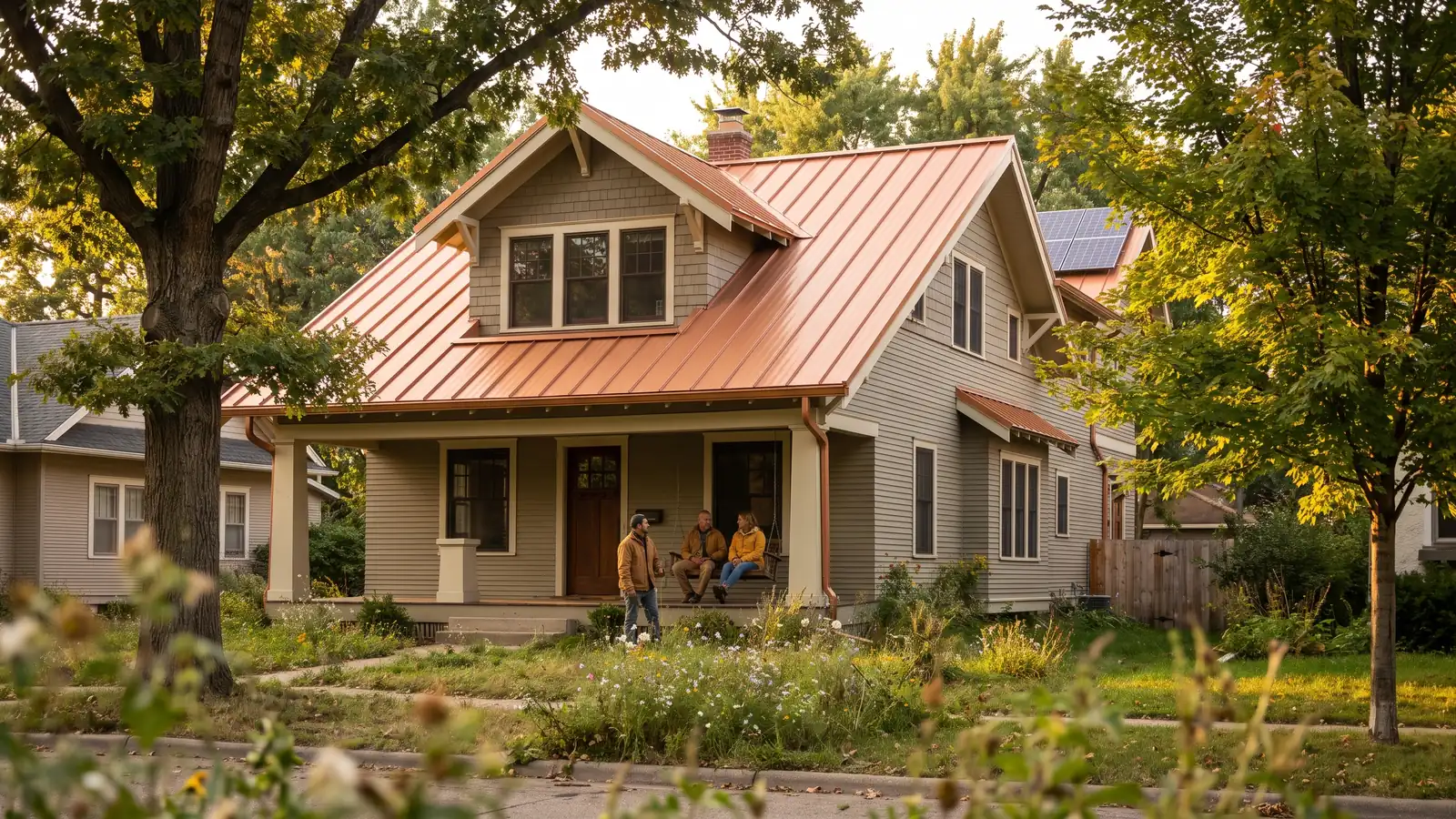
Energy performance is the second lever, and it depends on climate. The EPA reports that a cool roof can cut peak cooling demand by 11% to 27% in air-conditioned homes, solar roofing is the only option here that generates power, and green roofs cut stormwater runoff by roughly 60% for extensive systems and up to 100% for intensive ones.
Learn how the eco-friendly roofing options compare, including lifespan by material, which ones need a structural review first, and how to weigh cost when the cheapest roof today is the one you buy twice. If you’re planning a larger project, start with our Home Improvement & Design guide.
Key takeaways:
- Lifespan is the honest green metric: Metal carries an estimated 40 to 80 years of service and slate 60 to 150, versus about 30 for architectural asphalt, so the longest-lived material your structure can carry usually beats whichever one is marketed hardest.
- Cool roofs pay off where cooling dominates: EPA figures put a cool roof’s peak cooling demand reduction at 11% to 27% in air-conditioned homes, but in a heating-dominated state the winter sun you reflect away gives part of that back.
- Two of the five need an engineer first: Solar arrays and green roofs both add dead load, and even a minimal extensive green roof carries 2 to 4 inches of growing medium that gets far heavier saturated.
Why choose an eco-friendly roof?
Because roofing is one of the few home projects where the environmental case and the financial case point the same way: manufacturing and disposal dominate a roof’s lifetime footprint, so a roof that lasts 50 years instead of 20 does more environmental work than any label on the wrapper. The honest caveat is that a roof with 10 good years left is rarely worth replacing early for efficiency alone.
- Lower energy use: Reflective surfaces cut cooling load, vegetation buffers temperature swings, and solar shingles offset purchased electricity outright.
- Fewer replacement cycles: Metal, slate, and clay stretch the interval by decades, and metal is recyclable at end of life and often made with recycled content. Our guide to maintaining a home’s roof covers the inspection cadence that gets you the full rated life.
- Certification credit: Roofing contributes points in green building programs if you’re pursuing a formal rating.
What are the main eco-friendly roofing options?
Five categories cover almost everything a residential roofer will quote you, and they solve different problems, reflectivity, longevity, generation, stormwater, and material sourcing.
| Option | Typical service life | Primary benefit | Structural requirement | Best climate fit |
|---|---|---|---|---|
| Cool roof (reflective shingle, tile, or coating) | Inherits the substrate’s life | Cuts peak cooling demand 11% to 27% | None beyond the underlying material | Hot, sunny, cooling-dominated |
| Metal (standing seam, panel, or metal shingle) | 40 to 80 years; copper 70+ | Recyclable, often recycled content, sheds snow, resists fire | Usually none, lighter than tile or slate | Nearly all, including snow and wildfire country |
| Solar roofing (panels or integrated shingles) | The roof beneath must outlive the array | Generates electricity on site | Structural review; some roofs need reinforcement | Unshaded planes plus a workable utility program |
| Vegetative green roof | EPA evaluates green roofs on a 50-year lifecycle | Cuts runoff 60% (extensive) to 100% (intensive); surface up to 56°F cooler | Substantial, saturated soil adds real dead load | Urban and low-slope; rare on steep-slope homes |
| Recycled and reclaimed materials | Reclaimed slate 60 to 150 years; wood about 25 | Diverts material from landfill; avoids new extraction | Reclaimed slate and clay are heavy; verify the deck | Depends entirely on the material |
How do cool roofs save energy?
By reflecting sunlight instead of absorbing it. The EPA puts the effect at an 11% to 27% cut in peak cooling demand for air-conditioned homes, and a 2.2°F, 5.9°F drop in maximum indoor temperature for homes without air conditioning.
Cool roofing is a surface property, not a material, so it shows up across categories: reflective asphalt shingles, light-colored tile, coated metal, and coatings on low-slope roofs. That means a cool roof inherits the lifespan of whatever it’s applied to. Check rated product listings in the Cool Roof Rating Council directory before taking a contractor’s reflectivity claim at face value.
The tradeoff is seasonal: the EPA acknowledges that cool roofs may increase winter energy use in cold climates, while noting that low sun angles, short days, good insulation, and reflective snow cover all limit the penalty.
What makes metal roofing eco-friendly?
Longevity and recyclability. Metal carries an estimated service life of 40 to 80 years, with copper at 70 or more, so it commonly outlasts two asphalt cycles and the two tear-offs that come with them, and it’s recyclable at the end of that run, often made with recycled content to begin with.
Metal also sheds snow, resists fire, holds up in high wind, and weighs less than tile or slate, so it usually installs without structural upgrades. The honest downsides are upfront cost, fewer qualified installers than asphalt, rain and hail noise, largely a decking and insulation question, and dent risk on softer metals like aluminum and copper.
How does solar roofing work?
Solar roofing generates electricity on site, through rack-mounted panels over your existing roof or photovoltaic shingles integrated into the roof plane. It’s the only option here that produces energy rather than conserving it.
Three factors decide whether it works on your house: unshaded roof area with usable orientation and pitch, structural capacity for the added load, and the utility program that sets what your production is worth. That last one varies enormously by state and utility, which makes national payback claims close to meaningless.
Sequence matters here. If your roof has fewer than roughly 10 years of life left, replace it first. Removing and reinstalling an array to re-roof underneath is an avoidable expense. Our guide to solar panels: costs and benefits covers the payback variables, and buying a home with solar panels covers what changes when someone else installed the system.
What is a green roof, and who should consider one?
A green roof is a layered assembly, waterproof membrane, drainage layer, growing medium, and plants, installed over the roof deck, and its headline benefits are stormwater and heat rather than household energy savings. The EPA reports runoff reductions of about 60% for extensive systems and up to 100% for intensive ones, surface temperatures up to 56°F below conventional roofs, and nearby air temperatures up to 20°F cooler.
Extensive systems use hardy, shallow-rooted plants in 2 to 4 inches of growing medium and are the lighter, cheaper grade; the EPA notes a simple extensive roof without public access can cost as little as one-tenth to one-third of an intensive build with deeper soil and foot traffic. Realistically this is an urban, low-slope option: most steep-slope suburban houses aren’t candidates, the structural demands are real, and the maintenance is ongoing gardening.
Are recycled and reclaimed roofing materials worth it?
Often yes, if you verify durability first. The category covers recycled-content composite shingles, rubber and polymer products made from post-consumer material, reclaimed slate and clay tile, and sustainably harvested wood shakes.
The variance is the catch. Reclaimed slate can deliver 60 to 150 years of service; wood shingles average about 25 and demand more maintenance than most homeowners expect. Composites vary by manufacturer, so the written warranty and any independent testing matter more than the recycled-content percentage on the brochure. Ask whether local installers have worked with the product, and whether replacement stock will exist in 20 years.
How long do low-slope and specialty roofing materials last?
Low-slope sections are where coatings and green roofs usually go. According to InterNACHI’s Standard Estimated Life Expectancy Chart for Homes, the membranes used on flat and low-slope roofs run from 7 years at the low end for TPO to 30 years for built-up roofing. The same chart lists a vegetation-covered roof at 5 to 40 years.
| Material | Estimated life (years) |
|---|---|
| Built-up roofing (BUR) | 30 |
| Coal and tar | 30 |
| Modified bitumen | 20 |
| EPDM rubber | 15 to 25 |
| TPO | 7 to 20 |
| Green (vegetation-covered) | 5 to 40 |
| Fiber cement | 25 |
| Simulated slate | 10 to 35 |
Source: InterNACHI, Standard Estimated Life Expectancy Chart for Homes, which says its figures assume regular recommended maintenance and should be used as guidelines only.
Have the roofer price a low-slope porch or addition roof as a separate line; see our guide to budgeting for home maintenance.
How do you choose the right eco-friendly roof for your home?
Work through four filters in this order, climate, structure, ownership horizon, budget, because the first two eliminate options before the last two get a vote.
- Climate: Cooling-dominated climates reward reflectivity; heating-dominated climates reward insulation, ventilation, and materials that handle snow and ice. Wildfire regions favor metal, tile, and slate.
- Structure: Green roofs and, sometimes, solar arrays add dead load your framing may not have been designed for. An engineer’s review costs a fraction of the roof.
- Ownership horizon: If you’ll sell in 5 to 7 years, you won’t personally recover the premium on a 50-year material. If this is your long-term home, the durability options move from expensive to obvious.
- Budget and sequencing: A high-performance roof over an under-insulated attic wastes most of its potential. Our guide to energy-efficient home upgrades ranks roofing against competing projects.
Before you spend on the roof, find out where your losses actually are. A home energy audit will tell you whether the problem is the roof assembly or the attic beneath it, and in older houses the answer is frequently upgrading your home’s insulation.
Then vet the contractor as carefully as the material. Ask for licensing and insurance, a written scope covering tear-off and disposal, and the product and labor warranties as two separate terms. Get 3 itemized quotes on the same specification, or you’re comparing numbers that describe different jobs.
How much attic insulation should be in place before a new roof?
Enough to reach the retrofit level for your climate zone, because in a cold climate the insulation does more heating-season work than the shingles above it. ENERGY STAR’s table of recommended insulation levels calls for R60 in an uninsulated attic and R49 over 3 to 4 inches of existing insulation in every zone from 4 through 8. ENERGY STAR also says sealing and insulating can save up to 10% on annual energy bills.
According to the EIA’s Residential Energy Consumption Survey, space heating and air conditioning together made up 52% of a household’s annual energy consumption in 2020. The EIA also reports that households in the Northeast and Midwest use more energy on average than households in the South and West because of higher space-heating demand.
Ask the roofer and the insulation contractor who installs the baffles at the eaves, so new insulation does not block the soffit vents. For later attic checks, see our seasonal home maintenance checklist.
What do eco-friendly roofs cost, and how do you pay for one?
There’s no honest national price, because the number swings with square footage, pitch, complexity, tear-off layers, material, and local labor. References like roof replacement cost ranges by material set rough expectations, but your written quotes are the only figures that count.
Roofers price in squares, one square equals 100 square feet of roof area, so ask for the square count and the per-square price separately. Then convert every quote into cost per year of service, which is the number the durability argument rests on.
Say two quotes come back on the same Waterford colonial: $15,000 for architectural asphalt and $30,000 for standing-seam metal.1 At roughly 30 years of service, the asphalt roof runs about $500 a year; at roughly 50 years, the metal roof runs about $600. The gap is far smaller than the sticker price suggests, and it narrows further once you count the second tear-off the asphalt roof needs at year 30. In our experience shopping renovation and cash-out files, the variable that changes this answer is rarely the quote, it’s how long the borrower plans to stay.
On incentives, verify before you budget. The IRS states that the federal Residential Clean Energy Credit, which covered solar roofing tiles and solar shingles because they generate energy, is not available for property placed in service after December 31, 2025; conventional roofing components never qualified.2 Check current federal and utility incentive status before budgeting, and treat any incentive a contractor cites as unverified until you confirm it.
- Home equity loan or HELOC: The common route when you have equity. A fixed home equity loan gives you a set payment; a line of credit gives you a draw period and a variable rate.
- Cash-out refinance: Replaces your mortgage with a larger one and pays out the difference. Worth comparing when the rest of your loan terms would improve too.
- Renovation loan: These base the loan on the home’s after-improved value, which helps a buyer purchasing a house that needs a roof now.
- Contractor financing: Convenient, occasionally competitive. Compare the total finance charge against a lender quote, not the monthly payments.
Our Homeownership guide covers where a roof sits among the long-cycle expenses to plan for.
Which roofing and energy upgrades still earn a federal tax credit?
Neither of the two federal home energy credits for homeowners covers work finished this year. According to the IRS page on the Energy Efficient Home Improvement Credit (last reviewed April 2026), that credit covers improvements made through the end of 2025. Per the IRS page on the Residential Clean Energy Credit (last reviewed July 2026), the clean energy credit equaled 30% of the costs of qualified clean energy property installed from 2022 through 2025.
For a 2025 return, the IRS limited insulation and air sealing materials that meet International Energy Conservation Code standards to a $1,200 annual cap, a qualifying home energy audit under a limit of $150, exterior doors at $250 each and $500 in total, and windows and skylights at $600, inside an overall ceiling of $3,200. Labor to install building envelope components did not count, and roofing does not appear on the IRS list of eligible items. See our guide to tax law changes for homeowners.
State, local and utility programs run on their own schedules. The DSIRE database, run by the N.C. Clean Energy Technology Center at N.C. State University, tracks renewable energy and efficiency incentives by state; confirm any listing with the program itself before it goes into your budget.
Michigan’s state-run rebates are a separate track. According to an August 20, 2026 update from EGLE, the MiHER program has two rebate pathways, each of which received just over $105 million in federal funding. Its Home Efficiency Rebates (HOMES) support whole-home upgrades such as insulation and air sealing, with rebate amounts based on modeled energy savings, and its HEAR rebates cover high-efficiency electric equipment such as heat pumps, water heaters and electric stoves, for households at or below 150% of Area Median Income. EGLE reported a temporary pause in Detroit district approvals as participation neared the single-family funding cap.
Which loan programs can fund efficiency work alongside a new roof?
Fannie Mae’s Selling Guide section B5-3.3-01, HomeStyle Refresh for Improvements on Existing Properties (dated August 5, 2026) lists energy or water efficiency improvements and disaster-related repairs or protective upgrades among eligible work, allows improvement costs up to 15% of the “as completed” appraised value on a purchase or limited cash-out refinance, and requires the work to be completed within 180 days of the note date. The section does not name roofing as its own category.
Hypothetical example, not an offer. On a home with an as-completed appraised value of $300,000, a 15% ceiling would allow up to $45,000 of eligible improvement costs under that section.
HUD’s Title I property improvement program insures loans for alterations, repairs and site improvements on single family homes. According to HUD, loans that exceed $7,500 must be secured against the property, and the house must have been completed and occupied for at least 90 days before the application. See our guides to FHA 203(k) loans and renovation loans.
According to the CFPB’s HELOC explainer, monthly payments are often significantly higher once you enter repayment. Our guides to HELOCs, home equity loans and cash-out refinancing compare the three; financing home renovations covers the rest.
What Michigan homeowners should know
Michigan is a heating-dominated climate with real snow load, which reorders this list: durability and water management outrank reflectivity, and the attic usually matters more than the surface above it.
- Reflectivity is the wrong first priority: The EPA notes that low winter sun angles, short days, good insulation, and snow cover that already reflects sunlight all limit what a cool roof gains in a cold climate. Insulation, air sealing, and ventilation deliver more here.
- Ice damming is a ventilation problem, not a shingle problem: Ice dams form when heat escaping into the attic melts snow that refreezes at the cold eave. Metal sheds snow, which helps, but the durable fix is insulation, air sealing, and balanced ventilation, which is why winterizing your home is worth doing before a re-roof.
- Design snow load is county-specific: Ground snow load requirements vary widely across Michigan under the state residential code. Confirm the design load for your address with your local building department before pricing slate or reclaimed tile, and pull the permit your municipality requires.
- Solar runs on distributed generation, not net metering: Michigan replaced net metering under 2016 Public Act 342, effective April 2017, and expanded the program under 2023 Public Act 235. Under MCL 460.1173 you pay retail for everything the utility delivers and receive a monthly credit for what you export, set below full retail by the Michigan Public Service Commission. State law also caps capacity at 110% of your prior 12 months of consumption, so size an array to your usage, not your roof.
The practical Michigan shortlist for most homeowners is architectural asphalt or standing-seam metal, with the ventilation and insulation work done at the same time.
Who can legally replace a roof in Michigan?
A state-licensed contractor, or you on your own home. LARA’s Bureau of Construction Codes lists roofing among the trades for the maintenance and alteration contractor license, and the trades a holder is qualified to practice are listed on the license itself. Look the company up on LARA’s State License Search before you sign, and check that roofing is printed on the license.
Michigan’s Occupational Code lists several exemptions from that license. One covers a person working on one project when the aggregate contract price for the labor, material and other items is less than $600, an exemption sized for small repairs, not a re-roof. Another covers an owner working on their own home, explained in the FAQ below.
Municipalities add their own steps. Thomas Township in Saginaw County, for example, states in its roofing information handout that a building permit is required for all re-roofing projects, calls for open roof, flashing and final inspections, and lists an ice barrier from the lower edges of all roof surfaces to at least 24 inches inside the exterior wall line plus ventilation of 1 square foot per 300 square feet of attic area. Ask your own building department for its list. Our guides to home renovation permits and home insurance during renovations cover the rest.
How much snow does a Michigan roof have to be designed for?
It depends on the county, and the state publishes the values. Michigan’s amendment to the residential code, Mich. Admin. Code R 408.30515, adds a county table of ground snow loads: 25 in Oakland, Macomb and Livingston, 20 in most of Wayne (25 in the city of Northville), 30 in most of Genesee, 35 in most of Kent, 70 in most of Marquette and 90 in most of Keweenaw, with exceptions listed by township, village or city in several counties. The version posted by Cornell’s Legal Information Institute carries an effective date of August 29, 2025; ask your building department which edition it enforces for your permit.
Keweenaw’s base value is more than three times Oakland’s, which is why green roof soil or reclaimed slate needs a structural check up north. See also our guide to building code changes.
How fast is rooftop solar growing under Michigan’s distributed generation program?
Steadily. The Michigan Public Service Commission reported in October 2025 that distributed generation capacity rose to 222.4 MW in 2024 from 189.6 MW in 2023, a more than 17% increase, with 23,910 customers and 24,150 installations, up from 21,609 customers and 21,845 installations in the prior report. The same release says Public Act 235 raised the minimum program size for regulated utilities to 10% of a utility’s average in-state peak load for the previous 5 years, up from 1%.
The MPSC’s distributed generation page adds that PA 235 raised the size of eligible projects to 550 kW, that the Commission approved each utility’s updated tariff on March 13, 2025, and that a customer must properly interconnect a project with the utility before operating it. Call your utility’s interconnection staff before you sign a solar roofing contract.
How Align finances a renovation
You are not just financing the house. You are financing a plan for it. Align places HomeStyle and FHA 203(k) renovation loans, standalone HELOCs and home equity loans, so the project can be paid for the way that fits it, not the way one bank prefers.
Samantha starts with why: what the work is, what it should cost, and whether your equity or a renovation loan is the better tool. Then one application goes to multiple wholesale lenders.
FAQ: Eco-friendly roofing options
Here are answers to common questions about eco-friendly roofing options.
What is the most eco-friendly roofing material?
There is no single winner. Metal scores highest on lifespan and recyclability, cool roofs score highest on cooling energy savings, solar roofing is the only option that generates energy, and vegetative roofs lead on stormwater and urban heat. The genuinely greenest roof is usually the one that lasts longest in your climate, because manufacturing and disposal dominate a roof’s lifetime environmental footprint.
Are cool roofs a good idea in cold climates?
Less so. A reflective roof reduces summer cooling load, but in a cold-winter state it also reflects away winter solar heat gain you would otherwise use. In northern climates the bigger wins are attic insulation, air sealing, and ventilation, plus a durable material that handles snow load and ice damming. Reserve cool roofing for homes with heavy summer air conditioning use, and start with a home energy audit to find where your losses actually are.
Can I put solar panels on any roof?
No. Installers evaluate roof age, structural capacity, pitch, orientation, and shading before quoting. If your shingles have fewer than about 10 years of life left, most installers recommend replacing the roof first, since removing and reinstalling an array later is expensive. South-facing planes with minimal shade produce the most, and some roofs need structural reinforcement to carry the added load. Our guide to maintaining a home’s roof covers how to track remaining life.
Does an eco-friendly roof increase home value?
A new roof of any type improves marketability because it removes a known buyer objection and often reduces insurance friction. Metal and solar tend to carry the strongest appraisal support because they are documented, long-lived improvements. Green roofs are less common in residential appraisal comps, so their value depends heavily on local market familiarity. Keep receipts and warranties for the appraiser, our guide to the home appraisal process covers what documentation gets credited.
Does ENERGY STAR still certify roofing products?
No. ENERGY STAR’s Roof Products specification page says the specification was sunset on June 1, 2022, so a shingle or coating still showing the label is not certified to it. The Cool Roof Rating Council’s guide for home and building owners says its ratings are based on solar reflectance and thermal emittance, and tells owners to look up a contractor’s cool products in its Rated Roof Products Directory.
Can I cancel a roofing contract I signed at home in Michigan?
Usually. Michigan’s Home Solicitation Sales Act covers sales of more than $25 solicited and agreed to at your residence, but not a sale made after earlier negotiations at the seller’s place of business. MCL 445.112 lets you cancel until midnight of the third business day after signing. The exception is an emergency job you asked to start without delay, once the seller has made a substantial beginning in good faith and you have signed a handwritten waiver.
Can I replace my own roof in Michigan without a license?
Yes, on your own home. MCL 339.2403 exempts an owner of property working on a structure on that property for the owner’s own use and occupancy, and Thomas Township’s roofing handout says plainly that the homeowner is allowed to do their own work. The exemption covers the license only: the building code, the local permit and its inspections still apply, and anyone you pay to help is back under the licensing rules.
How long does an aluminum roof coating last?
A few years at most. According to InterNACHI’s Standard Estimated Life Expectancy Chart for Homes, an aluminum roof coating lasts 3 to 7 years, and the chart notes its figures assume regular recommended maintenance. That row covers aluminum coatings only. For an elastomeric or acrylic cool-roof coating, ask the manufacturer for its rated life and recoat interval in writing, and price at least one recoat into the bid comparison.
The bottom line on eco-friendly roofing options
Eco-friendly roofing comes down to five options and one principle: the greenest roof is usually the one that lasts longest on your house. Metal runs 40 to 80 years against about 30 for architectural asphalt, which is why it commonly replaces two roofs and two tear-offs. Cool roofs cut peak cooling demand 11% to 27% in air-conditioned homes but give part of that back in a heating-dominated climate. Solar roofing is the only option that generates power, green roofs cut runoff by 60% or more, and recycled materials swing from 25-year wood to 150-year reclaimed slate. Filter by climate and structure first, then by how long you plan to stay, and convert every quote into cost per year of service.
If you’re ready to finance a roof replacement or buy a home that needs one, talk to Align Lending. We’ll shop your scenario across our lender network and show you home equity, cash-out, and renovation loan options side by side. Call 248-506-5727 or start online.
Footnotes:
1. Example figures are hypothetical and for educational purposes only; they do not constitute an advertisement of credit terms or a rate quote under federal or state lending laws. Actual roofing costs depend on your contractor’s written quote, your roof’s size and complexity, and local labor and material pricing, and your loan amount, rate, and terms will depend on your application, the property, and market conditions. Return to text.
2. This is a general summary, not tax advice. Federal tax credit rules, limits, and expiration dates are set by Congress and administered by the IRS, and are subject to change. State and utility incentive programs change independently. Confirm current-year eligibility with a qualified tax professional and your utility before relying on any incentive. Return to text.
Sources: estimated service life by roofing material, 3-tab asphalt 20 years, architectural asphalt 30, metal 40 to 80, copper 70+, slate 60 to 150, clay and concrete 100+, wood 25, InterNACHI Standard Estimated Life Expectancy Chart for Homes. Cool roof peak cooling demand reduction of 11% to 27%, maximum indoor temperature reduction of 2.2°F, 5.9°F in non-air-conditioned homes, and cold-climate heating penalty context, U.S. EPA, Using Cool Roofs to Reduce Heat Islands. Green roof runoff reduction of 60% (extensive) to 100% (intensive), surface temperatures up to 56°F below conventional roofs, air temperature reduction up to 20°F, extensive growing medium depth of 2 to 4 inches, 50-year lifecycle evaluation, and extensive-versus-intensive cost comparison, U.S. EPA, Using Green Roofs to Reduce Heat Islands. Residential Clean Energy Credit coverage of solar roofing tiles and shingles, exclusion of traditional roofing components, and unavailability for property placed in service after December 31, 2025, Internal Revenue Service. Michigan distributed generation program under 2016 Public Act 342 (effective April 2017) and 2023 Public Act 235, outflow credited below retail under MCL 460.1173, and the 110%-of-prior-consumption capacity limit, Michigan Compiled Laws.
This article is for informational purposes only and is not intended to provide legal, financial, or tax advice. Building code requirements, snow load design values, permit rules, contractor licensing, utility program terms, and tax incentives vary by jurisdiction and change over time; verify current requirements with your local building department, your utility, a licensed contractor, and a qualified tax professional. Consult a qualified professional about your situation. Figures shown are illustrative, are not a rate quote or an offer of credit, and are subject to change. Align Lending is an independent Michigan mortgage broker, NMLS #2041154, and is not acting on behalf of, endorsed by, or sponsored by the U.S. Environmental Protection Agency, the IRS, the Michigan Public Service Commission, or any government agency.
Sources
Every outside source this guide links to, in the order it appears. How we choose and check sources
- InterNACHI’s life-expectancy chartInternational Association of Certified Home Inspectors
- The EPA puts the effectU.S. Environmental Protection Agency
- Cool Roof Rating Council directorycoolroofs.org
- The EPA reports runoff reductionsU.S. Environmental Protection Agency
- Recommended insulation levelsENERGY STAR
- Sealing and insulatingENERGY STAR
- Residential Energy Consumption Surveyeia.gov
- The IRS statesInternal Revenue Service
- IRS page on the Energy Efficient Home Improvement CreditInternal Revenue Service
- DSIRE databasedsireusa.org
- August 20, 2026 update from EGLEState of Michigan
- B5-3.3-01, HomeStyle Refresh for Improvements on Existing PropertiesFannie Mae Selling Guide
- Title I property improvement programU.S. Department of Housing and Urban Development
- CFPB’s HELOC explainerConsumer Financial Protection Bureau
- Under the state residential codelaw.cornell.edu
- Under MCL 460.1173Michigan Legislature
- Maintenance and alteration contractor licenseState of Michigan
- The aggregate contract price for the labor, material and other items is less than $600Michigan Legislature
- Roofing information handoutthomastwp.org
- Reported in October 2025State of Michigan
- MPSC’s distributed generation pageState of Michigan
- Roof Products specification pageENERGY STAR
- Guide for home and building ownerscoolroofs.org
- Home Solicitation Sales ActMichigan Legislature
- MCL 445.112Michigan Legislature
Related resources
20-minute read
Energy-efficient home upgrades: What to do first, and what it saves
See which energy-efficient home upgrades pay off first, from air sealing and insulation to heat pumps and solar, with real costs and yearly savings.

20-minute read
DIY home renovation projects: 12 upgrades you can actually finish
Discover DIY home renovation projects that upgrade your space on a budget, from peel-and-stick backsplashes to floating shelves and smart lighting.
20-minute read
The benefits of a home energy audit and what it includes
Learn what a home energy audit finds, how blower door and infrared tests work, and why the Department of Energy ties audits to 5% to 30% savings.
