
How to maintain a home’s plumbing system
Maintaining a home’s plumbing system is a repeating schedule, not a one-time project: check for leaks monthly, clear drains without harsh chemicals, flush the water heater once a year, and keep water pressure between 40 and 60 psi. Those habits matter because the average family wastes roughly 9,400 gallons a year, about 180 gallons a week, on household leaks alone, according to the EPA’s WaterSense program.
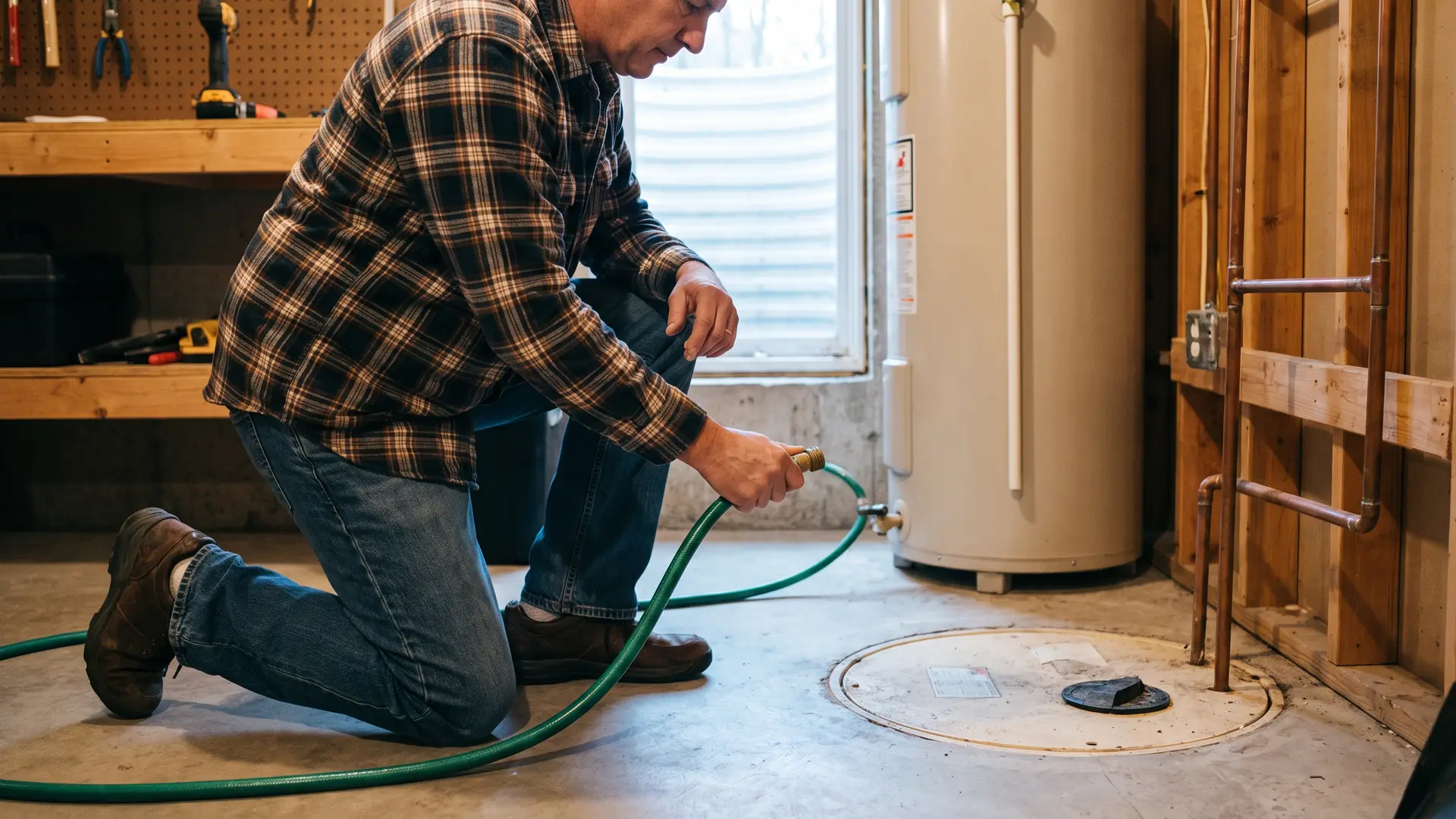
Two settings do most of the protective work: set the water heater to 120°F for scald safety and lower standby heat loss, and book a professional inspection every one to two years, annually once the house passes 40, when original supply lines reach the end of their service life.
Learn how to find a hidden leak with your water meter, how often to flush a water heater, and what pressure your house should run, all part of the wider calendar in our home maintenance guide.
Key takeaways:
- Leak checks are the highest-value habit: The average family loses about 9,400 gallons a year to household leaks, and a 2-hour water meter test finds hidden ones in a single afternoon.
- Flush the water heater yearly and set it to 120°F: Have the anode rod checked every 3 to 5 years. Sediment and a spent rod are what cut a tank’s typical 8- to 12-year life short.
- Hold water pressure between 40 and 60 psi: Sustained high pressure stresses joints, supply lines, and appliance valves; a sudden drop points to a clog or hidden leak.
Why does plumbing maintenance matter?
Because the cheapest plumbing failure is the one you catch while it’s still a drip. EPA WaterSense estimates household leaks waste about 9,400 gallons per family per year, and that 9% of homes have leaks bad enough to waste 50 gallons or more every day.1 A leak that size means a fixture that has been failing quietly for months.
The real money isn’t the wasted water. It’s what water does when nobody is watching: a supply line weeping behind a vanity ruins the cabinet, then the subfloor, then the ceiling below. That’s why water damage response is the most expensive homeowner skill to need. Maintenance also buys equipment life. A water heater flushed annually tends to reach the top of its 8- to 12-year range.
How do you find a hidden plumbing leak?
Use your water meter and give it 2 hours. It costs nothing and catches leaks inside walls, under slabs, and in irrigation lines.
- Run the meter test: Shut off every fixture and appliance that uses water, including the ice maker and any irrigation timer. Record the meter reading, wait 2 hours, then read it again. Any movement means water is escaping between the meter and your fixtures.
- Test the toilets with food coloring: Put a few drops in the tank, wait 10 minutes, and don’t flush. Color in the bowl means the flapper is leaking. A worn one can silently waste thousands of gallons a year, and the part is among the cheapest in the house.
- Inspect what you can see and smell: Under sinks, behind the washer, around the water heater, and along basement runs, look for drips, green or white crust on copper joints, and rust streaks. Brown ceiling rings, cupped flooring, soft baseboard, and a musty cabinet smell are downstream evidence of an upstream leak.
Do both tests twice a year, together. If the meter moves and you can’t find the source, that’s a plumber call. For the fixture side of the same problem, see our guide to improving your home’s water efficiency, plus the EPA’s WaterSense leak statistics and Fix a Leak guidance.
How much water does a small leak waste?
The EPA’s Fix a Leak Week page, last updated March 13, 2026, puts household leak waste at nearly 1 trillion gallons a year nationwide and reports that fixing easily corrected leaks can save homeowners about 10% on their water bills.
| Leak | Water wasted, per the EPA |
|---|---|
| Faucet dripping once per second | More than 3,000 gallons a year |
| Showerhead leaking 10 drips per minute | More than 500 gallons a year |
| Irrigation leak 1/32 of an inch across, about the thickness of a dime | About 6,300 gallons a month |
| One leaky or running toilet | As much as 200 gallons a day |
Source: U.S. EPA WaterSense, Fix a Leak Week (updated March 13, 2026); toilet row, U.S. EPA, How to Care for Your Septic System (updated August 17, 2026).
Plan for washers, flappers and other small parts with our guide to budgeting for home maintenance.
How do you keep drains clear without harsh chemicals?
Catch debris before it enters the drain, then clean monthly: half a cup of baking soda, a cup of white vinegar, 15 minutes, then a kettle of hot water. Chemical drain openers generate heat and a caustic reaction. Exactly what you don’t want sitting against aging pipe, older seals, and rubber gaskets.
- Use strainers everywhere: Hair in the shower and food scraps in the kitchen cause most household clogs. A mesh strainer removes the cause instead of treating the symptom.
- Never pour grease down the drain: Cooking fat is liquid in the pan and solid in the pipe. Pour it into a can, let it harden, throw it out. Coffee grounds and eggshells belong in the trash too.
- Clear a slow drain early: One that’s slow “but still works” is a clog forming. Clearing it now costs a kettle of hot water.
How often should you flush a water heater?
Once a year for most tank water heaters, and twice on hard water, which describes much of Michigan. Sediment forms a mineral layer on the tank bottom that insulates the burner or element from the water it’s meant to heat. The result is longer run times, noisy operation, and a tank that dies before the end of its typical 8- to 12-year life.
- Flush the tank: Shut off power or gas, run a garden hose from the base drain valve to a floor drain, and open it until the water runs clear. Refill fully before restoring power, an element energized in an empty tank burns out immediately.
- Set the thermostat to 120°F: This is the long-standing U.S. Department of Energy Energy Saver recommendation. It limits scald risk and cuts the standby heat loss you pay for while the tank sits idle.
- Check the anode rod every 3 to 5 years: The anode is a sacrificial rod that corrodes so the steel tank doesn’t. Once consumed, the tank rusts from the inside. Replacing a rod is routine; replacing a tank is not.
- Test the relief valve, then listen: Lift the T&P valve lever, confirm water discharges through the drain tube, and let it snap shut. One that won’t reseal is a safety issue. Popping or rumbling means sediment; rust-colored hot water or moisture at the base means plan a replacement now.
If yours is near the end of its life, price the replacement before it fails. ENERGY STAR water heater efficiency ratings compare models on measured performance.
Does hard water shorten a water heater’s life?
It can. The U.S. Geological Survey’s page on water hardness (dated August 24, 2026) explains that heating hard water forms calcium carbonate scale, which can reduce the life of equipment, raise the cost of heating water, lower the efficiency of electric water heaters and clog pipes.
| USGS class | Hardness as calcium carbonate |
|---|---|
| Soft | 0 to 60 mg/L |
| Moderately hard | 61 to 120 mg/L |
| Hard | 121 to 180 mg/L |
| Very hard | More than 180 mg/L |
Source: U.S. Geological Survey, Hardness of Water (August 24, 2026).
To find your number, check your utility’s annual Consumer Confidence Report, which the EPA says covers drinking water quality in your area; a private well needs its own lab test.
How hot is too hot for tap water, and how cool is too cool?
The U.S. Consumer Product Safety Commission’s tap water scald alert says most adults will suffer third-degree burns from 150-degree water in two seconds, 140-degree water in six seconds and 130-degree water in thirty seconds, and that even 120-degree water can cause them after five minutes. It recommends checking with a candy or meat thermometer under the faucet first thing in the morning, then adjusting the thermostat and rechecking.
The lower limit comes from bacteria. The CDC’s Legionella guidance for vacation rental owners (January 22, 2026) names 77 to 113°F as the range favorable for Legionella growth and advises a water heater setting at or above 120°F; above 120°F, it recommends thermostatic mixing valves at the faucet or shower to prevent scalds.
What water pressure should a house have?
Between 40 and 60 psi. Screw a threaded pressure gauge onto an outdoor hose bib or the laundry faucet, turn the water fully on with nothing else running, and read it. The test takes under a minute; do it once a year.
- Above 60 psi and climbing: Sustained high pressure stresses pipe joints, supply lines, and the inlet valves on washers, dishwashers, and toilets. Braided supply hoses are usually first to let go, and they let go while nobody’s home. Where municipal pressure runs high, a plumber installs a pressure-reducing valve on the main.
- Below 40 psi: Low pressure house-wide points to a partly closed main shutoff, a failing pressure-reducing valve, mineral buildup in old galvanized lines, or a leak upstream of your fixtures. A sudden drop deserves same-week attention.
- Low at one fixture only: That’s almost always scale in the aerator or showerhead, not a system problem. Unscrew it, soak it in white vinegar overnight, brush it, reinstall. Do this yearly on hard water.
Take a morning reading and an evening one. Municipal pressure swings with demand, so a house that reads fine at 7 a.m. can be straining its fixtures at midnight.
How do you maintain a sump pump and catch leaks early?
Test the sump pump twice a year with a 5-gallon bucket, and put electronic leak sensors at the 4 places that flood first.
To test the pump, pour water into the pit until the float rises. It should start, move the water out, and shut off cleanly. If it hums without pumping, cycles rapidly, or runs on after the pit empties, service it before the next heavy rain. Clear debris from the pit and inlet screen, and confirm the discharge line outside isn’t blocked, crushed, or aimed back at the foundation. A sump pump also fails exactly when the power does, so a battery backup earns its cost in one storm.
For leak sensors, cover the water heater, clothes washer, dishwasher, and sump pit. They’re inexpensive, run for years on a battery, and alert your phone within seconds. Whole-home versions add an automatic shutoff valve on the main, turning a catastrophe into a puddle.
Home plumbing maintenance schedule: what to do and how often
Here’s the whole routine on one page. Repair costs vary widely by market, so get written quotes from local licensed plumbers rather than budgeting from national averages. Fold these into our seasonal maintenance checklist.
| Task | Frequency | DIY or pro | Why it matters | Risk if you skip it |
|---|---|---|---|---|
| Inspect exposed pipes and under-sink cabinets | Monthly | DIY | Catches drips early | Cabinet rot, subfloor, mold |
| Water meter leak test (2 hours) | Twice a year | DIY | Finds leaks in walls and slabs | Months of hidden waste |
| Food-coloring toilet flapper test | Twice a year | DIY | Flapper leaks are silent | Thousands of gallons a year |
| Clean drains with baking soda and vinegar | Monthly | DIY | Stops grease and hair hardening | Backups, emergency drain calls |
| Flush the water heater | Yearly; twice on hard water | DIY or pro | Removes heat-blocking sediment | Shorter tank life |
| Inspect or replace the anode rod | Every 3 to 5 years | Usually pro | A spent rod lets the tank corrode | Early tank failure, flooded floor |
| Test water pressure with a gauge | Yearly | DIY | Confirms 40 to 60 psi | Burst supply hoses |
| Test the sump pump with a bucket | Twice a year, and before thaw | DIY | Confirms float and check valve | A flooded basement |
| Whole-system professional inspection | Every 1 to 2 years; yearly over 40 | Pro | A pro sees corrosion you won’t | Failures found after damage |
How fast do you need to dry things out after a leak?
Within 24 to 48 hours. Close the fixture’s shutoff valve, empty the cabinet under a leaking sink, pull wet rugs away from the water heater or washer, and leave cabinet doors open. The EPA’s guide to mold and moisture (updated February 18, 2026) says to fix plumbing leaks quickly; materials dried in that window usually never grow mold. A $10 to $50 humidity meter confirms it is dry; keep humidity below 60%.
How do you thaw a frozen pipe without damaging it?
Slowly, with the faucet open, and never with a flame. The National Weather Service’s winter safety guidance says to remove the insulation, completely open all faucets and pour hot water over the pipes, and that a hand-held hair dryer, used with caution, also works well. University of Illinois Extension’s cold weather pipe guide adds: never try to thaw a pipe with an open flame or torch. See also our fire safety tips for homeowners.
When should you call a plumber instead of fixing it yourself?
Call when the problem involves the main line, the gas line, sewage, or a leak you can’t locate. Those 4 categories are where DIY attempts turn small bills into large ones. Everything on the DIY side of the table is homeowner work, and a step-by-step home plumbing maintenance walkthrough covers the technique.
- The meter moves and you can’t find why: Hidden leaks need acoustic or thermal locating gear. Guessing means opening drywall in the wrong place.
- The same drain clogs, or several drain slowly at once: One clog is hair. Monthly clogs mean trouble in the branch line, and multiple slow fixtures or a sewage backup means the main sewer line. Stop using water and call.
- Anything involving gas or a water heater’s T&P valve: Not a judgment call. Licensed pro, same day.
- House-wide pressure outside 40 to 60 psi: Pressure-reducing valves and main shutoffs are code-regulated in most jurisdictions, and permit rules vary. Ask your building department what applies.
Vet plumbers like any contractor: current state license, proof of insurance, written scope and price up front, and a warranty you can read. Get 3 quotes on anything larger than a service call.
Does homeowners insurance cover plumbing leaks?
It depends on the cause and the policy wording. Michigan’s Department of Insurance and Financial Services, in its homeowners insurance guide, says to read the policy for water damage exclusions and warns you may need added coverage for water backup and sump pump overflow.
Per the Insurance Information Institute’s homeowners fact page (ISO data), water damage and freezing produced 1.50 claims per 100 insured homes a year from 2019 to 2023, second only to wind and hail, and averaged $15,400 a claim.
| Cause, 2019 to 2023 | Claims per 100 insured homes a year | Average claim |
|---|---|---|
| Wind and hail | 2.80 | $14,747 |
| Water damage and freezing | 1.50 | $15,400 |
| Fire and lightning | 0.23 | $88,170 |
| Theft | 0.12 | $5,524 |
| All property damage | 5.53 | $16,857 |
Source: Insurance Information Institute, “Average Homeowners Losses, 2019-2023” (ISO data).
Measured in dollars, water damage and freezing took between 19.8% and 28.7% of homeowners insurance losses each year from 2019 to 2023, ahead of fire and lightning in four of the five years, per the same III page.
| Share of homeowners insurance losses | Wind and hail | Water damage and freezing | Fire and lightning |
|---|---|---|---|
| 2019 | 38.1% | 28.7% | 21.2% |
| 2020 | 47.7% | 19.8% | 21.2% |
| 2021 | 38.9% | 23.7% | 22.8% |
| 2022 | 45.4% | 25.8% | 18.7% |
| 2023 | 42.5% | 22.6% | 21.6% |
Source: Insurance Information Institute, “Homeowners Insurance Losses By Cause, 2019-2023” (ISO data).
Federal tax rules separate sudden damage from wear. For example, IRS Publication 547 (for 2025 returns) lists damage to a water heater that bursts as progressive deterioration, not a casualty, but the rust and water damage it causes to rugs and drapes does qualify. It also says that for tax years beginning after 2017, personal casualty and theft losses are deductible only to the extent they’re attributable to a federally declared disaster. See our guides to evaluating home insurance options and homeowners insurance deductibles.
Can plumbing problems affect selling or refinancing a home?
Yes. Fannie Mae’s Selling Guide section B4-1.3-06 (dated June 4, 2025) requires an appraisal to comment on the effect on value when it shows evidence of dampness, and lists minor plumbing leaks as a condition that must be reported in an “as is” appraisal. A property rated C6, which the guide describes as having substantial damage or deferred maintenance, must be appraised “subject to” repairs that bring it to at least C5, because loans on C6 properties are not eligible for sale to Fannie Mae. See our guides to the home appraisal process, refinance appraisal requirements, reading a home inspection report and buyer repair requests.
How do homeowners pay for a major plumbing repair?
Start with a repair reserve; our guide to planning for unexpected repair costs shows how to build one. When the job is bigger than the reserve, a home equity line of credit lets you draw as the plumber bills, a home equity loan pays out once against a fixed quote, and a cash-out refinance replaces the first mortgage. A renovation loan can fold a repipe into purchase financing; see financing home renovations.
What Michigan homeowners should know about plumbing maintenance
Michigan’s plumbing risk is seasonal, concentrated in about 4 months. Water expands when it freezes at 32°F, and the pipes that get there first run through uninsulated exterior walls, crawl spaces, garages, and unheated basements, not those inside the heated envelope.
- Winterize hose bibs before the first hard freeze: Disconnect and drain every garden hose, and shut off the interior valve feeding each outdoor spigot. A hose left attached traps water in the bib, a common source of the burst pipe found in spring. Our guide to winterizing your home covers the fall sequence.
- Insulate the vulnerable runs, not all of them: Foam sleeves on exposed pipe in crawl spaces, garages, and rim joists beat heat tape everywhere. In a cold snap, open cabinets under exterior-wall sinks and let one far-end faucet drip.
- Test the sump pump before the thaw, not during it: Michigan’s melt-plus-rain weeks are when pits fill fastest and pumps idle all winter fail. Run the bucket test in late winter and clear ice from the discharge line.
- Manage hard-water scale year-round: Groundwater across much of the Lower Peninsula is hard, which is why aerators clog and tanks build sediment faster here, the case for flushing twice a year rather than once.
Frozen pipes and sump failures are the Michigan events most likely to end in an insurance claim, so knowing what to do in the first hour of water damage matters more here.
Do you need a permit for plumbing work in Michigan?
For most work beyond basic repairs, yes. LARA’s Bureau of Construction Codes states on its plumbing permit page that plumbing work shall not be started until a permit has been issued, and that the applicant must be a licensed plumbing contractor or a homeowner installing his or her own plumbing, building sewer or private sewer. LARA’s code books page lists the 2021 Michigan Plumbing Code as current since March 12, 2024, with residential requirements in the Michigan Residential Code. See our guide to home renovation permits.
- Digging a sewer or water line yourself: MISS DIG 811 locates public underground utilities through its more than 1,700 members, and you cannot dig before the start time on your request.
- Paying the plumber: LARA’s 2019 home improvement tips advise asking the contractor, subcontractors and suppliers for a completed and signed waiver of lien form.
Who replaces a lead service line in Michigan?
Your water supplier. A 2019 University of Michigan Graham Sustainability Institute brochure on the state’s revised Lead and Copper Rule says water supplies must replace all lead service lines by January 1, 2041, including the portions on private property. EGLE’s service line page adds that supplies must notify homes served by lead, galvanized previously connected to lead, or lead-status unknown lines every year.
Inside the house, according to the EPA’s lead free plumbing page (updated May 19, 2026), Congress banned pipes, solder and flux that were not lead free in 1986, then defined as no more than 8% lead in pipes and 0.2% in solder; today’s limit is a weighted average of 0.25%. Michigan’s seller disclosure form, MCL 565.957, asks whether the plumbing is copper, galvanized or other.
How should you care for a private well or septic system in Michigan?
On its own schedule. EGLE’s private well FAQ says approximately 25% of Michigan residents get water from a private residential well, and its drinking water overview counts nearly 1.12 million households on private wells, with about 15,000 domestic wells drilled each year. The EPA’s septic care guidance (updated August 17, 2026) calls for an inspection at least every three years and pumping every three to five years.
Michigan’s seller disclosure form under MCL 565.957 asks about the well’s age and repair history, whether the water has been tested, and the septic system’s condition, so keep test results and pumping receipts. See buying a home with a septic system, how well water affects a home’s value and what a seller’s disclosure is.
How Align helps when a repair is bigger than your savings
Most repairs belong in a savings account, not a loan. When one does not, like a roof or a furnace, Samantha looks at whether a home equity line, a home equity loan or waiting makes more sense for you.
Align places standalone HELOCs and home equity loans, so you can keep your first mortgage and its rate in place. She explains the payment and the risk before you borrow against your home.
FAQ: Home plumbing maintenance
Here are answers to common questions about home plumbing maintenance.
How often should I flush my water heater?
Once a year for most tank water heaters, and twice a year in hard-water areas where sediment accumulates faster. Flushing removes the mineral layer on the tank bottom that otherwise insulates the burner or element and forces longer run times. Homeowners can do it with a garden hose, and a plumber will check the anode rod on the same visit. Put it on the calendar with your seasonal home maintenance tasks.
What is the easiest way to detect a toilet leak?
Add a few drops of food coloring to the tank and wait 10 minutes without flushing. If color appears in the bowl, the flapper is leaking. A worn flapper can waste thousands of gallons a year silently, and the replacement part is among the cheapest in the house. Test every toilet twice a year. Toilets are also the largest indoor water user in a typical home.
Can I clean my drains without harsh chemicals?
Yes, and you generally should. Chemical drain cleaners generate heat and a caustic reaction that can damage older pipe, seals, and gaskets, and they do nothing about the cause. Pour half a cup of baking soda, then a cup of white vinegar, wait 15 minutes, then flush with hot water. Catch hair and food scraps with strainers so clogs never form, and see our home maintenance guide for the routine.
Are smart water leak detectors worth installing?
For most homeowners, yes. Water damage is among the most common homeowners insurance claims, and sensors near the water heater, washer, dishwasher, and sump pit alert your phone within seconds of getting wet. Whole-home versions add an automatic shutoff valve on the main. Some insurers offer premium credits for monitored systems, so ask your carrier what qualifies, and read how to address water damage in your home for what to do after an alert.
How much water does a normal household use?
The EPA’s WaterSense statistics (updated March 11, 2026) say each American uses an average of 82 gallons a day at home and that outdoor use is more than 30% of household use on average. In winter, when outdoor use stops, the EPA’s Fix a Leak Week page says a family of four using more than 12,000 gallons a month could have serious leaks.
Should you drink water from the hot water tap?
No. The EPA’s guidance on lead in drinking water (updated June 18, 2026) says to use only cold water for drinking, cooking and making baby formula, and notes that boiling water does not remove lead. Before drinking water that has sat in the pipes, it suggests flushing them by running the tap, taking a shower, doing laundry or running the dishwasher.
Should you shut off the water when you leave home in winter?
Either shut it off and drain the lines or keep the heat on and have someone check. University of Illinois Extension’s cold weather pipe guidance says to leave the heat set no lower than 55 degrees, and if you will be away, to have someone check the house daily to make sure the heat is still on, or to drain and shut off the water system, except indoor sprinkler systems.
Do you need a permit to replace a water heater in Michigan?
Check before you start. LARA’s plumbing permit page says a permit is not required only for repairs involving the working parts of a faucet or valve, or clearing stoppages, when existing piping and fixtures are not altered. A water heater swap is not on that exempt list, so ask your local building department or LARA which agency issues the permit before the old tank comes out.
How many gallons per flush should a toilet use?
The federal standard is 1.6 gallons per flush, and WaterSense labeled toilets use 1.28 gallons or less, 20% less, according to the EPA’s residential toilets page (updated May 29, 2026). Older toilets can use as much as 6 gallons per flush, and toilets account for nearly 30% of an average home’s indoor water use.
The bottom line on home plumbing maintenance
Maintaining a home’s plumbing system is a schedule, not a project. Inspect exposed pipes monthly, run a 2-hour water meter test and a food-coloring toilet test twice a year, clean drains with baking soda and vinegar instead of chemicals, and flush the water heater once a year, twice on Michigan’s hard water, with the thermostat at 120°F. Test water pressure annually and hold it between 40 and 60 psi, and test the sump pump before the spring thaw. Bring in a licensed plumber every one to two years, or yearly once the house is over 40. Household leaks alone waste around 9,400 gallons per family per year, and nearly all of it is preventable. The rest of the house runs on the same logic, covered in our homeownership guide.
If a plumbing problem has grown past what maintenance can fix, a repipe, a sewer line, or a basement that needs rebuilding, talk to Align Lending. We’ll shop renovation and cash-out refinance options across our lender network and show you the numbers side by side. Call 248-506-5727 or start online.
Footnotes:
1. EPA WaterSense states that the average family can waste 180 gallons per week, or 9,400 gallons annually, from household leaks; the agency’s Fix a Leak Week materials express the same estimate as “more than 9,300 gallons” per household per year and report that 9% of homes have leaks wasting 50 gallons or more per day. These are national averages across all housing types, not a prediction for any individual home. Your actual water loss depends on fixture age and condition, water pressure, occupancy, and irrigation. Return to text.
2. Align Lending is an independent mortgage broker and does not set loan terms. Renovation and cash-out refinance program terms, eligibility, and available loan amounts are set by the individual wholesale lenders in Align’s network and are subject to change, credit approval, property eligibility, and equity requirements. Nothing here is an offer of credit or a commitment to lend. Return to text.
Sources: household leak waste of 180 gallons per week and 9,400 gallons annually per family, and the 9% of homes with leaks wasting 50 gallons or more per day, U.S. Environmental Protection Agency, WaterSense (“Statistics and Facts” and “Fix a Leak Week”). Recommended 120°F water heater setting, U.S. Department of Energy, Energy Saver. Water heater efficiency ratings, ENERGY STAR.
This article is for informational purposes only and is not intended to provide legal, financial, tax, or engineering advice. Repair costs, product pricing, insurance credits, and local permit and code requirements vary by municipality and change over time, confirm current requirements with your local building department and get written quotes from licensed local contractors before work begins. Plumbing, gas, and water heater work should be performed by a licensed plumber under applicable Michigan code and permitting rules. Align Lending is an independent Michigan mortgage broker, NMLS #2041154.
Sources
Every outside source this guide links to, in the order it appears. How we choose and check sources
- The EPA’s WaterSense programU.S. Environmental Protection Agency
- WaterSense leak statistics and Fix a Leak guidanceU.S. Environmental Protection Agency
- Fix a Leak Week pageU.S. Environmental Protection Agency
- How to Care for Your Septic SystemU.S. Environmental Protection Agency
- ENERGY STAR water heater efficiency ratingsENERGY STAR
- Page on water hardnessusgs.gov
- Consumer Confidence ReportU.S. Environmental Protection Agency
- Tap water scald alertcpsc.gov
- Legionella guidance for vacation rental ownerscdc.gov
- Guide to mold and moistureU.S. Environmental Protection Agency
- Winter safety guidanceweather.gov
- Cold weather pipe guideextension.illinois.edu
- Step-by-step home plumbing maintenance walkthroughFamily Handyman
- Homeowners insurance guideState of Michigan
- Homeowners fact pageInsurance Information Institute
- Publication 547Internal Revenue Service
- B4-1.3-06Fannie Mae Selling Guide
- Plumbing permit pageState of Michigan
- Code books pageState of Michigan
- MISS DIG 811
- 2019 home improvement tipsState of Michigan
- University of Michigan Graham Sustainability Institute brochuregraham.umich.edu
- Service line pageState of Michigan
- Lead free plumbing pageU.S. Environmental Protection Agency
- MCL 565.957Michigan Legislature
- Private well FAQState of Michigan
- Drinking water overviewState of Michigan
- Guidance on lead in drinking waterU.S. Environmental Protection Agency
- Residential toilets pageU.S. Environmental Protection Agency
Related resources
20-minute read
Seasonal home maintenance checklist for every season
Find a seasonal home maintenance checklist covering exterior, interior, HVAC and plumbing tasks for all four seasons, keeping repairs small and planned.
20-minute read
Home maintenance for first-time homeowners: A full checklist
Learn what home maintenance for first-time homeowners involves, with monthly, seasonal, and annual tasks plus how much to budget each year for upkeep.
20-minute read
Winterizing your home: how to seal, insulate and protect before the first freeze
Learn how to winterize your home step by step, from sealing drafts to insulating pipes and prepping the furnace, so you avoid frozen pipes this winter.
