
Roofing materials: pros, cons and cost by type
Roofing materials differ in three ways that matter more than looks: how long they last, what they weigh, and what they cost. InterNACHI’s life-expectancy chart runs from about 20 years for 3-tab asphalt shingles and 30 for architectural up to 40 to 80 for metal, 60 to 150 for slate, and 100 or more for clay and concrete tile.
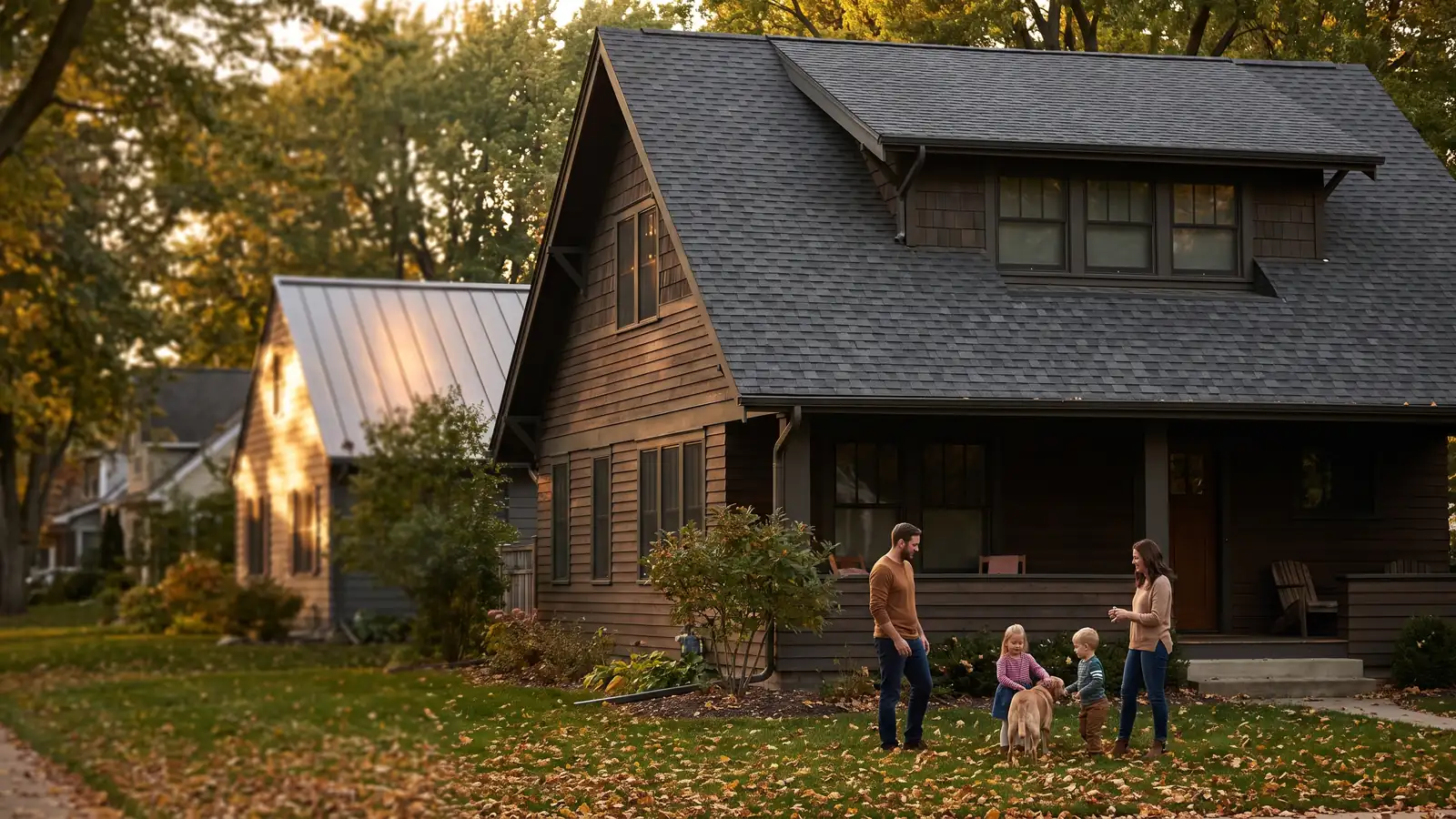
Weight is the constraint most homeowners don’t see coming. Slate and tile weigh several times what asphalt does per square, and Michigan’s code requires your structural roof components to support whatever covering goes on them, ruling out the premium materials on many houses before price comes up.
Learn how the common roofing materials compare, including the pros and cons of each and which need a structural review first. Our Home Improvement & Design guide covers the rest of the project queue.
Key takeaways:
- Asphalt is the default for a reason: 3-tab shingles run about 20 years and architectural shingles about 30, the shortest service life of any common covering, but they’re the cheapest and the easiest to find a crew for.
- Premium materials buy decades, not just curb appeal: Slate carries an estimated 60 to 150 years, clay and concrete tile 100 or more, and copper 70-plus, but their weight often forces a structural evaluation and a full tear-off.
- Match the material to your ownership horizon: If you’ll sell within 5 to 7 years you won’t recover the premium on a 100-year roof, so divide each quote by that material’s service life and compare cost per year.
How do you choose a roofing material?
Work through five filters in this order, because the first two eliminate options before budget and taste get a vote.
- Structure and weight: Michigan’s code requires the structural roof components to support the covering system, so going heavier means a licensed roofer or structural engineer signs off first.
- Climate: In a heating-dominated state the questions are snow load, ice damming, and freeze-thaw durability, not solar reflectance.
- Lifespan versus how long you’ll stay: Durability only pays off if you hold the house long enough to collect. A 5-year owner and a forever owner shouldn’t buy the same roof.
- Total installed cost: Tear-off, disposal, decking repair, and roof complexity often move a quote more than the shingle price does. Ask for the square count and per-square price separately.
- Maintenance appetite: Wood and slate need a specialist; metal and asphalt need inspections and clear gutters. Our guide to maintaining a home’s exterior covers the cadence, and gutter cleaning, DIY versus professional covers the chore that protects the roof edge.
How do the main roofing materials compare?
Here is the whole decision in one block. Lifespans are the estimated service lives in InterNACHI’s Standard Estimated Life Expectancy Chart for Homes, which assumes recommended maintenance and normal wear; cost and weight are relative.
| Material | Typical lifespan | Relative cost | Weight | Best for |
|---|---|---|---|---|
| Asphalt shingles | 3-tab 20 years; architectural 30 | Lowest | Light | Most houses and budgets; shorter ownership |
| Metal (standing seam, panel, shingle) | 40 to 80 years; copper 70+ | Moderate to high | Light, no reinforcement | Snow country and long ownership |
| Clay and concrete tile | 100+ years | High | Heavy, structural review | Homes framed for it; Mediterranean styles |
| Slate | 60 to 150 years | Highest | Heavy, structural review | Historic homes; one-and-done roofs |
| Wood shakes and shingles | 25 years | Moderate to high | Light | Rustic exteriors, with fire treatment |
| Synthetic (simulated slate and shake) | 10 to 35 years, by manufacturer | Moderate | Light | Premium looks on framing that can’t carry stone |
Weight, not price, is what actually rules out slate and tile on most houses, and synthetics carry the widest lifespan range, a warning about the category rather than any one product.
Here is each material in turn, starting with the one already on most American roofs.
Are asphalt shingles worth it?
For most homeowners, yes, and the case rests on cost per year, not longevity. Architectural asphalt carries an estimated 30 years against about 20 for 3-tab, and that step up is usually the highest-return upgrade on an asphalt roof.
Pros:
- Lowest installed cost: Material is widely stocked and no specialized crew is needed, which keeps product and labor cheap.
- Every roofer installs it: Competition among installers is why asphalt quotes cluster while slate quotes scatter.
- Light enough for any framing: Replacing asphalt with asphalt raises no structural questions.
Cons:
- Shortest service life of the common materials: At 20 to 30 years you’ll likely buy two asphalt roofs during a long tenure, plus two tear-offs.
- Weather ends it early: Wind uplift and hail usually finish asphalt before its rated life, and Michigan’s code bars laying new asphalt over an existing roof where hail exposure is moderate or severe.
- Landfill at end of life: Tear-off asphalt is the least recoverable common material, our guide to eco-friendly roofing options ranks the alternatives.
- Slope limits where it can go: Michigan’s code allows asphalt shingles only on slopes of 2:12 or greater, with double underlayment between 2:12 and 4:12.
How long does a metal roof last?
Metal carries an estimated 40 to 80 years, with copper at 70 or more, roughly two asphalt cycles in one installation. It’s also light enough for most existing framing, which makes it the standard step up from asphalt in northern climates.
Pros:
- Two roofs’ worth of service life: One metal roof commonly replaces two asphalt roofs and both tear-offs, which is where cost-per-year math turns.
- Sheds snow, resists fire and wind: Panels let snow slide off rather than holding it, and metal comes in Class A assemblies, the highest fire classification under the ASTM E108 and UL 790 standards.
- Recyclable, and often recycled already: Our roundup of energy-efficient home upgrades ranks roofing against insulation and windows.
Cons:
- Higher upfront cost: The premium is front-loaded while the payoff arrives in decades three and four.
- Fewer qualified installers: Standing-seam work is a specialty, poorly detailed metal leaks at the flashings, and fewer crews bid against each other.
- Noise and denting: Rain noise is largely a decking and insulation question, but softer metals like aluminum and copper dent.
Are clay and concrete tile roofs worth the weight?
Only if your framing can carry them, which is the whole question. Clay and concrete tile carry an estimated 100 or more years, the longest on paper of anything here, but weigh several times what asphalt does per square.
Pros:
- Longest paper lifespan: At 100-plus years, tile is a one-and-done roof on a house designed for it.
- Noncombustible and low maintenance: Fired clay and concrete don’t burn, and single tiles swap out without touching the field.
- Period-correct look: On Mediterranean and Mission-style homes nothing else reads right.
Cons:
- Weight forces a structural evaluation: An engineer or licensed roofer checks the rafters and decking first, and reinforcement can add thousands.
- Freeze-thaw is a real risk here: Tile that absorbs water and then freezes is the failure mode that keeps tile rare in the Upper Midwest. Insist on a product rated for freeze-thaw exposure.
- Expensive to repair and walk on: Tiles crack under foot traffic, and Michigan’s code bars roofing over existing clay, cement, or slate tile, tile always means a full tear-off.
Is a slate roof worth the cost?
On the right house, slate is the best long-term value in roofing and the worst short-term one. The National Park Service reports properly installed slate roofs last 60 to 125 years or longer, with some over 200: Vermont and New York slates about 125 years, Buckingham Virginia slates 175 or more.
Pros:
- Multi-generational service life: The Park Service notes that several artificial slate roofs would be installed during the lifespan of one natural slate roof.
- Naturally frost-resistant: Slate’s low porosity and absorption limit frost damage, the property that fails on porous materials in a freeze-thaw climate.
- Noncombustible and irreplaceable on period homes: Our guide to buying a historic home covers what else comes with that property.
Cons:
- Highest cost of any common material: The Park Service uses roughly one square, 100 square feet, per crew-day as a planning average, against a full asphalt roof in a day or two.
- Weight and lead time: Most retrofits need a structural evaluation, and delivery can take 4 to 12 weeks, or a year for special orders. This is not a storm-damage turnaround.
- Repairs need a slater: Broken slates must be replaced promptly by someone who owns a ripper and knows how to use it.
Are wood shakes and shingles a good idea?
Rarely as a practical choice, often as an aesthetic one. Wood carries an estimated 25 years, less than architectural asphalt, and demands more maintenance than most homeowners expect.
Pros:
- A look nothing else duplicates: Hand-split shakes weather to a texture that reads correctly on Craftsman and shingle-style homes.
- Light and workable: Wood adds no structural burden, so it’s a straight swap on framing that already carries asphalt.
Cons:
- Maintenance and a 25-year service life: Rot, moss, insects, and splitting shorten it further, our guide to maintaining a home’s roof covers the inspection schedule that protects the rated life.
- Fire performance requires treatment: Pressure-treated shakes can reach Class A, but only in a tested assembly with fire-resistant underlayment, and some jurisdictions restrict wood roofs outright.
Are synthetic roofing materials as good as the real thing?
Sometimes, and it depends entirely on the manufacturer. InterNACHI puts simulated slate at 10 to 35 years, the widest range on the list, which tells you the category isn’t one product but dozens.
Pros:
- Premium looks without the weight: Composite slate and shake give you the profile on framing that couldn’t carry stone, often the deciding factor on a retrofit.
- Lower cost, simpler installation: Synthetics install more like shingles than like slate, widening the pool of crews who can bid.
Cons:
- Lifespan swings from 10 to 35 years: The written warranty, its transferability, and independent testing matter far more than the marketing.
- It can read as an imitation: Up close some products don’t hold up. Look at an installed roof five years old before committing.
What are the best flat roofing options?
Flat and low-slope roofs are a membrane problem, not a shingle problem. Anything under a 2:12 slope can’t take asphalt shingles under Michigan’s code. Four membrane types cover almost everything a residential contractor will quote.
- TPO: Estimated at 7 to 20 years. Affordable and reflective, but the range is wide because seam quality and formulation vary by manufacturer.
- PVC: Durable, fire-resistant, and chemically resistant, which is why it shows up over restaurant kitchens. It costs more than TPO and is the least eco-friendly option here.
- EPDM rubber: Estimated at 15 to 25 years. The residential default, simple to repair, though the black membrane absorbs heat unless coated.
- Modified bitumen and built-up roofing: Estimated at 20 and 30 years, older technologies that still perform on the right deck.
Whatever the membrane, the failure point is almost always a penetration or a seam, not the field, our guide to the pros and cons of installing a skylight covers the flashing logic that governs vents and curbs too.
How do you compare roof quotes by cost per year?
Divide each written quote by the service life of its material, then compare that with how long you expect to own the house. The service lives below are the low end of each range in InterNACHI’s estimated life expectancy chart for homes, which the association says should be used as guidelines only, not relied on as guarantees or warranties.
Hypothetical example, not an offer. The quotes are invented for illustration and are not market prices; your own itemized bids replace them.
| Material | Hypothetical quote | Low-end service life | Cost per year of service life |
|---|---|---|---|
| Architectural asphalt | $15,000 | 30 years | $500 |
| Standing-seam metal | $30,000 | 40 years | $750 |
| Natural slate | $60,000 | 60 years | $1,000 |
| Simulated slate | $30,000 | 10 years | $3,000 |
Source for the service lives: InterNACHI, Standard Estimated Life Expectancy Chart for Homes.
The table reads differently at the high end of each range. If the metal roof in this example reaches 60 years, its $30,000 works out to $500 a year, level with asphalt. At its low-end life the synthetic costs six times as much per year as asphalt, which is why its written warranty matters. An owner who sells after 7 years has used 7 years of any of these roofs; how much of the rest a buyer pays for is decided by the market, not by this arithmetic.
The same math explains a point in the National Park Service’s slate roof brief (published spring 1993): although artificial slate costs less than natural slate, the total initial cost of an artificial slate roof is only marginally less, because labor, flashings and tear-off of the old roof cost the same in both cases.
When the quote is larger than savings can cover, the Consumer Financial Protection Bureau describes a HELOC, in a page last reviewed August 28, 2026, as a line of credit, like a credit card, except you are borrowing against the equity of your home, and notes that a cash-out refinance replaces your existing mortgage with a bigger one and often carries closing costs. Our guides to a home equity line of credit, home equity loans, cash-out refinancing and financing home renovations compare them, and our maintenance budgeting guide covers saving ahead.
How do wind and hail change the choice of roofing material?
Per the Insurance Information Institute’s homeowners insurance statistics, which use ISO data, wind and hail produced 2.80 claims per 100 insured house-years from 2019 to 2023, with an average claim of $14,747, and their share of all homeowners losses moved between 38.1% and 47.7% in those years.
| Year | Wind and hail share of homeowners losses |
|---|---|
| 2019 | 38.1% |
| 2020 | 47.7% |
| 2021 | 38.9% |
| 2022 | 45.4% |
| 2023 | 42.5% |
Source: Insurance Information Institute, Facts + Statistics: Homeowners and renters insurance, losses by cause, 2019 to 2023, data from ISO, a Verisk Analytics business.
The Insurance Institute for Business & Home Safety (IBHS) builds its FORTIFIED Roof standard around those losses. It requires the seams of the roof deck to be sealed, which it says can reduce water intrusion by up to 95% when the covering is damaged, and ring-shank nails installed in an enhanced pattern instead of common smooth nails, which it says nearly doubles the roof’s strength against wind. Ask every bidder to price them as separate line items. Our guides to homeowners insurance deductibles and evaluating home insurance options explain how a wind or hail claim gets paid.
How much do homeowners spend on roofing nationally?
More than on any other energy-related project. According to Harvard’s Joint Center for Housing Studies, in its Improving America’s Housing 2025 key facts, market spending on projects that affect home energy use reached $139 billion in 2023, more than double the $66 billion of 2013 and nearly four times the $37 billion of 2003. Roofing replacements accounted for a third of the 2023 total, $46 billion, and HVAC for 29%, or $40 billion.
| Measure (Harvard JCHS) | Figure |
|---|---|
| Energy-related improvement spending, 2023 | $139 billion |
| Roofing replacements, 2023 | $46 billion, about a third |
| HVAC, 2023 | $40 billion, 29% |
| Energy-related share of homeowner improvement spending | 34% in 2023, 27% in 2003 |
| Median age of owner-occupied homes, 2023 | 42 years |
| Average improvement and repair spending, owners of homes built before 1940, 2023 | $6,700 |
Source: Harvard Joint Center for Housing Studies, Improving America’s Housing 2025, Key Facts, 2023 data. The report notes the $6,700 for pre-1940 homes is about 50 percent more than owners of homes built since 2010 spent.
If the roof is one item on a longer list, a home energy audit can show whether attic insulation and air sealing belong in the same project, and our guide to renovation ideas that add value ranks the other big jobs.
What does a roof cost, and how do you pay for it?
There’s no honest national replacement price, the number moves with square footage, pitch, complexity, tear-off layers, material, and local labor. For scale, the National Association of Home Builders’ 2024 Construction Cost Survey put roofing at $16,732 on an average single-family home, or 3.9% of a $428,215 total construction cost.1 That’s a builder’s cost on new construction, not a retrofit quote. References like current roof replacement cost ranges by material and NAHB’s construction research set expectations; your quotes are the only figures that count.
When a roof outgrows what you’d put on a card, the usual routes are a home equity loan or line of credit, a cash-out refinance, or a renovation loan based on the home’s after-improved value. Because Align is a broker rather than a direct lender, we shop all three across competing wholesale lenders and show the total cost of each side by side.2 Our Homeownership guide covers long-cycle expenses like this one.
Do cool roofs make sense on a cold-climate house?
Rarely on their own. ENERGY STAR’s cool roof guidance says cool roofs save more energy in hot sunny climates, like the Southern U.S., on buildings with low levels of roof insulation. Where homes are air-conditioned, the EPA’s heat island page on cool roofs, last updated June 18, 2026, reports that a cool roof’s solar reflectance can reduce peak cooling demand by 11% to 27%, and the Cool Roof Rating Council puts average savings at 7% to 15% of total cooling costs.
Lawrence Berkeley National Laboratory’s Heat Island Group reports that a cool-colored roof reflecting 35% of sunlight stays about 22°F cooler than a traditional roof that looks the same but reflects only 10%; the EPA notes that infrared reflective pigments tend to cost more.
The decision only comes up at a planned replacement: the Department of Energy’s guide to cool roofs says it is rarely economical to replace a mechanically sound roof just to increase its solar reflectance.
What Michigan homeowners should know
Michigan reorders this list. Freeze-thaw cycling, lake-effect snow, and ice damming make water management matter more than reflectivity, and the state’s code adds requirements that change what you can install.
- Ice barrier at the eaves is code, not an upsell: Where ice historically forms at the eaves and backs up water, the Michigan Residential Code requires an ice barrier, two cemented layers of underlayment or a self-adhering polymer modified bitumen sheet, running from the lowest roof edge to at least 24 inches inside the exterior wall line.
- Some materials mean a mandatory tear-off: The code bars a new covering over existing wood shake, slate, clay, cement, or asbestos-cement tile, or over a roof already carrying two or more layers. Budget for full removal, not a layover.
- Freeze-thaw punishes anything that absorbs water: This is the honest reason clay tile is common in Phoenix and rare in Petoskey.
- Reflectivity is the wrong priority here: EPA retired ENERGY STAR certification for roof products on June 1, 2022, noting that reflective roofing helps in hot climates but is counterproductive in cold ones. Check ENERGY STAR’s current home efficiency guidance and spend on attic insulation, air sealing, and ventilation instead.
- Snow load is county-specific: Design ground snow loads vary widely across Michigan, so confirm the value for your address with your building department before pricing slate or tile.
The practical Michigan shortlist is architectural asphalt or standing-seam metal, with the attic work done at the same time.
What do Michigan rules say about roofers, permits and storm sales?
Roofing is a licensed trade in Michigan. MCL 339.2404 lists roofing among the crafts and trades a residential maintenance and alteration contractor license includes and says a license shall specify the particular craft or trade for which the licensee is qualified, so check that roofing is on the license, not only that a license exists.
Whether a re-roof needs a permit is set locally: Oak Park’s roofing guidelines, in a file dated July 2026, allow minor repairs in no more than a 10-foot by 10-foot area in any 12-month period without a permit. Our guide to home renovation permits covers the inspection steps.
Storms bring door-to-door sellers. On March 17, 2026, after tornadoes in southwest Michigan, the Department of Insurance and Financial Services warned that people posing as adjusters and contractors go door to door offering repairs that may never be finished, and told homeowners to contact their insurance company before hiring a contractor and to check licenses, references and insurance.
If the old roof is asbestos-cement tile, which the code bullet above says must come off before a new covering goes on, the EPA’s asbestos guidance for families, last updated June 25, 2026, says removal is complex and must be done only by a trained and accredited asbestos professional. See home insurance and renovations for how a re-roof can change a policy.
How Align arranges renovation financing
You are not just financing the house. You are financing a plan for it. Align places HomeStyle and FHA 203(k) renovation loans, standalone HELOCs and home equity loans, so the project can be paid for the way that fits it, not the way one bank prefers.
Samantha starts with why: what the work is, what it should cost, and whether your equity or a renovation loan is the better tool. Then one application goes to multiple wholesale lenders.
FAQ: Choosing roofing materials
Here are answers to common questions about roofing materials.
What is the longest-lasting roofing material?
Clay and concrete tile and slate lead the field. InterNACHI puts clay and concrete at 100 or more years and slate at 60 to 150, with copper at 70-plus and metal at 40 to 80, and the National Park Service reports some slates have lasted over 200 years. All cost far more upfront than asphalt, and the heavy ones need a structural evaluation. Our comparison of eco-friendly roofing options ranks the same materials on recyclability.
What is the cheapest roofing material?
Three-tab asphalt shingles are the cheapest roofing material to buy and install. They’re widely stocked, need no specialized crew, and often go on in a day or two. The trade-off is roughly 20 years of service life against about 30 for architectural shingles, plus less wind and hail resistance. Our guide to maintaining a home’s roof covers the upkeep that protects that rated life.
Do I need to reinforce my roof for tile or slate?
Often, yes. Clay tile and natural slate weigh several times more per square than asphalt shingles, and many framing systems were never designed for that load. Michigan’s code requires structural roof components to support the covering system, so a licensed roofer or engineer should evaluate the rafters and decking first. Our Home Improvement & Design guide covers budgeting that work.
Does a new roof increase home value?
A new roof rarely returns its full cost at resale, but it removes a major objection for buyers, inspectors, and lenders. Appraisers flag roofs near the end of their service life, and some insurers won’t write a policy on a roof over a certain age. If yours is past 20 years or visibly damaged, replacing it before listing usually means a faster sale. See our overview of the home appraisal process.
Does a new roof raise your property taxes in Michigan?
Not until the home sells. Under MCL 211.27(2), a Michigan assessor may not count the increase in true cash value from normal repairs, replacement and maintenance until the property is sold, and repairing or replacing a roof is on the statute’s list of normal maintenance when it is not part of a structural addition. The rule applies only to residential property, and the excluded value is noted on the assessment roll. See how home improvements affect property taxes.
Which roofing materials can go over the old shingles instead of a tear-off?
Asphalt over one sound layer, and some metal panels. Milan’s building office, in a handout headed 2015 Michigan Residential Code, requires removal when the existing roof “is water soaked or has deteriorated to the point that it is not acceptable as a base for additional roofing.” Its metal guide says some makers permit corrugated panels over an existing roof, on purlins every 24 inches; standing-seam panels typically go on the deck. Our roof maintenance guide covers deck checks.
Do solar shingles qualify for a federal tax credit?
Not if they go on in 2026. According to the IRS page on the Residential Clean Energy Credit, the credit equaled 30% of the cost of qualified clean energy property installed from 2022 through December 31, 2025, and it is not available for property placed in service after that date. Solar roofing tiles and shingles counted while it ran because they generate clean energy. Our guide to buying a home with solar panels covers leases and ownership.
Can you roll the cost of a new roof into a mortgage?
Yes, through renovation programs. According to HUD’s 203(k) page, the Limited 203(k) lets homebuyers and homeowners finance up to $75,000 into an FHA mortgage to repair, improve or upgrade a home. Fannie Mae’s HomeStyle Renovation guide, dated December 10, 2025, lets the loan amount cover repairs or energy improvements, with the work done within 15 months of closing. Align is not affiliated with HUD or Fannie Mae. See FHA 203(k) loans and renovation loans.
The bottom line on roofing materials
Roofing materials separate on lifespan, weight, and cost. InterNACHI’s estimates run from about 20 years for 3-tab asphalt and 30 for architectural to 40 to 80 for metal, 60 to 150 for slate, and 100 or more for clay and concrete tile. Weight eliminates the premium options on most houses, since Michigan’s code requires your framing to support whatever covering goes on it. Asphalt wins on price, metal on cost per year in snow country, slate and tile only if you’re staying decades. Get three itemized quotes on one specification and divide each by the material’s service life.
If you’re ready to finance a roof replacement or buy a home that needs one, talk to Align Lending. We’ll shop your scenario across our lender network and show you home equity, cash-out, and renovation loan options side by side. Call 248-506-5727 or start online.
Footnotes:
1. The $16,732 roofing figure and the $428,215 total construction cost come from NAHB’s 2024 Construction Cost Survey, conducted in the fall of 2024 with 41 usable builder responses, on an average home of 2,647 finished square feet. NAHB cautions that the survey is designed to show percentage cost breakdowns for a typical home built by a subset of its builder members and is not designed to capture representative characteristics of the average home built in a given year. These are builder costs on new construction, not a replacement quote for an existing roof, and they are not an estimate of what your project will cost. Return to text.
2. Align Lending is an independent mortgage broker and does not set loan terms. Home equity, cash-out refinance, and renovation loan program terms, eligibility, and available loan amounts are set by the individual wholesale lenders in Align’s network and are subject to change, credit approval, property eligibility, and equity requirements. Nothing here is an offer of credit or a commitment to lend. Return to text.
Sources: estimated service life by roof covering, asphalt shingles (3-tab) 20 years, asphalt (architectural) 30, metal 40 to 80, copper 70+, slate 60 to 150, clay/concrete 100+, wood 25, simulated slate 10 to 35, TPO 7 to 20, EPDM rubber 15 to 25, modified bitumen 20, built-up roofing 30, InterNACHI’s Standard Estimated Life Expectancy Chart for Homes, International Association of Certified Home Inspectors. Slate service life of 60 to 125 years or longer, slates known to last over 200 years, Vermont and New York slates about 125 years, Buckingham Virginia slates 175 years or more, one square equals 100 square feet of roof surface, delivery lead times of 4 to 12 weeks or up to a year for special orders, a planning average of about one square per crew-day, low porosity and low absorption limiting frost damage, and the observation that several artificial slate roofs would be installed during the lifespan of one natural slate roof, U.S. National Park Service, Preservation Brief 29, “The Repair, Replacement and Maintenance of Historic Slate Roofs.” Ice barrier extending at least 24 inches inside the exterior wall line (R905.1.2), the requirement that structural roof components support the roof covering system (R908.2), mandatory removal of existing coverings over wood shake, slate, clay, cement or asbestos-cement tile, over two or more existing layers, and for asphalt shingles in areas of moderate or severe hail exposure (R908.3), and the 2:12 minimum slope with double-underlayment requirement for asphalt shingles (R905.2.2), Chapter 9, Michigan Residential Code. Roofing at $16,732 and 3.9% of a $428,215 average total construction cost on 2,647 finished square feet, National Association of Home Builders, Cost of Constructing a Home, 2024 Construction Cost Survey. Sunset of the ENERGY STAR roof products specification on June 1, 2022, and EPA’s stated rationale that reflectivity is helpful in hot climates but counterproductive in cold climates, U.S. Environmental Protection Agency, ENERGY STAR Roof Products Sunset documents. Class A as the highest roof covering fire classification under the ASTM E108 and UL 790 test standards.
This article is for informational purposes only and is not intended to provide legal, financial, tax, engineering, or construction advice. Building code requirements, snow load design values, permit rules, contractor licensing, and product warranties vary by jurisdiction and change over time, verify current requirements with your local building department and a licensed roofing contractor or structural engineer before starting work. Estimated service lives are general guidelines based on recommended maintenance and normal wear, not guarantees; actual roof performance depends on installation quality, ventilation, maintenance, and local weather. No cost figure here is a quote for your project. Align Lending is an independent Michigan mortgage broker, NMLS #2041154, and is not acting on behalf of, endorsed by, or sponsored by the U.S. Environmental Protection Agency, the National Park Service, or any government agency.
Sources
Every outside source this guide links to, in the order it appears. How we choose and check sources
- InterNACHI’s life-expectancy chartInternational Association of Certified Home Inspectors
- Published spring 1993nps.gov
- Describes a HELOCConsumer Financial Protection Bureau
- Notes that a cash-out refinanceConsumer Financial Protection Bureau
- Insurance Information Institute’s homeowners insurance statisticsInsurance Information Institute
- FORTIFIED Roof standardfortifiedhome.org
- Improving America’s Housing 2025 key factsjchs.harvard.edu
- NAHB’s construction researchNational Association of Home Builders
- Cool roof guidanceENERGY STAR
- Heat island page on cool roofsU.S. Environmental Protection Agency
- Cool Roof Rating Councilcoolroofs.org
- Heat Island Groupheatisland.lbl.gov
- Guide to cool roofsU.S. Department of Energy
- ENERGY STAR’s current home efficiency guidanceENERGY STAR
- MCL 339.2404Michigan Legislature
- Oak Park’s roofing guidelinesoakparkmi.gov
- Department of Insurance and Financial ServicesState of Michigan
- Asbestos guidance for familiesU.S. Environmental Protection Agency
- MCL 211.27(2)Michigan Legislature
- Handout headed 2015 Michigan Residential Codecms7files.revize.com
- IRS page on the Residential Clean Energy CreditInternal Revenue Service
- HUD’s 203(k) pageU.S. Department of Housing and Urban Development
- HomeStyle Renovation guideFannie Mae Selling Guide
Related resources
20-minute read
Energy-efficient home upgrades in Michigan: What to do first, and how to pay for it
See which energy-efficient upgrades pay off first in a Michigan home, what they cost, and how to pay for them in 2026 with rebates, loans and mortgages.

20-minute read
DIY home renovation projects: 12 upgrades you can actually finish
Discover DIY home renovation projects that upgrade your space on a budget, from peel-and-stick backsplashes to floating shelves and smart lighting.
20-minute read
The benefits of a home energy audit and what it includes
Learn what a home energy audit finds, how blower door and infrared tests work, and why the Department of Energy ties audits to 5% to 30% savings.
