Coping with smoke damage: Cleanup, odor removal and claims
After a house fire, the order of operations is safety, documentation, then cleanup, 3 steps that only work in that order. Don’t re-enter until the fire department clears the structure, and once you’re inside, photograph every room before you move or throw away a single item, because your settlement gets built from that record.
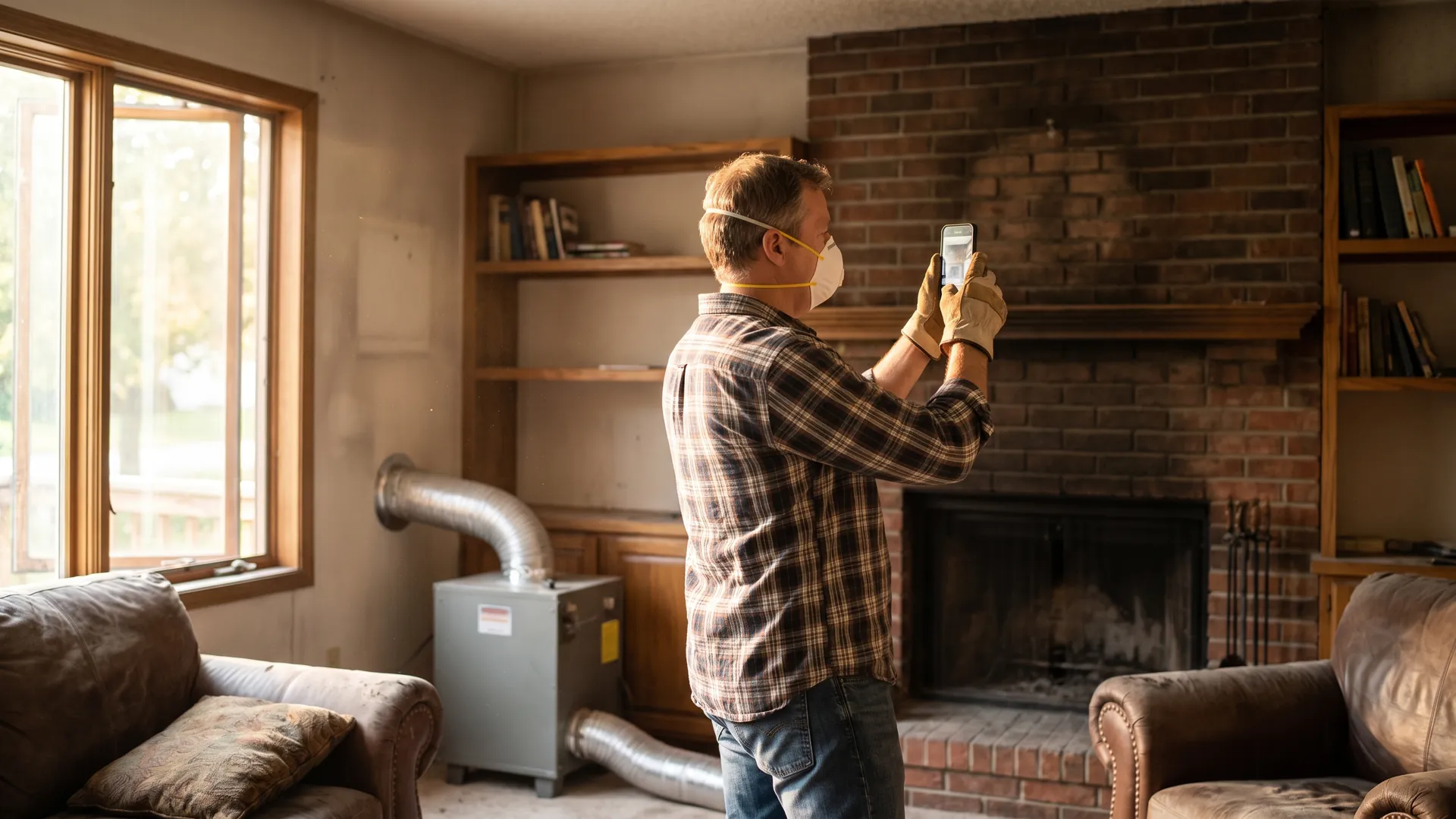
Then move quickly. Soot is acidic, and it begins etching metal, glass and painted finishes within days, so ventilation and surface cleaning should start as soon as the property is safe to work in. Residue type matters too: wet smoke from a smoldering fire is far harder to remove than dry powder from a fast, hot one.
Learn how to cope with smoke damage step by step, including what to do in the first 24 hours, how to clean soot without driving it deeper into your walls, how the insurance claim pays out, and when to call a restoration contractor. Our home maintenance guide covers the rest of the upkeep calendar.
Key takeaways:
- 3 steps, in this order: Safety, documentation, then cleanup. Don’t enter until the fire department clears the structure, and photograph and inventory every room before you move or discard anything, because that record is what your insurer settles from.
- Soot is corrosive and time-sensitive: Acidic residue starts etching metal, glass and finishes within days, and the 4 residue types, dry smoke, wet smoke, protein and fuel oil, clean so differently that the wrong method sets a stain permanently.
- Odor removal is a separate job from soot removal: Air fresheners do nothing for residue embedded in drywall, insulation and ductwork, so plan on HVAC cleaning, sealing and professional deodorization, and start a receipt file in the first 24 hours for the claim.
What to do in the first 24 hours after a fire
5 things belong in the first day, 4 of them free, and the order matters because each one protects the next.
- Wait for the all-clear: Check with the fire department that your home is safe to enter, and don’t reconnect utilities yourself. Crews are supposed to confirm utilities are safe or disconnected before they leave. Ready.gov guidance on returning home after a fire walks through the sequence.
- Gear up before you walk in: Wear a NIOSH-approved N95 or P100 respirator, gloves, long sleeves, long pants and closed shoes, and wash off any ash that reaches your skin, eyes or mouth, because wet ash can cause chemical burns. Federal health guidance is that people with heart or lung disease, older adults and pregnant women should sit out ash cleanup, and that children shouldn’t do cleanup work at all.
- Photograph before you touch anything: Shoot wide video of every room, then close-ups of damaged items, model and serial numbers, and wall and ceiling surfaces. Build a written inventory as you go, and don’t throw damaged goods away until it’s done.
- Call your insurer, then your mortgage servicer: Your insurer will tell you how to protect the property from further loss and start the claim. Your servicer needs to hear from you too, because on a mortgaged home it will be named on the settlement check.
- Start a receipt file: Save receipts for every dollar you spend on the loss, from a hotel room to a shop vacuum. Your insurer may need them, and they can matter for losses claimed on your income taxes.
What is smoke damage?
Smoke damage is the residue, corrosion, staining and odor that smoke leaves on surfaces, contents and building systems. Damage that keeps working long after the flames are out. It isn’t the same thing as fire damage, and it routinely turns up in rooms the fire never reached.
That’s because smoke follows air. It travels through wall cavities, around door frames, up stairwells and into return ducts, so a contained kitchen fire can leave residue on closet shelves two floors up.
The 4 types of smoke residue
Residue type decides your cleaning method, so identify what you’re dealing with before you buy a single supply.
| Residue type | Typical fire source | What it looks like | Cleaning difficulty |
|---|---|---|---|
| Dry smoke | Fast, hot fires burning paper and wood | Dry, powdery, sits loosely on the surface | Easiest, vacuums and dry-sponges off before washing |
| Wet smoke | Slow, smoldering fires involving plastics and rubber | Sticky and thick; smears when wiped; heavy odor | Hard, smearing sets the stain, so usually a contractor’s job |
| Protein residue | Kitchen fires and scorched food | Nearly invisible yellowish film; intense lingering smell | Deceptive, easy to miss, still needs full cleaning and deodorizing |
| Fuel oil soot | Furnace puffback or oil burner malfunction | Greasy black film spread widely, often room to room | Hard, travels through ductwork and coats everything at once |
How common are house fires, and which causes do the most damage?
Common and costly. According to the U.S. Fire Administration’s residential fire estimates, there were 344,600 residential building fires in 2023, causing 2,890 deaths, 10,400 injuries and $11,266,200,000 in dollar loss. From 2014 to 2023, USFA reports a 6% decrease in those fires and an 8% decrease in injuries, but a 5% increase in deaths and a 25% increase in inflation-adjusted dollar loss.
| Cause, ranked by number of fires | Fires, 2023 | Change, 2014 to 2023 | Dollar loss, 2023 |
|---|---|---|---|
| Cooking | 167,800 | 11% decrease | $572.7 million |
| Other unintentional, careless | 31,500 | 42% increase | $2,480.5 million |
| Heating | 27,900 | 31% decrease | $488.0 million |
| Electrical malfunction | 23,700 | 2% increase | $1,501.6 million |
Source: U.S. Fire Administration, Residential Building Fire Causes (2014 to 2023) and Residential Building Fire Dollar-Loss Causes (2014 to 2023), 2023 national estimates.
Kitchen fires, the most common kind, leave the protein residue described above. Cost ranks differently: per the USFA dollar-loss estimates, careless fires cost more than four times what cooking fires did in 2023, and their inflation-adjusted loss rose 76% from 2014 to 2023.
Why is smoke damage dangerous?
3 hazards ride along with smoke damage, and only one is visible.
- What you breathe: Soot and ash are fine particles carrying the byproducts of whatever burned, plastics, foam, insulation, treated lumber. That’s why the respirator, gloves and covered skin aren’t optional.
- What it corrodes: Acidic residue attacks metal first. Chrome and nickel fixtures, appliance finishes, electrical contacts and circuit boards discolor and pit while you’re still deciding what to do.
- What arrived with the water: Putting the fire out soaked the house. Saturated drywall, insulation and framing start a second problem on a different clock, our guide to addressing water damage in your home covers the drying sequence, and addressing mold issues in your home covers what happens when drying doesn’t get done.
How do you prevent a second emergency during repairs?
The CDC’s carbon monoxide basics page (updated October 26, 2026) reports that each year more than 400 Americans die from unintentional carbon monoxide poisoning not linked to fires and more than 100,000 visit an emergency department.
According to Ready.gov’s power outage guidance (last updated June 4, 2026), generators and fuel should always be used outdoors and at least 20 feet away from windows, doors and attached garages. Per the Consumer Product Safety Commission’s Carbon Monoxide Information Center, install battery-operated CO alarms, or alarms with battery backup, on every level of the home and outside sleeping areas.
According to the U.S. Fire Administration’s heating fire safety page, portable heater fires were only 3% of home heating fires annually for 2017 to 2019 but accounted for 41% of fatal heating fires in homes; keep anything that can burn at least 3 feet away. In its report on heating fires in residential buildings (2017 to 2019), USFA reported that 77% were confined to chimneys, flues or fuel burners, the heat source was too close to combustibles in 27% of the rest, and smoke alarms were present in 56% of nonconfined heating fires in occupied buildings.
How to clean smoke damage, step by step
Work dry before wet, and top to bottom. Washing soot before you dry-remove it is the single most common way a homeowner turns a cleanable wall into a repaint.
- Ventilate first: Open windows and doors on opposite sides of the house and set fans to push air out rather than stir it around, before you start cleaning.
- Dry-remove the soot: Use a HEPA vacuum with the nozzle held slightly off the surface, then a dry chemical sponge in single straight strokes, turning to a clean face often. No water, no pressure, no scrubbing yet.
- Then wash hard surfaces: Wash walls, trim, counters and floors with a mild degreasing cleaner. Work bottom to top on walls so runs don’t streak into dry soot, and change your water often.
- Handle contents separately: Launder fabrics with an odor-neutralizing additive, twice if needed. Electronics, artwork, documents and heavily soiled upholstery usually go to a contents cleaning facility.
- Deal with the HVAC system: Replace filters and have the ductwork inspected and cleaned before you run the system again, or you’ll redistribute soot through every room.
- Deodorize last: Odor work only holds once the residue is gone. Persistent smell means smoke soaked into porous materials, which calls for sealing primers, professional deodorization and sometimes removal.
Don’t stop at the interior. Soot settles on siding, soffits and roofing and stains as it weathers.
Mistakes that make smoke damage worse
- Wet-washing soot first: Water turns dry soot into a spreading stain that soaks into drywall paper, and hard scrubbing drives it deeper. Dry removal always comes first.
- Running the furnace or air conditioning: Circulating air pulls soot into the ducts and delivers it to clean rooms. Leave the system off until the ductwork is checked.
- Counting on an ozone generator: The EPA’s position is that at concentrations that don’t exceed public health standards, ozone has little potential to remove indoor air contaminants and is not effective at removing many odor-causing chemicals. It’s also a lung irritant, and the levels that do cut odors sit above what’s considered safe for people.
DIY or hire a pro? How to decide
One test settles most cases: if the fire stayed in one room, was out in minutes, and left dry powdery soot on hard surfaces, homeowner cleanup is realistic. Almost everything else is a contractor call.
- Reasonable to take on yourself: Light residue on washable walls and hard flooring, no structural damage, no HVAC involvement, and an odor that fades once you’ve ventilated and washed.
- Call a restoration contractor when: Soot reached more than one room, residue is sticky or greasy, the smell returns after cleaning, ductwork or insulation is involved, electronics were exposed, there’s fire-suppression water in the structure, or framing, wiring or drywall needs replacing.
How to choose a restoration contractor
Ask 4 questions before you sign anything, and be wary of anyone who shows up at the curb unsolicited.
- Certification and standards: The Institute of Inspection, Cleaning and Restoration Certification publishes ANSI/IICRC S700, the American National Standard for professional fire and smoke damage restoration, and certifies technicians through its Fire and Smoke Restoration Technician credential. Ask what your crew holds.
- A written scope and phase schedule: Assessment, stabilization, contents removal, soot cleaning, deodorization and reconstruction should appear as separate phases with dates, not a lump-sum handshake.
- Coordination with your adjuster: Reputable firms work from a scope agreed with your insurer instead of billing you and leaving you to argue for reimbursement.
- Verification after cleaning: Ask how they’ll confirm the job worked, odor testing, surface inspection and a walkthrough before reconstruction.
Get more than one written estimate on the same scope. Restoration prices swing widely with residue type, square footage, contents volume and local labor, and no national average will tell you what your job costs.
How to file a smoke damage insurance claim
A standard homeowners policy names smoke as a covered peril, so most claims turn on documentation, limits and depreciation rather than whether you’re covered at all.1
- What a standard policy covers: On the widely used ISO HO-3 form, the smoke peril covers sudden and accidental damage from smoke, including the emission or puffback of smoke, soot, fumes or vapors from a boiler, furnace or related equipment. The same provision excludes smoke from agricultural smudging and industrial operations.
- Loss of use is a separate limit: Coverage D pays additional living expenses when the home is uninhabitable after a covered loss, the difference between your normal costs and your temporary ones, under its own limit, separate from dwelling coverage.
- What a standard policy won’t do: It doesn’t pay for flood or earthquake damage; those need separate policies. Read your own declarations page before you assume anything. Our guide to evaluating home insurance options compares the coverage parts, and the Insurance Information Institute explains how insurers settle claims after a disaster.
- Your servicer is on the check: If you have a mortgage, the settlement is generally paid by a check made out to both you and your servicer, because most mortgage agreements require it. The servicer typically releases part of the money up front so you can hire a contractor, more as work progresses, and the balance once the home passes inspection. You still owe your regular payments throughout.
- Contents and depreciation: Check whether your policy settles personal property at replacement cost or actual cash value, because that one line decides how much of your inventory you get back.
Where the settlement doesn’t cover the full rebuild, a high deductible, depreciated contents, or an upgrade you want while the walls are open, the gap is a financing question. Lenders in Align’s network offer renovation and cash-out refinance options that fold repair costs into the mortgage, as our homeownership guide explains.2
What does a fire claim pay, and how are the limits set?
Fire claims are rare but large. Per the Insurance Information Institute’s homeowners insurance statistics (ISO data, 2019 to 2023), fire and lightning claims came less often than water or wind claims but paid more than five times as much on average:
| Cause of loss | Claims per 100 house-years | Average claim payment |
|---|---|---|
| Fire and lightning | 0.23 | $88,170 |
| Water damage and freezing | 1.50 | $15,400 |
| Wind and hail | 2.80 | $14,747 |
| Theft | 0.12 | $5,524 |
| All property damage | 5.53 | $16,857 |
Hypothetical example, not an offer. Actual rates, costs and payments vary.
Source: Insurance Information Institute, Average Homeowners Losses, 2019 to 2023, as reported from ISO data; excludes renters and condominium policies.
The National Association of Insurance Commissioners’ A Consumer’s Guide to Home Insurance (2022) says the other limits are usually set as percentages of the dwelling limit:
| Coverage part | Typical limit, per the NAIC |
|---|---|
| Other structures | 10% of the dwelling limit |
| Personal property | 50% of the dwelling limit |
| Loss of use | 20% of the dwelling limit |
Source: National Association of Insurance Commissioners, A Consumer’s Guide to Home Insurance (2022), Table 2. Your own policy can use different percentages. The same guide warns that if dwelling coverage drops below 80% of the home’s full replacement cost, the insurer may reduce what it pays on a claim. Our guide to insurance and protection covers how these parts fit together.
Hypothetical example, not an offer. A $300,000 dwelling limit at the NAIC’s typical percentages carries $150,000 for personal property and $60,000 for loss of use. If smoke ruins a sofa that costs $2,000 to replace and the adjuster depreciates it by half, an actual cash value settlement on that item is $1,000 before the deductible.
How does the insurance money move when you have a mortgage?
The Insurance Information Institute’s guide to settling insurance claims after a disaster notes that the first check is often an advance, and that you can reopen the claim if you find more damage later, which matters when soot later turns up in ducts.
For a loan Fannie Mae owns, its Servicing Guide topic B-5-01, Insured Loss Events (dated 07/12/2023) says that when the loan is current or less than 31 days delinquent at the time of the loss, the servicer may release an initial disbursement up to the greater of $40,000, 33% of the insurance loss proceeds, or the amount by which the proceeds exceed the loan’s unpaid balance, accrued interest and advances, then pay out the rest based on periodic inspections of the repair work. Other investors set their own terms, so ask the servicer’s loss draft department for its checklist before you sign with a contractor; our guide to mortgage servicing explains how to reach that department.
Hypothetical example, not an offer. On a $120,000 dwelling settlement for a current Fannie Mae loan with a balance above the settlement, 33% of the proceeds is $39,600, so the first release can be up to $40,000, and the remaining $80,000 follows as inspections show progress.
How can you pay for repairs the settlement does not cover?
Size the gap first: the deductible, depreciation held back on contents, anything above a limit, and upgrades the policy never covered. Our guide to planning for unexpected home repairs covers building that number, and our guide to home renovation permits explains who pulls the permit on a rebuild. According to HUD’s 203(k) program page, the FHA-insured Limited 203(k) permits homebuyers and homeowners to finance up to $75,000 into the mortgage, and the Standard 203(k) requires rehabilitation costs of at least $5,000; our guide to the benefits of FHA 203(k) loans explains the program.
The other common routes, compared in our guides to renovation loans, cash-out refinancing and home equity lines of credit, each treat the existing first mortgage differently.
What Michigan homeowners should know
Michigan adds 2 wrinkles: a disclosure duty that outlives the repair, and a heating season long enough to make furnace, chimney and space heater fires an ordinary risk.
- You’ll have to disclose it when you sell: Michigan’s Seller Disclosure Act, 1993 PA 92, prescribes a statutory form whose “Other Items” section asks whether the seller is aware of major damage to the property from fire, wind, floods or landslides. You answer yes, no or unknown, and a yes requires an explanation, so keep restoration invoices, permits and inspection sign-offs in one file. Our guide to how to handle seller disclosures covers the form and its deadlines.3
- Heating fires track the heating season: The U.S. Fire Administration estimated 27,900 residential building heating fires nationwide in 2023, causing 115 deaths, 525 injuries and $488 million in property loss. Furnace puffbacks and chimney fires also tend to leave heavy, greasy residue rather than a contained burn.
- The risk concentrates in one month: USFA found residential building heating fire incidence peaked in January at 20% of the year’s heating fires and fell to its lowest point in June, July and August. Annual furnace service, a swept chimney and clean dryer vents are low-cost prevention steps; our fire safety tips for homeowners and the U.S. Fire Administration home fire resources cover the rest.
How does Michigan law set the clock on a fire insurance payment?
Michigan’s Insurance Code puts deadlines on the insurer, not just on you (Michigan Compiled Laws as published through Public Act 114 of 2026).
- Proof of loss: Under MCL 500.2006, the insurer must specify in writing what makes up a satisfactory proof of loss within 30 days after receiving the claim, and an amount supported by that proof is timely if paid within 60 days after the insurer receives it.
- Late payment: When benefits to the insured are not paid on time, the same section adds simple interest at 12% per year, running from 60 days after the insurer received satisfactory proof of loss.
- Appraisal: MCL 500.2833 requires Michigan fire policies to let either side demand appraisal in writing when they disagree on the amount of loss. Each side names an appraiser within 20 days, and an agreement signed by 2 of the 3, umpire included, sets the amount.
Can a Michigan city or township hold back part of a fire settlement?
Yes, if your community is enrolled. According to the Department of Insurance and Financial Services’ fire insurance FAQ, it applies only when the community participates and the damage exceeds 49% of the insurance on the property. The insurer then escrows 25% of the property’s actual cash value or 25% of the settlement, whichever is less, under one of two sections of the Insurance Code:
| Section and perils | Where it applies | Maximum hold-back |
|---|---|---|
| MCL 500.2227: fire, explosion, vandalism, malicious mischief, wind, hail, riot or civil commotion | Any community in a county of 425,000 or more (currently Genesee, Kent, Macomb, Oakland and Wayne), or any city of 50,000 or more | $25,090 from July 1, 2026 through June 30, 2027 ($24,096 the year before) |
| MCL 500.2845: fire or explosion | Communities under 50,000 people in counties under 425,000 | $16,383 for residential property, January 1 through December 31, 2026 ($16,025 in 2025) |
Source: Michigan Department of Insurance and Financial Services, Fire Insurance FAQ and Fire Insurance Withholding Maximum Escrow (caps adjusted yearly by the consumer price index).
- Why it exists: Under both MCL 500.2227 and MCL 500.2845, a final settlement that large is prima facie evidence that the structure violates local health and safety standards, so the money serves as surety for repair or removal.
- Getting it back: The treasurer releases it on reasonable proof, such as contracts, invoices and receipts, a contractor’s affidavit or an inspection. Without proof within 120 days after the treasurer receives the money, each statute directs the community to use it to secure, repair or demolish the structure and return any unused part.
- Avoiding it: No withholding applies if, within 15 days after agreeing on the settlement, you file a repair contract with the insurer and consent to payment directly to the contractor.
Hypothetical example, not an offer. A home insured for $150,000, worth $200,000 at actual cash value, settles a fire for $80,000, more than 49% of the insurance. In a participating Oakland County township, 25% of the settlement ($20,000) is under the $25,090 cap, so $20,000 is held; under Section 2845 the $16,383 cap for 2026 would apply instead. Our guide to what a seller’s disclosure is covers how the repair is reported when you sell.
How Align helps when a repair is bigger than your savings
Most repairs belong in a savings account, not a loan. When one does not, like a roof or a furnace, Samantha looks at whether a home equity line, a home equity loan or waiting makes more sense for you.
Align places standalone HELOCs and home equity loans, so you can keep your first mortgage and its rate in place. She explains the payment and the risk before you borrow against your home.
FAQ: Smoke damage
Here are answers to common questions about smoke damage.
Does homeowners insurance cover smoke damage?
Generally, yes. Standard homeowners policies cover smoke damage from a sudden fire, including cleaning, deodorization, repairs and additional living expenses while the home is uninhabitable, and smoke from a neighbor’s fire is usually covered too. What varies is the payout: limits, deductible and depreciation on contents all shape the number. Our guide to homeowners insurance deductibles explains how much lands on you first.
Can you remove smoke smell yourself?
Sometimes. Light odor from a small contained fire often clears with ventilation, thorough washing of hard surfaces, laundering fabrics, replacing HVAC filters and cleaning the ducts. Persistent odor means residue is still embedded in porous materials like drywall, insulation and framing, which usually needs professional deodorization, sealing and sometimes removal of the material. If the smell is musty rather than smoky, you may have a moisture problem, see addressing mold issues in your home.
How long does smoke damage restoration take?
Anywhere from a few days to several months. A small contained kitchen fire cleans up in days; a job with structural rebuilding runs months. The sequence is assessment, stabilization, contents removal, soot cleaning, deodorization, then reconstruction. Insurance approvals and material availability are the biggest variables, so ask for a written phase schedule early. Fire-suppression water adds drying time, our guide to addressing water damage in your home covers that timeline.
Do you have to disclose past fire damage when selling a home?
In most states, yes. Seller disclosure laws typically require reporting known material defects and past damage, and fire and smoke damage are standard disclosure items even after full repair. Michigan’s statutory form asks about it directly. Keep the restoration invoices, permits and inspection sign-offs together, because documented repair reassures buyers far more than an unexplained gap in the home’s history. Our guide to handling seller disclosures walks through the form.
Should you hire a public adjuster after a fire?
Michigan caps the fee. Under MCL 500.1226, an adjuster for the insured may not charge more than 10% of what the insurer pays, must use a state-approved contract form. A contract signed within 48 hours after the loss can be voided by you for 10 days. According to the Insurance Information Institute, the service could cost as much as 15% of a settlement, and after some disasters the insurance department sets the percentage.
How long do you have to file a fire insurance claim?
Report the loss right away, and check your policy’s deadline. According to the Insurance Information Institute, most policies require claims within one year from the date of the disaster. In Michigan, MCL 500.2833 requires fire policies to allow a lawsuit within 1 year after the loss or the policy’s longer period, with that time paused from when you notify the insurer until it formally denies liability.
Can you deduct smoke damage on your taxes?
Usually not, unless the loss is tied to a federally declared disaster. IRS Publication 547 (2025) says personal casualty losses are deductible only in that case, in most cases reduced by $100 per casualty and 10% of adjusted gross income. You have no loss to the extent insurance reimburses you, and cleanup cost is not part of the loss, though it can be used to measure the drop in value. A tax professional can apply the rules to your return.
How often should you change furnace filters after a fire?
At least once a month for the first year. A Texas A&M AgriLife Extension guide to removing smoke smell passes on FEMA cleanup tips that call for changing filters when you first return to the home and at least monthly for the first year. The guide also notes that ventilation only dilutes smoke odor; the particles must be cleaned out.
The bottom line on coping with smoke damage
Coping with smoke damage comes down to 3 steps in a fixed order: safety, documentation, then cleanup. Wait for the fire department’s all-clear, photograph and inventory every room before you move or discard anything, then start ventilation and dry soot removal quickly, because acidic residue begins etching metal, glass and finishes within days. Match your method to the residue, dry smoke, wet smoke, protein and fuel oil all clean differently, treat odor removal as its own job, and hand multi-room, ductwork or structural work to a certified restoration contractor.
If you’re ready to finance repairs, a rebuild, or the upgrades you want to make while the walls are open, talk to Align Lending. We’ll shop your scenario across our lender network and show you the options side by side. Call 248-506-5727 or start online.
Footnotes:
1. Insurance coverage descriptions here are general and refer to the widely used ISO HO-3 homeowners form. Policy language, named perils, exclusions, endorsements, sub-limits and settlement basis vary by carrier, form and state, and some losses require separate coverage. Nothing here is insurance advice or a representation about your policy, read your own declarations page and policy language, and ask your agent or carrier about your situation. Align Lending does not sell insurance and is not affiliated with any insurer. Return to text.
2. Align Lending is an independent mortgage broker and does not set loan terms. Renovation and cash-out refinance program terms, eligibility, and available loan amounts are set by the individual wholesale lenders in Align’s network and are subject to change, credit approval, property eligibility, and equity requirements. Nothing here is an offer of credit or a commitment to lend. Return to text.
3. Summaries of the Michigan Seller Disclosure Act are provided for general information only and are not legal advice. Statutory requirements, form contents, exemptions and deadlines are set by Michigan law and are subject to change; a seller’s obligations depend on the facts of the transaction. Consult a licensed Michigan real estate attorney about your situation. Return to text.
Sources: guidance to check with the fire department before entering, not to reconnect utilities yourself, to inventory damaged property before discarding it, to contact your insurer for instructions, and to save receipts related to the fire loss, U.S. Department of Homeland Security, Ready.gov (“Home Fires”). Protective equipment for ash cleanup, including NIOSH-approved N95 or P100 respirators, gloves, long sleeves and long pants, the chemical-burn risk from wet ash, and the recommendation that people with heart or lung disease, older adults and pregnant women avoid ash cleanup and that children not perform cleanup work, U.S. Environmental Protection Agency and Centers for Disease Control and Prevention (“Protect Yourself from Ash“). Ozone having little potential to remove indoor air contaminants and not being effective at removing many odor-causing chemicals at concentrations that do not exceed public health standards, U.S. Environmental Protection Agency (“Ozone Generators that are Sold as Air Cleaners”). ISO HO-3 smoke peril language, including boiler and furnace puffback and the agricultural smudging and industrial operations exclusion, Homeowners 3, Special Form (HO 00 03). Coverage D loss-of-use and additional living expenses, National Association of Insurance Commissioners; flood and earthquake exclusions from standard homeowners policies, Insurance Information Institute. Settlement checks payable to both the homeowner and the mortgage servicer, staged release of repair funds, final release after the home passes inspection, and continued mortgage payment obligations during a claim, Consumer Financial Protection Bureau. Estimated 27,900 residential building heating fires, 115 deaths, 525 injuries and $488 million in property loss in 2023, U.S. Fire Administration, residential building heating fire trends. Residential building heating fire incidence peaking in January at 20% and declining to its lowest point in June, July and August, U.S. Fire Administration, “Heating Fires in Residential Buildings (2017 to 2019),” Topical Fire Report Series Vol. 21, Issue 10. Statutory seller disclosure form and its “Other Items” question on major damage from fire, wind, floods or landslides, Michigan Seller Disclosure Act, 1993 PA 92, MCL 565.957; limits on transferor liability for information outside personal knowledge, MCL 565.955. ANSI/IICRC S700 Standard for Professional Fire and Smoke Damage Restoration and the Fire and Smoke Restoration Technician certification, Institute of Inspection, Cleaning and Restoration Certification. Restoration pricing is deliberately not stated as a dollar figure because it varies by residue type, square footage, contents volume and local labor, obtain local written estimates.
This article is for informational purposes only and is not intended to provide legal, financial, tax, insurance, or engineering advice. Insurance coverage, seller disclosure requirements, building code and permitting rules vary by policy, state and locality and change over time, verify current requirements and consult a qualified professional about your situation. Restoration, electrical, HVAC and structural work should be performed by licensed contractors under local code and permitting requirements. Align Lending is an independent Michigan mortgage broker, NMLS #2041154.
Sources
Every outside source this guide links to, in the order it appears. How we choose and check sources
- Ready.gov guidance on returning home after a fireReady.gov
- U.S. Fire Administration’s residential fire estimatesU.S. Fire Administration
- Residential Building Fire Causes (2014 to 2023)U.S. Fire Administration
- Residential Building Fire Dollar-Loss Causes (2014 to 2023)U.S. Fire Administration
- CDC’s carbon monoxide basics pagecdc.gov
- Ready.gov’s power outage guidanceReady.gov
- Consumer Product Safety Commission’s Carbon Monoxide Information Centercpsc.gov
- U.S. Fire Administration’s heating fire safety pageU.S. Fire Administration
- Report on heating fires in residential buildings (2017 to 2019)U.S. Fire Administration
- The EPA’s positionU.S. Environmental Protection Agency
- Publishes ANSI/IICRC S700iicrc.org
- How insurers settle claims after a disasterInsurance Information Institute
- Insurance Information Institute’s homeowners insurance statisticsInsurance Information Institute
- A Consumer’s Guide to Home InsuranceNational Association of Insurance Commissioners
- Servicing Guide topic B-5-01, Insured Loss Eventsservicing-guide.fanniemae.com
- HUD’s 203(k) program pageU.S. Department of Housing and Urban Development
- 27,900 residential building heating fires nationwideU.S. Fire Administration
- U.S. Fire Administration home fire resourcesU.S. Fire Administration
- MCL 500.2006Michigan Legislature
- MCL 500.2833Michigan Legislature
- Fire insurance FAQState of Michigan
- Fire Insurance Withholding Maximum EscrowState of Michigan
- MCL 500.2227Michigan Legislature
- MCL 500.2845Michigan Legislature
- MCL 500.1226Michigan Legislature
- IRS Publication 547 (2025)Internal Revenue Service
- Texas A&M AgriLife Extension guide to removing smoke smelltexashelp.tamu.edu
- Protect Yourself from AshU.S. Environmental Protection Agency
- Consumer Financial Protection Bureau
- MCL 565.957Michigan Legislature
Related resources
20-minute read
Seasonal home maintenance checklist for every season
Find a seasonal home maintenance checklist covering exterior, interior, HVAC and plumbing tasks for all four seasons, keeping repairs small and planned.
20-minute read
Home maintenance for first-time homeowners: A full checklist
Learn what home maintenance for first-time homeowners involves, with monthly, seasonal, and annual tasks plus how much to budget each year for upkeep.
20-minute read
Winterizing your home: how to seal, insulate and protect before the first freeze
Learn how to winterize your home step by step, from sealing drafts to insulating pipes and prepping the furnace, so you avoid frozen pipes this winter.