
The 30 Metro Detroit Communities With the Most Land per Owner Home
In the six-county Detroit metro area, within 45 straight-line miles of Detroit City Hall, the most land per home is in the farm townships of northern Macomb, St. Clair, Lapeer and Oakland counties. Richmond Township in Macomb County leads, with about 21 acres of land per owner-occupied home, followed by Riley, China, Berlin and Columbus townships in St. Clair County, by Census figures. That is land, not lot size: farms, parks, roads and business land count too. Owning there often means a well and septic, a gravel or private road, zoning that sets the lot and barn, and a tax set by township and school district.
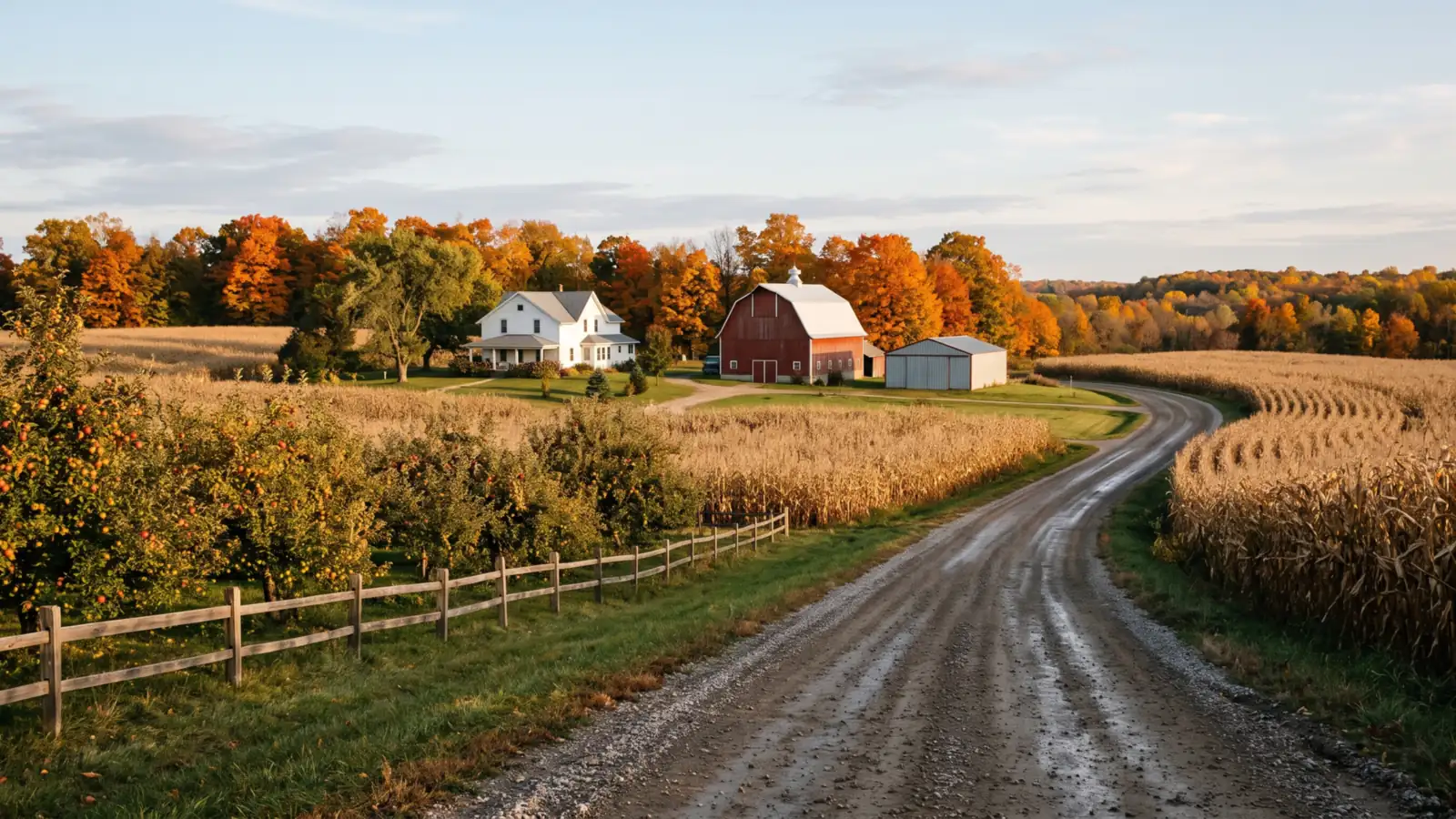
Here are the 30 Metro Detroit communities with the most land per owner home, 14 of them walked as a local would, then what changes when you buy one of the larger homes and lots near Detroit.
Key takeaways:
- The most land per owner home in the six-county metro is north and northeast: Richmond Township has about 21 acres per owner-occupied home and 30 owner homes per square mile, while Highland Township, 30th, has about 3 acres and 196.
- Zoning sets the real lot: the 13 townships checked here require from 1 acre (Metamora Township’s A-1 district) to 10 acres (Addison’s A and Metamora’s A-2 districts) for a new lot, most of them 1.5 to 2.5 acres.
- Macomb County checks the well and septic at sale: it requires an evaluation before closing, while the Oakland, St. Clair, Lapeer and Livingston county health departments state no such rule.
More land in Metro Detroit at a glance
| Question | Answer |
|---|---|
| The measure | Acres of land per owner-occupied home: 2020 Census land area, water left out, over owner-occupied homes (ACS 2020 to 2024). Not a lot size: farms, parks, roads and commercial land count too. |
| The region | The six-county Detroit metro area (Wayne, Oakland, Macomb, Livingston, St. Clair, Lapeer): cities and townships within 45 straight-line miles of Detroit City Hall, with 300+ owner homes and a reliable Census estimate |
| The list | 30 communities with 91,150 owner-occupied homes among them; 14 walked below |
| Most and least land on the list | Richmond Township, 21.37 acres per owner home; Highland Township, 3.27 |
| Census median home value | $159,500 (Romulus) to $588,900 (Oakland Township); Michigan’s is $231,600 |
| Median rooms, owner homes | From 5.9 (Berlin Township) up, with Oakland Township highest; Michigan’s is 6.5 |
| 2025 homestead millage | 21.57 to 50.69 mills, set by township and school district |
| Zoning minimum lot, 13 townships checked | 1 to 10 acres in their agricultural and rural districts |
| Who to call | The township’s zoning and assessing offices; the county health department for the well and septic; the county road agency for the road |
Which Metro Detroit communities have the most land per owner home?
In the six-county metro, within 45 miles of Detroit City Hall, the 30 communities with the most land per owner home are all townships but one, led by Richmond Township and three St. Clair County townships at 18 to 19 acres each. Romulus, the one city, is there because the measure counts business and public land too. Washtenaw and Monroe counties sit outside the federal metro area, and three of their townships within 45 miles have even more: Milan (35.21 acres), Saline (27.31) and London (22.80).
| # | Community | County | Acres per owner home | Owner homes per sq mi | Census median value | 2025 homestead mills | School districts | Align page |
|---|---|---|---|---|---|---|---|---|
| 1 | Richmond Township | Macomb | 21.37 | 30.0 | $378,800 | 25.92 to 29.46 | Armada, Richmond, Memphis | |
| 2 | Riley Township | St. Clair | 19.38 | 33.0 | $348,500 | 25.38 to 28.78 | Armada, Capac, Memphis, Yale | |
| 3 | China Township | St. Clair | 19.36 | 33.1 | $322,600 | 24.06 | East China | |
| 4 | Berlin Township | St. Clair | 17.97 | 35.6 | $313,100 | 25.30 to 32.13 | Almont, Armada, Capac | |
| 5 | Columbus Township | St. Clair | 16.67 | 38.4 | $323,200 | 23.59 to 29.35 | Richmond, East China, Marysville, Memphis | |
| 6 | Ray Township | Macomb | 16.64 | 38.5 | $377,700 | 25.97 to 30.73 | Armada, New Haven, Romeo, Utica | |
| 7 | Casco Township | St. Clair | 16.39 | 39.0 | $303,200 | 24.60 to 31.70 | Anchor Bay, Richmond, East China | |
| 8 | Metamora Township | Lapeer | 14.83 | 43.1 | $383,000 | 23.59 to 30.68 | Lapeer, Dryden, Oxford | Metamora |
| 9 | Hadley Township | Lapeer | 14.35 | 44.6 | $356,100 | 21.57 to 32.93 | Goodrich, Lapeer, Oxford, Brandon | |
| 10 | Armada Township | Macomb | 13.42 | 47.7 | $331,100 | 30.27 to 33.03 | Armada, Romeo | |
| 11 | Dryden Township | Lapeer | 12.91 | 49.6 | $302,200 | 23.93 to 31.03 | Lapeer, Almont, Dryden, Oxford | Dryden |
| 12 | Addison Township | Oakland | 11.21 | 57.1 | $416,700 | 27.44 to 35.98 | Almont, Romeo, Oxford, Lake Orion | Addison Township |
| 13 | Cottrellville Township | St. Clair | 11.06 | 57.9 | $293,900 | 26.03 | East China | |
| 14 | Groveland Township | Oakland | 9.81 | 65.2 | $342,500 | 23.54 to 33.23 | Goodrich, Brandon, Holly | Groveland Township |
| 15 | Rose Township | Oakland | 9.50 | 67.4 | $345,100 | 28.48 to 29.55 | Fenton, Holly | Rose Township |
| 16 | Almont Township | Lapeer | 9.38 | 68.2 | $297,300 | 22.23 to 24.73 | Almont, Dryden, Imlay City | Almont |
| 17 | St. Clair Township | St. Clair | 8.92 | 71.8 | $334,600 | 23.58 to 29.34 | East China, Marysville | |
| 18 | Lenox Township | Macomb | 8.18 | 78.2 | $212,900 | 30.90 to 34.40 | Anchor Bay, Armada, New Haven, Richmond | New Haven |
| 19 | Sumpter Township | Wayne | 7.16 | 89.4 | $270,700 | 32.76 to 39.45 | Airport, Lincoln, Huron, Van Buren | Sumpter Township |
| 20 | Bruce Township | Macomb | 6.67 | 95.9 | $388,600 | 27.22 to 34.06 | Almont, Armada, Romeo | Bruce Township |
| 21 | Ira Township | St. Clair | 6.48 | 98.8 | $244,200 | 27.55 to 34.66 | Anchor Bay, Algonac, East China | |
| 22 | Clay Township | St. Clair | 6.11 | 104.8 | $307,600 | 32.23 | Algonac | Clay Township |
| 23 | Springfield Township | Oakland | 4.88 | 131.1 | $384,800 | 31.65 to 36.81 | Brandon, Clarkston, Holly | Springfield Township |
| 24 | Hartland Township | Livingston | 4.08 | 157.0 | $378,300 | 28.44 | Hartland | Hartland Township |
| 25 | Huron Township | Wayne | 4.01 | 159.7 | $276,700 | 38.37 to 42.59 | Flat Rock, Huron, Woodhaven | Huron Township |
| 26 | Brandon Township | Oakland | 3.90 | 164.2 | $331,000 | 35.81 to 40.07 | Oxford, Brandon | Brandon Township |
| 27 | Milford Township | Oakland | 3.81 | 168.2 | $425,400 | 33.36 to 34.24 | Huron Valley, South Lyon | Milford |
| 28 | Oakland Township | Oakland | 3.54 | 181.0 | $588,900 | 24.68 to 31.07 | Romeo, Lake Orion, Rochester | Oakland Township |
| 29 | Romulus | Wayne | 3.45 | 185.7 | $159,500 | 44.91 to 50.69 | Romulus, Wayne-Westland, Woodhaven | Romulus |
| 30 | Highland Township | Oakland | 3.27 | 196.0 | $330,800 | 32.72 | Huron Valley | Highland |
Census Bureau, 2020 land area and American Community Survey 2020 to 2024 owner homes and median value (the owner’s estimate, not a sale price); townships include their villages. Millage: Michigan Treasury, 2025 total rates, outside villages, lowest to highest school district. Align pages cover the township or its village.
What does land per owner home tell you about a township near Detroit?
It tells you how much open ground a township has for each home its owners live in, not how big any one lot is. Census land area leaves out lakes but counts farms, parks, roads and business land, so read it as how rural a township is.
For larger homes, the Census counts rooms. Owner-occupied homes in Michigan have a median of 6.5 rooms, and 16 of the 30 communities sit above it in the 2020 to 2024 estimates (table B25021): Oakland Township highest, then Springfield at 7.6 and Addison and Rose at 7.4; Berlin Township’s 5.9 is the fewest. Zoning sets a floor too: Addison Township’s agricultural district requires 1,100 square feet of floor area per home, and Hartland’s conservation district 1,200 for a one-story house.
How big a lot does zoning require in the townships with the most land?
In the 13 townships checked here, a new lot in the agricultural or rural district needs 1 to 10 acres, most of them 1.5 to 2.5, by each township’s zoning. Align’s guides to zoning regulations and how zoning affects value explain the basics.
| Township | District | Minimum lot | Minimum width | Ordinance section |
|---|---|---|---|---|
| Richmond | A-1 Agricultural Residential | 1.5 acres | 150 feet | Sec. 7.01.C |
| Riley | AR Agricultural/Rural Residential | 2 acres (3 on the Belle River) | 200 feet | Art. VIII, zoning sheet |
| China | AG Agricultural | 2.5 acres | 220 feet | Sec. 30-391 |
| Columbus | AG Agricultural | 2 acres | 250 feet | Sec. 3.2.D |
| Ray | R-1 Agricultural Residential | 90,000 sq ft (about 2.1 acres) | 150 feet | Sec. 400 |
| Metamora | A-1 and A-2 Agricultural | 1 acre (A-1); 10 acres (A-2) | 150 feet; 330 feet | Sec. 1300 |
| Armada | AG Agricultural Preservation | 1.75 acres | 165 feet | Sec. 8.03.A |
| Addison | A Agricultural | 10 acres | 300 feet | Sec. 6.01, Art. 24 |
| Groveland | RE/F Rural Estate/Farm | 2.5 acres | 165 feet | Sec. 3.3.3 |
| Bruce | RS Rural Suburban | 5 acres | 330 feet | Sec. 161-3.1.1 |
| Springfield | R-1-A Suburban Estates | 2.5 acres | 165 feet | Sec. 40-572 |
| Hartland | CA Conservation Agriculture | 2 acres (10 for a farm dwelling) | 200 feet | Sec. 3.1.1.E |
| Oakland Township | VLRD Very Low Residential Density | 100,000 sq ft (about 2.3 acres) without sewer | 200 feet | Sec. 16-403.02.C |
Township ordinances and Riley’s May 2025 zoning sheet, read in November 2026, in list order. Every township also has smaller-lot districts.
What is the land like in northern Macomb County?
Northern Macomb County is orchards, crop fields and small villages, with Richmond, Ray, Armada and Bruce townships holding 7 to 21 acres of land per owner home. You drive county roads here, about 335 miles of them gravel, and the Department of Roads gravel program typically begins in May, once the weather allows brining and grading.
Richmond Township
Ride the Macomb Orchard Trail on a fall Saturday, 27 miles from Shelby Township to the City of Richmond, and you cross the most land per owner home in the six-county metro, about 21 acres. The township’s master plan counted about 68% of the township in farm production.
- Taxing units and school districts: 2025 homestead millage of 25.9237 with Memphis Community Schools, 28.1118 with Richmond Community Schools and 29.4618 with Armada Area Schools.
- Worth knowing: the A-1 district’s 1.5-acre minimum sits beside a horse rule of 5 acres for the first horse, so the lot that fits a house may not fit a horse.
Ray Township
Turn onto Wolcott Road and you reach Wolcott Mill Metropark, a 250-acre working farm whose grist and feed mill ran from 1847 to 1967, a spring Saturday among the barns. Ray Township is the closest to Detroit of the communities with more than 10 acres per owner home, about 30 straight-line miles, with about 16.6 acres each, and its zoning says most of the township is not meant to have public sewer.
- Taxing units and school districts: 25.9689 mills with Utica Community Schools, 27.5644 with Romeo Community Schools, 30.3189 with Armada Area Schools and 30.7289 with New Haven Community Schools.
- Worth knowing: the R-1 district requires 90,000 square feet, and barns run from 2,000 square feet on 2 to 2.49 acres to 5,000 on 9.5 to 10 (Sec. 402).
Armada Township
Come for the Armada Fair, which the township’s master plan says has run for 150 years, and you see what the plan names as the main land uses: large farms, orchards and single-unit homes. The Village of Armada is the center. Land per owner home is about 13.4 acres.
- Taxing units and school districts: 30.2721 mills with Romeo Community Schools and 33.0266 with Armada Area Schools outside the village; 46.647 inside the Village of Armada.
- Worth knowing: the AG district requires 1.75 acres and 165 feet of frontage (Sec. 8.03.A), and a horse or cow needs 2 acres, plus 1 for each more.
Bruce Township
Drive north out of the Village of Romeo, part of which is in Bruce Township, and the lots open up: the township’s master plan says owners in the northern portion have 5 to 20 acres each. Land per owner home is about 6.7 acres across the township, and its RS Rural Suburban district requires 5 acres.
- Taxing units and school districts: 27.2245 mills with Almont Community Schools, 31.3006 with Romeo Community Schools and 34.0551 with Armada Area Schools; 45.6482 in the Romeo village part.
- Worth knowing: Macomb County’s sale-time well and septic evaluation applies here; Align’s Bruce Township and Romeo pages cover local services.
What is the land like in St. Clair and Lapeer counties?
St. Clair and Lapeer counties hold 13 of the 30 communities on the list, from Riley, China and Berlin townships at 18 to 19 acres per owner home to Clay Township at about 6. Five are walked here.
Riley, China and Berlin townships
Riley, China and Berlin townships rank second to fourth, each with about 18 to 19 acres per owner home. In Riley Township you drive in on Belle River Road to the township office; its zoning sheet sets 2 acres and 200 feet in the Agricultural/Rural Residential district and 3 acres and 300 feet for any lot on the Belle River. China Township, first settled in 1825 when a dam and grist mill went up and named, its history page says, for China, Maine, requires 2.5 acres and 220 feet in its AG district (Sec. 30-391). In Berlin Township, whose office is on Capac Road in Allenton, a split starts with the St. Clair County Treasurer’s office confirming how many divisions a parcel has, by the township’s split procedure.
- Taxing units and school districts: Riley, 25.3808 mills with Capac Community Schools, 26.4754 with Yale, 27.1193 with Memphis and 28.7754 with Armada; China, 24.0554 with East China School District; Berlin, 25.3033 with Almont, 28.7393 with Capac and 32.1339 with Armada.
- Worth knowing: China Township caps accessory buildings by parcel, 2,700 square feet on 2.5 to 5 acres up to 5,400 on 15 or more (Sec. 30-424).
Columbus Township
Pull into Columbus County Park beside the township hall on Bauman Road and you are on the Belle River, with a lodge, a sledding hill for a February afternoon and horse and hiking trails. Columbus Township is mostly 2-acre country: its master plan calls Agricultural Residential, planned for 2-acre lots, its largest land use, and says most homes sit on simple splits along county roads. Land per owner home is about 16.7 acres.
- Taxing units and school districts: 23.5871 mills with East China School District, 26.8856 with Memphis Community Schools, 27.1917 with Richmond Community Schools and 29.347 with Marysville Public Schools.
- Worth knowing: the AG district requires 2 acres and 250 feet of frontage, and accessory buildings run from 1,800 square feet on 2 acres or less to 7,500 on more than 7 acres (Sec. 5.17).
Metamora Township
Climb from Lake Metamora at 903 feet toward Mount Christie at 1,280 and you are in what the township’s history page calls a place known for “wide-open large parcels of land for horseback riding and agriculture”, home to the Metamora Hunt. Its master plan sets aside 40% of the township as Equestrian Estates, lots of at least 10 acres, and land per owner home is about 14.8 acres. In winter, ask about the road: Lapeer County’s seasonal roads are not normally plowed from November through April.
- Taxing units and school districts: 23.5869 mills with Lapeer Community Schools, 24.9369 with Dryden Community Schools and 30.6844 with Oxford Community Schools; 33.1985 in the Village of Metamora.
- Worth knowing: the A-1 district allows a 1-acre lot and A-2 requires 10 acres (Sec. 1300), so neighbors can sit under different rules.
Where is there more land in northern Oakland and Livingston counties?
In northern Oakland and Livingston counties, five townships pair 3.5 to 11 acres of land per owner home with large parks. On Oakland County’s gravel roads, the Road Commission sprays chloride four times a summer where the community pays for it.
Addison Township
Head a mile north of Leonard on Rochester Road and you reach Watershed Preserve Park‘s 231 acres; Addison Oaks County Park adds 1,140 acres and 20 miles of trails for an October hike. Addison Township has the most land per owner home in Oakland County, about 11.2 acres, and its A district requires 10 acres.
- Taxing units and school districts: 27.443 mills with Almont Community Schools, 31.5191 with Romeo Community Schools, 34.1905 with Oxford Community Schools and 35.6458 with Lake Orion Community Schools; 35.983 in an area shared by Oxford and Lake Orion.
- Worth knowing: Sec. 6.03.1 caps a private garage at the greater of 800 square feet or half the home’s floor area, up to 1,200.
Oakland Township
Walk the boardwalks of Bear Creek Nature Park, 107 acres of rolling hills between Snell and Gunn roads, or pick up the Paint Creek Trail where it crosses the township. Oakland Township has the highest Census median value on this list, $588,900, and about 3.5 acres per owner home, and its VLRD district is meant for homes “on large lots which provide large expanses of open space”.
- Taxing units and school districts: 24.6821 mills with Rochester Community Schools, 26.9482 with Romeo Community Schools and 31.0749 with Lake Orion Community Schools.
- Worth knowing: the VLRD lot drops from 100,000 to 75,000 square feet where sewer is available (Sec. 16-403.02.C), so ask whether the parcel has it.
Springfield Township
Ride the paved 8-mile trail at Indian Springs Metropark on a summer evening and you are on some of the nearly 2,215 acres the Metroparks hold in Springfield Township. The township chose its large lots: its 2024 master plan recalls that residents petitioned for a 2.5-acre minimum in 1979, and R-1-A still requires 2.5 acres. Land per owner home is about 4.9 acres.
- Taxing units and school districts: 31.646 mills with Clarkston Community Schools, 33.146 with Holly Area Schools and 36.806 with Brandon School District.
- Worth knowing: accessory buildings may total up to 3,200 square feet on more than 2.5 to 5 acres and 5,400 on more than 5 (Sec. 40-649).
Groveland Township
Take I-75 exit 101, drive 1.5 miles east, and Groveland Oaks County Park sits on Stewart Lake. Nearly a third of Groveland Township is parks and recreation land: its master plan counts over 5,500 acres of public parkland and 1,710 acres of private recreation, over 31% of the township, and calls its 2.5-acre RE/F district the township’s backbone. Land per owner home is about 9.8 acres.
- Taxing units and school districts: 29.5732 mills with Holly Area Schools, 30.3884 with Goodrich Area Schools and 33.2332 with Brandon School District; 23.5404 in a small area shared by Brandon and Goodrich.
- Worth knowing: the RE/F district caps lot coverage at 10% and allows one home per lot (Sec. 3.3.3).
Hartland Township
Find the mill pond and gristmill at Parshallville, one of two historic settlements the township’s 2004 comprehensive plan describes, along with large homes on large lots and farm homes on acreage. A 2021 amendment puts about 51% of the township in Estate Residential, one home per 2 acres, and Livingston County’s road commission grades a gravel road before each chloride pass.
- Taxing units and school districts: one district, Hartland Consolidated Schools, at 28.4412 mills.
- Worth knowing: the CA district requires 2 acres for a house but 10 acres for a farm dwelling (Sec. 3.1.1.E), and the township posts its land division forms online.
What does a home on more land near Detroit cost to own under Michigan tax rules?
The yearly tax depends on the township and school district first: in 2025 a principal residence on this list paid about 22 to 51 mills, and in the 11 townships in the example below, outside their villages, about 24 to 37. The year after you buy, the tax also resets. In Michigan, a home’s taxable value is capped while one owner holds it. The year after it sells, that cap comes off and taxable value resets to the state equalized value, which is half of the assessor’s estimate of market value, not automatically half of what you paid.
Align’s 2026 Michigan Property Tax Uncapping Study puts the typical jump in taxable value the year after a sale at about 27% in Oakland Township, 36% in Metamora, 40% in Bruce, 44% in Ray, 47% in Richmond and 60% in Columbus Township. Samantha plans with half the price you pay, which errs on the high side. The planning number is half the price times the property’s millage, divided by 1,000.
| Same $400,000 home in | 2025 mills, principal residence | Planned yearly tax | 2025 mills, second home | Planned yearly tax |
|---|---|---|---|---|
| Richmond Township, Richmond Community Schools | 28.1118 | $5,622 | 46.0362 | $9,207 |
| Ray Township, Romeo Community Schools | 27.5644 | $5,513 | 45.5644 | $9,113 |
| Armada Township, Armada Area Schools | 33.0266 | $6,605 | 51.0266 | $10,205 |
| Bruce Township, Romeo Community Schools | 31.3006 | $6,260 | 49.3006 | $9,860 |
| Columbus Township, Richmond Community Schools | 27.1917 | $5,438 | 45.1161 | $9,023 |
| Metamora Township, Lapeer Community Schools | 23.5869 | $4,717 | 41.5869 | $8,317 |
| Addison Township, Oxford Community Schools | 34.1905 | $6,838 | 51.506 | $10,301 |
| Oakland Township, Rochester Community Schools | 24.6821 | $4,936 | 42.6821 | $8,536 |
| Springfield Township, Clarkston Community Schools | 31.646 | $6,329 | 49.646 | $9,929 |
| Groveland Township, Brandon School District | 33.2332 | $6,647 | 51.1038 | $10,221 |
| Hartland Township, Hartland Consolidated Schools | 28.4412 | $5,688 | 46.3548 | $9,271 |
Hypothetical example, not an offer. Planning number: half the price, $200,000, times the 2025 millage for one school district part of each township (Michigan Treasury), divided by 1,000. Your bill depends on the assessor’s value and any special assessments.
A second home pays about $3,460 to $3,600 more here, because only a principal residence can claim Michigan’s exemption from up to 18 mills of school operating tax, which Treasury says also covers unoccupied residential or timber-cutover land next to the house. Align’s property tax calculator finds the exact 2025 rate for an address.
Farmland has its own rule: qualified agricultural property is exempt from school operating tax under MCL 211.7ee, and Treasury’s guidelines say a parcel qualifies when it is classified agricultural or more than half its acres are farmed, and a farm that stays a farm keeps its taxable value when the buyer files Form 3676. The assessor decides which applies.
On acreage, also budget for septic and well upkeep (see maintaining a septic system and well water), chloride on a gravel road where the township does not pay for it, and outbuilding insurance (see evaluating home insurance).
How do buyers finance a home with acreage near Detroit?
Under Fannie Mae’s and Freddie Mac’s rules, a house on acreage can be financed like any other when it is a residence, not a farm, and the appraisal supports the land. The 2026 conforming limit for a one-unit home is $832,750 everywhere in Michigan, according to the Federal Housing Finance Agency, and every Census median on this list, up to Oakland Township’s $588,900, is under it. A loan above the limit is a jumbo loan, and the loan amount decides that, not the acreage. For loans from January 1, 2027, the Federal Housing Finance Agency has set the 2027 limit at $855,400. See Align’s loan limits tool and jumbo loans page.
What the programs say about land, in their own rules:
- Fannie Mae. Its Selling Guide B4-1.3-03 gives the example of an area where typical building sites are two acres, the lot Columbus Township plans for and Hartland’s CA district requires: the loan is eligible whatever share of the value the land is, and the lender reviews larger sites, because Fannie Mae does not buy loans on agricultural-type properties. Under B4-1.3-04 the appraiser values the whole parcel, and B4-1.3-05 accepts small barns or stables of minor value, while large barns and silos get more review.
- Freddie Mac. Its Guide Section 5605.4 says “Freddie Mac does not limit Mortgage purchases based on the size of the subject property site”, and its FAQ asks for more analysis where a large parcel sits among commercial farms.
- USDA. The guaranteed program’s rule, 7 CFR 3555.201, says the site size must be typical for the area and must not include income-producing land. Align’s USDA eligibility check tests an address; see USDA loans and USDA loan basics.
- The road and the well. Fannie Mae wants the well and septic on the property, or a binding agreement to reach and maintain them, and a written maintenance agreement for a privately maintained road. That matters in St. Clair County, where the road commission takes no new private road contracts.
Align does not show land or lot loans; this guide is about homes on acreage. Moving from a smaller lot? Buy Before You Sell covers two closings, and the appraisal process guide explains comparable sales.
Who checks the well, septic and road in Macomb, Oakland, St. Clair, Lapeer and Livingston counties?
Macomb County is the one county here that requires a well and septic evaluation before closing; as of November 2026 the other four county health departments state no sale-time rule, so the inspection is yours to order. Each county’s road agency handles its public roads.
| County | Well and septic at sale | Water testing | Roads |
|---|---|---|---|
| Macomb | Required before closing since 2002; report due 5 days before closing; good for one year; 586-469-5236 | Free sample collection for well owners; lab fees apply | About 335 miles of gravel kept by the Department of Roads; private roads are not its job |
| Oakland | None stated; permits for new and repaired septic systems; 248-858-1312 | Bacteria, nitrate and nitrite yearly, recommended | More than 750 of 2,700-plus miles unpaved; chloride four times a summer where paid for |
| St. Clair | Evaluation only on request; (810) 987-5306 | Owner samples the well | 1,553 road miles, 613 paved (Road Commission); takes no new private road maintenance contracts |
| Lapeer | None stated; permits for wells and septic; (810) 667-0392 | Bacteria sample required for new wells | Seasonal roads not normally plowed November through April |
| Livingston | No point-of-sale program; records searchable; (517) 546-9858 | Coliform, nitrate and nitrite every year | Townships share dust control costs; roads graded before chloride |
Outside Macomb County, put a well and septic inspection in your offer; Align’s guides to buying a home with a septic system and the home inspection checklist explain what to ask for.
What should you check before you make an offer on a home with land near Detroit?
Check the zoning, the well and septic, the road and the tax status first; each item names who answers it.
- The zoning district. Ask the township planning office (linked in the zoning table) for the district, the minimum lot and any animal or barn limits.
- The well and septic. In Macomb County, ask the seller for the county’s evaluation; elsewhere, order your own and ask the health department for the permit file: Oakland, St. Clair, Lapeer or Livingston.
- The water test. Oakland and Livingston counties recommend a bacteria, nitrate and nitrite test each year; Macomb collects well samples at no charge.
- Who maintains the road. The county road agency for a public road (Oakland, Macomb, St. Clair, Lapeer, Livingston); for a private road, the recorded maintenance agreement your lender will want. In Lapeer County, ask whether it is a seasonal road.
- The division rights. Under MCL 560.109 the deed states how many splits pass to you; ask the assessor how many remain under the Land Division Act, amended in 2025 and in effect since March 2026.
- The tax status. Ask the assessor whether the parcel is classified residential or agricultural, and run the address through Align’s tax calculator.
- The outbuildings. Ask the township building department whether the barn has permits, and expect the appraiser to note a large one.
- The flood map and insurance. Look the address up on FEMA’s Flood Map Service Center, then quote the house and outbuildings before your contingency ends.
- The drive. Drive it on a weekday morning; see researching a place and buying in a rural area.
Align’s county pages for Macomb, Oakland, St. Clair, Lapeer and Livingston counties, and the Michigan taxable value and homestead exemption guides, go deeper.
Samantha’s take
Samantha’s office is on Pontiac Lake Road in Waterford, 10 to 40 straight-line miles from the 14 townships walked here. Acreage adds costs a city lot doesn’t have, and her budget questions are where they belong. One she asks to find a comfortable number: “Are there things you’re not willing to give up just because you bought a house?” In her words: “Then let’s build the housing decision around your life instead of making your life fit around the mortgage.”
Her planning number for the tax uses the township and school district the parcel is really in. Meet Samantha, read Align’s reviews, or send her the listing and plan the numbers together.
How Align fits your buying strategy
Local real estate agents bring Samantha in for a second opinion when their buyer arrives preapproved somewhere else. She regularly finds a lower rate or less cash to close, whichever helps the buyer more.
That comes from the broker model. One application goes to multiple wholesale lenders, so your offer is built on the loan that fits your situation, not the only one a single bank sells. A 2024 Polygon Research analysis of federal mortgage data found broker borrowers paid about $10,662 less over the life of a $400,000 loan than borrowers at nonbank retail lenders.
FAQ: Larger homes and lots near Detroit
What does acres per owner home mean?
It is a township’s land area, water left out, divided by the homes their owners live in, from the Census. Richmond Township’s 37.46 square miles and 1,122 owner-occupied homes give about 21 acres each. It counts farms, parks, roads and commercial land, so it shows how rural a township is, not the size of any lot; the assessor has a parcel’s acreage.
Which township in Metro Detroit has the most land per home?
In the six-county Detroit metro area, within 45 miles of Detroit City Hall, it is Richmond Township in Macomb County, with about 21.4 acres of land per owner-occupied home, by 2020 Census land area and 2020 to 2024 home counts. Riley, China and Berlin townships in St. Clair County follow at 18 to 19.4 acres. Just outside the metro area, Milan Township in Monroe County has about 35.
Is every lot in these townships several acres?
No. Zoning sets the minimum for a new lot, from 1 acre in Metamora Township’s A-1 district to 10 acres in Addison’s A and Metamora’s A-2, and each township has smaller-lot districts. Villages such as Armada, Romeo, Leonard and Metamora have town lots, and the assessor’s record shows a parcel’s real size.
How many acres do you need to keep a horse in these townships?
It depends on the township. Oakland Township, Armada and Bruce require 2 acres for the first large animal and 1 more for each additional one. Richmond requires 5 acres for the first horse, China 5 for the first two, Metamora 5 for up to two in its R-1 and R-2 districts, and Groveland 5 for a stable plus 2 per horse. Hartland allows private stables on 5 acres.
How big can a pole barn be on a few acres?
Most of these townships cap accessory buildings by lot size. Ray allows 2,000 square feet on 2 to 2.49 acres, China 2,700 on 2.5 to 5 acres, Springfield up to 3,200 on more than 2.5 to 5 acres, Groveland 3,200 between 2 and 5 acres, and Columbus 1,800 on 2 acres or less, rising to 7,500 on more than 7. Richmond sets no limit at 5 acres or more.
If a Macomb County well and septic evaluation calls for work, can the sale still close?
Yes. Macomb County’s property transfer rule lets a sale close when a corrective action plan is filed and money for the repair is held in escrow, with the work done within 180 days of the health department’s approval. The seller arranges the evaluation, its report must reach the department at least five days before closing, and it stays good for one year.
Does farmland lower the property tax on a house?
It can, but not in addition to the homestead exemption. Qualified agricultural property is exempt from school operating tax under MCL 211.7ee, much like a principal residence, and Treasury says property with the principal residence exemption cannot also be qualified agricultural property. The assessor decides how a house on farm acreage is classified, so ask before you plan the tax.
Why is Romulus on a list of the most land per home?
Because the measure counts all land, not just home lots. Romulus has 35.61 square miles of land and 6,611 owner-occupied homes, about 3.45 acres each, and that land includes business, industrial and public property as well as neighborhoods. Its Census median value, $159,500, is the lowest on the list.
How long is the drive to Detroit from the townships with the most land?
About 50 to 82 minutes to Detroit City Hall without traffic from the Census center points of the 14 townships walked here, by OpenStreetMap routing: about 50 minutes from Oakland Township, 52 from Springfield, 57 from Ray, 71 from Richmond and 82 from Riley and Berlin townships. Straight-line distances run from about 30 to 44 miles.
The bottom line on larger homes and lots near Detroit
The most land per home in the six-county Detroit metro is in the farm townships north and northeast of the city; the parcel decides the rest: its zoning, well, septic, road and tax. Sort the list by what you want the land to do:
- You want the most open ground around you: Richmond Township, then Riley, China and Berlin in St. Clair County, each 18 to 21 acres per owner home.
- You want acreage and a shorter drive: Oakland and Springfield townships, about 50 minutes from Detroit City Hall, or Ray at about 57.
- You want horses: read the stable rule first; Oakland Township, Armada and Bruce start at 2 acres, Richmond, China and Metamora at 5.
- You want a village downtown nearby: Armada, Romeo, partly in Bruce Township, Leonard in Addison, Metamora, or the City of Richmond.
- You want parks next door: Groveland’s 5,500 acres of public parkland, Springfield’s Indian Springs or Ray’s Wolcott Mill.
Which one fits your plans? Send Samantha the listing, and she will plan the tax and the loan for the parcel you are looking at.
Sources
Every outside source this guide links to, in the order it appears. How we choose and check sources
- American Community SurveyU.S. Census Bureau
- 2025 total ratesState of Michigan
- Sec. 7.01.Ccms2.revize.com
- Art. VIII, zoning sheetrileytownship.com
- Sec. 30-391chinatwp.net
- Sec. 3.2.Dcolumbustwpmi.gov
- Sec. 400raytwp.org
- Sec. 1300metamoratownship.com
- Sec. 8.03.Aarmadatwp.gov
- Sec. 6.01, Art. 24addisontownshipmi.gov
- Sec. 3.3.3grovelandmi.gov
- Sec. 40-572springfield-twp.us
- Sec. 3.1.1.Ehartlandtwp.com
- Sec. 16-403.02.Coaklandtwpmi.gov
- Department of Roadsmacombgov.org
- Macomb Orchard Trailcms2.revize.com
- Wolcott Mill Metroparkmetroparks.com
- Master planarmadatwp.gov
- History pagechinatwp.net
- Split procedureberlintwpstclairmi.gov
- Columbus County Parkstclaircounty.org
- History pagemetamoratownship.com
- Seasonal roadslcrconline.com
- Road Commissionrcocweb.org
- Watershed Preserve Parkaddisontownshipmi.gov
- Addison Oaks County Parkoaklandcountymi.gov
- Bear Creek Nature Parkoaklandtwpmi.gov
- Paint Creek Trailpaintcreektrail.org
- Indian Springs Metroparkmetroparks.com
- Master plancms1files.revize.com
- Groveland Oaks County Parkoaklandcountymi.gov
- Master plangrovelandmi.gov
- Comprehensive planhartlandtwp.com
- Road commissionlivingstonroads.org
- Land division formshartlandtwp.com
- TreasuryState of Michigan
- MCL 211.7eeMichigan Legislature
- GuidelinesState of Michigan
- Federal Housing Finance Agency
- 2027 limitFederal Housing Finance Agency
- Selling Guide B4-1.3-03Fannie Mae Selling Guide
- B4-1.3-04Fannie Mae Selling Guide
- B4-1.3-05Fannie Mae Selling Guide
- Section 5605.4Freddie Mac
- FAQFreddie Mac
- 7 CFR 3555.201govinfo.gov
- Required before closingmacombgov.org
- Septic systemsoaklandcountymi.gov
- Bacteria, nitrate and nitrite yearlyoaklandcountymi.gov
- Only on requeststclaircounty.org
- Owner samples the wellstclaircounty.org
- Road Commissionsccrc-roads.org
- Wellslapeercountymi.gov
- Septiclapeercountymi.gov
- No point-of-sale programmilivcounty.gov
- Coliform, nitrate and nitrite every yearmilivcounty.gov
- Livingstonmilivcounty.gov
- Macombmacombgov.org
- Macombmacombgov.org
- Lapeerlcrconline.com
- MCL 560.109Michigan Legislature
- Land Division ActMichigan Legislature
- FEMA’s Flood Map Service CenterFEMA Flood Map Service Center
Related resources

20-minute read
How to create a competitive offer on a house in a seller’s market
Learn how to create a competitive offer on a house, from preapproval and pricing to contingencies and appraisal gap coverage, and win in a hot market.

20-minute read
Advantages of buying a fixer-upper: 7 key benefits (and the tradeoffs)
Discover the advantages of buying a fixer-upper, from lower prices and less competition to renovation loans that roll repair costs into your mortgage.

20-minute read
Guide to Negotiating a Home Purchase
Strategies for negotiating a home purchase, from inspection findings and seller concessions to offers that win without overpaying.
