
How to maximize your home’s resale value
This article is for informational purposes only and is not intended to provide legal, financial, or tax advice. It touches on the Section 121 capital gains exclusion and other tax-adjacent topics in general terms only. Consult a qualified professional about your situation.

The projects that return the most money at resale are almost never the expensive ones. In Zonda’s 2025 Cost vs. Value Report, a garage door replacement costing a national average of $4,672 was estimated to add $12,507 at resale, 267.7% of its cost, the best result among the 28 projects the report tracks, and 8 of the report’s top 10 projects were exterior replacements.
That is the hierarchy: exterior first, then the visible layer of the kitchen, then usable square footage, then efficiency. Money leaks out at the other end of the list, on interior additions, primary suites, and finishes priced above what the neighborhood’s comps can support.
One caution first: every return-on-investment figure below comes from a survey in which real estate professionals estimated what a project would add at resale, not from measured sale prices. Treat the ordering as reliable and the percentages as soft. Learn how to maximize your home’s resale value, including which projects return their cost, which ones lose money, and how to pay for the work. Start with our Selling A Home guide if you’re early in the process.
Key takeaways:
- Exterior replacements lead by a wide margin: 8 of the top 10 projects in Zonda’s 2025 Cost vs. Value Report were exterior replacements, led by a garage door at 267.7% of cost recouped and a steel entry door at 216.4%.
- Big interior projects recover the least: In the 2025 Remodeling Impact Report from the National Association of Realtors and NARI, agents estimated a bathroom renovation recovers 50% of its cost and a new primary suite 54%, against 100% for a steel front door.
- Efficiency pays before the sale, not at it: The EPA estimates air sealing plus insulation in attics, floors over crawl spaces, and accessible basement rim joists saves an average of 15% on heating and cooling costs, a return you collect monthly while you still own the house.
Which improvements actually return their cost?
Exterior replacements do, and nothing else comes close. Zonda’s 2025 Cost vs. Value Report (the 38th annual edition, published September 18, 2025, covering 28 projects) put five projects above 100% cost recovery, and four of the five were work you can see from the street.
| Project | Typical national cost | Estimated cost recouped | Effort |
|---|---|---|---|
| Garage door replacement | $4,672 | 267.7% | Low. One trade, one visit. |
| Steel entry door replacement | $2,435 | 216.4% | Low. One trade, one visit. |
| Manufactured stone veneer | $11,702 | 207.9% | Medium. Partial facade only. |
| Fiber-cement siding replacement | $21,485 | 113.7% | High. Whole-house scope. |
| Minor kitchen remodel | $28,458 | 112.9% | High. Kitchen out of service. |
Read the ordering, not the decimals. The same garage door was reported at 193.9% in the 2024 edition on a $4,513 cost, so one year of survey responses moved the headline by roughly 74 percentage points. Noise, not a change in what a door is worth. Our walkthrough of renovation ideas to boost home value takes each project one at a time, and how to assess a home’s resale potential covers the diagnostic that comes first.
Improvements that lose money at resale
The bottom of the list is large interior work. In the 2025 Remodeling Impact Report, Realtors estimated the share of cost a homeowner recovers at resale, and every interior addition landed under 60%.
| Project | Estimated share of cost recovered at resale |
|---|---|
| New steel front door | 100% |
| Closet renovation | 83% |
| New fiberglass front door | 80% |
| New vinyl windows | 74% |
| Basement conversion to living area | 71% |
| Attic conversion to living area | 67% |
| Complete kitchen renovation | 60% |
| Add a new bathroom | 56% |
| New primary suite | 54% |
| Bathroom renovation | 50% |
The two reports disagree: Zonda’s panel put a steel entry door at 216.4% of cost, NAR’s at 100%. Both are agent estimates from different panels and cost assumptions, which is why no single percentage should decide a five-figure project. They agree on direction, which is the usable part.
Three patterns lose money reliably. Over-improving past the neighborhood: a finish level no comparable sale contains is the hardest value to get credit for. Single-purpose rooms: a bedroom converted to a theater or gym subtracts a bedroom from the listing, and bedroom count is a search filter. Taste-specific work: anything a buyer would pay to undo is worse than nothing.
Which projects do Realtors tell sellers to finish before listing?
Paint, not remodeling. In the 2025 Remodeling Impact Report, NAR asked Realtors which projects they recommend sellers take on before selling: 50% named painting the entire home, 41% painting one interior room and 37% new roofing, while a kitchen upgrade drew 30% and a bathroom renovation 24%. The same report found that 46% of buyers are less willing to compromise on a home’s condition, according to the Realtors surveyed, and that 18% of consumers who remodeled did so because they planned to sell within two years.
| Project Realtors recommend before selling | Share of Realtors recommending it |
|---|---|
| Paint the entire home | 50% |
| Paint one interior room | 41% |
| New roofing | 37% |
| Kitchen upgrade | 30% |
| Bathroom renovation | 24% |
Source: NAR and NARI, 2025 Remodeling Impact Report, April 9, 2025. Realtor survey of a random sample of 100,000 members in summer 2024, 4,005 responses.
The cheaper list is longer still. In a separate NAR survey of agents reported on May 6, 2025, the most common improvement recommendations to sellers were decluttering the home (91%), cleaning the entire home (88%) and improving curb appeal (77%), and 51% of sellers’ agents skipped staging altogether but recommended that sellers declutter or correct property faults. For the staging side of this work, see how staging affects sale price.
How much does curb appeal really move the price?
Enough that it should absorb your first dollar. The exterior is the only part of the house every buyer evaluates before anything else: the photo set and the drive-by happen before the kitchen gets a vote.
The two reports that measure this agree on it. Zonda’s top three projects for 2025 were a garage door at 267.7% of cost, a steel entry door at 216.4% and manufactured stone veneer at 207.9%, all exterior, all visible from the curb. NAR’s panel put a new steel front door first on its own list at 100% of cost recovered. Be careful with the front-door-color numbers that circulate alongside these: the dollar figures attached to specific paint colors come from image-based preference surveys, not from sale prices, and we don’t repeat them here.
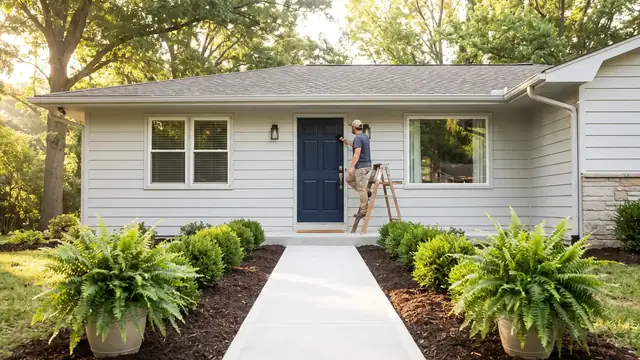
The cheap moves are the ones that show up in listing photos: pressure-washed siding and concrete, fresh mulch, cut-back overgrowth, matched fixtures and house numbers, a repainted door. The checklist lives in how to improve your home’s curb appeal, and home staging on a budget handles the inside. Both feed into pricing and preparing the home for market.
Kitchens and bathrooms: what to do and what to skip
Refresh the visible layer; skip the gut. Zonda’s minor kitchen remodel recouped 112.9% on a $28,458 average cost, while NAR’s panel put a complete kitchen renovation at 60% and a bathroom renovation at 50%. The gap between those two numbers is the entire recommendation.
A resale-grade kitchen refresh is countertops, cabinet paint or refacing with new hardware, a faucet and sink, updated lighting, and appliances that match. It leaves the layout, plumbing, and electrical alone, which is where remodel budgets and timelines go. Bathrooms follow the same rule: fixtures, lighting, mirror, vanity, and grout, not relocated drains. For bigger scope, renovating a small bathroom shows where the cost curve bends, and contractor marketplaces publish typical project cost ranges to check bids against.
Does adding usable square footage pay off?
Converting space you already have beats building space you don’t. In the 2025 Remodeling Impact Report, a basement conversion to living area recovered an estimated 71% of its cost and an attic conversion 67%, better than a new primary suite at 54% or a bathroom renovation at 50%, and far cheaper than an addition because the roof, foundation, and exterior walls already exist.
The catch is that finished space only counts if it counts. Below-grade square footage is typically reported and valued separately from above-grade living area, and an attic room generally needs code-compliant ceiling height, egress, and heat before anyone calls it a bedroom. Confirm requirements with your building department first, and see financing home renovations for how owners fund this scope.
Do energy-efficiency upgrades pay you back?
They pay in utility bills first and resale second, which is the honest version. The EPA estimates that sealing air leaks and adding insulation in attics, floors over crawl spaces, and accessible basement rim joists saves an average of 15% on heating and cooling costs, or about 11% of total energy costs.
Windows are the upgrade sellers reach for and the one to think hardest about: NAR’s panel put new vinyl windows at 74% of cost recovered and wood windows at 71%, both below a $2,435 steel door. Insulation and air sealing cost less and do more per dollar. Start with a home energy audit instead of a guess, then work through energy-efficient home upgrades and current ENERGY STAR efficiency upgrades guidance in priority order.
What buyers notice versus what an appraiser can credit
These are two different scoreboards, and confusing them is expensive. Smart thermostats, video doorbells, cameras, and smart lighting move buyer interest and offer strength. They rarely move appraised value, because appraisers work from comparable sales and almost no comp set isolates a $200 thermostat as a line-item adjustment.
The appraisal side runs on documented facts. On a purchase, the lender sizes the loan against the lower of contract price or appraised value under Fannie Mae’s selling guide, so a low appraisal is a financing problem before it is a pricing problem. Federal valuation-independence rules bar the parties providing settlement services on the loan from influencing an appraiser’s opinion of value, so you affect the number by supplying facts (dated improvements with costs, accurate square footage, permits pulled) not by arguing for a figure. See how to prepare for a home appraisal, and what to do if your home doesn’t appraise for the reconsideration path.
How does an appraiser rate condition, and which repairs change the rating?
Fannie Mae’s Selling Guide gives appraisers a condition scale from C1 to C6, and the line that matters to a seller sits between C4 and C5. Per Selling Guide B4-1.3-06, a C4 home has some minor deferred maintenance and wear and needs only minimal repairs, while a C5 home has obvious deferred maintenance and needs some significant repairs. The guide’s own examples of minor conditions are worn floor finishes or carpet, minor plumbing leaks, holes in window screens, missing handrails and cracked window glass: a short, cheap punch list. Homes rated C1 through C5 are eligible as is; a home rated C6 has to be appraised subject to repairs that bring it to at least C5.
Three more rules in the guide explain why documented upkeep matters more than new finishes:
- Effective age: B4-1.3-05 says a well-maintained property generally has an effective age somewhat lower than its actual age, and that appraisers measure square footage under the ANSI Z765-2021 standard, so finished area is measured by that standard rather than taken from the listing.
- Comparable sales: B4-1.3-08 requires at least three closed comparables and says sales closed within the last 12 months should be used, with current listings allowed only as supporting data.
- Market-based adjustments: B4-1.3-09 says adjustments must reflect the market’s reaction to a difference, and calls a $20 per square foot rule-of-thumb adjustment inappropriate where market analysis shows $100. It also allows home price indices to support time adjustments.
Those sections are quoted as the Selling Guide read when it was published October 7, 2026. The valuation rule that limits pressure on an appraiser, 12 CFR 1026.42, also lists what is allowed: asking the appraiser to consider additional, appropriate property information, including comparable properties, and asking for errors to be corrected. A dated list of repairs and their receipts is that kind of information. If a value still comes in short, how to appeal a low appraisal walks through the request.
What you have to disclose, no matter how good it looks
Improving a home does not shrink your disclosure duty. Michigan’s Seller Disclosure Act, MCL 565.951 and following, requires a seller’s disclosure statement on transfers of real estate containing not less than 1 and not more than 4 residential dwelling units, made in good faith, meaning honesty in fact. Its exemptions are structural (court-ordered transfers, writs of execution, foreclosure sales, bankruptcy trustees, eminent domain) and selling “as is” is not among them.1
The second rule is federal. For housing built before 1978, Section 1018 of Title X requires sellers to disclose known lead-based paint and hazards, hand over available records, provide the EPA’s “Protect Your Family From Lead in Your Home” pamphlet, include a lead warning statement in the contract, and give buyers a 10-day period for a lead inspection, which the parties may lengthen, shorten, or waive in writing. Fresh paint over a known problem is a disclosure item, not a fix. If the issue is structural, selling a home with foundation issues covers how those sales get written.
What should you check before hiring a contractor for pre-listing work?
License, insurance, more than one written estimate and a payment schedule that keeps most of the money until the work is done. Michigan’s Attorney General spells this out in a building and remodeling consumer alert: get two or three written estimates and compare the services and materials against the price, always ask whether the contractor is licensed and insured and demand to see proof, never pay in cash or in full up front, and pay only part of the job at the start, generally about one-third of the contract price, with the rest once the work is complete.
The same alert notes that residential builders and maintenance and alteration contractors are licensed by the Licensing Division of LARA’s Bureau of Professional Licensing, so a license claim can be checked with the state before you sign. Three Michigan and federal rules then shape the job itself:
- The small-job exemption is narrow: under MCL 339.2403, the license requirement does not apply to one project whose total price for labor and materials is less than $600, but not when that work is part of a larger operation or is split into smaller contracts to evade the law. An owner working on a structure for their own use and occupancy is also exempt.
- Permits come before the work: MCL 125.1510 requires the owner or the owner’s builder to apply in writing to the local enforcing agency for a building permit before construction. Unpermitted work tends to surface when the buyer’s inspector or appraiser asks about it; home renovation permits covers which jobs need one.
- Older paint needs certified hands: the EPA’s Renovation, Repair and Painting rule requires firms that disturb lead-based paint in homes built before 1978 to be EPA- or state-certified and to use certified renovators. Pre-listing painting and window work in an older house falls under it.
How to pay for the work without eating your net proceeds
Decide the funding source before the scope, because the wrong one turns a 267.7% project into a break-even one. Say you plan $12,000 of pre-listing work: on cards at revolving rates, the carrying cost eats the margin; funded with a renovation loan or existing equity, the cost is a rate you can quote in advance.2
Align Lending is a mortgage broker, not a listing brokerage, so what we shop is the financing on both ends of your move: a renovation loan or a draw against equity before you list, and the purchase on the other side, where sellers closing on the next house first often use bridge loans. Weigh the trade-offs in using home equity wisely.
Build the net-proceeds picture the way a closing statement does: sale price, minus payoff, minus the commission you negotiated, minus transfer tax, minus concessions, minus what you spent getting ready. Commission is negotiable and always has been; since the NAR practice changes took effect August 17, 2024, offers of compensation to buyer brokers are prohibited on the MLS and buyer agreements must be written with compensation stated. If this is your primary residence, ask a tax professional how the Section 121 exclusion applies: up to $250,000 of gain, or $500,000 on a joint return, if you meet the ownership and use tests for 2 of the 5 years ending on the sale date.3
What Michigan homeowners should know
Michigan changes three things: what pays back, what the sale costs you, and what your buyer’s tax bill looks like after closing.
- Insulation outranks cosmetics in a cold climate: ENERGY STAR recommends adding insulation to R60 in an uninsulated attic across climate zones 4 through 8, and every Michigan county sits in zone 5, 6 or 7. An insulated attic, a serviced furnace, and a dry basement are what buyers here price hardest, and what an inspector finds anyway.
- Transfer tax is a seller line, at $8.60 per $1,000: The state tax is $3.75 per $500 of value and the county tax 55 cents per $500 in counties under 2 million residents, which is all of them. On a $300,000 sale that’s $2,250 plus $330. MCL 207.523 makes the seller liable, with payment due to the county treasurer within 15 days of delivery of the deed.
- The sale uncaps taxable value for your buyer: Under Proposal A of 1994 and MCL 211.27a, a transfer of ownership uncaps taxable value in the year following the transfer, resetting it to the state equalized value. Your buyer’s tax bill won’t look like yours, which shapes what they can pay.
- Disclosure covers 1 to 4 residential units, improved or not: The Seller Disclosure Act’s good-faith standard applies to known conditions no matter how recently you renovated. A cosmetic upgrade over a known water, foundation, or environmental issue does not retire the duty to disclose it.
For envelope decisions at this latitude, choosing energy-efficient windows covers what matters.
How do the Detroit-area Cost vs. Value numbers compare for Michigan sellers?
They run lower on most projects, and the order holds. The 2025 Cost vs. Value Report publishes a Detroit market page beside its national averages, and the Detroit panel estimated smaller recovery on most exterior and kitchen projects. The garage door still led at 214.6% in Detroit, against 282.2% for the East North Central region and 267.7% nationally, but the minor kitchen remodel that clears its cost nationally did not in the Detroit estimates.
| Project | Detroit job cost | Detroit cost recouped | National cost recouped |
|---|---|---|---|
| Garage door replacement | $4,527 | 214.6% | 267.7% |
| Entry door replacement, steel | $2,389 | 186.2% | 216.4% |
| Manufactured stone veneer | $11,128 | 151.3% | 207.9% |
| Minor kitchen remodel, midrange | $28,109 | 85.5% | 112.9% |
| Siding replacement, fiber-cement | $22,292 | 73.8% | 113.7% |
| Window replacement, vinyl | $22,597 | 69.7% | 75.5% |
| Bath remodel, midrange | $26,941 | 61.2% | 80% |
| Major kitchen remodel, midrange | $86,274 | 38.2% | 50.9% |
| Primary suite addition, midrange | $164,449 | 30% | 32.3% |
Source: 2025 Cost vs. Value Report, Detroit, Michigan, with national figures from the same page and the 2025 national averages. Recouped figures are estimated resale value divided by job cost.
For example, the Detroit page puts a midrange minor kitchen remodel at $28,109 in cost and $24,042 in estimated resale value, while a garage door and a steel entry door together cost $6,916 and were estimated to add $14,163. The same budget logic as the national list applies here, with a thinner margin on the interior work.
Hypothetical example, not an offer. A Michigan seller with $10,000 set aside for preparation could spend it on the Detroit page’s garage door and steel entry door ($6,916) and put the remaining $3,084 toward paint and cleanup, or put it toward a kitchen refresh the same panel valued below its cost. Run either plan through the seller net sheet calculator to see what each leaves after the payoff, commission and transfer tax, and read what a seller net sheet shows first.
The market backdrop matters too. FHFA reported on October 27, 2026 that house prices rose 2.4% nationally from August 2025 to August 2026, and that the 12-month change ranged from 0.5% in the Mountain division to 4.4% in the East North Central division, the Census division that includes Michigan, Ohio, Indiana, Illinois and Wisconsin. A pricing plan built on those numbers starts with pricing a home for sale, and how improvements affect property taxes covers the assessment side of the same projects.
How Align helps before you list
If you are buying your next home too, talk to Samantha before you list. Knowing your buying power and your timeline first lets you price and prepare your home with a plan, not a guess.
Your closing date is set by your purchase agreement. Her job is to have your loan ready well before it.
FAQ: Maximizing your home’s resale value
Here are answers to common questions about maximizing resale value.
What is the fastest way to increase my home’s resale value?
Exterior work you can finish in a weekend. Pressure-wash the siding and driveway, repaint the front door, refresh mulch, cut back overgrowth, and swap dated light fixtures and house numbers. None of it needs a permit or a contractor, all of it lands in the listing photos, and it typically costs a few hundred dollars. Pair it with decluttering before you list, which costs nothing and changes how every room photographs.
Do smart home features add to a home’s appraised value?
Not directly. Appraisers work from comparable sales, and comps almost never isolate a smart thermostat, camera, or lighting system as a separate adjustment, so these items are treated close to their conventional equivalents. What they change is buyer appeal, which shows up in offer strength and days on market rather than in the appraisal.
Should I remodel the whole kitchen before selling?
Usually not. Realtors surveyed for the 2025 Remodeling Impact Report estimated a complete kitchen renovation recovers about 60% of its cost, while Zonda’s 2025 report put a minor kitchen remodel at 112.9%. Focus on the visible layer: countertops, cabinet paint and hardware, faucet, lighting, and appliances that match. That captures most of the buyer response at a fraction of the cost and timeline. See how to renovate a kitchen on a budget.
Which home improvements actually lose money at resale?
The ones no comparable sale contains. In the 2025 Remodeling Impact Report, a new primary suite recovered an estimated 54% of cost and a bathroom renovation 50%, the two lowest on the list. Add pools in cold climates, bedrooms converted to single-purpose rooms, and finishes above the neighborhood’s price ceiling. Value is anchored to comps, as our walkthrough of the home appraisal process explains.
Should I get a pre-listing inspection before making repairs?
It helps you choose repairs, but what it finds becomes something you know. Michigan’s statutory disclosure form asks about evidence of water in the basement and known environmental hazards such as radon and lead-based paint (MCL 565.957), and under MCL 565.955 a seller is not liable for errors outside their personal knowledge. Plan to disclose what the report shows. See pre-listing inspections.
Is professional home staging worth paying for before selling?
Sometimes. In NAR’s 2025 staging survey, the median cost of a staging service was $1,500 versus $500 when the agent staged, 29% of sellers’ agents reported a 1% to 10% higher offer and 49% saw less time on market. A 2015 Journal of Housing Research study found staging alone did not raise the price, though neutral walls and good furnishings improved perceived livability.
Can I still claim a federal tax credit for energy upgrades before I sell?
Probably not for new work. The IRS page on the Energy Efficient Home Improvement Credit, updated April 28, 2026, says the credit (30% of qualified expenses, generally up to $1,200 a year and $2,000 for qualified heat pumps) is allowed for property placed in service from January 1, 2023 and before December 31, 2025. Insulation added in 2026 still lowers bills. Ask a tax professional about your return.
Does a radon mitigation system help a Michigan home sell?
It can. Michigan’s environmental agency says an installed system is a plus for buyers and can enhance resale value, with typical installation costs of $800 to $2,000 or more and about $3 a month to run. Buyers here often ask about it, because EGLE estimates about one in four Michigan homes has elevated radon, so a system already in place, with its last test result, answers a question before the inspection raises it.
The bottom line on maximizing your home’s resale value
Spend from the outside in. Zonda’s 2025 Cost vs. Value Report put a $4,672 garage door replacement at 267.7% of cost recouped, with 8 of the top 10 projects exterior replacements, while NAR’s 2025 panel put a new primary suite at 54% and a bathroom renovation at 50%. Refresh the visible layer of the kitchen instead of gutting it, convert existing space before building new, and treat insulation as a return you collect monthly at roughly 15% of heating and cooling costs. Every percentage here is an agent estimate: use the ordering to set priorities, your own bids to set the budget.
If you’re ready to fund the work before you list or line up the loan on your next home, talk to Align Lending. We’ll shop your scenario across our lender network and show you the numbers side by side. Call 248-506-5727 or start online.
Footnotes:
1. This is general information, not legal advice. Disclosure obligations, exemptions, and remedies depend on the facts of your transaction and on statutes that change; confirm your obligations with a Michigan real estate attorney before signing anything. Return to text.
2. Example figures in this article are hypothetical and for educational purposes only; they do not constitute an advertisement of credit terms or a rate quote under federal or state lending laws. Your rate, payment, and terms depend on your application, property, credit, and market conditions at the time of lock. Return to text.
3. This is general information, not tax advice. Eligibility for the Section 121 exclusion depends on your ownership and use history, filing status, prior exclusions, and any period of non-qualified use. Consult a qualified tax professional about your situation. Return to text.
Sources: garage door replacement at a $4,672 national average cost and $12,507 estimated value at resale (267.7%), steel entry door replacement $2,435 and 216.4%, manufactured stone veneer $11,702 and 207.9%, fiber-cement siding replacement $21,485 and 113.7%, minor kitchen remodel $28,458 and 112.9%, vinyl siding 96.5%, backup power generator 95.3%, wood deck addition 94.9%, composite deck addition 88.5%, fiberglass grand entrance 84.7%, 28 projects across U.S. markets, and 8 of the top 10 projects being exterior replacements, Zonda 2025 Cost vs. Value Report, 38th annual edition, published September 18, 2025; resale values estimated in part from surveys of real estate professionals, with project costs from Verisk’s XactRemodel. Garage door replacement at $4,513 and 193.9%, Zonda 2024 Cost vs. Value Report. Estimated share of project cost recovered at resale for a new steel front door (100%), closet renovation (83%), new fiberglass front door (80%), new vinyl windows (74%), basement conversion to living area (71%), new wood windows (71%), attic conversion to living area (67%), complete kitchen renovation (60%), minor kitchen upgrade (60%), add a new bathroom (56%), new primary suite (54%), and bathroom renovation (50%), 2025 Remodeling Impact Report, National Association of Realtors and the National Association of the Remodeling Industry, April 2025; costs estimated by NARI members for a 2,300-square-foot post-1978 home with no concealed problems, and resale value estimated by Realtors surveyed. Average savings of 15% on heating and cooling costs and 11% on total energy costs from air sealing plus insulation in attics, floors over crawl spaces and accessible basement rim joists, and recommended attic insulation of R60 for uninsulated attics in climate zones 4 through 8 (guidance based on the 2021 International Energy Conservation Code, Table R402.1.3), U.S. EPA ENERGY STAR. Loan-to-value on a purchase determined using the lower of the sales price or the appraised value, Fannie Mae Selling Guide B2-1.2-01. Prohibition on causing a dwelling’s assigned value to be based on anything other than the valuation preparer’s independent judgment, 12 CFR § 1026.42(c). Seller disclosure statement required on transfers of not less than 1 and not more than 4 residential dwelling units, the good-faith standard, and the exemptions for court-ordered transfers, writs of execution, foreclosure sales, bankruptcy trustees and eminent domain, Michigan Seller Disclosure Act, MCL 565.951 et seq. Lead-based paint disclosure, records, EPA pamphlet, lead warning statement and the 10-day inspection opportunity for pre-1978 housing, Section 1018 of Title X (Residential Lead-Based Paint Hazard Reduction Act of 1992), 42 U.S.C. § 4852d; U.S. EPA. Michigan state real estate transfer tax of $3.75 per $500, MCL 207.525; county transfer tax of 55 cents per $500 in counties under 2,000,000 population, MCL 207.504; seller or grantor liability and payment within 15 days of delivery of the instrument, MCL 207.523. Uncapping of taxable value to state equalized value in the year following a transfer of ownership, Proposal A of 1994 and MCL 211.27a; Michigan Department of Treasury. Prohibition on offers of compensation through the MLS, required written buyer agreements, and the negotiability of commission effective August 17, 2024, National Association of Realtors settlement practice changes. Section 121 exclusion of up to $250,000 of gain ($500,000 on most joint returns) with ownership and use tests over the 5-year period ending on the sale date, IRS Publication 523.
This article is for informational purposes only and is not intended to provide legal, financial, or tax advice. Remodeling costs, return-on-investment estimates, transfer taxes, disclosure obligations, and tax rules change and vary by property, county, and transaction; the return figures cited are survey-based estimates from real estate professionals, not measured sale outcomes. Confirm your figures with licensed contractors, your closing statement, and a qualified professional about your situation. Figures shown are illustrative, are not a rate quote or an offer of credit, and are subject to change. Align Lending is an independent Michigan mortgage broker, NMLS #2041154.
Sources
Every outside source this guide links to, in the order it appears. How we choose and check sources
- Zonda’s 2025 Cost vs. Value Report, a garage door replacementjlconline.com
- Remodeling Impact Report from the National Association of Realtors and NARINational Association of Realtors
- Decluttering the home (91%), cleaning the entire home (88%) and improving curb appeal (77%)National Association of Realtors
- ENERGY STAR efficiency upgradesENERGY STAR
- Federal valuation-independence rulesElectronic Code of Federal Regulations
- Selling Guide B4-1.3-06Fannie Mae Selling Guide
- B4-1.3-05Fannie Mae Selling Guide
- B4-1.3-08Fannie Mae Selling Guide
- B4-1.3-09Fannie Mae Selling Guide
- Michigan’s Seller Disclosure ActMichigan Legislature
- Section 1018 of Title X requireslaw.cornell.edu
- Building and remodeling consumer alertState of Michigan
- MCL 339.2403Michigan Legislature
- MCL 125.1510Michigan Legislature
- Renovation, Repair and Painting ruleU.S. Environmental Protection Agency
- Ask a tax professional how the Section 121 exclusion appliesInternal Revenue Service
- The state tax is $3.75 per $500 of valueMichigan Legislature
- MCL 207.523 makes the seller liableMichigan Legislature
- A transfer of ownership uncaps taxable value in the year following the transferState of Michigan
- Detroit market pagejlconline.com
- 4.4% in the East North Central divisionFederal Housing Finance Agency
- Census divisionU.S. Census Bureau
- MCL 565.957Michigan Legislature
- Median cost of a staging serviceNational Association of Realtors
- Staging alone did not raise the priceeconpapers.repec.org
- Energy Efficient Home Improvement CreditInternal Revenue Service
- Typical installation costs of $800 to $2,000State of Michigan
- EGLE estimates about one in four Michigan homesState of Michigan
Related resources
18-minute read
How to improve your home’s curb appeal before you list
Discover how to improve your home’s curb appeal with paint, cleaning, landscaping and lighting upgrades that photograph well and bring buyers to the door.

20-minute read
How to prepare for a home appraisal and support your price
See how to prepare for a home appraisal with a clean exterior, finished repairs and a documented upgrade list that helps the appraiser support your price.

20-minute read
Benefits of a pre-listing home inspection: what sellers gain
See how a pre-listing home inspection helps you price accurately, control repairs and avoid renegotiation, plus what it costs and when to order one.
