
16 Historic Small Towns 49 to 75 Minutes From Detroit, 8 Under an Hour
Eight small towns with historic downtowns are under an hour from Detroit City Hall without traffic: Clarkston, Lake Orion, Romeo, Oxford, Milford, Saline, Richmond and Milan. Eight more, from Dexter at 61 minutes to Pinckney at 75, sit past it, and all 16 are villages or small cities under 10,000 people within 50 straight-line miles of City Hall. Owning in one usually means two governments: a village home pays the village and its township, and in 2025 Treasury’s total for a principal residence in these towns ran about 36 to 52 mills.
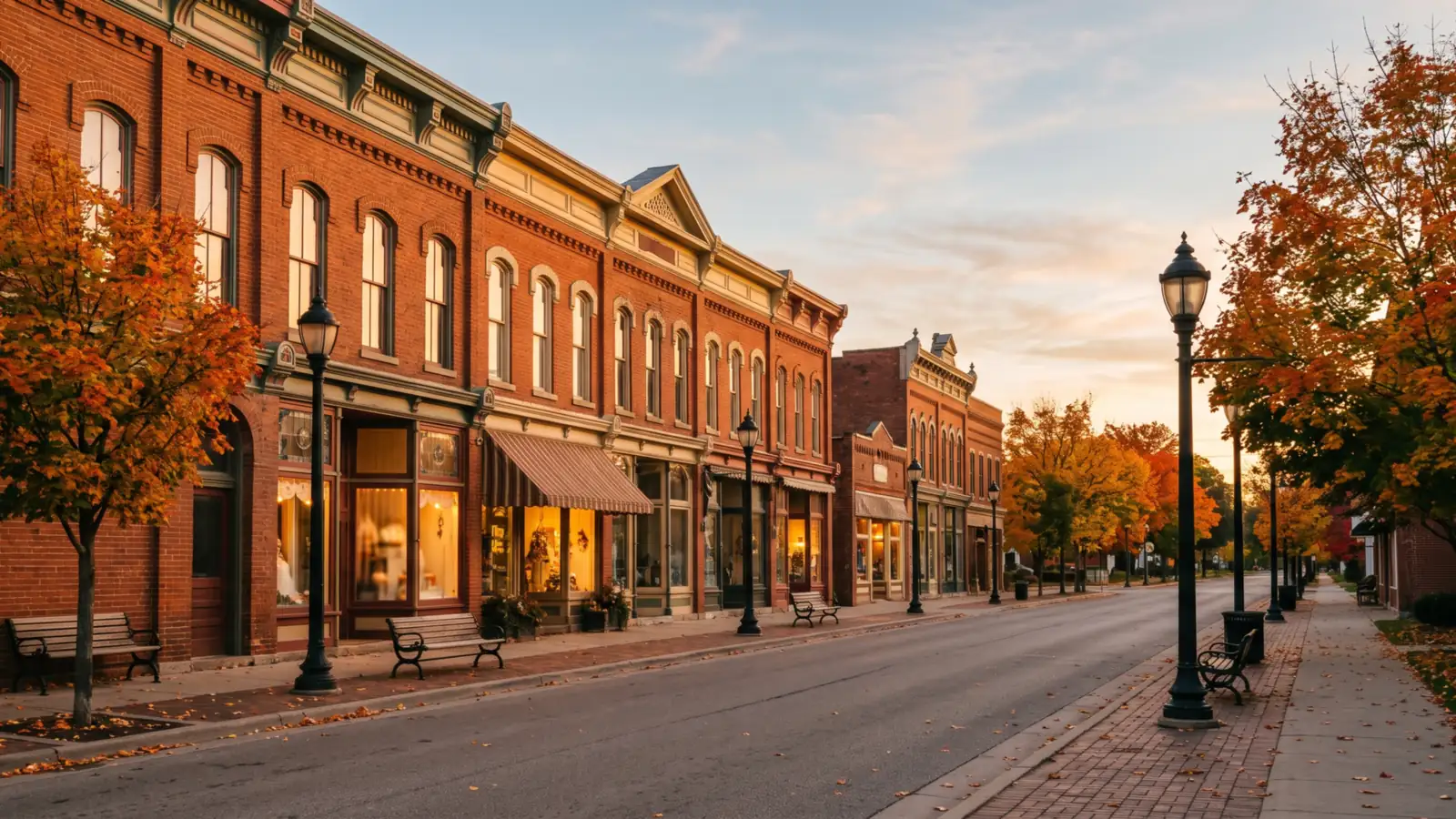
If you are looking at small towns within an hour of Detroit, here is each one as a local would show it to you, the closest first, then the taxes, the village rules and the checks before an offer.
Key takeaways:
- Eight are under an hour without traffic: Clarkston and Lake Orion at 49 minutes, Romeo at 52, Oxford at 55, Milford at 56, Saline at 57, Richmond at 58 and Milan at 60; the other eight run 61 to 75 minutes, and rush hour adds more.
- The village line moves the tax: in 2025 Treasury’s total for a village home in Lake Orion, Oxford, Milford, Romeo, Holly, Ortonville, Armada or Almont ran about 7 to 15 mills above the same school district just outside the village, because a village home pays both the village and its township.
- The village or city sets the house rules: Romeo’s whole original square mile is a historic district, Lake Orion bars rentals under 30 days, and Saline, Milan and Marine City certify or register rental homes.
Small towns within an hour of Detroit at a glance
| Question | Answer |
|---|---|
| Drive time | 49 to 75 minutes without traffic (OpenStreetMap routing to Detroit City Hall); 8 of 16 under an hour; all within 50 straight-line miles |
| What counts as a small town here | A village or city under 10,000 people (Census ACS 2020 to 2024) with a historic downtown named by its DDA, a Main Street program, a historic district or its own government |
| How many | 64 villages and cities that size lie within 50 straight-line miles; this guide maps 16 with a historic downtown |
| Counties | Oakland, Macomb, Lapeer, St. Clair and Livingston, all in Metro Detroit (the federal metro area of those five plus Wayne); Washtenaw and Monroe nearby |
| Census median home value | $159,800 in Marine City to $457,800 in Clarkston; Michigan’s is $231,600 |
| 2025 total millage, main home | 36.26 (Clarkston) to 51.99 (Milan, Washtenaw side) |
| 2025 total millage, second home or rental | 54.26 to 69.96 |
| Village homes | Pay the village and the township they sit in; Treasury’s total runs about 6.9 to 15.3 mills above the same district outside the village |
| Who to call | The village or city office for utilities, rentals and historic review |
Values: Census Bureau, American Community Survey 2020 to 2024, owner estimates, not sale prices. Millage: Michigan Treasury’s 2025 total rates, special assessments included. Miles: straight line from each town’s Census center point. Drives: OpenStreetMap (OSRM) routing, no traffic, November 2026.
Which small towns are within an hour of Detroit, and what do homes there cost?
Eight of the 16 towns are under an hour from Detroit City Hall by car without traffic, Clarkston and Lake Orion the closest at 49 minutes, and their Census median home values run from $237,700 in Richmond to $457,800 in Clarkston. The table is sorted by drive time, not by any judgment of which town is better.
| Town | County; township it sits in | Drive / straight-line miles | Census median value | 2025 total mills, main home (school district) | Historic downtown named by |
|---|---|---|---|---|---|
| Under an hour without traffic | |||||
| Clarkston (city) | Oakland; inside Independence Township’s outline | 49 min / 33.8 | $457,800 | 36.26 (Clarkston Community Schools) | National Register, 1980 |
| Lake Orion (village) | Oakland; Orion Township | 49 min / 33.0 | $376,600 | 44.84 (Lake Orion Community Schools) | DDA since 1985 |
| Romeo (village) | Macomb; mainly Washington and Bruce townships | 52 min / 32.9 | $266,200 | 41.58 to 45.65 (Romeo Community Schools) | Historic district since 1970 |
| Oxford (village) | Oakland; Oxford Township | 55 min / 35.6 | $347,800 | 44.11 (Oxford Area Community Schools) | National Register, 2019 |
| Milford (village) | Oakland; Milford Township | 56 min / 33.6 | $363,700 | 41.66 (Huron Valley Schools) | DDA, Main Street model |
| Saline (city) | Washtenaw | 57 min / 39.0 | $341,300 | 49.55 (Saline Area Schools) | Michigan Main Street program |
| Richmond (city) | Macomb | 58 min / 36.4 | $237,700 | 39.90 (Richmond Community Schools) | Richmond Main Street Initiative |
| Milan (city) | Washtenaw and Monroe | 60 min / 37.0 | $247,100 | 50.89 to 51.99 (Milan Area Schools) | National Register, 1999 |
| Past an hour without traffic: the next ring | |||||
| Dexter (city) | Washtenaw | 61 min / 42.7 | $421,000 | 48.90 (Dexter Community Schools) | DDA since 1986 |
| Ortonville (village) | Oakland; Brandon Township | 62 min / 41.0 | $244,400 | 50.84 (Brandon School District) | Village history: 1856 mill |
| Almont (village) | Lapeer; Almont Township | 63 min / 40.8 | $246,500 | 36.82 (Almont Community Schools) | DDA; National Register street, 1986 |
| Holly (village) | Oakland; Holly and Rose townships | 64 min / 43.8 | $192,300 | 43.17 to 44.87 (Holly Area School District) | National Register, 1986 |
| Armada (village) | Macomb; Armada Township | 64 min / 36.4 | $274,300 | 46.65 (Armada Area Schools) | Village history: founded 1833 |
| Marine City (city) | St. Clair | 65 min / 38.3 | $159,800 | 38.11 (East China School District) | City historic district, 2008 |
| Chelsea (city) | Washtenaw | 68 min / 49.8 | $312,700 | 47.01 (Chelsea School District) | National Register |
| Pinckney (village) | Livingston; Putnam Township | 75 min / 46.6 | $267,600 | 37.62 (Pinckney Community Schools) | DDA since 1991 |
Drive: OSRM routing to Detroit City Hall, no traffic. Values: ACS 2020 to 2024 medians for the village or city itself; Clarkston’s rests on 245 owner homes and Lake Orion’s carries a margin of about $62,000, so read both as estimates. Millage: Michigan Treasury’s 2025 total for a principal residence, village and township together for a village home.
Linden and Manchester sit just past the 50-mile line. Plymouth and Northville pass the size and distance tests too, at about 22 and 24 miles; Align covers them with the walkable downtowns closer to Detroit.
What are the eight small towns under an hour from Detroit like?
They run north and west of the city: Clarkston, Lake Orion, Oxford and Milford in Oakland County, Romeo and Richmond in Macomb County, and Saline and Milan south of Ann Arbor, each with a downtown you can park once and walk.
Clarkston
Park by Depot Park and you are in the middle of the Clarkston Village Historic District, on the National Register since 1980, with Main Street, which is M-15, running through it and the Mill Pond inside the city’s limits. On a June Friday you can bring a chair to one of Depot Park’s free evening concerts; on Saturdays from June into October the farmers market sets up on Waldon Road. Walk the side streets and the houses are older and close together, the Census median built in 1957. The legal name is the City of the Village of Clarkston: a city since 1992 that sits inside Independence Township’s outline but governs itself.
- Tax and schools: Treasury’s 2025 total for a Clarkston home, Clarkston Community Schools, 36.2619 mills as a principal residence, the lowest total in this guide’s table.
- Worth knowing: the city has its own Historic District Commission, so call the city office (248-625-1559) before you plan exterior work.
Lake Orion
In Lake Orion the shops and the water sit side by side. You walk downtown along M-24 on the lake’s east shore, and west of it the lake opens around Bellevue and Park islands, joined to the mainland by bridges and lived on year round. From the village you can pick up the Paint Creek Trail, Michigan’s first rail-trail, or the Polly Ann Trail behind Civic Center Park. Late June brings the Lake Orion Jubilee, and each fall the village lowers the lake about a foot to its winter level. The village’s downtown authority, formed in 1985, is charged with keeping the district’s historical character.
- Tax and schools: Treasury’s 2025 total for a village home, Lake Orion Community Schools, 44.8431 mills; Orion Township outside the village, same district, 35.623.
- Worth knowing: the village’s zoning bars rentals of less than 30 days in every district (Section 13.31), so a weekend rental plan does not fit inside the village.
Romeo
Park on Main Street, which is Van Dyke, and everything you walk past is inside Romeo’s historic district: the village says its whole original square mile, homes and storefronts alike, has been one since 1970 and is on the National Register. Labor Day weekend belongs to the Romeo Peach Festival, held for the 95th time in 2026. On a fall afternoon you can pick up the paved Macomb Orchard Trail in the village and ride it east to Richmond, where it begins, and Wolcott Mill Metropark is a short drive away.
- Tax and schools: Treasury’s 2025 total for a village home, Romeo Community Schools, 41.5818 mills in its Washington Township part and 45.6482 in its Bruce Township part, against about 31.3 in either township outside the village.
- Worth knowing: parcel numbers starting 01 are in Bruce Township and 04 in Washington Township, per the village treasurer, which tells you which township sends the other two bills.
Oxford
Oxford’s downtown is two blocks of Washington Street, which is M-24, centered on Burdick Street, listed on the National Register in 2019 as the Oxford Downtown Historic District. Park there and you can walk to the village’s Scripter Park and Beach, or pick up the Polly Ann Trail through Orion, Oxford and Addison townships. In early December the downtown authority’s Soup and Sweet Stroll keeps the shops open after dark.
- Tax and schools: Treasury’s 2025 total for a village home, Oxford Area Community Schools, 44.1076 mills; Oxford Township outside the village, same district, 37.1942, and 38.6495 in its Lake Orion Community Schools part.
- Worth knowing: the village’s own levy is 11.12 mills on one bill each July 1, due by August 31, and you also get the township’s summer and winter bills, as the village’s taxes page explains.
Milford
Park on Main Street, walk the shops, then pick up the village trail toward Kensington Metropark’s wooded hills around Kent Lake. The town is here because of the Huron River: the Ruggles brothers’ 1832 sawmill stood on it, and the downtown authority now runs its program on the National Main Street model. Inside the village, lots typically run about 7,200 to 9,000 square feet; out in Milford Township, home sites run an acre or more.
- Tax and schools: Treasury’s 2025 total for a village home, Huron Valley Schools, 41.6603 mills; Milford Township outside the village, same district, 34.2383.
- Worth knowing: the village sends its own tax bill each July, due by August 31, besides the township’s two bills, and has run its own water system since 1895.
Saline
Saturday morning is the time to see Saline: the farmers market sets up downtown, indoors in winter, and the Depot Museum opens its doors. Downtown is a Michigan Main Street community, run by Saline Main Street, a preservation-based nonprofit that began as the Saline Historic Downtown Alliance. Mill Pond Park, the city’s largest, is on West Bennett Street, in July the Michigan Celtic Festival comes to town, and Ann Arbor is about 18 minutes north. With about 9,000 people (Census), Saline has the largest population of the 16 towns.
- Tax and schools: Treasury’s 2025 total for a Saline home, Saline Area Schools, 49.5525 mills.
- Worth knowing: the city’s rental housing certification program requires a certificate of compliance and inspections every two years before you rent.
Richmond
Richmond grew up on the railroad: the Grand Trunk arrived in 1859, the village followed in 1879, and it has been a city since 1966, per its city history. You walk downtown along Main Street, which is M-19, and the Richmond Main Street Initiative works to keep the historic center a place people walk. The Macomb Orchard Trail begins here, so you can ride west toward Romeo.
- Tax and schools: Treasury’s 2025 total for a Richmond home, Richmond Community Schools, 39.8993 mills in the city’s Macomb County part.
- Worth knowing: the city assesses its own parcels; the assessor is at City Hall on Division Road (586-727-7571).
Milan
Milan’s downtown is the Main Street Historic District, on the National Register since 1999 and covering East and West Main. On summer Friday nights the downtown authority’s Live from Tolan Square puts local musicians on the square, and in December downtown holds its holiday parade. Wilson Park, given to the city for one dollar, anchors its parks, and Ann Arbor is about 26 minutes north.
- Tax and schools: Treasury’s 2025 total, Milan Area Schools, 51.9861 mills on the Washtenaw County side and 50.8861 on the Monroe County side.
- Worth knowing: Milan certifies rental housing under Ordinance 2022-05, with inspections every two years; ask city hall before you count on rent.
Which small towns sit just past an hour from Detroit?
Eight towns run 61 to 75 minutes from Detroit City Hall without traffic, so they are past an hour even on a clear road: Dexter, Ortonville, Almont, Holly, Armada, Marine City, Chelsea and Pinckney. They are the next ring out, worth a look when Detroit is not your daily drive.
Dexter
Dexter sits where Mill Creek meets the Huron River. You can walk Mill Creek Park along the creek downtown, then follow the trail about five miles to Hudson Mills Metropark, per the city’s parks and trails page; in August the Paint Dexter Plein Air Festival sets up in Monument Park. Ann Arbor’s City Hall is about 18 minutes east.
- Tax and worth knowing: Treasury’s 2025 total, Dexter Community Schools, 48.9002 mills; the city’s resident handbook makes you responsible for the house’s sewer lead and water line.
Chelsea
Chelsea’s downtown is the Chelsea Commercial Historic District, on the National Register, and the Clock Tower that by 1907 overlooked a 10-acre industrial complex is part of its history. You can follow the free Sculpture Walk downtown and sit in Pierce Park on Main Street, with the Waterloo Recreation Area’s 11 inland lakes just outside town.
- Tax and worth knowing: Treasury’s 2025 total, Chelsea School District, 47.0139 mills; the city bars street parking from 2 a.m. to 5 a.m., per its public works page, so count the driveway spaces.
Holly
Holly’s downtown is the Downtown Holly Commercial District, on the National Register since 1986, bounded by Broad Street, First Street and the railroad, with one-lane Battle Alley inside it. The Holly Dickens Festival fills its weekends after Thanksgiving into mid-December, and the Holly Recreation Area’s woods and lakes are a short drive.
- Tax and schools: Treasury’s 2025 total for a village home, Holly Area School District, 43.1698 mills in its Holly Township part and 44.8746 in its Rose Township part, against 32.0444 in Holly Township and 29.5492 in Rose Township outside the village. That 15.3-mill gap in the Rose Township part is the widest in this guide.
- Worth knowing: the village’s tax page lists a public safety special assessment of 4 mills and a garbage special assessment of $259 for 2026, both added to the bill beside the village’s own 10.9641 mills; Treasury’s total already counts 4 mills of special assessment.
Ortonville
Ortonville grew around a mill on Kearsley Creek: the 1856 mill still stands as the historical society’s museum, a short walk from the Old Town Hall on Mill Street, per the village’s history page. North of the village, the Ortonville Recreation Area’s wooded hills begin.
- Tax and worth knowing: Treasury’s 2025 total for a village home, Brandon School District, 50.838 mills, against 40.0718 in Brandon Township outside the village; ask the village office (248-627-4976) whether a house has its own well and septic system.
Almont and Armada
Almont, on M-53 in Lapeer County, keeps its own downtown calendar through the Almont DDA, from the September Heritage Festival to the December Holly Day Light Festival, and West Saint Clair Street, a residential street, is on the National Register. Armada, southeast in Macomb County, was founded in 1833 and has held the Armada Fair every year since 1873, per the village’s own history.
- Tax and schools: Treasury’s 2025 totals: the Village of Almont, Almont Community Schools, 36.8173 mills against 22.2333 in the township outside, one of the widest village gaps in this guide at about 14.6 mills; the Village of Armada, Armada Area Schools, 46.647 against 33.0266.
- Worth knowing: Almont contracts building, rental inspections and zoning to the Construction Code Authority (810-667-0420), and Macomb County evaluates a well and septic system before a sale under its property transfer program.
Marine City
Marine City’s downtown faces the St. Clair River. You can walk the Nautical Mile, a half-mile of shops and parks on the riverfront, past the restored 1908 Peche Island Rear Range Light, then up to the block around City Hall, a city historic district since 2008. Algonac’s riverfront boardwalk is 12 minutes south.
- Tax and worth knowing: Treasury’s 2025 total, East China School District, 38.1132 mills; the city’s building and code enforcement office (810-765-8846) registers rental property. Its Census median, $159,800, is the lowest in this guide’s table.
Pinckney, at 75 minutes the longest drive here, is a village on M-36 near the 11,000-acre Pinckney Recreation Area, with a downtown authority since 1991.
What do homes in small towns near Detroit cost to own each year?
In 2025 Treasury’s total for a principal residence in these 16 towns ran about 36 to 52 mills, and inside a village that total includes both the village and its township. The year after you buy, the tax also resets. In Michigan, a home’s taxable value is capped while one owner holds it. The year after it sells, that cap comes off and taxable value resets to the state equalized value, which is half of the assessor’s estimate of market value, not automatically half of what you paid.
Align’s 2026 Michigan Property Tax Uncapping Study puts the typical jump in taxable value the year after a sale at about 29% in Saline, 33% in Chelsea, 35% in Dexter, 55% in Clarkston and 62% in Marine City. The study measures cities and townships, so a village reads its township’s figure: about 33% in Milford Township, 36% in Oxford Township, 39% in Orion Township around Lake Orion and 49% in Holly Township.
Samantha plans with half the price you pay, which errs on the high side. The planning number is half the price times the property’s millage, divided by 1,000.
| Same $300,000 home in | 2025 total mills, principal residence | Planned yearly tax | 2025 total mills, second home or rental | Planned yearly tax |
|---|---|---|---|---|
| Clarkston, Clarkston Community Schools | 36.2619 | $5,439 | 54.2619 | $8,139 |
| Village of Lake Orion, Lake Orion Community Schools | 44.8431 | $6,726 | 62.8431 | $9,426 |
| Village of Romeo, Washington Township part | 41.5818 | $6,237 | 59.5818 | $8,937 |
| Village of Oxford, Oxford Area Community Schools | 44.1076 | $6,616 | 61.4231 | $9,213 |
| Village of Milford, Huron Valley Schools | 41.6603 | $6,249 | 59.3812 | $8,907 |
| Saline, Saline Area Schools | 49.5525 | $7,433 | 67.5525 | $10,133 |
| Milan, Milan Area Schools (Washtenaw side) | 51.9861 | $7,798 | 69.9555 | $10,493 |
| Dexter, Dexter Community Schools | 48.9002 | $7,335 | 66.9002 | $10,035 |
| Village of Ortonville, Brandon School District | 50.838 | $7,626 | 68.7086 | $10,306 |
| Village of Almont, Almont Community Schools | 36.8173 | $5,523 | 54.8173 | $8,223 |
| Village of Holly, Holly Area School District (Holly Township part) | 43.1698 | $6,475 | 61.1698 | $9,175 |
| Marine City, East China School District | 38.1132 | $5,717 | 56.1132 | $8,417 |
| Chelsea, Chelsea School District | 47.0139 | $7,052 | 65.0139 | $9,752 |
Hypothetical example, not an offer. Planning number: half the price, $150,000, times Treasury’s 2025 total millage by unit and school district, divided by 1,000. Treasury’s totals count special assessments levied in mills, such as Holly’s 4, but not flat charges such as Holly’s $259 garbage assessment. Your bill depends on the assessor’s value.
On this example, the village line costs from about $1,040 a year in Oxford to about $2,190 in Almont over the same house just outside the village in the same school district, and a second home or rental pays about $2,600 to $2,700 more in every row, because only a principal residence can claim Michigan’s exemption from up to 18 mills of school operating tax. You claim it by filing Form 2368 with the city or township, as Michigan Treasury’s principal residence exemption page explains.
Align’s Michigan property tax calculator finds the 2025 rate for an exact address, village line and school district included.
Other costs differ by town:
- Village charges on the bill: Holly’s garbage assessment, Almont’s garbage charge, and Milford’s levy on parcels in its DDA district.
- Water, wells and septic: Milford, Holly, Romeo, Oxford and Milan run village or city water; past those lines, ask whether a house has its own well and septic system (see Align’s guides to septic systems and well water).
- Older houses and insurance: get an early insurance quote for an older or historic home and read the guide to comparing home insurance.
How do buyers finance a home in a small town near Detroit?
In these 16 towns the house shapes the loan more than the price does: every Census median in the table, from Marine City’s $159,800 to Clarkston’s $457,800, sits under the 2026 conforming limit of $832,750 for a one-unit home, set by the Federal Housing Finance Agency, and under HUD’s 2026 FHA limit of $541,287 in every Michigan county. For loans from January 1, 2027, the Federal Housing Finance Agency has set the 2027 limit at $855,400.
Align’s loan limits tool checks a purchase against both.
The housing here brings its own loan questions:
- Pre-1978 houses. The Census puts the median year built at 1957 in Clarkston, 1969 in Milan and 1973 in the Village of Milford. HUD’s FHA handbook and VA’s lender handbook require defective paint on homes built before 1978 to be repaired, and sellers must disclose known lead-based paint, so a peeling porch on an older house can become a repair item. Align’s FHA loans page and the guide to buying a historic home cover the rest.
- Homes past the village line. USDA’s own map, not the size of the town, decides whether a rural address can use a USDA loan. Align’s USDA eligibility check looks an address up on that map, and the USDA loan basics guide explains the program.
- Moving out from the suburbs. Selling closer in and buying in Milford or Romeo means lining up two closings. Buy Before You Sell lays out the timing, and the guide to home sale contingencies covers the offer.
What Michigan village rules do buyers meet in small towns near Detroit?
Three come up most: historic district review, rental rules and well and septic checks at sale, set by the village, city or county, not the state. A village stays part of its township, as the Michigan Manual explains, and adds its own ordinances.
- Historic district review. Romeo’s Historic District Commission reviews plans “for the construction, alteration, moving, or demolition of all buildings in the Historic District”, though it does not dictate paint colors or interior work, per its FAQ. Marine City’s ordinance covers the same kinds of work in its district, and Clarkston has its own commission. A National Register listing, as in Holly, Oxford, Milan and Chelsea, does not by itself add a local review; ask whether a local district covers the address.
- Renting it out. Lake Orion bars stays under 30 days, Saline and Milan certify rental housing, Marine City registers it, Almont’s Construction Code Authority inspects it, and Milford Township runs a rental registration program. Align’s guide to short-term rental rules covers the rest.
- Wells and septic at sale. Macomb County evaluates a well and septic system before the property changes hands, and Washtenaw County’s Time of Sale program bars the sale of a parcel with its own system until the seller files a certified inspector’s report.
What should you check before you make an offer in a small town near Detroit?
Check the government and school district first, then the tax, the water, the historic district, rentals, the flood map and the USDA map; each item names who answers it.
- Village, city or township. A village parcel is assessed by its township: for Holly, Holly Township assessing (248-634-9331), listed on the village’s tax page. A city (Clarkston, Richmond, Saline, Milan, Dexter, Chelsea, Marine City) assesses its own parcels. Ask which units tax the address.
- The school district for the exact address. Ask the district itself, for example Romeo Community Schools, Chelsea School District or Saline Area Schools.
- The tax at your price, not the seller’s bill. Run the address through Align’s property tax calculator, then ask the village treasurer about its own levy and special assessments, as on Milford’s property tax page.
- Village water and sewer, or a well and septic. Ask the village or city public works office, then the county: Oakland County Health (248-858-1280), Macomb County’s property transfer program, Washtenaw County’s Time of Sale program, the St. Clair County Health Department (810-987-5306), Livingston County Environmental Health (517-546-9858), Monroe County Environmental Health (734-240-7900) or the Lapeer County Health Department. Outside Macomb and Washtenaw, ask whether a transfer inspection applies.
- The historic district. For Romeo, read the village’s commission FAQ before you plan exterior work; in Marine City, call the city clerk (810-765-8830), listed on the Historical Commission page; in Clarkston, the city office (248-625-1559).
- Your rental plans. Read Saline’s rental certification page, ask Milan’s city hall about its certificate, and call Marine City’s code office (810-765-8846) or the Construction Code Authority for Almont (810-667-0420) before you count on rent.
- The flood map and the insurance quote. For a house near a river or creek especially, look the address up on FEMA’s Flood Map Service Center, then have your agent quote the exact house before your contingency ends.
- The USDA map, for a home outside the village. Run the address through Align’s USDA eligibility check before you pick a loan.
Align has a lending page for most of these towns, linked in the table, and county pages for Oakland, Macomb and Washtenaw. The guides to Michigan taxable value, the homestead exemption, buying in a rural area and researching a city before you move go deeper.
Samantha’s take
On a village listing, Samantha plans the tax with the village line in it, on your price rather than the seller’s bill, and she checks which village, township and school district the parcel sits in before anything else. When someone asks how to land on a number they are comfortable spending, she starts with their life, and one of her questions fits a move to a small town: “Are there things you’re not willing to give up just because you bought a house?” The Saturday market, the weekday drive and the village line on the tax bill all belong in that answer. In her words: “Then let’s build the housing decision around your life instead of making your life fit around the mortgage.”
Meet Samantha, read Align’s reviews, or send her the address you are looking at and plan it together.
How Align fits your buying strategy
Local real estate agents bring Samantha in for a second opinion when their buyer arrives preapproved somewhere else. She regularly finds a lower rate or less cash to close, whichever helps the buyer more.
That comes from the broker model. One application goes to multiple wholesale lenders, so your offer is built on the loan that fits your situation, not the only one a single bank sells. A 2024 Polygon Research analysis of federal mortgage data found broker borrowers paid about $10,662 less over the life of a $400,000 loan than borrowers at nonbank retail lenders.
FAQ: small towns within an hour of Detroit
Which small towns near Detroit are under an hour’s drive?
Eight with historic downtowns, by OpenStreetMap routing to Detroit City Hall without traffic: Clarkston and Lake Orion at 49 minutes, Romeo at 52, Oxford at 55, Milford at 56, Saline at 57, Richmond at 58 and Milan at 60. Dexter, Ortonville, Almont, Holly, Armada, Marine City and Chelsea run 61 to 68 minutes, and Pinckney 75. Rush hour adds time.
What counts as a small town in this guide?
A village or city under 10,000 people, by the Census Bureau’s 2020 to 2024 estimates, with a historic downtown named by its downtown authority, a Main Street program, a historic district or its own government. The Census counts 64 villages and cities that size within 50 straight-line miles of Detroit City Hall; 16 with historic downtowns are mapped here.
Do you pay village and township taxes in a Michigan village?
Yes. A Michigan village stays part of the township it sits in, so a village home pays township and county taxes plus the village’s own levy. In 2025 Treasury’s total for a village home ran about 6.9 mills (Oxford) to 15.3 (Holly’s Rose Township part) above a home in the same school district just outside the village. That gap is not the village levy alone: Oxford’s taxes page lists 11.12 village mills.
Which small towns near Detroit have a downtown on the National Register of Historic Places?
Among the 16 here: Clarkston (1980), Holly (the Downtown Holly Commercial District, 1986), Milan (the Main Street Historic District, 1999), Oxford (the Oxford Downtown Historic District, 2019) and Chelsea (the Chelsea Commercial Historic District). Romeo says its original square mile is on the Register. Almont’s listed district is a residential street.
What does a local historic district review cover?
In Romeo, the Historic District Commission reviews construction, alteration, moving or demolition in the original square mile, but not paint colors or interiors. Marine City’s ordinance covers similar work. Ask before closing if exterior work is part of your plan.
Are Chelsea, Dexter, Saline and Milan part of Metro Detroit?
Not by the federal definition. The Detroit-Warren-Dearborn metropolitan area is Wayne, Oakland, Macomb, Livingston, St. Clair and Lapeer counties, and these four cities are in Washtenaw County, with Milan reaching into Monroe. Without traffic, Saline (57 minutes) and Milan (60) are an hour or less from Detroit City Hall; Dexter (61) and Chelsea (68) run past it.
Can you use a USDA loan in a small town near Detroit?
It depends on the address, not the town’s size. USDA publishes a map of the areas where its loans can be used, and whether a house is inside one is a question for that map, address by address. Run the exact address through a USDA map check before you choose a loan, and ask Samantha what else the program looks at.
How do home values in these towns compare with Michigan’s median?
Michigan’s Census median home value is $231,600 (ACS 2020 to 2024). Fourteen of the 16 towns sit above it, from Richmond at $237,700 to Clarkston at $457,800; Holly ($192,300) and Marine City ($159,800) sit below. These are owners’ own estimates of value, not sale prices.
The bottom line on small towns within an hour of Detroit
Eight small towns with historic downtowns are under an hour from Detroit without traffic and eight more sit just past it, each with a tax bill shaped by the village line and the school district. Sort them by what you want the house to do:
- You want the drive under an hour: Clarkston, Lake Orion, Romeo, Oxford, Milford, Saline, Richmond or Milan.
- You want water downtown: Lake Orion on its lake, Milford on the Huron River, or Marine City on the St. Clair.
- You want a downtown on the National Register: Clarkston, Oxford, Milan, Holly or Chelsea, or Romeo’s historic square mile.
- You want farm country past the village line: Romeo, Almont or Armada.
- You want Ann Arbor close too: Saline, Milan, Dexter or Chelsea.
Check the parcel’s government and school district, plan the tax on your own price, and read the village’s rules. Send Samantha the address and she can run all of it before you write the offer.
Sources: Census Bureau (ACS 2020 to 2024); Michigan Treasury; National Park Service National Register records; the villages, cities and townships named; Michigan Main Street; Macomb, Washtenaw, Livingston and Monroe counties; FHFA; HUD; Align’s Uncapping Study. Drive times from OpenStreetMap routing.
This article is for informational purposes only and is not legal, tax or insurance advice. Ordinances, millage rates and school boundaries change; check each source for the address you are considering. Align Lending does not rate or rank places, neighborhoods or schools. Align Lending is an independent Michigan mortgage broker, NMLS #2041154.
Sources
Every outside source this guide links to, in the order it appears. How we choose and check sources
- American Community SurveyU.S. Census Bureau
- Downtown authoritydowntownlakeorion.org
- Romeo Peach Festivalromeopeachfestival.com
- Village treasurervillageofromeomi.gov
- Polly Ann Trailpollyanntrail.org
- Taxes pagethevillageofoxford.org
- Water systemvillageofmilford.org
- Rental housing certification programsalinemi.gov
- City historycityofrichmond.net
- City hallmilanmi.gov
- Parks and trails pagedextermi.gov
- Historychelseamich.com
- Public works pagecity-chelsea.org
- Holly Dickens Festivalhollydickensfestival.org
- Tax pagehollyvillage.org
- History pageortonvillevillage.com
- Almont DDAalmontdda.com
- Historyvillageofarmada.org
- Property transfer programmacombgov.org
- Building and code enforcement officemarinecity.gov
- Principal residence exemption pageState of Michigan
- Federal Housing Finance Agency
- 2027 limitFederal Housing Finance Agency
- FAQvillageofromeomi.gov
- Rental registration programmilfordtwpmi.gov
- Time of Sale programwashtenaw.org
- Romeo Community Schoolsromeok12.org
- Chelsea School Districtchelseaschools.org
- Saline Area Schoolssalineschools.org
- Property tax pagevillageofmilford.org
- Livingston County Environmental Healthmilivcounty.gov
- Monroe County Environmental Healthco.monroe.mi.us
- Historical Commission pagemarinecity.gov
- FEMA’s Flood Map Service CenterFEMA Flood Map Service Center
Related resources

20-minute read
How to create a competitive offer on a house in a seller’s market
Learn how to create a competitive offer on a house, from preapproval and pricing to contingencies and appraisal gap coverage, and win in a hot market.
20-minute read
Advantages of buying a fixer-upper: 7 key benefits (and the tradeoffs)
Discover the advantages of buying a fixer-upper, from lower prices and less competition to renovation loans that roll repair costs into your mortgage.

20-minute read
Guide to Negotiating a Home Purchase
Strategies for negotiating a home purchase, from inspection findings and seller concessions to offers that win without overpaying.
