
The cost of building a house: Is it worth it?
Building a typical single-family home costs roughly $323,000 to $428,000 before land, with per-square-foot costs generally running $140 to $200 and premium custom builds far higher. Add land ($3,000 to $350,000+ depending on location), permits (often $4,000 to $25,000), site prep and utility hookups, and plan on a 9 to 12 month timeline.
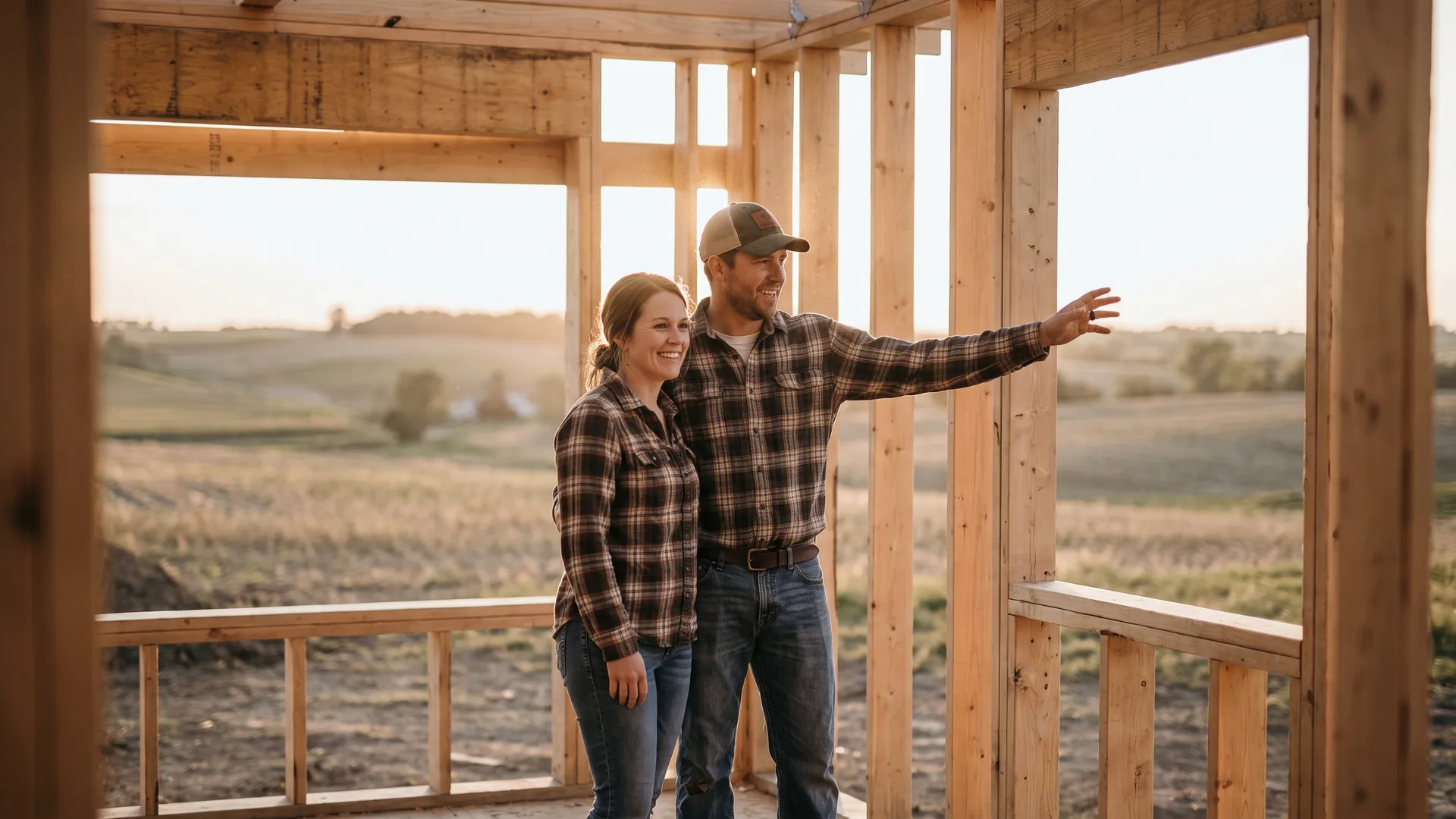
Whether that’s worth it depends on what you’re optimizing for. Building wins for buyers who want full customization, new systems and energy efficiency and can absorb the wait. Buying existing usually wins on speed, upfront cost and simplicity.
Learn more about the cost of building a house, including what a construction budget covers, how building compares against buying existing, and how construction financing works. If you’re earlier in the process, start with our Home Buying guide.
Key takeaways:
- The national average build runs $323,000 to $428,000 excluding land: Materials consume about 60% of construction costs, and general contractors add 10% to 20% on top of that.
- Land, permits and hookups are the budget-busters people forget: Land runs $3,000 to $350,000 per acre and permits and impact fees commonly run $4,000 to $25,000 on top of the construction quote, so price the full project before you compare it against existing homes.
- Time is the hidden cost: Expect 9 to 12 months to build versus 1 to 2 months to close on an existing home, and carry financing or rent costs for that entire gap.
What does it cost to build a house?
Most new single-family homes cost between $323,000 and $428,000 to build before land, and the spread comes down to who’s building and how custom the house is. HomeAdvisor’s 2025 cost data puts the national average at $323,026, with a typical range of $138,937 to $531,294. The National Association of Home Builders’ 2024 Cost of Constructing a Home survey, which samples more custom builders, puts average construction cost at $428,215 on an average finished size of 2,647 square feet.
Neither number includes your land, and both flatten enormous regional variation. Treat them as a starting point, not an answer, the NAHB construction cost research behind the higher figure warns against using it to price a specific house in a specific place.
What does a build cost per square foot, and why does size change it?
Most builds land between $140 and $200 per square foot. NAHB’s 2024 survey averaged about $162 per square foot; the full market runs from roughly $60 per square foot for basic construction in low-cost regions to $380 or more for custom work in expensive markets.
One counterintuitive rule governs that number: bigger houses usually cost less per square foot. Utility connections, the permit package, the driveway and the plans cost about the same whether the house is 1,600 square feet or 2,800, so spreading them over more floor area shrinks the per-foot figure. A neighbor’s quote on a 3,000-square-foot build will understate what your 1,800-square-foot build costs per foot.
Where the money goes, stage by stage
Roughly 60% of construction cost is materials, and a general contractor’s fee typically adds 10% to 20% on top. Here’s how a mid-range build distributes across the major stages.
| Construction stage | Typical low | Typical high |
|---|---|---|
| Excavation and foundation | $20,000 | $50,000 |
| Framing and roofing | $30,000 | $100,000 |
| Plumbing, electrical and HVAC rough-ins | $15,000 | $50,000 |
| Interior finishes (drywall, cabinets, flooring, fixtures) | $50,000 | $100,000 |
Interior finishes carry the widest range on that list, and that’s where most budgets break. The framing package for a given floor plan is close to fixed; cabinets, counters, flooring and fixtures are where a $50,000 allowance becomes $100,000 one selection at a time. Angi’s home project cost data and a detailed cost-of-building breakdown show the same pattern.
NAHB’s 2024 survey also found construction made up 64.4% of the average new home’s sale price, with the finished lot at 13.7% and builder profit at 11.0%. Building for yourself means taking on the lot and the profit line personally. Which is where the savings come from, and where the risk lives.
Land, permits and the costs a builder quote leaves out
Land runs $3,000 to $350,000 per acre depending on region, and permits and impact fees commonly run $4,000 to $25,000. Neither appears in the per-square-foot number a builder quotes you.
- Site preparation: Clearing, grading, soil and perc testing, and a driveway. A wooded or sloped lot can add $10,000 or more before a shovel touches the foundation.
- Utility connections: A lot with water, sewer, gas and electric at the street beats one needing a well and septic system, which frequently run five figures combined.
- Soft costs: Architectural plans ($1,000 to $2,000), engineering, surveys and construction-loan inspection fees.
- Move-in costs: Landscaping, window treatments, appliances and fencing are excluded from most base contracts.
- Contingency: Budget 10% to 15% for change orders and material price swings. Overruns are the norm.
Here’s what that looks like assembled. Hypothetical example, not an offer. Say you’re building a 2,000-square-foot home in Waterford at $175 per square foot: construction runs $350,000. Add $60,000 for the lot, $12,000 for permits and site work, $2,000 for plans and a $35,000 contingency, and the real project cost is about $459,000, roughly 31% above the number you started with.1
What does a contractor-built home cost, according to the Census Bureau?
The Census Bureau’s Highlights of 2025 Characteristics of New Housing reported that 131,000 contractor-built single-family homes were started in 2025 and that their median contract price was $404,000. The same release put the median size of a single-family home completed in 2025 at 2,142 square feet.
The same Census release shows how lots are served: among homes built for sale in 2025, 91% had a public sewer system and 9% had an individual septic system, so a lot that needs septic puts you outside what most builders’ homes have. Our guide to the benefits of buying a newly constructed home covers the builder-lot side of that comparison.
How is construction cost split across the stages of a build?
The National Association of Home Builders broke construction cost into eight stages in its 2024 Cost of Constructing a Home analysis, published January 23, 2025. The shares below are percentages of construction cost, not of the sale price.
| Stage of construction | Share of construction cost (2024) |
|---|---|
| Interior finishes | 24.1% |
| Major system rough-ins | 19.2% |
| Framing | 16.6% |
| Exterior finishes | 13.4% |
| Foundations | 10.5% |
| Site work | 7.6% |
| Final steps | 6.5% |
| Other costs | 2.1% |
Source: NAHB, Cost of Constructing a Home in 2024 (Eye on Housing, January 23, 2025).
Interior finishes and rough-ins together come to 43.3% of construction cost in the NAHB figures for 2024, which is why the allowance sheet in a builder contract deserves as much attention as the base price. In a reply posted on that page on August 18, 2026, NAHB said its survey sample is not large enough for a geographic breakdown, so these are national averages with no Michigan figure behind them.
How long does it take to build a house?
Plan on 9 to 12 months from groundbreaking to move-in, and longer if you’re hiring the contractor yourself. Census Bureau Survey of Construction data show single-family homes completed in 2025 averaged 7.5 months from construction start to completion nationally, plus about 1.4 months between permit authorization and the first day of work. Who builds the house moves that number more than anything else: among 2024 completions, homes built for sale finished fastest at 7.6 months from authorization to completion, homes built by an owner-hired contractor took about 12 months, and owner-built homes averaged 15.1 months.
Even the authorization-to-completion figures start the clock at the permit. Land search, design and competitive bids all happen before it and routinely add two to four months. Buying an existing home takes 1 to 2 months from accepted offer to closing, the home buying process guide maps that calendar step by step.
That gap costs real money, and it’s the line most build budgets omit:
- Double housing costs: You’re paying rent or an existing mortgage for the whole build, plus a construction loan payment.
- Interest on drawn funds: Construction loans generally charge interest only on money disbursed, so carrying cost climbs as the house goes up.
- Price exposure: A fixed-price contract shifts 12 months of material and labor risk to the builder; a cost-plus contract leaves it with you.
What did the 2025 data show about build times by builder type?
NAHB’s analysis of Census data on 2025 completions, published September 8, 2026, found single-family homes completed in 2025 took 8.8 months on average from permit to completion. Homes built for sale took 7.4 months from permit to completion, homes built by hired contractors about 11.7 months, and homes built by their owners 14.3 months. All four run from permit to completion, while the 7.5 month average above runs from construction start. The same analysis listed the East North Central division, which includes Michigan, with the shortest average wait from permit to start, at 1 month.
Building vs. buying an existing home
Buying wins on speed and usually on upfront cost; building wins on customization and condition. For scale: the National Association of REALTORS® reported a median existing-home price of $434,100 in July 2026, while the Census Bureau and HUD put the median sales price of a new house sold in June 2026 at $398,300. New construction can price below the resale median when builders are moving inventory, but a production home off a builder’s lot and a custom build on your own land are different transactions.
| Factor | Building | Buying existing |
|---|---|---|
| Upfront cost | $323,000 to $428,000 construction, plus land, permits and site work | $434,100 median existing-home price, all in |
| Timeline | 9 to 12 months; contractor-built averaged about 12 months from permit to completion in 2024 | 1 to 2 months from accepted offer to closing |
| Customization | Full control of layout, finishes and systems | Limited to what exists; renovation is a separate budget |
| Early maintenance | New systems and builder warranties; low repair spend in years 1 to 5 | An aging roof, furnace or water heater can surface in year one |
| Financing | Construction loan with draws, then permanent financing | One mortgage, one closing |
| Budget risk | Change orders and price swings; 10% to 15% contingency is standard | Price fixed at contract; inspection findings negotiable |
When building is worth it
- Nothing on the market fits: A specific layout, accessibility need, workshop or multigenerational floor plan is often cheaper to build than to renovate into an existing house.
- You already have the land, or land is cheap where you’re going: Land is 13.7% of a typical new home’s price, so owning it already is the single biggest lever on whether building pencils.
- You’re staying long enough to collect the payback: New systems, current energy codes and zero deferred maintenance pay back over years. That math needs time.
When buying an existing home wins
- You need to move in months, not seasons: Nine to twelve months of double housing costs erases a lot of theoretical savings.
- Your budget has no contingency room: If a 10% overrun would break you, a fixed contract price on an existing home is the safer product.
- You want established neighborhoods: Mature trees and walkable streets come with age. If inventory looks thin, Off-Market Listings: How to Find Them covers houses that never hit the MLS, and preparing to buy gets your file ready first.
Is building still worth it as existing-home prices rise?
The Federal Housing Finance Agency reported on August 25, 2026 that U.S. house prices rose 2.1% between the second quarter of 2025 and the second quarter of 2026, and 4.5% in the East North Central division, which includes Michigan. New homes are moving at a steady pace: the Census Bureau’s New Residential Sales release of October 27, 2026 put the median sales price of new houses sold in September 2026 at $400,400, the annual sales pace at 676,000, and the supply of new homes for sale at 8.4 months at that pace.
Rising resale prices narrow the gap against an all-in build cost, while an 8.4 month supply means some buyers can find a builder’s new home without a custom build. If the build budget will not close that gap, a factory-built route is worth comparing too: our guide to manufactured homes, pros and cons sets out the trade-offs.
How do you finance a build?
Construction financing is a different product from a mortgage: the lender releases money in draws as inspected work is completed. Lenders in Align’s network typically want a bigger down payment than a standard purchase loan, a licensed builder with approved credentials, and complete plans with a signed contract before issuing terms; Samantha can tell you what her lenders are asking for on your file. Construction loans also generally price above comparable permanent mortgages, because the lender is financing a house that doesn’t exist yet.
Construction loans vs. construction-to-permanent loans
There are two structures, and the difference is how many times you go to closing. A two-closing setup finances construction, then refinances into a permanent mortgage when the house is done, two applications, two sets of closing costs, and a second round of underwriting at the end. A single-closing construction-to-permanent loan closes once, before construction starts, and converts automatically at completion.
Agency rules bound the single-closing version. Under Fannie Mae’s Selling Guide, no single construction period may run longer than 12 months and the total may not exceed 18 months; the loan isn’t eligible for purchase until construction is complete and the terms have converted. Build your schedule with room inside those limits. Our Construction Loan Guide covers the draw mechanics, and it’s worth learning to budget for closing costs twice if you’re weighing the two-closing route.
Government-backed construction options
Three agency programs let qualified borrowers build with far less than 20% down.
- FHA construction-to-permanent: HUD’s Single Family Housing Policy Handbook 4000.1 treats this as a single closing before construction begins, with no separate permanent-loan closing. FHA’s minimum down payment is 3.5% of adjusted value at a 580 credit score or above, and 10% below that. A licensed general contractor is required.2
- VA construction loans: A VA-backed loan can be used to buy, build or improve a home, and VA construction financing may require no down payment for eligible borrowers with a valid Certificate of Eligibility. Nearly 90% of VA-backed home loans are made with no money down.3
- USDA single-close construction-to-permanent: USDA Rural Development’s combination construction-to-permanent option under the Single Family Housing Guaranteed Loan Program allows 100% financing with one closing in eligible rural areas. The lender must have at least two years of construction-lending experience, which narrows the field considerably.
That last point is the practical one. Construction lending is a specialty, and plenty of retail banks don’t offer it. Because Align is a broker, we place construction and construction-to-permanent loans through partner lenders that do, and compare their draw schedules and conversion terms side by side.
What has to be true when a construction-to-permanent loan converts?
The conversion from construction loan to permanent mortgage has conditions of its own. Under Fannie Mae Selling Guide B5-3.1-01, the borrower must hold title to the lot, every mechanic’s lien, materialman’s lien and other claim that could become a lien relating to the construction must be satisfied before the loan is delivered to Fannie Mae, and the lender must keep a certificate of occupancy or an equivalent form from the local government.
Selling Guide B5-3.1-02, dated May 6, 2026, limits what can change in a single-closing transaction to four terms: the interest rate, the loan amount, the loan term and the amortization type. It also says cash-out refinance transactions are not eligible for single-closing construction-to-permanent mortgages.
The disclosures follow a separate federal rule. Under Regulation Z, 12 CFR 1026.17(c)(6)(ii), when a multiple-advance construction loan may be permanently financed by the same creditor, the construction phase and the permanent phase may be disclosed as one transaction or as more than one. Ask which way your lender is disclosing it before you compare Loan Estimates from two lenders, or the numbers will not line up. Government-backed options are covered in our guides to VA construction loans, FHA loans and USDA loan basics, and the home appraisal process guide explains the as-completed appraisal a construction lender orders.
Five ways to build for less
Most of the savings on a build are decided before construction starts, not during it.
- Buy land with utilities already at the street: Water, sewer, gas and electric at the lot line can save five figures against a well-and-septic parcel, and it removes the biggest source of site-work surprises.
- Simplify the footprint: A rectangle costs less than the same square footage with bump-outs, dormers and roof valleys. Two stories beat one for equal space, half the foundation, half the roof.
- Spend on structure, save on swappables: Insulation, windows, roofing and mechanicals are expensive to change later. Countertops and light fixtures are not. Put the money where the retrofit hurts.
- Get three fixed-price bids on identical plans: Bids on the same drawings are comparable; bids on vague scopes are not. Fixed pricing also moves material-cost risk to the builder.
- Write a change-order rule before you sign: Require every change in writing with a price and schedule impact attached. Verbal change orders are how a 10% contingency vanishes by month four.
One warning on the DIY route: your own painting, landscaping or fixture work can save roughly $40 per square foot on what you actually finish, but lenders release draws against inspected, completed work, not intentions, so unfinished DIY stalls your funding and your schedule at once. More tactics are in Building a Home on a Budget: Tips and Tricks.
Building is one of several routes to the house you want, and which fits depends on your market and your timeline, the full set lives in our Buying Strategies & Situations hub.
Which Michigan rules change what a build costs?
- Pay as the work is done: In a July 17, 2025 LARA release, the Bureau of Construction Codes director called a contractor who cannot give a license number or a copy of the license a red flag. LARA also advises against paying for a whole job up front and suggests scheduling payments as the job progresses, which is how a construction loan releases draws.
- Plan costs for a smaller house: LARA’s building permit information waives the architect or engineer seal on one- and two-family dwellings under 3,500 square feet of calculated floor area, so a design-fee line on a bid is a choice for a house that size, not a code requirement. Our guide to home renovation permits explains the permit and inspection sequence.
- Liens: Under Michigan’s Construction Lien Act (MCL 570.1107), anyone who works on the house and goes unpaid can claim a lien on it, so a fair build-versus-buy comparison counts the time spent collecting lien waivers and sworn statements at every draw, steps our guide to building a home on a budget walks through.
Which Michigan costs belong in a build budget?
- Septic review by the local health department: EGLE describes onsite wastewater management as a required service of local health departments under Michigan’s Public Health Code, Act 368 of 1978, so a septic permit and soil evaluation run through your county or district health department. Our guide to buying a home with a septic system covers what owning one involves.
- Well testing after the first test: EGLE says a private well was required to be tested when it was first installed, and after that the owner is responsible for protecting the water quality. Budget for periodic testing, and see how well water affects a home’s value.
- Property taxes on the finished house: The Michigan Department of Treasury says a principal residence exemption exempts an owner’s principal residence from the local school operating millage, up to 18 mills, so file for it once you live in the house. The millage itself depends on the exact address. Samantha Shelton, Align’s loan originator, puts it this way: “I wouldn’t tell somebody, ‘You’re in Oakland County, so here’s what your taxes are.’ It doesn’t work like that. We need the actual property.” Our Michigan property tax calculator looks up the published millage for an address and turns it into a yearly planning number for the finished house.
Which features cost less to build in than to add later?
Anything that sits inside the walls or under the slab is easier to add during a build than after it. The EPA’s guidance on radon-resistant new construction says no special skills or materials are required to add radon-resistant features while a home is being built, and that the builder’s cost is typically less than the cost to mitigate the home after construction.
The same logic applies to the building envelope. According to the EPA’s ENERGY STAR Certified New Homes program, a certified home is at least 10% more energy efficient than one built to minimum code, using quality-installed insulation and high-performance windows in a well-sealed structure. The program cites studies showing sales price premiums of up to 8% for ENERGY STAR certified and similarly efficient homes. Our guides to energy-efficient home upgrades, home energy audits and the impact of new building codes on home purchases go further, and the calculators page has tools for the financing side of the plan.
How Align fits your buying strategy
Local real estate agents bring Samantha in for a second opinion when their buyer arrives preapproved somewhere else. She regularly finds a lower rate or less cash to close, whichever helps the buyer more.
That comes from the broker model. One application goes to multiple wholesale lenders, so your offer is built on the loan that fits your situation, not the only one a single bank sells. A 2024 Polygon Research analysis of federal mortgage data found broker borrowers paid about $10,662 less over the life of a $400,000 loan than borrowers at nonbank retail lenders.
FAQ: The cost of building a house
Here are answers to common questions about the cost of building a house.
Is it cheaper to build or buy a house?
Buying an existing home is usually cheaper upfront and always faster. Building averages $323,000 to $428,000 before land, and land plus permits and site work can push the total well past comparable resale prices. Building pays back through customization, new systems, lower early maintenance and energy efficiency, value that accrues over years, not at closing. Regional costs can flip the math either way, and the benefits of modular homes include build costs that often land below a site-built quote.
How much does it cost per square foot to build a house?
Most builds land between $140 and $200 per square foot, though the full range runs from about $60 for basic construction in low-cost regions to $380 or more for custom work in expensive markets. Larger homes often cost less per foot because fixed expenses, utility connections, permits, driveways, don’t scale with size. Finishes and site conditions drive most of the variation. Our guide to New Home Construction: What to Expect covers what a builder’s quote does and doesn’t include.
What are the hidden costs of building a house?
Beyond the construction contract, budget for land preparation (clearing, grading, soil testing), utility hookups or well and septic, permits and impact fees ($4,000 to $25,000), architectural plans, a driveway, landscaping, window treatments and appliances that base quotes often exclude. Add a 10% to 15% contingency for change orders and material price swings. Overruns are the norm, not the exception. Independent home inspections for new construction at framing and pre-drywall belong in the budget too.
How do you finance building a house?
Most buyers use a construction loan that disburses funds in draws as work completes, then either converts automatically to a permanent mortgage or gets refinanced into one at completion. Lenders typically want 20% to 25% down on construction loans, approved builder credentials and detailed plans. VA and FHA construction options exist for eligible borrowers with lower down payments. Our guide to Construction-to-Permanent Loans covers how the single-closing version works.
Can land I already own help me qualify for a construction loan?
It can change the math. Under Fannie Mae Selling Guide B5-3.1-02, when you are the owner of record of the lot at the first construction advance, the loan is measured against the as-completed appraised value of the lot and finished house, not what you paid for the land. Our guide to building a home on a budget covers a lot bought with the loan. Samantha can tell you how her lenders treat land on your file.
What energy code applies to new homes in Michigan?
Michigan’s residential energy code is the 2015 IECC with state amendments, effective February 8, 2016 and enforced statewide, according to the U.S. Department of Energy. DOE rates that amended code as about equivalent to the 2009 IECC. DOE estimates that adopting the 2024 IECC would add about $10,610 to a home’s first cost and save about $536 a year in energy costs, a simple payback of 19.8 years.
Do builders get a tax credit for energy-efficient new homes?
Only for homes acquired by June 30, 2026. The IRS Section 45L page, last updated June 27, 2026, gives eligible contractors a credit of up to $5,000 per home acquired in 2023 through June 30, 2026, based on ENERGY STAR or Zero Energy Ready Home requirements, and lists no amount for homes acquired later. The contractor claims it, not the buyer, so a build starting now should not count on it.
The bottom line on building a house
Building a typical single-family home costs roughly $323,000 to $428,000 before land, generally $140 to $200 per square foot, with land ($3,000 to $350,000+), permits ($4,000 to $25,000), site work and hookups stacked on top. Plan on 9 to 12 months to build against 1 to 2 months to close on an existing home, and carry a 10% to 15% contingency. Building is worth it when nothing on the market fits, land is affordable and you’ll stay long enough to collect the payback. Buying wins on speed, cost and certainty.
If you’re ready to price a build with real financing behind it, talk to Align Lending. We’ll shop construction and construction-to-permanent loans across our lender network and show you the draw terms and numbers side by side. Call 248-506-5727 or start online.
Footnotes:
1. Example figures are hypothetical and for educational purposes only; they do not constitute an advertisement of credit terms or a rate quote under federal or state lending laws. Your construction costs, land price, permit fees and loan terms will depend on your builder, your site, your application and market conditions. Return to text.
2. Align Lending is not acting on behalf of or at the direction of FHA or HUD. FHA construction-to-permanent requirements, minimum down payment and credit standards are set by HUD and are subject to change. Return to text.
3. Align Lending works with VA-approved lenders and is not endorsed or sponsored by the Dept. of Veterans Affairs or any government agency. VA construction loan eligibility and terms are set by the Department of Veterans Affairs and are subject to change. Return to text.
Sources: average construction cost, cost per square foot, average finished size, and construction/lot/profit shares of sale price, National Association of Home Builders, Cost of Constructing a Home, 2024. National average build cost and range, HomeAdvisor 2025 cost data. Average length of time from construction start to completion (2025) and average length of time from authorization to completion by builder type (2024), U.S. Census Bureau Survey of Construction. Median sales price of new houses sold, U.S. Census Bureau and U.S. Department of Housing and Urban Development, New Residential Sales, June 2026. Median existing-home price, National Association of REALTORS®, Existing-Home Sales, July 2026. Single-closing construction-to-permanent construction period limits, Fannie Mae Selling Guide B5-3.1-02. FHA construction-to-permanent and minimum down payment requirements, HUD Single Family Housing Policy Handbook 4000.1. VA construction loan and no-down-payment data, U.S. Department of Veterans Affairs. Single-close combination construction-to-permanent program, USDA Rural Development Single Family Housing Guaranteed Loan Program.
This article is for informational purposes only and is not intended to provide legal, financial, or tax advice. Construction contracts and builder agreements should be reviewed by a licensed real estate professional or attorney in your state. Consult a qualified professional about your situation. Cost figures shown are national estimates, are not a rate quote or an offer of credit, and are subject to change. Align Lending is an independent Michigan mortgage broker, NMLS #2041154.
Sources
Every outside source this guide links to, in the order it appears. How we choose and check sources
- NAHB construction cost researchNational Association of Home Builders
- A detailed cost-of-building breakdownFamily Handyman
- NAHB’s 2024 survey also foundeyeonhousing.org
- Highlights of 2025 Characteristics of New HousingU.S. Census Bureau
- Analysis of Census data on 2025 completionseyeonhousing.org
- Federal Housing Finance Agency reportedFederal Housing Finance Agency
- New Residential Sales releaseU.S. Census Bureau
- Under Fannie Mae’s Selling GuideFannie Mae Selling Guide
- HUD’s Single Family Housing Policy Handbook 4000.1U.S. Department of Housing and Urban Development
- A VA-backed loan can be used to buy, build or improve a homeU.S. Department of Veterans Affairs
- Fannie Mae Selling Guide B5-3.1-01Fannie Mae Selling Guide
- 12 CFR 1026.17(c)(6)(ii)Consumer Financial Protection Bureau
- July 17, 2025 LARA releaseState of Michigan
- Building permit informationState of Michigan
- MCL 570.1107Michigan Legislature
- EGLEState of Michigan
- EGLE saysState of Michigan
- Michigan Department of TreasuryState of Michigan
- Radon-resistant new constructionU.S. Environmental Protection Agency
- ENERGY STAR Certified New HomesENERGY STAR
- U.S. Department of Energyenergycodes.gov
- IRS Section 45L pageInternal Revenue Service
Related resources
20-minute read
How to create a competitive offer on a house in a seller’s market
Learn how to create a competitive offer on a house, from preapproval and pricing to contingencies and appraisal gap coverage, and win in a hot market.
20-minute read
Advantages of buying a fixer-upper: 7 key benefits (and the tradeoffs)
Discover the advantages of buying a fixer-upper, from lower prices and less competition to renovation loans that roll repair costs into your mortgage.

20-minute read
Guide to Negotiating a Home Purchase
Strategies for negotiating a home purchase, from inspection findings and seller concessions to offers that win without overpaying.