
DIY home security upgrades: What actually deters a break-in
The DIY home security upgrades that do the most work are also the cheapest: a Grade 1 deadbolt paired with a steel strike plate anchored by 3-inch screws, motion-activated exterior lighting, and a visible camera or video doorbell at the entries people actually use. Grade 1 is the top of the 3 performance grades used for residential lock hardware, and swapping one in is usually an under-an-hour job with a screwdriver.
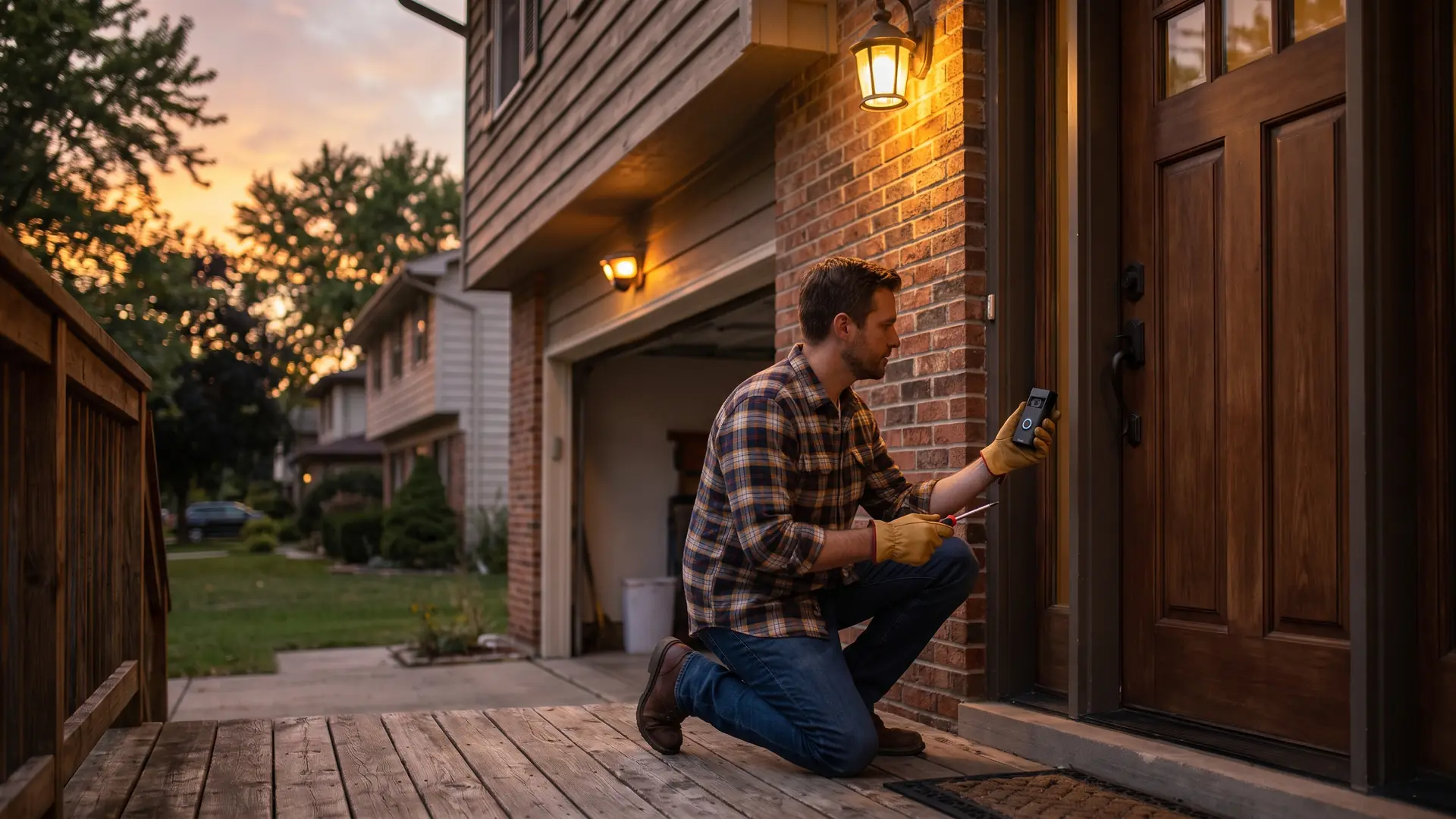
Layering matters more than any single device: hardware resists forced entry, lighting removes cover, cameras and signage change the math before anyone touches the door, and an alarm shortens how long someone stays inside. Insurers credit part of that back, but the credit follows the alarm and the lock, not the gadget.
Learn which DIY home security upgrades are worth your money, including how to audit your house in 20 minutes, which hardware changes stop a kick-in, and what your insurer will discount. For more projects, see our Home Improvement & Design hub or the Homeownership guide.
Key takeaways:
- Hardware comes first: A Grade 1 deadbolt and a steel strike plate anchored with 3-inch screws into the framing is the lowest-cost upgrade here, and the only one that addresses how a locked door usually fails.
- Four layers beat one gadget: Reinforced hardware, motion-activated lighting, a camera or video doorbell, and visible deterrents each cover a gap the other 3 leave open.
- Insurance credits are real but narrow: The Insurance Information Institute says you can usually get at least 5% off for a burglar alarm, smoke detector, or deadbolt locks, and as much as 15% or 20% for a monitored fire-and-burglar alarm paired with a sprinkler system.
How do you find your home’s security weak points?
Walk the outside of your house once, on foot, at dusk. 20 minutes is enough to find nearly every weak point you have. Work these 6 checks in order and write down what you find. That list is your shopping list.
- 1. Start at the street: Note what reads as easy from 40 feet away, an open garage, a porch package, a blind approach down one side.
- 2. Test every exterior door: Push hard with the deadbolt thrown. If the jamb flexes, the wood is doing the work, not the lock.
- 3. Pull one strike-plate screw: If it’s a 3/4-inch screw biting into thin trim, you found the most common failure point in entry doors.
- 4. Work the ground-floor windows: Flag sash locks that don’t engage, painted-over latches, and windows hidden behind fences, hedges, or a deck.
- 5. Come back after dark: Map where the light stops. Side yards, the back door, and the driveway path are the usual dead zones.
- 6. Finish at the garage: Check the overhead door’s emergency release, the side service door, and the door between garage and house.
The habit is the one behind a home energy audit: walking the building with a specific question beats shopping for products first.
How do most burglars actually get in?
More often through an unlocked opening than a broken door. In Household Burglary, 1994-2011 (June 2013), the Bureau of Justice Statistics reported that the largest share of burglaries over those years were completed unlawful entries, where someone got in without using force. The household burglary rate fell 56% in that period, from 63.4 to 27.6 victimizations per 1,000 households.
| Type of household burglary | 1994 | 2011 |
|---|---|---|
| Attempted forcible entry | 1,092,500 | 549,200 |
| Completed forcible entry | 1,920,000 | 1,226,700 |
| Completed unlawful entry (no force) | 3,341,200 | 1,618,800 |
| All household burglaries | 6,353,700 | 3,394,700 |
Source: Bureau of Justice Statistics, Household Burglary, 1994-2011, appendix table 1 (NCJ 241754, June 2013), estimated victimizations from the National Crime Victimization Survey, 2-year rolling averages.
A UNC Charlotte survey of 422 incarcerated burglars, published May 15, 2013 and funded by an alarm-industry research foundation, reported that most entered through open windows or doors or forced them, 41% called burglary mostly a “spur of the moment” event, about 83% would check for an alarm first, and 60% would pick another target if they found one.
Police data show the same downward trend: the FBI’s 2024 figures from 16,675 agencies covering more than 95% of the population put burglary down 8.6% and property crime down 8.1% from 2023, as Government Executive reported on August 11, 2025. Locking doors, latching windows and closing the garage covers the common way in; the hardware in the next section covers the forced one.
Which physical security upgrades stop a break-in?
Start here: door hardware is the highest-value, lowest-cost layer you can buy. Locked doors rarely fail at the lock, they fail at the jamb, where a short screw pulls out of soft trim.
Upgrade the deadbolt, and take the strike plate seriously
Buy a deadbolt rated Grade 1, the top tier of the grading system maintained by the Builders Hardware Manufacturers Association, the ANSI-accredited body that writes performance standards for locks. Look for a bolt that throws a full inch into the frame and a solid metal housing rather than a plated shell.
Then spend your attention on the part nobody photographs. A heavy steel strike plate mounted with 3-inch screws that pass through the jamb into the king stud transfers force into the framing instead of a strip of pine. Parts for both commonly run under $100 per door.1 Replace one screw in each hinge with a 3-inch screw too.
Make ground-floor windows harder and slower
Windows are about delay, not denial. Confirm every sash lock engages, then add a secondary pin or keyed lock on the windows your dusk walk flagged as hidden. Glass-break sensors are worth more here than any lock, because they cover the failure mode a lock can’t.
Be honest about security film. Film bonded to glass holds a broken pane together and buys time, but a determined intruder can push a filmed pane out of its frame; systems that anchor film to the frame do more. If you’re weighing replacement anyway, our guide to choosing energy-efficient windows covers the frame and hardware decisions that also affect security.
Fix sliding doors, the garage, and the door behind it
- Sliding patio doors: Add a pin lock through both sashes so the panel can’t be lifted, and drive pan-head screws into the upper track. A bar in the track alone is easy to defeat.
- Overhead garage door: Keep the emergency release cord short and away from the top weather seal, and never leave a remote clipped in a car parked outside.
- The door from garage to house: Treat it as an exterior door, same Grade 1 deadbolt, same reinforced strike plate. An intruder inside a closed garage works with total privacy.
- Service and basement doors: Usually the oldest hardware you own. Upgrade them before buying a fourth camera.
What do the ratings on a lock package actually mean?
BHMA also publishes two residential standards, for deadbolts and locksets, and its standards page says they require telling consumers how a product tested on security, durability and finish. Under ANSI/BHMA A156.40, the residential deadbolt standard (the 2015 edition’s grade rules), a manufacturer must state a grade of A, B or C for each category, and the lock must pass every test for the grade claimed. A box can read A for security and B for finish.
- Durability: BHMA’s summary of the A156.40-2025 standard says a Grade A residential deadlatch must pass 400,000 open and close cycles.
- Strength and security: The same summary lists seventeen tests, one loading the door against the deadbolt with 1,350 pounds of force.
BHMA adds that the tests run in a lab and real results vary with installation and door and frame construction, which is why the strike plate screws still matter.
How should you light the outside of your home?
Lighting is the cheapest deterrent per square foot you can buy, and motion-activated fixtures beat always-on floodlights on both counts. A light that snaps on signals attention; a light that burns all night signals nothing.
- Motion fixtures at every entry: Cover the front door, back or side door, garage service door, and driveway path. Aim them down and outward to light faces and ground.
- Solar where there’s no wiring: Solar fixtures light a detached garage, fence line, or side yard without pulling a circuit. Check the panel gets real sun, and expect shorter winter runtimes.
- Timers and smart bulbs inside: Randomized schedules across 2 or 3 rooms read as far more convincing than one lamp clicking on at 7:00 nightly.
- Pathway and landscape lighting: This layer improves safety and curb appeal at once. Match fixture style to the house.
One boundary: swapping a fixture on an existing circuit is DIY. New circuits, panel work, and exterior wiring runs are not.
Which DIY security tech is actually worth buying?
Buy by category, not by brand. Model names turn over every year or two; the criteria below have held steady far longer.
DIY alarm systems
A modern DIY system is a hub or keypad plus adhesive door and window contacts, wireless motion detectors, and app control, with monitoring as an optional subscription. Judge one on 5 things: sensor count against every ground-floor opening you found, cellular backup if the internet drops, battery backup for outages, month-to-month monitoring rather than a long contract, and replacement sensor pricing. Roundups like these DIY home security system comparisons help narrow the field.
Cameras
Cover the entries burglars actually use rather than ringing the whole house. Weigh field of view, infrared versus color night vision, local storage versus a cloud subscription, and wired versus battery power. Battery cameras are easier to place and harder to keep charged.
Video doorbells
A video doorbell covers the one approach every visitor uses, and it deters whether or not anyone watches the feed. The question is power: a wired unit uses your existing transformer and chime, which sometimes need replacing; a battery unit adds a recharge cycle.
Smart locks and keyless entry
Smart locks solve a key-management problem more than a strength problem, temporary codes for a contractor or dog walker, remote locking, auto-lock, and a record of who came and went. Check two things: that the lock body still carries a Grade 1 or Grade 2 rating rather than trading strength for features, and that there’s a mechanical key override. Our overview of smart home technology for homeowners covers keeping locks, cameras, and lighting in one app instead of 4.
How do you keep smart cameras and locks from becoming the weak point?
A connected lock or camera is a computer on your network. The Cybersecurity and Infrastructure Security Agency’s Secure Our World program boils its advice down to four steps that apply to any security app: avoid and report phishing, use strong passwords, use multifactor authentication and a password manager, and update software. In practice that means a unique password on each camera and lock account, automatic firmware updates, and deleting temporary codes when a contractor’s job ends.
On its U.S. Cyber Trust Mark page, the Federal Communications Commission says it sought comment in August 2023 and adopted rules in March 2024 for a voluntary cybersecurity label on wireless smart products. Labeled products will carry a QR code that opens a registry showing details such as the support period and whether updates are automatic. The FCC says it is still standing the program up, so many products will not carry the mark yet.
How do you make your home look like a hard target?
Deterrence costs the least and gets skipped the most. The goal isn’t an impossible house, it’s one that’s obviously more work than the 2 on either side.
- Place signage where it’s read in time: A yard sign where someone sees it before they commit, and window stickers at the back and side doors where the decision happens.
- Simulate occupancy unpredictably: Fixed timers are a pattern, and a pattern is information. Our guide to home automation systems covers scheduling that varies on its own. Hold your mail when you travel, too, a full mailbox undoes the effect.
- Cut the cover: Trim shrubs below window sill height and limb up trees near entries. Landscaping that hides a window from the street hides an intruder too.
One common recommendation we’d argue against: skip the fake cameras. Decoys are easy to spot up close, and they buy false confidence in exactly the spots where you’d otherwise install something real.
What do DIY security upgrades cost, and what will insurance credit?
Costs run from a pack of 3-inch screws to a monitored service with a monthly fee, and the insurance credit does not track the price. The Insurance Information Institute says you can usually get discounts of at least 5% for a smoke detector, burglar alarm, or deadbolt locks, and that some companies cut premiums by as much as 15% or 20% for a sophisticated sprinkler system paired with a fire and burglar alarm that rings at a police, fire, or monitoring station.2 Not every system qualifies, so ask what your carrier credits first.
The table ranks these upgrades by relative cost and effort rather than price, because hardware costs, labor rates, and credits vary too much by market to quote.
| Upgrade | Relative cost | DIY effort | Typical insurance credit |
|---|---|---|---|
| Grade 1 deadbolt + steel strike plate | Lowest | Under an hour per door | Commonly listed credit |
| Motion-activated exterior lighting | Low | Under an hour for solar; electrician for new circuits | Rarely credited on its own |
| Window sash locks and security film | Low to moderate | Half a day; film needs patient prep | Rarely credited on its own |
| Video doorbell | Moderate | Under 2 hours; transformer swap needs an electrician | May count inside a monitored plan |
| Self-monitored DIY alarm system | Moderate | An afternoon; adhesive sensors | Sometimes; unmonitored often doesn’t qualify |
| Professionally monitored alarm service | Highest, ongoing monthly fee | Self-install hardware plus a subscription | The largest credits, up to 15% or 20% with sprinklers |
Two costs get underestimated. Labor on anything you won’t install yourself, get written local bids, and treat Angi’s typical installation costs for security hardware as a starting range only. And upkeep: batteries, camera subscriptions, and monitoring fees are permanent line items, the kind our guide to home maintenance for first-time homeowners covers planning for.
And don’t buy a monitored plan for the discount alone: a monthly fee can easily exceed the annual premium savings. The Institute’s guidance on how security upgrades affect homeowners insurance covers what carriers ask for.
What happens after a break-in, and what does insurance pay?
Small losses rarely reach an insurer. Per the Bureau of Justice Statistics, the median value stolen in 2011 burglaries with a loss was $600, up 54% from $389 in 1994 in 2011 dollars, and the average loss was about $2,116. That year 35% of households that lost $1,000 or more reported it to an insurance company, against 10% of those losing $500 to $999 and 3% of those losing $1 to $499. Police reports followed the same pattern: 83% for losses of $1,000 or more, 68% for $500 to $999 and 38% for $1 to $499.
The BJS flyer Key Findings from the 2024 NCVS: Property Crime, drawn from Criminal Victimization, 2024 (September 2025), reported that 41% of burglary and trespassing victimizations reached police, and about 30% of all 13,069,560 property victimizations.
Michigan’s Department of Insurance and Financial Services lists the records that speed a theft claim in its homeowners insurance guide for Michigan consumers (dated August 2019): a written inventory, receipts, photos or video of every room, closet and garage kept somewhere other than the house, and appraisals for jewelry and collectibles. The same guide lists protective devices, such as smoke detectors, burglar alarms and heavy duty locks, among the common premium discounts, and says each insurance company sets the amount of discounts it offers.
Hypothetical example, not an offer: a policy costs $1,800 a year and the carrier credits 5% for a monitored alarm, which is $90 a year. If monitoring runs $25 a month, or $300 a year, the credit covers 30% of the fee. Our guides to evaluating home insurance options and home insurance and renovations cover the rest of the policy.
Do security features matter to buyers when you sell?
Buyers say they want them. In NAHB’s What Home Buyers Really Want survey of more than 3,000 recent and prospective buyers, reported on October 7, 2024, 76% rated security cameras essential or desirable, 74% a video doorbell and 70% a wireless security system, trailing only a programmable thermostat, at 78%, in NAHB’s summary of technology features. In the American Institute of Architects’ Home Design Trends Survey with data from the first quarter of 2026, security lighting scored a net 14% (firms reporting rising popularity minus those reporting a decline), up from 11% a year earlier.
That measures demand, not sale price. Hardware, lighting and a doorbell camera stay with the house; a monitoring contract usually does not. See our guides on assessing a home’s resale potential, curb appeal and renovations that can add value.
Should smoke and carbon monoxide alarms be part of the plan?
Yes: they cover risks a lock does not, and smoke detectors sit on the insurer discount lists above. Ready.gov’s home fires page, updated February 26, 2026, says to put smoke alarms on every level including the basement, change batteries twice a year unless they are 10-year lithium, replace units every 10 years, and make sure window security bars open for escape.
In Michigan, MCL 125.1504f lets the state code require at least 1 carbon monoxide device when a single-family home has a permitted renovation or gains a bedroom, placed near bedrooms, an attached garage and fuel-burning appliances (Michigan Compiled Laws as compiled through Public Act 114 of 2026). More in our fire safety tips.
When should you hire a pro instead of doing it yourself?
Two jobs are worth handing off, and one piece of paperwork is worth checking. None of it undoes your DIY work, a reinforced front door and 2 motion lights beat a plan you never start.
- Electrical beyond a fixture swap: New circuits, panel work, exterior wiring, and transformer replacement call for a licensed electrician, and most municipalities require a permit.
- Structural door work: Replacing a slab and frame, squaring a sagging jamb, or hanging a steel door is carpentry, not hardware. A door hung out of square never locks properly.
- Alarm registration: Many cities and townships require you to register an alarm system, and some charge fees for repeat false-alarm responses. Check your municipality’s rules before activating monitoring.
If the security list is really the first item on a larger project, new exterior doors, replacement windows, or a garage conversion, price the whole scope at once and decide how to fund it before buying hardware piecemeal.3
What should Michigan homeowners check before hiring a security company?
Michigan licenses alarm companies. Under the Private Security Business and Security Alarm Act, MCL 338.1053 bars a business from working as a security alarm system contractor unless licensed under the act, and a violation is a felony punishable by up to 4 years, a fine of up to $1,000.00, or both (as compiled through Public Act 114 of 2026). It also bars installing a device that auto-dials a police or utility line with a recorded message without that agency’s written permission.
- Ask for the agency license: LARA’s page on the act says it issues a Security Alarm Contractor Agency license, not individual licenses, so the license belongs to the company.
- Read your city’s ordinance: Ann Arbor’s ORD-16-14, for example, requires registering an alarm that signals police or fire, with the first fee due within 5 days of installation, installation by a contractor licensed under Public Act 330 of 1968, and lets chiefs stop responding after 5 or more false alarms in 12 months.
- Be wary at the door: The Attorney General warned on July 28, 2023 about people posing as security company representatives to sign up homeowners, and advised asking for identification.
- Know your exits and permits: LARA’s homeowner information gives three days to cancel a contract you were solicited for and signed at home, and requires a LARA license for contractors offering work of $600 or more. Its electrical permit page issues permits to licensed contractors or to homeowners wiring a single-family home they own and occupy.
- Read the state guide: On May 18, 2026, LARA released a 13-page Consumer Guide to Home Improvement Projects on contractors, contracts, fraud signs and permits.
The DIFS home insurance FAQ notes that Michigan law does not require insuring your home, though a lender likely will, and that some companies cut premiums for a security system. See our guide to renovation permits.
How do you fit security work into a larger home project?
ENERGY STAR’s LED guide says LEDs produce light up to 90% more efficiently than incandescent bulbs and are directional, which suits motion fixtures aimed at a path.
When the list grows into doors, windows or a remodel, Samantha Shelton’s renovation advice applies: “You’re not just financing the house. You’re financing the plan for the house.”
One federal route for that kind of plan: per HUD’s 203(k) program page, as it read in October 2026, the Limited 203(k) mortgage lets homebuyers and homeowners finance up to $75,000 into their mortgage to repair, improve or upgrade the home, while the Standard 203(k) supports major renovations and structural additions.
Compare the options in our guides to HELOCs, renovation loans, refinancing for improvements and financing renovations, and add upkeep to your seasonal maintenance checklist.
How Align finances a renovation
You are not just financing the house. You are financing a plan for it. Align places HomeStyle and FHA 203(k) renovation loans, standalone HELOCs and home equity loans, so the project can be paid for the way that fits it, not the way one bank prefers.
Samantha starts with why: what the work is, what it should cost, and whether your equity or a renovation loan is the better tool. Then one application goes to multiple wholesale lenders.
FAQ: DIY home security upgrades
Here are answers to common questions about DIY home security upgrades.
What is the cheapest way to improve home security?
Upgrade your door hardware. A Grade 1 deadbolt plus a steel strike plate secured with 3-inch screws into the wall framing commonly costs under $100 per door and directly counters kick-in entry. Add solar motion lights at dark entry points and a peephole or video doorbell, and you’ve covered the 3 highest-value fixes for a few hundred dollars.
Do DIY security systems work as well as professionally installed ones?
For most single-family homes, yes. Modern DIY systems use adhesive-mounted sensors, wireless motion detectors, and app-based control, and many offer optional monitoring for a monthly fee. The trade-off is that you’re responsible for sensor placement and battery upkeep. Professional installation still makes sense for large or complex properties and for hardwired systems tied into existing panels, where local requirements can apply, our guide to building codes and home purchases explains how those rules get enforced.
Will a home security system lower my homeowners insurance?
Often, yes. The Insurance Information Institute says carriers usually discount premiums by at least 5% for a smoke detector, burglar alarm, or deadbolt locks, and by as much as 15% or 20% for a monitored fire-and-burglar alarm paired with a sprinkler system. Ask which certifications your carrier requires and get the discount in writing before you buy, because unmonitored systems sometimes don’t qualify. Our guide to homeowners insurance deductibles covers the other lever on your premium.
Where should I place security cameras?
Cover the entry points burglars actually use: the front door, the back or side door, the garage entry, and any ground-floor window hidden from the street. Mount cameras about 9 feet up, angled down, so faces stay in frame but the unit is out of easy reach. Avoid pointing cameras at neighboring property, and add lighting anywhere a camera would otherwise record only darkness. A doorbell camera also doubles as one of the accessibility features in modern homes, since it lets you answer the door without crossing the house.
Should I change the locks after buying a house?
Yes, on move-in day, because you cannot know who still holds keys. Rekeying the cylinders is enough when the hardware is sound; replace a weak or worn deadbolt. Reset garage opener and keypad codes and any smart lock or alarm accounts tied to the old owners. Our inspection checklist and guide to hiring movers cover the rest of moving week.
Is it legal to record audio with a home security camera in Michigan?
Audio needs more care than video. Michigan’s eavesdropping statute, MCL 750.539c, makes it a felony, punishable by up to 2 years or a $2,000 fine, to willfully use a device to eavesdrop on a private conversation without the consent of all parties. Many owners turn off microphones on outdoor cameras facing sidewalks or neighbors; an attorney can review your setup.
Can I deduct home security upgrades on my taxes?
Usually not for the home you live in. IRS Publication 523 lists a security system among improvements that increase your home’s basis, and a higher basis can reduce the taxable gain when you sell. Keep the receipts with your home records, and ask a tax professional how it applies to your sale. Our guide for first-time home buyers covers other records to keep.
Does homeowners insurance cover items stolen in a burglary?
Generally yes, subject to your deductible and limits. Michigan’s regulator explains in its consumer guide (August 2019) that theft is one of the named perils in a Broad (HO-2) policy. In the All Risk (HO-3), the most common type, the dwelling is covered against all perils not excluded, while the home’s contents, where stolen items fall, are generally covered against named perils. See our insurance and protection guides.
The bottom line on DIY home security upgrades
The DIY home security upgrades that actually deter a break-in are the unglamorous ones. A Grade 1 deadbolt and a steel strike plate anchored with 3-inch screws into the framing addresses how a locked door usually fails; motion-activated lighting removes the cover; a camera or video doorbell and visible signage make yours the harder house on the block. Layer those 4 things first, walk your property at dusk to set the order, and confirm what your carrier credits. At least 5% for an alarm or deadbolts is common, and as much as 15% or 20% for a monitored system with sprinklers.
If your security list is really the front end of a renovation you plan to finance, talk to Align Lending. We’ll shop your scenario across our lender network and show you the options side by side. Call 248-506-5727 or start online.
Footnotes:
1. The per-door figure and the cost and effort ratings in the table above are illustrative relative rankings for educational purposes only; they are not price quotes, estimates, or return-on-investment projections. Actual cost and installation time depend on your market, the hardware grade you choose, the condition of the existing door and jamb, your home’s construction, and whether you hire out the labor. Price the work from written local bids. Return to text.
2. Discount percentages are published by the Insurance Information Institute as general industry guidance, not as an offer from any carrier. Homeowners insurance discounts are set by individual insurers and vary by company, state, policy, and the certification or monitoring standard a device meets; the Institute notes that not every system qualifies. Align Lending does not sell insurance. Confirm any discount with your carrier in writing before you purchase. Return to text.
3. Renovation loans, home equity lines of credit, and cash-out refinances are offered by the individual lenders in Align Lending’s network, which set their own terms; those terms are subject to change. Eligibility, draw rules, and which improvement costs can be financed depend on the program and your application. Align Lending is a broker and does not set lender program terms. Return to text.
Sources: residential lock and builders hardware performance grades, Builders Hardware Manufacturers Association (BHMA), the ANSI-accredited standards developer for locks and builders hardware. Homeowners insurance discounts of at least 5% for a smoke detector, burglar alarm, or dead-bolt locks, and of as much as 15% or 20% for a sophisticated sprinkler system plus a fire and burglar alarm ringing at a police, fire, or monitoring station, Insurance Information Institute, “12 Ways to Lower Your Homeowners Insurance Costs.” Grade 1 deadbolt and steel strike plate prioritization, motion-activated lighting, and layered deterrence, summarized from published consumer coverage of DIY home security upgrades. Burglary and claims statistics come from the Bureau of Justice Statistics, the FBI (as reported by Government Executive) and UNC Charlotte, linked where they appear. No return-on-investment percentages or installed-price estimates appear in this article; price projects from local quotes.
This article is for informational purposes only and is not intended to provide legal, financial, tax, or insurance advice. Electrical, structural, alarm-permitting, and inspection requirements vary by municipality, confirm them with your local building department and use licensed trades for wiring and structural work. Insurance discount availability is determined solely by your carrier. Renovation financing mentioned here is not a rate quote or an offer of credit and is subject to lender approval. Align Lending is an independent Michigan mortgage broker, NMLS #2041154.
Sources
Every outside source this guide links to, in the order it appears. How we choose and check sources
- Household Burglary, 1994-2011bjs.ojp.gov
- UNC Charlotte survey of 422 incarcerated burglarsinside.charlotte.edu
- As Government Executive reported on August 11, 2025govexec.com
- Builders Hardware Manufacturers Association, the ANSI-accredited body that writes performance standards for locksbuildershardware.com
- Must state a grade of A, B or C for each categorybuildershardware.com
- A156.40-2025 standardbuildershardware.com
- DIY home security system comparisonssecurity.org
- Secure Our World programcisa.gov
- U.S. Cyber Trust Mark pagefcc.gov
- How security upgrades affect homeowners insuranceInsurance Information Institute
- Key Findings from the 2024 NCVS: Property Crimebjs.ojp.gov
- Homeowners insurance guide for Michigan consumersState of Michigan
- Reported on October 7, 2024eyeonhousing.org
- Home Design Trends Survey with data from the first quarter of 2026hdts.aia.org
- Home fires page, updated February 26, 2026Ready.gov
- MCL 125.1504fMichigan Legislature
- MCL 338.1053Michigan Legislature
- LARA’s page on the actState of Michigan
- ORD-16-14a2gov.org
- Attorney General warned on July 28, 2023State of Michigan
- Homeowner informationState of Michigan
- Electrical permit pageState of Michigan
- Released a 13-page Consumer Guide to Home Improvement ProjectsState of Michigan
- DIFS home insurance FAQState of Michigan
- LED guideENERGY STAR
- 203(k) program pageU.S. Department of Housing and Urban Development
- MCL 750.539cMichigan Legislature
- Publication 523Internal Revenue Service
- “12 Ways to Lower Your Homeowners Insurance Costs.”Insurance Information Institute
Related resources
20-minute read
Energy-efficient home upgrades: What to do first, and what it saves
See which energy-efficient home upgrades pay off first, from air sealing and insulation to heat pumps and solar, with real costs and yearly savings.
20-minute read
DIY home renovation projects: 12 upgrades you can actually finish
Discover DIY home renovation projects that upgrade your space on a budget, from peel-and-stick backsplashes to floating shelves and smart lighting.
20-minute read
The benefits of a home energy audit and what it includes
Learn what a home energy audit finds, how blower door and infrared tests work, and why the Department of Energy ties audits to 5% to 30% savings.
