
Installing a backup generator: Costs, steps, and permits
Installing a whole-home standby backup generator typically costs $3,000 to $10,000 including the unit, the site work, and the labor, and most installations take one to two days on site once the permits are approved. The job breaks into four parts: a level concrete or gravel pad, an automatic transfer switch wired into your electrical panel, a natural gas or propane fuel line, and a final inspection.
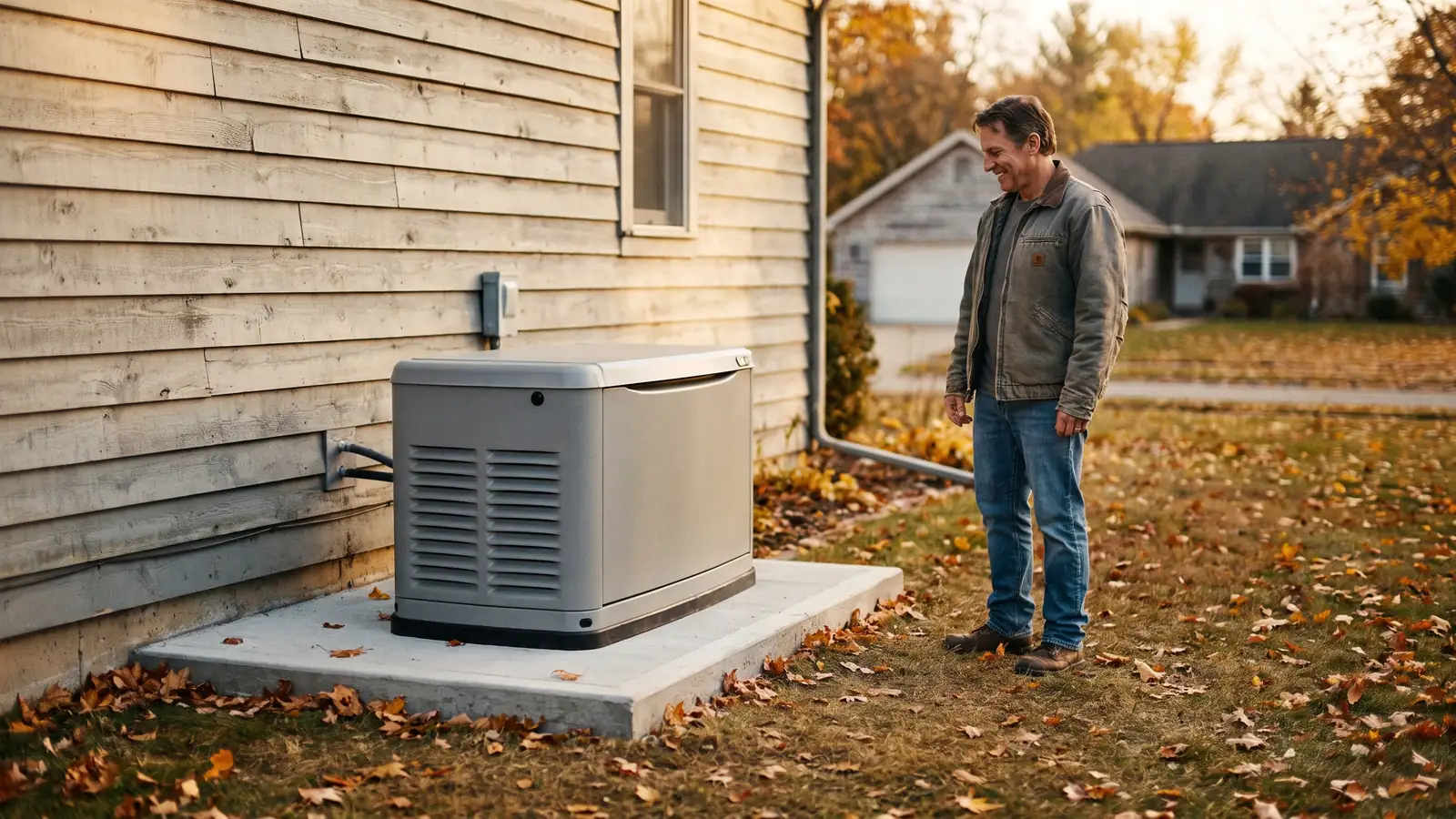
You can handle the pad and the paperwork. The electrical and gas connections require licensed professionals in nearly every jurisdiction, and the unit sits outdoors, generally at least 5 feet from windows, doors, and vents, so exhaust never finds a way back inside.
Learn how installing a backup generator works, including how to size the unit and choose a fuel, what each step involves, and which permits your township will want. For related projects, see our Home Improvement & Design hub and the broader Homeownership guide.
Key takeaways:
- Total cost: A standby generator installation generally runs $3,000 to $10,000, and the unit itself is often about half of that, the transfer switch and fuel line drive most of the rest.
- Two licensed trades: Site prep is DIY-friendly, but 2 of the 4 steps, the transfer switch wiring and the gas connection, call for a licensed electrician and gas technician in most municipalities, and both need a permit and an inspection.
- Placement rule: Generators belong outdoors on a level pad, typically at least 5 feet from windows, doors, and vents, with carbon monoxide alarms on every level inside.
Do you need a backup generator?
A standby generator earns its $3,000 to $10,000 price when outages at your address run long rather than merely annoying. A few flickers a year rarely justify it; repeated multi-day outages on a house with a sump pump, a well, or a medical device usually do. The test isn’t how often your power goes out, it’s what breaks when it stays out.
- Sump pump downtime: A basement that depends on a pump can take on water within hours, and the damage routinely costs more than the generator would have.
- Heat and pipes: A furnace without power isn’t running, and a cold snap turns that into a frozen-pipe problem rather than a comfort problem.
- Medical and work equipment: Oxygen concentrators, CPAP machines, and a home office that has to stay online move a generator from luxury to infrastructure.
If storm season sent you looking, pair this with the rest of a plan.
How long do power outages usually last?
The average U.S. electricity customer went without power for about 5.6 hours in 2022, spread over 1.4 interruptions, according to the U.S. Energy Information Administration’s January 25, 2024 analysis of utility reliability data. Leave out major events such as hurricanes and ice storms and the yearly total has stayed around two hours since 2013, the EIA reported, so the long hours a generator has to carry come from major events. Ready.gov, FEMA’s preparedness site, suggests starting with an inventory of the items you need that rely on electricity.
What size and fuel type should you choose?
Decide between whole-house coverage and essential circuits first, because that one choice drives the unit size, the fuel line, and much of the $3,000 to $10,000 total. A furnace, sump pump, refrigerator, and a few outlets need a far smaller machine than central air, a well pump, and a range at once.
| Generator type | Installed cost | What it powers | Fuel | Automatic operation |
|---|---|---|---|---|
| Standby (permanent) | $3,000 to $10,000 installed | Whole house, or a defined set of essential circuits | Natural gas, propane, or diesel | Yes, starts itself within seconds of an outage |
| Portable | Equipment only, unless you add a transfer switch | A few circuits, or appliances on cords | Gasoline, sometimes propane | No, you roll it out and connect it by hand |
| Inverter | Equipment only | The smallest load of the three; sensitive electronics | Gasoline or propane | No, manual, but quieter and more efficient |
How do you size a backup generator?
Add the running watts of everything you want live during an outage, then add the starting surge of the largest motor on that list, well pumps, air conditioners, and compressors all draw several times their running load at startup, and that surge sets the size. Nameplate ratings live on each appliance label; our guide to energy-saving appliances for homeowners explains how to read them, and a home energy audit shows what your house actually draws.
Which fuel type fits your house?
- Natural gas: Simplest if a gas line already serves the house. The supply is effectively unlimited and there’s no tank to refill.
- Propane: The standard where natural gas isn’t available. It stores well, but you’re buying or leasing a tank and watching its level.
- Diesel: Mostly larger units and rural properties, most energy per gallon, with on-site storage.
Fuel isn’t the only option.
1. How is the site prepared?
Site prep is one day of work at most, and it’s the part a capable homeowner can genuinely do. The generator needs a level base that won’t settle, a poured concrete pad or a compacted gravel bed inside a frame, sized to the unit’s footprint with working clearance on every side.
Placement gets decided before the pad is poured, not after. The unit sits outdoors, generally at least 5 feet from windows, doors, and vents, and clear of dryer vents and fresh-air intakes that could pull exhaust indoors. Confirm your municipality’s property-line setback at the same time, and check your unit’s clearances in its installation manual, those numbers come from the manufacturer and they govern. Once the base cures, the generator is anchored with corrosion-resistant hardware so it can’t shift in a storm; National Association of Home Builders construction standards are a useful reference for a properly built exterior pad.
2. How does a transfer switch get installed?
The transfer switch is the most important safety component in the installation, and it is licensed electrical work every time. It isolates your house from the grid before the generator energizes anything, preventing backfeed. Power flowing from your generator into lines where a utility crew is working.
- Automatic transfer switch (ATS): Senses the outage, starts the generator, and moves the house over without you touching anything. This is what pairs with a standby unit.
- Manual transfer switch: You throw it by hand after starting a portable generator. Much cheaper, and still a permitted installation done by an electrician.
The electrician mounts the switch beside your service panel, runs feeders between panel, switch, and generator, and lands the circuits you’ve chosen to back up. That last step is where an existing panel becomes the problem: one that’s full, undersized, or obsolete has to be dealt with first.
3. How is the fuel line connected?
The fuel connection is the second licensed trade, and on natural gas or propane it usually means trenching from the meter or tank to the pad. A gas technician sizes the line for the generator’s demand, an undersized run starves the unit under load even though it lights fine on a test, then pressure-tests the connection before anything goes into service.
Trenching is where the surprises live. Have every buried utility located first, and flag anything you installed yourself. Irrigation is the classic casualty: if you’ve put in one of the setups covered in our guide to smart irrigation systems, its lines and valve boxes belong on the plan. Rock, roots, and a long run from the meter all add hours, and on propane the tank’s own clearance rules get settled alongside the generator’s location.
4. How is the job permitted, tested, and inspected?
Plan on at least two permits and two inspections: an electrical permit covering the transfer switch and wiring, and a mechanical or plumbing permit covering the fuel line. Many municipalities add a zoning review for setbacks and noise, and some treat the pad as its own building permit.
Your installer normally pulls them, and you should confirm that in writing. The consequences of skipping a permit land on the homeowner: a failed inspection you open walls to correct, an insurance claim questioned after a fire, and a disclosure problem when you sell. Our look at how new building codes affect home purchases covers how unpermitted work surfaces during a sale.
Nothing is finished until the unit completes a supervised test under load. Commissioning is more than “does it start”: the installer confirms the switch actually drops the utility connection, that the generator picks up its circuits without tripping, that it transfers back cleanly, and that the exercise schedule is programmed. Be there, and have them show you the manual shutoff. Keep the permit numbers, inspection cards, and manuals in one file.
Is a portable generator with a transfer switch enough?
A portable generator on a manual transfer switch can carry a furnace, a sump pump and a refrigerator, if the connection is done right. The Occupational Safety and Health Administration’s fact sheet on portable generators says never to attach a generator directly to a building’s electrical system unless a qualified electrician has installed it with a transfer switch, because a direct connection can energize wiring systems for great distances and put utility workers and others at risk of electrocution.
The trade-off is the work someone does in the dark. The CPSC’s February 19, 2026 storm guidance says not to run one on a porch or in a carport, and to look for models with a CO shut-off safety feature.
What does a backup generator installation cost?
Most homeowners spend $3,000 to $10,000 all in, with the generator often accounting for roughly half and labor, permits, and materials making up the rest. Angi publishes typical generator installation cost ranges by project scope, a sanity check before you collect bids.
| Line item | What it covers | What pushes it higher |
|---|---|---|
| Generator unit | Engine, alternator, enclosure, controller, often about half the project | Whole-house rather than essential-circuit coverage; liquid-cooled units |
| Pad and site prep | Concrete pour or gravel base, leveling, anchoring hardware | Sloped lots, poor drainage, a long carry from the driveway |
| Transfer switch and electrical labor | The switch, feeders to panel and generator, the electrician’s time | A panel that’s full, undersized, or needs a service upgrade first |
| Fuel line | Trenching, pipe, fittings, pressure testing, the gas technician’s time | Long runs, rock, roots, landscaping, a new propane tank |
| Permits and inspections | Electrical and mechanical permits, zoning review, inspector visits | Municipalities requiring separate zoning or noise review |
Get three written quotes that itemize those lines separately. A single bottom-line number hides which contractor assumed a panel upgrade and which one will discover it on day two, the discipline our guide to energy-efficient home upgrades applies to furnaces and windows.
Financing changes the shape of the decision. Say a homeowner lands at $9,000 for a standby unit plus a panel upgrade. Paid from savings, that’s a hit to the emergency fund the generator is meant to protect; rolled into a cash-out refinance or a renovation loan alongside other work, it becomes part of a mortgage payment.1 Lenders in Align’s network offer both paths, and which fits depends on your equity and your project list.2
How do renovation loans treat a generator project?
Two program families can carry a generator inside a mortgage, each with its own rules. HUD’s Limited 203(k) lets homebuyers and homeowners finance up to $75,000 into their mortgage to repair, improve or upgrade a home, and the standard 203(k) handles major renovations and structural additions, with rehabilitation costs of at least $5,000, according to HUD’s 203(k) program page.
Fannie Mae’s HomeStyle Renovation is the conventional counterpart. Its Selling Guide (published October 7, 2026) counts costs for required permits among renovation-related costs and caps renovation costs at 75% of the as-completed appraised value on a refinance, 75% of the lesser of purchase price plus renovation costs or the as-completed value on a purchase, and 50% of the as-completed value for manufactured homes. See what a renovation loan is and the benefits of FHA 203(k) loans.
Hypothetical example, not an offer. Here is how those caps compare with a generator job bundled with other work on a house expected to appraise at $320,000 once the work is done (caps from Fannie Mae Selling Guide B5-3.2-02 and HUD’s 203(k) page).
| Item | Amount |
|---|---|
| Standby generator, transfer switch and panel upgrade | $9,000 |
| Other planned repairs on the same project list | $16,000 |
| Total renovation costs | $25,000 |
| HomeStyle refinance cap: 75% of $320,000 | $240,000 |
| Limited 203(k) ceiling | $75,000 |
Source: caps from Fannie Mae Selling Guide B5-3.2-02 (topic dated December 10, 2025) and HUD’s 203(k) Rehabilitation Mortgage Insurance Program Types; project figures are hypothetical.
Here the project uses a small share of either cap, so equity, credit and the rest of the project list decide the route, as our guide to financing home renovations explains. A cash-out refinance and a home equity line of credit are the other common routes; refinancing for home improvements covers when replacing the first mortgage makes sense.
Where does the 5-foot clearance come from, and is it enough?
The 5-foot figure traces to NFPA 37, the National Fire Protection Association’s standard for stationary combustion engines. According to a June 3, 2025 staff report from the U.S. Consumer Product Safety Commission, Section 4.1.4 of that standard requires an outdoor engine and its enclosure to sit at least 5 feet from openings in the walls of structures and from structures with combustible walls, to limit the risk of fire. The report notes exceptions, such as a wall with at least a one-hour fire rating.
Fire spacing is not carbon monoxide spacing, and the CPSC report says no code or standard addresses the CO hazard from these units. After Hurricane Ida cut power around New Orleans in 2021, CPSC staff received information on 256 homes that reported CO exposure and identified the home’s own stationary generator as the source in at least 105 of them. In some incidents the exhaust traveled at least 25 feet from the enclosure and rose more than 10 feet. Where the distance was reported, 51 of 56 generators (91%) sat 6 feet or less from the house, and in 46 of the 105 homes at least one path inside was through attic vents, most often soffit vents in the eaves.
In 85 of the 105 homes (about 81%), a CO alarm activated, and CPSC staff recommended raising the NFPA 37 separation from openings to at least 25 feet. Ask each bidder where the exhaust will face and its distance from soffit vents and bedroom windows.
In Michigan that clearance also has to survive the snow season. The National Weather Service’s Detroit/Pontiac office lists a 1991 to 2020 normal of 45.0 inches of snow a year at Detroit, 14.0 inches of it in January, so put clearing the unit on your seasonal home maintenance checklist after every storm.
How do you keep a standby generator safe and running?
A standby generator is a small engine that sits outside for years and is asked to start on the worst night of the year, so plan on maintenance measured in minutes per month.
- Exercise cycle: Most units self-test weekly or biweekly and report status to a phone app. Leave both enabled, our guide to home automation systems covers folding that into the rest of the house.
- Oil and filters: Change oil, oil filter, and air filter on the manufacturer’s engine-hour schedule.
- Starting battery: Installers consistently point to the battery as a common reason a standby unit won’t crank. Replace it on schedule, not on failure.
- Clearances stay clear: The 5-foot separation isn’t a one-time measurement, snow drifts, new landscaping, and stacked firewood all erase it.
Carbon monoxide is the hazard that matters most. Put CO alarms on every level and outside sleeping areas, and never run any generator in a garage, breezeway, or crawlspace, even with the door open. The U.S. Fire Administration guidance on carbon monoxide and home fire prevention covers alarm placement, and our fire safety tips for homeowners cover the rest of the exterior checklist. Portables carry a stricter rule: the U.S. Consumer Product Safety Commission tells homeowners to run them at least 20 feet from the house, exhaust pointed away from doors, windows, and vents.
How often does generator carbon monoxide hurt people?
An average of nearly 100 people die in the U.S. each year from carbon monoxide poisoning caused by portable generators, the U.S. Consumer Product Safety Commission said in a February 19, 2026 winter storm warning. Counting every source not linked to fires, more than 400 Americans die from unintentional CO poisoning each year, more than 100,000 visit an emergency department and more than 14,000 are hospitalized, according to the Centers for Disease Control and Prevention’s carbon monoxide page, updated October 26, 2026.
The EPA warns that CO from a generator run inside a home, garage, crawlspace or shed can linger for hours, even after the generator has shut off. The CPSC recommends alarms with battery backup, interconnected so that when one sounds they all sound, and tested monthly; the CDC adds replacing detectors on the manufacturer’s schedule or every 5 years. Put both on the same calendar as the exercise cycle and in your home maintenance budget.
What Michigan homeowners should know
Michigan gives a standby generator more work to do than most states, for two reasons that arrive in opposite seasons: winter ice storms that bring down lines across whole townships, and summer thunderstorms that do the same in an afternoon. Both tend to produce multi-day outages rather than brief ones, the profile that justifies the $3,000 to $10,000 spend.
- Permits are township business, not county business: Oakland, Macomb, and Wayne counties each contain dozens of municipalities running their own building departments, so setback, noise, and zoning rules differ between neighboring communities. Call the department for the address, not the county.
- Trenching goes deeper here: Michigan’s frost depth puts gas and electrical runs below a frost line southern installers never think about. Your local code official sets the minimum depth, and it’s part of why the fuel line is a bigger line item in a Michigan bid.
- Winter is the real test: Keep the 5-foot clearance free of drifted snow all season and confirm the exercise cycle runs through the cold months. Our guide to winterizing your home folds the generator into the fall checklist.
Ask each bidder how many of these they’ve permitted in your municipality, a contractor who works your township weekly already knows its rules.
What does Michigan’s power outage credit pay, and does it change the math?
Michigan utility customers who sit through a long or repeated outage now get a bill credit of $44 per day, after the Michigan Public Service Commission raised it in Case No. U-20629, according to the MPSC’s September 10, 2026 release. That is a 77% increase over the $25 credit in place before the commission updated the rules in 2023. The credits are now automatic.
The clock depends on the size of the event, per the MPSC: the credit starts after 96 hours in catastrophic conditions, meaning 10% or more of a utility’s customers without power; after 48 hours in gray sky conditions affecting between 1% and 10% of customers; and after 16 hours in normal conditions. More than 6 sustained interruptions in one year also qualify. The commission reported that customers received $11,609,444 in outage credits in 2025, compared with $1,213,286 in 2022, the last year under the previous rules.
For a generator decision, the credit is compensation, not protection. At $44 a day it takes 69 qualifying days of credits to reach $3,000, the low end of a typical installation. At the peak of the late February 2023 ice storm Michigan had more than 800,000 outages, and as a new storm arrived on February 27, Consumers Energy and DTE Energy together still had more than 140,000 customers without power, PBS NewsHour reported.
Which Michigan permit and licensing rules apply to a generator job?
Michigan enforces one construction code statewide through the Department of Licensing and Regulatory Affairs (LARA), and per LARA’s building permit page an application goes to the enforcing agency for your address. LARA’s electrical permit page says no one may equip a building with electrical conductors or equipment, or alter them, without a permit. The same page lists one route besides a licensed contractor: a homeowner performing electrical work in a single family home they own and occupy may pull the permit.
The fuel line follows the same pattern. LARA’s mechanical permit page says mechanical work cannot start until a permit is issued and that a homeowner must secure a permit for work they perform at their residence.
A standby generator involves two trades, so check that each bid names a contractor licensed by LARA for the work they will do (electrical for the transfer switch and panel, mechanical for the gas line), and that the contract says the contractor pulls both permits before work starts; our guide to home renovation permits covers contractor licensing, contract terms and cancellation rights.
One more state rule follows the job indoors. Under MCL 125.1504f, Michigan’s construction code may require at least 1 operational carbon monoxide device when an existing single-family home is renovated under a permit, and the statute places those devices near the bedrooms, next to an attached garage and next to fuel-burning appliances. Ask whether it applies to your permit.
How Align finances a renovation
You are not just financing the house. You are financing a plan for it. Align places HomeStyle and FHA 203(k) renovation loans, standalone HELOCs and home equity loans, so the project can be paid for the way that fits it, not the way one bank prefers.
Samantha starts with why: what the work is, what it should cost, and whether your equity or a renovation loan is the better tool. Then one application goes to multiple wholesale lenders.
FAQ: Installing a backup generator
Here are answers to common questions about installing a backup generator.
Can I install a backup generator myself?
Only partly. You can pour or set the pad, clear the site, and start the permit application, but the transfer switch wiring and the gas connection require licensed trades in almost every municipality. Doing it yourself can void the warranty, fail inspection, and create backfeed and carbon monoxide hazards. Our guide to DIY home renovation projects covers where that line falls.
How much does it cost to install a whole-house generator?
Most homeowners spend $3,000 to $10,000 all in. The generator itself is often half the total; the rest covers the pad, the transfer switch, electrical labor, trenching and running the fuel line, permits, and inspection. Liquid-cooled units serving an entire house, long gas runs, and panel upgrades push toward the high end. Read how to spot hidden costs before you sign an itemized bid.
Do I need a permit to install a backup generator?
Yes, in nearly every city and township. Projects usually require an electrical permit for the transfer switch and a mechanical or plumbing permit for the fuel line, sometimes with a separate zoning review for setbacks and noise. Your installer typically pulls them, but you’re responsible for making sure inspections pass. Keep the paperwork, it supports the energy and systems evaluation a buyer or appraiser runs later.
What size backup generator do I need for my house?
It depends on whether you want essential circuits or the whole house. A furnace, sump pump, refrigerator, and a few outlets need a smaller unit; central air, a well pump, and a range at once requires far more capacity. Add up the running and starting watts of everything you want live, then have an electrician confirm the sizing with a load calculation. If your envelope drives the load, choosing energy-efficient windows lowers what you cover.
How long will food stay safe in the fridge during a power outage?
About four hours in a closed refrigerator and about 48 hours in a full freezer, according to Ready.gov. Throw out food that has been at 40 degrees or higher for two hours or more. That window is why the refrigerator sits on most essential-circuit lists, and why a portable setup has to be running well before the fourth hour.
Can you run a generator in the rain or snow?
Only as the manufacturer allows. The CPSC tells portable owners to follow the manufacturer’s instructions on shock hazards in bad weather, which may mean an NFPA-rated noncombustible generator tent or waiting until the rain or snow passes. Ready.gov warns that touching a wet generator, or devices connected to one, can cause electrical shock. A standby unit is built to be permanently installed outside.
Do I need to call MISS DIG before installing a generator in Michigan?
Yes, if the job involves digging, such as a gas trench. MISS DIG 811 says to contact it at least 3 business days before the project, and Michigan law sets the notice at 72 hours to 14 calendar days ahead, with a ticket valid for 21 days. If you dig yourself, the call is your responsibility. The service is free, but private lines such as sprinklers need a private locator, for a fee.
Does homeowners insurance change after you install a generator?
It can. Michigan’s Department of Insurance and Financial Services says that if you’ve renovated your home, your policy may need to be updated, and suggests asking about endorsements or optional coverages. DIFS also notes that some companies reduce premiums for certain safety features, and each insurer sets its own discounts, so ask whether a generator counts. Our guide to home insurance and renovations covers the call.
The bottom line on installing a backup generator
Installing a backup generator is a $3,000 to $10,000 project that takes one to two days on site once permits are approved, and it comes down to four steps: a level pad, an automatic transfer switch wired into your panel, a fuel line, and a passed inspection. You can do the site prep and the paperwork. The transfer switch and the gas connection need a licensed electrician and a licensed gas technician in nearly every municipality. Keep the unit outdoors and generally at least 5 feet from windows, doors, and vents, and collect three itemized quotes before you sign anything.
If you’re ready to finance a generator along with the rest of your project list, talk to Align Lending. We’ll shop your scenario across our lender network and show you renovation loan and cash-out refinance numbers side by side. Call 248-506-5727 or start online.
Footnotes:
1. Example figures are hypothetical and for educational purposes only; they do not constitute an advertisement of credit terms or a rate quote under federal or state lending laws. Actual project costs depend on your home, your contractor, and your local market, and your loan amount, payment, and terms will depend on your application and market conditions. Return to text.
2. Renovation loan and cash-out refinance program terms are set by the wholesale lenders in Align Lending’s network, not by Align Lending, and vary by program, property, and borrower. Availability, equity requirements, and eligible improvement types are subject to change. Return to text.
Sources: standby generator installed cost range of $3,000 to $10,000 and the share attributable to the unit itself, industry installer project cost data (Angi). Placement of at least 5 feet from windows, doors, and vents, manufacturer installation manuals and fire-safety placement guidance, confirm the clearances published for your specific unit and with your local code official. Carbon monoxide alarm placement and home fire prevention, U.S. Fire Administration. Portable generator operating distance of at least 20 feet from the home, U.S. Consumer Product Safety Commission portable generator safety guidance. Permit types, setback rules, noise limits, and trench depth requirements are set locally and vary by municipality.
This article is for informational purposes only and is not intended to provide legal, financial, or tax advice. Generator sizing, electrical work, gas connections, permitting, and code compliance should be handled by licensed professionals and verified with your local building department. Program terms and figures shown are illustrative, are not a rate quote or an offer of credit, and are subject to change. Align Lending is an independent Michigan mortgage broker, NMLS #2041154.
Sources
Every outside source this guide links to, in the order it appears. How we choose and check sources
- U.S. Energy Information Administration’s January 25, 2024 analysiseia.gov
- Ready.gov, FEMA’s preparedness site,Ready.gov
- National Association of Home Builders construction standardsNational Association of Home Builders
- Occupational Safety and Health Administration’s fact sheet on portable generatorsosha.gov
- CPSC’s February 19, 2026 storm guidancecpsc.gov
- HUD’s 203(k) program pageU.S. Department of Housing and Urban Development
- Selling GuideFannie Mae Selling Guide
- June 3, 2025 staff report from the U.S. Consumer Product Safety Commissioncpsc.gov
- National Weather Service’s Detroit/Pontiac officeweather.gov
- U.S. Fire Administration guidance on carbon monoxide and home fire preventionU.S. Fire Administration
- Centers for Disease Control and Prevention’s carbon monoxide pagecdc.gov
- EPA warnsU.S. Environmental Protection Agency
- MPSC’s September 10, 2026 releaseState of Michigan
- PBS NewsHour reportedpbs.org
- LARA’s building permit pageState of Michigan
- LARA’s electrical permit pageState of Michigan
- LARA’s mechanical permit pageState of Michigan
- MCL 125.1504fMichigan Legislature
- MISS DIG 811
- Michigan lawMichigan Legislature
- Department of Insurance and Financial ServicesState of Michigan
- Some companies reduce premiumsState of Michigan
Related resources
20-minute read
Energy-efficient home upgrades in Michigan: What to do first, and how to pay for it
See which energy-efficient upgrades pay off first in a Michigan home, what they cost, and how to pay for them in 2026 with rebates, loans and mortgages.
20-minute read
DIY home renovation projects: 12 upgrades you can actually finish
Discover DIY home renovation projects that upgrade your space on a budget, from peel-and-stick backsplashes to floating shelves and smart lighting.
20-minute read
The benefits of a home energy audit and what it includes
Learn what a home energy audit finds, how blower door and infrared tests work, and why the Department of Energy ties audits to 5% to 30% savings.
